
Ruggiero, Fate-Marked Knight of Bradamante and the Hippogriff
A fate-marked champion whose courage is easier to command than his destiny.
Alias: Rogero, Ruggiero of Reggio, the Fate-Marked Knight, the Knight of the Hippogriff
Gender: Male
Race: Human
Occupation: Knight, champion, noble warrior, enchanted ward
Homeland: Reggio in Calabria, in the Aragonese Kingdom of Naples
Culture: Courtly Saracen knight of the western Mediterranean romance tradition, shaped by the courts of the Maghreb, the Kingdom of Naples, and the chivalric war-world of France and Italy
Religion: Ruggiero begins as a Saracen knight of the western Mediterranean romance world and later undergoes a public transfer of sacred allegiance, oath-law, household loyalty, and dynastic future before his marriage to Bradamante.
Languages: Arabic, Italian courtly dialects, Old French or Middle French, Latin used for diplomacy and learned exchange, and magical command words taught by Atlantes
Allies: Bradamante, Marfisa, honourable knights who respect courage across enemy lines
Enemies: Rodomonte, rival Saracen warlords, jealous paladins of Charlemagne, oath-bound commanders, and any power trying to keep him from choosing his own fate
Guardian / Captor: Atlantes
Base of Operations: Atlantes’ enchanted stronghold; Agramante’s war camps; Reggio in Calabria; the Kingdom of Naples; the Kingdom of France; the Duchy of Ferrara; Hafsid Ifriqiya; the Zayyanid Kingdom of Tlemcen; and the Emirate of Granada
Allegiance: Agramante’s war-host before his change of allegiance; later bound to Bradamante and the dynastic future their marriage creates
Significant Other: Bradamante
Use in Play: Heroic rival, possible ally, enchanted prisoner, romantic-dynastic figure, or tragic champion
Overview
Ruggiero is a major heroic figure from Italian chivalric romance: a brilliant Saracen knight, raised under enchantment, promised to war, protected by prophecy, and drawn toward a love that threatens every allegiance placed upon him.
He should not be reduced to “enemy knight who changes sides.” Ruggiero matters because he stands between worlds: Calabria and the wider Mediterranean, Saracen war-hosts and Frankish courts, old oaths and new honour, enchantment and freedom, prophecy and choice. His change of allegiance is not merely personal; it alters oath, cult, law, household loyalty, dynastic legitimacy, and the political meaning of his marriage.
In campaign terms, Ruggiero is strongest when the party first meets him as a dangerous opponent and only later discovers that he is not corrupt. He can defeat a beloved ally and spare them. He can win a battle and regret its cost. He can serve the wrong king while behaving better than many knights on the “right” side.
Character Summary
Ruggiero was not raised by an ordinary court. He was kept from one.
His youth belongs to guarded towers, hidden tutors, veiled prophecies, and the anxious love of Atlantes, the magician who protects him by imprisoning him. Ruggiero grows into the perfect knight: swift in battle, generous after victory, courteous to enemies, and dangerously susceptible to glory. Yet his life is treated by others as already written. Kings want his sword. Enchanters want his obedience. Lovers want his choice. Prophecy wants his death.
He is most alive when acting from honour rather than instruction. This makes him difficult for commanders to control. He may spare the wrong prisoner, answer the wrong challenge, refuse the wrong cruelty, or risk a campaign because a private vow means more to him than a public order.
Appearance
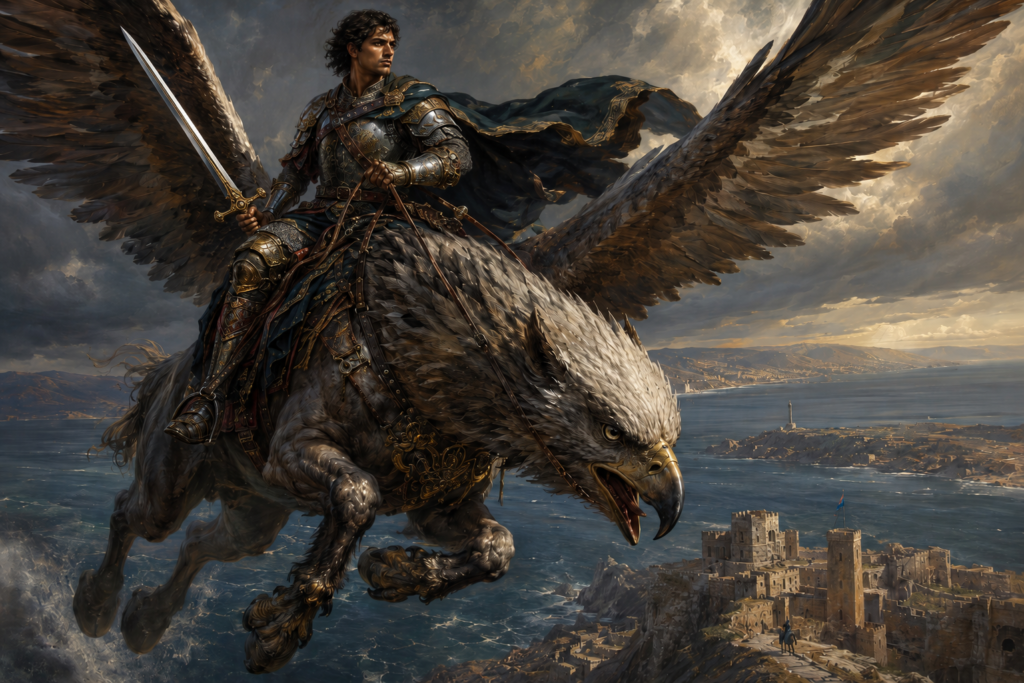
Ruggiero is a young knight in heroic beauty: strong without heaviness, graceful rather than brutal, with the alert poise of a hawk before release. He should look like a warrior raised in refinement but tested in true battle.
His armour is finely made but not gaudy: mail, plate, Mediterranean and North African fittings, a bright helm, a courtly cloak, and weapons suited to both mounted combat and formal duel. When he rides the hippogriff, his equipment becomes more specialised: reinforced saddle-straps, heavy gloves, wind-worn cloak-clasps, a shorter aerial lance, and armour fittings designed not to catch in wing, rein, or harness.
The hippogriff should not look like ordinary transport. It is a battle-trained creature of speed, altitude, and shock: eagle-headed, horse-bodied, fierce-eyed, and intelligent enough in bearing to seem bonded to the knight rather than merely owned by him.
Personality
Ruggiero is brave, courteous, impressionable, proud, and deeply vulnerable to ideals. He does not lack intelligence, but his emotions often move faster than his judgement. Honour speaks to him before strategy does.
He is not cruel. He can be terrifying in battle, but he is capable of mercy even when mercy harms his cause. That is why he works better as a morally complicated opponent than as a villain.
What He Wants
Ruggiero wants to become the man he believes he ought to be: free, honourable, loved, and remembered without shame.
What He Fears
He fears that every choice he makes has already been arranged by someone else. He also fears being unworthy of Bradamante, not because he doubts his sword, but because he doubts the purity of a life shaped by war, captivity, and prophecy.
What Breaks Him
Ruggiero breaks when people treat him as proof instead of as a person: proof of dynasty, proof of allegiance, proof of victory, proof of prophecy, proof that one court’s honour is greater than another’s.
Roleplaying Ruggiero
Ruggiero speaks with courtesy even to enemies. He does not boast crudely, threaten the helpless, or mock defeated foes. His anger shows when honour is twisted into obedience, when prisoners are abused, or when someone claims to know his destiny better than he does.
Use three behaviours at the table:
- He answers insults with formal challenge, not shouting.
- He spares worthy enemies when doing so costs him something.
- He hesitates when Bradamante, Atlantes, Marfisa, or prophecy is invoked.
Important Relationships
Bradamante
Bradamante is not a prize. She is the person who reveals whether Ruggiero’s honour is real.
Their relationship should feel like two warriors recognising one another across the wreckage of politics. If Ruggiero loves her, a battlefield becomes a moral problem. A siege becomes a negotiation. A duel becomes a confession.
Atlantes
Atlantes loves Ruggiero badly. He protects him through imprisonment, deception, enchantment, and delay.
This should not be played as simple villainy. Atlantes may be right that freedom will lead Ruggiero toward death. He is wrong to confuse preservation with life.
Rodomonte
Rodomonte is Ruggiero’s violent mirror: pride without inward change. Their conflict is not merely a duel between two famous knights. It is old allegiance demanding blood from a man who has begun to outgrow it.
Marfisa
Marfisa is one of the few figures who can stand beside Ruggiero without diminishing him. She belongs to the same heroic register: fierce, noble, dangerous, and not easily contained by courtly expectation. Use her as a reminder that Ruggiero’s world contains other warriors of equal force, not merely rivals and lovers arranged around him.
First Encounter
The best first encounter with Ruggiero should show three things at once: his danger, his courtesy, and his lack of freedom.
He might descend from the sky on the hippogriff during a battle, break the party’s line with a single charge, and then refuse to kill a fallen opponent. He may be under orders he clearly dislikes, watched by commanders who do not trust him, or bound by a token from Atlantes that tightens when he disobeys.
The party should leave the scene thinking:
We may have to fight him again, but he is not the true villain.
Using Ruggiero in Your Campaign
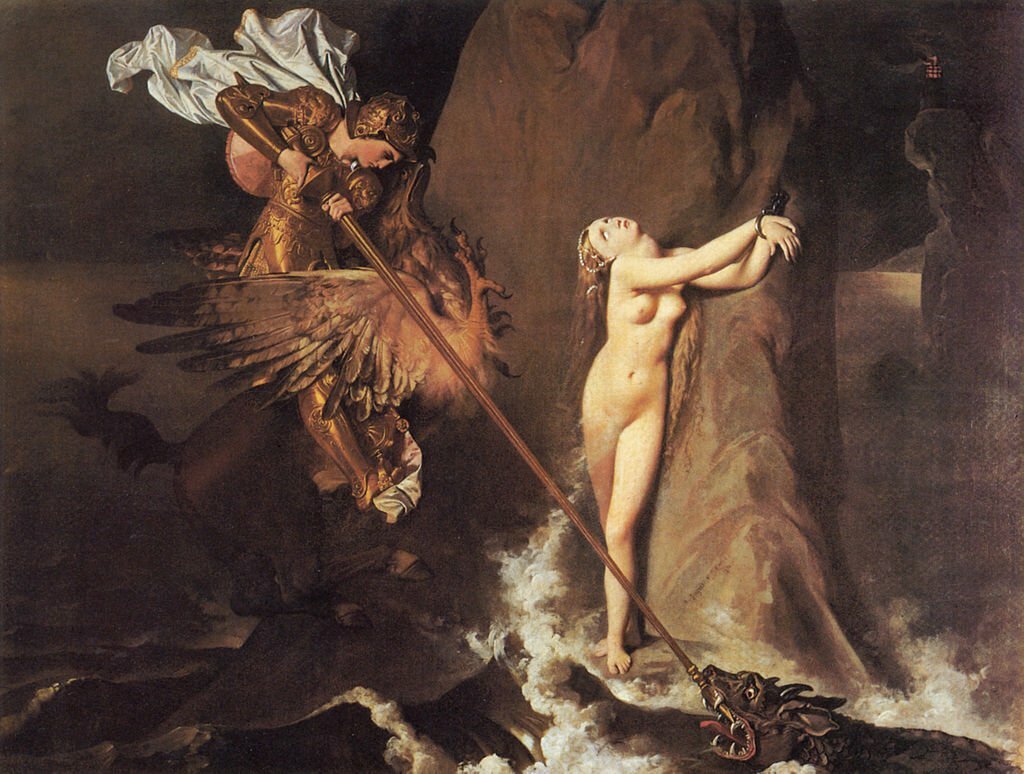
Ruggiero works best when the party cannot easily decide whether to help him.
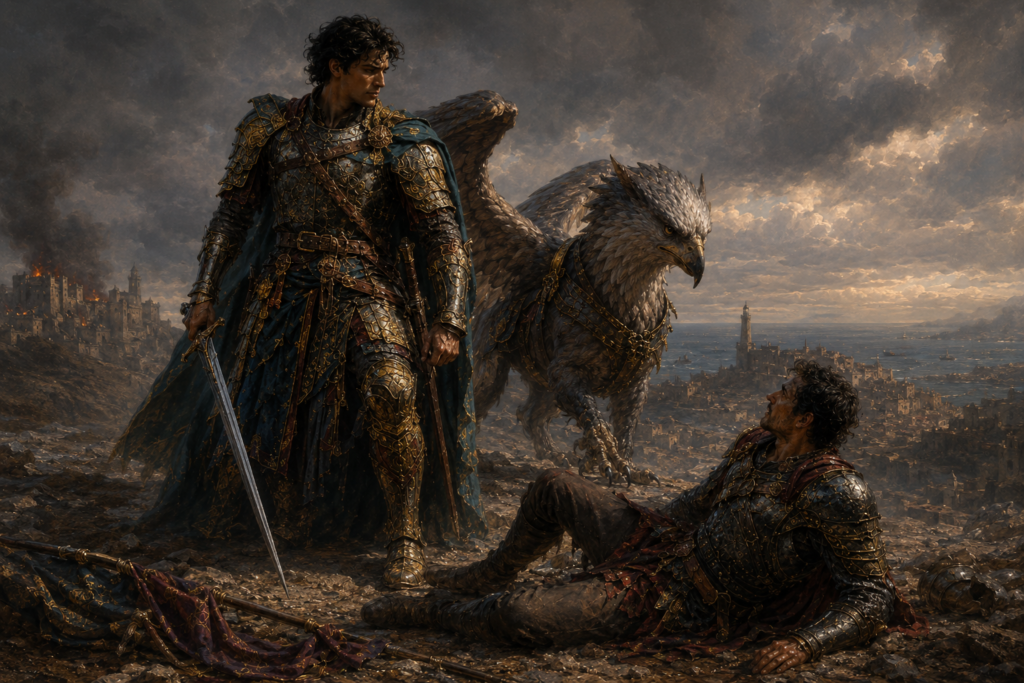
He may begin as an enemy champion leading a devastating charge. He may defeat a PC and spare them. He may return a captured banner. He may refuse an order that would slaughter civilians. He may protect someone he has been commanded to kill.
The first impression should be clear:
This man is dangerous, but he is not rotten.
Strong campaign uses include:
- The Rescued Enemy: The party frees prisoners from an enchanted fortress and discovers Ruggiero among them.
- The Duel That Should Not Happen: A kingdom’s peace depends on Ruggiero losing, but honour demands that he fight.
- The Hippogriff Knight: Ruggiero arrives from the sky to turn a battle, then asks the party to help him escape the magician who “saved” him.
- The Impossible Marriage: His union with Bradamante could end a war, but both sides call it betrayal.
- The Prophecy Trap: Every attempt to keep him safe pushes him closer to the foretold death.
Adventure Hooks
The Castle That Protects Him
Atlantes has hidden Ruggiero in an enchanted castle where every captive believes they are close to what they most desire. The party is hired to rescue several missing knights. Freeing them may release Ruggiero into the war and make the larger conflict worse.
The Champion Who Spares
Ruggiero defeats a beloved NPC in single combat and spares them. His own commanders accuse him of weakness. The party may exploit the division, defend him, or force him into open treason.
The Hippogriff’s Bridle
A stolen bridle allows command of Ruggiero’s hippogriff. Whoever holds it can draw him into a trap, because he will not let the creature be tortured, sold, corrupted, or used as leverage.
Bradamante’s Challenge
Bradamante has declared that she will marry only the warrior who can withstand her in battle. Several kings send champions to rig the outcome. Ruggiero must fight without revealing himself too soon, while the party decides whether love, law, or peace matters most.
Rodomonte at the Feast
During a wedding, treaty, or victory feast, Rodomonte arrives and accuses Ruggiero of betrayal. This should be a public crisis, not just a duel. If Ruggiero refuses, he looks guilty. If he fights, the peace may die with the loser.
Edition Tabs
Ruggiero 5.5e / 2024
Ruggiero Pathfinder 1e
Ruggiero, Fate-Marked Knight
Medium Humanoid, Neutral Good
Armor Class 19
Hit Points 178
Speed 30 ft.
| STR | DEX | CON | INT | WIS | CHA |
|---|---|---|---|---|---|
| 20 (+5) | 16 (+3) | 18 (+4) | 13 (+1) | 14 (+2) | 18 (+4) |
Saving Throws Str +9, Dex +7, Con +8, Cha +8
Skills Animal Handling +6, Athletics +9, Insight +6, Persuasion +8, Religion +5
Senses passive Perception 12
Languages Arabic, Italian courtly dialects, Old French or Middle French, Latin used for diplomacy and learned exchange, magical command words taught by Atlantes
Challenge 12
Proficiency Bonus +4
Traits
Fate-Marked. When Ruggiero fails a saving throw, he can choose to succeed instead. Once he uses this trait, he cannot use it again until he finishes a long rest.
Knight of Divided Allegiance. Ruggiero has advantage on saving throws against being charmed or frightened when the effect would force him to betray a sworn oath, abandon Bradamante, slaughter helpless foes, or serve as another person’s puppet.
Knight of the Hippogriff. While mounted on his hippogriff, Ruggiero has advantage on ability checks and saving throws made to remain mounted. In addition, opportunity attacks against Ruggiero are made with disadvantage while the hippogriff is flying.
Heroic Mercy. When Ruggiero reduces a creature to 0 hit points with a melee attack, he may choose to knock it unconscious. If the creature was a meaningful enemy rather than a helpless victim, Ruggiero gains 10 temporary hit points.
Actions
Multiattack. Ruggiero makes three Sword of the Fate-Marked attacks. While mounted, he may replace one of those attacks with Lance of the Sky-Rider.
Sword of the Fate-Marked. Melee Weapon Attack: +9 to hit, reach 5 ft., one target. Hit: 12 slashing damage plus 7 radiant or force damage.
Lance of the Sky-Rider. Ruggiero can use this attack only while mounted. Melee Weapon Attack: +9 to hit, reach 10 ft., one target. Hit: 14 piercing damage. If Ruggiero is mounted on his hippogriff and the hippogriff moved at least 30 feet straight toward the target this turn, the attack instead deals 28 piercing damage.
Commanding Challenge. One creature Ruggiero can see within 60 feet must make a DC 16 Wisdom saving throw. On a failed save, the creature has disadvantage on attack rolls against creatures other than Ruggiero until the end of Ruggiero’s next turn. This is not mind control; it represents public challenge, battlefield pressure, and the force of chivalric reputation.
Bonus Actions
Courtly Recovery. Ruggiero regains 18 hit points and ends one of the following conditions on himself: charmed, frightened, or poisoned. He can use this bonus action twice per long rest.
Sky-Rider’s Turn. If Ruggiero is mounted on his hippogriff, he commands the hippogriff to move up to half its speed without provoking opportunity attacks.
Reactions
Parry. Ruggiero adds 4 to his AC against one melee attack that would hit him. To do so, he must see the attacker and be wielding a melee weapon.
Interpose Honour. When a creature Ruggiero can see within 5 feet of him is hit by an attack, Ruggiero can cause the attack to hit him instead.
Ruggiero’s Hippogriff
Large Monstrosity, Unaligned
Armor Class 15
Hit Points 95
Speed 40 ft., fly 80 ft.
| STR | DEX | CON | INT | WIS | CHA |
|---|---|---|---|---|---|
| 18 (+4) | 15 (+2) | 16 (+3) | 3 (-4) | 14 (+2) | 10 (+0) |
Saving Throws Dex +4, Con +5, Wis +4
Skills Perception +6
Senses passive Perception 16
Languages —
Challenge 4
Proficiency Bonus +2
Traits
Battle-Trained Mount. The hippogriff has advantage on saving throws against being frightened while Ruggiero is mounted on it.
Aerial Bond. While Ruggiero rides the hippogriff, the hippogriff can take the Dash or Disengage action as a bonus action.
Sure-Footed Landing. The hippogriff ignores difficult terrain caused by rubble, slopes, broken stone, battlefield debris, and natural uneven ground when landing or taking off.
Actions
Multiattack. The hippogriff makes one beak attack and one claw attack.
Beak. Melee Weapon Attack: +6 to hit, reach 5 ft., one target. Hit: 11 piercing damage.
Claws. Melee Weapon Attack: +6 to hit, reach 5 ft., one target. Hit: 13 slashing damage.
Diving Strike. If the hippogriff descends at least 30 feet straight toward a creature and then hits it with a claw attack on the same turn, the target takes an extra 10 slashing damage.
Reaction
Winged Evasion. When a creature the hippogriff can see targets it or Ruggiero with a ranged weapon attack, the hippogriff can move up to 20 feet without provoking opportunity attacks. If this movement would take the target out of the attack’s normal range or line of sight, the attack misses.
Encounter Balance Note
Ruggiero remains Challenge 12 when encountered on foot or when the hippogriff is present mainly as narrative support.
When Ruggiero fights mounted in open terrain, the encounter may feel closer to CR 13–14, especially if he can use altitude, charge lanes, cliffs, towers, bridges, open courtyards, or battlefield space. In cramped halls, dense woods, caves, or enclosed castle rooms, the hippogriff’s value drops sharply and the encounter remains closer to CR 12.
Do not treat the hippogriff as a disposable side creature. It is part of Ruggiero’s identity and battlefield silhouette. At the same time, it should not become the real boss. Its purpose is to make Ruggiero mobile, dramatic, and tactically different from an ordinary knight.
Ruggiero, Fate-Marked Knight CR 12

XP 19,200
Male human heroic knight
NG Medium humanoid
Init +3; Senses Perception +17
AC 27, touch 13, flat-footed 24
hp 152
Fort +16, Ref +11, Will +12
Defensive Abilities bravery +4, heroic resolve 1/day
Speed 30 ft.
Melee +2 longsword +23/+18/+13 (1d8+10/19–20)
Mounted Lance +2 lance +23 (1d8+10/x3), usable only while mounted; increased damage on mounted charge
Ranged dagger +18 (1d4+5)
Special Attacks challenge 4/day, mounted charge, fate-marked strike 3/day
| STR | DEX | CON | INT | WIS | CHA |
|---|---|---|---|---|---|
| 20 | 16 | 18 | 13 | 14 | 18 |
Base Atk +12; CMB +17; CMD 30
Feats Mounted Combat, Ride-By Attack, Spirited Charge, Power Attack, Weapon Focus longsword, Iron Will, Leadership, Dazzling Display
Skills Diplomacy +19, Handle Animal +19, Knowledge nobility +16, Perception +17, Ride +21, Sense Motive +17
Languages Arabic, Italian courtly dialects, Old French or Middle French, Latin used for diplomacy and learned exchange, magical command words taught by Atlantes
Special Abilities
Heroic Resolve. Once per day, when Ruggiero fails a saving throw, he may reroll it and take the better result.
Fate-Marked Strike. Three times per day, Ruggiero may add +4 to an attack roll after seeing the roll but before knowing the result. If the attack hits, it deals an additional 2d6 damage.
Honour-Bound Mercy. When Ruggiero reduces a meaningful foe below 0 hit points, he may choose to leave that foe stable. If he does, he gains a +2 morale bonus on saving throws until the end of the encounter.
Hippogriff-Rider. When mounted on his hippogriff, Ruggiero gains a +4 competence bonus on Ride checks, and his mount gains a +2 morale bonus on saving throws against fear effects. When Ruggiero charges from the air with his lance, use normal mounted charge rules, but the charge path may include downward aerial movement if the terrain allows it.
Equipment: +2 longsword, +1 full plate, +1 heavy steel shield or reinforced mounted harness, +2 lance, noble cloak, court token, magical riding gear.
Ruggiero’s Hippogriff CR 4
XP 1,200
N advanced battle-trained hippogriff
N Large magical beast
Init +3; Senses darkvision 60 ft., low-light vision; Perception +12
AC 18, touch 12, flat-footed 15
hp 52
Fort +9, Ref +8, Will +4
Speed 40 ft., fly 100 ft.
Melee bite +10 (1d6+5), 2 claws +10 (1d4+5)
Space 10 ft.; Reach 5 ft.
| STR | DEX | CON | INT | WIS | CHA |
|---|---|---|---|---|---|
| 21 | 17 | 19 | 2 | 14 | 10 |
Base Atk +5; CMB +11; CMD 24
Feats Flyby Attack, Iron Will, Skill Focus Perception
Skills Fly +9, Perception +12
SQ combat trained, loyal mount
Special Abilities
Combat Trained. Ruggiero’s hippogriff does not require a Ride check to attack while bearing a rider trained to fight from the saddle.
Loyal Mount. While Ruggiero rides it, the hippogriff gains a +2 morale bonus on saving throws against fear, charm, and compulsion effects.
Diving Strike. If the hippogriff descends at least 30 feet before making a claw attack, one claw attack that hits deals an additional 1d6 damage.
Treasure
Ruggiero’s treasure should be personal rather than random.
Sword of the Fate-Marked: A +2 sword suitable for formal duel and battlefield command.
Sky-Rider’s Lance: A +2 lance balanced for mounted or aerial combat.
Court Token: A ring, seal, clasp, or embroidered war-token tying him to his original allegiance.
Bradamante’s Token: A glove, ribbon, ring, broken chain-link, or devotional charm that matters more than coin.
Atlantes’ Ward-Charm: A protective charm that may also function as a prison-key, tracking focus, or unfinished spell-anchor.
Hippogriff Harness: Reinforced magical riding gear that grants practical protection and control in aerial combat, but only for a trained rider.
Secrets
- Ruggiero has been spared from death so often that he no longer knows whether courage or enchantment keeps him alive.
- Atlantes placed one final safeguard in his armour, mount, dreams, or bloodline.
- Ruggiero’s death may be true prophecy, political lie, or self-fulfilling curse.
- His marriage or alliance may legitimise a dynasty.
- He can be turned from an enemy cause, but not by humiliation. He must be allowed to choose honour.
- The hippogriff may know the way back to Atlantes’ hidden prison, even if Ruggiero does not.
GM Guidance
Do not play Ruggiero as gullible muscle. His weakness is not stupidity. His weakness is that he believes deeply in honour while surrounded by people who use honour as a tool.
Ruggiero should rarely be the campaign’s true villain. He is better used as the noble enemy whose choices expose the villainy of the courts, magicians, and warlords around him.
He should create difficult choices:
- Kill him and remove a dangerous enemy.
- Spare him and risk him returning stronger.
- Rescue him and unleash a prophecy.
- Help his love and possibly end a war.
- Capture the hippogriff and become morally worse than his enemies.
- Expose his origin and destabilise two courts.
The hippogriff should sharpen these choices. It gives Ruggiero speed, reach, and legend, but it also gives enemies leverage. A rival who cannot defeat Ruggiero may go after the mount. A court that cannot command Ruggiero may try to seize the bridle. A party that captures the hippogriff must decide whether they are handling a battlefield asset, a living creature, or the key to a man’s freedom.
Source and Literary Context
Ruggiero, also rendered Rogero in some English traditions, is a major knightly figure in the Italian chivalric romance tradition, especially Ludovico Ariosto’s Orlando Furioso, which continues the world of Matteo Maria Boiardo’s Orlando Innamorato. He is bound to Bradamante through one of the central romances of the poem, guarded and delayed by the magician Atlantes, and associated with the marvellous hippogriff. Their union becomes part of the legendary ancestry of the Este family, Ariosto’s patrons. For concise literary background, see Encyclopaedia Britannica’s entries on Ruggiero, Bradamante, and Ludovico Ariosto.
Keep this reference growing
If this page helped with your reading or game, you can support its upkeep or explore the curated books.
Explore the Bookshop — epics, classics and stories behind imagined worlds.