
Khanate of Kazan
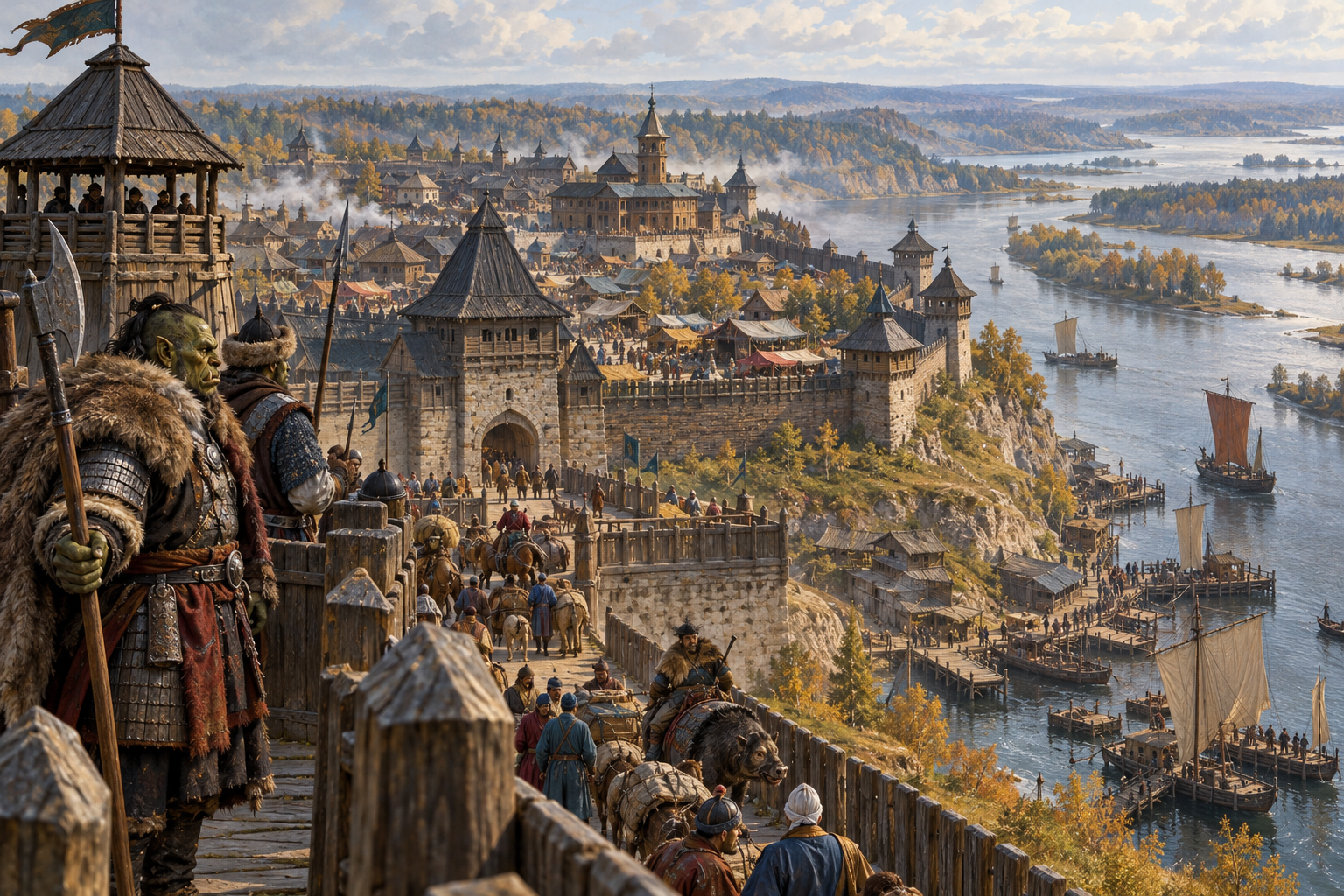
Middle Volga · Kazan · Myev Stone-Eye · Forest-Steppe · Rival Standards
Kazan at a Glance
| Campaign Present | 1454 CE |
|---|---|
| Realm | Middle Volga khanate within the fractured world of Mhurak’s Great Muster |
| Capital | Kazan, a defended river-market and fortress court |
| Ruler | Myev Stone-Eye, orc khan of Kazan; the hobgoblin Azgar maintains a rival claim |
| Government | Khan’s household, clan Scar-Chiefs, fortified garrisons, merchant elders and rival military factions |
| Other Places | Volga and Kama landings, Arça woodland roads, Zogar’s war-camp, Krog’s shrine and fortified crossings |
| Neighbours | Muscovy, the Great Horde, Nogai war-clans and independent forest peoples |
| Peoples | Orcs, humans, local river and forest communities; permanent hobgoblin military households, with goblin and bugbear warbands in the marches |
| Languages | Orc, regional Turkic and Volga tongues; Goblin in hobgoblin military households; interpreters at the markets |
| Beliefs | First-Scar traditions, river and ancestral spirits, diverse local customs; Varkesh’s Standard-law among hobgoblin officers; Maglubiyet among Azgar’s warbands |
| Trade | Furs, timber, grain, leather, metalwork, horses, boats, tolls and the movement of captives |
| Main Threats | Competing khans, dangerous roads, tribute raids, hostage-taking, worg packs and creatures of the deep river |
The River Khanate
The Khanate of Kazan holds the middle Volga where river wealth meets the dangerous forest-steppe. A merchant can arrive with silk and leave carrying furs, but the safety of the roads depends upon which standard controls the next crossing. Kazan’s walls shelter traders, hostages, armourers and rivals who would gladly see the khan’s council broken.
Myev Stone-Eye rules through the alliances and obligations inherited from the Great Muster. Her warriors ride when pasture and roads allow; in the wooded valleys they fight on foot, patrol in boats and employ Gore-Riders mounted upon dire boars. A distant clan may obey her summons, refuse it or send only enough warriors to avoid an open feud. Kazan is neither a single-species realm nor a province of the separate hobgoblin Ninefold Dominion.
The old hobgoblin leader Azgar still uses the title of khan among his followers. His warlord Zogar and the shaman Krog defend their faction’s camps and red banners. Merchants and lesser chiefs bargain with both courts, then conceal those bargains when the other side arrives. The result is not a tidy frontier war, but a struggle over who may collect tolls, hold hostages and speak for Kazan.
Explore the Neighbouring Realms
What Is Happening Right Now?
The Khan Calls the Standards
Myev has commanded the Scar-Chiefs to present themselves with their war banners and account for the winter tolls. A missing chief’s place at the gathering is conspicuous. Some say Azgar holds his heir; others say the heir defected. Witnesses and safe-conducts become more valuable than swords.
Azgar Tests the City
Hobgoblin guards wearing the red war-banner inspect grain shipments and demand payment in Azgar’s name. Their patrols have begun to appear beside crossings already held by the khan’s soldiers. A toll clerk possesses two orders bearing rival seals; obeying either may make him a traitor to the other.
The Oka Road Grows Dangerous
Captains on the Muscovite frontier are strengthening river posts and questioning travellers from Kazan. Scouts move through forests where treaties are known by word of mouth and the wrong banner at a ford can start a fight. Traders seek neutral escorts who know both tongues.
Something Moves Beneath the Volga
Boats have returned with great scoring along their keels. Fisherfolk speak of the Kazan Dragon, a vast serpent in deep water. Some suspect an ordinary creature made monstrous by rumour; Krog insists it recognises ancient offerings. Nobody has yet brought convincing proof to the khan.
Places Adventurers Can Actually Reach
Kazan Fortress and the Khan’s Court
Earthworks, towers, timber palisades and guarded gates shelter storehouses, the audience hall and the households of powerful chiefs. Admission requires a recognised seal, a sponsor or an urgent message. Even a guest who reaches the inner court remains under observation.
The River Quays and Market Yards
Boatmen exchange cargo with horse caravans beneath toll sheds and warehouse walls. Fur buyers, metalworkers, interpreters and slave brokers compete for space. A merchant can hire passage here, buy a false seal or learn which patrol last travelled a dangerous road.
Zogar’s War-Camp
The hobgoblin warlord Zogar maintains barracks, wagons and armed retainers beyond the settled centre. His troops follow written orders and move in close formation, in sharp contrast to the more personal bonds of the orc clans. The camp’s watch will bargain over prisoners but treats strangers who approach at night as spies.
Krog’s Shrine
Under old trees outside a military encampment, Krog receives petitioners who fear curses, broken oaths and restless spirits. His rituals are effective often enough that even those who dislike Azgar come to him in secret. The shrine is not the compulsory sanctuary of the whole khanate.
The Forest Roads and the Kama Approaches
Cart tracks divide beneath dense trees, then emerge at ferry stages, farms and fortified toll gates. Scouts travel ahead of caravans to judge the water and the allegiance of the next village. Boar herds, wolves and hidden bands of deserters make a shortcut dangerous.
The Red-Banner Quarter
Behind a separate stockade near the market road stand the permanent homes of Azgar’s hobgoblin military households. Children learn letters, signals and drill in the same courtyards where veterans sharpen spearheads; armourers, cooks, clerks, widows and dependants keep the quarter functioning when the field companies march. Crimson standards mark the guarded approaches, but the residents trade with their orc and human neighbours every day. The gates close at the officers’ order, not at the khan’s.
The Muster House and Armourers’ Yard
Azgar’s officials maintain registers of soldiers, stores, hostages, grain debts and repaired weapons. A visitor seeking a missing person may find an answer in these ledgers long before finding anyone willing to speak. Armourers fit matching shields and spearheads, while wagonwrights and engineers calculate how many days of supplies a garrison can survive. The work is disciplined, costly and vulnerable to forged accounts. The muster house keeps duplicates of important orders because Azgar intends his command to outlive any single captain.
People Adventurers May Actually Meet
Myev Stone-Eye, Khan of Kazan. A calculating orc ruler who understands the value of walls, boats and written tribute. She grants protection to useful travellers but expects a favour in return. Defying her publicly invites a challenge from the chiefs who uphold her standard.
Azgar, self-styled rival khan. The hobgoblin commander behind the old red banner. He seeks to turn control of garrisons and provisions into recognition of his claim. He is dangerous precisely because he can offer merchants an orderly alternative to clan politics.
Zogar, hobgoblin warlord. Azgar’s hard-handed field commander, more comfortable with marching orders and prisoners than courtly negotiation. He can be bribed with an advantage over a rival, but he remembers insults.
Krog, shaman and curse-worker. A keeper of forbidden bargains whom travellers consult when ordinary healing fails. The price of his help may be a truth, a future service or an object taken from the river.
The Skullcrusher. A colossal ogre of campfire tales, said to be unbeatable in battle. Whether the stories concern one living champion or several warriors using the same name is disputed among veterans.
Factions and Powers
Myev’s orc households hold the khanate together through kinship, sworn standards, armed escorts and control of the river gates. Their greatest weakness is rivalry between Scar-Chiefs.
Azgar’s red-banner hobgoblins maintain disciplined war-camps and prize written ranks, supplies and reliable garrisons. They are a powerful faction within the region, not the dominant people of every Kazan settlement.
River merchants and town elders keep trade flowing even when the khans quarrel. Their warehouses and credit can finance a campaign, and their information may matter more than a hundred swords.
Forest communities and neighbouring clans do not necessarily submit to either claimant. A village may pay for protection, shelter escaped prisoners or negotiate with outside powers.
The Red-Banner War Council
Azgar commands more than a travelling band. Zogar directs the field companies, but garrison captains, a quartermaster, a siege master and the senior household elders must keep soldiers fed, weapons repaired and families protected. The council records orders under a red wax seal. Officers argue about whether to seize the city gates, demand a formal place at Myev’s court or wait until an orc Scar-Chief defects. Azgar claims the title of khan; his captains disagree about how quickly he should make that claim real.
What the council can offer: guarded passage, prisoner exchanges, reliable stores, construction crews and a disciplined escort. What it demands: written pledges, hostages for dangerous guarantees and the right to inspect cargo. The council’s greatest weakness is its dependence on grain and river tolls that Myev’s orc households can still deny it.
Not Another Ninefold Dominion
These households carry old hobgoblin ideas of ranks, records and permanent standards, but they do not answer to the distant Ninefold Dominion. Some officers admire that empire’s order; others mistrust any foreign marshal who might strip them of their local estates. Their loyalty is to Azgar’s red banner and the households whose survival depends upon it.
Magic, Trade and Services
In the city: river pilots, boat repair, smiths, leatherworkers, fur dealers, interpreters, hired guards, stables and modest lodging can usually be found through the quays or a trusted patron. Military equipment and restricted supplies require a recognised sponsor.
In the marches: guides, horse fodder, herbal treatment and information about passable fords come from local households rather than fixed shops. Spirits, omens and ancestral rites remain part of many communities’ understanding of the landscape.
Supernatural help: Krog is a known curse-worker, but not the sole source of magic in Kazan. Healers, seers and wandering practitioners have their own allegiances. An adventurer should ask what the practitioner demands before accepting an oath-bound cure.
Dangers and Adventure Hooks
The Two Seals
Clue. A ferryman holds two genuine toll warrants, one from Myev’s steward and one bearing Azgar’s banner. Problem. Each garrison calls the other document treason. Choice. The adventurers must obtain a ruling, expose a forgery or carry goods by an unguarded river branch. Consequence. Whoever secures the revenue can pay warriors before the next muster.
The Missing Scar-Chief
Clue. A war banner arrives at court without its chief, but the bearer knows a private blood-oath. Problem. A hostage, an ambush and a planned defection are all plausible. Choice. Find the missing clan leader before Myev declares him an oath-breaker. Consequence. A successful rescue may prevent a feud—or reveal the chief is plotting rebellion.
The Broken Barges
Clue. Three vessels drift back with their cargo untouched and long grooves beneath the waterline. Problem. The boatmen blame the Kazan Dragon; smugglers insist river pirates made the marks. Choice. Track the damage, secure passage or enter the river’s deepest reaches. Consequence. The evidence may change who controls the lucrative crossing.
Krog’s Unpaid Price
Clue. A cured child begins speaking words from a traveller’s sealed letter. Problem. Krog claims a promise has come due, but the parents deny knowing its terms. Choice. Recover the original oath, negotiate a substitute or confront the shrine. Consequence. Breaking one bargain may release others the shrine has held for years.
The Empty Barracks
Clue. A row of homes in the red-banner quarter has been sealed, though their owners’ names remain on the grain rolls. Problem. Zogar says the families followed their soldiers to a remote fort; the quarter’s elders insist no wagons departed. Choice. Examine the muster registers, question the gate watch or escort a relative past the guards. Consequence. The evidence may reveal desertion, secret hostages or a faction quietly preparing to betray Azgar. Restoring the households wins civilian allies but risks the council’s anger.
The Siege Master’s Bargain
Clue. An engineer offers to open a stockade gate in exchange for the return of missing tools and a stolen plan. Problem. The theft has been blamed on Myev’s orcs, although a hobgoblin officer signed for the tools the night before. Choice. Recover the equipment, expose the false accusation or help the engineer escape. Consequence. The decision determines whether the next confrontation is settled by negotiation or begins with a breach in the walls.
Travel, Law and Practical Play
Safe conduct. A recognised seal or the escort of a known household improves the chance of passage but does not bind a rival warband. Patrols may seize weapons, inspect cargo and question the identity of companions.
Tolls and tribute. Expect charges at defended quays, roads and ferries. A payment made to one authority does not guarantee safety across the next boundary. Written receipts and witnesses are often more useful than threats.
Seasons. Spring floods complicate crossings; summer opens caravan roads; autumn trade rushes to move before hard weather; winter may close channels while permitting dangerous overland journeys over frozen ground. Conditions should affect travel plans, not merely scenery.
Encounter guidance. An orc river patrol, a hobgoblin inspection squad, a band of desperate refugees or a wild boar herd should each have a purpose and an avenue for negotiation, evasion or investigation. Use the actual creatures’ linked bestiary rules; do not treat the region as one enormous combat encounter.
Peoples of the Middle Volga
Orc ruling households and their sworn followers occupy important fortresses and military estates, while human cultivators, boatmen, traders and long-established Volga forest communities sustain the khanate’s everyday life. Hobgoblins, goblins, ogres and bugbears occur in different numbers from settlement to settlement, often in armed households rather than as a single subject people. Captives and displaced families also live in the realm, some in bondage and others attempting to escape it.
Not every orc answers Myev, and not every hobgoblin supports Azgar. An adventurer’s reception is shaped by the local household, the season, the traveller’s business and the memory of recent raids.
Orc Clans and Hobgoblin Households
At sunrise the orc gate guards change beneath Myev’s iron-tusk crest; across the city the red-banner quarter answers a drum and forms ranks before opening its workshops. The two peoples are neither natural allies nor perpetual enemies. Orc boatmen sell fish and passage to hobgoblin garrisons, hobgoblin smiths mend orc cavalry harness, and families on both sides resent the tolls and reprisals imposed in the names of rival rulers.
Two Kinds of Law
Among Myev’s orc households, clan memory, witnesses, compensation and Scar-Law bind chiefs to their followers. A dispute can become an oath-debt that the next generation inherits. Azgar’s officers prefer written warrants, inventories, fixed ranks and military hearings. Both systems can protect a traveller, and both can be used to ruin one. A merchant carrying a valid red-banner receipt may still owe the khan’s toll; an orc clan’s spoken safe-conduct may mean nothing to a hobgoblin quartermaster.
Standards, Faith and the Dead
Orc Scar-Chiefs honour their ancestors and the First Scar, marking oaths before kin and the symbols of their war-host. Within the hobgoblin quarter, some senior clerks and officers uphold the teaching of Varkesh, the First Standard: the barracks, grain store and chain of command must survive the death of any commander. Others follow Maglubiyet as a war god, especially among Azgar’s more militant companies. Krog’s bargains with spirits and curses draw their own followers and critics; his shrine is not the public religion of every hobgoblin family. Local Volga peoples preserve their own rites apart from these rival war-hosts.
The Price of Discipline
Hobgoblin children train beside family workshops rather than being born into an army fully formed. Veteran soldiers may become clerks, household judges, engineers or instructors; a disgraced officer can lose rank, housing and access to grain. Orc allies respect the garrisons’ resilience but distrust their habit of taking hostages and recording every debt. Hobgoblins, in turn, fear that the withdrawal of one orc clan could cut off a winter’s provisions. That tension is felt in bread queues and marriage bargains as often as on the battlefield.
Deeper History
The middle Volga was wealthy long before the present khans. Fortified settlements, river trade, farms and the inheritance of the Volga Bulgar lands survived the rise and fragmentation of the steppe empires. Tatar, Chuvash, Mari and Udmurt communities retain different languages, obligations and ties to the market roads, especially in the wooded Arsk country. Mhurak Stone-Blood’s Great Muster changed the ruling war-hosts but did not erase the peoples already living beside the rivers.
Now the old imperial command is disputed among successor hosts, regional khans and strong local households. The neighbouring Great Horde claims tribute along the Volga, while Muscovy contests the routes westward. Myev seeks to preserve Kazan’s authority; Azgar seeks to replace it. Neither can ignore the merchants and ferry towns that make the contest worth winning.
Map and River Approaches
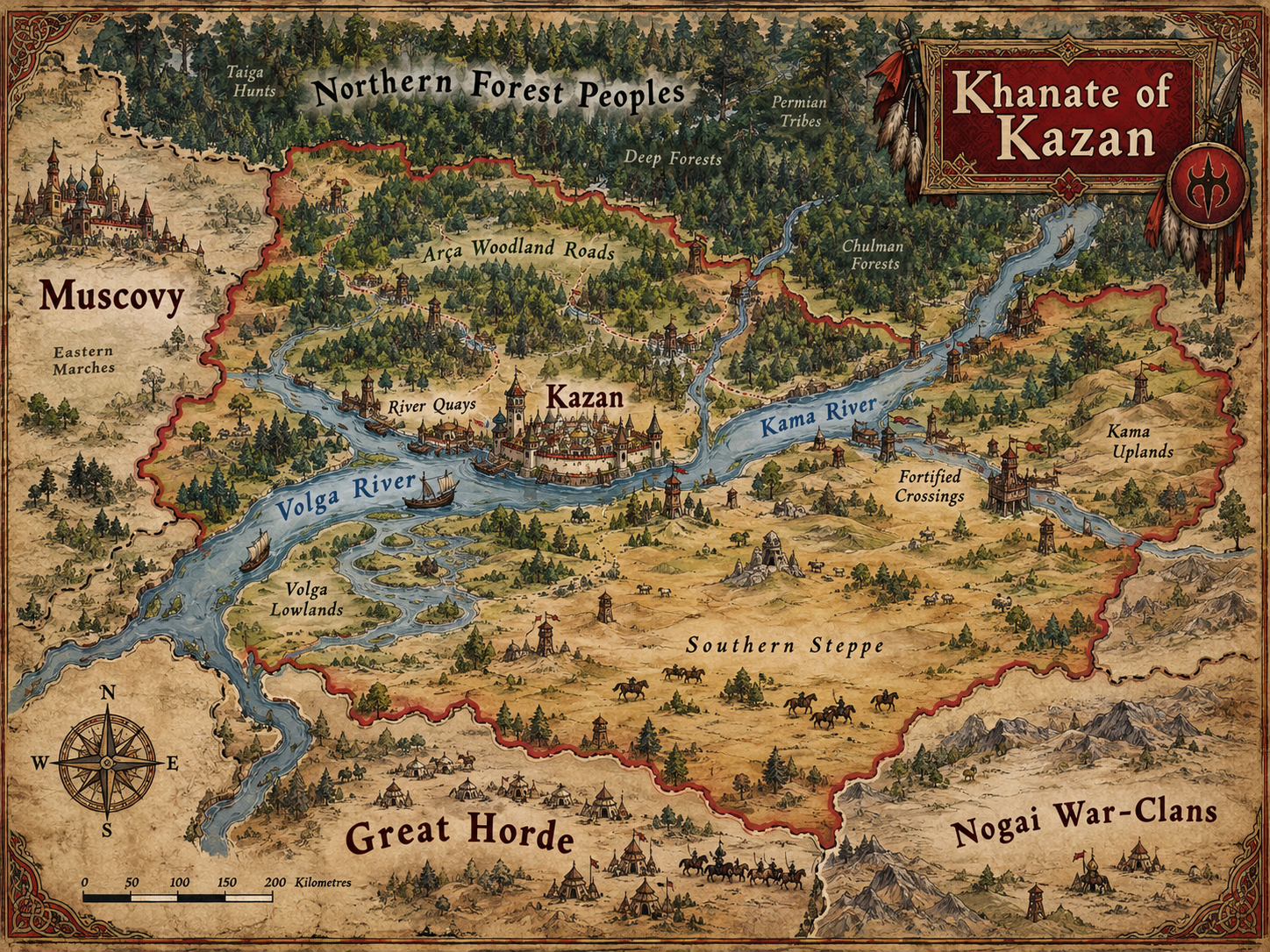
The Volga is the khanate’s great river road. Kazan stands where the smaller Kazanka enters the Volga; the much larger Kama meets the Volga farther south, drawing traffic from the eastern interior. River pilots reckon their passages by season, current, landing stages and guarded toll stations rather than by the decorative scale on the illustrated map.
West towards Muscovy. Forest tracks carry Oka-bound trade past scouts, armed escorts and settlements where tribute claims remain disputed.
South along the Volga. Barges and patrol boats pass defended toll points, while war-hosts and envoys from the Great Horde compete for influence.
Southeast to the Kama, then eastward. Boats travel down the Volga from Kazan to reach the Kama confluence farther south, then follow its river landings towards inland trading households, wooded country and eastern markets.
North into the forest. Fur paths, timber settlements and smaller waterways reach communities beyond the khan’s easy authority.
Sources, Links and Artwork
Campaign connections: the Empire of the Orcs, orc peoples and Gore-Riders, Muscovy, the Great Horde and the Crimean Khanate.
Historical background: The historical Kazan Khanate emerged in the 1430s and lasted until 1552; it was a Turkic-Tatar polity, unlike the orc-ruled campaign realm. The Volga and Kama shaped its economy, but its outer boundaries shifted and cannot be plotted as fixed lines for every year. See historical settlement and trade in the Middle Volga, research on the disputed eastern border and the historical overview.
Artwork: The Khanate of Kazan heraldic shield is an original campaign emblem, showing iron tusks, an orc fortress and the Volga. The painted riverfront hero depicts the fortified approaches to Kazan, while the illustrated campaign map portrays the river routes, neighbouring powers and forest-steppe frontier. These are original fantasy illustrations, not historical state arms or a surveyed historical map.
Keep this reference growing
If this page helped with your reading or game, you can support its upkeep or explore the curated books.
Explore the Bookshop — epics, classics and stories behind imagined worlds.