
Crimean Khanate — Black Sea Frontier
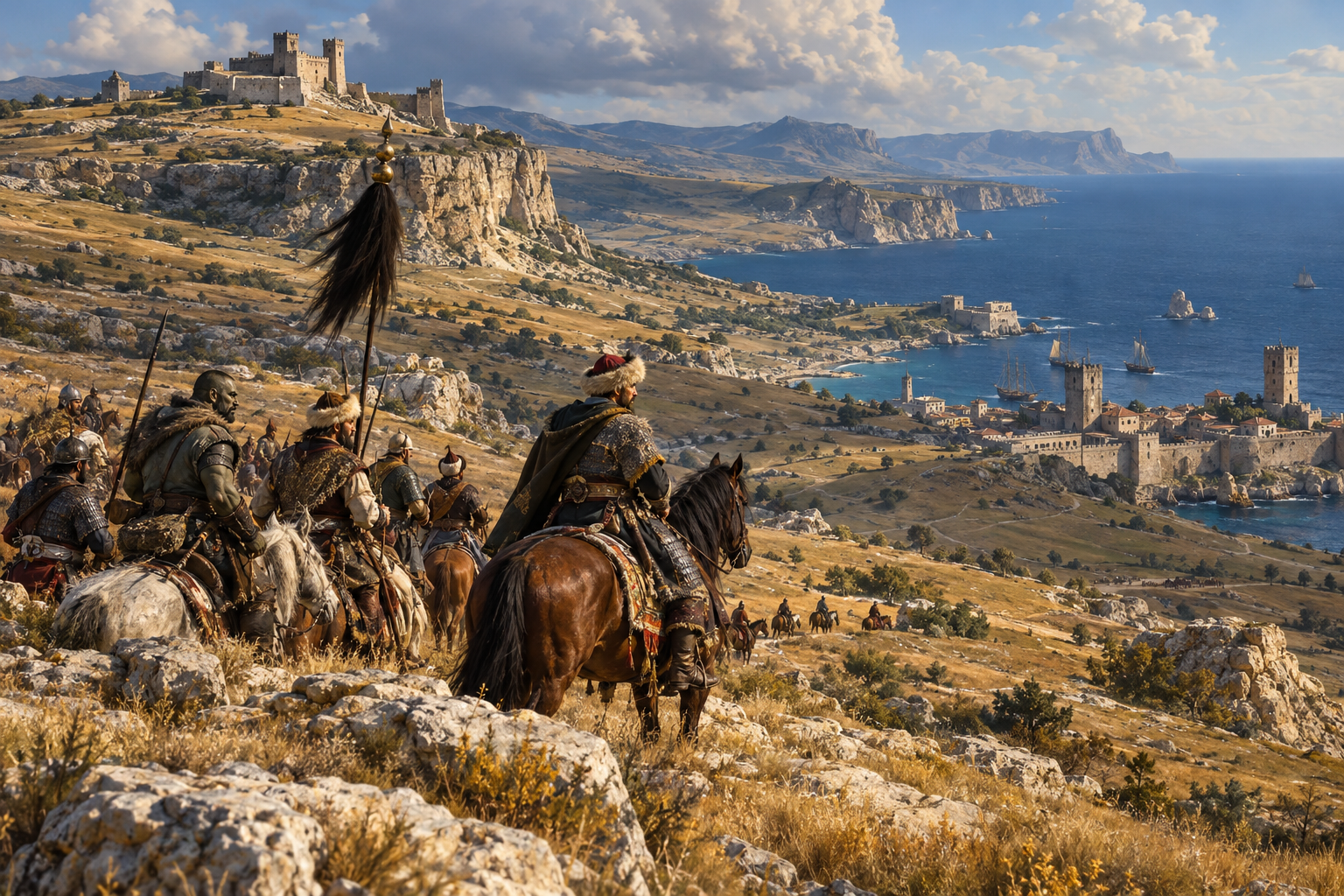
Black Sea · Qırq Yer · Hacı Giray · Perekop · Genoese Harbours
Crimean Khanate at a Glance
| Realm | Independent Crimean khanate on the northern Black Sea; not a vassal of the Great Horde, the Ottomans or the Ninefold Dominion |
|---|---|
| Great Horde Claim | Former lands of the wider orc Great Muster; Krusk Ash-Standard demands renewed tribute and overlordship, but Hacı Giray refuses |
| Ruler | Hacı Giray, founder of the Giray dynasty, supported by powerful Crimean clan families |
| Seat of Power | Qırq Yer, the cliff-top stronghold above the sheltered valley; Solkhat (Stary Krym) remains an older trading centre |
| Government | Khan’s household, allied beys and mirzas, hereditary claims, negotiated clan allegiance and appointed officials |
| Territory | Interior Crimean peninsula, northern steppe approaches and disputed land routes; the Genoese ports and Theodoro retain separate rule |
| Peoples | Crimean Tatar and other Turkic households, coastal merchants, Greek-speaking and upland communities, orc veterans and their descendants |
| Languages | Crimean Turkic, other steppe tongues, Orc, Greek and Italian in trading ports; interpreters are essential at courts and customs houses |
| Beliefs | Household and ancestral traditions, local sacred places and the First-Scar observances of orc families |
| Trade | Horses, grain, salt, wool, hides, ship-borne goods, tolls, ransoms and the trafficking of captives |
| Neighbours | Great Horde, Ottoman realm, Genoese merchants and western steppe powers |
| Chief Dangers | Rival tribute demands, horse raids, hostages, hostile garrisons, ravine ambushes and sudden Black Sea storms |
A rider emerges from the haze at Perekop with three seals hanging from his saddle. One promises the khan’s protection. Another bears the stamp of a Genoese merchant house. The third is a warning from an orc captain who refuses to yield the northern road. Beyond him lie grassy pastures, salt flats, upland fortresses and harbours where a captured ship can change the balance of power before sunset.
Hacı Giray rules an independent khanate. His court must bargain with the great clan houses and defend its claim against enemies from the steppe. The Genoese still hold important walled ports along the Black Sea; Theodoro guards its mountain strongholds; Ottoman envoys and ships press their own interests from across the water. None of these powers commands the whole peninsula.
Families descended from Mhurak’s Great Muster have left orc warbands, households and obligations across the steppe. They are part of Crimea’s political world, but the khanate is not a fifth co-equal orc successor empire. The orc Great Muster once imposed its power across the western steppe, including Crimea’s approaches. Krusk Ash-Standard now claims that this older conquest entitles his Great Horde to renewed tribute and obedience. Hacı Giray rejects that demand. Neither Krusk’s claim nor the presence of orc households makes the independent khanate a fifth orc successor empire.
Entering the Crimean Khanate
- At Perekop: guards ask for the name of the household guaranteeing your passage and search for undeclared weapons or captives.
- At Qırq Yer: a sponsor, suitable gift and willingness to wait matter more than a boast about distant titles.
- In a coastal port: Genoese charters can protect cargo at sea but not necessarily on the khan’s roads.
- On the open steppe: fresh mounts, reliable wells and news of the last patrol are worth their weight in coin.
What Is Happening Right Now?
The Siege That Became a Bargain
Ottoman ships have appeared off the rich Genoese harbour of Kaffa while Hacı Giray’s mounted forces approach from inland. Its sea walls are formidable. The merchants would rather pay for peace than surrender their warehouses, and every party seeks terms that will not make its allies too powerful. Someone has already altered the figures on a promised payment.
A Khan Cannot Trust Every Standard
Hacı Giray has demanded fresh pledges from families whose riders once served rival steppe claimants. Some send honourable envoys. Others send an empty saddle as an insult. A missing hostage threatens to turn a fragile understanding into a blood-feud.
Krusk Demands Tribute — Hacı Giray Refuses
Messengers from Krusk Ash-Standard’s Great Horde demand the khan’s oath, a tribute payment and safe passage for Horde collectors. Hacı Giray refuses to acknowledge Krusk as his overlord. Some orc households remember their old obligations, while Crimean beys defend the khan’s independence. A single seized courier could turn the northern road into a battlefield.
The Mountain Principality Watches the Coast
In the southwest, the lords of Theodoro watch the Genoese fortresses and every foreign sail. They will open a gate to a useful messenger but may imprison a spy who bears the wrong letter. Refugees from the coast have begun arriving with stories that contradict one another.
Places Adventurers Can Actually Reach
Qırq Yer — The Khan’s Heights
Stone walls crown steep limestone heights above a narrow valley. Watchers scrutinise riders on the approach; stairways, gates and inner courtyards turn a hurried audience into a deliberate act of submission. The khan’s representatives receive gifts, hear claims and decide which feud deserves attention. This is the working seat of power; the later great palace at Bakhchysarai has not yet been built.
Solkhat (Stary Krym) — The Older Market
Caravan courtyards and workshops stand in a town whose former importance outlives many changes of ruler. Dealers trade leather, cloth, grain, livestock and information. Old families remember who controlled the roads before the Girays, and their accounts can settle a debt or awaken a dangerous claim.
Perekop — The Narrow Gate
The isthmus at the north connects the peninsula to the grasslands. Earthworks, trenches, marshy approaches and guarded passages make it a natural toll point and a place to stop a fleeing enemy. A traveller with a proper seal can still be delayed by an officer who recognises a rival household’s mark.
Kaffa (Caffa, Kefe) — The Wealthy Genoese Harbour
Great walls defend warehouses, quays, counting houses and the agents of faraway Genoa. This is not a Crimean provincial town obedient to Hacı Giray: it is a competing power, dependent upon safe trade inland and ships from the sea. Money, grain and secret negotiations cross its gates daily.
Sudak (Soldaia) and the Eastern Coastal Road
A Genoese-held fortress watches the coastal trade road and its difficult approaches. Hill paths and narrow valleys make a small escort vulnerable to ambush. The road ultimately reaches the eastern trading settlements and the Kerch approaches, where the Black Sea and the Sea of Azov meet.
Mangup and Theodoro — The Mountain Holds
On the southwestern uplands, steep-sided plateaux shelter a principality with its own commanders, farms, castles and ambitions. Theodoro is not interchangeable with the Genoese possessions. Its agents seek partners who will help it resist pressure from the coast without inviting a stronger master inland.
The Salt Lakes and Northern Pastures
Salt workers, herders, horse breeders and moving encampments occupy open country where boundaries are known through wells, grazing rights and sworn agreements. A rider can cross an apparently empty horizon and discover that the next valley is claimed by three different leaders.
People Adventurers May Actually Meet
Hacı Giray — Khan of Crimea
The Giray ruler prefers an alliance that strengthens his position without placing his seal beneath another sovereign’s. He is generous to messengers who bring useful intelligence and relentless towards those who allow his rivals through the northern passage. Adventurers might serve as neutral witnesses, escort his household or discover that one of his trusted envoys has already sold a secret.
A Bey of the Şirin Clan
The Şirin are among the powerful families whose riders and alliances help sustain the khanate. A senior bey can promise an escort or close a road, sometimes before the khan’s orders reach it. A traveller who mistakes the bey for a mere court servant may discover how much power the clan holds.
The Genoese Harbour Consul
A representative at Kaffa weighs tariff income, garrison supplies and the risk of another siege. He will buy good news, pay for discreet couriers and deny having hired them should they be caught. The richest merchant in the room may be more useful to him than the best swordsman.
Theodoro’s Mountain Envoy
A guarded negotiator seeks grain and secure paths through rival territories. The envoy’s letters are genuine, but one asks for more than the prince could safely admit in public. Delivering it may change which banners fly over the coastal fortresses.
Ovak Black-Boar — Orc War-Chief of the Northern Roads
Ovak Black-Boar, an orc war-chief of the wider Great Muster inheritance, commands a mixed war-host of riders, scouts and dependants. She has ties both to Crimea and the Great Horde. She is not the khan of Crimea, and her loyalties cannot be guessed from her ancestry or the scar on her banner; it must be earned, purchased or enforced.
Who Holds Power?
The Giray household claims authority over the independent khanate, its sworn families and the roads it can defend. Its greatest strength is a network of alliances; its weakness is the right of powerful nobles to withhold cooperation.
Clan beys and mirzas control horsemen, pasture and local obligations. The khan must negotiate with them. Their households keep the peace in one valley and may provoke a feud in the next.
The Genoese colonies defend major harbours and profit from maritime trade. Their walls make them difficult to take quickly, but food, horses and safe roads still come from outside the gates.
Theodoro holds mountain strongholds and cultivates partners against Genoese pressure. It can be a sanctuary, an ally or a dangerous middle ground.
The Ottomans are a separate sovereign power under Mehmed II, capable of bringing ships, artillerymen and diplomacy into Crimean disputes. Their rivalry and cooperation with the Girays do not amount to present-day overlordship. Across the wider sea, the hobgoblin Ninefold Dominion holds Constantinople, not the Ottoman court.
Orc veteran households and Great Horde envoys preserve older steppe obligations. Krusk calls Crimea a disobedient tributary and wants its roads, riders and tolls; the Giray court recognises no such authority. Some clan captains favour restored ties to Sarai, while others serve Hacı Giray. Their competing oaths are a source of intrigue, not evidence that Crimea is a fifth co-equal orc successor empire.
The hobgoblin Ninefold Dominion is a foreign competitor rather than Crimea’s master. Its agents seek influence at Black Sea ports and may quietly court disgruntled captains or merchants, but they neither govern the Giray court nor command its levies.
Markets, Magic and Services
Buying Passage and Supplies
At large ports and inland markets, travellers can hire interpreters, guides, pack animals, horse grooms, carpenters, smiths and ships’ crews. Good mounts are costly; replacing several in haste can reveal a secret expedition. A Genoese sea charter does not confer immunity at a steppe toll gate, nor does the khan’s seal guarantee entry into a coastal fortress.
Ransom, Credit and Captives
Merchant houses lend against cargo and kinship guarantees. Captives are bought, exchanged, ransomed and trafficked, and people trapped in this trade have families, names and loyalties beyond the account books. A rescue may require forged shipping records, a wealthy patron or an agreement with the very captain who seized the prisoners.
Seers, Healers and Oath-Keepers
Herbalists, bone-setters, travelling diviners and ancestral practitioners can be found through trusted households. Orc First-Scar seers sometimes read a banner’s omens before an oath is sworn; such rites belong to those families, not to every Crimean community. True spellcasters exist, but a ruler’s court cannot simply purchase a spell to make every rival obedient.
Dangers and Adventure Hooks
The Ledger of Kaffa
Clue: two legitimate copies of a Genoese tribute ledger name different recipients. Problem: the missing payment could trigger a renewed siege. Choice: recover the clerk who altered the record, protect an innocent courier or expose the merchant house that profits from war. Consequence: the next agreement may strengthen the Giray court, the Ottoman fleet or the Genoese council.
Three Claims at Perekop
Clue: a salt convoy bears the khan’s permit, a Şirin escort token and a black-standard demand from the Great Horde. Problem: armed collectors from all three parties await it. Choice: negotiate safe conduct, smuggle the convoy through wetlands or prove one seal was stolen. Consequence: the next season’s passage rights will be decided by the result.
The Prince’s Hidden Road
Clue: a wounded Theodoro messenger carries a map with a second route scratched out. Problem: the erased passage leads beneath a threatened mountain gate. Choice: warn the garrison, sell the route to another court or lead refugees through it first. Consequence: whoever learns the passage can change the balance along the southwest coast.
The Banner Without Its Captain
Clue: orc scouts return with their banner but neither their commander nor the remount herd. Problem: rivals accuse the Crimean khan of secretly arresting a Great Horde envoy. Choice: track the missing riders, negotiate with their captors or discover a deliberate desertion. Consequence: exposing the truth may prevent a frontier feud or start one.
Night at the Salt Lake
Clue: a salt worker insists a vanished caravan’s iron-shod hoofprints lead into water too shallow to hide a horse. Problem: frightened guards refuse to cross after dark. Choice: investigate a hidden ford, a smuggler’s illusion or a genuine creature in the reeds. Consequence: the owner of the recovered cargo becomes an ally—or a powerful enemy.
Travel, Law and Practical Play
Arrival by sea: a ship enters a Genoese-controlled harbour under its own customs rules. Captains face inspections, harbour dues and questions about who stands behind their cargo. Bad weather may delay a coastal voyage for days.
Arrival from the north: the narrow Perekop approaches concentrate patrols and tolls. Beyond them, open grasslands reward mounted travellers with spare horses and punish poorly supplied infantry.
Passes and protection: written charters and witnessed oaths matter, but the seal of one power cannot bind its rival. A respected escort can be worth more than a bag of silver.
Seasons: spring mud slows wagons and swells streams; summer heat increases dependence upon wells; autumn winds threaten coastal shipping; winter storms make exposed journeys difficult. Travellers should plan water, fodder and shelter before estimating a journey by distance alone.
Encounters: orc patrols, ransom brokers, Genoese crossbow guards, rival horsemen and desperate travellers should arrive with recognisable motives. Not every roadblock is a fight, and not every armed escort tells the truth about whom it serves.
The Girays and the Black Sea
The peninsula has long sat between sea-borne commerce and the shifting powers of the steppe. Solkhat grew rich through inland routes; fortified ports connected the shore to the Mediterranean; upland lords held narrow mountain approaches. The old Great Muster’s conquests left orc households and rival standards in the wider steppe without erasing the peninsula’s other peoples.
Hacı Giray has spent years building his claim against rival rulers and the great families who might support them. His coinage and messengers announce authority even where he must still bargain for obedience. The Genoese retain Kaffa and other important coastal strongholds, and the mountain principality of Theodoro follows its own interests. Cooperation with Ottoman ships against a shared enemy does not make Hacı Giray the Ottoman sultan’s subject.
The balance is precarious. A single lost fortress, a disputed succession or a bargain struck in a foreign harbour could change Crimea’s relationship with every neighbouring power. For now, the khan’s banners fly by their own authority.
Map and the Roads Into Crimea
North — Perekop: the isthmus is the land entrance from the steppe. Roads lead towards the western pasturelands and the Don basin.
Southwest — Qırq Yer and Mangup: steep limestone ridges and defensible plateaux shelter the Giray court and, farther southwest, the separate principality of Theodoro.
East-central — Solkhat: the old inland market connects caravan traffic to coastal ports and eastern roads.
South and southeast — Sudak and Kaffa: Genoese fortresses command sections of the coastal trade. Eastward, roads run to the Kerch strait between the Black Sea and the Sea of Azov.
Distances depend upon passes, river crossings and guarded roads. Treat any decorative map as a guide to approaches and political centres, not a survey of fixed borders.
Related Realms and Historical Sources
Follow the wider frontier through the Great Horde, the Khanate of Kazan, the Great Muster’s successor powers, Muscovy, the Republic of Genoa and the Ottoman realm.
Historical reference for the Giray house, Ottoman–Crimean dealings, Kaffa and the peninsula’s towns: TDV İslâm Ansiklopedisi — Hacı Giray I; Türk Dünyası Ansiklopedisi — Kırım Hanlığı; Crimean Cities of the Thirteenth–Fifteenth Centuries.
The three-pronged Giray tamga above is the dynastic mark already preserved in this archive.
Keep this reference growing
If this page helped with your reading or game, you can support its upkeep or explore the curated books.
Explore the Bookshop — epics, classics and stories behind imagined worlds.