
Person · Condottiere · Florence and northern Italy
Sir John Hawkwood — Captain of the White Company
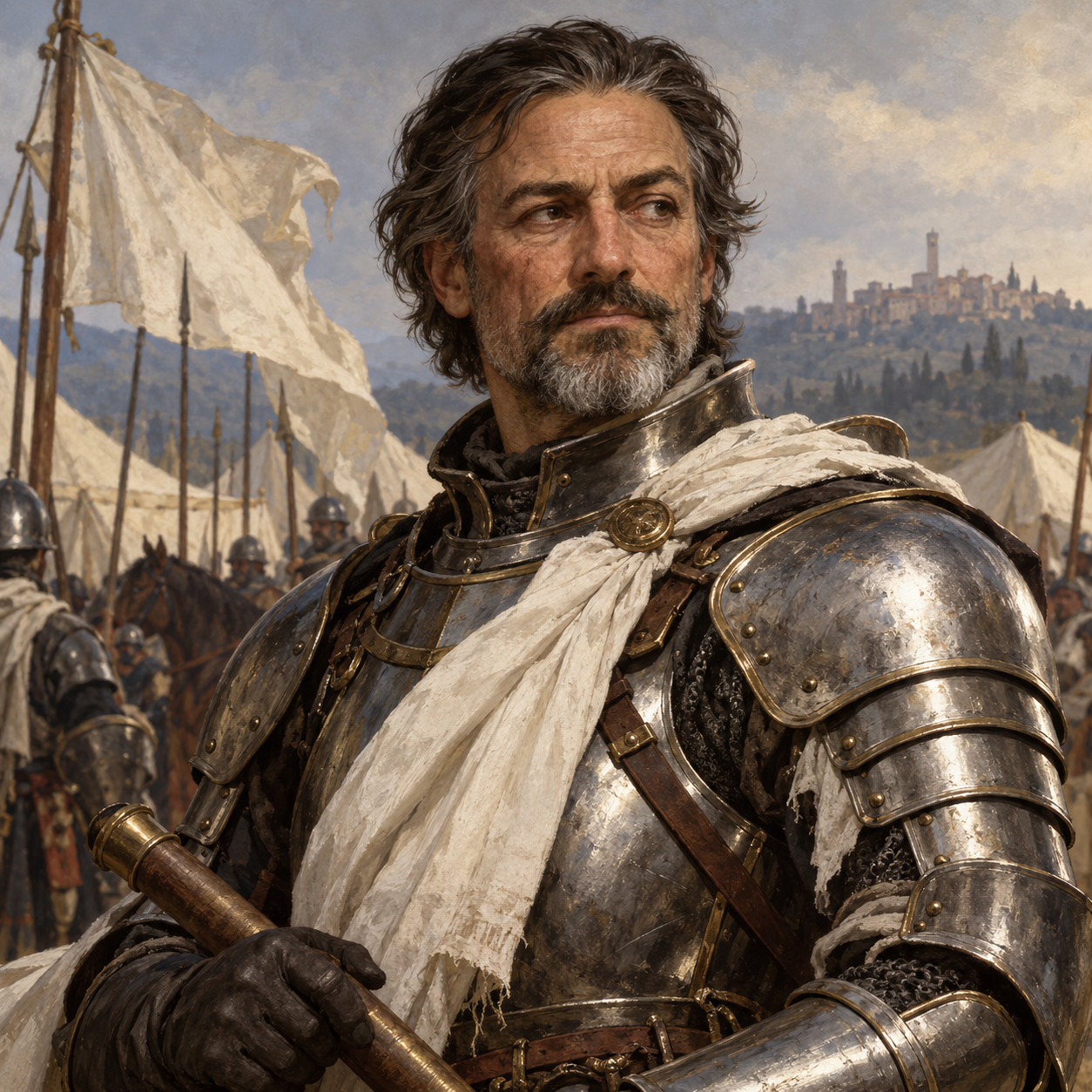
At a Glance
| Name | Sir John Hawkwood, Giovanni Acuto |
|---|---|
| Status | Alive in 1454 · born in England in 1400 · approximately 54 years old |
| Loyalty | His soldiers and the White Company he founded in 1435 |
| Current base | Florence and its Tuscan hiring roads |
| Goal | Win a sustainable contract, keep his troops paid and protect his military reputation |
| Threat | A rival financier holds records of a damaging military bargain from an earlier campaign |
| Role | Employer, rival commander, military mentor or perilous ally |
White Company Emblem

“An army marches on bread, coin and roads — in that order. Glory doesn’t feed a horse.”
John Hawkwood remembers every bad road in Tuscany and more dead soldiers than he will ever admit. He counts horses, food and distances before he counts enemies. Born in England in 1400, he spent his early campaigns learning what victory costs the people beside the road. Nearly two decades of leading the White Company have made him a formidable veteran; his successes do not excuse abuses committed under its colours.
Hawkwood commands the established White Company. Old accounts, new recruits and desperate nobles gather around it. He will negotiate with a farmer as seriously as with a prince if the farmer can actually supply his men.
Use him at the table: a disciplined but morally compromised military professional, not a quest dispenser or an unavoidable boss fight. Characters who protect his supply line, expose a forged order, or prevent civilian reprisals may earn an introduction to northern Italy’s hiring captains. Characters who sabotage his payroll may make an enemy of an entire company.
What Is John Hawkwood Doing Right Now?
His soldiers can hold the roads outside Florence, but Florence is not yet his assured employer. Merchants want escorts. Councillors argue over whether he can be trusted with a renewed commission. The Peace of Lodi has changed what an army may legally be asked to do, and his rival captains are competing for the same contracts. One person in the city holds evidence of a secret wartime payment that could destroy Hawkwood’s latest contract.
He meets potential clients after sundown, surrounded by officers and pay ledgers rather than courtly splendour. He rejects any commission without a credible supplier of grain. He is willing to help adventurers recover stolen payroll or end a raiding band’s abuse, but will not commit his entire company simply because a messenger calls it a just cause.
The First Meeting: Three Signatures
The characters reach a guarded paymaster’s pavilion beside the Arno. A muddy courier brings three sealed contracts: one from a Florentine grain guild, one from a noble who wants a disputed bridge held, and one from a lender promising the company an advance in exchange for silence about missing wages. Hawkwood refuses to sign until he knows which messenger is lying. He gives the characters until the evening bell to return with evidence.
| What the party does | Hawkwood’s response | Visible consequence |
|---|---|---|
| Checks seals, books and witnesses | Grants access to the company accountant and captain’s tent | The disputed contract can be amended without bloodshed |
| Bribes or threatens the paymaster | Demands the accounts be opened before a neutral witness | A lieutenant begins counting how many guards the party brought |
| Protects the threatened village | Orders his scouts to verify the harm and holds the wagons | Villagers offer a safer route, but a rival employer raises its price |
| Steals the papers and flees | Seals nearby roads rather than ordering a blind pursuit | The party must outrun informants, not just swords |
Personality and Relationships
Dry-humoured and cautious, Hawkwood can talk an angry captain out of a costly charge while leaving him convinced the retreat was his own idea. He cares about discipline but struggles to distinguish the obligations he owes his dead comrades from those of his living recruits. Publicly he refuses to discuss the disputed terms of an earlier campaign; privately he keeps a duplicate ledger naming those who profited from it.
Allies and rivals: interested bankers and officials in Florence; competing Colleoni and Piccinino companies; veterans of the company’s campaigns since 1435; civilians who suffered under hired troops or whose families bore the costs of war.
Equipment: well-maintained plate armour, sword, command baton, waterproof contract case, a trustworthy mount and a small book of debts. His signal flags matter more to him than a jewelled weapon.
Portraying Hawkwood
Manner: he stays seated when someone boasts, rises when an actual eyewitness speaks, and asks the quietest soldier for the horse count. Voice: clipped English softened by years of speaking Italian; precise on terms, slow to threaten. Flaw: he can calculate the cost of a damaged bridge more readily than the terror of a family hiding beneath it.
When characters earn trust: he lends a scout or provides a guarded letter, not a whole army. When they cross him: he cancels passes, calls in creditors and waits for a better moment. When he is wrong: a ledger bearing his own seal can make him reconsider where a sword cannot.
People at His Table
The Paymaster
An overworked, unglamorous officer whose worn accounts determine whether Hawkwood’s next campaign is possible. Wants the company to stay solvent; secretly suspects a lieutenant of drawing wages for nonexistent soldiers.
The Rearguard Captain
A veteran of the northern roads, fiercely loyal to the rank and file but increasingly impatient with careful retreats. Wants one dramatic victory that will raise recruiting prices and his own standing.
The Florentine Negotiator
A lawyer with authority to write terms but not to guarantee payment. Wants the city roads defended without handing a foreign-born captain undue influence over its gates.
Game Statistics by Edition
Custom playable interpretations of a seasoned, living mercenary commander. Soldiers are separate creatures, not part of his personal challenge rating. The four stat blocks are intended for different rulesets rather than interchangeable numbers.
Sir John Hawkwood — Veteran Commander
Medium Humanoid (Human), Lawful Neutral · D&D 2024 original NPC
Armor Class 19 (plate armour; defensive fighting training) · Hit Points 189 (18d8 + 108) · Speed 30 ft. · Initiative +2 (Advantage from Battlefield Reader).
Saving Throws Str +8, Con +10, Wis +7 · Skills History +7, Insight +11, Intimidation +8, Perception +7, Persuasion +8 · Senses passive Perception 17 · Languages Common, Italian, French · Gear officer’s sword (+1), plate armour, contract case, baton.
Traits
Battlefield Reader. Hawkwood has Advantage on Initiative rolls. Friendly creatures of his choice within 30 feet that can hear him gain +2 to Initiative rolls.
Hold the Line. Once per turn when a creature Hawkwood can see within 30 feet would be pushed or knocked Prone, he may expend his Reaction to grant that creature Advantage on the saving throw to avoid that effect.
Actions
Multiattack. Hawkwood makes three Officer’s Sword attacks.
Officer’s Sword. Melee Attack Roll: +9, reach 5 ft., one target. Hit: 10 (1d10 + 5) Slashing damage. On the first hit of each of Hawkwood’s turns, the target takes an extra 9 (2d8) Slashing damage.
Orderly Withdrawal (Recharge 5–6). Hawkwood chooses up to three allies within 60 feet who can hear him. Each chosen ally can use its Reaction immediately to move up to half its Speed without provoking Opportunity Attacks. An Incapacitated ally cannot use this movement.
Bonus Actions
Rally the Line (2/Day). Two allies within 30 feet who can hear Hawkwood each gain 10 Temporary Hit Points.
Reactions
Watch That Flank. Trigger: A creature Hawkwood can see within 30 feet that can hear him is hit by an attack roll. Response: He grants the target +3 AC against that attack, potentially causing a miss. Hawkwood must choose this or Hold the Line; he has only one Reaction until the start of his next turn.
Original 2024-compatible NPC. The captain’s individual CR does not include his soldiers, mounts or fortifications.
Sir John Hawkwood — Veteran Commander
Medium humanoid (human), lawful neutral · D&D 5e / 2014 original NPC
Armor Class 19 (plate, Defence fighting style); Hit Points 189 (18d8 + 108); Speed 30 ft.; Challenge 9 (5,000 XP); Proficiency Bonus +4.
Saving Throws Str +8, Con +10, Wis +7; Skills History +7, Insight +11, Perception +7, Persuasion +8; Senses passive Perception 17; Languages Common, Italian, French.
Traits
Veteran’s Eye. Advantage on initiative checks; allies within 30 feet who hear him gain +2 to initiative. Company Discipline. Allies within 30 feet who hear him have advantage on saving throws against being frightened.
Actions
Multiattack. Hawkwood makes three attacks with his +1 longsword.
Longsword. Melee Weapon Attack: +9 to hit, reach 5 ft., one creature. Hit: 10 (1d10 + 5) slashing damage, plus 9 (2d8) extra damage to the first creature he hits on each of his turns.
Withdraw in Order (Recharge 5–6). Up to three allies within 60 feet who hear him may each use a reaction to move half speed without provoking opportunity attacks.
Reactions
Cover the Captain. When a creature Hawkwood can see within 30 feet that can hear him is hit by an attack, he grants it +3 AC against that attack, potentially causing it to miss.
Original 2014-compatible NPC. The company is not part of this creature’s personal Challenge Rating.
Sir John Hawkwood — Veteran Condottiere
Male human fighter 13 · Lawful Neutral · Medium Humanoid (Human) · Pathfinder 1e
Initiative and Senses
Init +6; Senses Perception +15; Languages Common, Italian (campaign languages).
Defence
AC 27, touch 12, flat-footed 25 (+11 armour, +4 shield, +2 Dex); hp 150 (13d10 + 78, rolled; includes Toughness and 13 favoured-class hp); Fort +14, Ref +8, Will +11 (+3 additional against fear from bravery).
Offence
Speed 30 ft. (heavy-armour speed reduction removed by fighter armour training); Space/Reach 5 ft./5 ft.; Melee masterwork longsword +23/+18/+13 (1d8 + 11, 17–20/×2); Base Atk +13; CMB +17; CMD 29.
Attack breakdown +13 BAB, +4 Strength, +3 weapon training (heavy blades), +1 masterwork, +1 Weapon Focus, +1 Greater Weapon Focus. Damage breakdown +4 Strength, +3 weapon training, +2 Weapon Specialization, +2 Greater Weapon Specialization.
Statistics
Abilities Str 19, Dex 14, Con 18, Int 16, Wis 16, Cha 17.
Skills Diplomacy +13, Intimidate +19, Knowledge (history) +10, Perception +15, Profession (soldier) +25, Ride +13 while wearing armour and shield (+18 without their –5 combined check penalty), Sense Motive +13.
Skill ranks (78 total) Diplomacy 10, Intimidate 13, Knowledge (history) 7, Perception 12, Profession (soldier) 13, Ride 13, Sense Motive 10; six ranks per level from human fighter with Int 16.
Feats (15) Combat Expertise, Combat Reflexes, Greater Weapon Focus (longsword), Greater Weapon Specialization (longsword), Improved Critical (longsword), Improved Initiative, Iron Will, Mounted Combat, Power Attack, Ride-By Attack, Skill Focus (Profession [soldier]), Spirited Charge, Toughness, Weapon Focus (longsword), Weapon Specialization (longsword).
Class Features bravery +3, armour training 3, weapon training 3 (heavy blades); weapon training 2 and 1 in other groups. Possessions +2 full plate, +2 heavy steel shield, masterwork longsword, cloak of resistance +2, contract satchel and heavy warhorse.
Special Ability and Tactics
Command the Rearguard (Ex; bespoke campaign ability; 1/day). As a standard action Hawkwood directs allied creatures within 30 feet who can hear and understand him. They gain a +2 morale bonus on saving throws against fear for three rounds. This homebrew ability is not part of the fighter class.
Before Combat Scouts mark the route and the company keeps an orderly fallback. During Combat Hawkwood fights around supply lines rather than chasing fleeing enemies. Morale He negotiates withdrawal before losing the troops needed to complete the contract.
Rules audit: Fighter 13 supplies BAB +13/+8/+3, Fort +8, Ref +4, Will +4; bravery +3 is a situational fear bonus. Armour training allows normal heavy-armour speed and increases the maximum Dexterity bonus. His soldiers and mount are not part of his individual CR.
Sir John Hawkwood — White Company Free-Captain
Male human fighter 13 · Lawful Neutral · Medium Humanoid (Human) · D&D 3.5e
Initiative and Senses
Init +6; Senses Listen +3, Spot +11; Languages Common, Italian (campaign languages).
Defence
AC 26, touch 12, flat-footed 25 (+10 armour, +4 shield, +1 Dex [full-plate maximum], +1 deflection); hp 117 (13d10 + 39, rolled); HD 13d10; Fort +11, Ref +6, Will +9 (includes Iron Will).
Offence
Speed 20 ft. in heavy armour (base 30 ft.); Space/Reach 5 ft./5 ft.
Melee masterwork longsword +20 (1d8 + 8, critical 17–20/×2); Full Attack masterwork longsword +20/+15/+10 (1d8 + 8, 17–20/×2); Ranged light crossbow +15 (1d8, 19–20/×2).
Base Atk/Grapple +13/+17; Attack breakdown +13 BAB, +4 Strength, +1 masterwork, +1 Weapon Focus, +1 Greater Weapon Focus; Damage breakdown +4 Strength, +2 Weapon Specialization, +2 Greater Weapon Specialization.
Power Attack option Hawkwood can accept –3 to all melee attack rolls for +3 longsword damage (one-handed); apply the penalty and bonus to each attack made before his next turn.
Statistics
| STR | DEX | CON | INT | WIS | CHA |
|---|---|---|---|---|---|
| 18 (+4) | 14 (+2) | 16 (+3) | 16 (+3) | 16 (+3) | 17 (+3) |
Abilities Str 18, Dex 14, Con 16, Int 16, Wis 16, Cha 17.
Feats (13) Combat Expertise, Combat Reflexes, Greater Weapon Focus (longsword), Greater Weapon Specialization (longsword), Improved Critical (longsword), Improved Initiative, Iron Will, Mounted Combat, Power Attack, Ride-By Attack, Spirited Charge, Weapon Focus (longsword), Weapon Specialization (longsword).
Skills Intimidate +19, Handle Animal +11, Ride +10 in listed armour and shield (+18 without their combined –8 armour-check penalty), Sense Motive +11, Spot +11. Fighter cross-class Sense Motive/Spot ranks respect the eight-rank limit.
Possessions +2 full plate, +2 heavy steel shield, ring of protection +1, masterwork longsword, light crossbow and bolts, trained heavy warhorse, baton of command, White Company articles and pay ledger.
Special Ability and Tactics
Orders Before Glory (Ex; bespoke campaign ability; 1/day). As a standard action Hawkwood issues a rearguard order. Allies within 30 feet who can hear and understand him gain a +2 morale bonus on saving throws against fear for 3 rounds. This is a custom commander ability, not a normal fighter class feature.
Before Combat Hawkwood places scouts on the approach and identifies a secure withdrawal. During Combat He uses Combat Expertise while defending a bridge or contracts a disciplined rearguard. Morale He withdraws rather than sacrificing his troops for an unwinnable contract.
Rules audit: Fighter 13 supplies BAB +13/+8/+3 and base saves Fort +8, Ref +4, Will +4. The displayed totals incorporate his abilities, chosen feats and specified equipment. His White Company escorts are separate creatures, not included in his CR.
Running a Hawkwood Encounter
First round: he reads the flanks, positions scouts and orders his soldiers to protect wagons and bridges. Second round: he uses withdrawal orders to trade ground for time. Third round: he negotiates from defensible terrain or concentrates on the one enemy who threatens his supply line. The company never materialises from nowhere: establish its scouts, patrols and retreat routes before initiative.
Balance note: the 5e CR 9 ratings are recalculated provisional homebrew estimates for Hawkwood alone (189 hp, AC 19, approximately 40–41 damage per round, +9 attack), not a playtest guarantee. His soldiers, mounts and fortifications increase encounter difficulty. Pathfinder 1e and D&D 3.5e use their own character-level and challenge conventions; do not transfer CR numbers between editions.
Player counterplay: intercepted orders, a compromised pay chest, muddy fords, a false signal and protection of nearby civilians can change the engagement more effectively than dealing damage. If combat begins, defeat need not mean death: Hawkwood may accept a negotiated surrender, prisoner exchange or lawful withdrawal.
Encounters and Adventure Hooks
The Pay Chest and the False Muster
A treasurer discovers soldiers drawing wages under names copied from a previous campaign. The inflated muster may finance a rival officer or conceal a bribe to an Italian official. Recover the pay chest, expose the fraud or secure back wages before men begin raiding farms.
The River Bridge
Two rival captains hold opposing ends of a bridge under contradictory agreements. Hawkwood asks the adventurers to identify which seal is genuine before he fights. Both documents are real, and neither party can afford bloodshed.
The Price of an Old Commission
A financier produces a wartime contract apparently binding Hawkwood to surrender a fugitive officer. The document may be authentic but its terms are being abused. The party can examine the records, negotiate a settlement or uncover the political employer behind the demand.
The Four-Armed Escort
Clue: four merchants claim the same wagon of pay and each has a valid-looking seal. Decision: use testimony, contract law or a dangerous escort to determine who paid for the cargo. Consequence: exposing the right patron earns a company pass; accusing a neutral merchant risks shutting the local market to the party.
The Quiet Village
Clue: an abandoned inn outside Florence still has warm bread and a White Company receipt nailed to the door. Decision: investigate missing families, a rival band wearing white or an officer whose requisitions exceeded his orders. Consequence: Hawkwood will punish proven wrongdoing, but public accusations made without evidence could drive his soldiers to choose their lieutenant over him.
If the Party Does Nothing
The company is employed by the quickest bidder, unpaid troops seize supplies and a ruthless financier invokes an old contractual obligation against Hawkwood. He orders a withdrawal rather than a massacre, but a furious lieutenant takes the remaining men on a raid under stolen white colours.
The Chronicle: A Mercenary Career
1400: John Hawkwood is born in England. His later fame belongs to this campaign generation, not to an earlier mercenary era.
1420s: Hawkwood learns soldiering on English and continental campaigns, acquires a reputation for disciplined withdrawals and establishes relationships with captains and suppliers.
1435: Hawkwood founds the White Company, recruiting a contracted force and creating the muster books and company articles that still bind its officers.
1440s: Repeated campaigns in Italy make Hawkwood a formidable condottiere. The White Company wins contracts, accumulates enemies and acquires an increasingly expensive train of soldiers and horses.
Early 1450s: His officers renegotiate contracts, argue over arrears and seek opportunities as the diplomatic balance between Italian states changes.
1454: Hawkwood is about 54 years old and actively commands the White Company around Florence, competing for work as the Peace of Lodi reshapes the market for soldiers.
History: Treccani, John Hawkwood; William Caferro, John Hawkwood. Hawkwood’s birth in 1400 and the White Company’s founding in 1435 are the campaign’s deliberate alternate historical chronology.
Historical and Rules Context
The documented Giovanni Acuto served in fourteenth-century Italy and died in 1394; his real biography and the White Company’s original development should not be confused with this setting’s later-born, 1435-founding counterpart. The captain’s strategic reputation, contract culture and Italian nickname are historical inspirations, not evidence that the alternate dates are real.
Research: Treccani — Giovanni Acuto; William Caferro, John Hawkwood. Rules: SRD 5.2.1 (2024), SRD 5.1 (2014), Pathfinder 1e Fighter and 3.5e Fighter. These NPC stat blocks are original game-ready adaptations, not quoted official stat blocks.
Continue into play: The White Company, Free Companies, Florence, Venice, Colleoni, Piccinino, the Italian NPCs directory, Timeline and Age of Severed Crowns.
Keep this reference growing
If this page helped with your reading or game, you can support its upkeep or explore the curated books.
Explore the Bookshop — epics, classics and stories behind imagined worlds.