
Fūma Clan — Riders of Sagami
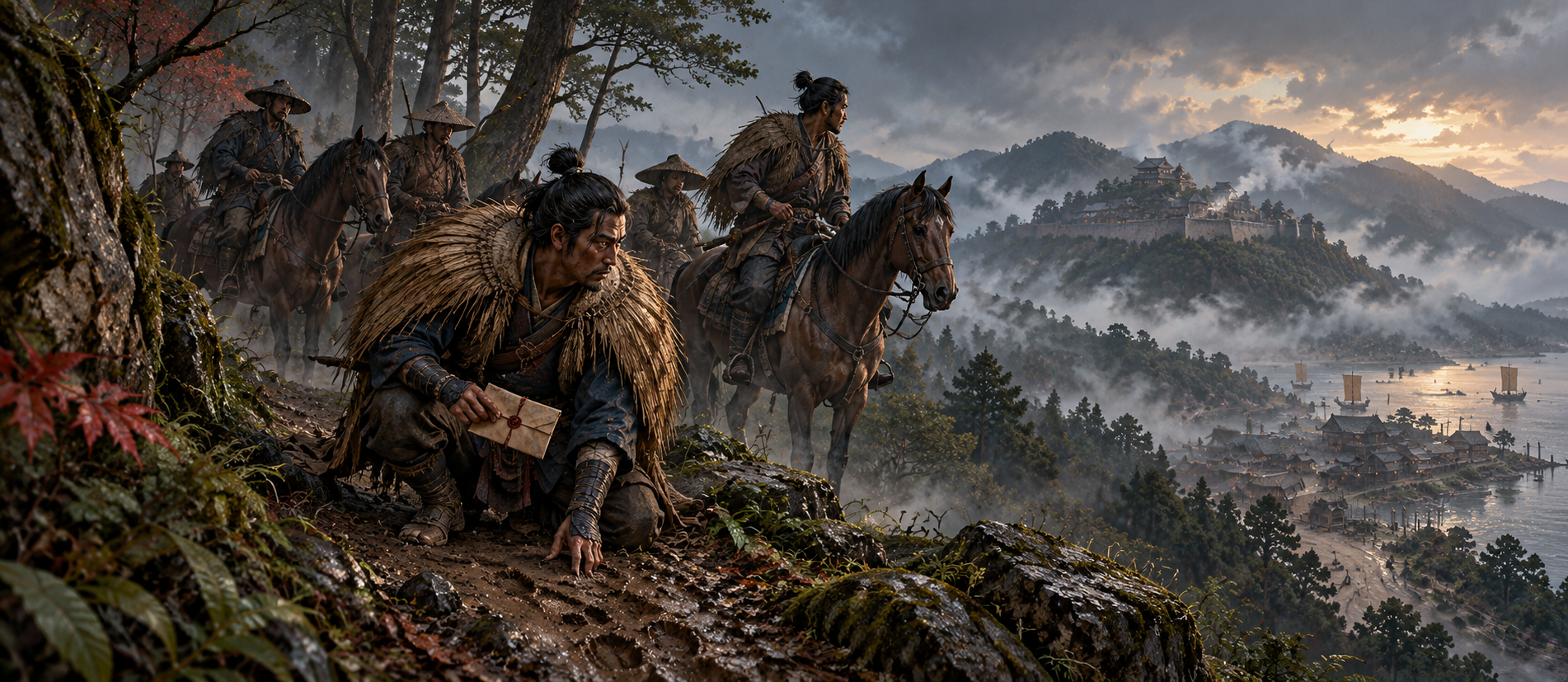
Sagami Province · Kantō roads · Mounted scouts · Coastal intelligence
The ferry is empty when it should be full. A tax boat lies against its moorings with wet footprints on the deck and every passenger’s name crossed out of the register. Across the estuary, three riders watch the road without wearing a lord’s colours. One has the missing seal. The Fūma Clan will return it to its owner—but first they want to know which owner can be trusted.
At a Glance
| Name | Fūma Clan (風魔); an inherited network of scouts, retainers, ferrymen and informants |
|---|---|
| Heartland | Sagami’s uplands, roads through Hakone, and approaches to the western Kantō coast |
| Nature | Human-led Japanese warrior and intelligence households, not a universal assassin guild |
| Public work | Guiding travellers, guarding crossings, finding missing riders and carrying intelligence |
| Hidden work | Reconnaissance, night raids, sabotage of supply lines and identifying false allegiances |
| Leadership | Fūma Kotarō, the name borne by the present clan head in this setting; branch captains wield local authority |
| Loyalties | Family and dependants first; contracts with rival Kantō patrons are increasingly dangerous |
| Recruitment | Kin, adopted dependants and a small number of trusted retainers; work is earned, not purchased |
| Sign | A wind-mark above three estuary waves: a campaign device, not a verified historical clan crest |
| Strength / weakness | Terrain knowledge, horses, boats and ordinary faces / divided households, captured messengers and unreliable patrons |

What the Fūma Clan Wants
The Fūma sell certainty in a country running short of it. A lord can hire twenty armed riders and still lose his grain train in the Hakone hills. A merchant can afford three bodyguards and still disappear at a ferry used by both rival armies. The clan’s value is knowing who controls the path tomorrow, whose horses have passed tonight and which seemingly friendly village has changed sides.
They are not innocent protectors. Fūma scouts sometimes burn stores, steal horses or lead a pursuing army toward the wrong ford. Kotarō keeps these operations limited because the clan lives among the people who pay the price. His eastern captain, eager for a richer patron, argues that restraint is a luxury a family on the edge of civil war cannot afford.
The question is not whether the Fūma can find someone. It is whether they will hand that person over once they do.
What Is Happening Right Now?
The Empty Ferry
A boatman in the lower Sagami reaches has disappeared along with a provincial magistrate’s travel permit. The permit is genuine; the name on it is not. The Fūma offer the characters a place in a search party, but the boatman’s daughter insists that the clan already knows he is alive. At low tide the mud reveals two sets of hoofprints: one riding to rescue him, the other riding to silence him.
The Letter from Kamakura
In Kantō, the rivalry between Ashikaga Shigeuji and the Uesugi leadership is turning violent. A sealed letter claims a retainer intends to change allegiance before his lord does. Its bearer has been killed, and both sides want the original. The Fūma can carry a copy across the hills; they cannot promise the family named in it will survive publication.
Blue Lanterns on the Coast
Fishing boats near the Sagami shore have begun using a signal that resembles a Fūma warning light, except the third flash comes too soon. Whoever is copying the signal has lured two patrols onto reefs. The clan wants the impostor caught alive long enough to reveal his employer. A tidebound shrine keeper says the false lights began after something strange washed ashore; the clan demands proof before turning a human crime into a monster hunt.
How the Clan Actually Works
The name Fūma Kotarō passes with leadership in this campaign’s clan tradition, but not every scout is a Kotarō and there is no omniscient master giving orders from a mountain throne. A household head controls safe lodgings and families; branch captains control riders and boats; dependable guides may know only the next stop. A captured courier can betray one road without exposing them all.
| Role | What they do | What can go wrong |
|---|---|---|
| Kotarō, clan head | Decides which patrons may draw on the clan’s people | A desperate branch accepts a contract he has refused |
| Mounted pathfinders | Watch ridges, mark false trails and carry warning between crossings | Fresh hoofprints expose a hidden rendezvous |
| Ferry and shore contacts | Count passengers, conceal crossings, track small boats and tides | A harbour official recognises the wrong signal |
| Keepers of households | Feed horses, hide injured scouts and protect children of absent riders | The war arrives at a home rather than a battlefield |
| Infiltrators and runners | Carry letters, map stores, listen in markets and test loyalty | Someone acts on a report that was deliberately falsified |
In public a scout may wear a travel cloak, straw rain-cape and ordinary working clothes. Clan dress is useful to enemies; the uniform black-clad figure beloved of later theatre is not the Fūma’s everyday disguise. Their reputation for vanishing comes from prepared routes, riders who change horses and neighbours willing to lie for them—not universal invisibility.
Joining, Trust and the Price of Service
The Fūma are chiefly Japanese human families and retainers. Birth opens doors, but skill keeps them open: an adopted boatman’s son who reads the tides may be entrusted with more than a boastful warrior cousin. Women sustain intelligence networks, carry letters, manage households and sometimes lead an operation when their experience merits it. The clan’s internal obligations come from family, service and local customs, not the entry rules of an unrelated European court.
A non-human adventurer may be useful as a specialist or outsider hired for a particular journey. Such a person does not automatically inherit the household’s oaths, safe houses or command of retainers. A suspicious captain may test their loyalty more harshly, while a pragmatic head may accept help that keeps families alive. The decision depends on people and politics, not a universal rule for all Japanese clans.
The clan honours ancestral households, roadside shrines and local sacred places. Scouts leave offerings before dangerous passes, but their priests and shrine keepers are not members of an invented uniform magical order. Ghost stories around abandoned barriers can conceal real haunts, war dead, frightened villagers or simply a bandit trying to frighten off witnesses.
Where the Fūma Can Be Found
Hakone crossings: rough paths and steep wooded slopes suit small patrols, false trails and sudden changes of route. The clan can find a caravan lost in the hills, or keep pursuers away long enough for it to disappear.
Sagami shore: fishing fleets and ferry landings provide eyes on unfamiliar sails. Storms stop even good boats; coastal infiltration requires tide knowledge, not fantastical mastery of the sea.
Kamakura and Kantō roads: households, temples and armed retainers are choosing sides in dangerous political disputes. A Fūma courier may know which official signed a letter, but not whether the seal was placed there willingly.
Across the wider world: most of the Fūma’s power is local. Foreign merchants, travelling adventurers and strange visitors can create opportunities, but the clan has no implausible worldwide network of ninja houses.
People Adventurers May Actually Meet
| Person | What they need | The difficult choice |
|---|---|---|
| Fūma Kotarō, clan head | A proof that a new patron can honour his word | Will he abandon a lucrative contract rather than sacrifice a family? |
| Fūma Aya, river keeper | The names of the passengers on the empty ferry | Her missing brother may have chosen to vanish |
| Ishida Genpachi, eastern rider | Authority to strike at an enemy supply train | His target carries grain meant for civilians |
| Toma, shrine messenger | Someone to investigate lights at an abandoned barrier | The spirit story may protect a very human murderer |

Using the Fūma Clan in an Adventure
| Opening | Players can choose | Consequences |
|---|---|---|
| The grain train | Sabotage a convoy, warn its guards or expose why its manifests are falsified | Villages receive food, rebels gain supplies, or both parties accuse the characters of treason |
| The horse without a rider | Track the wounded scout, secure his letters or trade them for captives | An entire branch is saved—or its refuge is burned |
| Three lanterns at the inlet | Follow the counterfeit signal by boat or confront the shore watcher | A foreign trader is rescued, or a covert landing succeeds |
| Kotarō’s impossible order | Obey a sealed command, seek the real Kotarō or prove the order was forged | A family feud begins; the party gains access to the clan’s innermost contacts |
Running the clan: make discovery and escape as important as combat. The party should be able to win by protecting a witness, intercepting a message, finding a safer crossing or persuading a captain to break a ruinous contract. Fūma scouts retreat when a fight no longer serves their orders. Their children, boatmen and horses are not disposable props.
Encounter-Ready Fūma Pathfinder — Four Editions
The following is a capable but mortal human field scout. It is not Kotarō’s personal stat block. The 2024 and 2014 versions use separate wording; Pathfinder 1e and D&D 3.5e use their own class and combat formats. Use the same scout as a rider, guard for a mountain pass or a messenger who would rather escape than fight.
Fūma Pathfinder — D&D 5.5e / 2024
Medium Humanoid (Human), Neutral
| Armor Class | 15 (studded leather) | Initiative | +3 (13) |
|---|---|---|---|
| Hit Points | 32 (5d8 + 10) | Speed | 30 ft. |
| Challenge | 1 (200 XP) | Proficiency Bonus | +2 |
Saving Throws Dex +5, Wis +4
Skills Perception +4, Stealth +7, Survival +4
Senses Passive Perception 14
Languages Japanese and a local Kantō dialect
Gear Studded leather, shortsword, shortbow, 20 arrows, cord, riding kit and sealed message.
Traits
Trailwise. The scout has Advantage on Wisdom (Survival) checks made to follow tracks or navigate wooded hills and tidal crossings.
Actions
Multiattack. The scout makes two Shortsword or Shortbow attacks.
Shortsword. Melee Attack Roll: +5, reach 5 ft. Hit: 6 (1d6 + 3) Piercing damage.
Shortbow. Ranged Attack Roll: +5, range 80/320 ft. Hit: 6 (1d6 + 3) Piercing damage.
Bonus Actions
Break Contact. The scout takes the Disengage or Hide action.
Tactics
The pathfinder warns allies of an ambush, fires from cover and withdraws along a known route. A Fūma courier will give up a weapon before surrendering a sealed message.
Fūma Pathfinder — D&D 5e / 2014
Medium humanoid (human), neutral
| Armor Class | 15 (studded leather) | Hit Points | 32 (5d8 + 10) |
|---|---|---|---|
| Speed | 30 ft. | Challenge | 1 (200 XP) |
Saving Throws Dex +5, Wis +4
Skills Perception +4, Stealth +7, Survival +4
Senses passive Perception 14
Languages Japanese and a local Kantō dialect
Traits
Trailwise. The scout has advantage on Wisdom (Survival) checks to follow tracks or navigate wooded hills and tidal crossings.
Actions
Multiattack. The scout makes two attacks with its shortsword or shortbow.
Shortsword. Melee Weapon Attack: +5 to hit, reach 5 ft., one target. Hit: 6 (1d6 + 3) piercing damage.
Shortbow. Ranged Weapon Attack: +5 to hit, range 80/320 ft., one target. Hit: 6 (1d6 + 3) piercing damage.
Bonus Actions
Break Contact. The scout takes the Disengage or Hide action.
Tactics
The scout avoids prolonged melee, protects its retreat route and uses signals to guide allies away from danger.
Fūma Pathfinder — Pathfinder 1e
Human rogue 3 (CR 2; XP 600)
LN Medium humanoid (human)
Init +7; Senses Perception +10
Defense
AC 16, touch 13, flat-footed 13 (+3 armor, +3 Dex)
hp 20 (3d8 + 6, including favored-class bonuses)
Fort +2; Ref +6; Will +3
Defensive Abilities evasion; trap sense +1
Offense
Speed 30 ft.
Melee shortsword +5 (1d6+1/19–20)
Ranged shortbow +5 (1d6/×3; range increment 60 ft.)
Special Attacks sneak attack +2d6
Statistics
STR 12, DEX 16, CON 12, INT 14, WIS 14, CHA 10
Base Atk +2; CMB +3; CMD 16
Feats Alertness, Improved Initiative, Weapon Finesse
Skills Acrobatics +9, Disable Device +10, Knowledge (local) +8, Perception +10, Ride +6, Sense Motive +8, Stealth +9, Survival +5
Languages Japanese and a regional tongue
SQ rogue talent (fast stealth), trapfinding +1
Combat Gear studded leather, shortsword, shortbow with 20 arrows, rope, travel papers and a signal whistle
Tactics
Before Combat Watches roads and identifies the safest route for allies.
During Combat Uses cover, shortbow shots and flanking to apply sneak attack; makes no stand-up duel by choice.
Morale Withdraws with a message or wounded companion once the route is clear.
Fūma Pathfinder — D&D 3.5e
Human rogue 2 (CR 2)
LN Medium humanoid (human)
Init +7; Senses Listen +9, Spot +9
Defense
AC 15, touch 13, flat-footed 12 (+2 armor, +3 Dex)
hp 13 (2d6 + 4)
Fort +2; Ref +6; Will +2
Defensive Abilities evasion
Offense
Speed 30 ft.
Melee shortsword +2 (1d6+1/19–20)
Ranged shortbow +4 (1d6/×3; range increment 60 ft.)
Special Attacks sneak attack +1d6
Statistics
STR 12, DEX 16, CON 14, INT 14, WIS 14, CHA 10
Base Atk +1; Grapple +2
Feats Alertness, Improved Initiative
Skills Hide +8, Listen +9, Move Silently +8, Search +7, Spot +9, Tumble +8, Use Rope +8
Languages Japanese and a regional tongue
Special Qualities trapfinding
Possessions leather armor, shortsword, shortbow, 20 arrows, message tube and riding kit
Tactics
Before Combat Marks escape routes and scouts the crossing.
During Combat Attacks from cover or beside allies and uses sneak attack when a foe is flanked.
Morale Breaks contact to deliver intelligence; fights to protect a helpless comrade.
History, Legend and the Campaign
The later fame of the Fūma comes from stories of the Hōjō of Odawara and the successive leaders called Fūma Kotarō. The best-known exploits of a fifth Kotarō, including battles of the late sixteenth century, are later than the present setting; they must not be described as events that have already occurred here. Local tradition also claims an older line back to the revolt of Taira no Masakado. That ancestry is a claim within the clan’s legend, not an independently proven historical pedigree.
Here the Fūma already operate as a lesser, fiercely local network in Sagami while Ashikaga and Uesugi retainers struggle over the Kantō. Their exact early contracts, the current use of the Kotarō name, Aya, Genpachi, Toma, and the recent ferry and lantern cases are original campaign material. The clan may later make powerful Hōjō connections, but no later allegiance is treated as a foregone conclusion.
Historical context: Katsushika Ward’s municipal history of the Kyōtoku conflict; Odawara’s Fūma Ninja historical and tourism account. For related campaign material, see Fūma Kotarō, the Factions directory and the Bestiary.
Keep this reference growing
If this page helped with your reading or game, you can support its upkeep or explore the curated books.
Explore the Bookshop — epics, classics and stories behind imagined worlds.