
Brethren of the Coast
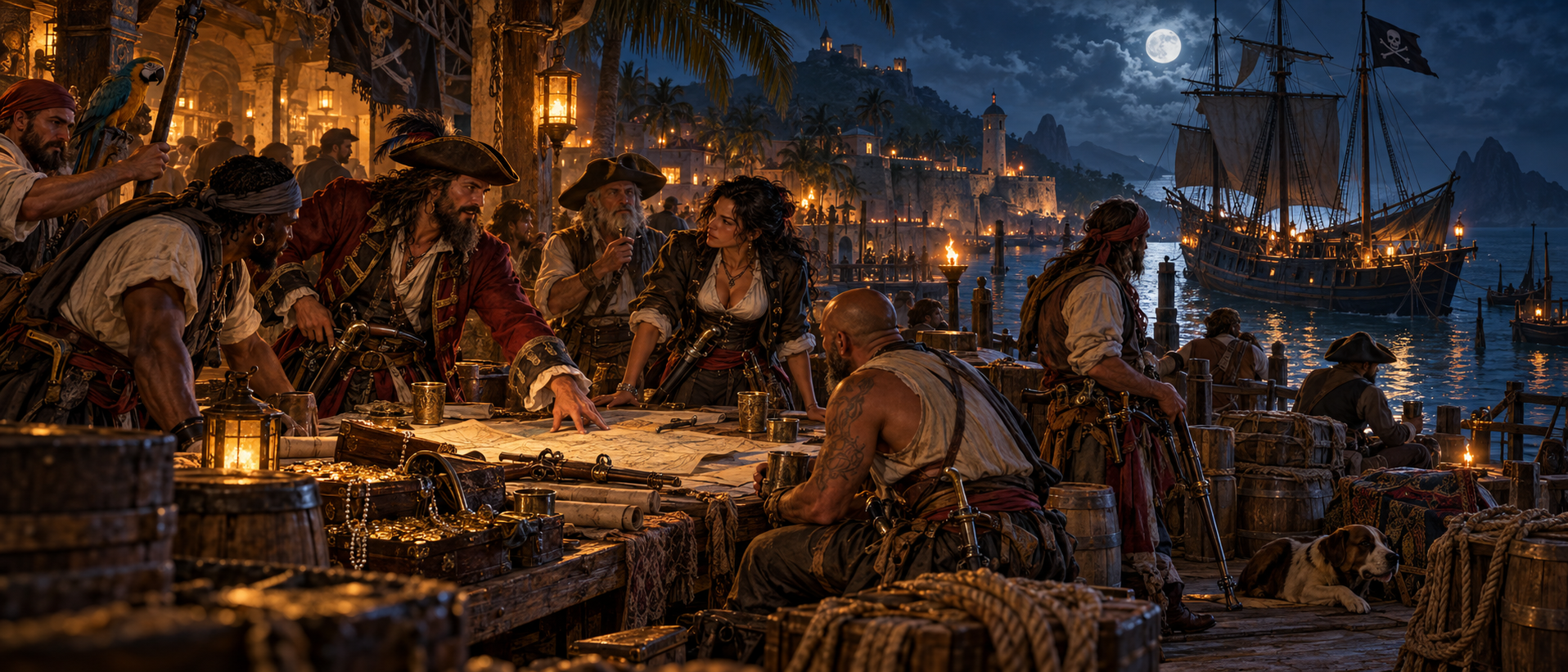
Caribbean Sea · Independent pirate republic · Free crews and defended harbours
A merchant carrack limps into Tortuga with its colours torn away, seven rescued prisoners below decks and three captains demanding the same prize. The crew who brought her in insist they have a lawful commission. The captives say the commission was forged. Before the tide turns, the Brethren must decide who receives a share—and who hangs for the taking. The verdict will test the laws of their pirate republic before a foreign governor can test its guns.
At a Glance
| Name | Brethren of the Coast |
|---|---|
| Nature | An independent pirate republic sustained by allied free harbours, self-governing crews and shore communities; not a single obedient navy |
| Central Goal | Preserve the pirate republic against foreign rule and internal collapse; defend its harbours, maintain its laws and keep its trade and fleet supplied |
| Government | The Council of the Free Harbours, where pirate captains and delegates of independent ports decide common laws and defence; crews retain their own articles and captains |
| Waters | Caribbean Sea, Gulf of Mexico and Atlantic approaches |
| Havens | Tortuga and defended free anchorages; Port Royal is an important but politically contested trading contact |
| Allegiance | Defence and continued independence of the republic; each member crew also retains its own articles, captain and voyage |
| Notable Captains | Henry Morgan, Laurens de Graaf, Michel de Grammont, Anne Dieu-le-Veut and Roche Braziliano; not all serve under the same articles |
| Strength | Defended anchorages, fast ships, pooled stores, skilled pilots, prize settlement, sea intelligence and mutual aid |
| Weakness | Rival captains, divided councils, foreign blockades, indebted harbours and captains tempted by pardon or private advantage |
| Common Signs | Articles of agreement, prize tallies, distinctive ship colours and coded signals; no universal flag |

The Republic They Mean to Keep
The Brethren have a country to lose, even if no crowned ruler will recognise it. Their pirate republic is a working alliance of free anchorages, ships and harbours that govern their own affairs, shelter their crews and refuse permanent submission to foreign governors. It survives by keeping its sea approaches open, its fortifications serviceable, its people fed and its captains willing to defend one another. Its purpose is not endless plunder. Prizes pay for timber, shot, wages, medicines and walls; those things keep the republic alive.
The Brethren’s shared understanding is simple: no distant throne may appoint their rulers, dispose of their harbours or dictate whom their free crews must serve. Each member ship keeps its articles and can choose its captain; the harbours maintain their own wardens and customary laws. Their captains and harbour delegates convene the Council of the Free Harbours to settle common defence, port safety, supplies and the division of contested prizes. The council’s authority rests on continued consent and the willingness of ships and harbours to stand together, not obedience to a pirate monarch.
That freedom creates hard questions. A captain may want pardons and lawful trade; a gunner may refuse to surrender the refuge for which comrades died; a merchant may demand a monopoly in return for supplying the fort. Residents ashore need peace and food even when the crews vote for another war. The republic cannot call itself free while ignoring the treatment of prisoners, debtors or people brought into harbour against their will. It has common enemies but no common conscience.
A captain needs the crew’s confidence to keep command, a quartermaster’s accounts to keep the peace, a pilot to reach a prize and a shore merchant willing to purchase what was taken. None of these people holds absolute power. A winning voyage can conceal bitter debts; one disputed share can undo a fleet that survived three battles together. The Brethren need not agree on every raid, but they must keep agreeing that the republic is worth defending.
The Council of the Free Harbours
The council is called when the republic itself is at stake. The chamber at Tortuga is a former counting house above a sheltered quay. An old sea chart covers the centre table, weighted down by a pistol, a judge’s seal and a damaged cannonball. Captains arrive with armed escorts, shipboard articles and demands they expect the others to refuse. Outside, sailors and dockworkers crowd the steps, waiting to learn whether their harbour will be defended, betrayed or sold.
Here, the Brethren must reach common decisions while fiercely guarding their independence. Every recognised member ship can speak through its captain or a chosen delegate, and every free harbour sends its own representatives. The chair is chosen for each sitting to keep order, not to reign. A ship’s captain may be famous enough to silence the room and still find that the harbour wardens can block a treaty that would surrender their homes.
Voices Around the Table
These are the leaders whose presence or envoys can change a council’s decision. None commands the entire republic, and a captain away at sea may send a trusted representative rather than attend in person.
| Voice | What they demand | How the characters can sway them |
|---|---|---|
| Henry Morgan | A common defence plan, disciplined fleet musters and stores counted before any grand attack | Bring reliable intelligence on the enemy fleet, usable gunpowder or a captain willing to commit ships |
| Anne Dieu-le-Veut | No surrender of a free harbour to a foreign garrison; no private bargain that binds other crews | Expose the secret terms of a pardon or rescue those whose safety the council has overlooked |
| Laurens de Graaf | A seaworthy route, experienced crews and a strategy that can survive the first broadside | Prove an approach through the reefs or recover charts concealed by a rival pilot |
| Michel de Grammont | Strike the threatening squadron before it gathers enough strength to blockade the harbours | Find a weakness in the enemy’s shore defences—or convincing evidence that an immediate raid would fail |
| Bartolomeu Português | Shipboard articles respected, claims heard, shares properly counted and captains answerable for broken agreements | Recover a stolen tally or witness testimony that can settle a disputed prize without bloodshed |
| Roche Braziliano | Harsh reprisals against enemies and reluctant allies; promises of decisive force rather than compromise | Offer a target whose capture serves the defence—or stop his men from provoking a war the harbours cannot sustain |
| Tortuga’s harbour delegates | Food, timber, wages, safe streets and shore families represented in decisions taken by armed captains | Pay the shipwrights, secure a provision convoy or prove that a council bargain will leave the town starving |
How the Council Decides
Ordinary matters—pilots, supplies, prize hearings and harbour rules—are settled by a majority of those represented at the sitting. A decision that would surrender a free harbour, accept a foreign garrison or commit the entire republic to war must win support from both the ship delegates and the harbour delegates. Neither group can lawfully trade away the other’s freedom. A temporary commander may be appointed for a particular fleet muster but cannot claim a permanent crown or rule over crews that never joined the venture.
Most disputes begin with a call for evidence, not a vote. A quartermaster places the ship’s articles beside the prize ledger; a pilot presents a chart; a harbour warden shows how much powder and bread remain. The council may reject the evidence, postpone its decision or send an independent party to discover the truth. Captains who walk out can make a lawful decision impossible to enforce. Persuasion matters, but so do food, witnesses, charts and the ships waiting beyond the reef.
Tonight’s Vote: Pardon or Independence?
A governor has offered amnesty, legal trade and powder in exchange for a permanent garrison inside the free harbour. The powder stores are nearly empty. One captain has already pledged support to the offer; another threatens to fire on any ship that carries foreign soldiers into the anchorage. The council has until dawn to answer, and the governor’s messenger waits downstairs with an unsigned treaty.
The characters can change the outcome. They might uncover the governor’s secret clause, broker a neutral powder shipment, persuade wavering captains to hold the harbour, expose a forged fleet order or argue for an agreement that protects trade without surrendering sovereignty. If the vote fails, the ships may fight one another before the governor needs to fire a shot. If it succeeds, the republic still needs crews willing to honour it.
What Is Happening Right Now?
The Commission with Two Seals
A ship reaches harbour with two incompatible letters of marque. One bears a wealthy patron’s mark; the other was countersigned after the attack. A cargo of medicinal supplies is missing, and the surviving sailors claim their master was killed by his supposed rescuers. The republic’s prize arbiters want the survivors heard before anyone is paid; an impatient captain wants the cargo auctioned at once. If the council cannot uphold its own rules, the next accused captain may ignore its judgment entirely.
The Empty Powder Magazine
The Brethren’s usual suppliers have stopped selling powder and shot on credit. A rival merchant is offering full barrels in return for exclusive rights to the next captured vessel. Several crews are already trading favours with the same agent. The council must decide whether to accept the monopoly or leave the republic’s harbour batteries without powder. Whoever secures a different supply line may save its independence without ever commanding a ship.
A Prisoner Nobody Will Name
Among a recent ship’s captives is a navigator who knows a hazardous channel through an island reef. Two captains intend to keep the navigator from one another; the prisoner says a third party has been paying to chart the route for months. A storm will close the ordinary passage in days.
The Price of a Pardon
A mainland governor’s agent offers commissions, safe harbour and pardon to captains who surrender one notorious raider, accept royal inspectors and permit a foreign garrison at the republic’s principal anchorage. One crew wants secure trade; another calls it the surrender of everything the republic was built to defend. A shore merchant supports the bargain because it gives her warehouses an exclusive right to sell every captured prize. The agent leaves at the next tide. Captains who sign separately may retain their ships while costing everyone else their country.
Harbours, Fleets and Shore Contacts
Tortuga is the republic’s most visible refuge: a place for rough bargains, swift refits, coastal guides and crews looking for a berth beneath laws made in the harbour rather than imposed from overseas. The free anchorages beyond it give the council places to hide provision ships and muster defenders. Port Royal brings wealthier brokers, repair facilities and political risks, but trade with its merchants does not make that port a possession of the republic.
The distinction between a member ship, a free harbour and an outside sympathiser matters. The republic’s shared rules protect its anchorages and regulate common affairs; a captain’s articles still govern that individual crew. A friendly shore broker cannot promise the aid of a squadron, and a harbour that sells to pirates is not automatically theirs to govern. Maintaining territory requires more than displaying a flag: a free harbour must have its own stores, defences, people and consent to remain within the alliance.
Who Holds the Harbour?
Its guns may be in the hands of one captain, its wharves owned by merchant families and its drinking houses owed money by half the fleet. The shipwright will not repair a broken mast without timber and wages; the powder dealer will not extend credit to a captain who cheated him last season; the harbour pilot may keep the only chart of a reef passage. A fleet can win at sea yet starve beside its own anchorage if these people withdraw their support.
That makes a prosperous port a place of bargaining, not merely a refuge. A broker who holds the prize market can offer a captain hard coin today and quietly bankrupt a rival tomorrow. A ship’s company may control its own articles while depending upon labourers and families ashore who never agreed to those terms. Threatening the merchants may bring immediate supplies, but at the cost of the next season’s repairs and food.
Captains, Articles and the Division of a Prize
From Council Vote to Orders at Sea
The Council of the Free Harbours sets common policy, but the crews still elect their officers and agree to their own articles. Harbour wardens organise watches, food and repairs ashore; captains must bring ships, sailors and powder when they promise them. A council vote does not conjure the supplies it needs. A captain who refuses an agreed muster may lose a berth, while a harbour that denies food to its own defenders may force its council delegates to answer before their neighbours.
Articles of a Free Crew
Each company writes or swears its own articles before a voyage. The articles determine who gives orders in a fight, what happens when a captain is removed, how losses are paid and what share belongs to a wounded sailor. Arguments over a captured vessel are heard before officers and, when confidence has collapsed, before the company itself.
The captain may command during pursuit and battle, yet still face a vote over a destination, a disputed punishment or the refusal of a share. A quartermaster guards the records and can speak against the captain before the crew; the two offices need not belong to allies. A first mate might fulfil the quartermaster’s duties on a small ship, but the jobs are not automatically the same. Elections and articles do not make every crew fair: a frightened majority may condemn an innocent sailor, while a popular captain may buy loyalty with another person’s property.
| Position | What the holder controls | What can challenge them |
|---|---|---|
| CaptainPirate Captain | Course in battle, engagements, fleet agreements and dealings with patrons | Articles, a hostile crew vote, rival captains or failure to pay shares |
| QuartermasterFirst Mate | Stores, prize records, discipline under the articles and distribution of shares | False tallies, favouritism or a crew that no longer trusts the accounts |
| Sailing master or pilotGuide / Shipmate | Channels, reefs, soundings and practical navigation | Storms, a withheld chart or conflicting directions from an impatient captain |
| Master gunnerVeteran Buccaneer | Powder, shot, gun crews and readiness for a broadside | Wet stores, worn ordnance or an order to fire too soon |
| BoatswainShipmate | Rigging, working parties and the labour of keeping a vessel at sea | Exhaustion, storm damage and shortages of spare cordage |
| Shore brokerPawnbroker / Fence or Successful Merchant | Buyers, warehouses, intelligence, medicines and replacement gear | Unpaid debts, customs officers, informants and disputed ownership |
Henry Morgan is known for drawing captains together and imposing discipline long enough for ambitious expeditions to succeed. His reputation gives him influence rather than universal command. Other leaders may admire his organisation while refusing his preferred targets, terms or division of treasure.
The republic’s claim to freedom is tested by what it permits inside its harbours. Some sailors fled cruel service, unpaid wages or forced labour; others will gladly sell captives or take a civilian’s food to keep their own crew alive. A captain who frees prisoners may win skilled hands and the enmity of another captain who considers them valuable cargo. The articles of a ship bind its signatories, not the people seized at sea. Harbour wardens, merchants and crews may disagree fiercely over sanctuary, restitution and whether captives can be traded at all. Characters asked to defend the republic must decide whose freedom its laws should protect.
Independent Captains and Uneasy Allies
Not every feared or influential captain belongs to the council. Some can bring valuable ships to the republic’s defence; others have their own bargains, enemies and ambitions. Their help may come at a price the council cannot easily pay.
| Captain | What they bring | What they may demand |
|---|---|---|
| William Jackson | Experience of large ventures and contacts beyond the republic’s usual sea lanes | A share in a new expedition, influence over the chosen target or favours from a foreign port |
| Blackbeard | A fearsome reputation that may deter enemies before their guns fire | Freedom to use methods the council may condemn, and the right to walk away with his own crew |
Their arrival could break a deadlock or create another. For other sailors, quartermasters, castaways and rival captains, consult the Caribbean NPCs.
What the Brethren Can Offer
| Service | What it costs | The likely catch |
|---|---|---|
| Passage under a captain | Fare, service or a share of the voyage’s labour | A safe berth can become a fighting berth when a prize appears |
| A pilot through reefs | Coin, chart access or a future favour | The pilot may be bound by obligations to another harbour |
| A concealed cargo sale | Commission and an honest account of the cargo’s risks | Goods taken from a protected merchant could turn the market against the party |
| Arms, powder or a refit | Hard money or security against a future prize | Some dealers are already pledged to a rival ship |
| Protection for a threatened sailor | A witness, testimony or a binding promise | The crew may be divided over whether the sailor broke the articles |
How a Crew Meets the Brethren
The first approach is often a quartermaster, a harbour warden or a council messenger rather than a celebrated pirate captain. A newcomer might be asked to settle a prize dispute, test a chart, retrieve a stolen powder ledger or carry a sealed offer between two vessels that cannot be seen meeting. The crew’s background matters less than whether it can do the work, keep its terms and survive the consequences. An adventurer can earn a berth, testify at the council or act as an independent envoy; a stranger who claims to speak for every ship is likely to be laughed out of the room.
Characters need not become pirates to help keep the republic alive—or bring it down. They might represent a wounded sailor before the council, secure a merchant’s credit, organise an honest sale of cargo, find powder for the harbour batteries, expose the terms of a secret pardon or protect prisoners whom the captains are arguing over. They might instead serve a foreign power, support a dissenting harbour or demand new rights as the price of their aid. Each choice changes who has the ships, stores and consent to defend the republic when the next fleet arrives.
Adventures Among the Brethren
The Fourth Share
A dead gunner’s portion is missing from a prize tally, but his relatives insist the articles guarantee compensation. The quartermaster fears that paying the claim will expose an earlier theft. The characters can trace the money, defend the claim or persuade the crew to rewrite the articles.
Under False Colours
Two sloops attack the same merchantman while displaying mutually hostile flags. Both captains claim lawful authority and demand witnesses. The captives know which colours were flown first, but their account incriminates a powerful shore broker.
Through the Needle Reef
A pilot offers a route that will bring a vessel behind a hostile blockade. The route is real, but reef-dwelling creatures and an old wreck make the channel hazardous. The navigator wants a rescue carried out before any captain may use the passage.
The Powder Debt
A supplier’s powder has been exchanged for damp gravel. The captain who took delivery plans to hang the messenger. The players can uncover a warehouse substitution, negotiate compensation or follow the stolen powder to a secret coastal battery.
The Vote Before Dawn
Half a crew wants its captain removed for promising their next prize to a governor’s agent. The other half remembers that the captain saved them from a blockade. The quartermaster will call the vote at sunrise, while the agent’s guards wait ashore. The characters can reveal what the proposed pardon actually requires, negotiate a different agreement or help the crew choose its next commander. Whichever side wins will still need food, a pilot and somewhere to sell its cargo.
If No One Interferes
At the first tide, the forged commission is accepted and the disputed prize sold before its survivors can testify; the council’s authority is openly mocked. At the second, the captain who lost her share calls a vote aboard a rival ship and promises to withdraw from the republic’s defence. At the third, the powder dealer and the governor’s agent secure the signatures of captains who prefer a guaranteed commission to a starving free harbour. At the fourth, the harbour batteries stand unmanned, the shared treasury is empty and a foreign squadron appears at the reef. The pirate republic has ships enough to fight, but no agreement on whether it still has a country worth fighting for. Its independence is not lost in one battle; it is bartered away a tide at a time.
Further Paths
Explore the Caribbean Sea, the harbours of Tortuga and Port Royal, the story of Henry Morgan, and other guilds and factions.
Keep this reference growing
If this page helped with your reading or game, you can support its upkeep or explore the curated books.
Explore the Bookshop — epics, classics and stories behind imagined worlds.