
The Rus Lands
Republic of Novgorod
At a Glance
| Political Form | Boyar-dominated merchant republic governed through the veche, senior civic offices and powerful landed and commercial households |
|---|---|
| Capital | Novgorod on the Volkhov |
| Political Position | Independent, wealthy and increasingly threatened by Muscovy |
| Documented Civic Officeholders | Posadnik Dmitry Vasilyevich and tysyatsky Mikhail Andreevich are attested together in 1450 and in a charter dated 1448–1454; the exact senior officeholders for a specific date in 1454 are not securely fixed |
| Principal External Threat | Ivan IV of Muscovy — an ambitious external rival, not the ruler of Novgorod |
| Western Trade | Hanseatic League, especially the Peterhof merchant enclave |
| Major Exports | Furs, wax, honey, timber, resin, fish, salt and northern products |
| Currency | Novgorodian silver coinage, including the denga or novgorodka, alongside foreign silver and commercial weight systems |
| Languages | Old Novgorodian and related Rus speech; Middle Low German among many Hanseatic merchants; Finnic, Uralic and Baltic languages across the wider republic; learned languages among scholars |
| Sacred Life | Slavic gods, civic sacred institutions, household spirits, ancestral traditions and powerful local beings of forest, river and lake |
| Best For | Political intrigue, trade disputes, espionage, river journeys, winter travel, wilderness expeditions and supernatural investigation |
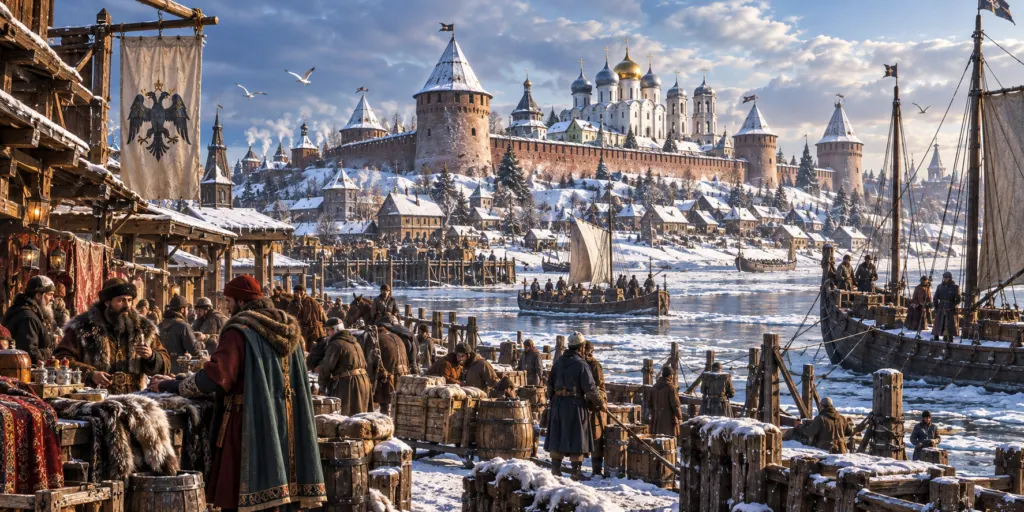
Novgorod is rich enough to tempt every neighbour and independent enough to offend them. Its merchants move silver, cloth, wax and mountains of northern fur through a city where civic office, family wealth, foreign privilege and public reputation matter almost as much as armed strength.
The republic escaped the fate suffered by most of the Rus lands during the great orc conquest. While other principalities were forced into tributary relationships with the powers that became the Great Horde, Novgorod remained beyond direct orc rule. That survival became part of how Novgorod understands itself: wealthy, stubborn, difficult to command and certain that freedom must be defended because stronger powers always believe it temporary.
In 1454 that belief is being tested. Dmitry Shemyaka, Vasily II’s defeated rival, died in Novgorod the previous year after receiving shelter and political support here. A treaty exists between Novgorod and Moscow, but nobody in the republic mistakes parchment for friendship. Moscow has survived its civil war, and Ivan IV now looks beyond his own borders.
What Is Happening Right Now?
The Treaty Buys Time
Novgorod and Moscow have set down terms again in 1454. Ivan IV may recognise the document for now, but neither side mistakes parchment for friendship.
Every disputed estate, arrested merchant, intercepted courier and ambiguous clause can now become a test of whether Moscow intends to enforce a wider claim over Novgorod — and whether Novgorod intends to resist.
Shemyaka Is Dead, but His Friends Are Not
Dmitry Shemyaka died in Novgorod in 1453. His defeat ended Moscow’s dynastic civil war, but it did not erase the networks that supported him. His household, correspondents, creditors, allies and enemies have not vanished.
A letter bearing the wrong seal can destroy a boyar. An old payment can suddenly look like treason. A surviving retainer can be a valuable witness, an embarrassment or the excuse Moscow requires.
Moscow Is Watching the Roads
Muscovy is no longer fighting for survival. The civil war is over, and Ivan IV now rules Muscovy. His court can turn its attention toward states that resisted Moscow, sheltered its enemies or obstructed its wider ambitions.
Merchants, envoys and travellers between Moscow and Novgorod now share roads with informants. Nobody has to wear a badge that says spy.
Peterhof Keeps Trading
The Hanseatic League maintains one of its great eastern trading enclaves at Peterhof beside Novgorod’s market. German-speaking merchants bring cloth, metals, salt, silver and luxury goods west-to-east and carry furs, wax and other northern commodities back toward the Baltic.
Peterhof has its own rules, internal discipline and commercial privileges. A dispute that would be an ordinary tavern quarrel elsewhere can become a diplomatic incident here.
The North Is Richer Than It Is Governable
Novgorod’s strength rests partly on territories and trading relationships extending far beyond the city. Rivers, lakes, portages and winter routes carry tribute, fur, wax and news through immense forests.
The farther a traveller goes from the Volkhov, the more authority becomes personal. A seal, family name or charter may matter greatly at one landing and mean nothing three days farther north.
Who Rules Novgorod?
No single ruler does.
Novgorod is a republic, but it is not a modern democracy. By the fifteenth century the great boyar households and other wealthy interests dominate much of political life. The veche remains a powerful public institution and symbol of Novgorodian liberty, but access, influence, wealth, office and family connections shape what the assembly actually decides.
| Institution | What It Does | Why It Matters in Play |
|---|---|---|
| The Veche | Assembly through which major civic decisions, agreements and political legitimacy are expressed. | A crowd can make a private dispute public. A bell can turn negotiation into crisis. |
| Posadniki | Senior civic officeholders drawn from the political elite. By this period the institution is considerably more complex than a single annually elected mayor. | Different posadniki may support different families, foreign relationships and solutions to the Moscow problem. |
| Tysyatsky | A senior office with military, judicial and commercial associations. | Merchant cases, civic security and mobilisation can place adventurers directly under this office’s attention. |
| Boyar Houses | Great landholding and political families whose wealth reaches from city property into distant estates and northern tribute lands. | A patron can offer protection across half the republic — and enemies in the other half. |
| Invited Princes | Princely authority exists through negotiated and constrained relationships rather than simple hereditary monarchy. | A prince can command soldiers and claim rights without becoming absolute sovereign. |
| Sacred Authorities | Major sacred institutions possess wealth, estates, prestige, scribes, diplomatic weight and public authority. | Sacred property disputes are political disputes with supernatural consequences. |
The Republic Has No Muscovite Ruler
Ivan IV the Terrible rules Muscovy in this campaign. He does not rule the independent Republic of Novgorod.
Contemporary documentation close to the campaign date records posadnik Dmitry Vasilyevich and tysyatsky Mikhail Andreevich together in 1450 and again in a charter dated 1448–1454. They are valid near-contemporary figures for the page, but the surviving evidence does not justify presenting both as the uniquely current senior officeholders throughout 1454.
Places That Matter
The Detinets
The fortified heart of Novgorod stands above the Volkhov. Walls, towers, halls, treasuries, archives and major sacred buildings concentrate political memory and civic power in a relatively small area.
Characters summoned here are rarely being invited merely to talk. Someone wants their testimony, service, silence or signature.
Yaroslav’s Court and the Market
Across the river lies the commercial heart of the city: merchants, warehouses, scales, imported cloth, silver, salt, wax, furs, scribes, money-changers and people who make fortunes by knowing tomorrow’s price today.
The market is also where political rumours become tradable goods.
The Volkhov Quays
Novgorod is a river city before it is a road city. Barges, fishing craft, merchant boats and winter traffic converge here. Ice changes the river but does not end movement; the transport system simply changes with the season.
Every quay has porters who know which crate was heavier when it arrived than when it left.
Peterhof — The German Yard
Peterhof is the easternmost of the great Hanseatic kontore. A palisaded merchant enclave sits beside the market and operates under detailed commercial rules.
Foreign merchants sleep, store goods, settle disputes and guard valuable silver within a space that is both part of Novgorod and deliberately separate from it.
Rurikovo Gorodishche
Downriver from the city, the old princely settlement remains a politically charged place. It is close enough to Novgorod to matter and far enough from the civic centre to serve princes, envoys and people who prefer negotiations without a veche crowd listening.
Lake Ilmen
Lake Ilmen opens the city toward southern waterways and surrounding settlements. Storm, fog, ice and supernatural water make apparent shortcuts dangerous.
Staraya Russa
Salt makes Staraya Russa strategically valuable. Saltworks do not look romantic until somebody interrupts supply to a city that needs food preserved through winter.
Oreshek and Korela
Fortresses toward Ladoga and the western approaches protect routes connecting Novgorod with the Baltic world. They are military positions, toll points, intelligence posts and warnings that trade routes are also invasion routes.
The Northern Dvina Lands
Here Novgorod becomes enormous and thin. Control follows rivers, tribute relationships, merchant interests and personal loyalties more readily than clean borders.
Fur wealth comes south. So do stories about abandoned settlements, old ruins, hostile spirits and things that were already living in the forest before Novgorod claimed anything.
People and Factions
| Person or Power | What They Want | Campaign Pressure |
|---|---|---|
| Dmitry Vasilyevich | Protect Novgorodian interests while navigating elite rivalries and relations with neighbouring powers. | A documented posadnik of the period, attested with Mikhail Andreevich in 1450 and in a charter dated 1448–1454. |
| Mikhail Andreevich | Maintain civic order, commercial authority and the power attached to the tysyatsky’s office. | A documented tysyatsky of the period whose office connects naturally to merchants, militia, courts and public disorder. |
| Yevfimy II | Preserve the wealth, authority, construction programmes and civic influence of Novgorod’s great sacred institutions. | In SpiralWorlds his historical religious office is adapted into the living non-Abrahamic sacred order. |
| Ivan IV of Muscovy | Ensure Novgorod never again becomes a secure base for his enemies and steadily increase Moscow’s leverage over the republic. | He is distant enough to be unseen and powerful enough to shape every council meeting. |
| Shemyaka’s Surviving Network | Survive, conceal records, preserve estates, recover debts or continue old resistance. | Even a dead claimant can destabilise the republic through documents and loyalties. |
| Hanseatic League | Keep routes open, privileges enforceable and Novgorodian exports moving west. | A commercial disagreement can bring pressure from Riga, Reval, Dorpat or Lübeck. |
| Boyar Houses | Land, office, trade, marriage alliances, northern revenues and political survival. | They cooperate when Novgorod is threatened and compete whenever it is not. |
| Northern Communities | Trade profitably while keeping distant city officials, rival collectors and supernatural neighbours manageable. | The republic is strongest where local people choose to make it strong. |
Trade, Money, Magic and Services
The Fur Economy
Novgorod’s western importance rests heavily on access to the forests. Squirrel and other furs move through collection networks and river routes toward the city before entering Baltic commerce. Wax is another major export, joined by honey, timber, resin and other northern products.
Westward connections bring cloth, silver, metals, salt and luxury goods into the republic.
Novgorod Mints Its Own Money
Novgorod began striking its own silver coinage in 1420. By 1454 the city’s money is another visible declaration that Novgorod is not simply a provincial market waiting for somebody else to rule it.
Large commercial deals can still involve weighed silver, foreign coin, credit, obligations and goods rather than a single universal currency.
Magic Is Learned, Hired and Inherited
Magic in Novgorod is not hidden behind a generic “magic shop.” It exists through specialised people and institutions.
Merchant families employ scribes, translators, diviners and advisers. Wealthy households retain private teachers and healers. Sacred institutions preserve texts and trained specialists. Artisans pass techniques through apprenticeship. Rural practitioners know charms, spirits and places that urban scholars classify differently.
See Magic for the wider SpiralWorlds magical framework.
Services Adventurers Can Actually Find
| Need | Where to Look | Complication |
|---|---|---|
| Foreign translation | Peterhof, large merchant houses, scribes | The translator may also report what was said. |
| Money changing and assaying | Market and established merchants | Suspicious silver attracts questions. |
| River pilot | Quays, fishing communities, merchant houses | The best pilot may refuse a particular stretch of water after sunset. |
| Healing | Household practitioners, learned healers, sacred specialists | The illness may have a supernatural cause medicine alone cannot address. |
| Magical expertise | Private masters, wealthy patrons, sacred archives and specialist artisans | Knowledge is usually attached to obligation. |
| Northern guide | Fur traders, hunters, river communities | A guide who knows the land may also know whose permission should have been obtained. |
Dangers of the Republic
Moscow
The greatest political danger is not an army already outside the walls. It is the possibility that an ordinary incident becomes the justification for one.
The Rivers Are Inhabited
Water is transport, food, defence and supernatural territory. Vodyanoi occupy rivers and marshes where humans are not automatically welcome. Rusalki make apparently peaceful water deadly for reasons that may begin with murder, betrayal or an unquiet death.
Every Old House May Have Another Resident
Novgorod’s streets are full of households older than living memory. A Domovoi may protect a family, workshop, stable or merchant house for generations.
That makes domestic spirits excellent witnesses and terrible enemies. They know who crossed the threshold.
The Forest Does Not Recognise Charters
Beyond cultivated land, Novgorodian ownership is often an assertion made by somebody standing hundreds of miles away. The northern forests contain animals, spirits, monsters and older powers that never agreed to the republic’s boundaries.
Use the Slavic Monsters collection when stocking these journeys.
Winter Is an Active Threat
Cold can make travel easier by turning mud, marsh and water into roads. It can also kill travellers who lose a sledge, miss a settlement or discover that the ice is not as trustworthy as the local guide claimed.
Law Is Local Enough to Surprise You
An agreement honoured in the market may be challenged in a princely court. Foreign merchants possess privileges. Boyars possess influence. Rural communities possess memory. A seal proves authority only to people prepared to recognise the person who used it.
Rumours and Adventure Hooks
- The Second Treaty. A second version of the 1454 agreement with Ivan IV’s court appears in Novgorod. Three clauses differ from the recognised copy, and both documents carry convincing seals.
- Shemyaka’s Ledger. A dead merchant’s strongbox contains payments made to supporters of Dmitry Shemyaka. Half the names belong to powerful people who insist the book is a forgery.
- Peterhof Closes Its Gate. A Hanseatic merchant is found dead outside the enclave. Peterhof seals itself while Novgorodian officials demand access. Someone inside is preparing to destroy evidence.
- The Grave Beneath the New Stonework. A major sacred building project begun in 1454 breaks into an old mass burial ground. Workers begin hearing voices beneath the foundations before the first disappearance.
- The Missing Dvina Convoy. A shipment of northern furs vanishes without wreckage, bodies or abandoned sledges. Rival collectors blame each other. The river spirits deny taking it.
- The Korela Warning. A frontier messenger reaches Novgorod carrying a broken arrow, a sealed report and no memory of the previous three days.
- The Domovoi Saw the Spy. A suspected Muscovite agent was killed inside a locked boyar house. No human witness saw the murderer. The household spirit did.
- The Price of the Crossing. Boats begin overturning at exactly the same bend of the Volkhov. The local Vodyanoi claims somebody in Novgorod broke an agreement made before the oldest surviving city charter.
Travel, Routes and Law
The Baltic Route
From Novgorod, traffic follows the Volkhov toward Lake Ladoga, then the Neva toward the Gulf of Finland and Baltic trading world. This is the commercial artery connecting Peterhof with western markets.
The Southern Routes
Lake Ilmen and the river systems beyond it connect Novgorod toward other Rus lands. These routes are politically sensitive because travellers eventually enter jurisdictions less friendly to republican independence.
The Northern Routes
Lakes, rivers and portages lead into the great northern forest and toward the Dvina. These are commercial roads without necessarily resembling roads at all.
Winter Roads
Snow and frozen waterways create an alternative transport network. Sledges may cover ground that is miserable or impossible during thaw, but settlements, food, weather and reliable ice determine whether a winter journey succeeds.
Law and Courts
Novgorodian law is institutional, literate and political. Courts associated with senior civic officers, princely authority and sacred institutions overlap rather than forming one simple royal hierarchy.
Commercial cases matter greatly. The tysyatsky’s office has particular relevance to trade, while foreign enclaves such as Peterhof operate under their own detailed rules and negotiated privileges.
For adventurers, the important rule is simple: find out which court thinks it owns the dispute before agreeing to solve it.
Military Power and the Frontiers
Novgorod is not defended by one permanent royal army. Military strength comes from several sources: civic mobilisation, boyar retainers, fortified settlements, river craft, frontier forces and soldiers raised or hired for particular needs.
The Republic Fights Through Geography
Lakes, rivers, forests, snow and distance are military assets when Novgorod controls the routes. An enemy who takes a road may still lack boats. An army that reaches a river may arrive during the wrong season. A fortress controlling a narrow passage can matter more than a much larger force elsewhere.
The Western Frontier
Oreshek, Korela and the Ladoga approaches guard the routes toward Sweden and the Baltic. Trade and military intelligence travel together here.
The Muscovite Frontier
The southern and south-eastern approaches are politically more dangerous in 1454. Moscow does not need to conquer the entire northern wilderness to hurt Novgorod. It needs to defeat the republic where roads, settlements, treaties and elite interests are concentrated.
The Orc Question
Novgorod’s survival outside direct orc domination distinguishes it from much of the wider Rus political landscape. Moscow’s long role as intermediary between Rus princes and the Great Horde makes Muscovite expansion especially uncomfortable to Novgorodians who regard their own independence as proof that submission was never inevitable.
Farther east, the Khanate of Kazan remains another independent orc power capable of reshaping Moscow’s priorities.
How Novgorod Became Different
A City That Limited Its Princes
Novgorod emerged from the early Rus world as a city whose political institutions increasingly constrained princely authority. Princes remained important, especially in war and diplomacy, but the city developed institutions capable of negotiating with them rather than simply obeying them.
The Republic
The veche, posadniki, tysyatsky, wealthy families and sacred authorities created a political order unlike the increasingly centralised principalities farther east.
By the fifteenth century this system is substantially oligarchic. Novgorodian liberty is real, but political equality is not.
Novgorod and the Orc Conquest
In SpiralWorlds history, the great orc invasion shattered the Rus principalities and forced most surviving rulers into tributary relationships. Novgorod resisted.
Its forests, waterways, distance, wealth and western connections allowed it to remain the great exception: a Rus state that did not become another tributary principality beneath orc domination.
The Northern Commercial Empire
Novgorod’s political territory expanded through river routes, tribute, estates, settlements and commercial penetration deep into the northern forests. The republic’s map therefore cannot be read like a modern nation-state border.
The core lands are one thing. The enormous sphere from which merchants and elites extract wealth is another.
The Hanseatic Connection
Western merchants came because Novgorod controlled resources Europe wanted. Peterhof developed into one of the major Hanseatic kontore, placing Novgorod inside a trading system stretching across the Baltic and North Sea.
Money, Law and Republican Identity
During the fifteenth century Novgorod increasingly expresses its independence through civic seals, its own coinage, legal codification and political symbols. The republic does not merely possess independence. It has developed institutions that assume independence.
The Civil War Reaches Novgorod
Moscow’s dynastic conflict between Vasily II and Dmitry Shemyaka draws Novgorod into a struggle it cannot safely ignore. The republic gives Shemyaka political space and refuge. His presence binds Novgorodian politics to the outcome of Moscow’s civil war.
Shemyaka dies in Novgorod in 1453.
In 1454 Novgorod is still free.
Everyone knows that does not mean the argument is finished.
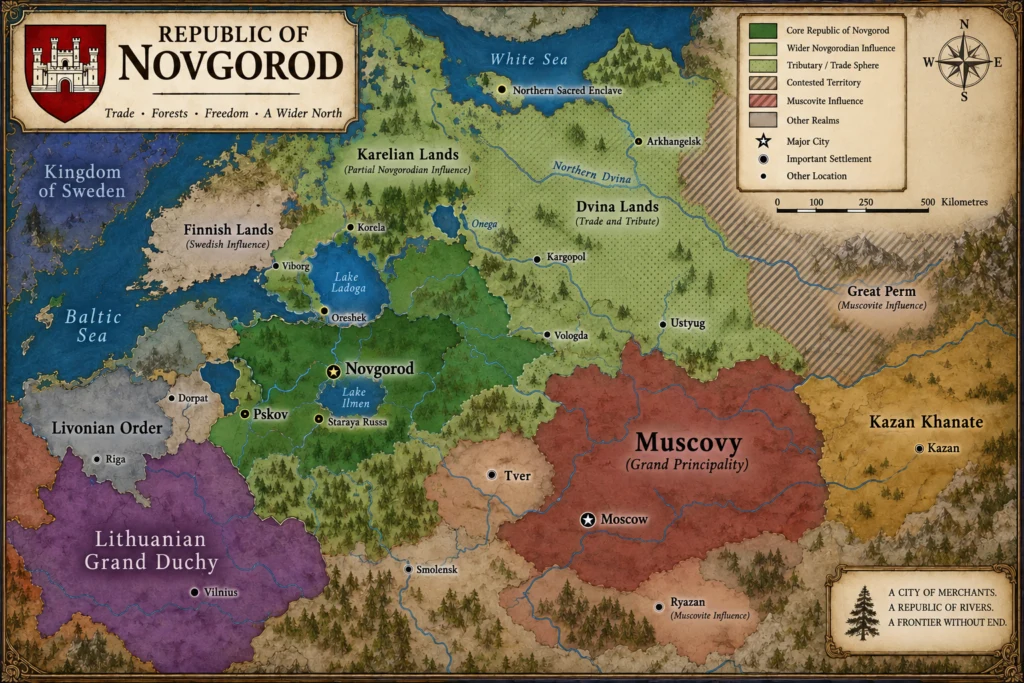
Republic of Novgorod Campaign Map — 1454
The republic is best understood as a core territory surrounded by a much larger sphere of tribute, estates, trade and influence. The northern frontier is deliberately shown as diffuse rather than pretending medieval control followed a modern surveyed border.
Historical Sources and Further Reading
SpiralWorlds uses real historical geography and institutions as the foundation beneath its fantasy overlay. The campaign present is 1454 CE; established campaign canon may deliberately diverge from conventional history.
- Lawrence N. Langer, “Novgorod Republic,” The Encyclopedia of Empire — political institutions, territorial scale and commercial importance.
- Pavel V. Lukin, “German Merchants in Novgorod: Hospitality and Hostility, Twelfth–Fifteenth Centuries” — Peterhof, Hanseatic relations and merchant interaction.
- Hanse.org — Medieval Hanseatic Trading Posts — the Novgorod kontor, trade goods and merchant organisation.
- 1454 treaty charter between Novgorod and Grand Prince Vasily Vasilyevich — campaign-present diplomatic evidence.
- 1450 treaty charter between Novgorod and the Hanseatic cities — directly attests posadnik Dmitry Vasilyevich and tysyatsky Mikhail Andreevich together.
- Novgorodian charter dated 1448–1454 — also records Dmitry Vasilyevich, Mikhail Andreevich and northern commercial administration.
- “On the Judicial System of the Novgorod Republic” — fifteenth-century courts and legal institutions.
- Pavel V. Lukin, “Why Did Lord Novgorod the Great Fall?” — republican institutions, seals, coinage, Shemyaka and late Novgorodian politics.
Licensing
The Republic of Novgorod campaign adaptation, 1454 adventure material, supernatural integration, encounter guidance, map presentation and editorial text on this page are SpiralWorlds setting material.
The hero, heraldic identity artwork and campaign map are original SpiralWorlds assets. Historical facts, historical names and public-domain historical material remain subject to their respective underlying status.
The Republic of Novgorod heraldic identity is campaign artwork based on documented late-medieval Novgorodian castle imagery. It is used as a clear 1454 identity device rather than presented as an authenticated modern-style state coat of arms.
This page contains no edition-specific game statistics. Linked Bestiary and rules pages carry their own Open Game Licence, Pathfinder, SRD or other licensing notices where applicable.
Keep this reference growing
If this page helped with your reading or game, you can support its upkeep or explore the curated books.
Explore the Bookshop — epics, classics and stories behind imagined worlds.