
South America
Andes · Amazonia · Northern Rivers · Southern Lands
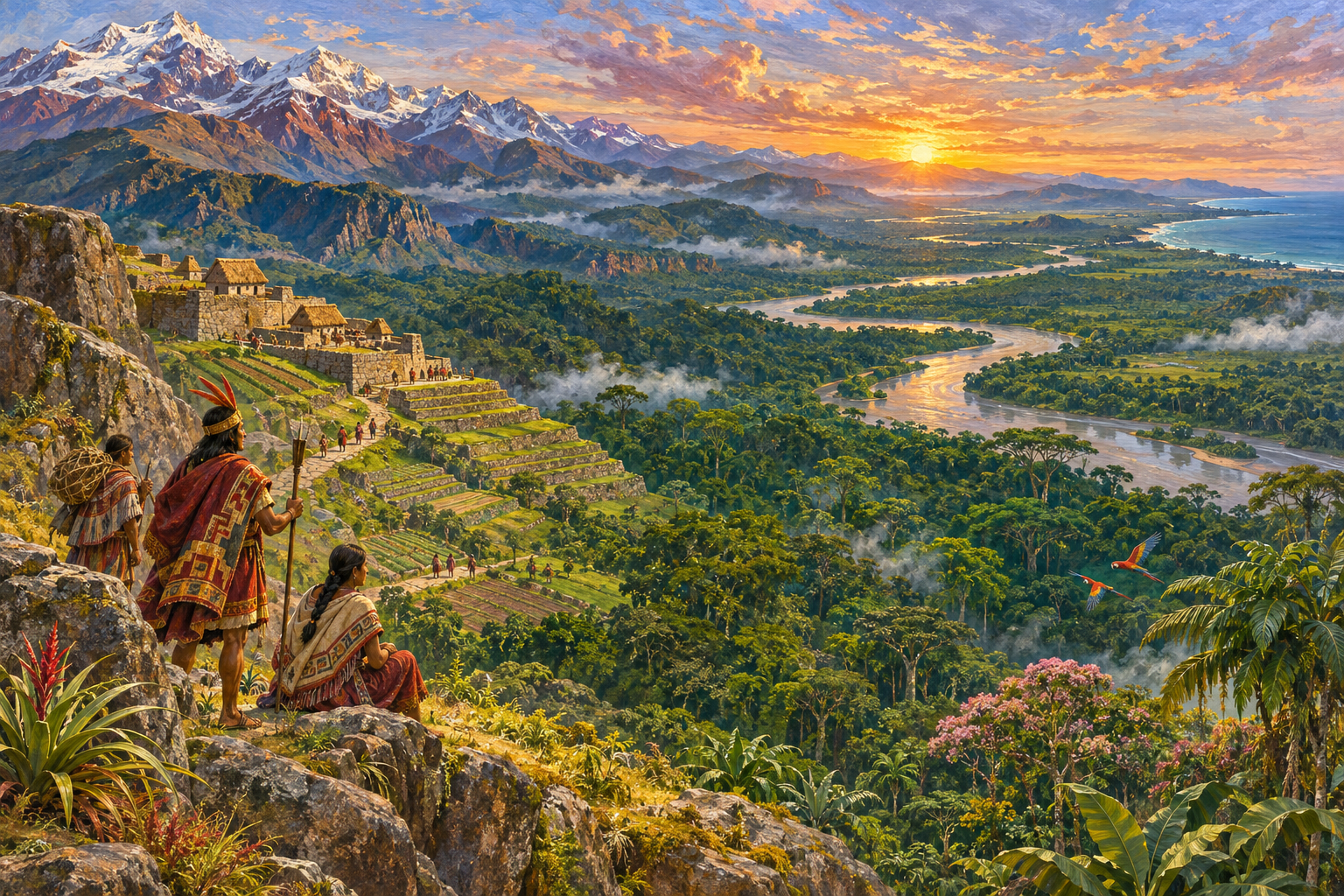
South America reaches from Caribbean shores to the storm-lashed islands beyond Patagonia. Mountains rise along its western edge; great rivers, forest settlements, grasslands and coastal kingdoms spread toward the Atlantic. In 1454, no European colonial government rules the continent. The land is already inhabited, cultivated, travelled, defended and sacred to its peoples.
In the Andes, Pachacuti’s expanding state is changing the balance of power. The Chimú kingdom remains independent on the north coast, while highland communities and peoples of the Amazon, Orinoco, Atlantic forests and southern lands govern their own territories. An adventurer’s journey crosses living networks of trade, kinship and rivalry, not an empty wilderness.
At a Glance
| Campaign Present | 1454 CE |
|---|---|
| Major Landscapes | Andes, Amazon and Orinoco basins, Guiana Highlands, Atlantic forests, pampas, Atacama Desert and Patagonia |
| Major Powers | Pachacuti’s Cusco state, independent Chimú coast, Aymara-speaking highland polities and numerous other regional societies |
| Major Pressures | Andean expansion, rival regional powers, difficult terrain, long-distance trade and supernatural territorial claims |
| Travel | Mountain roads, river routes, coastal sailing, forest paths and high passes |
| Best For | Exploration, diplomacy, highland warfare, river expeditions and encounters with powerful local traditions |
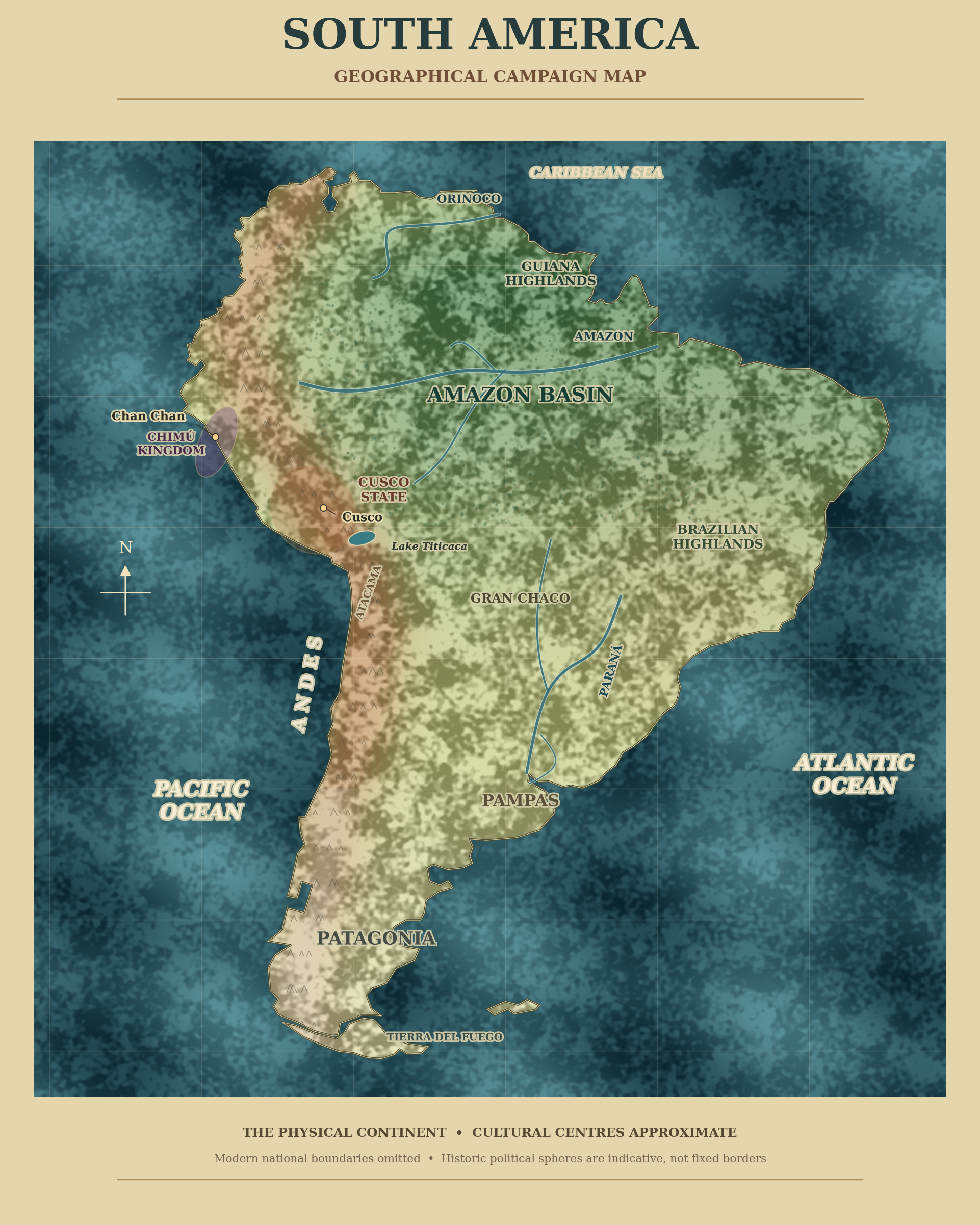
Geographical Campaign Map
What Is Happening Right Now?
From Cusco, Pachacuti extends his influence through military victories, negotiations, state storehouses, labour obligations and loyal officers. Roads and settlements long predate him, however, and his control is far from complete.
The independent Chimú kingdom rules wealthy settlements and irrigated valleys on the north coast. Its capital, Chan Chan, commands craft workshops and maritime trade. Its conquest lies in the future, not the present of 1454. Around Lake Titicaca and beyond, rival highland peoples defend their own interests. Farther east and south, the Amazonian river worlds, northern shores, Guiana uplands, grasslands and forests remain under many distinct local authorities.
For travellers, this is not an empty continent waiting to be discovered. Roads, river corridors, cultivated valleys, ceremonial centres and trading networks already belong to people with laws, alliances and enemies. Entering a territory without understanding those relationships is often more dangerous than the landscape itself.
Across the Continent
The High Andes
High valleys, terraces, market settlements and cold passes connect competing courts. The great roads grow in importance as Cusco expands, but an imperial patrol is only one of many powers a traveller may meet.
The Northern Coast and Guiana Uplands
Caribbean shores, the Orinoco waterways, forested highlands and northern Andean valleys form connected yet distinct worlds. River crews, coastal traders and mountain communities know routes which a foreign map may scarcely suggest.
The Amazon and Atlantic Forests
Water carries people and goods through forests, cultivated floodplains and distant settlements. Rivers change with the seasons; the right canoe pilot is worth more than a large mounted escort. Accounts of great forest beasts must be judged alongside the knowledge of the communities who live there.
Southern Valleys, Pampas and Patagonia
Far beyond the central Andes lie dry northern valleys, Mapuche lands, open grasslands and increasingly cold southern coasts. Different peoples command different routes, and no one kingdom speaks for them all.
Places to Explore
- Central Andes — Cusco, Chimú and the Highland Kingdoms — the wider region of mountain communities and the independent Chimú coast.
- Peru — The Andean Heartland — Pachacuti’s immediate territories around Cusco, royal estates and the mountain roads.
- Cusco — Pachacuti’s growing royal capital and centre of highland statecraft.
- Chan Chan — an independent Chimú capital of irrigation works, skilled craftspeople and powerful court interests.
- The Urubamba highlands — sacred mountain country where Pachacuti’s later royal estate at Machu Picchu will arise; its developed form belongs to the years ahead.
- Brazil — Coast, Forests and River Worlds — Indigenous coastal alliances, inland settlements and river traffic.
- Chile — Northern Valleys and Mapuche Lands — independent northern and southern communities, oases and river crossings.
- Venezuela, Colombia and the Guianas — northern shores, river mouths and inland approaches.
- Amazon Rainforest — immense river and forest systems where travel depends on local knowledge.
- South American Monsters — creatures tied to the continent’s forests, mountains, rivers and legends.
Peoples, Courts and Rivalries
The Cusco court rewards service and maintains order through officials, roads, military forces and provisions, but its demands for labour and loyalty can divide neighbouring communities. A commander protecting travellers may also be enforcing an unwanted annexation.
Chimú court networks defend the independence and wealth of coastal cities. Their interests include irrigation, artisans, trading rights and succession. Some nobles favour negotiation with Cusco; others see compromise as the beginning of submission.
Highland, forest, river and southern authorities possess their own alliances, rivalries and sacred obligations. Their choices are shaped by local needs rather than a single continental allegiance. For court intrigues, begin with the Cusco and Chan Chan entries; the wider factions directory covers established organisations.
Gods, Magic and Sacred Landscapes
Divine power does not make South America one religious community. In the Andes, Inti, Viracocha, Pachamama and sacred mountain or ancestral powers are approached through distinct but overlapping traditions. Royal ceremonies support the authority of Cusco, while a village may answer first to obligations connected with its own mountains, springs and ancestors.
Forest, river and coastal societies maintain other sacred histories. Their sacred places belong to living communities and may also have supernatural guardians. A rumoured lost city, such as El Dorado, does not make its approaches unclaimed. The gods and pantheons collection connects the wider divine world; Andean and Mesoamerican traditions are not the same pantheon.
In Amazonian forests, accounts of the Mapinguari warn of a territorial beast as well as a supernatural danger. More local creatures appear in the South American Bestiary; the continent’s different habitats should determine which creatures actually appear.
Dangers, Rumours and Adventures
The Missing Chimú Envoy
A messenger from Chan Chan vanishes on a mountain route carrying a proposed agreement with Cusco. The envoy is alive, hidden by a village that fears becoming the next target of either court. Bringing the messenger home may save a peace but expose the villagers; shielding them may provoke two rulers.
The River That Changed Allegiance
A seasonal flood severs a trading settlement from its neighbours. Two river communities offer boats to the party, but each claims custody of an ancestral object stranded on the far bank. The object may settle an old dispute—or ignite a new one if returned to the wrong hands.
The Forest Crossing
Merchants demand an immediate shortcut across a dry-season forest trail, but the river pilot refuses after finding enormous tracks near a new landing. A Mapinguari has moved beyond its usual territory. The characters can investigate what drove it out, escort the merchants by the longer river passage or risk the crossing.
The Mountain’s Claim
A Cusco official orders the reopening of a high pass that a local community keeps closed for sacred reasons. The first soldiers sent to clear it have disappeared. The party must choose whether to investigate for the officer, defend the community’s claim or uncover a third power exploiting the dispute.
A flooded Amazonian crossing may also attract a dire jaguar, forcing travellers to seek another ford or risk a confrontation.
Return to the world atlas to move between continental regions.
Travel and Survival
The Andes reward preparation. Thin air, cold nights, steep paths and narrow passes can defeat a party before an enemy appears. Pack llamas are at home on highland routes, but on the great lowland waterways, dugout canoes, skilled pilots and knowledge of seasonal channels are often essential. Heat, insects, floods and dense forest make an apparently short distance a lengthy journey.
Trade moves between ecological zones: highland metals, textiles, salt, foodstuffs, feathers, shells and other valuables connect courts, settlements and sacred centres. A local guide also brings relationships, obligations and loyalties; treating that person as expendable may close an entire route. Far south, cold, exposure and great distances replace tropical hazards.
Deeper History
The Cusco state is young in 1454. The later vast extent of Tawantinsuyu, the conquest of the Chimú and the arrival of Iberian colonial administrations do not yet belong to its present. Earlier Andean societies—including Chavín, Wari and Tiwanaku—have left monumental places, trade connections and spiritual traditions whose influence endures in living communities. The great road systems are built upon older paths as well as new state projects.
Outside the highlands, there is no single story of conquest or succession. Northern river communities, forest peoples, Pacific fishing towns, southern valley farmers and Patagonian societies follow their own histories. Their lands are not blank spaces between empires.
Historical Sources
National Museum of the American Indian — Inka Road chronology; Metropolitan Museum of Art — Central and Southern Andes, 1400–1600. These resources explain the development of Andean states and the distinction between the mid-fifteenth-century present and their later expansion.
Keep this reference growing
If this page helped with your reading or game, you can support its upkeep or explore the curated books.
Explore the Bookshop — epics, classics and stories behind imagined worlds.