
The Age of Awakening
The seas become hunting grounds. Armour answers claws, then jaws turn vertebrates into major predators. Primitive plants and fungi establish the first living ground; arthropods follow. Late Ordovician cooling locks water into continental ice and strips away shallow seas, while the survivors expand onto land. By the Devonian, armoured fishes rule the water, forests reshape the continents and finned vertebrates stand at the threshold of limbs.
The first great ages of monsters
The Age of Awakening begins where the Dawn of Earth ends: with the seas already alive, but not yet ruled by the great arms race of predator and prey.
The change is relentless. Creatures that once drifted now swim with purpose. Eyes watch from beneath armoured brows. Grasping limbs close around living prey. Shells thicken. Spines lengthen. Burrows cut through seabeds that had lain almost undisturbed for ages beyond counting.
With every new defence comes a hunter capable of overcoming it. With every new predator comes something faster, harder, better hidden or more watchful.
The great luminous Flumph choirs of the previous age survive only in scattered refuges. The oldest Aboleths retreat into drowned caverns and lightless trenches.
Neither people now command the history of Earth.
The age belongs instead to the living world itself.
538.8 Ma
Cambrian animal ecosystems become increasingly mobile, sensory and predatory.
c. 444 Ma
Late Ordovician cooling, glaciation and sea-level fall devastate shallow marine ecosystems.
Ordovician–Silurian
Plants, fungi, microbial films and arthropods establish increasingly persistent terrestrial communities.
Fungoid awakening
Rare sentient fungal networks arise within much older natural fungal ecosystems; Zuggtmoy later corrupts some of them.
Devonian
Placoderms, sharks and bony fishes diversify while true forests transform soils, rivers and climate.
358.9 Ma
Late Devonian extinction pulses remove placoderm dominance, but forests, sharks, arthropods and tetrapods survive into the Carboniferous.
The Seas Learn to Hunt
“The oceans discover eyes, armour, pursuit and escape.”
The Cambrian seas are crowded with forms that will never again walk the Earth. Some are tiny. Some are grotesque. A few are already hunters large enough to terrorise the animals around them.
The strange seas
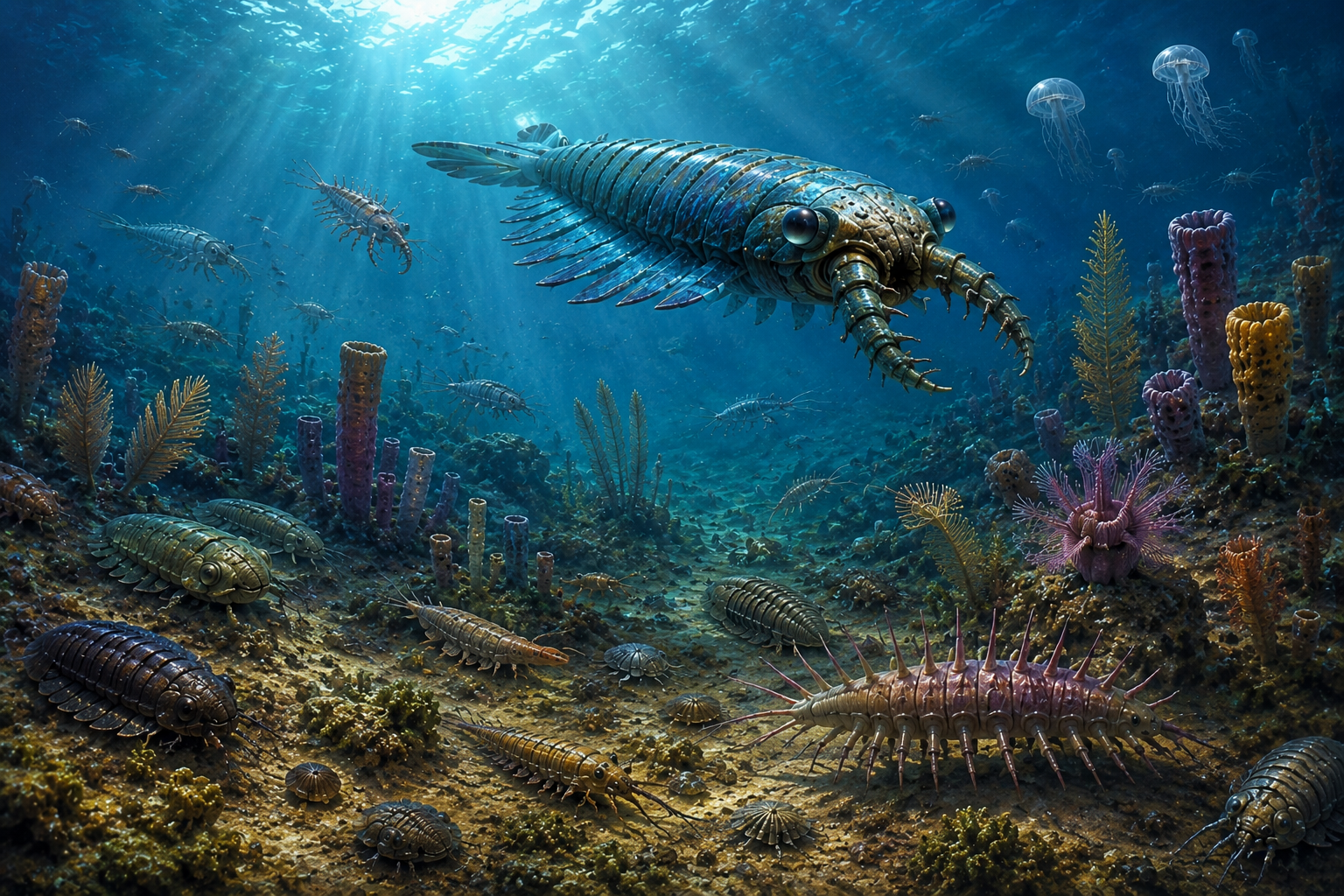
Trilobites crawl across the bottom in countless shapes and sizes. Some scrape food from the mud. Others burrow beneath it. Some scavenge. Some hunt.
Between them move stranger things. Hallucigenia picks its way across the seabed beneath a crown of defensive spines. Five-eyed Opabinia searches the sediment with a long, flexible grasping organ.
Above them swims Anomalocaris, one of the first great hunters of open water. Its enormous eyes scan the sea ahead while paired grasping limbs close around soft-bodied prey.
Trilobites
Armoured crawlers, burrowers and hunters that become one of the enduring signatures of the Palaeozoic seas.
Hallucigenia
Small walking creatures protected by great dorsal spines and an anatomy unlike anything familiar to later ages.
Anomalocaris
A great visual hunter of the Cambrian water column.
Opabinia
Five eyes and a flexible frontal grasping organ make it one of the age’s most unmistakable creatures.
Early Vertebrates
Small jawless fishes begin a lineage that will one day produce sharks, dragons, horses and humankind. By the Ordovician, some jawless vertebrates carry mineralised plates and scales—early experiments in vertebrate armour long before the great jawed placoderms of the Devonian.
Flumph Remnants
Scattered choirs withdraw from increasingly dangerous upper waters into hidden deep refuges.
The long-shell hunters
As ages pass, the seas grow richer still. Reefs spread across warm shelves. Shell beds gather beneath the waves. Fishes become more common.
Then enormous cephalopods appear.
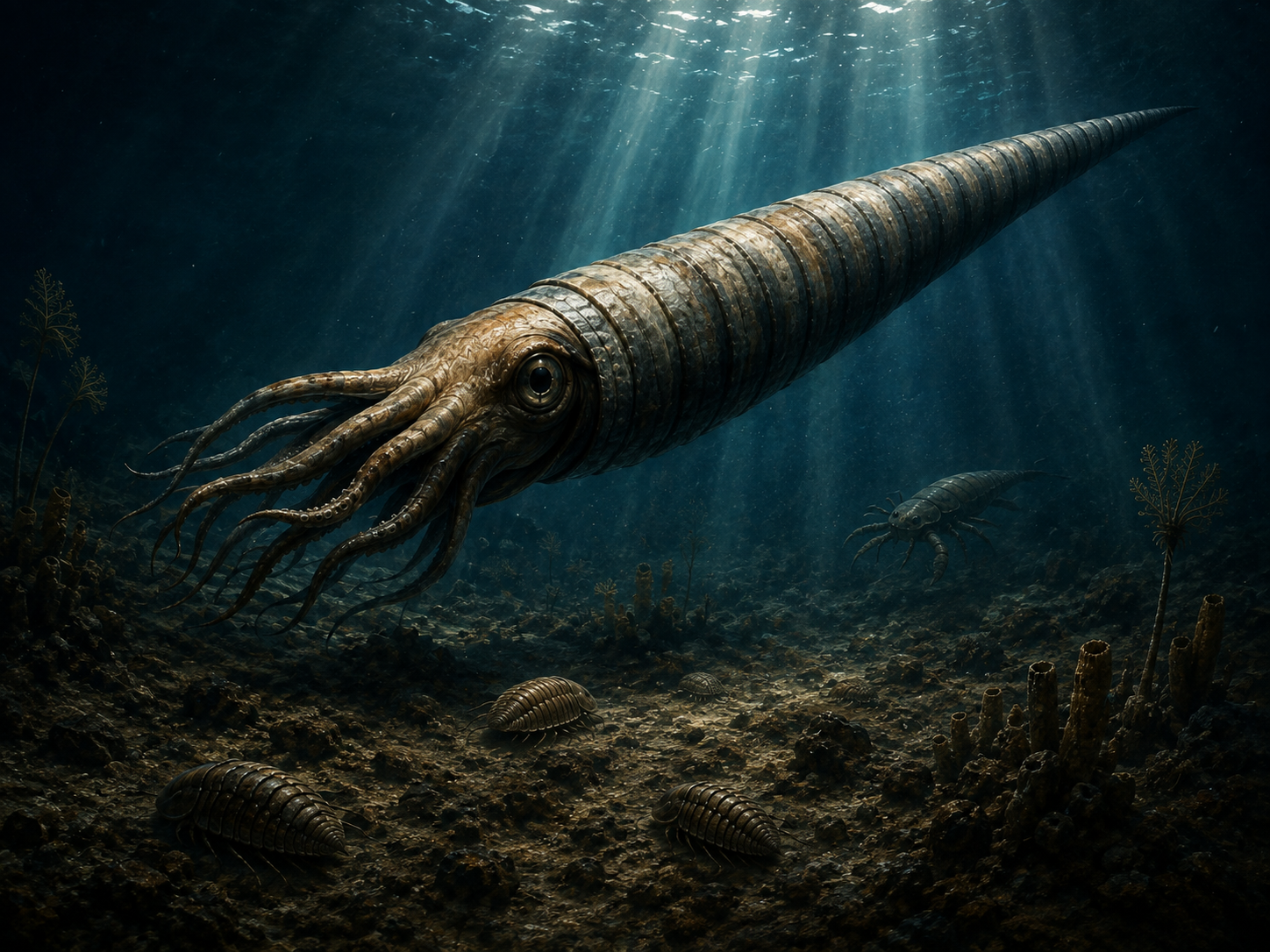
Great straight shells move through the water like living towers. Beneath them hang grasping tentacles and watchful eyes.
In the most isolated seas, monstrous members of these lineages survive as the Giant Orthocones of later legend.
The sea scorpions
In the shallows, another lineage appears: the Eurypterids.
At first they are only one more strange arthropod among many. In later eons some will become formidable hunters.
Rare supernatural bloodlines will eventually produce creatures such as the Bluetip Eurypterid.
The cephalopod line continues
The straight-shelled cephalopod lineages of these seas continue to diversify. True ammonoids are still in the future: they appear in the Early Devonian from later cephalopod ancestors. Their distant descendants will become some of the most recognisable shelled creatures in Earth’s history.
In Lost World waters, monstrous descendants survive as the Ammonites of later ages.
Ice over the world
The change is not instantaneous. Earth cools during a long Late Ordovician climatic shift; changes in the carbon cycle and ocean productivity contribute to a colder world. Gondwana lies across the high southern latitudes, placing vast continental ground where ice sheets can grow.
By the Hirnantian, cooling has become full glaciation. Water that once filled shallow continental seas is locked into ice on land.
Then the seas fall.
Great ice sheets spread across Gondwana. Shallow marine habitats contract dramatically as water is locked upon the continents. Reefs wither. Whole branches of marine life disappear.
It is one of Earth’s first great mass extinctions. The crisis comes in major pulses: first cooling and falling sea level strip away warm shallow-water habitats; then changing circulation and oxygen conditions punish survivors as the climate shifts again.
But the survivors inherit a world with a new frontier.
Beyond the water lies land—but it is not empty. By the Late Ordovician, primitive land plants and fungal communities already occupy wet terrestrial surfaces; the Silurian will expand a frontier that has already begun.
The Age of Spores and Pillars
“The sea still rules, but the continents are no longer empty.”
For most earlier animal life, dry land has seemed like a wasteland—but by the Late Ordovician that is no longer true. Green stains already established before the extinction now spread more widely along wet ground. Spores ride the wind. Rhizoids, microbial films and fungal threads work into stone and sediment. Tiny animals follow.
The first living ground
The first terrestrial landscapes are nothing like forests. Low plants cling to wet ground. Fungal hyphae and microbial films work through damp sediment, weathering minerals, recycling organic matter and forming symbioses with some early plants. Myriapods and arachnid relatives move between patches of vegetation and exposed mud.
There is no grass.
No flowers.
No birdsong.
Only wind, water, spores and crawling things.
The Fungoid awakening
Among Earth’s already ancient natural fungal ecosystems, a few magically altered networks develop something unprecedented.
Some colonies begin to share more than food.
They share warning. Memory. Sensation.
The spores between them become a language.
These are the oldest known Fungoid peoples of Earth. They are exceptional; most fungi remain ordinary, non-sentient Earth life. Silurian magical fungal fauna also includes the Ascomoid, a predatory spore-creature rather than part of one universal fungal civilisation.
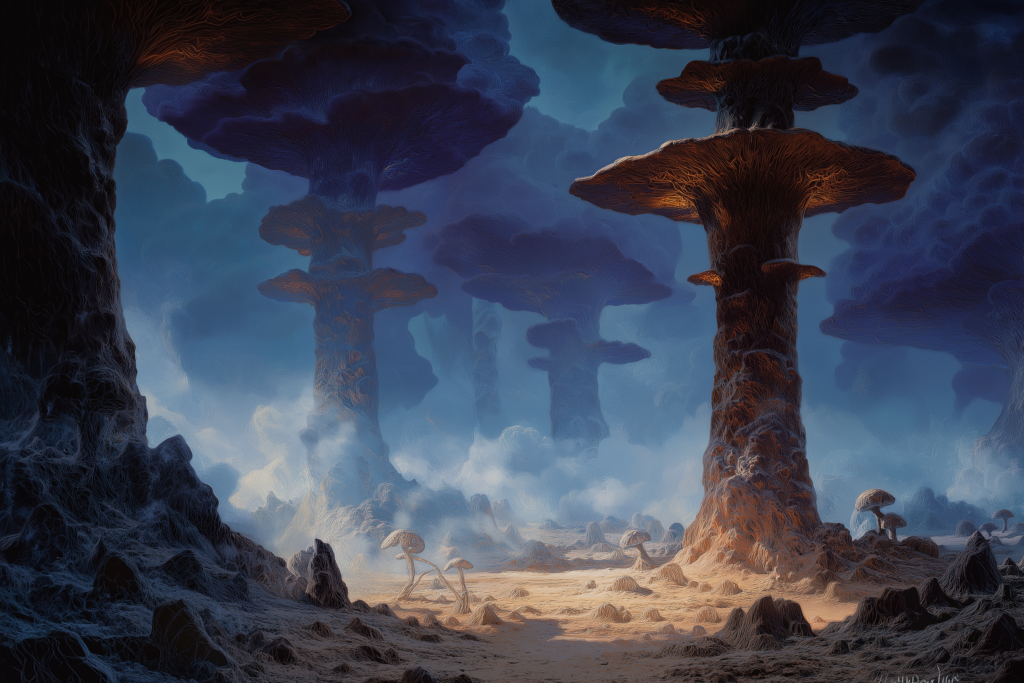
Their settlements are not towns of stone. A colony is itself a living community: chambers beneath the ground, fruiting groves above it and great hidden webs carrying thought from one body to another.
The Demon Queen finds Earth
Fungi are already ancient when Zuggtmoy finds them.
She comes from the Abyss not as their mother, but as their corrupter.
Where her influence takes hold, fruiting bodies swell into predatory growths. Spores carry madness and obedience. Networks once used to share nourishment become paths by which domination spreads from colony to colony.
Some corrupted lines become ancestors or distant kin of the Fungoids and Myceloids known to later ages.
The Spore Wars
The Fungoids fight by cutting themselves apart.
Infected networks are burned or buried. Whole colonies sever their deepest connections. Survivors retreat into caverns where corruption cannot travel so easily through the living earth.
The pillars
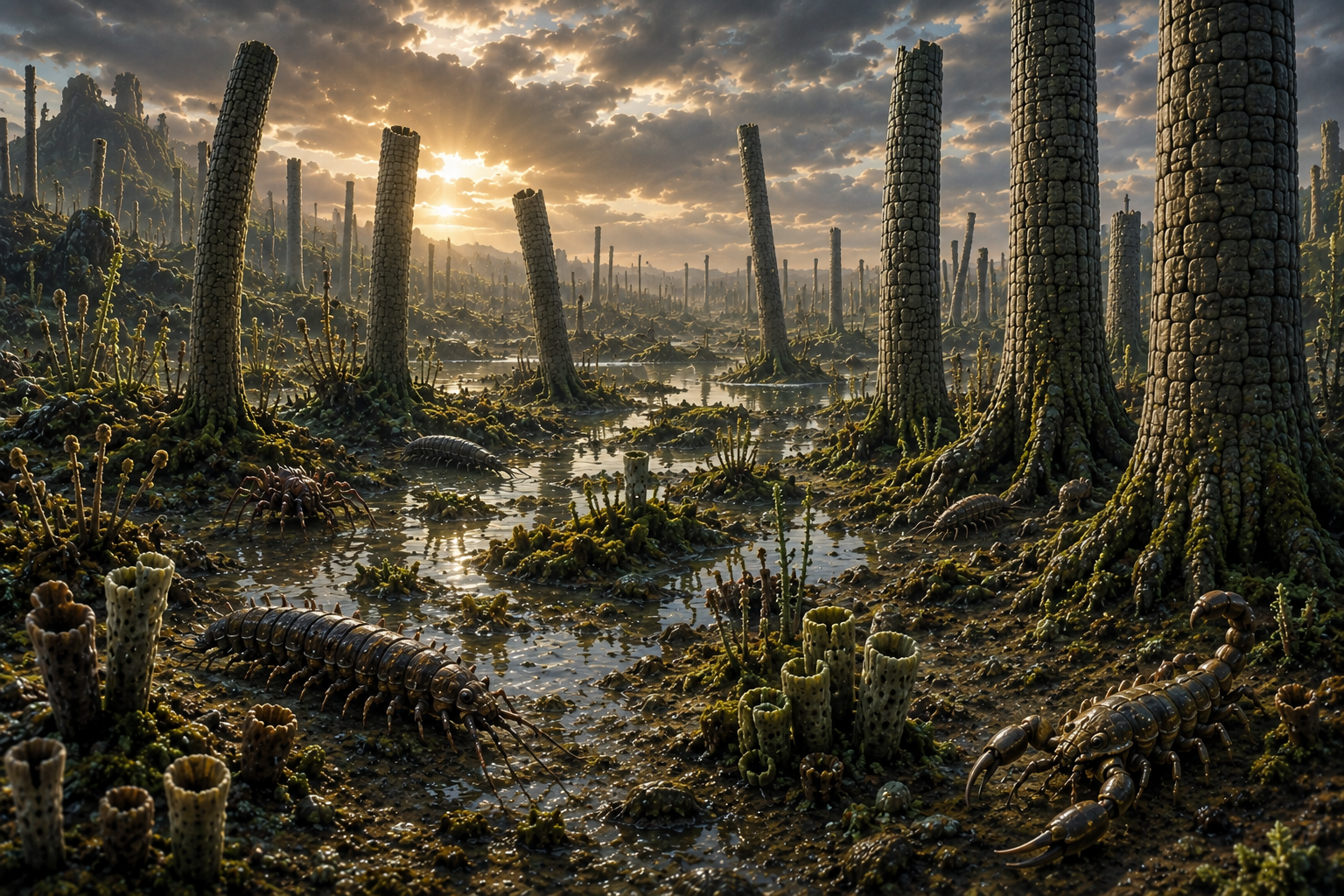
As the Silurian gives way to the Devonian, strange columns rise over landscapes still dominated by low vegetation.
They are Prototaxites.
Some tower several metres above the ground, branchless and silent, standing where no true forest yet exists.
For generations scholars of later ages call them giant fungi.
They are stranger than that.
Their surviving structure belongs comfortably to no known fungal lineage, and perhaps to no living branch of life at all.
Prototaxites is native Earth life. It is not a Fungoid, not a creation of Zuggtmoy and not one of her corrupted fungal servants.
By the close of Eon XXVIII, the continents are still harsh, open places—but they are alive.
The next age will give that life height.
The Age of Fishes and Forests
“The oceans grow jaws while the continents grow shadows.”
The Devonian is a world divided between two revolutions. In the water, jawed fishes become rulers. On land, vegetation rises into the first true forests.
The armoured lords of the sea
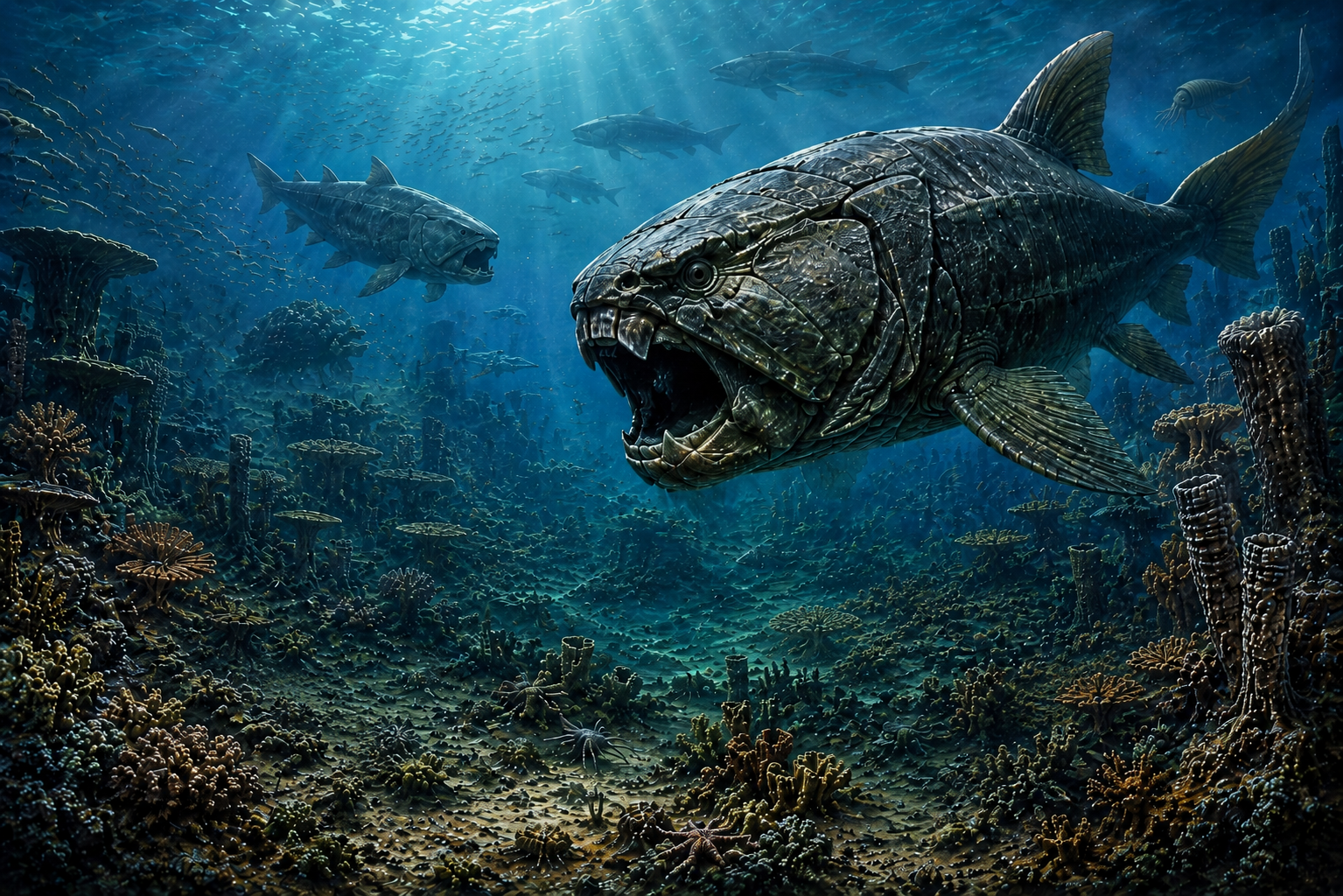
The seas belong to armour. Here the defensive experiments of earlier jawless vertebrates culminate in jawed placoderms: fishes whose skull and forebody are encased in heavy bony plates, including some of the most formidable predators Earth has yet produced.
Placoderms patrol reefs, rivers and open water with their heads enclosed in plates of bone.
Some remain small.
Others become giants.
Among them rises Dunkleosteus.
It hunts without ordinary teeth. Sharpened plates of bone close together like blades. Few animals of its world can meet such a predator without becoming prey.
Sharks and the lobe-finned bloodlines
Early sharks spread through the waters alongside ray-finned and lobe-finned fishes.
Among the latter are the ancestors and ancient kin of the Coelacanth.
Their descendants will survive the fall of the placoderms and carry one of the oldest vertebrate bloodlines into later seas. The Devonian also sees the first true ammonoids appear, finally fulfilling the coiled-shell lineage foreshadowed by older cephalopods.
Dunkleosteus
The great bone-jawed hunter and signature sea monster of the late Devonian.
Placoderms
Armoured fishes filling many niches from bottom-dweller to open-water predator.
Early Sharks
A growing predatory lineage that will outlast the armoured rulers of the age.
Coelacanth Lineage
Ancient lobe-finned fishes whose distant descendants survive into later ages.
Eurypterids
Sea-scorpion bloodlines inherited from older oceans.
Land Arthropods
Scorpions, myriapods and other hunters move through increasingly complex terrestrial habitats.
The forests rise
Meanwhile, the land changes beyond recognition.
Plants that once hugged the ground become tall enough to cast shadows. Simple tree-like forms gather into Earth’s first forests. Later come great woody plants with spreading crowns and deep roots.
The old pillar world disappears beneath them.
Roots split rock and bind riverbanks.
Soils deepen.
Fallen plant matter gathers upon the ground.
Rivers change course around living barriers.
For the first time, an animal on land can move beneath a canopy.
The fin-to-limb threshold
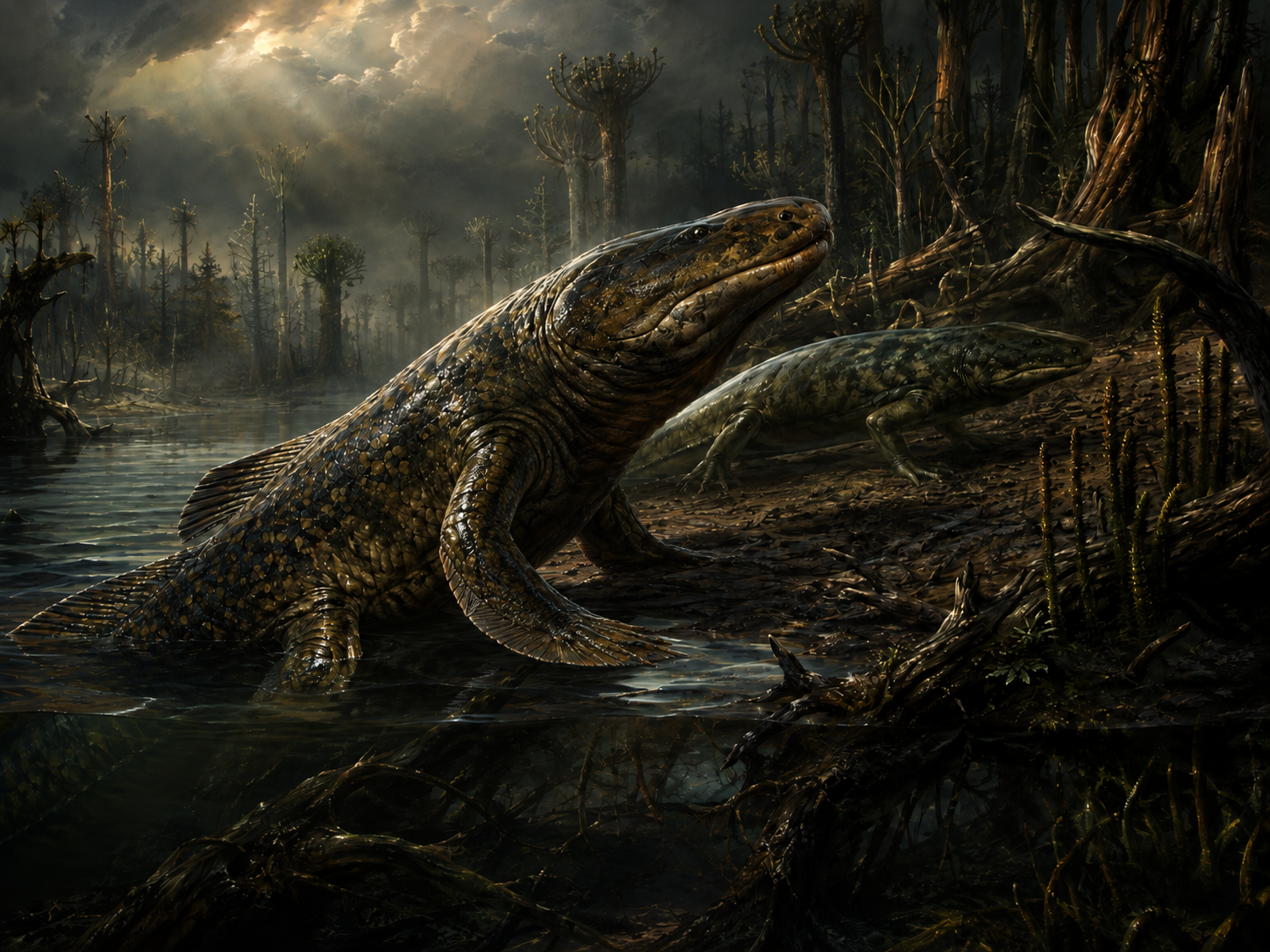
In weed-choked shallows and slow river channels, some fishes begin doing something new.
Their paired fins become stronger.
They brace against mud, submerged roots and the bottoms of shallow pools.
Tiktaalik can raise its head on a mobile neck and force its body through water too shallow for ordinary swimming.
It is still a fish.
But the old boundary is weakening.
Later comes Acanthostega.
It still belongs largely to the water, yet its limbs end in true digits.
The old minds beneath the water
In trenches far below the new fishes, Aboleths still remember seas that existed before armour, jaws or forests.
They are diminished, but not gone.
Some regard the multiplying vertebrates as brief biological noise.
Others recognise something more dangerous: Earth has become too diverse for any ancient power to dominate completely.
The dying seas
Then the waters begin to fail—not in a single instant, but through repeated Late Devonian crises.
Across several extinction pulses, great reefs collapse as climate, nutrient cycles and ocean circulation become unstable. Whole marine communities disappear. Vast stretches of sea become poor in oxygen.
The placoderms do not survive the ending.
Dunkleosteus vanishes with them.
But sharks remain.
Bony fishes remain.
Forests remain.
Arthropods remain upon the land.
Tetrapods now possess limbs and digits.
The next age inherits all of them.
Born here, changed here, or surviving from older worlds
The Age of Awakening contains genuine prehistoric animals, native magical lineages and a handful of much older supernatural survivors.
| Creature | Origin | Place in the age |
|---|---|---|
| Trilobite | Native Earth life | Armoured inhabitants of Cambrian and later Palaeozoic seas. |
| Hallucigenia | Native Earth life | Small spined Cambrian animal of the strange early seas. |
| Anomalocaris | Native Earth life | Large Cambrian predator of open water. |
| Giant Orthocone | Monstrous Earth lineage | Great straight-shelled cephalopod hunter of ancient seas. |
| Eurypterid | Native Earth life | Sea-scorpion lineage appearing in Ordovician waters. |
| Bluetip Eurypterid | Magically altered Earth lineage | Rare supernatural branch of ancient eurypterid ancestry. |
| Ammonite | Monstrous ammonoid lineage | Later fantasy-scale representative of the ancient coiled cephalopod bloodline. |
| Prototaxites | Native Earth life | Enigmatic terrestrial organism of no certain living affinity. |
| Fungoid Peoples | Native magical life | Sentient fungal communities arising within Earth’s terrestrial ecosystems; Silurian magical fungal fauna also includes predatory Ascomoids. |
| Fungoids and Myceloids | Corrupted magical fungal life | Predatory branches associated with the ancient Spore Wars. |
| Zuggtmoy | Abyssal intruder | Corruptor of ancient fungal networks and enemy of the first Fungoids. |
| Dunkleosteus | Native Earth life | Great bone-jawed predator of the late Devonian seas. |
| Coelacanth Lineage | Native Earth life | Ancient lobe-finned bloodline surviving far beyond the age. |
| Tiktaalik | Native Earth life | Late Devonian fish standing near the fin-to-limb threshold. |
| Acanthostega | Native Earth life | Early aquatic tetrapod bearing true digits. |
| Flumph | Far Realm exile | Residual choirs surviving from the previous age. |
| Aboleth | Ancient aberrant survivor | Old minds persisting in isolated deep-water refuges. |
The Age of Awakening in order
Three eons carry Earth from the first great animal seas to forests, giant fishes and the first true tetrapods.
The Cambrian threshold
Animal ecosystems become more active, mobile and predatory.
The strange seas
Trilobites, Hallucigenia, Opabinia, Anomalocaris and early vertebrates thrive.
The long-shell hunters
Great orthoconic cephalopods become major marine predators.
The sea scorpions appear
Eurypterid lineages enter the ancient oceans.
Ice and extinction
Long-term cooling culminates in Hirnantian glaciation; sea-level fall and subsequent ocean changes drive a major two-pulse marine extinction.
Life takes the land
Terrestrial communities that began in the Ordovician expand: low plants, fungi and arthropods become more persistent and widespread.
The Fungoid awakening
Rare sentient Fungoid networks arise within much older natural fungal ecosystems and later face the corruption of Zuggtmoy.
The pillar world
Prototaxites towers above still-low terrestrial landscapes.
The Age of Fishes
Placoderms, sharks and bony fishes diversify through seas and rivers.
The first forests
Tree-sized vegetation begins reshaping land, soil and rivers.
Dunkleosteus
The great bone-jawed placoderm becomes one of Earth’s first truly monstrous vertebrate predators.
Fin becomes limb
Tiktaalik and later tetrapods such as Acanthostega mark the weakening boundary between water and land.
The dying seas
Repeated extinction crises destroy reefs and end the dominion of the placoderms.
The Carboniferous threshold
The forests survive, arthropods spread and tetrapods inherit the land.
The monsters of the age are not entirely gone
Deep time survives in fossils, buried ecosystems, old bloodlines, underground colonies and places where ancient life never truly ended.
Cambrian Fossil Beds
Soft-bodied creatures can remain preserved in stone with unnerving detail.
Orthocone Graveyards
Immense fossil shells may form sacred sites, mineral beds or foundations beneath drowned ruins.
Eurypterid Refuges
Subterranean seas may still harbour monstrous branches of the ancient sea-scorpion line.
Fungoid Vaults
Colonies driven underground during the Spore Wars preserve memories older than forests.
Prototaxites Relics
A living specimen would represent an entire vanished branch of complex terrestrial life.
Devonian Black Waters
Isolated cavern seas may preserve fish lineages lost everywhere else.
Coelacanth Bloodlines
An ancient lineage continues through later seas long after the world that first shaped it has vanished.
Old Aboleth Refuges
Some forgotten waters contain memories older than forests, dinosaurs or humankind.
The First Forest Soils
Fossilised roots and ancient riverbeds preserve the moment land first became truly wooded.
When deep time wakes
The Age of Awakening is most useful in play when the modern world encounters something that should have been buried for hundreds of millions of years.
The Reef of a Thousand Eyes
A Cambrian fossil bed begins producing living trilobites, Hallucigenia and radiodonts whenever seawater covers the stone.
The Ivory Spear
A giant orthocone shell is exposed in a quarry. Something inside begins moving.
The Blue Brood
Bluetip eurypterids emerge from a flooded cavern connected to a sealed Palaeozoic sea.
The Pillar That Is Not Fungus
A living Prototaxites rises from thawing stone and belongs to no known branch of present-day life.
The Severed Colony
A Fungoid settlement receives thoughts from a fungal network cut away during the original Spore Wars.
The Queen’s First Infection
Ancient spores reopen one of Zuggtmoy’s oldest paths into Earth.
The Bone-Jaw Sea
A cavern ocean preserves a Devonian ecosystem still ruled by giant placoderms.
The Eight-Digit Track
A fossil tetrapod trail disappears into stone and continues inside a magically preserved Devonian wetland.
The Sleepless Aboleth
An Aboleth buried beneath Devonian sediment wakes to a world it does not recognise.
The real deep time beneath the chronicle
The supernatural history above sits inside real geological and evolutionary history. The science supports the chronicle; it does not need to dominate it. Scientific claims are sourced separately from the SpiralWorlds hidden-history layer: Fungoids, Zuggtmoy, Flumph refuges, Aboleth memories and supernatural survivals are setting canon, not palaeontological claims. Recent research used here includes work on Late Ordovician cooling and glaciation, Late Ordovician terrestrialisation, and the role of fungi in early plant life on land.
Geological Timescale
The Cambrian, Ordovician, Silurian, Devonian and Carboniferous sequence underlying Earth Age 02.
Natural History MuseumThe Cambrian World
The diversification of animals and the extraordinary creatures of the early Palaeozoic seas.
Natural History MuseumAnomalocaris
Current interpretation of its hunting adaptations and likely prey.
Science Advances · 2026Prototaxites
New structural and chemical evidence arguing against its traditional identification as a giant fungus.
Natural History MuseumThe First Forests
Early Devonian forests and the transformation of terrestrial landscapes.
Natural History MuseumThe Age of Fishes
The rise of placoderms, sharks and bony fishes through the Devonian.
University of ChicagoFin to Limb
Tiktaalik and the anatomical transition toward early tetrapods.
Natural History MuseumThe Devonian Extinction
The extinction crises that closed the age and destroyed many ancient marine communities.
Keep this reference growing
If this page helped with your reading or game, you can support its upkeep or explore the curated books.
Explore the Bookshop — epics, classics and stories behind imagined worlds.