
Caribbean — Contested Seas, Free Ports & Island Powers
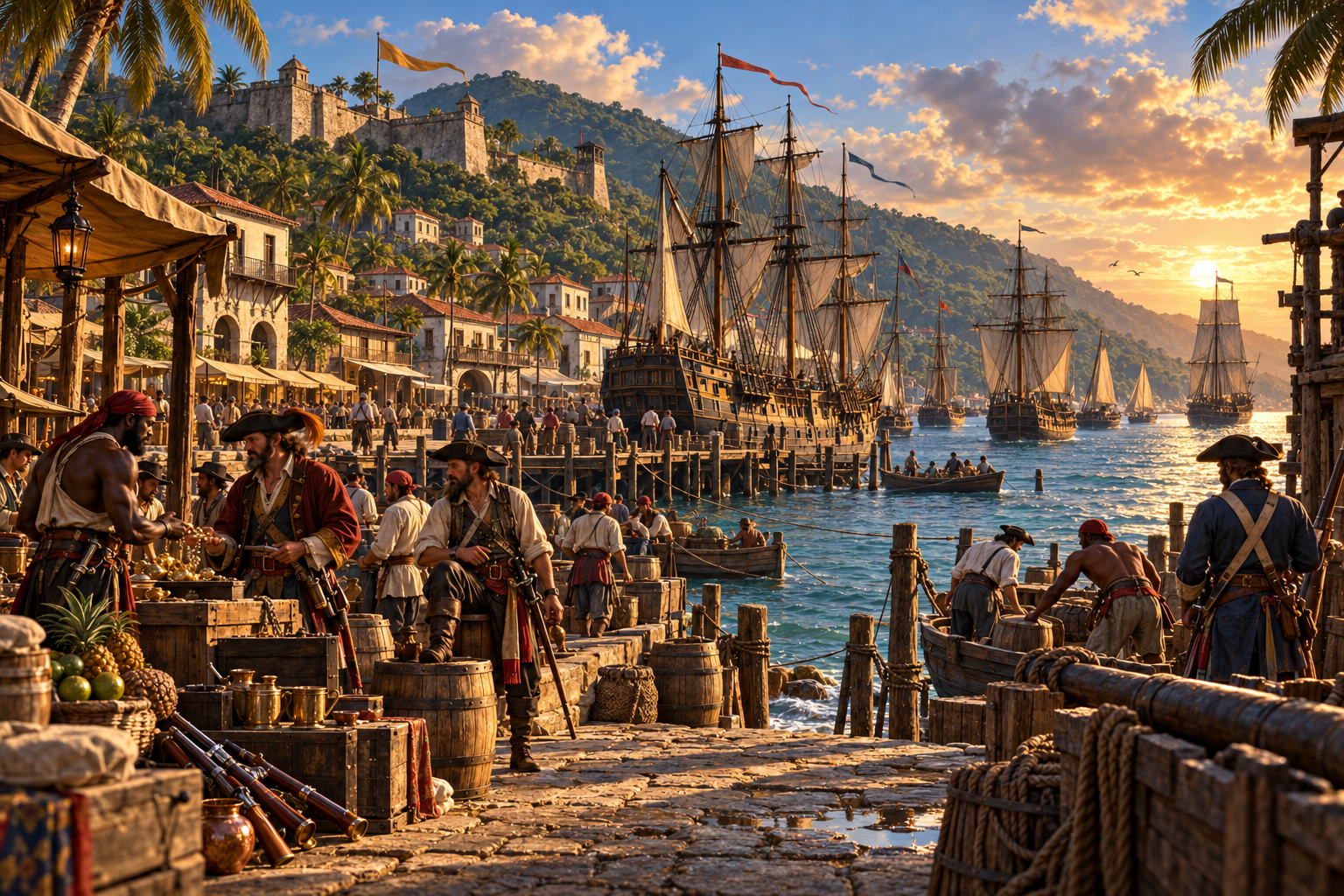
Caribbean Sea · Atlantic Approaches · Island Chains & Rival Harbours
The Caribbean is not one realm. It is a chain of islands, reefs, channels, ports and contested coastlines where every safe anchorage can become a fortress, a marketplace, a refuge or a prize.
At a Glance
- Political character
- Fragmented and fiercely contested. Indigenous island powers, maroon communities, colonial settlements, free ports, privateers and merchant interests overlap without any single authority controlling the whole sea.
- Principal pirate bases
- Tortuga and Port Royal are the strongest centres of the Brethren of the Coast, with Nassau and other harbours serving as secondary refuges, markets and recruiting grounds.
- Major factions
- Brethren of the Coast, Port Royal Harbour Council, Maroon Confederacies, Indigenous Island Councils, Norse Atlantic Sea-Road Network and Sea-Elf Reef Kingdoms.
- Common conflicts
- Harbour control, shipping, forced labour, escaped captives, privateering, smuggling, land claims, rival charters, tribute, wreck salvage and access to fresh water.
- Common arms
- Cutlasses, axes, bows, spears and knives remain widespread. Pistols, muskets, blunderbusses, grenadoes, swivel guns and cannon are especially common around armed ships, forts and free ports.
- Primary dangers
- Storms, reefs, disease, mutiny, piracy, naval war, ambush, hostile patrols, dangerous magic and great creatures beneath the sea.
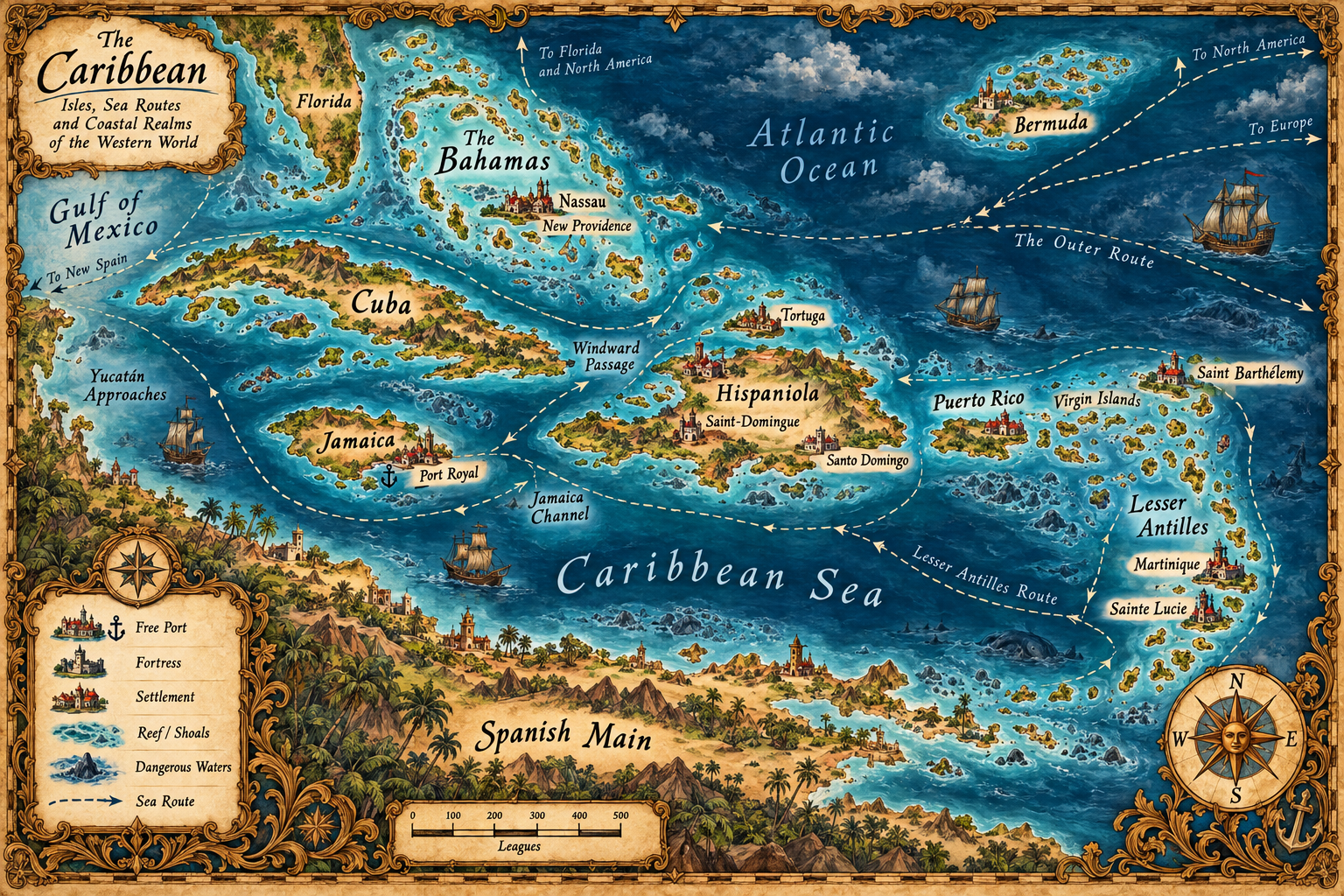
The Caribbean is one of the most politically crowded seas in the world. Deep-water routes from Europe, Africa and the North Atlantic converge with the island chains that guard the approaches to the Gulf of Mexico and the northern coast of South America. A vessel moving through these waters may pass an Indigenous-controlled island, a colonial fort, a maroon refuge, a pirate anchorage and a reef claimed by sea-elves before the same day is over.
Claims on maps are rarely the same as control on the ground. Governors may claim whole islands while commanding little beyond one harbour. Privateers sail under papers that enemies call piracy. Maroon communities hold forests, hills and marshlands outsiders struggle to enter. Indigenous councils control food, water, guides and local sea knowledge. Merchant captains bargain with whoever can actually guarantee that a cargo reaches the next port.
The result is ideal campaign territory. Alliances change quickly, information travels with ships, and the distance between political intrigue and open violence may be no more than the width of a quay.
What Is Happening Right Now?
The Brethren Are Powerful but Not United
The Brethren of the Coast can place dangerous captains, experienced crews and armed ships into the same cause when interests align. They cannot make every captain obey one command. Tortuga and Port Royal are their principal bases, but arguments over prizes, safe harbour, contracts, enslavement, ransom and who deserves protection continually threaten the coalition from within.
Colonial Claims Are Larger Than Colonial Control
Foreign governors issue charters and proclamations over islands they cannot reliably patrol. A flag over one fortress does not mean the interior, neighbouring coves or offshore reefs obey the same authority. This makes local alliances more important than distant claims.
Maroon Communities Are Becoming Powers in Their Own Right
Escaped captives and free communities are not merely hiding from plantation and colonial authorities. Some control defensible country, food sources, inland routes and intelligence networks. Their leaders can shelter fugitives, guide raiders, close mountain tracks or negotiate from positions outsiders cannot easily attack.
Indigenous Councils Still Control Critical Ground
Indigenous island societies have not vanished because foreign settlements exist. Councils and local leaders retain communities, allies, sacred places, fishing grounds, interior routes and detailed knowledge of water and weather. Some trade with newcomers, some fight them, and some exploit rival colonial powers against one another.
The Sea-Elves Control Routes No Surface Chart Shows
Beneath reefs and deep channels lie territories surface sailors cannot occupy. Sea-Elf Reef Kingdoms watch wreck grounds, spawning waters, submerged ruins and passages between islands. Surface powers that assume the sea itself belongs to whoever controls the nearest fort are making a dangerous mistake.
Arms at Sea
Firearms and gunpowder weapons already established elsewhere in the world are particularly common around Caribbean ships, forts and free ports. Privateers, pirates, colonial troops, maroon fighters, Indigenous allies and merchant crews acquire them through trade, capture and local armourers.
Pistols, muskets, blunderbusses, grenadoes, swivel guns and shipboard cannon therefore appear regularly alongside cutlasses, boarding axes, bows, spears and other regional weapons. The Caribbean does not possess a separate technological system; it simply concentrates armed ships, captured weapons and people who expect to fight at close quarters.
Open the Firearms reference for the established weapons used across the setting.
The Six Powers to Put into Play
Brethren of the Coast
Reach: Tortuga, Port Royal and allied captains across the sea.
Want: Profitable freedom of movement, safe havens, prizes and enough cooperation to stop stronger states destroying them one harbour at a time.
Use in play: Letters of marque, prize disputes, mutiny, stolen cargo, rival captains and temporary alliances.
Typical arms: Pistols, muskets, blunderbusses, cutlasses, boarding axes, grenadoes and captured naval guns.
Port Royal Harbour Council
Reach: Port Royal docks, warehouses, pilots, customs officers and merchant connections.
Want: A rich harbour that remains useful enough that nobody can afford to destroy it.
Use in play: Dock law, bribery, confiscated cargo, harbour defence, licences, informants and factional votes.
Typical arms: Muskets, pistols, polearms, naval swords, swivel guns and fixed harbour cannon.
Maroon Confederacies
Reach: Forests, hills, marshes, hidden settlements and inland tracks across several islands.
Want: Freedom, secure communities and the strength to prevent recapture or outside domination.
Use in play: Safe routes, rescues, reprisals, intelligence, ambushes, contested negotiations and escaped prisoners.
Typical arms: Captured or traded muskets and pistols alongside bows, spears, axes, heavy knives and ambush weapons.
Indigenous Island Councils
Reach: Island communities, fisheries, inland routes, local alliances and traditional territories.
Want: Survival, autonomy, control of land and sea access, and leverage against rival outsiders.
Use in play: Treaty disputes, guides, food supply, hostages, territorial boundaries, diplomacy and retaliatory raids.
Typical arms: Bows, spears, clubs and blades together with firearms gained through trade, alliance, capture or local repair.
Norse Atlantic Sea-Road Network
Reach: North Atlantic shipping, kinship links, Greenland, Vinland and routes feeding southward into warmer waters.
Want: Open sea-roads, dependable harbours, trade access and freedom from hostile monopolies.
Use in play: Long-range cargoes, northern intelligence, convoy work, wreck rescue and old sea obligations.
Typical arms: Axes, swords, sea-service muskets, pistols and robust shipboard weapons chosen for durability.
Sea-Elf Reef Kingdoms
Reach: Reefs, deep channels, submerged settlements and sea routes invisible to surface navigators.
Want: Control of their waters, protection of underwater communities and recognition that surface treaties do not automatically bind the sea below.
Use in play: Wreck salvage, underwater passage, missing ships, reef boundaries, drowned ruins and surface diplomacy.
Typical arms: Aquatic weapons below water; traded or captured pistols and conventional shipboard arms when operating aboard surface vessels.
Open the full Factions & Organisations index for the wider political network.
Run the Caribbean Tonight
Start with a ship, a harbour and one reason the characters cannot simply sail away. A seized cargo, missing crew member, disputed prize, approaching storm or hostile patrol is enough. Then connect the immediate problem to two factions that want different outcomes.
The Core Caribbean Question
Who actually controls this place when the flag, the harbour, the interior and the surrounding sea all answer to different powers?
The most useful Caribbean adventures force the party to deal with overlapping authority. A colonial governor may own the paperwork, a harbour council may control the docks, a maroon community may control the only safe inland road and sea-elves may control the reef passage needed to leave.
Four Things to Put on the Table
- A valuable cargo. Gold, powder, medicine, weapons, maps, prisoners, food or something recovered from a wreck.
- A contested authority. Two people or factions both claim the right to give orders.
- A route that can close. A reef channel, mountain track, harbour chain, river mouth or sea lane threatened by weather or enemies.
- A choice with consequences. Helping one faction should change how another treats the characters later.
Sea Roads and Strategic Routes
| Route | Why It Matters | Common Trouble |
|---|---|---|
| Bahamas & Florida approaches | Atlantic traffic, hidden channels, privateer interception and routes toward North America. | Reefs, wreckers, pirate patrols, storms and confusing channels. |
| Windward Passage | Fast route between Cuba and Hispaniola linking the Atlantic to western Caribbean waters. | Privateers, hostile patrols, pursuit and ships waiting beyond sight of shore. |
| Jamaica Channel | Connects Jamaica with Hispaniola and major routes toward the western sea. | Raiding, convoy interception, changing winds and disputed prizes. |
| Lesser Antilles chain | Island-hopping route between Atlantic approaches and the southern Caribbean. | Competing settlements, Indigenous territorial claims, reefs and volcanic islands. |
| Spanish Main approaches | Links the islands to the mainland ports, treasure routes and Gulf of Mexico. | Naval patrols, fortified ports, smugglers, captured pilots and dangerous coastal waters. |
| Deep reef routes | Hidden passages known to sea-elves, local pilots and experienced smugglers. | Submerged hazards, territorial disputes, monsters and routes omitted from surface charts. |
Ports, Islands and Starting Points
Port Royal — Armed Harbour and Political Marketplace
Port Royal works as the cluster’s best urban starting point. Captains need pilots, powder, repairs and buyers. Merchants need protection. Officials need privateers they can deny knowing. The Harbour Council turns all of that traffic into political leverage.
Tortuga — Brethren Stronghold
Tortuga is harder to control and easier to disappear into. It is a recruiting ground, refuge, repair point and meeting place where captains can cooperate without agreeing on much else.
New Providence and Nassau — Open Anchorage, Open Opportunity
New Providence sits within the Bahamas’ maze of channels and approaches. Nassau gives captains a place to trade information, recruit crew, buy stolen goods and vanish among vessels moving between the Atlantic and Caribbean.
Explore New Providence · Explore Nassau
Hispaniola — One Island, Several Competing Futures
Hispaniola is a natural campaign centre because rival settlements, Tortuga, Indigenous communities, maroon networks and foreign claims collide on and around the same island.
Explore Santo Domingo · Explore Saint-Domingue
The Lesser Antilles — Islands of Rival Harbours
Smaller islands become strategically important because water, anchorage, repair facilities and defensible coves matter more than size. A single harbour may determine which fleet can remain in the area after a storm.
Sainte Lucie · Martinique · Saint Barthélemy · Virgin Islands
Bermuda — Atlantic Gate
Bermuda sits outside the Caribbean Sea proper but matters to the wider Atlantic network. Ships moving between Europe, North America and the islands may use it as a waypoint, intelligence stop or refuge after storms.
Dangers Beneath the Surface
Sea Serpents
Great sea serpents turn ordinary voyages into monster hunts or disasters. Some are territorial rather than malicious, but a ship does not need to understand the difference while its hull is being crushed.
Use the Sea Serpent creature entry
Krakens
Krakens are campaign-scale threats rather than routine encounters. Their intelligence makes them more dangerous than storms or ordinary predators: a kraken can manipulate captains, control routes and arrange disasters without revealing itself until late in a campaign.
Merfolk and Reef Politics
Merfolk may act as traders, witnesses, rivals or guides around reefs and wreck grounds. Their knowledge of what happens below the waterline often makes them the only witnesses to sabotage, dumped cargo or ships sunk far from shore.
Adventure Hooks
- The Prize Nobody Owns. A captured merchant ship enters Port Royal flying three different sets of papers. The Brethren captain claims a lawful prize, the Harbour Council wants its customs share and another faction insists the ship was stolen before the privateers ever found it.
- The Closed Reef. Sea-elves close a channel used by smugglers and privateers after an underwater site is damaged. Three surface factions need the route reopened before a convoy arrives.
- The Powder Ship. A vessel carrying firearms and powder disappears between Nassau and Hispaniola. Everyone assumes piracy until wreckage appears on a shore no ordinary current should have reached.
- The Governor’s Letter. Two privateer captains possess letters authorising them to seize the same enemy vessel. Only one document is genuine, and the supposed forgery bears the correct seal.
- The Mountain Road. A maroon confederacy offers to guide the party across an island interior in exchange for escorting a group of fugitives beyond colonial patrols.
- The Empty Anchorage. An entire sheltered cove has been abandoned overnight. Boats, cooking fires and cargo remain, but every inhabitant has vanished.
- The Council Hostage. A colonial officer seizes a member of an Indigenous council to force access to a freshwater source. The nearest settlement will suffer first if negotiations collapse.
- The Thing Beneath the Convoy. Ships disappear in a pattern blamed on pirates. The surviving evidence instead points toward a creature or intelligence directing attacks from below.
Caribbean Encounter Table
| d12 | Encounter |
|---|---|
| 1 | A privateer fires a warning shot and demands to inspect the party’s papers. |
| 2 | A damaged merchant vessel offers twice the normal rate for an armed escort to the next harbour. |
| 3 | A canoe approaches under a white cloth with an Indigenous envoy carrying a warning about the island ahead. |
| 4 | A drifting longboat contains fresh blood, a locked sea chest and no crew. |
| 5 | A maroon scout appears on a ridge and signals for the party to leave the road immediately. |
| 6 | A powder store catches fire while two rival factions accuse each other of sabotage. |
| 7 | A sea serpent surfaces close enough to the ship to make the crew reach for weapons. |
| 8 | Merfolk return a body recovered from deep water and demand payment before revealing where it was found. |
| 9 | A sudden squall forces every nearby vessel toward the same narrow anchorage. |
| 10 | A pirate captain offers safe passage in exchange for one passenger whose name is on a folded list. |
| 11 | A colonial patrol is towing a captured vessel whose crew are signalling secretly for help. |
| 12 | At sunset, something enormous passes beneath the ship without breaking the surface. |
Beyond the Islands — The Spanish Main & Mainland Routes
The Caribbean cluster connects naturally to the Gulf of Mexico, Central America and the mainland colonies, but these are not Caribbean islands. Treat them as onward routes rather than mixing them into the island directory.
Using the Caribbean in a Campaign
The Caribbean works best as a moving campaign rather than a sequence of isolated island descriptions. Give the party a ship or regular access to one, then let reputation travel ahead of them. A choice made in Port Royal should affect prices in Tortuga. A broken promise to an Indigenous council should close a safe anchorage later. A maroon guide saved on one island may know relatives or allies on another.
Keep factions active between sessions. Captains change targets, councils strengthen harbour defences, governors issue new warrants, maroon networks move fugitives, Indigenous leaders close routes and sea-elves respond to damage beneath the water. The region should feel as though it moves even when the characters are elsewhere.
Do not make every problem piracy. Piracy is one expression of the larger struggle over who may move, trade, rule, escape and survive. The strongest campaigns mix shipboard action with diplomacy, monster threats, inland expeditions, investigations, rescue missions, treasure recovery and political consequences.
Caribbean NPCs
Captains, pirates, privateers, governors, rebels and adapted figures from history and fiction are gathered in the Caribbean NPC collection. Their campaign biographies should be read as living setting truth rather than strict reproductions of later real-world chronology.
Campaign Timeline
The Caribbean’s present condition grows out of an alternative Atlantic history in which established settlements, free communities, maritime factions and advanced artisanal firearms appear earlier than in conventional history. The region is already a contested colonial sea rather than an untouched frontier.