
Muscovy (Grand Duchy of Moscow)
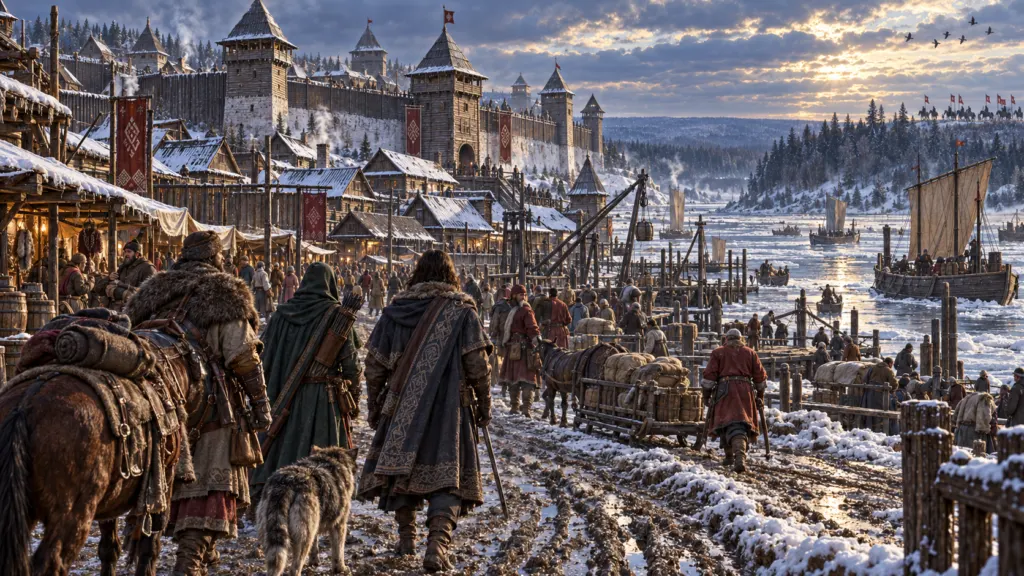
Moscow · Ivan the Terrible · Boyar Rivalries · The Oka Frontier · Unquiet Forests
Muscovy at a Glance
| Campaign Present | 1454 CE |
|---|---|
| Realm | Grand Duchy of Moscow, within the Rus lands |
| Ruler | Ivan IV Vasilyevich, called Ivan the Terrible — the ruling Grand Prince in the campaign |
| Capital | Moscow, where the Kremlin commands the Moskva River approaches |
| Government | Grand-princely household, boyar council, appointed governors and fortified district authorities |
| Major Centres | Moscow, Kolomna, Vladimir, Suzdal, Pereyaslavl-Zalessky and key Oka–Volga crossings |
| Independent Neighbours | Novgorod, Tver, Ryazan and Pskov; none is simply a district of Moscow |
| Other Powers | Grand Duchy of Lithuania, Kazan and the Great Horde |
| Languages | Regional Rus speech, scribal Slavonic and the tongues of merchants, envoys and forest communities; no universal Common |
| Wealth | Grain, forests, furs, wax, metalwork, tolls, river trade, estates and tribute |
| Dangers | The ruler’s suspicion, boyar vendettas, forged seals, tribute collectors, hostile scouts and wilderness powers |
| Best Adventures | Political intrigue, investigations, winter journeys, frontier diplomacy, sieges and haunted forest expeditions |
Under the Terrible Prince
Muscovy has become the most feared court in the northern Rus lands. The Grand Prince has learned how quickly a noble’s oath can become a plot and how swiftly a border lord can change masters. Ivan rules from Moscow by summons, reward, confiscation and carefully cultivated dread. His couriers reach places his soldiers cannot, and his silence in a council chamber can end a career.
Beyond the Kremlin, life remains practical. Merchants load barges on the Moskva River, farmsteads gather food for the winter, smiths repair harness and blades, and estates send rents to men who must satisfy an increasingly demanding ruler. Most households know Ivan through tax agents and armed retainers rather than an audience. A village may love the safety of the Grand Prince’s roads and fear the arrival of his messengers in equal measure.
His power is formidable but not unlimited. Novgorod governs itself. The princes of Tver and Ryazan keep their courts. The eastern river routes lead toward Kazan and the Great Horde, whose khans do not accept Moscow’s claims. Ivan can promise dominion over every Rus principality; fulfilment is another matter.
Explore the Rus Lands
What Is Happening Right Now?
Ivan Demands a New Oath
The Grand Prince has summoned the leading households to acknowledge his authority in person. Those who arrive with generous gifts receive courteous attention; those who plead illness attract investigators. A boyar may hire adventurers to recover a stolen family charter before his rivals use its absence as proof of treachery.
The Blackhound Brotherhood Opens Its Ledger
The Oprichniki, known as the Blackhound Brotherhood, have begun compiling the Black Ledger of suspect oaths, hidden alliances, debts and supernatural bargains. In this campaign they act under Ivan’s reign, but their commander, Svyatoy Voron, believes that his order’s Judgment stands above any one prince. Their mounted Kormchii close roads and seize suspects while Vedyuny examine curses, spirits and incriminating testimony. A party that saves a fugitive may discover its own names entered into the Ledger.
The Novgorod Road Fills with Informers
Moscow’s agents are listening to merchants and travellers returning from the north. Ivan has not conquered Novgorod, but he intends to know which families favour closer ties to Moscow and which hope for help from Lithuania. Couriers with the wrong names written in their satchels sometimes disappear.
Kazan Tests the River Crossings
Scouts from Kazan probe the forest-steppe borders while Ivan’s captains strengthen riverside posts. The khanate’s orc clans retain their own rivalries and loyalties; a captured scout may be an enemy, an envoy or a hostage someone hopes to recover.
The Great Horde Remembers Tribute
The khan’s collectors and allies claim rights on the old tribute routes. Ivan’s councillors argue whether to bargain, delay payment or risk a show of force. The question does not stay inside the palace: merchants, villages and frontier lords pay the price of every decision.
The Qasimov March Must Choose
Along the Oka, an allied orc war-host holds a precarious place beneath Moscow’s protection. Its mounted scouts are valuable against Kazan, but Muscovite nobles distrust commanders whose oaths were sworn in another tongue. A wrongfully seized prisoner could unravel the arrangement in a single week.
Places Adventurers Can Actually Reach
Moscow — Kremlin and River Quays
The capital sits at the meeting of the Moskva and Neglinnaya waterways, dominated by a fortified Kremlin of older white-stone walls. Guards control the principal entrances, scribes hold petitions, and the Grand Prince’s chambers are protected by layers of officials. Outside the walls, merchants argue over weights and tolls, smiths work for noble households, and warehouses collect goods for the princely court. The later red-brick Kremlin towers and grand ceremonial complexes have not yet been built.
Kolomna — Gate to the Oka
South-east of Moscow, Kolomna watches the junction of important waterways and the approaches to the steppe. Its garrison tracks ferries, armed boats and travelling envoys. A party carrying orders from Moscow can discover that local commanders obey the Grand Prince while quietly serving powerful patrons of their own.
Vladimir and Suzdal — The Older Seats
Old princely towns retain estates, archives, craft traditions and prestigious ancestral claims. Their noble families remember when power was less firmly centred on Moscow. Some keep sealed genealogies that could embarrass a claimant to the throne; others guard relics of older magic in storehouses and burial mounds.
The Forest Archives and Scriptoria
Beyond the capital lie secluded communities of scribes, healers, astronomers and keepers of ancestral records. Some live within fortified timber enclosures supported by nobles; others have made arrangements with local spirits and refuse royal intrusion. A manuscript may be safer here than in the city, provided its keeper can be persuaded to release it.
The Oka Marches
Fords, palisades, ferry stations and winter roads give the southern frontier its shape. Garrisons watch for raids, smugglers move along reed-filled banks, and scouts report to whichever commander can pay them. A river crossing often matters more than a line drawn on a distant map.
The Northern Forest Roads
Fur traders, foresters, smallholders and fugitives use seasonal tracks winding toward Novgorod, Rostov and the northern lakes. Deep snow closes one road and opens another across frozen rivers. Travellers should hire a local guide: maps are suggestions in country where storms can hide a village for weeks.
People Adventurers May Meet
Ivan IV, the Terrible
Ivan is shrewd, quick to recognise a weakness and slow to forget a slight. He rewards convincing service with access, estates or exemption, but treats secrets kept from him as deliberate insults. He need not be the villain of every adventure; his effort to make the roads safe can be real, even when his methods make every victory dangerous.
The Boyar Council
The leading noble families sit close to power and maintain their own retainers, marriages, estates and rivalries. None speaks for every boyar. A faction might assist a foreign investigator to remove a corrupt official while another fears that same investigation will give Ivan an excuse to seize its lands.
The Oprichniki — Blackhound Brotherhood
The Oprichniki are Ivan’s feared mounted enforcers, clandestine investigators and occult interrogators. Their order numbers about 1,106 sworn members in the campaign present, under Svyatoy Voron, the Sacred Raven. The Kormchii patrol and arrest; the Vedyuny pursue supernatural cases; the Chornyye Teni infiltrate and abduct; five Volkodlak lead the largest operations. Voron alone holds the highest rank.
Their distributed Black Ledger records families, allegiances, informants and forbidden bargains. The Brotherhood can be a useful ally against a genuine threat, an employer with unacceptable terms, or the force hunting a person the characters have sworn to protect. See the full faction entry for ranks, standing, encounters and edition-specific mechanics.
River Captains and Border Envoys
Captains, interpreters and commercial brokers know what actually happens between courts. They can arrange passage under a safe-conduct, identify the emblem of a visiting war-host or explain why an otherwise legal shipment has been detained at a riverside fort.
Factions, Law and Local Power
- Ivan’s household: controls audiences, orders, treasury stores and appointments. A royal seal carries weight, but forged seals circulate.
- Boyar families: protect inherited estates and compete to influence policy. A noble’s sworn retainers are not automatically loyal to other nobles.
- Town officers and guilds: supervise markets, dues, workshops and many ordinary disputes.
- The Oprichniki — Blackhound Brotherhood: Ivan’s secretive enforcers, spies and occult investigators, directed by Svyatoy Voron. Their Black Ledger reaches into merchant houses, princely courts and haunted forests; their authority is feared and contested rather than universally accepted.
- Frontier captains: command palisades, patrol roads and deal with Kazan and Horde emissaries.
- Forest communities: guard hunting rights, sacred groves, old bargains and routes the palace scarcely knows.
How law works. A sealed order grants leverage, not immunity from scrutiny. Local officials can detain a suspect, noble patrons can demand hearings, and wardens may confiscate an object while disputing which court should try its owner. A party that draws steel inside a market should expect immediate trouble regardless of whom it claims to serve.
Magic, Services and Everyday Life
Markets and supplies. Moscow offers armour repairs, horses, food stores, cloth, candles, maps of varying accuracy, boat passage and trained guides. Rare enchanted goods pass through private commissions and trusted intermediaries rather than an open shop with a fixed inventory.
Healers and learned arts. Herbalists, bone-setters and practitioners of protective rites serve villages and noble courts. Scribes study star tables, old treaties, genealogies and fragments of inherited magic. Not every scholar knows a spell, and written authority can matter as much as magical skill.
Nonhuman residents. Dwarven metalworkers, travelling halfling families and orc diplomats or hostages may be encountered where trade routes converge. Their status depends on household patronage and local arrangements; none is automatically welcome or outlawed throughout the principality.
Spirits and the wild. Household guardians, river presences and dangerous forest beings are part of local accounts. Villagers disagree about which tales are true, but a ferryman may refuse an evening crossing for reasons no prince can amend. Encounters should use creatures already established in the bestiary whenever rules are required.
Adventure Hooks
| d6 | Dangerous Business in Muscovy |
|---|---|
| 1 | The Prince’s Empty Seal Box. A confidential summons has been counterfeited. Three boyars possess convincing copies; find the true clerk before Ivan punishes the wrong household. |
| 2 | Ice Road of the Missing Tribute. A winter caravan vanishes with coin intended for a Horde envoy. Tracks lead onto a frozen tributary that no local guide will cross after sunset. |
| 3 | The Black Ledger’s Novgorod Names. An Oprichniki Vedyun demands the arrest of three merchants accused of financing rebellion. Their ledgers instead reveal that a princely officer has diverted customs money to mercenaries. Find proof before the Black Shadows seize the merchants—or before Voron decides the truth is less useful than the accusation. |
| 4 | Two Princes at One Ford. Ryazan and Moscow claim toll rights at a crossing. Resolve the dispute before soldiers arrive, or escort the witnesses out before either court silences them. |
| 5 | The Qasimov Hostage. An orc envoy’s child disappears in Kolomna. The kidnapping is meant to turn Ivan’s allies against him without leaving Kazan’s fingerprints. |
| 6 | A Boyar’s Buried Name. An ancestral record has been hidden beneath an abandoned watchtower. Recovering it will vindicate a family—and give Ivan a reason to question everyone who read it. |
Travel, Weather and Borders
Moving by River
The Moskva, Oka and Volga systems carry cargo, news and armed men. Barges are slower than a hard-ridden courier but carry far more supplies. Tolls, guarded landings, seasonal floods and disputes over safe-conducts are routine. A party travelling east must plan for the changing control of river crossings near Kazan.
Winter and the Thaw
Deep winter can turn rivers into temporary roads, while the spring thaw dissolves tracks into mud and dangerous water. Even good guides can be trapped between settlements when ferries stop running. A winter expedition needs shelter, provisions, dry equipment and a plan for exhausted animals.
Beyond Muscovy
North-west lie Novgorod’s trading lands; west and south-west, the powerful Grand Duchy of Lithuania holds extensive Rus territories. The south remains a landscape of separate principalities and contested tribute claims. Along the Volga, the Kazan Khanate controls approaches the Grand Prince would like to command, while the Great Horde expects deference on its older routes.
The Making of Moscow
Moscow rose among the forest principalities through trade, strategic marriages, inherited claims and the ability of its rulers to bargain with stronger neighbours. Its Kremlin changed from timber to stone in the fourteenth century, and the capital accumulated the officials, treasure and armed households needed to project power along surrounding rivers.
The northern Rus lands remain politically divided. Some princes submit, some bargain, and some watch Moscow grow while keeping their own seals. Old wars left confiscated estates, disputed successions and records that contradict the claims recited at court. Ivan now inherits a realm rich in instruments of power but surrounded by people who remember an earlier balance.
In this campaign, Ivan’s notorious rule is present in 1454. His suspicion and ambitions shape Moscow decades before the events associated with him in ordinary history, while the established frontiers of the Rus lands and their neighbouring states remain the immediate field of play.
Map and Regional Orientation
Moscow stands at the heart of the principality’s river roads. Kolomna protects the southern approach toward the Oka, while older towns such as Vladimir and Suzdal mark inherited authority to the east. Novgorod is a separate northern republic; Tver and Ryazan remain their own principalities; the Volga leads towards Kazan and the Horde. This is an orientation for journeys and politics, not a claim that every wooded border can be mapped precisely.
Campaign map pending: a verified illustrated Muscovy map must show Moscow, the Moskva–Oka–Volga route system and neighbouring independent powers without borrowing borders from later Russian expansion.
Historical Sources and Campaign Distinction
- Moscow Kremlin Museums — History of the Kremlin: the hill, river setting and medieval white-stone defences.
- World History Encyclopedia — Ivan III: historical Muscovy and its later territorial consolidation.
- Ivan IV — historical chronology: in recorded history Ivan IV lived 1530–1584 and ruled in the sixteenth century.
Campaign chronology. The setting deliberately casts Ivan IV the Terrible as ruler of Muscovy in 1454. Historically, Vasily II ruled Moscow in that year and the historical Oprichniki appeared much later, under Ivan IV. The altered chronology and the Blackhound Brotherhood’s presence are fictional campaign choices, not historical dating claims. Moscow’s river geography, neighbouring independent polities and older white-stone Kremlin are retained as historical foundations. The illustrated Rus emblem above is regional artwork, not a 1454 Muscovite state seal.
Keep this reference growing
If this page helped with your reading or game, you can support its upkeep or explore the curated books.
Explore the Bookshop — epics, classics and stories behind imagined worlds.