
Asia — Empires, Steppe Roads & Sacred Realms
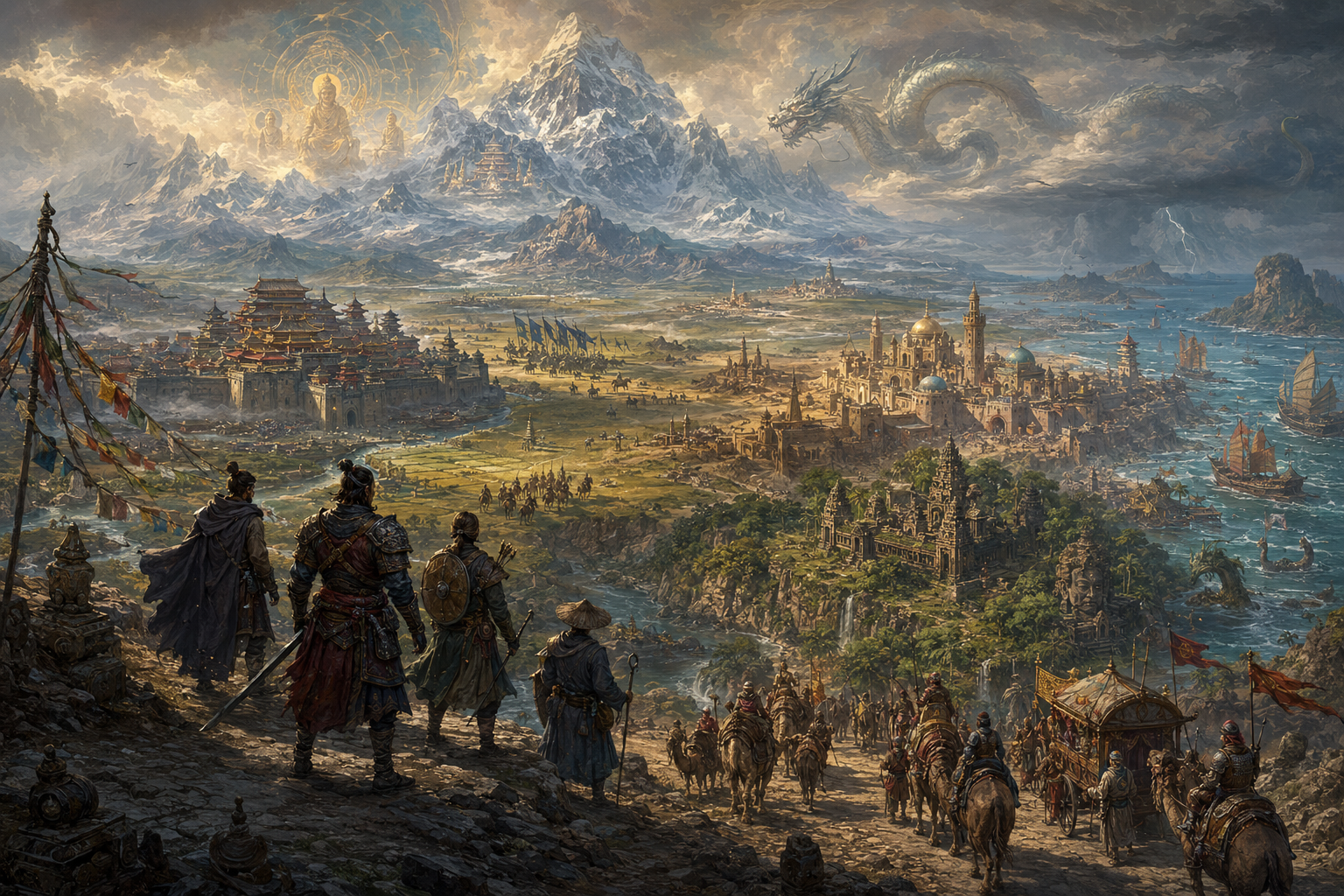
From the Ottoman marches and Timurid roads to the Ming court, Joseon, Japan, the great kingdoms of South Asia and the island empires beyond, Asia is a continent of competing centres rather than a single eastern frontier.
At a Glance
| Scale | The largest continent: imperial capitals, mountain frontiers, steppe roads, monsoon seas, deserts, river valleys and island realms |
|---|---|
| Great Powers | Ottoman Empire, Timurid Empire, Great Ming, Joseon, Vijayanagara, Delhi, Majapahit and the major steppe successor powers |
| Major Routes | Silk Road, caravan corridors, mountain passes and the Indian Ocean sea lanes |
| Supernatural Powers | Dragons, naga, oni, devas, rakshasas, ancestor spirits, mountain powers, celestial officials, elemental beings and older local powers |
| Campaign Pressure | Imperial diplomacy, steppe war, sacred obligations, border law, piracy, trade rivalry and supernatural claims to land and authority |
Asia cannot be reduced to one culture, one empire or one body of magic. Its western courts, Central Asian roads, South Asian kingdoms, Himalayan highlands, Chinese states, Korean courts, Japanese islands and Southeast Asian maritime powers each possess their own laws, monsters, sacred traditions, political rivalries and ways of dealing with the supernatural.
The continent’s size changes the meaning of travel. Crossing Asia can mean leaving one legal world for another, exchanging river roads for desert caravans, moving from imperial farmland into steppe territory, or sailing between island courts whose power is measured as much in harbours and tribute as in land.
Explore Asia
Ottoman, Timurid, Arabian and Caucasian lands Central Asia
Steppe powers, caravan roads and orc successor realms South Asia
Vijayanagara, Delhi and the eastern kingdoms East Asia
Great Ming, Joseon and Japan Southeast Asia
Majapahit, Cagayan and the island sea roads Silk Road
The continental trade route joining courts, caravans and frontier powers
What Is Happening Right Now?
No single ruler can dictate events across the continent. In the west, Ottoman and Timurid powers command roads, cities and frontier armies. Across the steppe and caravan country, the old orc imperial order has fractured into successor powers whose borders are still being tested. Farther east, the Great Ming, Joseon and Japan each face their own court politics, military pressures and supernatural obligations. South Asia is divided among powerful courts and regional kingdoms, while the sea routes toward Southeast Asia carry merchants, envoys, pirates, pilgrims and creatures that do not recognise human borders.
The result is a continent full of moving boundaries. A caravan charter valid in one realm may be worthless beyond the next pass. A mountain sanctuary can command more obedience locally than a distant governor. A dragon’s ancient claim may cross three human borders, while an imperial seal can still close a road faster than an army.
Western Asia
Western Asia links the Mediterranean, Caucasus, Iranian plateau, Arabian routes and the roads running east toward Central Asia. It is a region of imperial rivalry, fortified cities, caravan traffic and old kingdoms whose ruins still matter.
- Middle East / Western Asia — regional hub.
- Turkey — The Ottoman Empire.
- Iran — Timurid Empire.
- Arabia.
- Kingdom of Georgia.
- Edirne — Ottoman capital and western gateway.
- Iraq.
- Syria and Palestine.
Central Asia and the Steppe Roads
Central Asia is where caravan cities, steppe confederacies and imperial frontiers overlap. The collapse of older steppe dominion has not produced peace; it has created rival successor powers, contested grazing lands and roads that can change hands between one trading season and the next.
- The One-Eyed Horde — historical name for Mhurak Stone-Blood’s Great Muster, now divided into rival successor powers.
- Hobistan — Ili Valley Hobgoblin Confederacy.
- Silk Road — the principal overland artery connecting courts and markets.
- Eastern Fang Host, Ash-Standard Host, Red Fang Reach and Black Anvil Realm — recognised successor powers whose rival claims continue to shape the frontier.
- Uzbek Khanate and other steppe powers remain important neighbours and competitors along the caravan routes.
South Asia
South Asia contains some of the continent’s richest agricultural regions, largest courts and busiest long-distance trade networks. Power is divided rather than centralised, with major states competing through war, diplomacy, tribute, marriage and control of roads and ports.
- South Asia — regional hub.
- Vijayanagara Empire.
- Delhi Sultanate.
- Ahom Kingdom.
- Kachari Kingdom.
- Sutiya Kingdom.
- Kingdom of Mysore.
- Sultanate of Gujarat — a major western Indian power and maritime competitor.
East Asia
East Asia is dominated by powerful courts, heavily settled river systems, mountain frontiers and maritime routes. Great Ming authority is formidable but not absolute; Joseon has its own court and obligations, while Japan remains a separate political and supernatural world across the sea.
- Empire of the Great Ming.
- The Forbidden City.
- The Great Wall.
- Joseon — Korea.
- Japan.
- Himalayas and Gobi Desert — immense natural frontiers shaping movement between states.
- Bonin Islands — remote monster-haunted islands on the eastern sea routes.
Southeast Asia and the Island Seas
Southeast Asia is a maritime world of ports, island kingdoms, river systems and sea lanes. Control of a harbour or strait can be more valuable than possession of a distant interior, and supernatural dangers travel by water as readily as merchants do.
- South East Asia — regional hub.
- Majapahit Empire.
- Cagayan.
Peoples, Powers and the Supernatural
Human empires are only part of Asia’s political map. Orc and hobgoblin successor states hold strategic corridors. Dragons may possess claims older than the kingdoms surrounding them. Naga, oni, devas, rakshasas, ancestor spirits, hungry ghosts, mountain beings and elemental powers can command territory, tribute, ritual obligations or fear without appearing on any royal map.
Adventurers should expect authority to be layered. A town can obey an imperial governor, a hereditary clan, a guild, an ancestral taboo and a local supernatural power at the same time. Knowing which authority matters in the current dispute is often more important than simply knowing who claims the land.
Roads, Seas and Travel
The Silk Road is the best-known continental route, but it is not a single road. It is a network of caravan tracks, market cities, passes and negotiated safe-conducts. Sea travel binds Arabia, India, Southeast Asia and East Asia into another immense network whose politics can change from port to port.
Long-distance travel therefore depends on more than distance. Weather, monsoon seasons, local law, steppe warfare, piracy, tolls, monster territory and sacred prohibitions can all make the shortest route the most dangerous.
Adventure Starts
- A caravan’s safe-conduct is recognised by three states and rejected by the fourth, where a rival claims the seal was stolen.
- A steppe successor power demands the return of an artefact being carried toward a Ming court, insisting it was taken from an ancestral burial ground.
- A coastal ruler hires outsiders to determine whether repeated ship losses are piracy, a monster migration or punishment imposed by a sea power.
- A mountain sanctuary closes a pass used by an imperial army, forcing both sides to negotiate with a religious authority neither controls.
- Two courts issue contradictory orders concerning the same dragon, whose territory predates both states.
Deep History
Older kingdoms and cities still shape borders, ruins, legends and claims of inheritance. They belong to Asia’s deep history rather than its current political directory.
- Queendom of Arzawa.
- Byzantium.
- Miletus.
- Phrygia.
- Pergamum and Troy remain important names in the older history of western Anatolia even where their legacy pages are not part of the present-day regional directory.
Explore Further
Keep this reference growing
If this page helped with your reading or game, you can support its upkeep or explore the curated books.
Explore the Bookshop — epics, classics and stories behind imagined worlds.