
The Kingdom of Norway
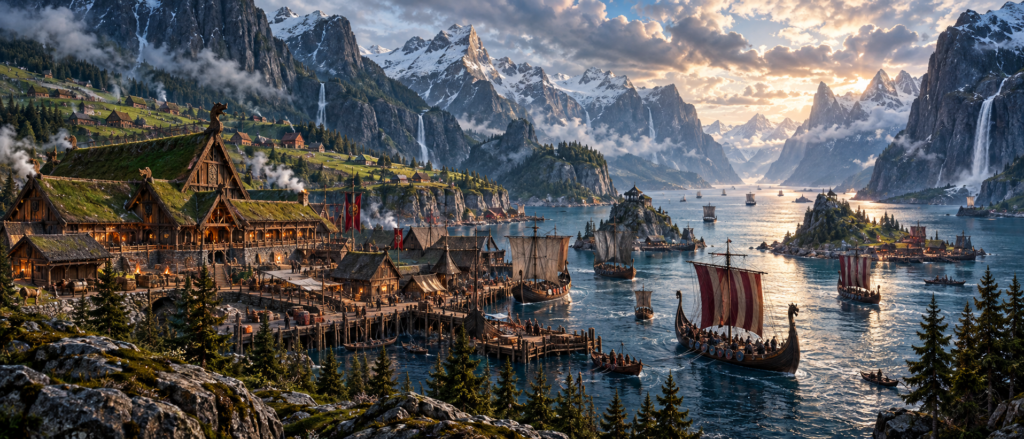
Fjord kingdom, western sea-gate and mountain realm where crown law meets heroic houses, old gods and older powers
At a Glance
| Realm | Kingdom of Norway within the fractured Union of Midgard |
|---|---|
| Ruler | Christian I |
| Principal Port | Bergen |
| Landscape | Fjords, mountains, forests, islands, coastal sea-roads and high winter country |
| Overseas Reach | Iceland, Greenland, Vinland and established North American routes |
| Living Powers | Royal officers, regional nobles, Hanseatic merchants, heroic houses, dwarf holds, jötnar, troll clans, nisse, dísir and landvættir |
| Notable Figures | Ragnar Lothbrok, Björn Ironside, Ivar the Boneless, Lagertha, Aslaug |
| Campaign Themes | Fjord voyages, giant borders, dwarf diplomacy, royal politics, monster hunting, sea trade and western exploration |
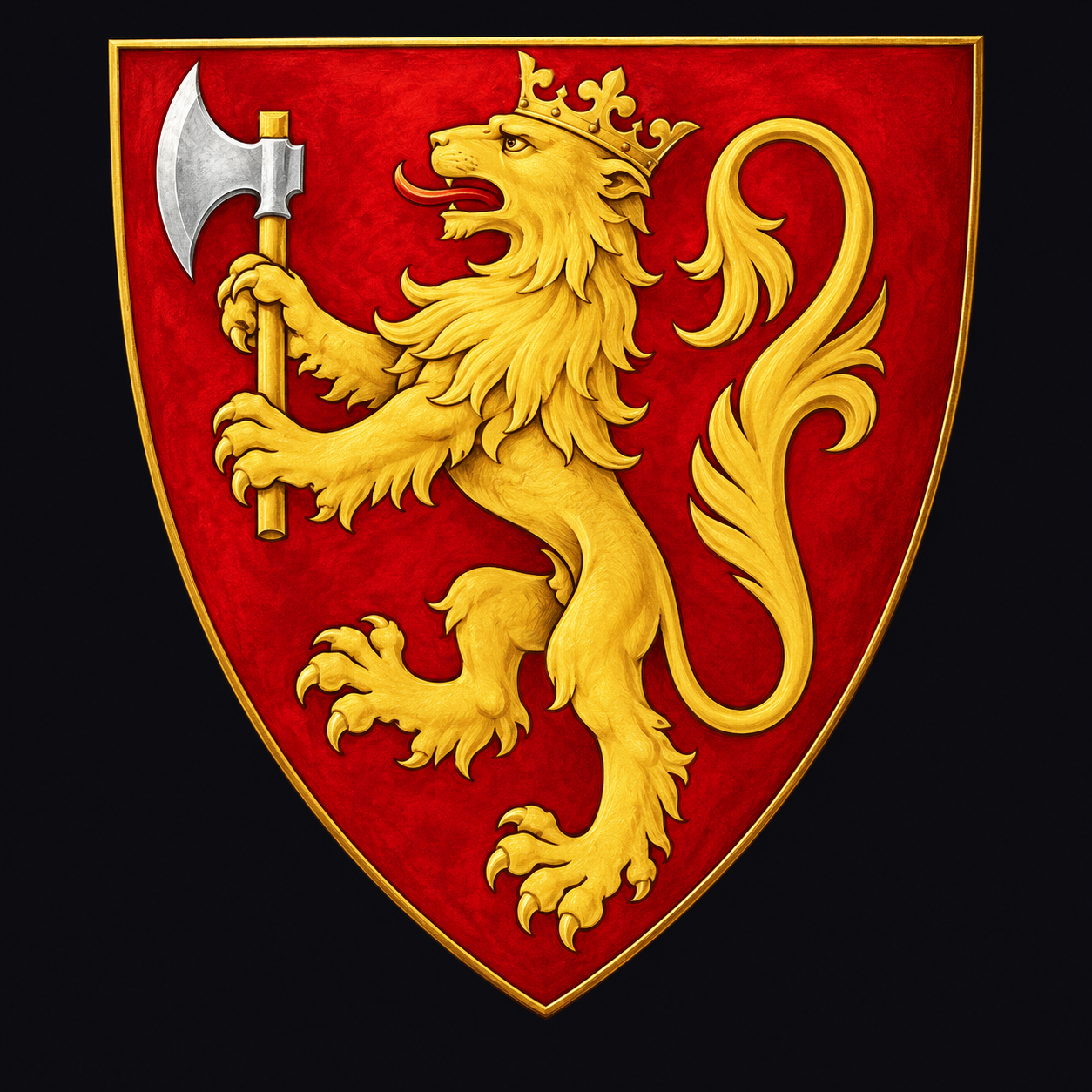
Norway is a kingdom of sea-roads divided by mountains, where royal authority, heroic households and nonhuman sovereignty overlap. A coastal voyage can move faster than an inland journey of a fraction of the distance. A king’s charter may settle a human dispute and still mean nothing to the dwarf hold beneath the mountain or the jötunn family that claims the valley by an older oath.
Christian I rules Norway as well as Denmark, but Norway remains a distinct kingdom with its own councils, nobles, law, regional interests and political memory. The crown depends upon ports, ships and local cooperation. The coast therefore produces powerful captains, merchants and households whose influence is not measured only by land.
Norway is also one of the great doors to the Atlantic. Ships leaving Bergen and other western ports connect the kingdom to Iceland, Greenland and the wider western sea-road. Those routes are commercial, familial and strategic rather than legendary one-off expeditions.
Explore: Bergen · Faroe Islands · Orkney · Iceland · Greenland · Hanseatic League
What Is Happening Right Now?
The Western Sea-Road Is Growing
More cargo, families, investors and armed expeditions are moving toward Greenland, Vinland and the North American settlements. Success creates wealth, but it also creates arguments over ownership, protection, tolls and authority.
The Mountains Have Borders Too
Dwarves, trolls and jötnar recognise boundaries that human officials do not always record correctly. Mining, road building or military movement can therefore become a diplomatic incident.
Bergen Pulls the Kingdom Westward
Bergen is both commercial engine and intelligence market. Hanseatic merchants, royal agents, navigators and sea captains compete for news before ships leave harbour.
Heroic Houses Are Political Powers
Ragnar Lothbrok and his family are not distant legends. Their ships, followers, rivalries and reputations affect the present balance of power.
Factions and Interests
| Power | What It Controls | What It Wants | How Adventurers Get Involved |
|---|---|---|---|
| The Norwegian Crown and Regional Law | Royal charters, taxation, officers, recognised law and access to crown ships. | Revenue, workable settlements, secure sea-roads and obedience that does not provoke open rebellion. | Escort royal messengers, investigate disputed charters, enforce or challenge a judgement, or carry terms into places where crown authority is weak. |
| Hanseatic and Bergen Merchants | Credit, warehouses, cargo networks, overseas information and much of Bergen’s commercial leverage. | Reliable fish, timber, wool and northern cargo; predictable tolls; favourable contracts and early news. | Convoy work, debt disputes, stolen cargo, commercial espionage and negotiations where a merchant contract collides with an older local claim. |
| Heroic Houses | Ships, sworn followers, family alliances, feud networks and expeditionary prestige. | Reputation, profitable voyages, advantageous marriages, leadership of western expeditions and leverage with the crown. | Choose between rival captains, protect a household, settle a feud, recover an heirloom or decide who leads an Atlantic venture. |
| Dwarf Holds | Mines, deep roads, workshops, winter passages and long-remembered contracts beneath the mountains. | Recognition of boundaries, payment of old obligations, secure trade and protection of craft secrets. | Negotiate passage, recover stolen work, witness a contract, reopen a sealed road or resolve a dispute between human surveyors and a hold. |
| Jötunn Houses | High valleys, mountain passes, storm coasts, grazing claims and ancient tribute routes. | Recognition of oath-stones, seasonal tribute, respect for inherited borders and redress for broken agreements. | Carry tribute, arbitrate a claim, survive a border crossing or discover that a human settlement stands on land covered by an older oath. |
| Troll Clans | Bridges, caves, forest margins, narrow roads and difficult approaches through wild country. | Tolls, territory, clan honour and observance of bargains travellers may not know still exist. | Pay or contest a toll, recover a kidnapped traveller, bargain for safe passage or decide whether a hostile-looking troll is actually enforcing an old right. |
| Nisse, Dísir and Landvættir | Household fortune, ancestral obligations and particular farms, rocks, waters, valleys and boundaries. | Continuity of custom, respected boundaries and observance of household and ancestral obligations. | Repair a broken custom, identify why a farm has turned hostile, settle an ancestral grievance or discover which boundary was crossed without permission. |
| Temple Keepers, Rune-Workers and Seers | Ritual knowledge, oath-making, divination, healing and access to divine or supernatural counsel. | Honoured oaths, proper ritual conduct, protection of sacred places and influence over decisions that affect the wider community. | Seek an omen, repair an oath, obtain ritual aid, investigate a failed divination or escort a seer into dangerous territory. |
Places and Routes to Use in Play
Norway works best when the land itself has agency. Roads close under snow. A fjord narrows into giant territory. A burial mound interrupts a farm boundary. A dwarf road offers the only safe winter passage, but the price is not coin. Monster encounters should reveal who controls a place, what agreement has failed or which old obligation somebody ignored.
Bergen and the Western Harbour
Bergen is the kingdom’s busiest meeting point between royal power, North Atlantic shipping and foreign merchant capital. News from Iceland and Greenland can reach its quays before it reaches inland courts, while cargo disputes can draw captains, guild agents, rune-workers and hired blades into the same street.
Fjords and Coast
Fjords are highways, borders, fisheries, hiding places and ambush sites. Villages may be physically close but politically distant if mountains block land travel. Sea monsters, wreckers, drowned dead and hostile captains all turn navigation into adventure.
Mountains and Dwarf Roads
Dwarf holds and workshops can control routes no human engineer could duplicate. Their contracts are precise and remembered. A royal messenger may reach a destination days faster through a dwarf road, but only if somebody has the right to ask.
High Winter Country
Winter does not simply stop travel; it changes it. Sledges, skis and frozen water open routes that vanish in summer. Ullr’s cults and local winter specialists become practically important when the landscape changes beneath the party.
Nonhuman Peoples and Powers
Norway is not a human kingdom with monsters waiting beyond the last farm. Human crown law sits over older sovereignties, household powers, hidden roads and territorial claims that are recognised because ignoring them is dangerous.
Dwarf Holds and Deep Roads
Dwarves are established northern neighbours, not dungeon inhabitants. Holds beneath the mountains control mines, workshops, winter routes and underground roads. Their contracts may govern passage, water, ore and old boundaries long before a royal clerk reaches the valley.
Jötnar and Giant Houses
Frost giants, mountain giants and storm giants hold passes, high valleys, storm coasts and old tribute territories. A jötunn household can be an enemy, trading partner, border power or claimant under an oath older than the present crown.
Troll Clans and Bridge Powers
Norse trolls and related troll-kind belong to bridges, caves, forest edges and mountain roads. Some attack travellers; others demand tolls, enforce clan boundaries or bargain for rights of passage. A troll on a road should feel like a local power before it feels like a random encounter.
Nisse, Dísir and Landvættir
Nisse may be bound to farms, halls and household fortunes. Dísir carry ancestral and fate-bound authority, while landvættir belong to particular valleys, rocks, waters and boundaries. These beings shape custom because their favour or anger can have immediate consequences.
Named Nonhuman Figures
- Dvalinn the Great — master dwarf craftsman, blacksmith and inventor whose commissions and forge-work give him influence among craftsmen, adventurers and mountain communities.
- Hreidmar — dwarven patriarch and keeper of ancient treasures, representing the older clan authority that can stand beside or against human rulers.
- Otr — dwarven shapeshifter, hunter and fisherman whose ties to mountain rivers, animals and nature spirits make him useful where settled law gives way to the wild.
- Ragnhilder storm-seers — ancient rune-scarred troll matriarchs of storm-battered fjords and glacial valleys, approached for prophecy at considerable risk.
Where Nonhuman Power Is Felt
| Landscape | Most Likely Powers | What Changes for Travellers |
|---|---|---|
| Mountain corridors and deep valleys | Dwarf holds, mountain giants, troll clans and hidden roads. | A road may be governed by a contract, toll or border older than the nearest human settlement. |
| High winter country | Frost giants, winter wolves, winter spirits and old hunting powers. | Seasonal routes can cross claimed ground that is inaccessible—and politically irrelevant—to human officials in summer. |
| Fjords, waterfalls and storm coasts | Storm giants, Ragnhilder storm-seers, sea beings and water-bound powers. | Weather, safe anchorage and passage can depend on bargains as much as navigation. |
| Farms, halls and settled valleys | Nisse, dísir, ancestors and landvættir. | A household can be prosperous, cursed or simply impossible to manage if its old obligations are ignored. |
| Bridges, caves and forest margins | Norse trolls and related troll-kind. | Travellers may meet a predator, a toll-keeper or a clan representative; assuming which one before speaking can start the fight. |
| Burial mounds and abandoned holdings | Draugr, barrow wights and ancestral dead. | Property, inheritance and boundary disputes can continue after death, and disturbing a mound may reopen a legal as well as supernatural claim. |
Hidden Folk and Otherworld Neighbours
Svartálfar, Dökkálfar and other hidden folk are rarer on the open road but are known powers around deep places, old mines and crossings toward Svartalfaheim. Their presence should create diplomacy, secrecy and competing claims rather than functioning as another wilderness encounter table.
Not Every Supernatural Being Is a People
Draugr, barrow-dead, hags, sea serpents and other hostile beings belong to Norway too, but they occupy a different place in the setting. They are curses, predators, oath-breakers, guardians or dangerous powers rather than recognised communities. The Midgard Bestiary is the wider encounter source for those threats.
People Who Shape Norway
- Ragnar Lothbrok commands loyalty, ships and a network broad enough to affect royal decisions.
- Björn Ironside is one of the strongest figures for western expeditions and Atlantic campaigning.
- Ivar the Boneless brings strategic intelligence and political danger wherever rival houses compete.
- Lagertha is an independent commander whose support cannot be assumed by any crown or household.
- Aslaug stands at the centre of dynastic relationships whose consequences extend beyond one household.
- Örvar-Odd embodies the living northern voyaging tradition and knowledge of routes most captains never see.
Gods, Magic and Services
The Asgardian gods are practical participants in Norwegian life. Njörðr matters to sea travel and prosperity; Thor to protection and hostile powers; Ullr and Skaði to winter movement and hunting; Týr to oaths and judgement. Local cults, ancestral rites and agreements with landvættir remain woven into public life, law, travel and household custom.
Bergen offers navigators, translators, merchants, shipwrights, armourers and expensive specialists. Outside the great ports, adventurers more often rely on local rune-workers, seers, healers, temple keepers and people who know one mountain, one ford or one supernatural neighbour exceptionally well.
Dangers, Rumours and Adventure Hooks
- The Closed Root-Road. A dwarf route that has carried royal messengers for generations is sealed without explanation.
- The Fjord Claimant. A jötunn household produces an oath-stone proving that a coastal valley owes them seasonal tribute. Useful giant entries: frost giant, mountain giant and storm giant.
- The Western Ship. A vessel from Greenland reaches Bergen with valuable cargo and an impossible chart showing a new coast.
- The Barrow Boundary. A dead landowner rises because royal surveyors moved a boundary marker. Use a draugr or barrow wight depending on whether the dead claimant is still recognisably tied to the household or has become a mound-bound guardian.
- The Captain’s Feud. Two heroic households each claim the right to lead the same Atlantic expedition.
- The Frozen Road. A winter route opens across a lake, but travellers vanish only when the moon is visible. The disappearance might involve a winter wolf, a spirit or something stranger; do not reveal the cause until the party investigates.
More encounter material: Midgard Bestiary · Norse Troll · Sea Serpent · Draugr.
Travel and Law
Sea travel dominates the coast. Inland roads vary sharply in quality, and mountain travel often depends on ferries, seasonal tracks, local guides or agreements with nonhuman powers. Winter can create new roads across snow and ice, but only for travellers equipped to use them.
Royal law, regional custom, thing traditions, town law and private contracts overlap. Oaths can carry supernatural consequences, and possession of a royal charter does not guarantee recognition outside human jurisdiction. Adventurers who negotiate first can sometimes avoid fights that would be impossible to win cleanly.
Deeper History
Christian I has held the Norwegian crown since 1450. The Bergen agreement made Denmark and Norway a personal union under one king while preserving Norway as a distinct realm with its own laws, council and political interests. In practice, royal authority still depends on regional elites, ports, law assemblies and trusted officers, leaving plenty of room for local power to matter.
Bergen’s importance is older than the present union. Its North Atlantic trade and the Hanseatic Kontor bind Norway into commercial networks reaching across the North Sea and Baltic. In play, merchant privilege, ship charters and cargo contracts can collide with heroic households, jötunn claims and dwarf-controlled routes.
The Western Door
Faroe Islands
The Faroes are Norway’s first great Atlantic stepping-stone: a chain of storm-beaten islands where the Løgting, Kirkjubøur, wool trade and local pilots connect royal authority to the western sea-road. They are close enough to Bergen to matter politically and remote enough that island law and seamanship remain decisive.
Norway’s importance to the wider setting rests heavily on the Atlantic. The chain Norway → Iceland → Greenland → Vinland → North America is a functioning route. Ships carry timber, fish, ironwork, weapons, cloth, livestock, families, rune-keepers, envoys and adventurers in both directions.
The route makes Norway a place where distant events arrive early. A dispute in Greenland can move prices in Bergen. A new North American alliance can affect which captain receives royal support. A monster sighting on the western sea can redirect an entire season of shipping.
Orkney remains another Norwegian-facing hinge on the western sea-road, tying northern Britain into the kingdom’s shipping, household politics and Atlantic intelligence network.
Campaign Map
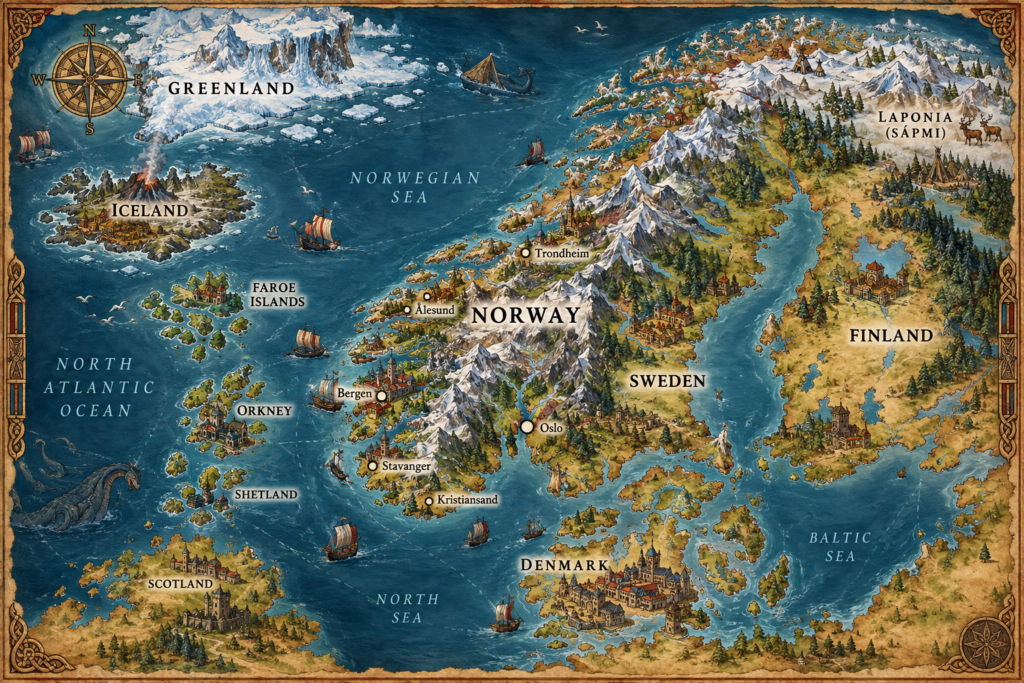
Map links: Bergen · Faroe Islands · Orkney · Iceland · Greenland · Scotland · Sweden · Finland · Laponia/Sápmi · Denmark
Sources and Image Licensing
Historical grounding: Store norske leksikon — Christian I · Store norske leksikon — Union Treaty of 1450 · The Hansa — Bergen.
Hero artwork and Norway shield: original campaign artwork. Regional map: original campaign map.
Explore the Midgard Cluster
Union of Midgard · Denmark · Sweden · Finland · Iceland · Greenland · Bergen · Faroe Islands · Midgard Bestiary
Keep this reference growing
If this page helped with your reading or game, you can support its upkeep or explore the curated books.
Explore the Bookshop — epics, classics and stories behind imagined worlds.