
Draugr — The Dead Who Walk Again
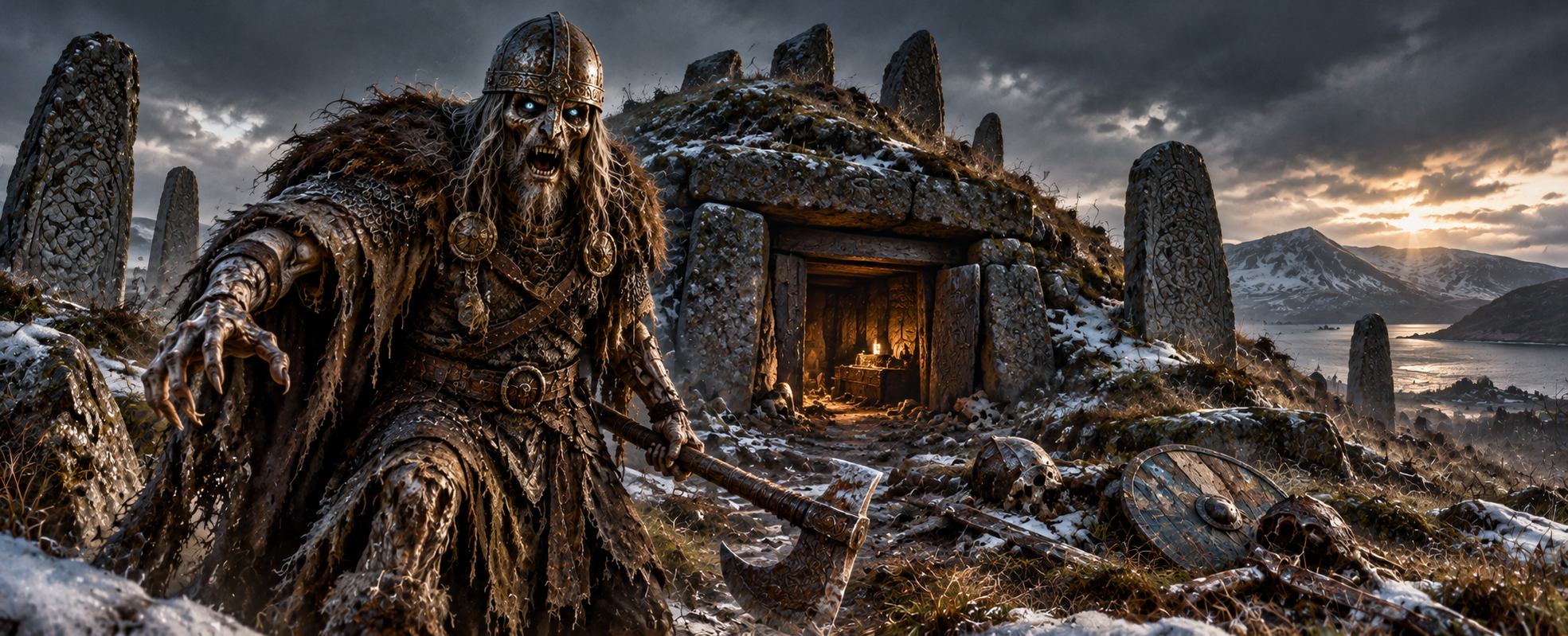
At dawn, a long-dead farmer walked out of his burial mound carrying the iron stake once driven through his heart. The neighbours barred their doors. By noon, the fieldstones had been moved into a line towards the harbour, and a young sailor swore he heard someone knocking from inside his father’s wreck.
A draugr is a revenant of the northern dead: a corpse that refuses the silence of burial. In the sagas it can be swollen and impossibly heavy, strong enough to throw a living man against a wall, sometimes able to grow monstrous in a confined chamber. Unlike an intangible spectre, it leaves footprints, pushes doors and may physically wrestle its victims to death.
Not every draugr is sea-born. The dead of inland cairns may rise to guard treasure, avenge an insult or punish someone who broke a funerary promise. Along haunted northern coasts, the drowned draugr returns from wrecks in fouled mail, its skin sodden with brine and its touch spreading sickness. The same word embraces related traditions, not a single universally identical monster.
Draugr Stat Blocks — Four Editions
Choose a single rules edition before the encounter. The Pathfinder 1e draugr is the published sea-drowned creature from Bestiary 2; the other rules are clearly marked campaign conversions. Captains have their own rules within each edition and should not be stacked onto the ordinary creature without adjusting encounter difficulty.
Draugr — D&D 2024
Medium Undead, Chaotic Evil · CR 4 (1,100 XP; PB +2) · Original campaign conversion
AC 15 (rotted mail and hardened flesh); Initiative +0 (10); HP 85 (10d8 + 40); Speed 30 ft. (sea-draugr variant: Swim 30 ft.)
| STR | DEX | CON | INT | WIS | CHA |
|---|---|---|---|---|---|
| 18 (+4) | 10 (+0) | 18 (+4) | 8 (−1) | 10 (+0) | 12 (+1) |
Saving Throws Str +6, Con +6; Skills Athletics +6, Perception +2, Stealth +2; Damage Resistances Cold; Damage Immunity Poison; Condition Immunities Exhaustion, Poisoned; Senses Darkvision 60 ft., Passive Perception 12; Languages Understands the languages it knew in life but rarely speaks.
Traits
Grave Reek. A living creature that starts its turn within 5 feet of the draugr makes a DC 14 Constitution saving throw. On a failure the creature is Poisoned until the start of its next turn. A creature that succeeds is immune to this draugr’s reek for 24 hours. A land-buried draugr smells of stale earth; a drowned draugr smells of brine and rot.
Undead Fortitude. If damage reduces the draugr to 0 HP, it makes a Constitution saving throw (DC 5 plus the damage taken). On a success it drops to 1 HP instead. It cannot use this trait against Radiant damage or a Critical Hit.
Actions
Multiattack. The draugr makes two Burial Strike attacks.
Burial Strike. Melee Attack Roll: +6, reach 5 ft. Hit: 13 (2d8 + 4) Bludgeoning damage. If the target is Medium or smaller, it must succeed on a DC 14 Strength saving throw or be pushed 5 feet.
Grasp of the Grave (Recharge 5–6). One Medium or smaller creature within 5 feet makes a DC 14 Strength saving throw. On failure it is Grappled (escape DC 14) and Restrained until the grapple ends. The draugr cannot use this action again while maintaining this grapple.
The saga-born revenant is the default of this original 2024 conversion; only the sea-drowned variant has a Swim speed. This is not an official 2024 monster or the published Pathfinder sea-draugr.
Draugr Captain — D&D 2024
Medium Undead, Chaotic Evil · CR 6 (2,300 XP; PB +3) · Original campaign variant
AC 17 (battle-worn mail); Initiative +0 (10); HP 114 (12d8 + 60); Speed 30 ft. (sea-captain variant: Swim 30 ft.)
| STR | DEX | CON | INT | WIS | CHA |
|---|---|---|---|---|---|
| 20 (+5) | 10 (+0) | 20 (+5) | 10 (+0) | 12 (+1) | 16 (+3) |
Saving Throws Str +8, Con +8, Wis +4; Skills Athletics +8, Intimidation +6, Perception +4; Damage Resistance Cold; Damage Immunity Poison; Condition Immunities Exhaustion, Poisoned; Senses Darkvision 60 ft., Passive Perception 14; Languages Understands and can speak the languages it knew in life.
Traits
Grave Reek. Creatures starting within 5 feet make DC 16 Constitution saves or are Poisoned until the start of their next turn. Success provides immunity to this captain’s reek for 24 hours.
Actions
Multiattack. Two Captain’s Axe attacks.
Captain’s Axe. Melee Attack Roll: +8, reach 5 ft. Hit: 14 (2d8 + 5) Slashing plus 4 (1d8) Cold damage.
Deathly Muster (Recharge 5–6). Up to two allied Undead within 30 feet that can hear the captain can each move up to half their Speed as a Reaction without provoking Opportunity Attacks. Their movement cannot pass through occupied spaces.
Howl from the Barrow (1/Day). Each enemy in a 20-foot Emanation from the captain makes a DC 14 Wisdom saving throw. On failure it is Frightened until the end of the captain’s next turn.
Reaction — Take the Blow (1/Turn). When another Undead within 5 feet is hit by an attack, the captain becomes the target of the attack instead, provided it is within the attack’s reach or range.
Draugr — D&D 2014
Medium undead, chaotic evil · Challenge 4 (1,100 XP) · Original campaign conversion
Armor Class 15 (rotted mail and hardened flesh); Hit Points 85 (10d8 + 40); Speed 30 ft. (sea-draugr variant: swim 30 ft.)
| STR | DEX | CON | INT | WIS | CHA |
|---|---|---|---|---|---|
| 18 (+4) | 10 (+0) | 18 (+4) | 8 (−1) | 10 (+0) | 12 (+1) |
Saving Throws Str +6, Con +6; Skills Athletics +6, Perception +2, Stealth +2; Damage Resistance cold; Damage Immunity poison; Condition Immunities exhaustion, poisoned; Senses darkvision 60 ft., passive Perception 12; Languages understands languages known in life but seldom speaks.
Traits
Grave Reek. A creature other than an undead or construct that starts its turn within 5 feet must succeed on a DC 14 Constitution saving throw or be poisoned until the start of its next turn. Success grants immunity to that draugr’s reek for 24 hours.
Undead Fortitude. When reduced to 0 hit points the draugr makes a Constitution saving throw at DC 5 + damage taken, dropping to 1 hit point on success. It cannot do so if the damage is radiant or from a critical hit.
Actions
Multiattack. The draugr makes two burial strikes.
Burial Strike. Melee Weapon Attack: +6 to hit, reach 5 ft., one target. Hit: 13 (2d8 + 4) bludgeoning damage. A Medium or smaller target must succeed on a DC 14 Strength saving throw or be pushed 5 feet.
Grasp of the Grave (Recharge 5–6). One Medium or smaller creature within 5 feet must make a DC 14 Strength saving throw or become grappled (escape DC 14) and restrained until the grapple ends. The draugr cannot use this ability again while the grapple lasts.
Draugr Captain — D&D 2014
Medium undead, chaotic evil · Challenge 6 (2,300 XP) · Original campaign variant
Armor Class 17 (battle-worn mail); Hit Points 114 (12d8 + 60); Speed 30 ft. (sea-captain variant: swim 30 ft.)
| STR | DEX | CON | INT | WIS | CHA |
|---|---|---|---|---|---|
| 20 (+5) | 10 (+0) | 20 (+5) | 10 (+0) | 12 (+1) | 16 (+3) |
Saving Throws Str +8, Con +8, Wis +4; Skills Athletics +8, Intimidation +6, Perception +4; Damage Resistance cold; Damage Immunity poison; Condition Immunities exhaustion, poisoned; Senses darkvision 60 ft., passive Perception 14; Languages languages known in life.
Traits
Grave Reek. Living creatures starting within 5 feet must succeed on a DC 16 Constitution saving throw or be poisoned until the start of their next turn; successful targets are immune to this captain’s reek for 24 hours.
Actions
Multiattack. Two Captain’s Axe attacks.
Captain’s Axe. Melee Weapon Attack: +8 to hit, reach 5 ft., one target. Hit: 14 (2d8 + 5) slashing plus 4 (1d8) cold damage.
Deathly Muster (Recharge 5–6). Up to two undead allies within 30 feet that hear the captain may use their reactions to move up to half their speed without provoking opportunity attacks.
Howl from the Barrow (1/Day). Enemy creatures within 20 feet must make a DC 14 Wisdom saving throw or become frightened until the end of the captain’s next turn.
Reaction
Take the Blow. When another undead within 5 feet is hit by an attack, the captain can become its target instead if it is within the attack’s reach or range.
Original 2014 campaign monsters; the inherited undead-fortitude convention is compatible with 2014 fifth edition. The Captain is a separate encounter, not a bonus attack to a standard draugr.
Draugr — Pathfinder 1e
CR 2 · XP 600 · CE Medium undead (water) · Published Bestiary 2, p. 110
Init +0; Senses darkvision 60 ft., Perception +6.
Defense
AC 14, touch 10, flat-footed 14 (+2 armor, +2 natural); hp 19 (3d8 + 6); Fort +2, Ref +1, Will +3; DR 5/bludgeoning or slashing; Immune undead traits; Resist fire 10.
Offense
Speed 30 ft., swim 30 ft.; Melee greataxe +5 (1d12 + 4/×3 plus nausea) or slam +5 (1d10 + 4 plus nausea).
Statistics
Str 17, Dex 10, Con —, Int 8, Wis 10, Cha 13; Base Atk +2, CMB +5, CMD 15; Feats Power Attack, Toughness; Skills Climb +9, Perception +6, Stealth +6, Swim +11; Racial Modifiers +8 Swim; Languages Common (cannot speak).
Ecology
Environment any coastal; Organization solitary or crew (2–8); Treasure standard (greataxe, leather armor, other treasure).
Special Abilities
Nausea (Su). A creature damaged by the draugr must succeed on a DC 12 Fortitude saving throw or be nauseated for 1 round. The DC is Charisma-based.
Tactics
The sea-draugr hides in weed-clogged wreckage or among wave-swept rocks and strikes as soon as a living creature enters reach. It does not need a special aura to inflict nausea; its successful blow triggers the Fortitude save. Loose ropes and narrow gangplanks make its shove or greataxe especially dangerous in play.
Draugr Captain — Pathfinder 1e (Advanced Template)
CR 3 · XP 800 · CE Medium undead (water) · Template-derived, playable captain
This is the Bestiary 2 captain described with the advanced simple template applied to the published CR 2 draugr. It has no extra class levels; adding fighter, barbarian or rogue levels requires a further CR and statistics recalculation.
Init +2; Senses darkvision 60 ft., Perception +8.
Defense
AC 18, touch 12, flat-footed 16 (+2 armor, +2 Dex, +4 natural); hp 25 (3d8 + 12); Fort +4, Ref +3, Will +5; DR 5/bludgeoning or slashing; Immune undead traits; Resist fire 10.
Offense
Speed 30 ft., swim 30 ft.; Melee greataxe +7 (1d12 + 7/×3 plus energy drain) or slam +7 (1d10 + 7 plus energy drain); Special Attacks energy drain (1 negative level, Fort DC 14 to remove); Spell-Like Abilities 3/day—obscuring mist (CL 5th, concentration +8).
Statistics
Str 21, Dex 14, Con —, Int 12, Wis 14, Cha 17; Base Atk +2; CMB +7; CMD 19; Feats Power Attack, Toughness; Skills Climb +11, Perception +8, Stealth +8, Swim +13; Languages Common (cannot speak).
Ecology Any coastal; solitary or commanding a crew; standard treasure (greataxe, leather armor, other treasure).
Special Abilities and Tactics
Energy Drain (Su). Its damaging greataxe or slam attack bestows one negative level instead of the base creature’s nausea; attacks with the same weapon can bestow no more than one negative level per round even if class levels later grant multiple attacks. The Fortitude save to remove a negative level after 24 hours is DC 14 (10 + ½ its 3 HD + Cha modifier +3). The captain uses obscuring mist to divide boarding parties while its crew closes in.
Template arithmetic: advanced adds +4 to Strength, Dexterity, Intelligence, Wisdom and Charisma, and +2 natural armor (Constitution remains —). This increases base AC 14→18, hp 19→25, CMB +5→+7, and CMD 15→19. These are recalculated values of the officially described CR 3 template captain, not the unrelated third-party CR 4 rogue captain.
Published Paizo rules from Pathfinder Roleplaying Game Bestiary 2 (2010), © Paizo Publishing, LLC, authors credited in Section 15. Used under the Open Game License v1.0a as identified in Sources & Licensing. This published version is specifically the sea-draugr; the inland saga-burial version in the narrative is a different tradition, not an official PF1e ability package.
Draugr — D&D 3.5e
Medium Undead (Original D&D 3.5e Conversion)
| Size/Type | Medium Undead |
|---|---|
| Hit Dice | 8d12 (52 hp) |
| Initiative | +6 |
| Speed | 30 ft. (6 squares); drowned variant swim 20 ft. |
| Armor Class | 16 (+2 Dex, +4 natural), touch 12, flat-footed 14 |
| Base Attack/Grapple | +4/+8 |
| Attack | Slam +9 melee (1d8+6 plus grave sickness) |
| Full Attack | Slam +9 melee (1d8+6 plus grave sickness) |
| Space/Reach | 5 ft./5 ft. |
| Special Attacks | Grave grip, grave sickness |
| Special Qualities | Darkvision 60 ft., resistance to cold 5, undead traits |
| Saves | Fort +2, Ref +4, Will +8 |
| Abilities | Str 18, Dex 14, Con —, Int 8, Wis 14, Cha 12 |
| Skills | Hide +5, Listen +5, Move Silently +4, Spot +5, Swim +4 (drowned variant +12) |
| Feats | Improved Initiative, Power Attack, Weapon Focus (slam) |
| Environment | Northern burial mounds, ancestral farms, ruined coastal vessels |
| Organization | Solitary, pair, or company (3–8) |
| Challenge Rating | 4 (original conversion; assess against the party and terrain) |
| Treasure | Standard, often hoarded grave goods |
| Alignment | Usually chaotic evil |
| Advancement | 9–12 HD (Medium); 13–16 HD (Large, GM-adjusted) |
| Level Adjustment | — |
Combat
A draugr guards a grave, household claim or stolen heirloom with the weight of its corpse. It prefers to block narrow exits and drag an intruder into a wrestling match, while the drowned variant uses submerged wreckage as cover.
Grave Sickness (Su): Any living creature damaged by the draugr’s slam must succeed on a DC 17 Fortitude save or be sickened for 1 round. This is a Charisma-based supernatural ability (DC 10 + ½ the draugr’s Hit Dice + its Cha modifier + 2 racial bonus). It does not cause the Pathfinder 1e sea-draugr’s nauseated condition.
Grave Grip (Ex): Once per round, when the draugr hits a Medium or smaller creature with its slam, it can attempt to start a grapple as a free action without provoking an attack of opportunity. Resolve the opposed grapple check normally. The draugr does not gain automatic bonus damage or a free additional attack from this ability.
Drowned Draugr (Variant): The drowned form has a swim speed of 20 feet and a +8 racial bonus on Swim checks, reflected in its Swim +12 modifier. The default barrow draugr has no swim speed and uses Swim +4. An inland draugr can optionally burrow 5 feet through loose grave soil instead; this is a GM-approved original variant, not an automatic trait.
Draugr Captain — D&D 3.5e
Medium Undead (Original D&D 3.5e Leader Variant)
| Size/Type | Medium Undead |
|---|---|
| Hit Dice | 12d12+3 (81 hp) |
| Initiative | +6 |
| Speed | 30 ft. (6 squares); drowned captain swim 20 ft. |
| Armor Class | 18 (+2 Dex, +6 natural), touch 12, flat-footed 16 |
| Base Attack/Grapple | +6/+11 |
| Attack | Slam +12 melee (1d8+7 plus grave sickness) |
| Full Attack | Slam +12 melee (1d8+7 plus grave sickness) |
| Space/Reach | 5 ft./5 ft. |
| Special Attacks | Captain’s command, grave grip, grave sickness |
| Special Qualities | Darkvision 60 ft., resistance to cold 5, undead traits |
| Saves | Fort +4, Ref +6, Will +10 |
| Abilities | Str 20, Dex 14, Con —, Int 8, Wis 14, Cha 16 |
| Skills | Hide +6, Listen +6, Move Silently +5, Spot +6, Swim +5 (drowned captain +13) |
| Feats | Cleave, Improved Initiative, Power Attack, Toughness, Weapon Focus (slam) |
| Environment | Northern burial mounds, coastal wrecks and ancient harbours |
| Organization | Solitary or with 2–8 subordinate undead |
| Challenge Rating | 6 (original campaign leader; provisional until encounter playtest) |
| Treasure | Double standard, often an ancestral weapon or command token |
| Alignment | Usually chaotic evil |
| Advancement | By Hit Dice or class levels; recalculate statistics and CR |
| Level Adjustment | — |
Combat
The captain carries the purpose of its oath into battle. It holds a narrow passage while lesser revenants obey its commands. Its single natural slam does not gain iterative attacks when its base attack bonus reaches +6.
Grave Sickness (Su): Any living creature damaged by the captain’s slam must make a DC 21 Fortitude save or be sickened for 1 round. The DC is Charisma-based (10 + ½ of 12 Hit Dice + 3 Cha modifier + 2 racial bonus).
Grave Grip (Ex): The captain uses the base draugr’s grave grip, with grapple modifier +11.
Captain’s Command (Su; 1/day): As a standard action, the captain chooses up to two allied undead within 30 feet that can hear its command. Each chosen undead gains one extra move action on its next turn. This grants no extra attack or full attack; a creature cannot benefit from more than one captain’s command at a time.
Drowned Captain (Variant): Only a sea-drowned captain has a swim speed of 20 feet and Swim +13; an inland captain uses Swim +5.
Both stat blocks are original D&D 3.5e campaign conversions using 3.5e SRD undead rules and Monster Manual–style ordering under OGL v1.0a. They are not official Wizards of the Coast or Paizo draugr. Challenge ratings are encounter-design estimates, not publisher-assigned ratings.
What Is Happening Right Now?
A row of cairns above the fjord has begun to sink into the wet earth. An old chieftain’s burial boat was cut apart to build a merchant’s new jetty, and the ghostly sound of oars can now be heard under the pier. The living merchant is innocent of the original theft; the ancestor of the village headman sold the timber. The draugr remembers the oars and the man who made the sale, but it knows nothing of generations passing. Its demand is simple: return every plank before the next high tide—or someone from the offending bloodline will be carried below.
Where Draugar Are Found
Across the northern kingdoms, draugar trouble the borders between farmsteads, old sacred places and the dead. In Norway, deep fjords and grave islands harbour drowned crews and shore-side mound guardians. Sweden‘s old royal burial landscapes offer inland tombs where contested inheritance can wake an ancient ruler. Merchants approaching Hedeby in Denmark encounter something worse when old ships are dragged from mud that has been sealed for generations.
In Orkney, a burial chamber on a windy island may be watched by a draugr whose family no longer remembers its name. The creature’s presence should grow out of a specific grave, oath, hoard or ship, not appear at random in every northern ruin.
Behaviour
The inland draugr may be territorial without being mindless. It knows its farm’s boundary stones, the shape of a stolen ring and the face of the family that interred it. It may pelt a roof with earth, sit on the chest of a sleeper, spoil stored food or wrestle someone who tries to cross the mound. Some demand restitution; some only want the living to suffer. When its demand is intelligible, a bargain may be possible—but claiming the corpse has been misunderstood is rarely enough.
Sea draugar behave differently. They wait inside wrecks, grasp at oars from below the waterline and use rotten ropes or broken decks as traps. A drowned crew may still act on the last order of its captain. Even when it cannot speak, a draugr’s repeated route through a wreck can tell explorers which chest, cabin or person it is guarding.
If Violence Starts
A draugr tries to get close and stay close. It attacks whoever has the most immediate claim to its treasure or who first breaks its burial seal. It seizes a wrist, blocks the only passage and uses its weight to shove intruders into deep water or against a stone slab. Its stink signals danger before characters enter melee range, giving them a chance to use longer weapons, light or an alternate route.
At sea, it uses underwater approaches that are plausible for a heavy corpse: it can swim if its rules give it a Swim speed, but it does not automatically teleport or become mist. An inland barrow guardian has no free aquatic powers simply because a related creature haunts shipwrecks. A captain keeps weaker draugar between itself and intruders, rallies them and retreats only if its charge or hidden relic can be moved to safety. Most fight until physically destroyed.
Clues Before the Encounter
The soil over the mound is pressed outward, as if something heavy pushed up from below. A guest bed sags with the outline of a body, although its chamber was locked from outside. A row of burial stones has been moved one pace closer to a farmhouse overnight. At the shore, a ship’s anchor chain hangs taut long after its anchor has been recovered. The smell of brine persists inside a room untouched by seawater. These details tell observant adventurers where to look and what precautions to take.
Using Draugar in Play
Give the dead a claim. Name the oath, treasure or injustice that anchors the corpse, then identify the living person who benefits from the current situation. The problem should be answerable by investigation or conflict, not solely by rolling initiative.
Provide counterplay. The party can discover the original burial goods, move civilians away, barricade an approach, investigate an oath, question descendants or meet the guardian on open ground rather than inside its mound. If it must be defeated, describe the physical reality of its strength: a stone slab being pushed aside, a heavy door cracking, wood bending beneath a hand.
Challenge guidance. The original D&D CR 4 draugr is intended for a prepared group of roughly level 4–5; a CR 6 captain supported by servants is substantially more dangerous, and should be assessed as a complete encounter. Pathfinder’s published CR 2 sea-draugr belongs in lower-level coastal encounters; an advanced-template captain is CR 3 before added class levels. These are playtest targets rather than guaranteed encounter difficulty: narrow decks, grapples, water, injuries and allied undead all change the risk.
The Draugr Captain
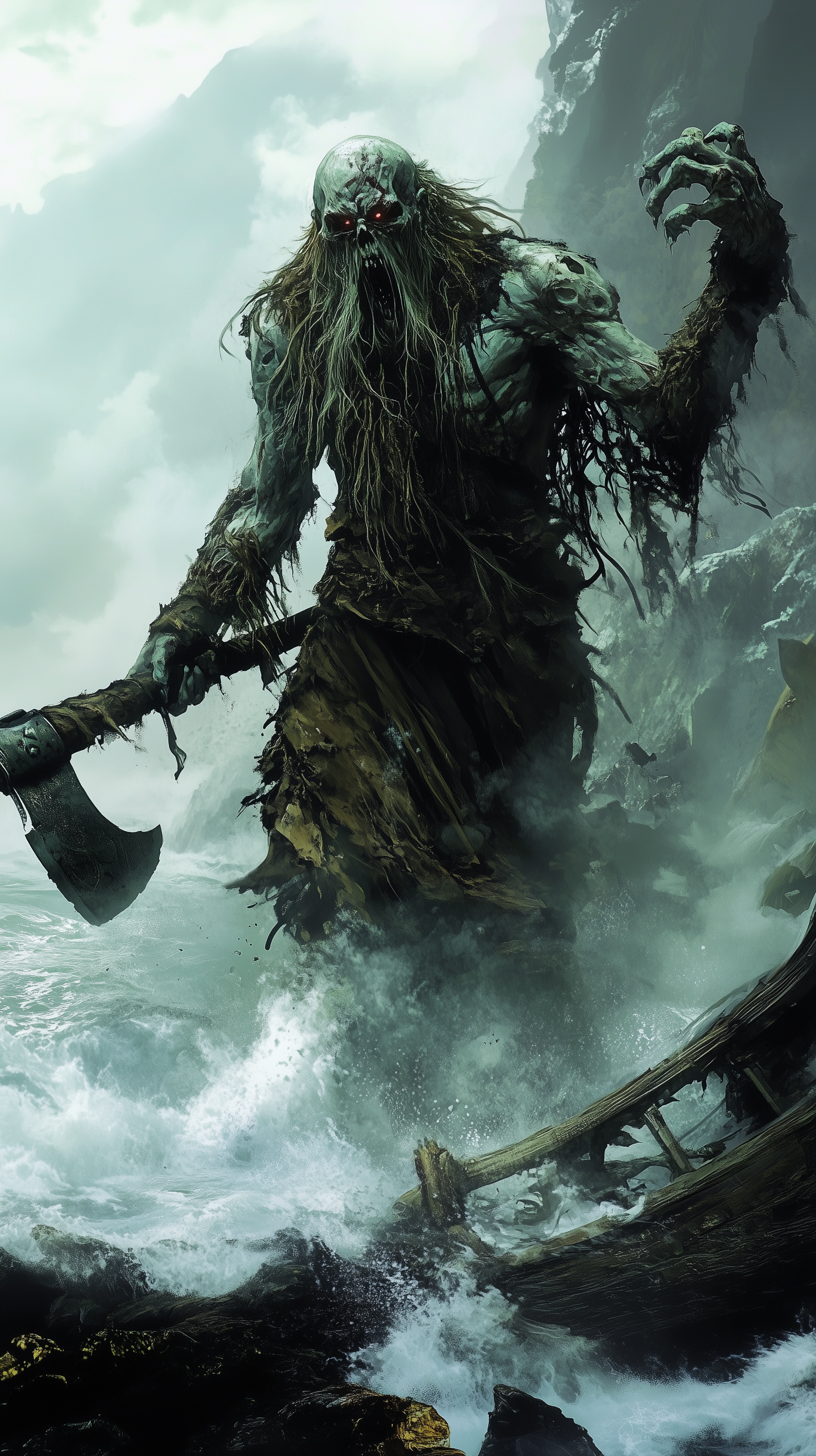
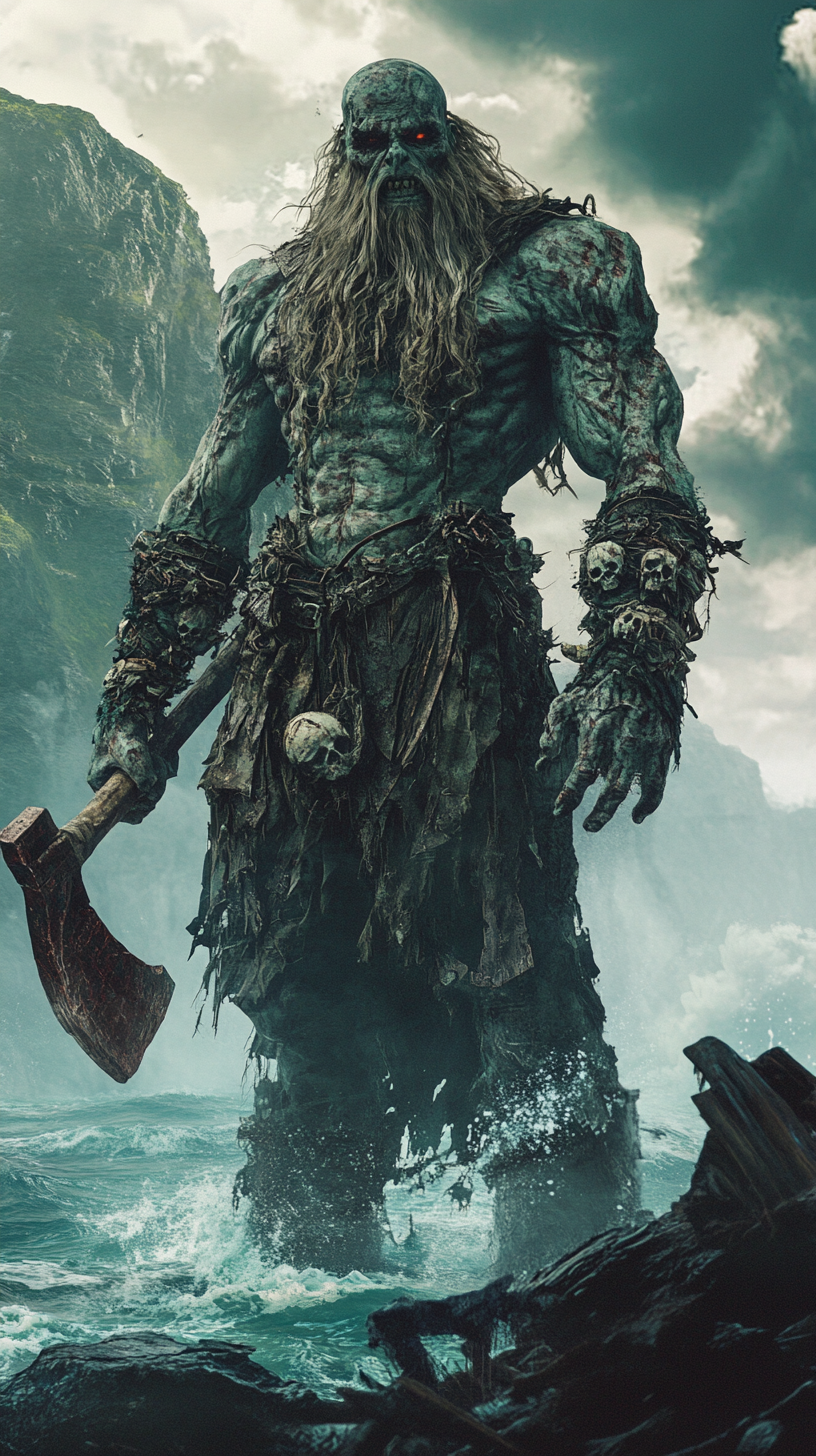
Unlike an ordinary revenant, a captain may still remember a chain of command. Its sailors obey a dead signal horn, a stamped bronze seal or a battle order that was never rescinded. It values possession of the ship or barrow almost as fiercely as the treasure itself. A living descendant may make the captain hesitate by repeating the last lawful command given before death—but a forged command can provoke immediate violence. Captain mechanics are provided separately within each edition tab above.
Adventure Hooks
The Jetty Built from the Dead
A merchant constructs a landing stage from timbers recovered from an old longship. Each night a dead oarsman removes one plank; each dawn the harbourmaster blames a rival guild. Restoring the funeral vessel prevents more deaths but ruins a trade agreement that was meant to feed the village through winter.
The Ring Beneath the Threshold
At a northern farm, a dead landowner has returned and begun moving the boundary stones. A woman finds her grandmother’s gold ring under the threshold and learns it was stolen from the landowner’s grave. Returning the ring restores one claim but may dispossess the household that sheltered the party.
Captain of the Closed Strait
Fishing boats vanish at low tide because a dead captain has closed the channel with an enchanted anchor chain. The crew cannot leave their wreck while an ancient command still binds them. The party can lift the chain, locate a surviving war standard or identify the rival captain whose false order doomed the ship.
The Corpse That Grew Too Heavy
A burial chamber is cracking; whatever lies inside is swelling with each fresh theft from its hoard. A stone mason offers to open a second route into the mound, but the local assembly forbids disturbing ancestral graves. Adventurers must choose between a legal hearing and the possibility that the creature will break into the nearby village first.
After the Encounter
Ancient arm-rings, boat fittings, iron spearheads and heirloom weapons tell more of a draugr’s history than a pile of coins. Bringing a broken grave seal back to its mound might end a haunting; smashing it can remove the last evidence of who was wrongly buried. The corpse may be burned or reburied according to the local rites, but the party should learn which story the living community will tell about what happened.
Historical and Mythical Context
In Old Norse tradition, the draugr, aptrganga (again-walker) and haugbúi (mound-dweller) belong to related accounts of the restless dead. Saga episodes show the dead as heavy, dangerous and stubbornly attached to the places or valuables they owned. These tales often focus on a confrontation between the living and the corpse, with a wrestler or brave household member forced to break the guardian’s hold.
The revenant Glámr in Grettis saga haunts people long after his death, while the saga tradition around Þórólfr bægifótr (Thorolf Twist-Foot) links destructive post-mortem haunting with farms and burial disputes. Such stories offer better clues to a saga draugr than the idea that every northern corpse is an undead pirate. The drowned sea-variant remains useful for adventures, particularly when a ship’s crew and their last orders are central to the story.
Read the direct saga tradition in Grettis saga, especially Grettir’s struggle with Glámr and the earlier mound-dweller Kárr. For further commentary on the folklore, see The Draugr — Scandinavian Archaeology. These stories are medieval literary evidence, not a single universal list of monster powers.
Watch: The Draugr of Norse Folklore
PBS Monstrum — Draugr: The Undead Nordic Zombie. A creature-specific introduction to the Norse undead, especially the contrast between physical revenants and the modern fantasy zombie. Use it for folklore and atmosphere, not as the authority for game rules.
Related Monsters and Places
For other intelligent walking dead, compare the Wight, Barrow Wight and Frost Wight. The Undead bestiary covers other grave-born threats, while Haunts offers ways to turn a burial site’s history into a supernatural encounter. For geographical connections, explore Norway, Sweden, Denmark, Orkney and the northern kingdoms.
Sources and Licensing
Folklore and story: Saga-linked descriptive material is original commentary, informed by surviving Norse revenant stories and Scandinavian Archaeology. A historical saga motif does not grant a creature a specific game ability unless it is stated in a stat block.
Pathfinder 1e: The sea-draugr CR 2 and the published Captain CR 3 variant are from Pathfinder Roleplaying Game Bestiary 2, © 2010 Paizo Publishing, LLC, referenced at Archives of Nethys. Their statistics and distinctive abilities presented here are Open Game Content under the terms of OGL v1.0a; the applicable full license and Section 15 copyright statement are included below.
D&D 2024 / 2014: Original fifth-edition campaigns conversions; terms and baseline rules conventions refer to the Creative Commons SRD 5.2.1 and CC BY 4.0 where applicable. Original powers, scenarios, artwork and campaign descriptions are not official game content.
D&D 3.5e: Original monster converted using undead and combat mechanics of the 3.5e SRD under OGL v1.0a. The 2024, 2014 and 3.5e draugr and their captains are marked as original conversions so they are not confused with Paizo’s published creature.
Open Game Content designation: Edition-native mechanics from published Pathfinder 1e and 3.5e SRD are designated Open Game Content. The original text that describes this campaign, local lore, characters, stories, encounter set pieces, original powers, site design and all illustrations remain separate and are not designated Open Game Content. Attribution does not imply endorsement by Paizo or Wizards of the Coast.
Open Game License v1.0a — complete text and copyright notices
OPEN GAME LICENSE Version 1.0a
The following text is the property of Wizards of the Coast, Inc. and is Copyright 2000 Wizards of the Coast, Inc (“Wizards”). All Rights Reserved.
1. Definitions: (a)”Contributors” means the copyright and/or trademark owners who have contributed Open Game Content; (b)”Derivative Material” means copyrighted material including derivative works and translations (including into other computer languages), potation, modification, correction, addition, extension, upgrade, improvement, compilation, abridgment or other form in which an existing work may be recast, transformed or adapted; (c) “Distribute” means to reproduce, license, rent, lease, sell, broadcast, publicly display, transmit or otherwise distribute; (d)”Open Game Content” means the game mechanic and includes the methods, procedures, processes and routines to the extent such content does not embody the Product Identity and is an enhancement over the prior art and any additional content clearly identified as Open Game Content by the Contributor, and means any work covered by this License, including translations and derivative works under copyright law, but specifically excludes Product Identity. (e) “Product Identity” means product and product line names, logos and identifying marks including trade dress; artifacts; creatures characters; stories, storylines, plots, thematic elements, dialogue, incidents, language, artwork, symbols, designs, depictions, likenesses, formats, poses, concepts, themes and graphic, photographic and other visual or audio representations; names and descriptions of characters, spells, enchantments, personalities, teams, personas, likenesses and special abilities; places, locations, environments, creatures, equipment, magical or supernatural abilities or effects, logos, symbols, or graphic designs; and any other trademark or registered trademark clearly identified as Product identity by the owner of the Product Identity, and which specifically excludes the Open Game Content; (f) “Trademark” means the logos, names, mark, sign, motto, designs that are used by a Contributor to identify itself or its products or the associated products contributed to the Open Game License by the Contributor (g) “Use”, “Used” or “Using” means to use, Distribute, copy, edit, format, modify, translate and otherwise create Derivative Material of Open Game Content. (h) “You” or “Your” means the licensee in terms of this agreement.
2. The License: This License applies to any Open Game Content that contains a notice indicating that the Open Game Content may only be Used under and in terms of this License. You must affix such a notice to any Open Game Content that you Use. No terms may be added to or subtracted from this License except as described by the License itself. No other terms or conditions may be applied to any Open Game Content distributed using this License.
3. Offer and Acceptance: By Using the Open Game Content You indicate Your acceptance of the terms of this License.
4. Grant and Consideration: In consideration for agreeing to use this License, the Contributors grant You a perpetual, worldwide, royalty-free, non-exclusive license with the exact terms of this License to Use, the Open Game Content.
5. Representation of Authority to Contribute: If You are contributing original material as Open Game Content, You represent that Your Contributions are Your original creation and/or You have sufficient rights to grant the rights conveyed by this License.
6. Notice of License Copyright: You must update the COPYRIGHT NOTICE portion of this License to include the exact text of the COPYRIGHT NOTICE of any Open Game Content You are copying, modifying or distributing, and You must add the title, the copyright date, and the copyright holder’s name to the COPYRIGHT NOTICE of any original Open Game Content you Distribute.
7. Use of Product Identity: You agree not to Use any Product Identity, including as an indication as to compatibility, except as expressly licensed in another, independent Agreement with the owner of each element of that Product Identity. You agree not to indicate compatibility or co-adaptability with any Trademark or Registered Trademark in conjunction with a work containing Open Game Content except as expressly licensed in another, independent Agreement with the owner of such Trademark or Registered Trademark. The use of any Product Identity in Open Game Content does not constitute a challenge to the ownership of that Product Identity. The owner of any Product Identity used in Open Game Content shall retain all rights, title and interest in and to that Product Identity.
8. Identification: If you distribute Open Game Content You must clearly indicate which portions of the work that you are distributing are Open Game Content.
9. Updating the License: Wizards or its designated Agents may publish updated versions of this License. You may use any authorized version of this License to copy, modify and distribute any Open Game Content originally distributed under any version of this License.
10. Copy of this License: You MUST include a copy of this License with every copy of the Open Game Content You Distribute.
11. Use of Contributor Credits: You may not market or advertise the Open Game Content using the name of any Contributor unless You have written permission from the Contributor to do so.
12. Inability to Comply: If it is impossible for You to comply with any of the terms of this License with respect to some or all of the Open Game Content due to statute, judicial order, or governmental regulation then You may not Use any Open Game Material so affected.
13. Termination: This License will terminate automatically if You fail to comply with all terms herein and fail to cure such breach within 30 days of becoming aware of the breach. All sublicenses shall survive the termination of this License.
14. Reformation: If any provision of this License is held to be unenforceable, such provision shall be reformed only to the extent necessary to make it enforceable.
15. COPYRIGHT NOTICE
Open Game License v 1.0a Copyright 2000, Wizards of the Coast, Inc.
System Reference Document, 5.0 Copyright 2016, Wizards of the Coast, Inc.; Authors Mike Mearls, Jeremy Crawford, Chris Perkins, Rodney Thompson, Peter Lee, James Wyatt, Robert J. Schwalb, Bruce R. Cordell, Chris Sims, and Steve Townshend, based on original material by E. Gary Gygax and Dave Arneson.
System Reference Document Copyright 2000-2003, Wizards of the Coast, Inc.; Authors Jonathan Tweet, Monte Cook, Skip Williams, Rich Baker, Andy Collins, David Noonan, Rich Redman, Bruce R. Cordell, John D. Rateliff, Thomas Reid, James Wyatt, based on original material by E. Gary Gygax and Dave Arneson.
Pathfinder Roleplaying Game Bestiary 2, © 2010, Paizo Publishing, LLC; Authors Wolfgang Baur, Jason Bulmahn, Adam Daigle, Graeme Davis, Crystal Frasier, Joshua J. Frost, Tim Hitchcock, Brandon Hodge, James Jacobs, Steve Kenson, Hal MacLean, Martin Mason, Rob McCreary, Erik Mona, Jason Nelson, Patrick Renie, Sean K Reynolds, F. Wesley Schneider, Owen K.C. Stephens, James L. Sutter, Russ Taylor, and Greg A. Vaughan, based on material by Jonathan Tweet, Monte Cook, and Skip Williams.
END OF LICENSE
Keep this reference growing
If this page helped with your reading or game, you can support its upkeep or explore the curated books.
Explore the Bookshop — epics, classics and stories behind imagined worlds.