
Svartalfaheim — Deep Realm of the Fey World
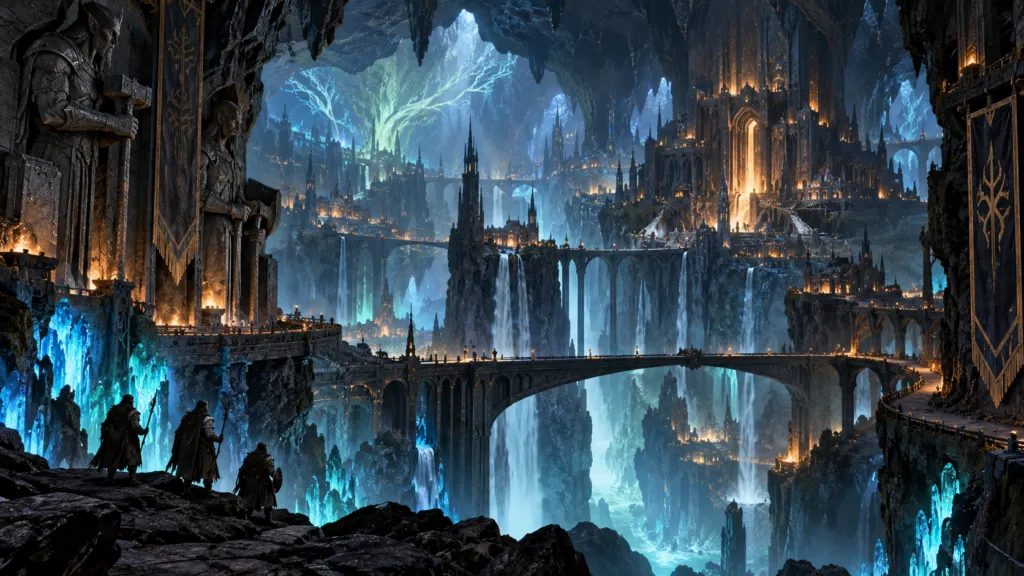
Svartalfaheim is a great subterranean realm within the Fey World. It is not a separate plane, not part of Ysgard, and not the universal homeland of dwarves. It is a dark Otherworld of immense caverns, hidden roads, night forests, under-courts, forge-cities, ancient bargains and peoples whose histories run beneath the mortal world without belonging to it.
Adventurers come here because something made below has surfaced above: a weapon no mortal smith could reproduce, a clan contract that should have ended centuries ago, a Duergar road reopening beneath an old mine, a vanished heir carried through a moonlit gate, or an Under-Court demanding payment from descendants who have never heard of the original debt.
At a Glance
| Cosmological Status | Major realm within the Fey World / Otherworld |
|---|---|
| Character | Subterranean, ancient, highly crafted, politically divided and dangerous rather than uniformly evil |
| Primary Peoples | Svartálfar, Dökkálfar, Duergar enclaves, other fey and under-earth peoples |
| Dwarves | Ancient visitors, traders, fugitives and road-builders; ordinary dwarves are not native to the whole realm |
| Government | Competing Under-Courts, forge-lords, city-holds, oath-houses and independent enclaves |
| Known For | Metalwork, gem-cutting, hidden roads, unusual materials, binding bargains, dark fey magic and impossible commissions |
| Common Routes | Fey breaches, old dwarf roads, barrows, mines, rootways of Yggdrasill and court-controlled gates |
| Great Danger | Entering somebody else’s jurisdiction without knowing it, accepting a gift without understanding its price, or following a road that remembers an older owner |
| Campaign Present | 1454 CE on Earth; time inside the realm is not always reliable |
Using Svartalfaheim in Play
Svartalfaheim is not a generic dungeon beneath the Fey World. It is a civilisation-space. Roads have owners. Mines have charters. Gates have witnesses. A forge may be older than the kingdom that now claims it. Courts recognise rank, debt, hospitality, inheritance and insult even when their rules seem alien to mortals.
The fastest way to make the realm feel distinct is to make craft and obligation as important as combat. The party may defeat a patrol and still lose because they broke safe-conduct. They may avoid a war by proving that a sword belongs to a different bloodline. They may discover that the bridge they crossed is itself part of a contract.
Pathfinder 1e Campaign Traits
| Planar Context | Realm within the Fey World; use the parent plane’s normal gravity, erratic time and highly morphic nature unless a local court stabilises its territory. |
|---|---|
| Light | Most settled regions range from dim forge-light to darkness. Local magical illumination is common and deliberately controlled. |
| Routes | Unmarked travel is unreliable. Knowledge (planes), Survival or an appropriate local guide can identify a recognised road, gate or jurisdiction. |
| Magic | Illusion, enchantment, transmutation, earth-working and crafted magic are culturally prominent. Wild or altered magic can occur in unclaimed deep regions. |
| Bargains | Breaking a witnessed formal bargain can carry social, magical or planar consequences determined by the court or power that witnessed it. |
These are SpiralWorlds campaign traits for this realm, not a claim that every published Pathfinder version of the First World uses the same local rules.
D&D 3.5e Campaign Traits
| Planar Context | A major fey subrealm. Treat it as coterminous with the broader Otherworld rather than as an independent Great Wheel plane. |
|---|---|
| Gravity | Normal in settled territories. |
| Time | Erratic by road, court and season. A traveller can leave by the same gate and still return to Earth later than expected. |
| Morphic Nature | Highly morphic in wild reaches; court domains, old roads and great forges are much more stable. |
| Magic | Local rulers can enhance, suppress or reshape magic inside bounded domains. Teleportation without a known destination or recognised road is especially unreliable. |
These are optional SpiralWorlds traits for D&D 3.5e play and should be applied consistently within a given journey or court domain.
5.5e / 2024 Campaign Rules
| Realm | Fey World / Otherworld subrealm |
|---|---|
| Gravity | Normal in inhabited regions; strange falls, inverted caverns and rootways are specific hazards rather than universal rules. |
| Time | Erratic. The GM decides the Earth-time difference when a party exits through a Fey crossing. |
| Navigation | Known roads and escorted gates are dependable. Leaving them turns travel into an exploration challenge rather than ordinary overland movement. |
| Court Law | Hospitality, witnessed bargains, ownership marks and safe-conduct have real force. Breaking them can change how the realm and its inhabitants treat a character. |
| Magic | Fey magic, illusion, transformation, stone-shaping and magical craft are common. Local courts and forges may impose specific magical conditions. |
Optional rule — Mark of Broken Bargain. When a character knowingly breaks a witnessed bargain made under an Under-Court’s authority, that court can mark the breach. Until restitution is made, the character has disadvantage on Charisma checks made to obtain hospitality, safe-conduct or formal bargains from members of that court. This is a social-planar consequence, not a universal curse on every agreement.
What Is Happening Right Now?
- A sealed Duergar road has opened again. It runs toward an Earth-side mine whose dwarf owners insist the passage was closed before their oldest clan records begin.
- Two Under-Courts claim the same forge. One holds the original deed; the other possesses the living key that makes the furnaces answer.
- Dwarf clans on Earth are tracing the Great Betrayal. Some want reconciliation with descendants left below. Others fear that opening the old roads will revive claims, feuds and obligations best left buried.
- A masterpiece has gone missing. No court will say what it is, who commissioned it, or why three separate factions are willing to kill for its return.
- The King of the Dökkálfar has sent envoys. Their demand is formally courteous, perfectly legal by their own law, and unacceptable to the court that received it.
- A root-road of Yggdrasill has become passable. Travellers are arriving from places that have not been connected to Svartalfaheim in living memory.
Peoples of Svartalfaheim
Svartálfar
The Svartálfar are one of the realm’s principal native peoples. They are elves of the deep Otherworld, associated with darkness, hidden roads, stone, metal, gem-cutting, magic and courtly craft. Their societies are not one empire and do not share one alignment, one religion or one political system.
Some Under-Courts are formal, conservative and obsessed with exact precedent. Others are predatory, beautiful and capricious. Some trade openly with dwarves and mortals. Others regard Earth as a source of raw material, stolen heirlooms and dangerously short-lived clients.
Svartálfar are not automatically equivalent to every Drow tradition. Lolth-worshipping drow can exist elsewhere in the wider setting and may enter, trade, raid or establish enclaves here, but Svartalfaheim is not defined by one spider cult or one Underdark city model.
Dökkálfar
The Dökkálfar are a related dark-elven kindred with strong ties to night, shadowed woodland, caverns and the wild borders between deep and bright Faerie. SpiralWorlds treats them as a distinct people rather than merely another spelling of Svartálfar.
The unique King of the Dökkálfar is a major ruler, not monarch of every dark elf in existence. His court is one great power among several.
Duergar
Duergar are not native creators of Svartalfaheim. They are the descendants of dwarven clans cut off during the collapse of the giant slave kingdoms in the Shattered Crown.
During the revolt, escaping dwarves sealed shafts, roads and gates behind them to stop pursuit. Entire clans remained below. Surface tradition remembers the decision as the act that saved the uprising. Duergar tradition remembers it as the Great Betrayal: the moment their own kin chose who would be abandoned.
Some trapped clans survived along roads that reached the deep Otherworld. Generations of isolation, warfare, bargains and adaptation changed them. Their descendants established enclaves and fortified marches in and around Svartalfaheim. They remain dwarven in ancestry while possessing a separate history and identity.
Dwarves and Deep Dwarves
Dwarves have ancient connections to the realm, but the distinction matters: living underground does not make a dwarf a Duergar. Deep Dwarves can maintain mines, holds and roads near Fey crossings without sharing Duergar history or transformation.
Surface clans enter Svartalfaheim as traders, smiths, emissaries, debt-collectors, relic hunters and descendants searching for lost kin. Some old dwarf roads are recognised by the Under-Courts. Others are claimed by Duergar who insist the surface clans forfeited them during the Betrayal.
Dwerg
The Dwerg, Keeper of the Buried Claim is not another dwarf subrace. It is a separate chthonic fey being associated with buried wealth, workmanship, tomb-claims and the memory carried by crafted things.
The Great Betrayal and the Old Dwarf Roads
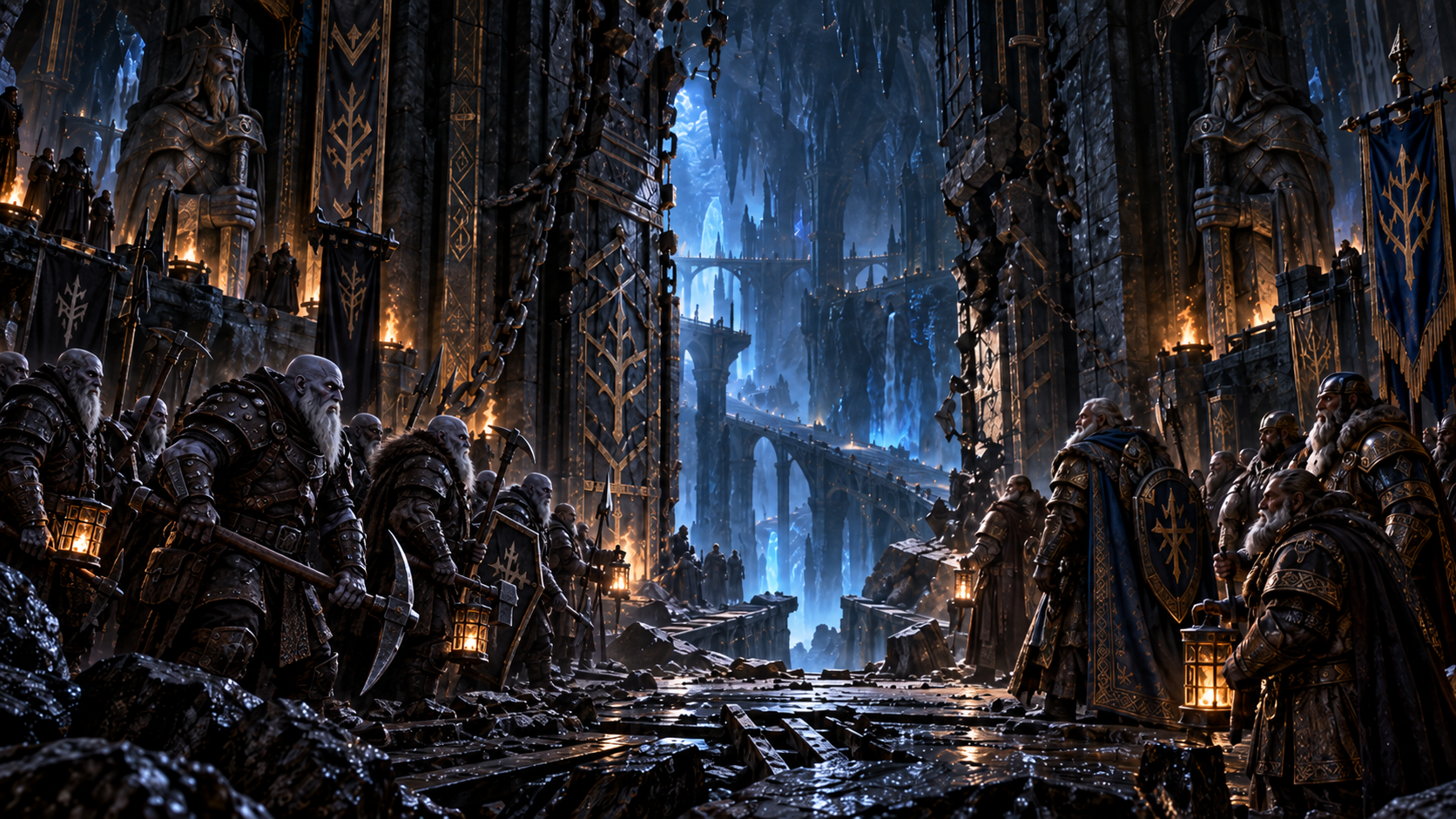
The Great Betrayal is one of the defining historical wounds connecting Earth’s dwarves to Svartalfaheim. It explains why some Duergar hate surface dwarves without reducing either people to a simple alignment stereotype.
Neither side disputes that the gates were sealed. They dispute what the act meant. Surface accounts describe desperate rebels buying time against giants, soldiers and recaptured workshops. Duergar accounts preserve names of clans, children, forge crews and wounded fighters left on the wrong side of those doors.
The argument is still alive because the roads are still there. A newly opened gate can expose a workshop untouched for geological ages, a Duergar stronghold built around an abandoned escape route, or a legal claim that names living dwarf clans as beneficiaries, debtors or traitors.
Some of those roads are still watched by golems built before the surface/deep schism became permanent. Their command marks can predate the words “surface dwarf” and “Duergar,” creating dangerous disputes over who now has the lawful right to command them.
Regions and Roads
| Region | What It Is | Why Adventurers Go There |
|---|---|---|
| The Upper Roads | Old gates, mines, barrows and tunnel systems nearest Earth and other accessible Fey crossings. | Missing travellers, clan records, smuggling, disputed gates and first contact with Under-Court law. |
| The Black Galleries | Enormous worked caverns crossed by bridges, aqueducts, abandoned processional roads and sealed halls. | Lost routes, ancient construction, salvage, political borders and things that have occupied forgotten spaces. |
| The Forge Belts | Settled industrial regions of furnaces, metal rivers, gem works, magical workshops and heavily defended storehouses. | Impossible commissions, master smiths, rare materials, sabotage and ownership disputes. |
| The Under-Courts | Territories shaped around rulers, oath-houses, markets, archives, gardens, galleries and formal law. | Diplomacy, safe-conduct, judgement, bargaining and court intrigue. |
| The Duergar Marches | Fortified enclaves controlling deep roads, mines and approaches tied to the history of the Great Betrayal. | Prisoners, ancestral claims, trade, raids and attempts at reconciliation. |
| The Nightwood Verge | Dark forests and caverns where Dökkálfar territory meets stranger Fey landscapes. | Night roads, hunts, vanished courts, wild magic and routes toward other parts of Faerie. |
| The Rootways | Rare passages tangled with the transitive structure of Yggdrasill. | Planar travel, divine errands, lost roots and journeys that bypass ordinary geography. |
| The Lightless Deeps | Unclaimed reaches below reliable maps and court authority. | Exploration, ancient ruins, dangerous fey, sealed powers and things even the Under-Courts avoid. |
The Under-Courts
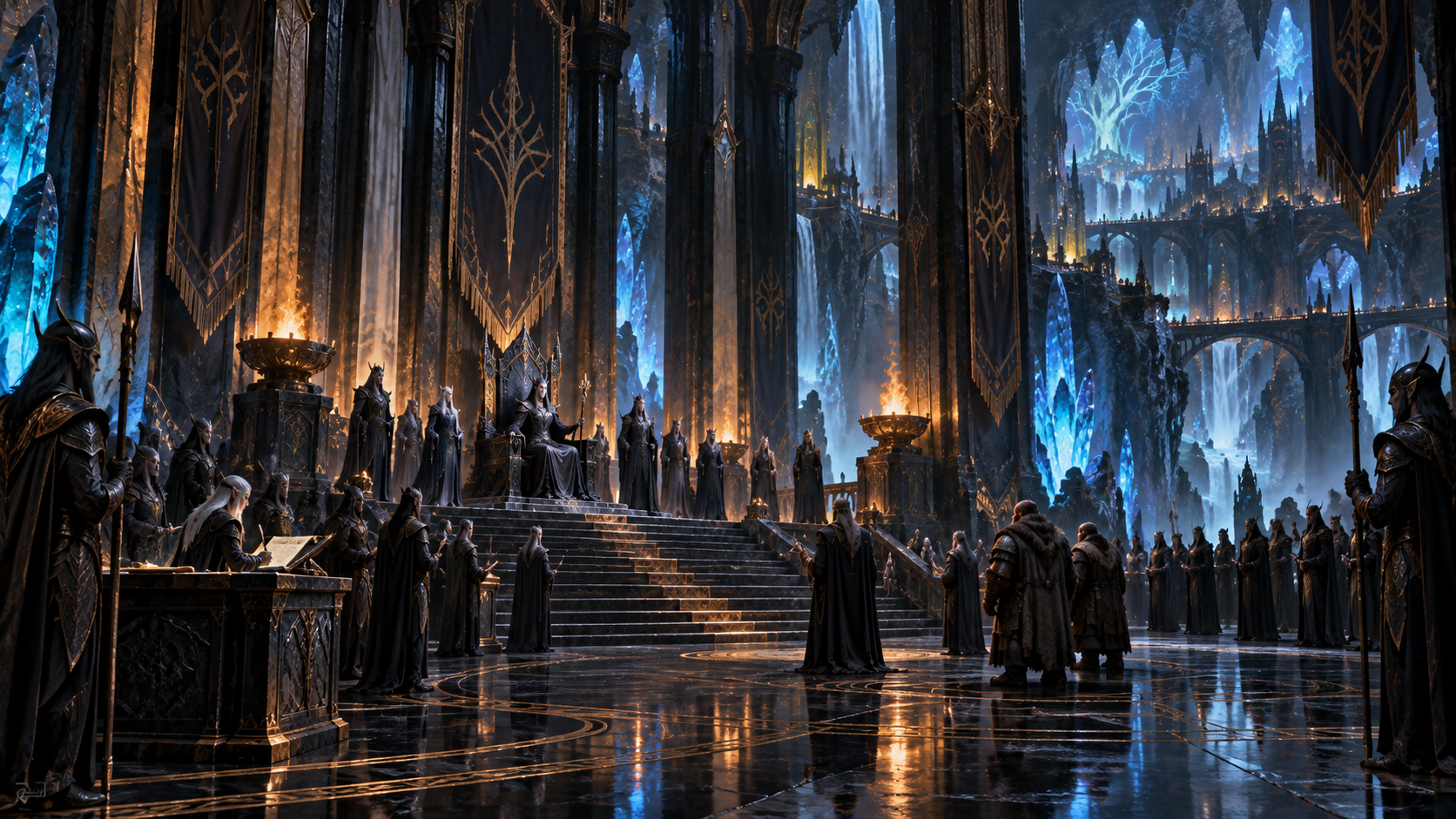
Svartalfaheim has no single universal throne. Power belongs to courts, city-holds, ancient houses, forge-masters, gate-lords and coalitions whose authority depends on territory and recognition.
An Under-Court can own a bridge but not the road beyond it. A forge-house can possess exclusive rights to one alloy but owe military service to a neighbouring court. A Duergar enclave may control a tunnel whose legal ownership is still recorded in a Svartálfar archive. A dwarf clan on Earth may hold a token that changes all three claims.
This makes Svartalfaheim political before it is monstrous. A party carrying the correct seal can cross territory that would destroy an army. A party carrying the wrong heirloom can start a war without drawing a sword.
Craft, Forges and Impossible Commissions
The realm is famous for work that combines material skill with Fey law. A lock can recognise a bloodline. A crown can refuse an unlawful claimant. A sword can carry the exact wording of the oath under which it was commissioned. A bridge can permit guests while turning against invaders.
That does not mean every local smith creates artifacts. Most inhabitants make tools, arms, jewellery, fittings, keys, engines and ordinary goods. The legendary reputation comes from masters whose commissions become part of history.
Customers should fear vague wording. “Make me a blade that cannot be defeated” is the kind of request that can produce a technically perfect disaster.
Magic and Bargain Law
Magic here behaves like the rest of the Fey World: alive to place, will, story and powerful personalities. Under-Courts stabilise their own territories by long use, law, architecture and repeated ritual. Wild regions are less dependable.
Bargains matter because the realm remembers them. A spoken promise before witnesses can affect status, hospitality, ownership and access to roads. The safest agreements are narrow, exact and witnessed by somebody both parties respect.
A gift is not automatically a bargain, but travellers should learn to ask three questions: Who made this? Who owns it? What is expected if I accept it?
Travel to Svartalfaheim
The realm is reached through the Fey World rather than by descending far enough beneath ordinary Earth. A mine can contain a breach, but digging deeper through mundane rock will not eventually reach Svartalfaheim.
Reliable entrances include old dwarf gates, Fey breaches in caves and barrows, court-controlled portals, particular mine workings, moonlit passages, deep wells and rare rootways connected to Yggdrasill. Some crossings open only under a condition: a season, a name spoken aloud, an inherited key, a specific ore in hand, or the fulfilment of an old promise.
Return is the greater danger. Time in the Fey World is erratic, and the road home may not be where the traveller left it. A party that entered from 1454 Earth can return hours later, months later, or through a different crossing unless it secured a dependable route.
Connections to Other Realms
Fey World
Svartalfaheim is part of the broader Otherworld and shares its mutable geography, breaches and dangerous relationship with time.
Alfheim
Bright and deep elven realms are connected through Fey roads, diplomacy, old kinship and rivalry, but one is not merely the moral opposite of the other.
Muspellheim / Plane of Fire
Forge routes and elemental trade connect the realms. Muspellheim remains a fire realm of the Elemental Plane of Fire, not part of Svartalfaheim.
Ysgard
Norse divine politics connect the worlds, but Svartalfaheim does not sit inside Ysgard.
Yggdrasill
Rare rootways can join Svartalfaheim to distant mythic realms without making those realms part of the same plane.
Material Earth
Earth-side mines, barrows, mountain caves and old clan roads are the most important mortal entrances in the campaign present.
Creatures and Hazards
The old page treated Svartalfaheim as a generic underground encounter table. The rebuilt realm does not assume that every subterranean or Norse-associated monster belongs here.
Use creatures that support the place: Svartálfar and Dökkálfar patrols, Duergar expeditions, chthonic fey, strange animals adapted to the Otherworld, living works of craft, ancient dwarven golems, guardians tied to a specific court, and unique deep predators. The oldest golems belong to the dwarven guardian tradition rather than the Under-Courts, although courts may capture, bargain for or attempt to control them. Undead are unusual in the Fey World and should appear because something exceptional has happened.
Fafnir, revenants, barrow wights, hell hounds, firedrakes and linnorms are not random default residents simply because an older table listed them. A unique creature can still appear when its individual story gives it a reason to be here.
Adventure Hooks
- The Door That Should Be Sealed. A dwarf mine breaks into a polished gate bearing the names of clans supposedly lost during the Great Betrayal.
- The Unpaid Sword. An Under-Court demands payment for a weapon commissioned by an Earth king centuries ago. The current dynasty insists the king never existed.
- Safe-Conduct. The party must cross three hostile territories under one court’s protection without giving any ruler a lawful excuse to revoke it.
- The Missing Master. A famous forge-master vanishes midway through an impossible commission. Every faction wants the unfinished work, but nobody wants to explain what it does.
- Descendants of the Sealed Gate. Duergar envoys offer peace to a surface dwarf clan if the clan publicly admits that its ancestors abandoned them.
- The King’s Envoy. A Dökkálfar embassy arrives with a claim based on a marriage contract older than recorded human history.
- The Rootway Opens. A Yggdrasill road appears in the Lightless Deeps and begins carrying refugees from a realm the local courts believed destroyed.
- The Gift. A party member accepts a beautiful object at a feast. Only afterward do they learn that accepting it signified agreement to act as champion in a court dispute.
Historical and Mythic Context
Norse traditions distinguish bright elves from dark or black under-earth beings and preserve overlapping names for subterranean peoples. SpiralWorlds treats those traditions as evidence of real encounters with different peoples and realms rather than forcing every medieval term into a single biological taxonomy.
The old account that dwarven beings arose from Ymir’s dead substance is retained as a real northern cosmological tradition, but its scope is limited: it concerns particular Norse under-earth lineages and creation events. It does not overwrite the much broader terrestrial history of dwarves on Earth.
Likewise, “Svartálfar,” “Dökkálfar,” “dwarf” and “Duergar” are not interchangeable words on this page. They describe peoples with related but different histories.
Related SpiralWorlds Pages
Sources, Attribution and Licensing
SpiralWorlds Canon Sources
- Fey World, Faerie, Fey Wild, Otherworld — parent-plane cosmology, travel, erratic time and morphic geography.
- Ysgard — current Norse cosmology placement, including Svartalfaheim outside Ysgard and Muspellheim in the Plane of Fire.
- Elemental Plane of Fire — Muspellheim’s current SpiralWorlds placement.
- Dwarves, Duergar and The Shattered Crown — the Great Betrayal and the distinction between Deep Dwarves and Duergar.
- Svartálfar, Dökkálfar and King of the Dökkálfar — existing peoples and unique ruler retained for further monster-page audits.
- Yggdrasill — transitive cosmic routes rather than one-plane containment.
Mythic Source Tradition
The page draws on the Norse distinction between light elves and dark/black under-earth beings, the smithing and subterranean traditions associated with dwarfs, and the wider mythic world-structure preserved in the Eddic tradition. SpiralWorlds adapts these sources into its own cosmology rather than treating any modern game setting as binding canon.
Legacy Page Audit
The former Svartalfaheim page described the realm as “the Dwarves underground Realm,” repeated the Ymir-origin statement as the origin of all dwarves, and presented several short CR-based encounter lists. The rebuild preserves the valid associations with under-earth craft, Svartálfar, Dökkálfar and Duergar while removing the universal-dwarf-homeland claim and the unsupported generic encounter tables. The legacy page contained no video embeds to preserve.
SRD 5.2.1 Attribution
This work includes material from the System Reference Document 5.2.1 (“SRD 5.2.1”) by Wizards of the Coast LLC, available at https://www.dndbeyond.com/srd. The SRD 5.2.1 is licensed under the Creative Commons Attribution 4.0 International License, available at https://creativecommons.org/licenses/by/4.0/legalcode.
Legacy Open Game Content
Mechanical terminology inside the Pathfinder 1e and D&D 3.5e campaign-trait panels is designated Open Game Content only to the extent that it derives from material already released as Open Game Content under the Open Game License version 1.0a.
No other portion of this page is designated Open Game Content. SpiralWorlds setting material, cosmology, original explanatory prose, adventure material, artwork, CSS and editorial presentation are excluded from that designation.
Open Game License v1.0a + applicable Section 15 notices
OPEN GAME LICENSE Version 1.0a
The following text is the property of Wizards of the Coast, Inc. and is Copyright 2000 Wizards of the Coast, Inc (“Wizards”). All Rights Reserved.
1. Definitions: (a) “Contributors” means the copyright and/or trademark owners who have contributed Open Game Content; (b) “Derivative Material” means copyrighted material including derivative works and translations (including into other computer languages), potation, modification, correction, addition, extension, upgrade, improvement, compilation, abridgment or other form in which an existing work may be recast, transformed or adapted; (c) “Distribute” means to reproduce, license, rent, lease, sell, broadcast, publicly display, transmit or otherwise distribute; (d) “Open Game Content” means the game mechanic and includes the methods, procedures, processes and routines to the extent such content does not embody the Product Identity and is an enhancement over the prior art and any additional content clearly identified as Open Game Content by the Contributor, and means any work covered by this License, including translations and derivative works under copyright law, but specifically excludes Product Identity; (e) “Product Identity” means product and product line names, logos and identifying marks including trade dress; artifacts; creatures characters; stories, storylines, plots, thematic elements, dialogue, incidents, language, artwork, symbols, designs, depictions, likenesses, formats, poses, concepts, themes and graphic, photographic and other visual or audio representations; names and descriptions of characters, spells, enchantments, personalities, teams, personas, likenesses and special abilities; places, locations, environments, creatures, equipment, magical or supernatural abilities or effects, logos, symbols, or graphic designs; and any other trademark or registered trademark clearly identified as Product identity by the owner of the Product Identity, and which specifically excludes the Open Game Content; (f) “Trademark” means the logos, names, mark, sign, motto, designs that are used by a Contributor to identify itself or its products or the associated products contributed to the Open Game License by the Contributor; (g) “Use”, “Used” or “Using” means to use, Distribute, copy, edit, format, modify, translate and otherwise create Derivative Material of Open Game Content; (h) “You” or “Your” means the licensee in terms of this agreement.
2. The License: This License applies to any Open Game Content that contains a notice indicating that the Open Game Content may only be Used under and in terms of this License. You must affix such a notice to any Open Game Content that You Use. No terms may be added to or subtracted from this License except as described by the License itself. No other terms or conditions may be applied to any Open Game Content distributed using this License.
3. Offer and Acceptance: By Using the Open Game Content You indicate Your acceptance of the terms of this License.
4. Grant and Consideration: In consideration for agreeing to use this License, the Contributors grant You a perpetual, worldwide, royalty-free, non-exclusive license with the exact terms of this License to Use, the Open Game Content.
5. Representation of Authority to Contribute: If You are contributing original material as Open Game Content, You represent that Your Contributions are Your original creation and/or You have sufficient rights to grant the rights conveyed by this License.
6. Notice of License Copyright: You must update the COPYRIGHT NOTICE portion of this License to include the exact text of the COPYRIGHT NOTICE of any Open Game Content You are copying, modifying or distributing, and You must add the title, the copyright date, and the copyright holder’s name to the COPYRIGHT NOTICE of any original Open Game Content You Distribute.
7. Use of Product Identity: You agree not to Use any Product Identity, including as an indication as to compatibility, except as expressly licensed in another, independent Agreement with the owner of each element of that Product Identity.
You agree not to indicate compatibility or co-adaptability with any Trademark or Registered Trademark in conjunction with a work containing Open Game Content except as expressly licensed in another, independent Agreement with the owner of such Trademark or Registered Trademark. The use of any Product Identity in Open Game Content does not constitute a challenge to the ownership of that Product Identity.
The owner of any Product Identity used in Open Game Content shall retain all rights, title and interest in and to that Product Identity.
8. Identification: If You distribute Open Game Content You must clearly indicate which portions of the work that You are distributing are Open Game Content.
9. Updating the License: Wizards or its designated Agents may publish updated versions of this License. You may use any authorized version of this License to copy, modify and distribute any Open Game Content originally distributed under any version of this License.
10. Copy of this License: You MUST include a copy of this License with every copy of the Open Game Content You Distribute.
11. Use of Contributor Credits: You may not market or advertise the Open Game Content using the name of any Contributor unless You have written permission from the Contributor to do so.
12. Inability to Comply: If it is impossible for You to comply with the terms of this License with respect to some or all of the Open Game Content due to statute, judicial order, or governmental regulation then You may not Use any Open Game Material so affected.
13. Termination: This License will terminate automatically if You fail to comply with all terms herein and fail to cure such breach within 30 days of becoming aware of such breach. All sublicenses shall survive the termination of this License.
14. Reformation: If any provision of this License is held to be unenforceable, such provision shall be reformed only to the extent necessary to make it enforceable.
15. COPYRIGHT NOTICE
Open Game License v 1.0a Copyright 2000, Wizards of the Coast, Inc.
System Reference Document. Copyright 2000, Wizards of the Coast, Inc.; Authors Jonathan Tweet, Monte Cook, Skip Williams, based on material by E. Gary Gygax and Dave Arneson.
Pathfinder Roleplaying Game Core Rulebook. © 2009, Paizo Publishing, LLC; Author: Jason Bulmahn, based on material by Jonathan Tweet, Monte Cook, and Skip Williams.
Pathfinder Roleplaying Game Reference Document. © 2011, Paizo Publishing, LLC; Author: Paizo Publishing, LLC.
END OF LICENSE
Keep this reference growing
If this page helped with your reading or game, you can support its upkeep or explore the curated books.
Explore the Bookshop — epics, classics and stories behind imagined worlds.