
Barrow Wight — The Grave That Will Not Rest
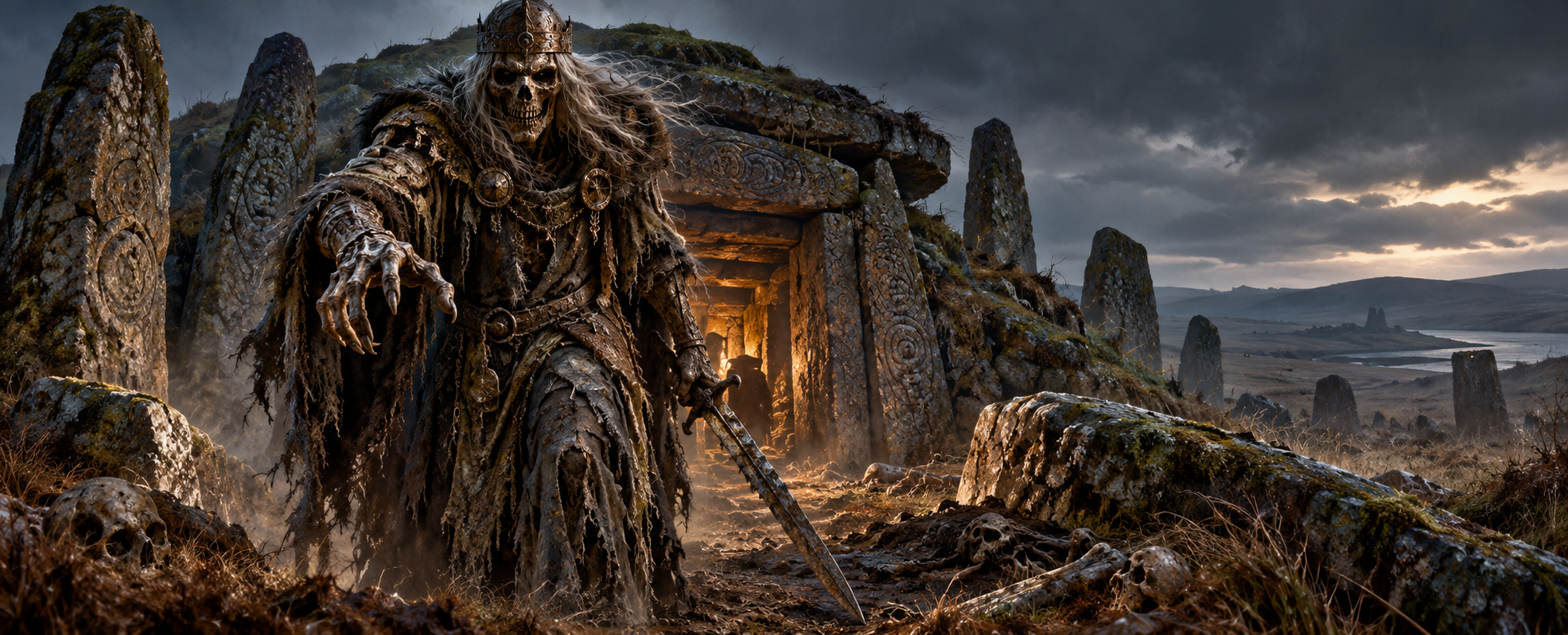
The burial mound had been sealed for generations. This morning the door stood open, and the dead man’s horn sounded from within. The villagers found wet footprints leading into the dark, but none leading out. Behind the last stone doorway, a voice speaks the name of someone who died before any living witness was born.
A Barrow Wight is a corpse animated by grave-magic, an oath or a spiteful possessing spirit. It guards burial goods and ancestral promises with more cunning than a mindless corpse. Its withered body is draped in decayed grave-cloths and rusted ornaments, its eyes glinting in green or sickly blue. Those it entices underground may be trapped by a chant, bound by supernatural dread or slain before they reach the open air.
The wight may have been a ruler, watchman, grave robber or a stranger hidden in an old lord’s tomb. Unlike an ordinary Wight, it rarely strays far from the mound that anchors it, though it can send lesser undead into nearby villages.
Barrow Wight Stat Blocks
Choose the edition being played. These are original CR 6 campaign conversions, not four identical official creatures. Edition-specific drain, saving throws, immunity and spawn timings differ; never import one edition’s mechanics into another.
Barrow Wight — D&D 2024
Medium Undead, Neutral Evil · CR 6 (2,300 XP; PB +3) · Original 2024 campaign conversion
AC 16 (grave-wrought mail); Initiative +2 (12); HP 112 (15d8 + 45); Speed 30 ft.
| STR | DEX | CON | INT | WIS | CHA |
|---|---|---|---|---|---|
| 16 (+3) | 14 (+2) | 16 (+3) | 11 (+0) | 14 (+2) | 16 (+3) |
Saving Throws Wis +5, Cha +6; Skills Perception +5, Stealth +5; Damage Resistance Necrotic; Damage Immunity Poison; Condition Immunities Exhaustion, Frightened, Poisoned; Senses Darkvision 60 ft., Passive Perception 15; Languages Common and any known in life.
Traits
Sunlight Sensitivity. In sunlight the barrow wight has Disadvantage on attack rolls and Wisdom (Perception) checks that rely on sight.
Keeper of the Mound. While standing in its burial mound, the wight always knows which sealed entrances have been opened, although it cannot identify an intruder unless it perceives one.
Actions
Multiattack. The barrow wight makes two Grave Claw attacks. It can replace one attack with Draining Touch.
Grave Claw. Melee Attack Roll +6, reach 5 ft. Hit: 10 (2d6 + 3) Slashing plus 7 (2d6) Necrotic damage.
Draining Touch. Melee Attack Roll +6, reach 5 ft. Hit: 16 (3d8 + 3) Necrotic damage. The target makes a DC 14 Constitution saving throw; on a failure its Hit Point maximum is reduced by the Necrotic damage taken until it finishes a Long Rest. The creature dies if this reduces its maximum to 0. A slain Humanoid can rise 24 hours later as a Wight under the barrow wight’s command unless revived or its corpse destroyed (maximum six servants).
Grave Command (Recharge 5–6). Two creatures the barrow wight can see within 30 feet that can hear its command each make a DC 14 Wisdom saving throw. On a failure, a creature is Paralyzed until the end of the barrow wight’s next turn.
Haunting Chant (1/Day). Creatures of its choice within 30 feet that hear its chant make DC 14 Wisdom saving throws. On a failure, they are Frightened for 1 minute, repeating the save at the end of each turn to end the effect.
Reaction
Sepulchral Withdrawal (1/Day). When damaged while inside its own mound, the wight moves up to half its Speed without provoking Opportunity Attacks. This movement cannot pass through solid walls.
Original D&D 2024 conversion. The 2024 SRD Wight is a separate CR 3 monster; the barrow’s fear and grave-command abilities are campaign inventions.
Barrow Wight — D&D 2014
Medium Undead, Neutral Evil · CR 6 (2,300 XP) · Original 2014 campaign conversion
Armor Class 15 (grave mail); Hit Points 112 (15d8 + 45); Speed 30 ft.
| STR | DEX | CON | INT | WIS | CHA |
|---|---|---|---|---|---|
| 16 (+3) | 14 (+2) | 16 (+3) | 11 (+0) | 14 (+2) | 16 (+3) |
Saving Throws Wis +5, Cha +6; Skills Perception +5, Stealth +5; Damage Resistance Necrotic; bludgeoning, piercing and slashing from nonmagical attacks that aren’t silvered; Damage Immunity Poison; Condition Immunities Exhaustion, Frightened, Poisoned; Senses Darkvision 60 ft., passive Perception 15; Languages Common and those known in life.
Traits
Sunlight Sensitivity. Disadvantage on attack rolls and sight-based Wisdom (Perception) checks in sunlight.
Actions
Multiattack. Two Grave Claw attacks; one can be replaced by Life Drain.
Grave Claw. Melee Weapon Attack: +6 to hit, reach 5 ft., one target. Hit: 10 (2d6 + 3) slashing plus 7 (2d6) necrotic damage.
Life Drain. Melee Weapon Attack: +6 to hit, reach 5 ft., one target. Hit: 16 (3d8 + 3) necrotic damage. DC 14 Constitution save or Hit Point maximum reduced by the Necrotic damage taken until the next long rest. The victim dies at a maximum of 0. A Humanoid killed by the touch rises after 24 hours as a Wight under the Barrow Wight’s control unless restored to life or its corpse destroyed; maximum six servants.
Grave Command (Recharge 5–6). Up to two creatures within 30 feet that can hear the wight make a DC 14 Wisdom saving throw or become Paralyzed until the end of the wight’s next turn.
Haunting Chant (1/Day). Each creature of the wight’s choice within 30 feet that hears it makes a DC 14 Wisdom saving throw or is Frightened for 1 minute. A creature repeats the saving throw at the end of each turn.
Reaction
Sepulchral Withdrawal (1/Day). Upon taking damage inside its mound, the wight moves 15 feet without provoking opportunity attacks, but cannot cross solid walls.
Original 2014 D&D monster based on the 2014 Wight SRD with independent barrow powers. Not the separate third-party Barrow Wight from Tome of Horrors Complete.
Barrow Wight — Pathfinder 1e
Barrow Wight · CR 6 (XP 2,400) · NE Medium Undead · Original Pathfinder 1e conversion
Init +6; Senses Darkvision 60 ft., Perception +15.
Defense
AC 20, touch 12, flat-footed 18 (+2 Dex, +8 natural); hp 75 (10d8 + 30); Fort +3, Ref +5, Will +9; Defensive Abilities undead traits, channel resistance +2; Immune undead traits.
Offense
Speed 30 ft.; Melee slam +11 (1d6 + 3 plus energy drain); Special Attacks energy drain (one negative level, Fort DC 18), grave command (1/day), haunting chant (1/day).
Statistics
| STR | DEX | CON | INT | WIS | CHA |
|---|---|---|---|---|---|
| 16 | 14 | — | 11 | 14 | 16 |
Base Atk +7; CMB +10; CMD 22; Feats Blind-Fight, Improved Initiative, Power Attack, Weapon Focus (slam), Alertness; Skills Intimidate +16, Perception +17 (includes Alertness), Stealth +15, Knowledge (religion) +13; Languages Common.
Ecology
Environment temperate or cold burial grounds; Organization solitary, pair, or tomb-guard (1 plus 2–4 lesser undead); Treasure standard, often sealed grave goods.
Special Abilities
Energy Drain (Su). Its slam bestows one negative level; the DC to remove it is 18 (Charisma-based). Each negative level bestowed grants the wight 5 temporary hit points.
Grave Command (Su; 1/day). Up to two creatures within 30 feet that can hear the wight must each attempt a DC 18 Will save or be paralyzed for 1 round. This is a mind-affecting, fear effect.
Haunting Chant (Su; 1/day). Living creatures within 30 feet that hear it make DC 18 Will saves or become shaken for 1d4 rounds; this is a sonic, mind-affecting fear effect.
Create Spawn (Su). A Humanoid slain by its energy drain can rise 1d4 rounds later as an ordinary Wight under its command; the spawn loses any abilities held in life.
Original Pathfinder 1e campaign monster, not Paizo’s standard Wight. A different third-party CR 4 Barrow Wight appears in Tome of Horrors Complete (2011); its Insanity Gaze and statistics are not reproduced here.
Barrow Wight — D&D 3.5e
Barrow Wight · Medium Undead · CR 6 · Original D&D 3.5e conversion
Size/Type Medium Undead; Hit Dice 10d12 (65 hp); Initiative +6; Speed 30 ft. (6 squares); Armor Class 19 (+2 Dex, +7 natural), touch 12, flat-footed 17.
Base Attack/Grapple +5/+8; Attack slam +9 melee (1d6 + 3 plus energy drain); Full Attack slam +9 melee (1d6 + 3 plus energy drain); Space/Reach 5 ft./5 ft.
Special Attacks energy drain, create spawn, grave command, haunting chant; Special Qualities darkvision 60 ft., undead traits, tomb sense; Saves Fort +3, Ref +5, Will +9.
Abilities Str 16, Dex 14, Con —, Int 11, Wis 14, Cha 16; Skills Hide +12, Listen +16, Move Silently +12, Spot +16; Feats Alertness, Blind-Fight, Improved Initiative, Weapon Focus (slam).
Environment Burial grounds; Organization solitary, pair, or tomb guard (1 plus 2–4 undead); Challenge Rating 6; Treasure standard; Alignment usually neutral evil; Advancement 11–15 HD (Medium), 16–20 HD (Large); Level Adjustment —.
Combat
Energy Drain (Su). A living creature hit by its slam takes one negative level; the DC to remove it is 18 (Charisma-based), and each such level gives the barrow wight 5 temporary hit points.
Create Spawn (Su). Humanoids slain by the wight may rise 1d4 rounds later as enslaved lesser wights. They cannot retain the class abilities they had in life.
Grave Command (Su; 1/day). Up to two living creatures within 30 feet that hear the wight make DC 18 Will saves or are paralyzed for 1 round (mind-affecting fear).
Haunting Chant (Su; 1/day). Living creatures within 30 feet must make DC 18 Will saves or become shaken for 1d4 rounds (sonic, mind-affecting fear).
Tomb Sense (Su). The wight knows whenever a door or burial seal within its home mound is opened, but does not automatically know the intruder’s position.
Original campaign variation on the D&D 3.5e SRD Wight; the SRD-derived energy-drain/spawn mechanics are Open Game Content under OGL 1.0a. Older third-party Dread Codex transformation rules are distinct and not reproduced in this block.
What Is Happening Right Now?
A burial mound on the old border road has begun ringing a horn at dawn. Travellers who hear it report dreaming of a banquet held by dead warriors. The keeper of the mound wants back a bronze clasp stolen from his funeral cloak, but the thief sold it to the local reeve, who has used the metal to fasten a document sealing a disputed boundary. Returning the clasp might quiet the grave; it might also break the reeve’s claim and reopen a feud between the living.
Where They Are Found
In Orkney, storm-washed mounds shelter dead chiefs who remember who robbed their burial boats. In the Scottish Borders, a marcher’s cairn may sit beneath a contested boundary stone. Along the Welsh Marches, a hillfort’s graves may be older than the walls built over them. Some mounds are guarded by living families who fear disturbing the dead more than they fear the tolls demanded by their lord.
Locals know the difference between a tomb that has always been dangerous and one recently awakened. Fresh mud on an ancient threshold, a missing offering or broken burial oath may tell adventurers what changed. Not every tomb marked by old bones conceals a wight; some are peaceful ancestors’ resting places, and violating them can make the party the villains of the story.
Behaviour
The barrow wight sits in stillness for days or years. It knows the order in which grave goods were laid down, the weight of a stone seal and the voices of descendants whose families have guarded the mound. It can speak gently from darkness, promising forgotten treasure or returning a stolen name to its rightful owner. Many are cruel, patient tormentors who delight in binding victims in funeral wrappings, yet a wight compelled by a particular oath can sometimes accept restitution.
Its needs differ from those of a battlefield wight. It does not have to hunt every night, and it may never leave the mound itself. Instead, an enthralled servant collects tokens, lures thieves inside or arranges for an enemy to be buried on top of an older grave. Destroying a servant without understanding the order that binds it can simply bring the next victim.
If Violence Starts
The wight attacks the intruder nearest its burial goods first, unless another carries the object it seeks. It tries to use its chant before committing to close combat, and then reserves Grave Command for anyone rushing to free a helpless companion. The narrow chamber favours the guardian: two adventurers might be unable to stand side by side in its doorway while the wight retreats behind a sliding stone.
Describe the danger before applying it. Dust swirls around a sealed door, an extinguished torch begins to smoke blue, and the sound of chanting can be heard through the stone. Clever players can deafen themselves to the chant, stop a door from closing, break the grave seal from outside, or bargain using the dead guardian’s true name. If hurt badly, a cautious wight offers a truce, withdraws behind a second door or defends the burial chamber to the end. It cannot become incorporeal or restore itself to full health for free in these rules.
Signs of the Wight
A bronze funerary bell ringing where there is no wind. Fresh soil on an old burial slab. Coins stacked in a new pattern overnight. An iron sword drawn half an inch from its sheath, though the tomb has been locked for a hundred years. A traveller speaking in an ancient accent after hearing a voice at the mound. A line of skulls turned to face the entrance. These clues should give players decisions, not merely warn them of unavoidable combat.
Using the Barrow Wight in Play
Introduce the mound as a place with history, not a treasure room with a monster. Give it two possible entrances and one secret that can be learned outside: a family dispute, a stolen burial ring or an inscription identifying whom it was meant to protect. A dangerous encounter becomes fairer when the party can choose whether to enter, lure the guardian outside, return a grave good or ask a relative to speak on its behalf.
Encounter scale. Four adventurers around level 5–6 may find one CR 6 guardian a serious opponent, depending on edition, preparation and available magic. At lower levels use its clues, servants or demands as an investigation rather than force a direct fight. Additional Skeletons and Zombies may raise the encounter difficulty substantially, particularly if a narrow doorway splits the group.
Grave veil, optional variant. Some barrow wights are genuinely incorporeal shades capable of passing through solid stone, unlike the material corpse in the four blocks above. If using this version, rebuild the creature’s AC, attacks, defenses and effective challenge; do not silently add the benefit to an already dangerous guardian.


Adventure Encounters
The Stolen Funeral Clasp
A reeve orders the party to empty a hill barrow because its horn frightens travellers. The wight will cease its warnings if a stolen clasp is returned, but the clasp currently secures a charter giving the reeve a neighbouring family’s land. The players can recover the metal, expose the forged document or destroy the wight before it begins calling its dead retainers out of the mound. Which grievance deserves justice?
The Seven Stones
Six standing stones mark a burial circle. When the seventh is uncovered during road building, travellers lose their memories of the previous night and begin carrying grave goods to the wrong chamber. A barrow wight has mistaken the site for the shrine of its former ruler. The adventurers may reseal the entrance, identify the buried heir or persuade the workers to change the new road, at the cost of angering the merchant who funded it.
A Name for the Dead
A family keeps a funeral torch burning each winter, insisting that the wight in the nearby mound is their disgraced ancestor. The flame goes out, and a child vanishes after whispering that the dead one knows her true name. The wight seeks the name erased from its grave stone by a surviving rival. Recovering an old roll of the dead will let it finally rest—but the rival’s descendants would rather a child be sacrificed than their inheritance questioned.
Remains and Rewards
Broken grave ornaments, bronze clasps, ancient coins and heirloom weapons survive where the corpse does not. A charter found in the burial chest may be more useful than treasure because it changes who owns land or who must fulfill an oath. Some grave goods should be returned to living descendants or reburied; claiming everything can invite the attention of another guardian.

Barrow Wights in Folklore and Fiction
The English word wight once referred to a person or creature, while barrow names an ancient burial mound. Restless grave-dwellers in northern storytelling include the Draugr; tales of the dead wrestling the living and guarding buried wealth make a powerful basis for a tomb encounter. Later fantasy made the barrow-wight especially famous as a spectral presence of haunted burial hills.
These are related ideas, not a single historical species. The creatures described here follow their own campaign rules. The third-party Pathfinder CR 4 Barrow Wight from Tome of Horrors Complete has different abilities, including an insanity gaze. The 2004 Dread Codex by Bret Boyd also presented a barrow-wight template. Those are separate third-party interpretations and have not been reproduced as official rules here.
Watch: Barrow-wights of the Burial Mounds
Nerd of the Rings — Barrow-downs & Barrow-wights: Tolkien Explained. A focused exploration of a well-known literary portrayal of the creature, useful for atmosphere and burial-hill storytelling. It is not a source of D&D or Pathfinder mechanics.
Related Creatures and Places
The Wight and Frost Wight prey more directly on living vitality. Compare Wraiths, Ghosts, Undead and Haunts; older British graves tie this monster to Orkney, the Scottish Borders and the Welsh Marches.
Sources and Licensing
D&D 2024 and 2014: Original Barrow Wight conversions, distinguished from the published Wight; foundational Wight references are SRD 5.2.1 and SRD 5.1. Attribution for source-derived content is under their respective CC BY 4.0 releases: Creative Commons Attribution 4.0 International. The conversions’ added abilities are original homebrew.
Pathfinder 1e and D&D 3.5e: Original conversions using the baseline mechanics of the D&D 3.5e SRD Wight. Open Game Content designation: The underlying 3.5e SRD energy-drain, undead and spawn mechanics reproduced within the 3.5e and Pathfinder tabs are Open Game Content under OGL 1.0a. Original scenarios, setting lore, illustrations, design, optional powers and other campaign material on this page are not designated Open Game Content. Complete OGL 1.0a terms and applicable Section 15 notices follow.
Third-party distinctions: The CR 4 Barrow Wight from Tome of Horrors Complete, © 2011 Necromancer Games, published by Frog God Games, and the Dread Codex template attributed to Bret Boyd (2004) are independently licensed material; this entry does not reproduce their distinct stat blocks or template instructions. The illustrations are separate from the cited game mechanics and are not presented as publisher artwork. Source credits do not imply endorsement.
Open Game License v1.0a — complete text and copyright notices
OPEN GAME LICENSE Version 1.0a
The following text is the property of Wizards of the Coast, Inc. and is Copyright 2000 Wizards of the Coast, Inc (“Wizards”). All Rights Reserved.
1. Definitions: (a)”Contributors” means the copyright and/or trademark owners who have contributed Open Game Content; (b)”Derivative Material” means copyrighted material including derivative works and translations (including into other computer languages), potation, modification, correction, addition, extension, upgrade, improvement, compilation, abridgment or other form in which an existing work may be recast, transformed or adapted; (c) “Distribute” means to reproduce, license, rent, lease, sell, broadcast, publicly display, transmit or otherwise distribute; (d)”Open Game Content” means the game mechanic and includes the methods, procedures, processes and routines to the extent such content does not embody the Product Identity and is an enhancement over the prior art and any additional content clearly identified as Open Game Content by the Contributor, and means any work covered by this License, including translations and derivative works under copyright law, but specifically excludes Product Identity. (e) “Product Identity” means product and product line names, logos and identifying marks including trade dress; artifacts; creatures characters; stories, storylines, plots, thematic elements, dialogue, incidents, language, artwork, symbols, designs, depictions, likenesses, formats, poses, concepts, themes and graphic, photographic and other visual or audio representations; names and descriptions of characters, spells, enchantments, personalities, teams, personas, likenesses and special abilities; places, locations, environments, creatures, equipment, magical or supernatural abilities or effects, logos, symbols, or graphic designs; and any other trademark or registered trademark clearly identified as Product identity by the owner of the Product Identity, and which specifically excludes the Open Game Content; (f) “Trademark” means the logos, names, mark, sign, motto, designs that are used by a Contributor to identify itself or its products or the associated products contributed to the Open Game License by the Contributor (g) “Use”, “Used” or “Using” means to use, Distribute, copy, edit, format, modify, translate and otherwise create Derivative Material of Open Game Content. (h) “You” or “Your” means the licensee in terms of this agreement.
2. The License: This License applies to any Open Game Content that contains a notice indicating that the Open Game Content may only be Used under and in terms of this License. You must affix such a notice to any Open Game Content that you Use. No terms may be added to or subtracted from this License except as described by the License itself. No other terms or conditions may be applied to any Open Game Content distributed using this License.
3. Offer and Acceptance: By Using the Open Game Content You indicate Your acceptance of the terms of this License.
4. Grant and Consideration: In consideration for agreeing to use this License, the Contributors grant You a perpetual, worldwide, royalty-free, non-exclusive license with the exact terms of this License to Use, the Open Game Content.
5. Representation of Authority to Contribute: If You are contributing original material as Open Game Content, You represent that Your Contributions are Your original creation and/or You have sufficient rights to grant the rights conveyed by this License.
6. Notice of License Copyright: You must update the COPYRIGHT NOTICE portion of this License to include the exact text of the COPYRIGHT NOTICE of any Open Game Content You are copying, modifying or distributing, and You must add the title, the copyright date, and the copyright holder’s name to the COPYRIGHT NOTICE of any original Open Game Content you Distribute.
7. Use of Product Identity: You agree not to Use any Product Identity, including as an indication as to compatibility, except as expressly licensed in another, independent Agreement with the owner of each element of that Product Identity. You agree not to indicate compatibility or co-adaptability with any Trademark or Registered Trademark in conjunction with a work containing Open Game Content except as expressly licensed in another, independent Agreement with the owner of such Trademark or Registered Trademark. The use of any Product Identity in Open Game Content does not constitute a challenge to the ownership of that Product Identity. The owner of any Product Identity used in Open Game Content shall retain all rights, title and interest in and to that Product Identity.
8. Identification: If you distribute Open Game Content You must clearly indicate which portions of the work that you are distributing are Open Game Content.
9. Updating the License: Wizards or its designated Agents may publish updated versions of this License. You may use any authorized version of this License to copy, modify and distribute any Open Game Content originally distributed under any version of this License.
10. Copy of this License: You MUST include a copy of this License with every copy of the Open Game Content You Distribute.
11. Use of Contributor Credits: You may not market or advertise the Open Game Content using the name of any Contributor unless You have written permission from the Contributor to do so.
12. Inability to Comply: If it is impossible for You to comply with any of the terms of this License with respect to some or all of the Open Game Content due to statute, judicial order, or governmental regulation then You may not Use any Open Game Material so affected.
13. Termination: This License will terminate automatically if You fail to comply with all terms herein and fail to cure such breach within 30 days of becoming aware of the breach. All sublicenses shall survive the termination of this License.
14. Reformation: If any provision of this License is held to be unenforceable, such provision shall be reformed only to the extent necessary to make it enforceable.
15. COPYRIGHT NOTICE
Open Game License v 1.0a Copyright 2000, Wizards of the Coast, Inc.
System Reference Document Copyright 2000-2003, Wizards of the Coast, Inc.; Authors Jonathan Tweet, Monte Cook, Skip Williams, Rich Baker, Andy Collins, David Noonan, Rich Redman, Bruce R. Cordell, John D. Rateliff, Thomas Reid, James Wyatt, based on original material by E. Gary Gygax and Dave Arneson.
END OF LICENSE
Keep this reference growing
If this page helped with your reading or game, you can support its upkeep or explore the curated books.
Explore the Bookshop — epics, classics and stories behind imagined worlds.