
Union of Midgard (Scandinavia)
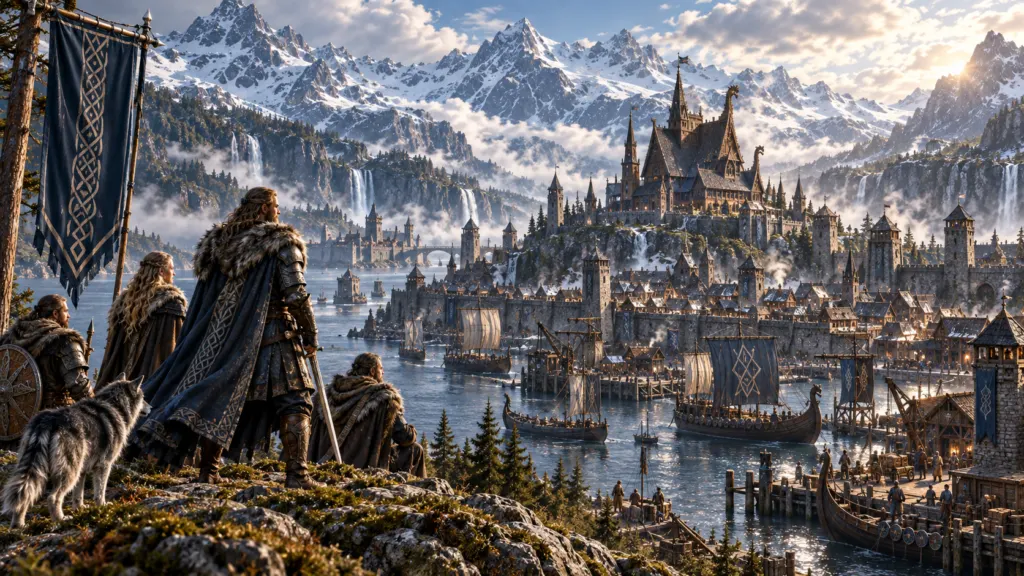
At a Glance
| Region | Northern Europe and the North Atlantic |
|---|---|
| Political Form | Fractured union of Scandinavian crowns, kingdoms, heroic houses and overseas territories |
| Principal Realms | Denmark, Norway, Sweden, Finland, Iceland and Greenland |
| Rival Crowns | Christian I in Denmark and Norway; Charles VIII in Sweden and Finland |
| Major Powers | Royal courts, jarls and noble houses, thing assemblies, heroic dynasties, temple authorities, merchant leagues, independent dwarf holds and supernatural territorial powers |
| Faith | Asgardian gods, Finnish gods, local cults, ancestral rites and sacred powers |
| Languages | Danish, Norwegian, Swedish, Icelandic/Norse, Finnish, Sámi, Karelian and regional languages; Middle Low German is important in international trade |
| Planar Connections | Yggdrasill, Asgard and Ysgard, divine roads, dwarf routes and other northern world-crossings |
| Overseas Reach | Faroe Islands, Iceland, Greenland, Vinland, the Norse Delaware colony and wider North Atlantic routes |
| Supernatural World | Trolls, draugr, giants, hidden folk, sea-beasts, spirits, dwarves and other creatures of the Midgard Bestiary |
| Campaign Themes | Broken crowns, sea voyages, monster hunting, heroic dynasties, trade wars, ancient rights, planar journeys, exploration and supernatural diplomacy |
| Danger | High outside protected settlements; extreme in some mountain, winter, sea, burial and planar regions |
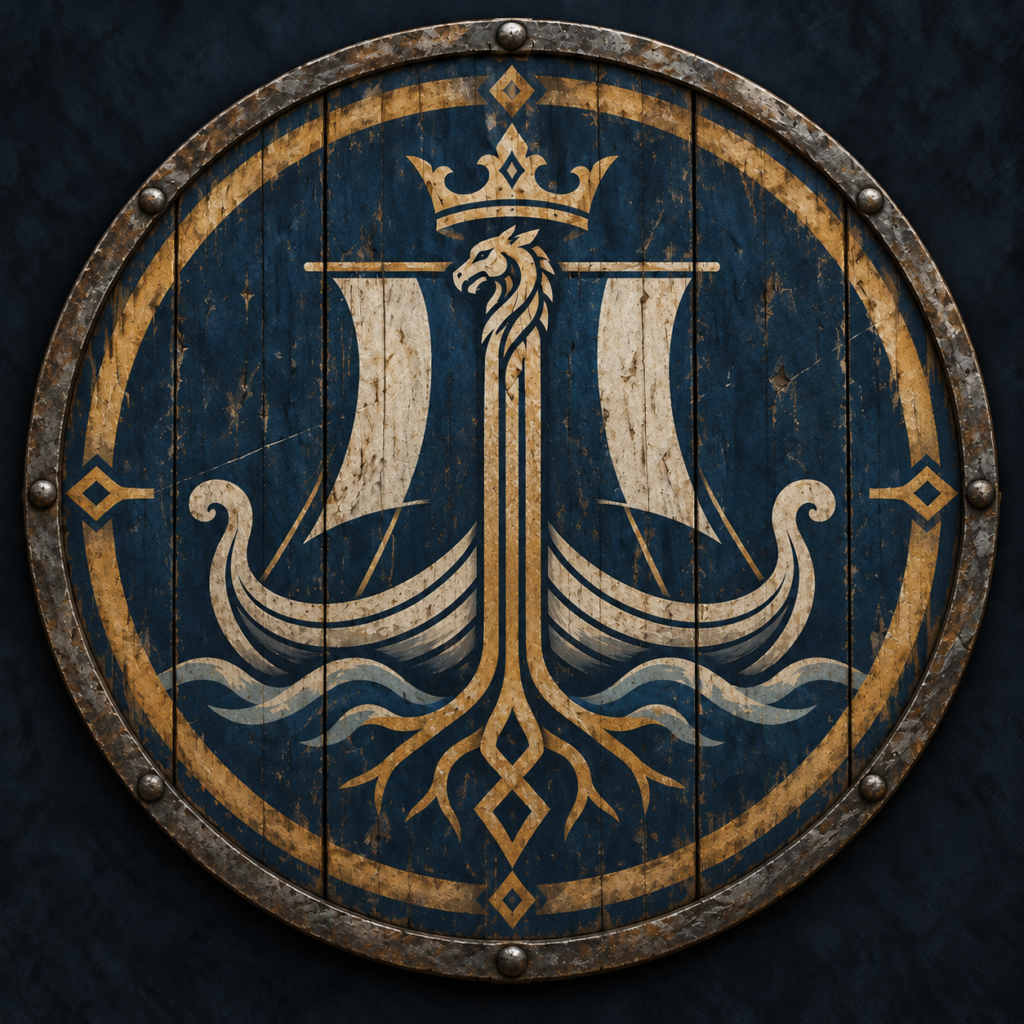
Midgard is a northern world of cold seas, wealthy ports, rival kings, runed halls, monster-haunted wilderness and roads that do not all remain on Earth. Merchant ships cross the Baltic beneath carved prows and bright banners. Longships still carry raiders, explorers, royal messengers and adventurers, but they share the water with larger cogs, cargo vessels and heavily armed ships of a sophisticated late-medieval maritime civilisation. Mountain roads enter territories claimed by dwarves and jötnar. Burial mounds can still enforce ownership. Sacred trees sometimes open onto roads between worlds.
The Union of Midgard once bound Denmark, Norway and Sweden beneath a shared crown. That crown is now divided. Christian I rules Denmark and Norway while Charles VIII holds Sweden and Finland. Neither side regards the northern political question as settled. Nobles change allegiance, merchants profit from competing privileges, old royal houses remember older claims, and powerful regional leaders have enough followers to complicate any king’s plans.
This is not a civilisation frozen in the Viking Age. Norse society has continued to build, trade, invent, fight and govern for centuries without abandoning the gods and traditions that shaped it. Timber halls have grown into great civic and royal complexes. Stone fortifications guard ports. Rune traditions remain alive. Warriors use axes and swords beside polearms, crossbows and the developing weapons of the fifteenth century. Skalds share courts with scholars, navigators and artificers.
The supernatural is equally present. A shipmaster may offer to Njörðr before crossing dangerous water. A Finnish hunting party may seek favour from the powers of the forest and lake. A barrow may contain a draugr who considers the surrounding farm legally his. Gods, spirits and monsters are not explanations invented after something strange happens; they are part of the world people already live in.
For adventurers, the North is connected in every direction. Sail west and the sea-road reaches Iceland, Greenland, Vinland and established settlements in North America. Travel farther than geography permits and a sacred ash, burial mound, dwarf road or oath-bound crossing may lead onto Yggdrasill itself. From there, a sufficiently fortunate—or sufficiently summoned—traveller might reach Asgard.
Campaign Map
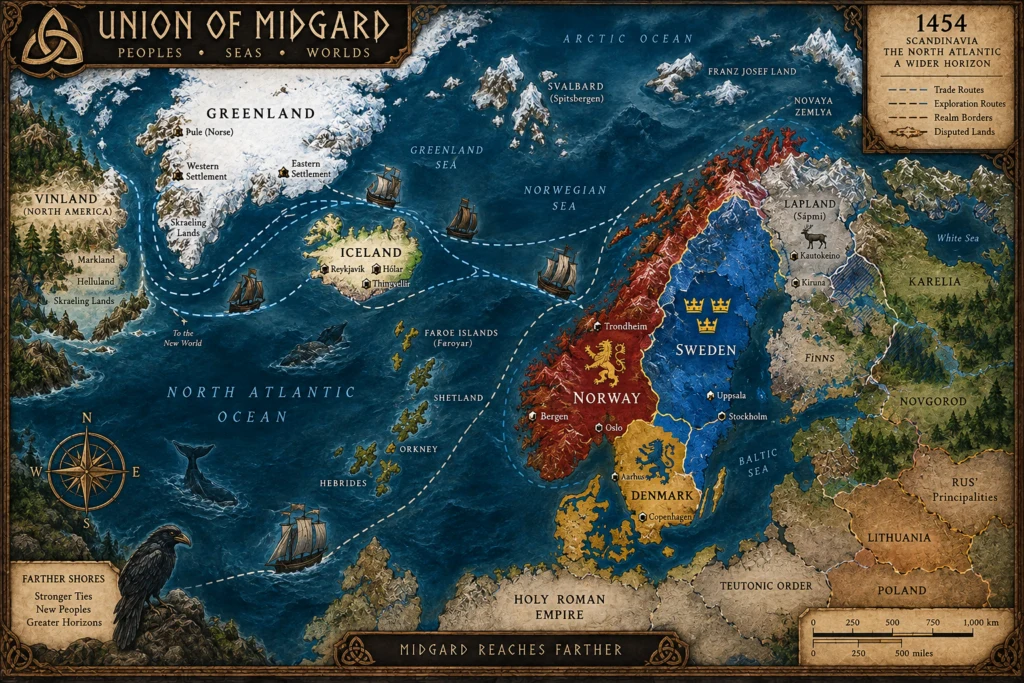
The campaign map shows the political fracture of the northern crowns, major ports, the North Atlantic sea-road and the relationship between Scandinavia, Iceland and Greenland. Planar connections are part of Midgard’s wider geography but are not represented as ordinary terrestrial roads.
What Is Happening Right Now?
The greatest danger in Midgard is not that civilisation is collapsing. It is that several strong versions of its future are competing at once.
The Union Has Fractured
Christian I holds Denmark and Norway. Charles VIII holds Sweden and Finland. The old union remains legally, politically and emotionally important even though no single ruler currently controls all three crowns. Unionists want the crowns reunited. Their opponents fear that reunion means domination by whichever king wins.
The Old Powers Are Close
Gods, giants, hidden folk, draugr, sea-beasts and heroic houses all shape everyday politics. A royal dispute can become a divine matter, a trade route can cross troll or jötunn territory, and a burial claim can still be enforced by the dead. The creatures of the Midgard Bestiary belong to the landscape rather than appearing as random encounters.
The Atlantic Is Becoming Rich
The western sea-road no longer ends at Greenland. Norse communities maintain routes through Vinland and onward to a permanent Delaware trading colony. Ships return carrying timber, furs, food, unfamiliar goods, stories of inland nations and rumours that encourage another generation of captains to sail west.
The Gods Have Interests
The powers of the Asgardian Pantheon are involved in kingship, war, sea travel, law, prosperity and prophecy, while the Finnish Pantheon remains deeply embedded in Finland’s forests, waters, storms, smithing traditions and sacred landscapes.
The Roads Between Worlds Remain Open
Known crossings to Yggdrasill are watched, bargained over and sometimes deliberately concealed. Some open through sacred trees, wells, burial places or old judgement grounds. Others belong to dwarf guides, divine messengers or powers that do not recognise mortal sovereignty.
Everyone Watches for Ragnarök
Ragnarök is a real prophecy, but it has not begun. Omens are politically dangerous. Kings seek interpretations. Cult leaders disagree. Charlatans manufacture signs. Genuine warnings are easily mistaken for propaganda until something impossible happens.
Why Adventurers Come to Midgard
- Serve rival crowns. Carry messages, escort negotiators, investigate treason, recover seals, expose false claims or keep a border dispute from becoming war.
- Hunt monsters. Settlements pay for help when creatures from the Midgard Bestiary threaten roads, farms, halls and shipping.
- Join a western voyage. Escort a Greenland convoy, seek Vinland, protect Norse Delaware, map a new route or discover why a ship returned with its crew missing.
- Negotiate with nonhuman powers. Dwarf holds, hidden folk and jötunn courts have their own laws, territory and diplomacy.
- Serve a temple or god. Divine disputes, stolen relics, broken oaths and supernatural messages can draw adventurers into the affairs of the Asgardian or Finnish gods.
- Recover saga treasures. Famous weapons, cursed rings, royal heirlooms and disputed hoards can change living political struggles.
- Travel between worlds. A ruler, temple, dwarf lord or divine envoy may need agents willing to enter Yggdrasill or reach Asgard.
- Make money. Baltic commerce, North Atlantic trade, rare northern materials, monster parts, dwarf craft and colonial ventures can make a capable company rich.
- Escape elsewhere. Outlaws, failed claimants, debtors and defeated warriors can disappear into forests, sea-roads or western settlements—if their enemies do not find them first.
The Northern Realms
Denmark — The Crown at the Narrows
Denmark sits across the routes between the North Sea and Baltic. Its islands, straits, royal ports and fortified approaches give Christian I wealth and leverage far beyond the kingdom’s size. Copenhagen is becoming an increasingly important royal and commercial centre, and the court watches Sweden as closely as it watches foreign fleets.
Denmark’s political drama centres on Christian I, the royal court, competing noble houses, strategic ports and the merchants who depend upon the Baltic approaches. Royal authority is substantial but never absolute, and Denmark’s position at the narrows makes almost every northern commercial or military dispute somebody’s opportunity.
The sea shapes religious life as much as commerce. Sailors seek favourable winds and safe passage from powers associated with the Asgardian Pantheon, while coastal settlements maintain their own rites against storms, drowned dead and the creatures that follow ships from deep water. The difference between piracy, monster hunting and royal naval service can become surprisingly narrow.
Use Denmark for: court intrigue, fleet politics, royal missions, monster-haunted islands, Baltic trade, temple interests and conflicts between crown authority and powerful sea-lords.
Key destinations: Copenhagen, Heligoland and the old site of Hedeby. Hedeby’s great trading age belongs to the past; its earthworks, buried wealth and strategic position make it far more useful now as an archaeological, haunted and contested adventure site.
Norway — Fjords, Mountains and the Western Sea
Norway remains a separate kingdom under Christian I, with its own interests, nobles, law and councils. The coast is a chain of natural sea-roads divided by steep country. Inland travel can be slow and dangerous, while ships link communities that mountains keep apart.
Norway is one of the strongest places in Midgard for campaigns in which mortal and nonhuman sovereignty overlap. Dwarf workshops and hidden roads penetrate the mountains. Troll claims linger around old crossings. Jötnar remember boundaries older than royal charters. Fjords and offshore waters contain creatures recorded in the Midgard Bestiary, and a mountain expedition can become a diplomatic problem long before it becomes a fight.
Ragnar Lothbrok and his sons Björn Ironside and Ivar the Boneless are Norwegian powers whose ships, followers and ambitions reach far beyond their homeland. Lagertha is an independent Norwegian commander and political force in her own right, while Aslaug is central to Ragnar’s household and dynastic network. Örvar-Odd belongs to the great northern voyaging tradition.
Njörðr’s sea cults, Thor’s protection against hostile powers and Ullr’s authority in winter travel all matter practically here. A captain, hunter or mountain traveller who treats the northern gods as decoration rather than participants in the world is likely to learn otherwise.
Use Norway for: fjord voyages, dwarf diplomacy, giant borders, monster hunts, mountain expeditions, royal politics, temple obligations and western exploration.
Key destinations: Bergen and the Faroe Islands, the great western commercial port and one of the principal doors to the North Atlantic.
Sweden — The Rival Northern Crown
Charles VIII rules Sweden while Christian I seeks a settlement favourable to his own claim. Stockholm controls the approaches to the Mälaren world, but Sweden is not a single cultural block. Svealand, Geatland, mining regions, forests, Baltic coasts and distant northern territories contain different loyalties and powers.
Burial country and old royal landscapes make Sweden particularly dangerous when inheritance, politics and the dead overlap. Draugr, barrow-haunters and other creatures of the Midgard Bestiary can turn an argument about ancestry into something physically lethal.
Some of Midgard’s most formidable houses operate here. Beowulf stands among the Geats as a renowned monster-slayer and ruler. Dyggvi, Dag the Wise and Agne belong to the Yngling political world. Angantyr, Arngrim, Hervor and Heidrek form part of the Tyrfing-linked dynastic struggle.
Uppsala and the wider royal world give the Asgardian gods direct political importance. Freyr matters to prosperity and kingship; Odin to dangerous wisdom and royal ambition; Týr to oath and judgement. A Swedish succession dispute can therefore attract priests, prophets and divine messengers alongside nobles and soldiers.
Use Sweden for: rival kingship, dynastic intrigue, heroic courts, monster hunting, sacred politics, forest travel, ancient mound sites, mining wealth and Baltic expeditions.
Key destinations: Stockholm, Uppsala and Birka. Birka is an old trading centre whose principal urban life ended centuries ago; its harbour landscape, fortifications, graves and buried trade wealth now make it an exceptional adventure site rather than a normal working city.
Finland — Forests, Lakes and the Eastern Frontier
Finland lies within the Swedish political sphere but has its own languages, communities and traditions. The southwest is increasingly bound into Baltic trade and royal administration while great forest, lake and northern regions remain far harder for distant rulers to control.
This is not merely a Swedish frontier. Finnish, Karelian and Sámi communities possess their own local law, sacred places, magical traditions and alliances. The Finnish Pantheon is part of everyday regional reality: Ukko’s storms, Ahti’s waters, Tapio and Mielikki’s forests and Ilmarinen’s smithing traditions all shape how people understand travel, hunting, craft, weather and supernatural danger.
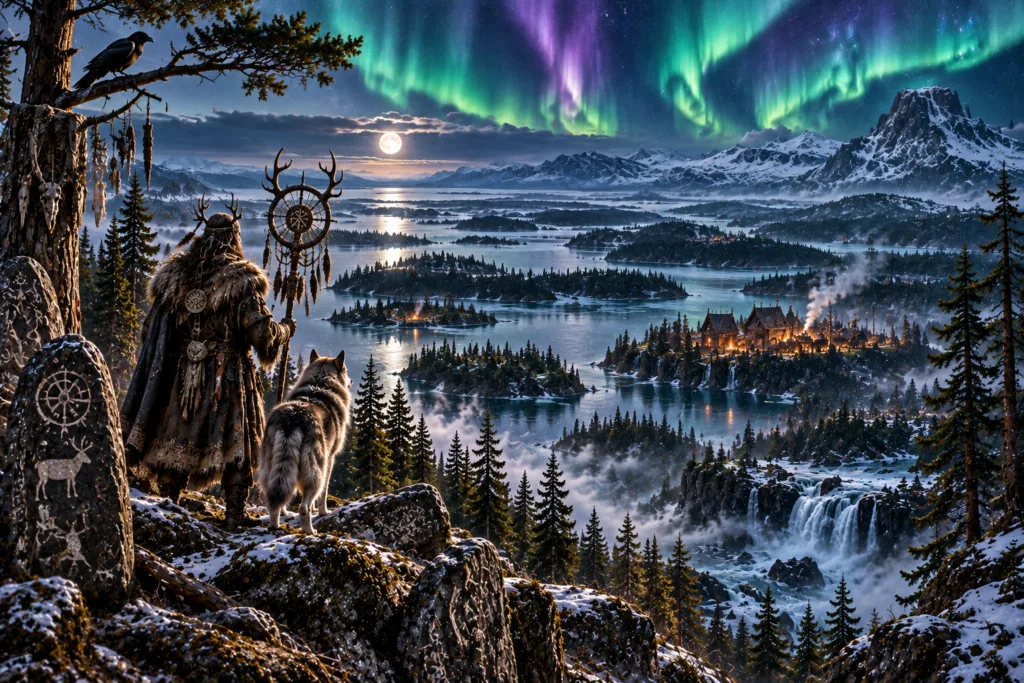
The landscape itself can resist outsiders. Forest spirits, lake powers, hostile beings and winter creatures turn what looks like empty wilderness on a political map into occupied supernatural territory. The Midgard Bestiary should be read here as geography as much as monster lore.
Wayland the Smith belongs to this wider northern world, as does his brother Agilaz. Wayland’s reputation has spread far beyond his homeland, making his movements important to kings, warriors and anyone who understands what a truly exceptional weapon can do to the balance of power.
Use Finland for: wilderness travel, lake journeys, divine obligations, contested administration, ancient magic, smith legends, eastern diplomacy, winter expeditions and encounters with powers outside royal control.
Key destinations: Turku, Porvoo, Korvatunturi and Pohjola.
Gotland and Visby — The Baltic Prize
Gotland sits where politics and commerce collide. Visby remains one of the Baltic’s great trading centres, while Danish control of the island places a strategic possession directly beside Swedish interests. Merchants care about privileges and safe cargo. Kings care about fleets. Local powers care about not being sacrificed to somebody else’s larger strategy.
The surrounding sea also refuses to behave like neutral territory. Storms, drowned dead and dangerous marine creatures from the Midgard Bestiary affect insurance, convoy planning and naval operations. Priests of sea gods can therefore possess as much practical influence as captains.
Captain Awilda operates naturally within this world of armed shipping and uncertain authority. Her fleet can be pirate, private war-band, ally or unwelcome third party depending on who is describing the encounter.
Use Gotland for: Hanseatic politics, espionage, smuggling, supernatural sea danger, private war, naval contracts and contested law.
Iceland — Law, Fire and the Western Road
Iceland is sparsely settled but never irrelevant. Farm districts, assemblies, great households, sacred places and learned centres occupy a landscape of lava, ice, geothermal ground and violent weather. Local authority can depend as much on reputation, kin and witnesses as on distant royal command.
Gods, land spirits and the dead remain woven into the landscape. A farm dispute may involve an ancestral mound. A winter road may pass into territory claimed by something recorded in the Midgard Bestiary. An omen associated with Odin, Thor or another power of the Asgardian Pantheon can become evidence in a political dispute rather than merely private religion.
Skálholt is one of the island’s important centres of learning, sacred authority, record keeping and navigation. The Reykjavík district is a far smaller place of farms and landing grounds rather than the great city later centuries will build there.
Iceland is also a staging point for the western sea-road. Navigators compare reports here, ships refit, crews change, and stories arriving from Greenland or Vinland can change an expedition before it sails.
Use Iceland for: feuds, law cases, volcanic mysteries, supernatural land claims, outlaw country, navigation, saga disputes and preparation for journeys west.
Greenland — The Edge That Became a Road
Greenland is difficult, isolated and essential. Norse settlements survive along habitable fjords while Inuit communities possess their own territories, knowledge and travel networks. Neither population should be reduced to scenery for the other.
Ice, darkness and distance make supernatural danger particularly difficult to separate from ordinary survival. Sea creatures, winter beings and other northern threats from the Midgard Bestiary can alter routes for an entire season. Sailors therefore treat divine favour, local knowledge and practical navigation as complementary rather than competing explanations of whether a voyage will succeed.
Brattahlid is one of the principal Norse centres and a major point in the westward chain. Ships bound for Vinland or farther south may carry timber, livestock, tools, weapons, families, adventurers, envoys or investors rather than merely explorers.
Use Greenland for: survival, cultural contact, missing ships, ice-bound monsters, sacred journeys, disputes over resources and western expeditions.
People Who Shape Midgard
The North contains kings, sea-lords, monster-slayers, smiths, seers and dynastic houses whose decisions can alter entire regions. They matter because of what they control, whom they serve and which current conflicts they can draw adventurers into.
Norway and the Western Sea
Ragnar Lothbrok, Björn Ironside, Ivar the Boneless, Lagertha, Aslaug and Örvar-Odd connect royal politics, heroic warfare and the Atlantic sea-road.
Sweden and Geatland
Beowulf, Dyggvi, Dag the Wise, Agne, Angantyr, Hervor, Heidrek and Hjalmar stand within competing heroic and dynastic traditions.
The Völsung House
Sigmund, Sinfjötli, Helgi Hundingsbane and Sigurd / Siegfried connect Scandinavian heroic politics with the Rhine and Burgundian world.
Smiths and Dwarf Powers
Wayland, Durin, Dvalinn, Regin, Brokkr and other master smiths control knowledge and craft capable of altering the balance between kings.
The Baltic and Eastern Roads
Captain Awilda, Svafrlami, Hlod and Gestumblindi connect Midgard to Baltic warfare and the eastern political world.
Divine Envoys
Skírnir is among the clearest examples of a figure able to move between mortal courts and divine politics. Such envoys make the interests of the gods immediate rather than theoretical.
See the complete Midgard Characters directory.
Powers and Factions
Midgard is not divided simply into humans on one side and monsters on the other. Every useful power has interests, territory, allies and obligations.
| Power | What It Wants | Why Adventurers Matter |
|---|---|---|
| Danish-Norwegian Crown | Secure Christian I’s realms, control strategic sea routes and strengthen the case for restoring the wider union. | Envoys, intelligence, escort work, naval service and deniable operations. |
| Swedish Crown | Preserve Charles VIII’s authority and prevent foreign control of Swedish political life. | Border work, counter-espionage, monster suppression and dealings with strong regional houses. |
| Asgardian Temples and Cults | Maintain worship, sacred obligations, divine treaties and the proper interpretation of signs. | Oaths, pilgrimages, relics, omens and missions involving divine powers. |
| Finnish Sacred Powers | Protect sacred landscapes, cult traditions, forests, lakes, storms, craft and local obligations. | Spirit diplomacy, weather, hunting rights, sacred sites and supernatural disputes. |
| Hanseatic League | Trade privileges, protected warehouses, predictable law and profitable Baltic routes. | Convoy work, commercial disputes, piracy, missing cargo and political leverage. |
| Norse Atlantic Sea-Road Network | Keep the Greenland, Vinland and North American routes supplied, navigable and profitable. | Exploration, convoy protection, lost ships, settlements and diplomacy across the Atlantic. |
| Independent Dwarf Holds | Control their own mines, roads, forges, contracts and ancestral claims. | Rare craft, disputed territory, underground travel and negotiations no human king can command. |
| Jötunn Courts | Defend ancient borders, family claims, hunting grounds and agreements that may predate human kingdoms. | Diplomacy is often safer than assuming every giant is a wandering monster. |
| Hidden Folk and Elven Courts | Protect hidden settlements, roads and agreements connecting mortal communities to supernatural territory. | Safe passage, missing travellers, enchanted boundaries and old bargains. |
| The Restless and Monstrous North | No single aim. Draugr defend property, trolls enforce claims, sea-beasts occupy waters and other beings follow their own natures and laws. | Adventurers are hired to fight, negotiate, investigate or determine who actually has the stronger claim. |
Midgard and the Nine Worlds
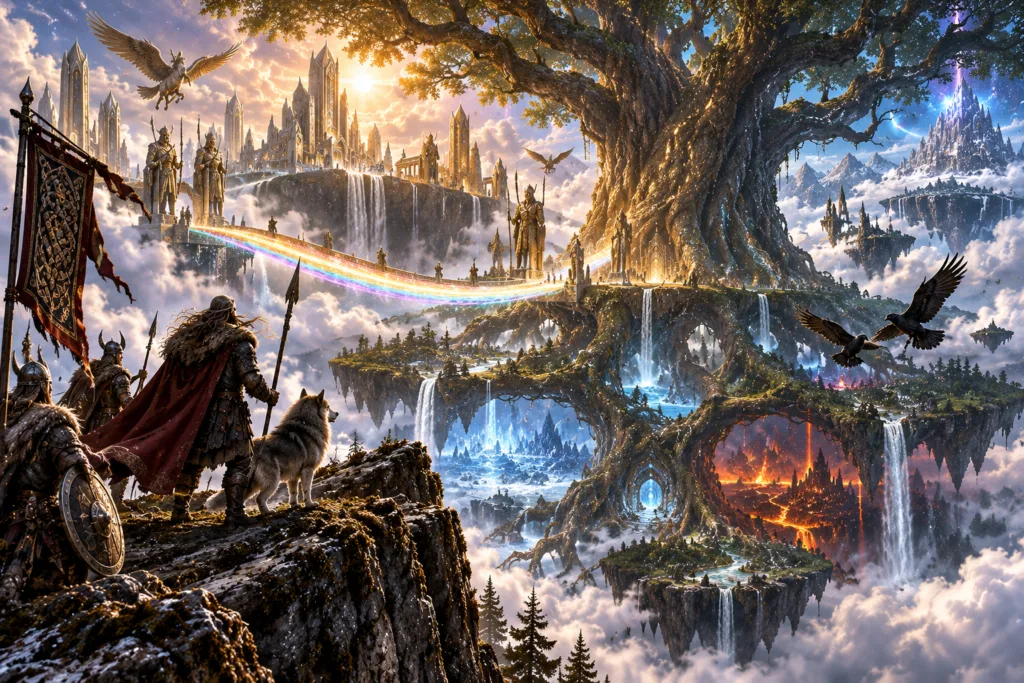
The people of Scandinavia do not debate whether the old northern cosmology is merely symbolic. They debate what particular omen means, which route is lawful, whether an envoy truly carries divine authority and what price should be paid for crossing a sacred boundary.
Yggdrasill — The World Tree
Yggdrasill is a living transitive plane connecting worlds through roots, trunk roads, branches, wells, wounds and lesser sacred trees. It is not a convenient transport network and it does not belong to the gods.
In Midgard, access may begin at a sacred ash grove, ancient well, burial mound, storm-struck tree, dwarf tunnel, judgement ground or lesser world-tree. Some routes are stable enough to be remembered across generations. Others open only because of an oath, bloodline, sacrifice, death, storm or particular need.
Asgard and Ysgard
Asgard is the fortified high realm of the Æsir within the heroic plane of Ysgard. It contains divine halls, courts, sacred places, armouries, feast houses and the gathering places of gods, Valkyries, heroes, messengers and skalds.
It is not the capital of every northern world. Vanaheim, Jötunheim, Alfheim, Midgard and other realms retain their own powers and laws. Bifröst is the most celebrated route toward Asgard, but it is not the only road between the worlds.
What This Means in Play
- A Swedish ruler may receive a genuine divine messenger.
- A Norwegian dwarf guide may know a root-road no human temple controls.
- A Finnish sacred site may connect a local divine obligation with a wider planar route.
- A murderer fleeing human law may discover that Yggdrasill remembers the crime.
- A party may be sent to Asgard as diplomats rather than only reaching it after death.
- A jötunn can possess a legitimate ancient claim to a mortal valley.
- A wound in the World Tree can leak monsters, weather or supernatural corruption into Scandinavia.
Gods, Spirits and Sacred Powers
Religion is a public and practical part of life throughout Midgard, but northern traditions are not uniform.
Across Denmark, Norway, Sweden, Iceland and much of the Norse Atlantic world, the Asgardian Pantheon shapes kingship, warfare, sea travel, prosperity, law, magic and prophecy. Odin, Thor, Týr, Freyr, Freyja, Njörðr, Ullr and Frigg matter because the things associated with them matter every day.
In Finland and its neighbouring cultural regions, the Finnish Pantheon gives the sacred landscape its own character. Ukko’s storms, Ahti’s waters, Tapio and Mielikki’s forests, Ilmarinen’s smithing and other divine powers belong to a world where landscape, craft and supernatural agency frequently overlap.
There is no single northern priesthood controlling all these traditions. Temple keepers, seeresses, ritual specialists, law-speakers, skalds, sacred families and local cult authorities can all possess legitimate influence.
The Sea-Road to North America
The North Atlantic is one of Midgard’s defining strategic systems. It is not an empty ocean separating the setting from another continent.
Norway → Iceland → Greenland → Vinland → the Norse settlements farther south, including the Delaware trading colony.
Families have been born on the western side of the ocean. Goods move east and west. Investors finance voyages. Disputes over cargo, land, marriage and authority now span the Atlantic.
Björn Ironside is particularly well placed to command western expeditions. Ragnar’s network can finance or exploit them. Örvar-Odd can possess practical knowledge of exceptional routes.
The sea-road is supernatural as well as commercial. Storm gods, sea powers, monsters and omens can determine whether a voyage leaves harbour at all. Captains therefore consult navigators, priests and people familiar with creatures of the Midgard Bestiary.
The existence of settlements does not mean North America is empty territory waiting for Europeans. It is an inhabited continent of established Indigenous nations, cities, alliances, trade networks and supernatural powers.
Magic, Knowledge and Services
Magic in Midgard is neither a single profession nor something confined to secret towers. Different traditions overlap.
| Specialist | What Adventurers Seek |
|---|---|
| Rune-workers | Wards, identification of old inscriptions, inheritance marks, oath-binding, protective signs and interpretation of magical runes. |
| Seeresses and diviners | Prophecy, dream interpretation, spirit consultation and investigation of unusual omens. |
| Skalds | Genealogy, reputation, remembered law, heroic history, magical poetry and access to powerful households. |
| Finnish ritual specialists | Forest and lake rites, weather lore, spirit diplomacy, sacred songs and interpretation of obligations tied to the Finnish gods. |
| Master smiths | Fine arms and armour, repair of unusual weapons, knowledge of famous blades and—rarely—access to dwarf craft. |
| Healers | Herbal medicine, surgery, supernatural cures and treatment of wounds that ordinary medicine cannot explain. |
| Navigators | Charts, stars, currents, ice knowledge, pilotage and information about western or Arctic routes. |
| Yggdrasill guides | Knowledge of a particular sacred crossing, route-oath or branch-road. |
| Temple authorities | Divine interpretation, ritual purification, oath witnessing, sacred safe-conduct and contact with higher powers. |
| Hanseatic factors | Credit, warehouses, shipping, translators, buyers, cargo information and commercial introductions. |
Creatures and Supernatural Powers
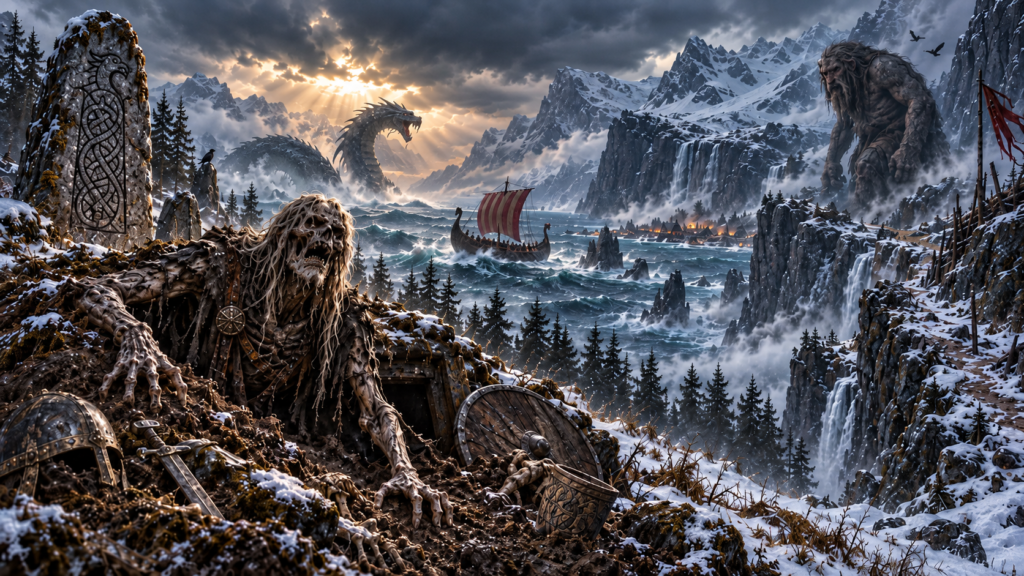
The northern wilderness is inhabited. A monster encounter should normally tell the party something about the place rather than simply interrupt travel.
The complete regional directory is the Midgard Bestiary.
| Landscape | Typical Problems |
|---|---|
| Burial mounds and old halls | Draugr, barrow wights, ghosts, inherited curses and dead owners who still recognise property rights. |
| Mountain roads | Trolls, giants, dwarf territory, dangerous weather and tolls based on agreements nobody in the human court remembers. |
| Deep forest | Hidden folk, elves, wolves, hags, supernatural hunters and paths that refuse to remain where maps place them. |
| Finnish forest and lake country | Creatures, spirits and sacred powers whose behaviour may depend upon local rites as much as weapons. |
| Fjords and rivers | Water spirits, drowned dead and creatures attracted to bridges, ferries and mills. |
| North Sea and Baltic | Sea monsters, supernatural storms, hostile fleets, pirates and things following ships from deeper water. |
| Winter wilderness | Cold, starvation, whiteout, winter spirits, dangerous beasts and supernatural processions. |
| World-tree crossings | Root-serpents, spirits, hostile watchers, giant scouts and things that should never have reached Midgard. |
Jörmungandr is real, but the ocean is not impassable. Scandinavian society depends upon maritime travel. The World Serpent belongs to the scale of cosmic danger, prophecy and exceptional manifestation rather than functioning as a permanent wall around northern Europe.
Travel Through Midgard
By Sea
Water is the great northern highway. Coastal ships and ferries handle local traffic. Merchant cogs move bulk cargo. Longships remain valuable for speed, shallow draft, warfare and exploration. Priests, seers and experienced captains also watch for supernatural signs before committing a ship to dangerous water.
By Road
Road quality changes sharply. Routes around prosperous towns may be busy and well maintained; mountain and forest roads can become little more than remembered paths. Bridges, ferries and winter crossings may also lie within troll, giant or spirit territory.
By Winter Road
Snow and frozen water can make some journeys easier rather than harder for travellers who possess skis, sledges, suitable animals and local knowledge. Ullr and local winter powers matter because winter itself changes the map.
By River and Lake
Sweden and Finland contain extensive inland water networks. Boats, portages and frozen winter routes connect communities that would otherwise require difficult overland travel. In Finland, the waters themselves may fall within the interests of powers associated with the Finnish Pantheon.
By Atlantic Sea-Road
Iceland and Greenland are regular parts of the northern maritime world. Vinland and the newer North American settlements require longer preparation but are established destinations rather than legendary rumours.
By Yggdrasill
A world-tree route is never simply the faster version of a sea voyage. The party needs a crossing, a means of passage and usually a legitimate reason or guide. Success may still create an obligation.
Law, Oaths and Custom
There is no single Scandinavian legal code governing every place on this page. Denmark, Norway, Sweden, Finnish regions, Icelandic communities, merchant enclaves, dwarf holds and supernatural territories possess different law.
- Witnesses matter. Reputation and sworn testimony can determine whether a traveller is treated as victim, outlaw or liar.
- Hospitality creates obligations. A recognised guest has protections, but abusing those protections can create a feud.
- Oaths can have supernatural weight. The closer a promise is made to a sacred site, divine authority or Yggdrasill crossing, the less wise casual wording becomes.
- Compensation may prevent bloodshed. Not every killing automatically produces endless feud if lawful settlement is possible.
- Assemblies still matter. Thing traditions survive within a developed late-medieval world of royal officials, noble councils, town law and written records.
- Merchant privilege complicates local law. A Hanseatic trader may claim protections that anger local competitors.
- Nonhuman law is still law. Human rulers cannot safely assume that dwarf, giant, troll, spirit or hidden-folk claims disappear because a human document ignores them.
An adventuring company can therefore be celebrated in one jurisdiction and wanted in the next.
A Norse Civilisation in the Fifteenth Century
Midgard looks and feels as though Norse civilisation continued developing rather than being replaced.
Architecture
Great timber halls remain culturally important, but major settlements also contain stone towers, fortified compounds, warehouses, paved or boarded streets, sophisticated harbour works and monumental structures derived from northern building traditions.
War
Shields, axes, swords and spears remain culturally important, but warfare has changed. Wealthy warriors wear sophisticated armour. Polearms and crossbows matter. Fortifications have evolved. Bombards and early firearms are entering appropriate military contexts.
Ships
Longships survive because they remain useful, not because shipwrights forgot how to innovate. They coexist with heavier merchant and military designs built for cargo, endurance and changing forms of naval war.
Writing and Runes
Runes remain alive in memorials, ownership marks, magical inscriptions, legal formulae, craft marks, navigation, monumental texts and sacred use.
Learning
Royal courts, temple centres, town schools, private tutors, guild traditions, master-apprentice relationships and scholarly circles preserve practical and theoretical knowledge.
Heroic Culture
Reputation is built by what a person does now: keeping an oath, surviving an impossible voyage, defeating a monster, giving generously, winning a legal struggle, composing a poem nobody can answer or accomplishing what a king’s professional soldiers could not.
Rumours in the North
- A Swedish noble possesses letters proving Christian I has already promised his estates to a Danish supporter.
- Björn Ironside is hiring people who can survive six months west of Greenland and refuses to explain why.
- A root of Yggdrasill has appeared beneath a burial mound that never contained a tree.
- A dwarf envoy has arrived in Bergen carrying a boundary stone and demanding the return of an entire valley.
- Someone in Visby is selling two sets of identical royal shipping documents—one Danish and one Swedish.
- Beowulf has heard of a creature powerful enough to make Grendel seem ordinary.
- A Greenland ship reached Iceland without its navigator. The crew insist he stepped onto a branch above the mast and kept walking upward.
- A false prophet has predicted the beginning of Ragnarök three times and been wrong. This time the temple authorities are listening.
- Awilda has taken a royal ship but returned its crew unharmed, along with a message intended for neither king.
- A Finnish hunting party has disappeared after entering a forest where every tree bears the same fresh mark.
- Wayland has refused a royal commission. Three rival courts now want to know who he is working for instead.
- Someone has reopened a sealed chamber beneath Birka and the dead are asking where their market went.
Adventure Hooks
The Third Crown
A set of union regalia vanishes while travelling under heavy guard. Christian I blames Swedish agents. Charles VIII insists the theft was staged. A third faction intends to present the regalia to a completely different candidate.
Björn’s Western Convoy
Björn Ironside hires the party for a voyage ostensibly bound for Greenland. Only after Iceland does he reveal that the real destination lies beyond Vinland, where a Norse settlement has stopped answering ships.
The Root Beneath the Hall
A great ash pushes through the floor of a royal hall overnight. Skírnir identifies it as a genuine Yggdrasill crossing—and warns that something is travelling toward Midgard from the other side.
The Forest’s Price
A Finnish settlement has expanded its fields into woodland claimed by a sacred power. Hunters vanish, livestock refuse to cross the tree line and the local priests insist the problem cannot be solved simply by killing whatever appears first.
The Dwarf Boundary
Miners discover an ancient stone marking an entire valley as dwarf territory. The human lord has a royal charter. Durin’s representatives possess an agreement older than the kingdom.
The Visby Ledger
A murdered Hanseatic factor leaves accounts showing that Danish officials, Swedish nobles and an independent sea-captain are all secretly financing the same convoy. The cargo is not listed.
The Market Under Birka
A newly opened mound leads not to a tomb but to a preserved underground market where dead merchants still honour contracts written centuries ago. One contract appears to grant ownership of a modern Swedish harbour.
The Sea God’s Warning
Three experienced captains refuse to sail after receiving the same omen. The royal court calls it superstition until something from the Midgard Bestiary begins following ships through the harbour mouth.
The King’s Monster
Beowulf is preparing to hunt a creature attacking Geatish settlements. Charles VIII wants him kept alive for political reasons. A rival house wants Beowulf to fail. The monster itself has begun sending messengers.
The Delaware Longship
A ship from the Norse Delaware colony reaches Greenland carrying unfamiliar cargo and no captain. A carved piece of living wood aboard the vessel begins growing toward the nearest Yggdrasill crossing.
Safe-Conduct to Asgard
A mortal embassy has received permission to approach Asgard. The document protects the diplomats from recognised authorities, but it says nothing about what waits on the road to reach them.
The Wrong Ragnarök
Three authentic omens appear simultaneously in Denmark, Sweden and Norway. Each royal court interprets them differently. The party must determine whether the signs concern Ragnarök at all—or whether someone has learned how to manipulate divine prophecy.
The Union Beneath the Rival Crowns
The Union of Midgard was created to bind the principal Scandinavian kingdoms beneath a shared monarch while allowing each realm to retain its own laws and institutions. That arrangement never erased local interests. Royal centralisation, noble privilege, merchant power, regional identity and succession repeatedly pulled in different directions.
The present fracture is therefore not the disappearance of the Union. It is another struggle over what the Union is supposed to be and who is entitled to command it.
Christian I’s supporters can argue that Scandinavian security requires restored unity. Swedish opponents can answer that unity under a foreign-centred crown becomes subordination. Norwegian elites have their own reasons to resent decisions made elsewhere. Merchants often prefer whichever arrangement protects privileges and keeps straits open. Heroic houses, temples and supernatural powers may support a king, oppose him or exploit the competition.
Adventurers should feel this political uncertainty without needing to memorise a constitutional history. A royal seal opens some doors. The wrong royal seal closes others.
What “Midgard” Means
The word is used in two related but distinct ways on SpiralWorlds.
The Union of Midgard is the campaign’s northern Scandinavian political and cultural region described on this page.
Cosmological Midgard is the mortal middle world within the wider northern mythic order connected through Yggdrasill.
Scandinavia has unusually strong cultural and practical relationships with that cosmology, but the mortal world is much larger than the Scandinavian union.
Regional Directory
Denmark
Norway
Sweden
Finland
- Territory of Finland
- Åland
- Finland Proper
- Turku
- Karelia
- Laponia
- Korvatunturi
- Pohjola
- Satakunta
- Savonia
- Tavastia
- Uusimaa
- Porvoo
Iceland and Greenland
People, Gods, Creatures and Planes
- Midgard Characters
- Midgard Bestiary
- Asgardian Pantheon
- Finnish Pantheon
- Ragnarök
- Yggdrasill
- Asgard and Ysgard
- Hanseatic League
- Guilds, Factions and Organisations
The Atlantic World
Videos and Visual Reference
Further Exploration
Explore the Midgard Bestiary for the creatures inhabiting the region, Asgardian Pantheon and Finnish Pantheon for its divine powers, Midgard Characters for major people, Yggdrasill for world-crossing and Asgard for adventures beyond mortal Earth.
Keep this reference growing
If this page helped with your reading or game, you can support its upkeep or explore the curated books.
Explore the Bookshop — epics, classics and stories behind imagined worlds.