
Kingdom of Denmark
At a Glance
| Realm | Kingdom of Denmark, southern anchor of the Union of Midgard |
|---|---|
| Ruler | Christian I |
| Political Position | United with Norway under Christian I; opposed by Charles VIII’s Swedish crown |
| Royal and Commercial Centre | Copenhagen |
| Key Adventure Site | Hedeby, an abandoned trade centre whose earthworks and buried wealth still matter |
| Strategic Strength | Islands, straits, ports and the approaches between the North Sea and Baltic |
| Faith | Living Asgardian worship, local sea and household cults, ancestral rites and Christian institutions |
| Campaign Themes | Fleet politics, court intrigue, trade disputes, island mysteries, royal missions, sea monsters and contested sacred rights |
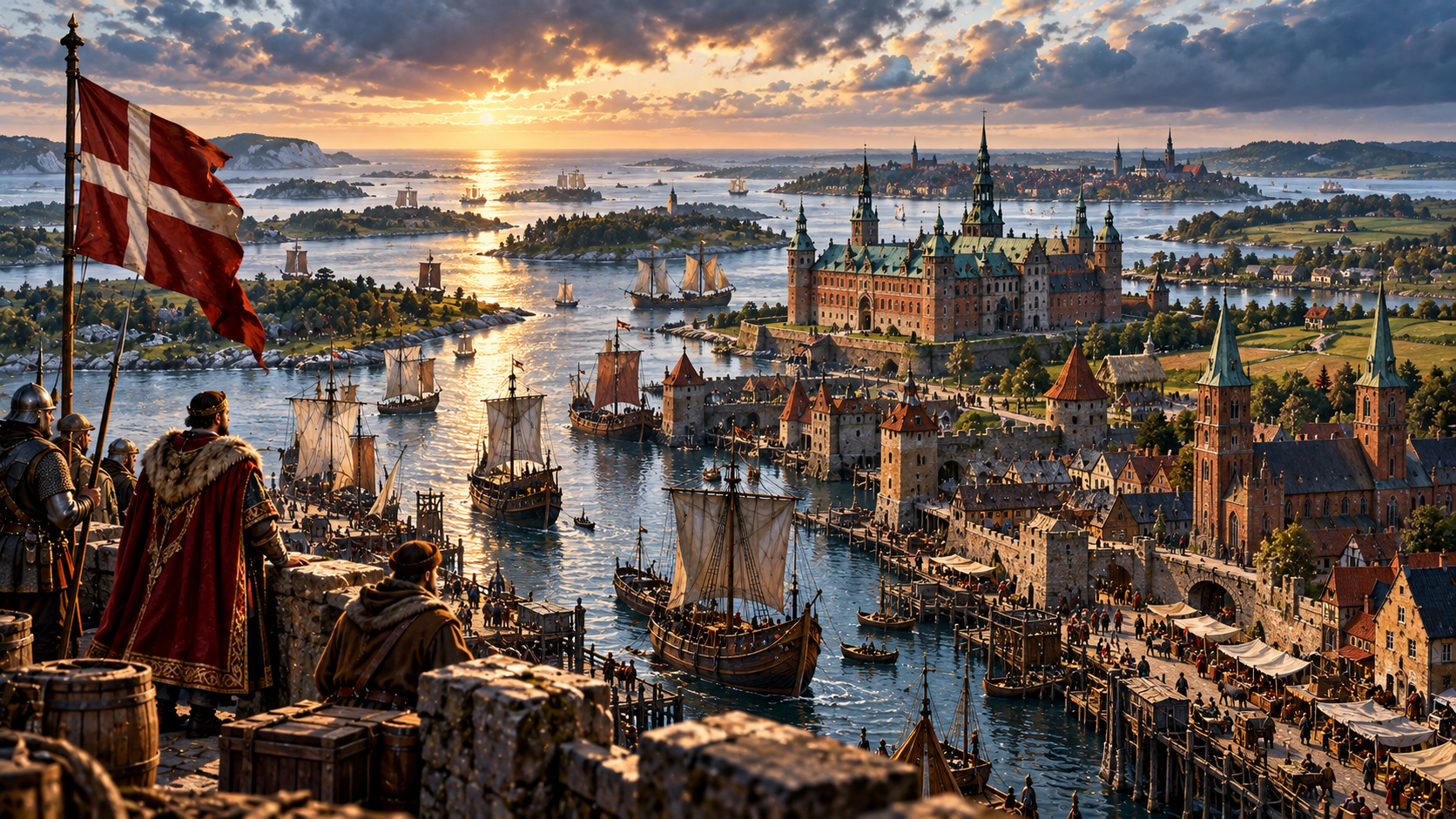
Denmark is the hinge between the North Sea and the Baltic: a compact kingdom whose islands, straits and ports give Christian I influence far beyond its size. Royal messengers, Hanseatic merchants, shipwrights, temple envoys, private captains and smugglers compete for access to the same water. A toll dispute can become a diplomatic crisis; a wreck can become a treasure hunt; a sea monster in the wrong channel can disrupt trade across half of northern Europe.
The kingdom is one of the two foundations of Christian I’s present power. He rules Denmark and Norway while Charles VIII holds Sweden. The old northern union has not vanished from political memory, but no single monarch controls all three crowns. Danish nobles who favour restored union, merchants who prefer predictable tolls and sea-lords who profit from rivalry do not necessarily want the same future.
Denmark is fully late-medieval rather than trapped in an earlier age. Fortified ports, merchant warehouses, stone churches, timber halls, royal compounds, crossbows, polearms and early gunpowder weapons exist beside longships, rune traditions and public worship of northern gods. The old ways survived because the powers behind them never disappeared.
What Is Happening Right Now?
The Crown Needs the Straits Secure
Christian I cannot afford prolonged disorder around the Danish islands. Piracy, sabotage, false beacons, monster attacks and rival toll claims all threaten royal revenue and military movement. Adventurers are useful as escorts, investigators, deniable agents and hunters.
Sweden Is the Political Question
Every rumour from Stockholm matters. Merchants hedge their loyalties, nobles cultivate both courts and royal officials watch for agents carrying letters, coin or promises to Charles VIII’s supporters.
The Sea Has Its Own Powers
Njörðr’s priests, coastal spirits, drowned dead and creatures from the Midgard Bestiary all shape navigation. A dangerous channel is rarely just dangerous water.
Hedeby Is Not Finished
The old emporium no longer functions as a normal great trading city, but its earthworks, graves, buried goods and strategic ground attract antiquarians, smugglers, treasure hunters and people who know that abandoned sacred places do not always become empty.
Places to Use in Play
Copenhagen
Copenhagen is the clearest royal and commercial stage for a Danish campaign. Ships arrive with Baltic grain, German metalwork, Norwegian stockfish, luxury goods, pilgrims, envoys and rumours. Royal policy is visible here, but so are the people who profit by bending it.
Hedeby
Hedeby’s great commercial age lies in the past. That makes it more useful for adventures: old ramparts, former harbour ground, graves, forgotten shrines, caches, disputed relics and routes remembered by beings older than the present kingdom.
The Danish Islands
Island travel compresses politics and supernatural danger into small spaces. A local lord may control the harbour while a temple controls the sacred spring, a merchant guild controls credit and an offshore creature controls whether anybody sails.
The Sound and the Baltic Approaches
This is Denmark’s great strategic asset. A ship entering or leaving the Baltic can pass through a web of watch posts, toll claims, pilotage, weather, reefs, private violence and supernatural interference.
People, Powers and Factions
| Power | What It Wants | Adventure Pressure |
|---|---|---|
| Christian I and the Royal Household | Secure Denmark and Norway, control the sea routes and strengthen the case for wider Scandinavian unity. | Diplomatic missions, missing dispatches, escorts, naval service and quiet investigations. |
| Danish Noble Houses | Protect estates, offices, privileges and influence over the crown. | Feuds, rival claims, marriages, hostage exchanges and contested inheritance. |
| Hanseatic Merchants | Predictable law, protected cargo, warehouse rights and profitable passage. | Convoys, stolen cargo, commercial espionage and disputes with local merchants. |
| Sea-Lords and Private Captains | Profit, reputation, royal favour and control of local waters. | The line between private war, piracy and royal service is often thin. |
| Asgardian Temples and Cults | Maintain rites, oaths, sacred property and divine obligations. | Relic recovery, omens, broken vows, sea rites and disputes over sacred ground. |
Magic and Services
Adventurers in Denmark can find shipwrights, armourers, merchants, translators, navigators, rune-workers, healers and priests in the major ports. Copenhagen is the best place to secure formal royal papers, expensive equipment and information from foreign captains. Rural islands and coastal settlements are more likely to rely on local ritual specialists, seers and hereditary keepers of particular shrines or crossings.
Magic tied to sea travel is practical knowledge. A captain who refuses a weather-worker, rune-reader or priest solely because he trusts his charts is considered as foolish as one who ignores currents.
Dangers, Rumours and Adventure Hooks
- The False Beacon. Three ships wreck on the same reef after following a light that no watchman admits tending.
- The King’s Sealed Letter. A dispatch bound for Norway vanishes; copies are already circulating in Copenhagen, but one sentence differs in every version.
- The Hedeby Claim. A noble family produces a charter granting land over the old site just as a draugr rises to enforce a much older ownership claim.
- The Merchant War. A Hanseatic warehouse burns after local traders accuse foreign factors of manipulating grain prices.
- The Strait Toll. A jötunn demands payment from ships passing a channel that royal officials insist belongs wholly to Denmark.
- The Silent Convoy. Five ships arrive together with cargo intact and no living crew.
Travel and Law
Sea travel is the fastest way to move between many Danish centres. Ferries and coastal ships connect islands while larger vessels carry cargo through the Baltic and North Sea. Royal roads and town approaches are better maintained than remote tracks, but local tolls, bridge rights and ferry privileges still matter.
Danish law combines royal authority, noble privilege, town law, merchant custom and older local practice. Oaths have special weight where divine witnesses are invoked. A party carrying a royal writ can gain access quickly, but the same document can make them a target for anyone opposed to Christian I.
Deeper History
Denmark helped create the old Scandinavian union, but union never erased the interests of each kingdom. Christian I now holds Denmark and Norway while Sweden follows Charles VIII. The struggle is therefore not simply Denmark against Sweden; it is a contest over what northern unity is supposed to mean, who benefits from it and which rights survive under a shared crown.
Older Danish history remains physically present. Fortified sites, burial grounds, abandoned trade centres and sacred places still shape land claims and local identity. The dead and the gods sometimes remember rights that royal clerks consider obsolete.
Explore the Midgard Cluster
Union of Midgard · Norway · Sweden · Finland · Iceland · Greenland · Midgard Bestiary · Midgard Characters
Keep this reference growing
If this page helped with your reading or game, you can support its upkeep or explore the curated books.
Explore the Bookshop — epics, classics and stories behind imagined worlds.