
Sir Galahad the Pure — Grail Knight of Camelot

Sir Galahad is the son of Sir Lancelot and Elaine of Carbonek, the knight who survives the Siege Perilous and the champion most closely bound to the Grail. His purity is not passive innocence: it is the discipline to refuse corruption when power, glory or expediency would make corruption easy.
Galahad is one of the greatest warriors of Camelot, but he works best in play as more than an overwhelmingly powerful sword arm. Use him as a demanding patron, temporary battlefield ally, moral obstacle, rival seeker or the living key to an Otherworld mystery that the player characters must solve themselves.
At a Glance
- Name
- Sir Galahad
- Titles
- The Pure; Grail Knight; Knight of the Round Table
- People
- Human
- Role
- Grail knight, champion, quester, patron and occasional ally
- Allegiance
- Camelot, King Arthur and the Round Table
- Family
- Son of Sir Lancelot and Elaine of Carbonek
- Grail Companions
- Sir Percival and Sir Bors the Younger
- Alignment
- Lawful Good
- Tradition
- Celtic Arthurian; the Grail as an Otherworld vessel of sovereignty, renewal and abundance
- Base
- Camelot, Avalon and the roads between Grail sites
- Languages
- Common, courtly French, Welsh and Sylvan
- Rules
- 5.5e / 2024 · 5e / 2014 · Pathfinder 1e · D&D 3.5e
Sir Galahad — Game Statistics
Choose the rules panel for your game. Each edition stands on its own.
Sir Galahad — 5.5e / 2024
Medium Humanoid (Human), Lawful Good
Armor Class 23 (Grail plate, knight’s shield)
Hit Points 315 (30d8 + 180)
Speed 30 ft.
| STR | DEX | CON | INT | WIS | CHA |
|---|---|---|---|---|---|
| 22 (+6) | 16 (+3) | 22 (+6) | 14 (+2) | 20 (+5) | 24 (+7) |
Saving Throws Str +13, Con +13, Wis +12, Cha +14
Skills Athletics +13, Insight +12, Perception +12, Persuasion +14, Religion +9
Damage Resistances necrotic, radiant
Condition Immunities charmed, frightened
Senses passive Perception 22
Languages Common, Sylvan
Challenge 21 (33,000 XP); Proficiency Bonus +7
Traits
Aura of the Grail. Galahad and allies of his choice within 20 feet of him can’t be Frightened. Those allies also have advantage on saving throws made to avoid or end the Charmed condition and have resistance to necrotic damage.
Otherworld Grace. Galahad has advantage on saving throws against spells and other magical effects.
Legendary Resistance (3/Day). If Galahad fails a saving throw, he can choose to succeed instead.
Grail-Blessed Arms. Galahad’s weapon attacks are magical. Their radiant damage is included below.
Grail Magic. Charisma is Galahad’s spellcasting ability (spell save DC 22, +14 to hit with spell attacks). He requires no material components:
- At will: detect magic, light, resistance
- 3/day each: bless, command, lesser restoration, zone of truth
- 2/day each: dispel magic, freedom of movement, revivify
- 1/day each: circle of power, destructive wave, greater restoration
Actions
Multiattack. Galahad makes three attacks with Espée or Lance in any combination.
Espée. Melee Attack Roll: +14, reach 5 ft. Hit: 13 (1d10 + 8) slashing damage plus 18 (4d8) radiant damage.
Lance. Melee Attack Roll: +14, reach 10 ft. Hit: 14 (1d12 + 8) piercing damage plus 13 (3d8) radiant damage. If Galahad is mounted and his mount moved at least 20 feet straight toward the target immediately before the hit, the attack deals an extra 13 (3d8) radiant damage and the target must succeed on a DC 21 Strength saving throw or have the Prone condition.
Grail Smite (Recharge 5–6). Immediately after Galahad hits a creature with Espée or Lance, the target takes an extra 36 (8d8) radiant damage. If the target is a Fiend or Undead, it has disadvantage on the next saving throw it makes before the end of Galahad’s next turn.
Restoring Touch (3/Day). Galahad touches himself or another creature. The target regains 45 hit points, and Galahad can also end the Poisoned condition or one disease affecting the target.
Bonus Actions
Radiance of the Grail (1/Day). Galahad radiates bright light in a 20-foot radius for 1 minute. An enemy of his choice that starts its turn in the light takes 10 radiant damage. At the start of each of Galahad’s turns, one ally of his choice in the light regains 15 hit points. The effect ends early if Galahad has the Incapacitated condition.
Reactions
Knight’s Shield. When an ally within 5 feet of Galahad is hit by an attack, Galahad can become the target instead if the attacker could reach him. He reduces the attack’s damage by 21 (3d8 + 7), and if the attacker is within 10 feet it takes 10 radiant damage.
Running the 5.5e Version
Galahad is strongest when he protects other people rather than simply trading damage. Give him room to intercept attacks, heal endangered allies and hold a line while the player characters solve the encounter’s real problem.
Sir Galahad — 5e / 2014
Medium humanoid (human), Lawful Good
Armor Class 24 (Grail plate, shield)
Hit Points 238 (28d8 + 112)
Speed 30 ft.
| STR | DEX | CON | INT | WIS | CHA |
|---|---|---|---|---|---|
| 20 (+5) | 18 (+4) | 18 (+4) | 15 (+2) | 18 (+4) | 20 (+5) |
Saving Throws Str +16, Con +15, Wis +15, Cha +16
Skills History +8, Insight +10, Persuasion +11, Religion +14
Damage Resistances fire, lightning, necrotic
Damage Immunities radiant
Condition Immunities charmed, frightened; Galahad is immune to disease
Senses passive Perception 14
Languages Common, Sylvan
Challenge 20 (25,000 XP)
Traits
Aura of Courage and Protection. Galahad and friendly creatures within 30 feet of him are immune to being charmed and frightened while Galahad is conscious. They also gain a +5 bonus to saving throws. The bonus is already included in Galahad’s saving throws above.
Indomitable. Galahad has advantage on saving throws.
Spellcasting. Galahad possesses the full spellcasting capabilities of a 20th-level paladin. His spellcasting ability is Charisma (spell save DC 19, +11 to hit with spell attacks).
Typical prepared spells:
- 1st level: bless, command, cure wounds, protection from evil and good, shield of faith
- 2nd level: branding smite, lesser restoration, magic weapon, zone of truth
- 3rd level: aura of vitality, blinding smite, crusader’s mantle, dispel magic, revivify
- 4th level: aura of life, aura of purity, banishment, death ward
- 5th level: banishing smite, circle of power, destructive wave, dispel evil and good
Actions
Multiattack. Galahad makes three melee attacks.
Espée. Melee Weapon Attack: +15 to hit, reach 5 ft., one target. Hit: 13 (1d10 + 8) slashing damage plus 33 (6d10) radiant damage.
Lance. Melee Weapon Attack: +12 to hit, reach 10 ft., one target. Hit: 11 (1d12 + 5) piercing damage plus 16 (3d10) radiant damage.
Shield Bash. Melee Weapon Attack: +12 to hit, reach 5 ft., one target. Hit: 7 (1d4 + 5) bludgeoning damage plus 16 (3d10) radiant damage. A Medium or smaller target must succeed on a DC 19 Strength saving throw or be knocked prone.
Radiance of the Grail (1/Day). For 1 minute Galahad sheds bright light in a 30-foot radius. Enemies of his choice in the light have disadvantage on attack rolls and saving throws and take 20 radiant damage when they begin their turns there. Allies of his choice in the light have advantage on attack rolls and saving throws.
Lay on Hands. Galahad has a pool of 200 hit points of healing each day. As an action, he can touch a creature and restore any number of hit points remaining in the pool. He can instead spend 5 hit points from the pool to cure one disease or neutralise one poison affecting the target.
Reactions
Knight’s Shield. Galahad interposes himself when an adjacent ally is struck in melee. If the attack would also hit Galahad’s AC, he becomes the target, gains resistance to the triggering attack’s damage and the attacker takes 16 (3d10) radiant damage.
Parry. Galahad adds 6 to his AC against one melee attack that would hit him. He must see the attacker and be wielding a melee weapon.
Running the 5e Version
This version presents Galahad as a powerful defensive champion. His radiant damage punishes supernatural evil, but his real strength is his ability to keep companions standing while controlling the centre of the battlefield.
Sir Galahad — Pathfinder 1e
Male human paladin 20 / cavalier 5, Lawful Good
CR 24; XP 1,228,800
Init +8; Senses Perception +27
Defense
AC 40, touch 18, flat-footed 36 (+14 armor, +7 shield, +3 Dex, +3 deflection, +2 natural, +1 dodge)
hp 338 (25d10 + 175 plus Toughness)
Fort +37, Ref +25, Will +32
Defensive Abilities divine grace, divine health, aura of courage, aura of resolve, aura of righteousness, holy champion; DR 10/evil
Immune disease, fear, charm effects and compulsion effects
Offense
Speed 20 ft. in armor
Melee +5 holy longsword +38/+33/+28/+23 (1d8+12/17–20 plus 2d6 holy) or +5 holy lance +38/+33/+28/+23 (1d8+12/×3 plus 2d6 holy)
Special Attacks challenge 2/day, channel positive energy, smite evil 7/day
Statistics
Str 24, Dex 18, Con 24, Int 14, Wis 20, Cha 28
Base Atk +25; CMB +32; CMD 50
Feats Combat Reflexes, Dodge, Extra Lay on Hands, Improved Critical (longsword), Improved Initiative, Mounted Combat, Power Attack, Ride-By Attack, Spirited Charge, Toughness, Vital Strike, Weapon Focus (lance), Weapon Focus (longsword)
Skills Diplomacy +37, Heal +28, Knowledge (nobility) +24, Knowledge (religion) +27, Perception +27, Ride +32, Sense Motive +30
Languages Common, Sylvan
Paladin Abilities
Smite Evil (7/day). Galahad adds his Charisma bonus to attack rolls against the chosen evil creature and his paladin level to damage, following the normal paladin rules.
Lay on Hands (19/day). Galahad heals 10d6 points of damage with each use. Holy champion maximises the healing to 60 hit points.
Mercies. Galahad can remove fatigued, sickened, diseased, poisoned, cursed and blinded conditions where the normal mercy rules allow.
Channel Positive Energy. Galahad can expend two uses of lay on hands to channel positive energy.
Divine Bond. Galahad can call upon his weapon bond four times per day, granting up to +6 worth of enhancement bonuses and appropriate weapon special abilities for 20 minutes.
Holy Champion. Galahad has DR 10/evil. His lay on hands and channel positive energy restore the maximum possible amount.
Cavalier Abilities
Challenge (2/day). Galahad deals +5 damage on melee attacks against the target of his challenge, subject to the normal cavalier restrictions.
Mount, Tactician, Expert Trainer and Banner. Galahad is an exceptional mounted combatant. His banner and teamwork abilities are most useful when fighting beside other knights or the player characters.
Spellcasting
Caster Level 17th; Concentration +26; save DC 19 + spell level.
Typical prepared spells: bless weapon, divine favor, protection from evil, lesser restoration, resist energy, shield other, dispel magic, prayer, remove blindness/deafness, remove curse, death ward, dispel evil, holy sword .
Gear
+5 holy longsword, +5 mithral full plate, +5 heavy steel shield, cloak of resistance +5, ring of protection +3, amulet of natural armor +2, sacred lance and Grail talismans.
Sir Galahad — D&D 3.5e
Male human paladin 23 / cavalier 5 / divine emissary 2, Lawful Good
Challenge Rating 30
Hit Dice 30d10 + 120 (290 hp)
Initiative +4
Speed 20 ft.
Armor Class 23 (+8 full plate, +1 Dex, +4 heavy steel shield), touch 11, flat-footed 22
Base Attack/Grapple +20/+30; Epic Attack Bonus +5
Attack lance +35 melee (1d8+5/×3) or longsword +34 melee (1d8+5/19–20) or ranged +31
Full Attack lance +35/+30/+25/+20 melee (1d8+5/×3) or longsword +34/+29/+24/+19 melee (1d8+5/19–20) or ranged +31/+26/+21/+16
Space/Reach 5 ft./5 ft.
Special Attacks deadly charge, divine inspiration, mounted weapon bonus, smite evil, turn undead
Special Qualities aura of courage, aura of good, burst of speed, detect evil, divine grace, divine health, Good domain, lay on hands, special mount, remove disease
Saves Fort +30, Ref +22, Will +30
Abilities Str 20, Dex 18, Con 19, Int 13, Wis 24, Cha 25
Skills Concentration +11, Diplomacy +18, Disguise +13, Gather Information +13, Handle Animal +11, Heal +15, Intimidate +13, Knowledge (nobility and royalty) +12, Knowledge (religion) +13, Ride +16, Search +9, Sense Motive +14, Spot +17
Feats Improved Critical (longsword), Iron Will, Mounted Combat, Power Attack, Ride-By Attack, Spirited Charge, Weapon Focus (longsword), Weapon Focus (lance)
Epic Feats Epic Prowess ×2, Great Smiting, Holy Strike, Spectral Strike
Class and Epic Abilities
Aura of Courage. Galahad is immune to fear. Allies within 10 feet gain a +4 morale bonus on saving throws against fear effects while he is conscious.
Burst of Speed. When Galahad charges while mounted, he can urge his mount beyond normal speed, doubling the maximum distance it can travel during the charge, to a maximum of four times its speed.
Deadly Charge (2/day). While mounted and charging, Galahad may attempt a deadly charge. A hit deals triple damage with a melee weapon or quadruple damage with a lance.
Divine Grace. Galahad adds his Charisma bonus to all saving throws. The bonus is included above.
Divine Health. Galahad is immune to all diseases, including supernatural and magical diseases.
Divine Inspiration (1/day). Galahad gains a +2 luck bonus on attack and damage rolls for 10 rounds.
Lay on Hands. Galahad can heal a total of 161 hit points per day, divided among recipients as he chooses.
Mounted Weapon Bonus. While mounted, Galahad gains a +1 bonus on attack rolls with swords and a +2 bonus on attack rolls with lances.
Smite Evil (7/day). Galahad adds +7 to his attack roll and deals 25 extra points of damage with a successful smite.
Special Mount. Galahad’s sacred mount receives the benefits appropriate to this epic multiclass build.
Turn Undead. Galahad can turn undead 10 times per day as a 20th-level cleric.
Spellcasting
Paladin spell slots (1st–4th) 3/3/3/3; caster level 25th; save DC 17 + spell level.
Possessions
Galahad carries Espée, a sacred lance, full plate and a Grail shield. In this build the shield functions as a +2 heavy steel shield with holy power.
What Is Sir Galahad Doing Right Now?
A road of pale light has begun appearing after midnight between forgotten stone circles, hill shrines, ancient wells and ruined halls in Britain.
Three young knights rode onto it believing it to be a Grail summons.
Only one returned.
He arrived at dawn unable to remember his own name, carrying a fragment of white stone carved with spirals that move whenever nobody looks directly at them.
Galahad followed the road once. The moment he crossed its threshold, every standing stone along the route flared with borrowed radiance and the enchantment grew stronger.
He withdrew immediately.
Whatever lies behind the road is not repelled by Galahad’s purity. It feeds upon the authority attached to the Grail knight’s name.
Run Galahad Tonight
As a Patron
Galahad gives the party a clear objective and the truth he knows, then gets out of the way.
He does not test adventurers with pointless riddles merely to prove that they are worthy.
If he withholds information, it is because speaking it aloud would trigger a geas, expose somebody under his protection or strengthen the enemy.
As an Ally
Use Galahad for one decisive encounter rather than an entire adventure.
Let him hold a gate, protect civilians, duel the enemy champion or keep a supernatural host occupied while the player characters complete the objective that actually ends the threat.
As a Moral Obstacle
Galahad can oppose good-aligned characters without becoming a villain.
He will not accept torture, deliberate sacrifice of innocents, a bargain that condemns somebody else or the use of a corrupt relic merely because the shortcut appears efficient.
As an Opponent
Galahad fights player characters only when they knowingly threaten innocents, profane a sanctuary, refuse to release somebody under his protection or persist in using corrupt power after he has warned them.
He normally offers surrender before lethal force.
How Galahad Fights
Galahad is not a berserker and does not chase the highest damage total every round. His first instinct is to establish who must be protected, who must be stopped and which battlefield position lets him do both.
On foot he fights behind a heavy knight’s shield and full plate, using his longsword to hold a line.
Mounted, his style draws directly on Mounted Combat, Ride-By Attack and Spirited Charge, with the lance as his decisive shock weapon.
At court, tournaments and jousting keep those skills sharp, but Galahad treats tournament glory as training rather than the purpose of knighthood.
Against fiends and undead he becomes more aggressive because his radiant attacks are at their most effective. Against mortal enemies he calls for surrender, knocks opponents down, blocks routes and uses healing to keep allies alive.
He does not kill a defeated opponent simply to save time.
A clever enemy attacks his priorities rather than his Armor Class. Hostages, divided battlefields, false visions, threatened sanctuaries and simultaneous crises force Galahad to choose where his protection matters most.
Those pressures create room for the player characters to matter beside one of the greatest knights of the Round Table.
Playing Sir Galahad
Voice
- Speaks plainly and rarely raises his voice.
- Does not boast, but does not pretend to be less capable than he is.
- Answers sincere questions directly.
- Uses formal courtesy even when refusing somebody.
- Becomes quieter, not louder, when genuinely angry.
What He Values
- Keeping an oath when doing so becomes costly.
- Mercy offered from strength rather than fear.
- Protecting people who cannot protect themselves.
- Truth spoken before it becomes convenient.
- Courage without the need for applause.
What Makes Him Difficult
- He has little patience for “ends justify the means” reasoning.
- He expects powerful people to accept greater obligations, not greater privileges.
- He can mistake hesitation for a moral problem when it is really uncertainty.
- He abandons political advantage rather than betray a sworn promise.
What He Notices
- Who in the room is being ignored.
- Whether a frightened person is being pressured into agreement.
- The exact wording of promises and bargains.
- Relics that feel almost—but not quite—Otherworldly.
- People who perform virtue only while they are being watched.
Relationships
King Arthur
Galahad honours Arthur as king and values the fellowship represented by the Round Table, but the Grail calling sits deeper than court politics.
If Arthur commands something that violates a sworn duty, Galahad does not stage a dramatic rebellion. He explains the conflict, refuses the command and accepts the consequences.
Sir Lancelot
Lancelot is Galahad’s father and one of the greatest warriors in Arthur’s company. Galahad does not treat him as a failed version of himself.
Their relationship is more painful and more useful than that: the son embodies the discipline the father repeatedly reaches toward, while Lancelot understands weakness, love, guilt and recovery in ways Galahad sometimes does not.
Elaine of Carbonek
Elaine is Galahad’s mother and a direct link to the Grail lineage surrounding Carbonek.
Galahad knows the troubling circumstances surrounding his conception. Their relationship turns on inheritance, prophecy, responsibility and what it means to be treated as the answer to somebody else’s vision.
Sir Percival and Sir Bors
Percival and Bors are the companions with whom Galahad can speak about the Grail without becoming a symbol.
They have shared the same road, seen the same Otherworld wonders and survived tests that separated them from the rest of Arthur’s fellowship.
Percival also ties Galahad’s Grail road to King Pellinore and the hunt for the Questing Beast.
Camelot
Camelot is home, court, duty and temptation at once.
Its ideal of chivalry gives Galahad a community worth defending, but the court can also turn living virtues into reputation, hierarchy and ceremony.
Galahad reminds the Round Table that the vows matter more than the theatre surrounding them.
Merlin
Merlin understands more of the structures surrounding Camelot, Avalon and the Otherworld than almost anyone at Arthur’s court.
Galahad respects his knowledge without assuming that prophecy removes the need to choose. A foretold event can still demand courage from everyone living through it.
Sir Gawain
Gawain represents a very different form of Arthurian greatness. He is brave, worldly, passionate and vulnerable to the pressures that Galahad so often withstands.
Galahad does not regard that humanity as contemptible. He simply refuses to pretend that virtue ceases to matter because maintaining it is difficult.
The Lady of the Lake
The Lady of the Lake belongs to the same borderland between court, water and Otherworld through which many Grail signs emerge.
Her knowledge of enchanted waters, Otherworld passages and supernatural obligations can make her an invaluable ally, a difficult negotiator or the keeper of information Galahad cannot simply demand.
Morgan le Fay
Morgan is not simply the evil opposite of Galahad. She commands forms of knowledge, sovereignty and Otherworld power that exist outside Camelot’s preferred order.
Galahad distrusts coercion and corruption, not magic itself. An encounter between them works best when Morgan possesses something genuinely necessary and Galahad cannot obtain it without negotiation.
Adventure Pressure
The False Grail Road
The luminous road now reaches a fourth stone circle. Every Arthurian knight who steps onto it makes the enemy stronger. Galahad can guard the entrance, but the player characters must discover what waits at the road’s end.
The Shield That Bleeds
A white knight’s shield marked with three red spirals appears in a hill-fort treasury.
It darkens when touched by a liar and has already exposed three genuine crimes. Galahad insists it is not his shield. The local ruler refuses to surrender an object that appears to reveal truth.
Lancelot’s Unfinished Oath
A promise made by Lancelot years ago has become magically enforceable.
The beneficiary is dead, witnesses disagree on the wording and the geas now threatens innocent descendants.
Galahad asks the party to fulfil the spirit of the promise without letting magic turn justice into cruelty.
The Empty Siege
Someone has built a copy of the Siege Perilous in a ruined hall.
People who sit in it disappear, but their voices can still be heard beneath the floor.
Galahad will not sit in the false seat until the characters know where the missing people are being sent.
The Knight Who Cannot Sin
A young warrior claims that Galahad has blessed him with perfect purity.
He cannot be charmed, frightened or magically compelled— and has begun executing anyone he judges corrupt.
Galahad has never met him.
Three Grails
Three Otherworld vessels appear in three kingdoms on the same night.
Each heals the sick. Each restores exhausted land. Each has a different history.
Galahad refuses to declare any of them false until the characters investigate the people and places being changed by their presence.
Equipment and Relics
Espée — Galahad’s Sword
Galahad carries the sword associated with the impossible test that announces his arrival among the greatest knights.
The blade becomes visibly radiant against corruption and supernatural evil, but its greater significance is the burden attached to wielding it.
It answers most strongly to a bearer who does not confuse strength with ownership.
In editions requiring a mundane weapon base, use the longsword.
The Grail Shield
Galahad’s shield is a knightly heater shield rather than a round Celtic war shield.
Its face bears a threefold spiral. The sign reflects patterns repeated throughout Grail lore: land, sovereign and Otherworld; wound, quest and renewal; seeker, test and return.
Its power is protective rather than triumphal. It strengthens Galahad when he places himself between danger and somebody who cannot withstand it.
For mundane shield rules, use the heavy steel shield as the mechanical foundation.
Sacred Lance
Galahad’s lance is the weapon of a mounted knight rather than a permanent magical projectile.
He uses it to break dangerous lines, challenge monstrous cavalry and reach enemies before they can close on people he is protecting.
Grail Plate
Galahad’s armour is immaculate in ceremony and scarred in the field.
Its enchantment reinforces his vows without removing consequences. It protects him so that he can stand where the danger is greatest.
Full plate is the mundane foundation for the enchanted armour.
Sacred Warhorse
When Galahad rides to battle, his warhorse is part of the encounter rather than expendable equipment.
He will break a charge rather than sacrifice the animal needlessly.
His mounted tactics connect directly to Mounted Combat, Ride-By Attack and Spirited Charge.
The Celtic Grail
The Grail is an Otherworld vessel older than the courtly stories that later gathered around it.
Its deeper roots lie in the mythic world represented by the Celtic traditions, where sovereignty, enchanted vessels, sacred hospitality, restoration and the fertility of the land repeatedly meet.
It belongs to the same broad mythic family as inexhaustible cauldrons, feasting vessels, sovereignty treasures and objects that restore land and people.
The Dagda and his traditions of inexhaustible abundance provide one particularly useful comparison, while Arawn anchors the Welsh conception of the Otherworld itself.
Otherworldly geography does not obey mortal distance. A road may begin in Wales, pass through a hollow hill, cross a lake at moonrise and emerge beside Avalon without travelling through the intervening countryside.
This is why a Grail quest cannot be solved with an ordinary map.
The Grail does not merely reward moral cleanliness. It tests whether a seeker can carry power without turning abundance into possession.
A false king wants the Grail because it can make a realm fertile. A true Grail knight understands that the vessel cannot be owned without poisoning the gift.
Galahad’s purity therefore means freedom from the hunger to possess what should pass through him.
He can bear the Grail because he does not try to become its master. Greed, coercion, domination and self-glorification corrupt Grail quests more reliably than ordinary human weakness.
Camelot, Avalon, the Faerie Courts and the wider Fey World all touch this tradition.
The Grail sometimes appears as a cup, sometimes as a bowl, sometimes as a shallow cauldron or luminous vessel whose shape changes with the expectations of the seeker.
Afallach and the traditions surrounding Avalon provide another route into the Grail’s island, orchard, healing and sovereignty associations.
Historical and Mythological Context
Galahad is a comparatively late arrival in the development of Arthurian literature. Earlier Celtic and Arthurian material already contained enchanted vessels, wounded lands, Otherworld journeys, tests of sovereignty and inexhaustible sources of food and renewal. Later medieval romances increasingly gathered those motifs around the Grail and around Galahad as the seeker most capable of reaching it.
The literary Grail changed as Arthurian tradition changed. Later medieval writers increasingly interpreted the vessel through the religious culture of their own period. Those later traditions remain important to the historical development of Galahad as a literary figure, but they do not define the Grail’s in-world origin here. The living Grail remains an older Celtic and Otherworld vessel of sovereignty, abundance and renewal.
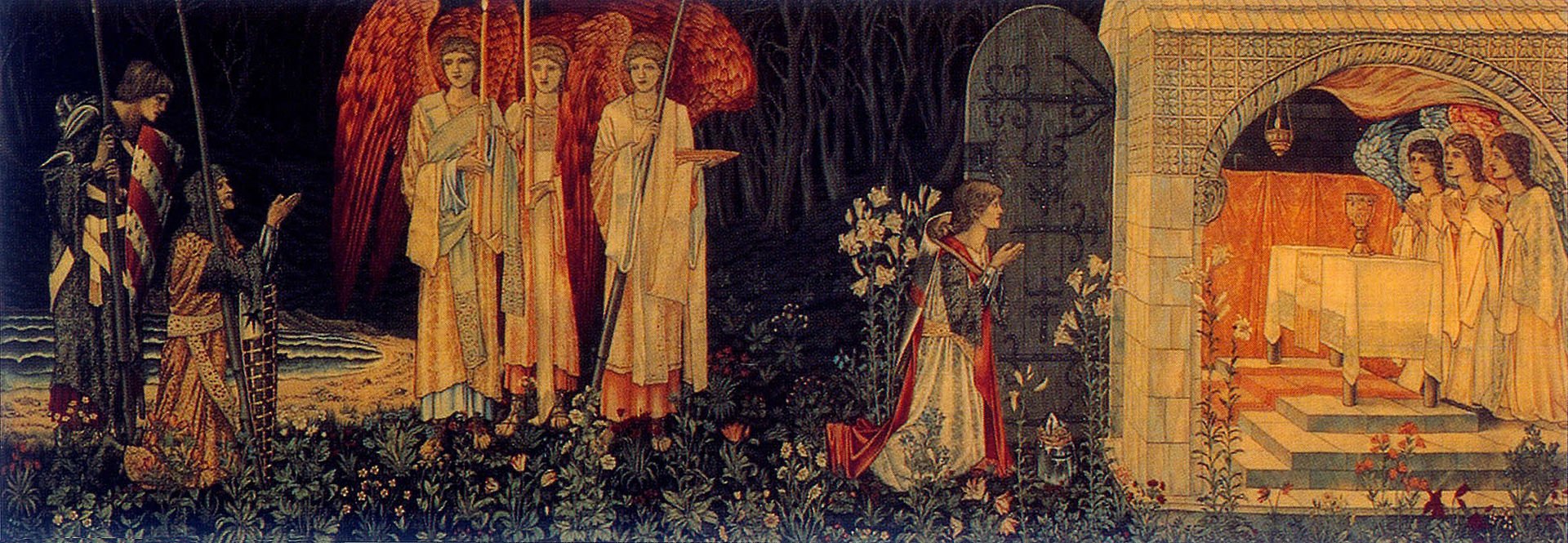
The Galahad of the later romances is defined less by conquest than by fitness for the quest. Where many Round Table knights are tested through love, loyalty, anger, pride or divided obligations, Galahad becomes the extreme case: the knight able to approach a power that destroys or rejects those who attempt to possess it for themselves.
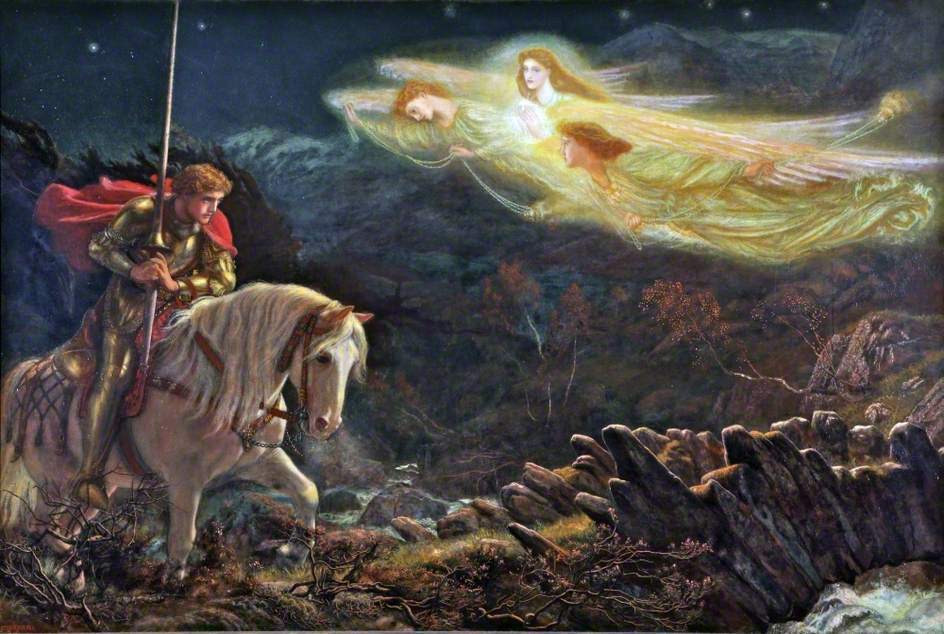
These later images remain useful historical material. They show how later centuries imagined Galahad, not necessarily how the Grail, Camelot or Galahad himself appear within the living world.
Galahad, Perceval and the Later Grail Tradition
This English-language overview examines Galahad, Perceval and the later Arthurian Grail tradition. It is useful as literary and mythological context, while its later religious interpretation of the Grail should not be treated as the in-world origin of the Grail.
Why Galahad Can Feel Inhuman
Many Arthurian heroes are compelling because they fail magnificently. Galahad is different.
He rarely falls to vanity, lust, jealousy, fear or ambition, and that can make him appear less human than knights such as Lancelot, Gawain or Percival.
At the table, do not solve this by secretly making Galahad corrupt. His integrity is the point.
Instead, give him problems that virtue alone cannot solve.
Two innocents may need protection in different places. An oath may have several honest interpretations. A defeated enemy may know how to save a village. A dangerous relic may genuinely be the fastest way to prevent a greater catastrophe.
Galahad knows what he will not do. The player characters become important when nobody yet knows what should be done instead.
Explore Galahad’s World
Galahad sits at the meeting point of the Round Table, the Grail quest, Celtic Otherworld traditions, Arthurian politics and high-level knightly play. These routes expand each part of that story.
The Grail Fellowship
Camelot and the Round Table
Places Beyond the Mortal Road
Celtic Myth and the Grail’s Older Roots
Arthurian Creatures and Quest Encounters
Running Galahad’s Knightly Mechanics
Weapons, Armour and Relics
Build the Adventure Around Him
Sources and Further Reading
- Welsh and Celtic Otherworld traditions. Material surrounding Annwn, enchanted vessels, sovereignty, supernatural abundance and restoration provides the deeper mythic framework used for the Grail here.
- Arthurian Grail romances. The medieval Grail cycles preserve Galahad’s arrival, the Siege Perilous and his place among the final Grail companions. Later religious interpretations remain part of the legend’s literary history rather than the Grail’s in-world origin.
- Sir Thomas Malory, Le Morte d’Arthur. A major later source for Galahad, Lancelot, Percival, Bors and the English Arthurian tradition. Project Gutenberg.
- D&D System Reference Document 5.2.1. Rules framework for the 5.5e / 2024 statistics. Official SRD.
- Pathfinder First Edition. Open rules reference for the Pathfinder 1e statistics. Archives of Nethys.
- D&D 3.5e. Open rules reference for the 3.5e statistics and epic attack progression. d20SRD.
Rules Sources and Licensing
D&D 5.5e / 2024
The 5.5e mechanics use the framework of System Reference Document 5.2.1 by Wizards of the Coast LLC. SRD 5.2.1 is available under the Creative Commons Attribution 4.0 International License.
D&D 5e / 2014
The 2014-compatible mechanics use material from System Reference Document 5.1. SRD 5.1 is available under Creative Commons Attribution 4.0 International.
Pathfinder 1e and D&D 3.5e
The Pathfinder 1e and D&D 3.5e statistics use open game mechanics appropriate to those editions. Mechanical material is Open Game Content only to the extent that it derives from material previously released as Open Game Content.
Character interpretation, Celtic Grail lore, Otherworld material, adventure hooks, encounter design, artwork and editorial presentation are not designated Open Game Content by this notice.
Open Game License v1.0a — applicable notice
OPEN GAME LICENSE Version 1.0a
The following text is the property of Wizards of the Coast, Inc. and is Copyright 2000 Wizards of the Coast, Inc (“Wizards”). All Rights Reserved.
1. Definitions: (a) “Contributors” means the copyright and/or trademark owners who have contributed Open Game Content; (b) “Derivative Material” means copyrighted material including derivative works and translations (including into other computer languages), potation, modification, correction, addition, extension, upgrade, improvement, compilation, abridgment or other form in which an existing work may be recast, transformed or adapted; (c) “Distribute” means to reproduce, license, rent, lease, sell, broadcast, publicly display, transmit or otherwise distribute; (d) “Open Game Content” means the game mechanic and includes the methods, procedures, processes and routines to the extent such content does not embody the Product Identity and is an enhancement over the prior art and any additional content clearly identified as Open Game Content by the Contributor, and means any work covered by this License, including translations and derivative works under copyright law, but specifically excludes Product Identity; (e) “Product Identity” means product and product line names, logos and identifying marks including trade dress; artifacts; creatures; characters; stories, storylines, plots, thematic elements, dialogue, incidents, language, artwork, symbols, designs, depictions, likenesses, formats, poses, concepts, themes and graphic, photographic and other visual or audio representations; names and descriptions of characters, spells, enchantments, personalities, teams, personas, likenesses and special abilities; places, locations, environments, creatures, equipment, magical or supernatural abilities or effects, logos, symbols or graphic designs; and any other trademark or registered trademark clearly identified as Product Identity by the owner of the Product Identity, and which specifically excludes the Open Game Content; (f) “Trademark” means the logos, names, mark, sign, motto, designs that are used by a Contributor to identify itself or its products or the associated products contributed to the Open Game License by the Contributor; (g) “Use”, “Used” or “Using” means to use, Distribute, copy, edit, format, modify, translate and otherwise create Derivative Material of Open Game Content; (h) “You” or “Your” means the licensee in terms of this agreement.
2. The License: This License applies to any Open Game Content that contains a notice indicating that the Open Game Content may only be Used under and in terms of this License. You must affix such a notice to any Open Game Content that You Use. No terms may be added to or subtracted from this License except as described by the License itself. No other terms or conditions may be applied to any Open Game Content distributed using this License.
3. Offer and Acceptance: By Using the Open Game Content You indicate Your acceptance of the terms of this License.
4. Grant and Consideration: In consideration for agreeing to use this License, the Contributors grant You a perpetual, worldwide, royalty-free, non-exclusive license with the exact terms of this License to Use the Open Game Content.
5. Representation of Authority to Contribute: If You are contributing original material as Open Game Content, You represent that Your Contributions are Your original creation and/or You have sufficient rights to grant the rights conveyed by this License.
6. Notice of License Copyright: You must update the COPYRIGHT NOTICE portion of this License to include the exact text of the COPYRIGHT NOTICE of any Open Game Content You are copying, modifying or distributing, and You must add the title, the copyright date, and the copyright holder’s name to the COPYRIGHT NOTICE of any original Open Game Content you Distribute.
7. Use of Product Identity: You agree not to Use any Product Identity, including as an indication as to compatibility, except as expressly licensed in another, independent Agreement with the owner of each element of that Product Identity. You agree not to indicate compatibility or co-adaptability with any Trademark or Registered Trademark in conjunction with a work containing Open Game Content except as expressly licensed in another, independent Agreement with the owner of such Trademark or Registered Trademark. The use of any Product Identity in Open Game Content does not constitute a challenge to the ownership of that Product Identity. The owner of any Product Identity used in Open Game Content shall retain all rights, title and interest in and to that Product Identity.
8. Identification: If you distribute Open Game Content You must clearly indicate which portions of the work that you are distributing are Open Game Content.
9. Updating the License: Wizards or its designated Agents may publish updated versions of this License. You may use any authorised version of this License to copy, modify and distribute any Open Game Content originally distributed under any version of this License.
10. Copy of this License: You MUST include a copy of this License with every copy of the Open Game Content You Distribute.
11. Use of Contributor Credits: You may not market or advertise the Open Game Content using the name of any Contributor unless You have written permission from the Contributor to do so.
12. Inability to Comply: If it is impossible for You to comply with any of the terms of this License with respect to some or all of the Open Game Content due to statute, judicial order or governmental regulation then You may not Use any Open Game Material so affected.
13. Termination: This License will terminate automatically if You fail to comply with all terms herein and fail to cure such breach within 30 days of becoming aware of the breach. All sublicenses shall survive the termination of this License.
14. Reformation: If any provision of this License is held to be unenforceable, such provision shall be reformed only to the extent necessary to make it enforceable.
15. COPYRIGHT NOTICE
Open Game License v 1.0a Copyright 2000, Wizards of the Coast, Inc.
System Reference Document Copyright 2000, Wizards of the Coast, Inc.;
Authors Jonathan Tweet, Monte Cook, Skip Williams,
based on original material by E. Gary Gygax and Dave Arneson.
Pathfinder Roleplaying Game Core Rulebook Copyright 2009,
Paizo Publishing, LLC;
Author Jason Bulmahn,
based on material by Jonathan Tweet, Monte Cook and Skip Williams.