
Full Plate
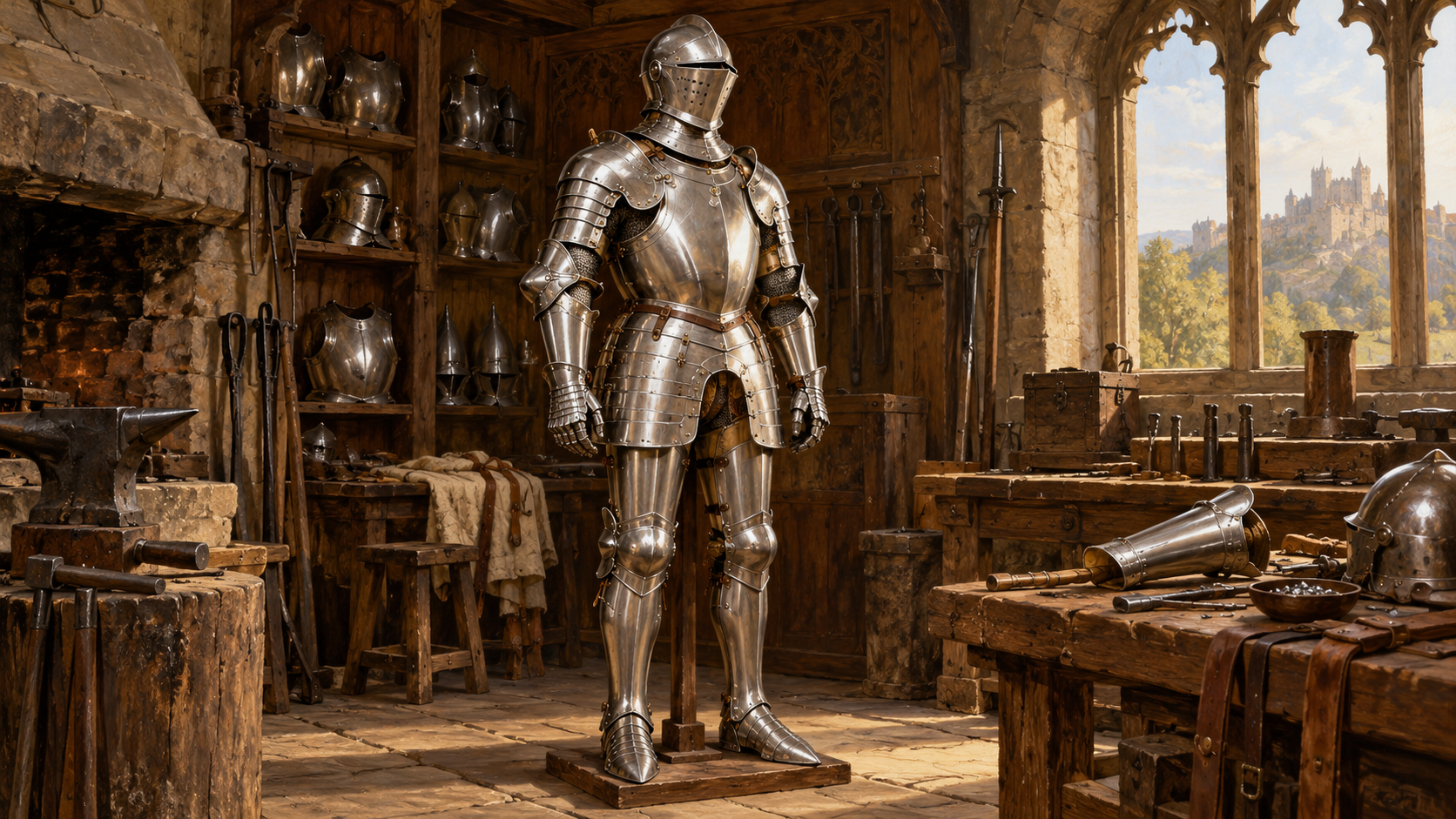
Full plate is a fitted harness of articulated steel, worn over protective clothing and covering the body from head to foot. It is costly, conspicuous and demanding to maintain, but a properly made suit lets its wearer walk, fight and move. The rules below show exactly what that protection means in four games.
Full Plate at a Glance
- Protection: breastplate and backplate, articulated arm and leg defences, gauntlets, helmet and protections for gaps in the plates.
- Underneath: fitted textile layers; mail can protect openings at joints and other vulnerable places.
- Wearer: a wealthy knight, well-equipped professional soldier, noble retainer or other combatant able to maintain a complete harness.
- Advantages: comprehensive protection while still allowing walking, fighting and mounting a horse when properly fitted.
- Trade-offs: expense, weight, heat, maintenance, noise and the time needed to dress and undress.
Four-edition rules · Using it in play · Original Pathfinder reference.

Full Plate Rules by Edition
Choose the edition your group plays. These four panels have different armour statistics, prices, weights and restrictions.
Full Plate — D&D 2024
Published rules. This is an edition-specific reference, not an invented conversion.
Category: Heavy Armor.
| Armor | Armor Class (AC) | Strength | Stealth | Weight | Cost |
|---|---|---|---|---|---|
| Plate Armor | 18 | Str 15 | Disadvantage | 65 lb. | 1,500 GP |
Edition-specific rules:
- Strength / Movement: Strength 15; Speed reduced by 10 ft. below that score, unless an exception applies.
- Training: Heavy Armour Training. Without it, Disadvantage on D20 Tests involving Strength or Dexterity and no spellcasting.
- Don / Doff: 10 minutes to don; 5 minutes to doff.
- Shields: An ordinary Shield grants +2 AC only with Shield Training; separate from the plate suit.
At the table: For a trained fighter, plate sets AC to 18 before eligible shield and other effects. It never adds +18 to an existing AC.
Source: D&D 2024 equipment rules.
Full Plate — D&D 2014
Published rules. This is an edition-specific reference, not an invented conversion.
Category: Heavy armor.
| Armor Name | Cost | Armor Class (AC) | Strength | Stealth | Weight |
|---|---|---|---|---|---|
| Plate | 1,500 gp | 18 | Str 15 | Disadvantage | 65 lb. |
Edition-specific rules:
- Strength / Movement: Strength 15; generally –10 ft. Speed if below the requirement, with applicable dwarf/class exceptions.
- Proficiency: Without Heavy Armour proficiency: Disadvantage on Strength/Dexterity ability checks, saves and attack rolls; cannot cast spells.
- Don / Doff: 10 minutes to don; 5 minutes to doff.
- Shields: A wielded ordinary Shield adds +2 AC; lack of Shield proficiency incurs 2014 penalties but does not erase its AC bonus.
At the table: The armour proficiency rule here is not the same wording as the 2024 Armour Training rule. Neither edition uses a percentile arcane spell-failure roll.
Source: D&D 2014 equipment rules.
Full Plate — Pathfinder 1e
Published rules. This is an edition-specific reference, not an invented conversion.
Category: Heavy armor.
| Armor | Cost | Armor/Shield Bonus | Maximum Dex Bonus | Armor Check Penalty | Arcane Spell Failure Chance | Speed (30 ft.) | Speed (20 ft.) | Weight |
|---|---|---|---|---|---|---|---|---|
| Full plate | 1,500 gp | +9 | +1 | −6 | 35% | 20 ft. | 15 ft. | 50 lb. |
Edition-specific rules:
- Donning / Fitting: Don properly in 4 minutes, with help. Don hastily in 4 minutes, reducing its armour bonus by 1 and worsening its armour check penalty by 1. Removal takes 1d4+1 minutes, halved with assistance. A captured suit requires fitting; see the original Pathfinder description below.
At the table: The +9 armour bonus and shield bonuses are separate Pathfinder AC components with their own stacking restrictions. Do not add +9 to a fifth-edition character’s AC 18.
Source: Pathfinder 1e equipment rules.
Full Plate — D&D 3.5e
Published rules. This is an edition-specific reference, not an invented conversion.
Category: Heavy armor.
| Armor | Cost | Armor/Shield Bonus | Maximum Dex Bonus | Armor Check Penalty | Arcane Spell Failure Chance | Speed (30 ft.) | Speed (20 ft.) | Weight |
|---|---|---|---|---|---|---|---|---|
| Full plate | 1,500 gp | +8 | +1 | −6 | 35% | 20 ft. | 15 ft. | 50 lb. |
Edition-specific rules:
- Don / Doff: 4 minutes with help to don properly; hasty donning gives worse protection; removing ordinarily takes 1d4+1 minutes with assistance.
At the table: Use the 3.5e +8 figure even though Pathfinder’s weight, skill penalty and spell failure are similar. Armour proficiency and donning rules are those of 3.5e.
Source: D&D 3.5e equipment rules.
How a Full Harness Works
A harness is not a single rigid shell. A shaped breastplate and backplate defend the trunk; hinged arm and leg plates move at the elbows and knees; gauntlets protect the hands, while a helmet and throat defence protect the head and neck. Overlapping plates and mail at gaps help keep a blade from finding an exposed opening. The wearer needs fitted clothing, straps and points to keep those parts properly seated.
The design of a suit matters as much as its weight. A harness built for a rider may have different shoulder and thigh arrangements from armour intended mainly for fighting on foot. Cheaply supplied pieces or ill-fitting captured armour may still protect, but they are less likely to work comfortably together.
Using Full Plate in Play
Preparing for a fight. A lookout reports raiders five minutes away. In D&D 2014 and 2024, the suit takes 10 minutes to don normally; the knight may have to fight before fully armoured. In Pathfinder 1e and D&D 3.5e, properly donning full plate takes 4 minutes and requires help; hasty donning has explicit penalties. This choice affects the encounter without inventing a special rule.
After the fight. A captured harness belongs to a particular body. The owner may be shorter, broader or differently proportioned than the character who found it. Resizing it can mean time, a skilled armoursmith and substantial cost. Plate is valuable loot, but not necessarily ready-to-wear loot.
In cramped or wet places. Armour cannot be slipped off instantly to squeeze into a concealed opening or cross a flooded cellar. Describe the harness realistically, but apply swimming, stealth, exhaustion, falling and encumbrance penalties only where the chosen rules edition actually provides them.
Fitting, Repair, and Buying a Harness
Rules price: a normal suit costs 1,500 gp in the cited equipment tables, but availability is a separate matter. A specialist armourer may take an existing harness apart to refit its plates, renew straps, replace rivets or repair a dented visor. A lavishly decorated court harness and a plain battlefield harness need not look or cost the same.
Pathfinder 1e and D&D 3.5e: the published full-plate description allows a captured suit to be resized for 2d4 × 100 gp (200–800 gp). D&D 2024: the optional Equipment Sizes variant sets refitting at 1d4 × 10% of the item’s market price. D&D 2014: its own optional Equipment Sizes variant also permits 10–40% of market price (roll 1d4 × 10 or let the DM determine the cost). These fifth-edition variants are optional, not automatic charges or Pathfinder rules.
Historical context: fifteenth-century Italian armourers developed and exported sophisticated full harnesses across Europe. Milan’s workshops, including those associated with the Missaglia family, are documented by the Metropolitan Museum of Art. The portrait above is a later sixteenth-century example of high-status plate, not a picture of every late-medieval soldier.
Related Equipment and Rules
Armour & Shields directory · Tower Shield · Armor Class (legacy bonus-based reference) · Special Materials. Sources: D&D 2024, D&D 2014, Pathfinder 1e and D&D 3.5e.
Original Pathfinder 1e Reference
The original Pathfinder description and printed armour figures are retained below for reference. The four edition panels above are the place to check the rules your group actually uses.
[This content was created for the Pathfinder rules by Paizo Publishing LLC and is part of the Pathfinder RPG product line.]
This metal suit includes gauntlets, heavy leather boots, a visored helmet, and a thick layer of padding that is worn underneath the armor. Each suit of full plate must be individually fitted to its owner by a master armorsmith, although a captured suit can be resized to fit a new owner at a cost of 200 to 800 (2d4 × 100) gold pieces.
Show original Pathfinder 1e full-plate statistics
This compactly reformatted version retains the numerical values from the previous Pathfinder table. A Medium creature’s normal 30-foot or 20-foot speed becomes 20 feet or 15 feet respectively unless an edition-specific exception applies. For the complete movement, donning and fitting rules use the linked Pathfinder reference above.
| Armour | Cost | Armour bonus | Max. Dex bonus | Check penalty | Arcane failure | Speed (30 ft. base) | Speed (20 ft. base) | Weight |
|---|---|---|---|---|---|---|---|---|
| Full plate (heavy) | 1,500 gp | +9 | +1 | –6 | 35% | 20 ft. | 15 ft. | 50 lb. |
Rules Credits and Copyright Notice
The original full-plate description and legacy table above come from the Pathfinder Roleplaying Game Core Rulebook, using material made available under the Open Game License v1.0a. Section 15 source notices for this material follow:
- Open Game License v1.0a, Copyright 2000, Wizards of the Coast, Inc.
- System Reference Document, Copyright 2000, Wizards of the Coast, Inc.; authors Jonathan Tweet, Monte Cook and Skip Williams, based on material by E. Gary Gygax and Dave Arneson.
- Pathfinder Roleplaying Game Core Rulebook, Copyright 2009, Paizo Publishing, LLC; author Jason Bulmahn, based on material by Jonathan Tweet, Monte Cook and Skip Williams.
- Pathfinder Roleplaying Game Reference Document, Copyright 2011, Paizo Publishing, LLC; author Paizo Publishing, LLC.
The fifth-edition rules comparisons draw on the D&D System Reference Documents 5.1 and 5.2.1 by Wizards of the Coast LLC, licensed under Creative Commons Attribution 4.0; the surrounding equipment advice and examples are original editorial text. This article is not an official Wizards of the Coast or Paizo publication.
Plate Armour in Motion
How to Dress in Medieval Armour (Modern History TV) demonstrates how a complete fifteenth-century style harness is put on, including the arming clothes, straps, riveted joints and help needed from another person. The other five historical video URLs are retained in the collapsed archive below rather than filling the page with unverified embeds.
Featured demonstration: “How to Dress in Medieval Armour”, Modern History TV. The reenactor shows the fitted layers, straps, joints and assistance involved in putting on a fifteenth-century style harness. Video demonstrations help identify the real equipment; they do not replace the four edition-specific game rules above.
Five more archived armour videos (awaiting editorial review)
The five URLs below appeared in the earlier page. They have been retained for reference, but their exact titles, subjects and playback have not yet been verified. They are links, not five extra autoplay or embedded video players.
- Archived armour video 1 (awaiting individual subject and playback review)
- Archived armour video 2 (awaiting individual subject and playback review)
- Archived armour video 3 (awaiting individual subject and playback review)
- Archived armour video 4 (awaiting individual subject and playback review)
- Archived armour video 5 (awaiting individual subject and playback review)
Keep this reference growing
If this page helped with your reading or game, you can support its upkeep or explore the curated books.
Explore the Bookshop — epics, classics and stories behind imagined worlds.