
Sir Mordred — Arthur’s Rival and the Fall of Camelot

Sir Mordred is building an alliance of discontented lords inside Arthur’s court. He knows which knights will follow the crown and which will follow the promise of land. His coup is a choice, not a curse. The characters find a letter offering to spare a hostage if a rival’s oath is broken.
At a Glance
- Identity
- Sir Mordred (Medraut in early Welsh references)
- Nature
- Human; a formidable mortal claimant
- Household
- Orkney; son of Morgause in the developed romance tradition
- Family
- Gawain, Agravain, Gaheris and Gareth; Arthur is uncle or father according to the source tradition
- Public allegiance
- Knights of the Round Table
- Secret aim
- Obtain a royal commission and the loyalty of its garrison
- Allies
- Ambitious household retainers and discontented court knights
- Enemies
- King Arthur; Merlin; the knights he seeks to divide
- Alignment
- Lawful Evil: manipulates oaths, courts and law to acquire power
- Immediate leverage
- A royal seal, an armed escort and a witness frightened into silence
What Is Happening Right Now?
The king’s household receives an order bearing Arthur’s seal. It transfers control of a stronghold to Mordred’s chosen captain. Merlin suspects forgery, but a real witness signed it under duress. Mordred arranges for the witness to disappear before anyone can ask whether the king gave the order. If the party acts too openly, the court may treat them as rebels.
First Meeting
Mordred sits behind a table, not on a throne. He moves a wax seal and three sealed letters into view, offers the visitors bread, and asks why a king should trust men who answer only to their consciences. The guards do not move until he gives them a reason. He wants the heroes to accept his commission before they learn its cost.
Three Scenes Tonight
- The forged commission: expose the scribe who copied Arthur’s seal without condemning the servant forced to hold the document.
- The divided brothers: Gawain and Gareth disagree over whether to arrest a knight accused of disloyalty; Mordred exploits both positions.
- The silent garrison: a castellain receives two orders, one genuinely royal and one carried by Mordred’s riders. The gates close at sunset.
Appearance and Manner
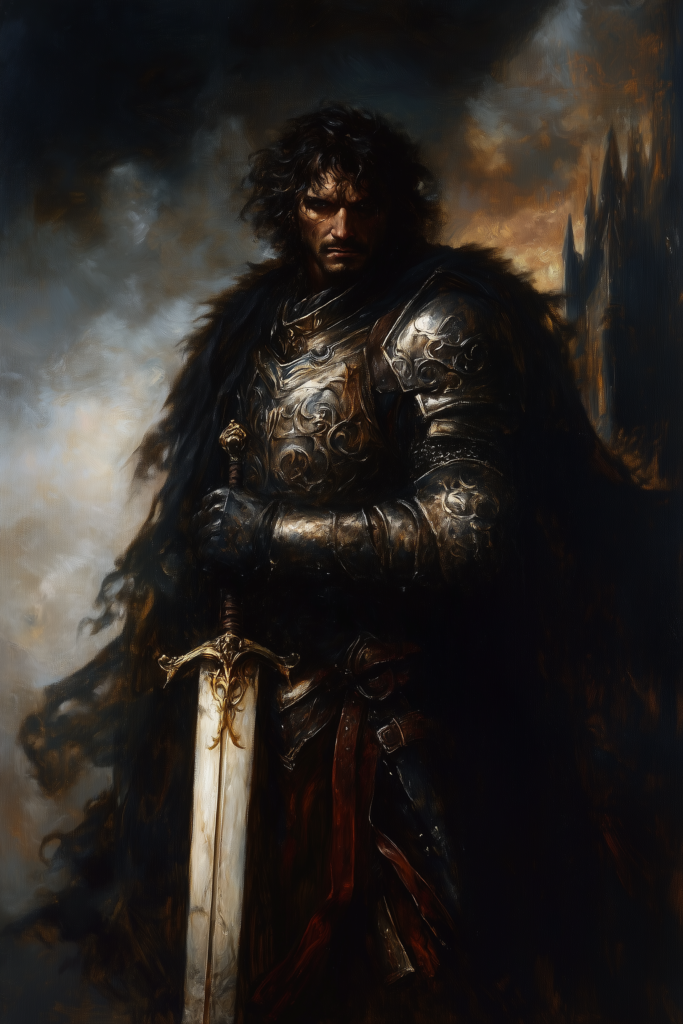
Mordred dresses as an armed nobleman, with dark plate, polished sword and a small crest of Orkney. He does not announce his treachery. His speech is precise and courteous, his threats almost legalistic. He praises loyalty while turning duty against whoever stands before him. A lie from him usually contains a verifiable fact.
Ambition, Pressure and Private Knowledge
- Ambition: gain a crown with support from households that feel neglected by Arthur.
- Pressure: his family loyalty is strained by disputes among Gawain, Agravain and Gareth; any public break may destroy his claim.
- Private knowledge: he knows the witness against him has a relative held in another lord’s house.
- Fear: to be exposed as a mere opportunist rather than a legitimate successor.
- Moral limit: there is no fated supernatural evil; his willingness to sacrifice hostages and oath-bound knights makes his acts culpable.
Relationships and Factions
- King Arthur: ruler Mordred seeks to supplant, by policy first and force if necessary.
- Morgan le Fay: sometimes a useful conspirator but not his mother in Malory’s account.
- Agravain: a brother who shares suspicions of the queen and Lancelot.
- Gaheris: a brother whose sense of honour may break with Mordred’s methods.
- Gareth: compassion and sworn duty Mordred finds inconvenient.
- Queen Guinevere and Lancelot: the secret around them can shatter court loyalties.
- Merlin: likely to identify a forged oath but unwilling to invent proof.
Game Statistics
Each panel represents a separate playable opponent. Mordred’s strength is the chain of command: compromise his witnesses, separate his guards, and the military danger becomes much smaller.
Sir Mordred — D&D 2024
Medium Humanoid (Human), Lawful Evil
Armor Class 20 (plate and shield); Initiative +3 (13); Hit Points 210 (20d10 + 100); Speed 30 ft.; Challenge 15 (13,000 XP; PB +5).
| STR | DEX | CON | INT | WIS | CHA |
|---|---|---|---|---|---|
| 20 (+5) | 16 (+3) | 20 (+5) | 16 (+3) | 14 (+2) | 18 (+4) |
Saving Throws Str +10, Con +10, Wis +7, Cha +9; Skills Athletics +10, Deception +14, Insight +7, Intimidation +9, Perception +7, Persuasion +9; Senses passive Perception 17; Languages Brythonic and the court tongues of Britain.
Traits
Legendary Resistance (2/Day). Mordred can turn a failed saving throw into a success.
Opportunist (Once per Turn). When Mordred hits with a weapon attack and an ally of his is within 5 feet of that target, the attack deals an extra 14 (4d6) Slashing damage.
Actions
Multiattack. Mordred makes three Longsword attacks.
Longsword +2. Melee Attack Roll: +12 to hit, reach 5 ft., one target. Hit: 12 (1d8 + 7) Slashing damage.
Royal Arrest (Recharge 5–6). Up to three guards who can hear Mordred within 30 feet can each move up to half their Speed and make one melee attack as a Reaction.
Bonus Action
Regroup. Mordred moves up to half his Speed without provoking Opportunity Attacks from creatures within 5 feet of one of his allies.
Reaction
Parry. Mordred adds 3 to his AC against one melee attack that would hit him, provided he can see the attacker and is holding his sword.
Legendary Actions
Mordred has three Legendary Action uses, regained at the start of his turn. At the end of another creature’s turn he can take one of: Advance (1 use), move up to half his Speed; Longsword (1 use), make one Longsword attack; Issue Orders (2 uses), a willing ally within 30 feet can use its Reaction to make a weapon attack.
Tactics
He surrounds the target with loyal knights, attacks only after a political excuse exists, and retreats if defeat would surrender evidence of his coup. He has no innate curse powers.
Sir Mordred — D&D 2014
Medium humanoid (human), lawful evil
Armor Class 20 (plate and shield); Hit Points 210 (20d10 + 100); Speed 30 ft.; Challenge 15 (13,000 XP; proficiency bonus +5).
| STR | DEX | CON | INT | WIS | CHA |
|---|---|---|---|---|---|
| 20 (+5) | 16 (+3) | 20 (+5) | 16 (+3) | 14 (+2) | 18 (+4) |
Saving Throws Str +10, Con +10, Wis +7, Cha +9; Skills Athletics +10, Deception +14, Insight +7, Intimidation +9, Perception +7, Persuasion +9; Senses passive Perception 17; Languages Brythonic and the court tongues of Britain.
Traits
Legendary Resistance (2/Day). Mordred can choose to succeed on a saving throw he fails.
Opportunist (Once per Turn). Mordred’s weapon attack deals an extra 14 (4d6) slashing damage if it hits a target within 5 feet of one of his allies.
Actions
Multiattack. Mordred makes three Longsword attacks.
Longsword +2. Melee Weapon Attack: +12 to hit, reach 5 ft., one target. Hit: 12 (1d8 + 7) slashing damage.
Orders to Seize (Recharge 5–6). Up to three allies within 30 feet who can hear Mordred can each use their reaction to move up to half their speed and make one melee weapon attack.
Reactions
Parry. Mordred adds 3 to his AC against one melee attack that would hit him if he sees the attacker and is wielding a melee weapon.
Legendary Actions
Three legendary action uses, regained at the start of his turn. One option can be used at the end of another creature’s turn: Move (1), up to 15 feet without provoking opportunity attacks; Blade (1), make a Longsword attack; Order (2), an ally within 30 feet makes one weapon attack using its reaction.
Tactics
His danger is coordination, not magical darkness. His guards can be persuaded, intimidated or separated; loss of command reduces his offensive pressure.
Sir Mordred — Pathfinder 1e
Sir Mordred CR 15; XP 51,200; male human fighter 16; LE Medium humanoid (human); Init +7; Senses Perception +18.
Defense
AC 33, touch 15, flat-footed 30 (+12 armor, +4 shield, +3 Dex, +2 natural, +2 deflection); hp 168 (16d10 + 80); Fort +17, Ref +10, Will +9; Defensive Abilities bravery +4, armor training 4.
Offense
Speed 30 ft. in armor (armor training); Melee +2 longsword +28/+23/+18/+13 (1d8+14, 17–20/×2); Ranged longbow +19/+14/+9/+4 (1d8/×3); Space 5 ft.; Reach 5 ft.
Special Attacks weapon training (heavy blades +3), weapon specialization (longsword +2); Power Attack is not included in the numbers above.
Statistics
Str 20, Dex 16, Con 20, Int 16, Wis 14, Cha 18; Base Atk +16; CMB +21; CMD 36.
Feats Weapon Focus (longsword), Greater Weapon Focus (longsword), Weapon Specialization (longsword), Greater Weapon Specialization (longsword), Improved Critical (longsword), Power Attack, Cleave, Combat Reflexes, Improved Initiative, Iron Will, Leadership, Mounted Combat, Ride-By Attack, Spirited Charge, Shield Focus, Improved Shield Bash, Improved Bull Rush, Critical Focus.
Skills Bluff +20, Diplomacy +20, Intimidate +23, Knowledge (nobility) +19, Ride +22; Languages Brythonic and royal court tongues; Combat Gear +3 full plate, +2 heavy steel shield, +2 longsword, ring of protection +2, amulet of natural armor +2, cloak of resistance +2.
Tactics
Before Combat he surrounds himself with retainers and has witnesses prepared. During Combat he uses shield and weapon training rather than spell-like shadow powers. Morale he retreats to preserve his claim if the line collapses.
Sir Mordred — D&D 3.5e
Sir Mordred CR 16; male human fighter 16; LE Medium humanoid (human); Init +7; Senses Listen +2, Spot +2.
Defense
AC 30, touch 13, flat-footed 29 (+11 armor, +4 shield, +1 Dex in plate, +2 natural, +2 deflection); hp 168 (16d10 + 80); Fort +17, Ref +10, Will +9.
Offense
Speed 20 ft. in full plate; Melee +2 longsword +25/+20/+15/+10 (1d8+11, 17–20/×2); Ranged longbow +19/+14/+9/+4 (1d8/×3); Base Atk/Grapple +16/+21; Space/Reach 5 ft./5 ft.
Statistics
Str 20, Dex 16, Con 20, Int 16, Wis 14, Cha 18; Feats Weapon Focus (longsword), Greater Weapon Focus (longsword), Weapon Specialization (longsword), Greater Weapon Specialization (longsword), Improved Critical (longsword), Power Attack, Cleave, Combat Reflexes, Improved Initiative, Iron Will, Leadership, Mounted Combat, Ride-By Attack, Spirited Charge, Shield Focus, Improved Shield Bash, Improved Bull Rush, Combat Expertise.
Skills Bluff +13, Diplomacy +13, Intimidate +23, Knowledge (nobility and royalty) +12, Ride +22; Languages Brythonic and Norman French; Possessions +3 full plate, +2 heavy steel shield, +2 longsword, ring of protection +2, amulet of natural armor +2, cloak of resistance +2, signet and letters.
Tactics
His sword and troop tactics are mundane apart from listed equipment. The threat of arrest and loss of royal authority shapes the encounter more than a fictional curse.
Using Mordred at the Table
He offers help before showing the bargain. His soldiers are not expendable undead; they have families, commanders and fears. Before combat, the heroes can turn guards, provide written evidence or force an open hearing. In battle Mordred stays with a disciplined retinue and escapes if capture would doom his plan. An arrest, duel or confession should have consequences for the whole court.
Five Encounters
- Road inspection: guards search every wagon for a missing royal seal.
- Hearing before Arthur: Mordred presents a true witness to support a false accusation.
- Riders at the ford: the party must rescue a courier before he is taken to a private prison.
- Feast accusation: a stolen token implicates the queen’s household.
- Castle at dawn: the garrison has sworn to a forged commission and refuses entry to the king’s envoys.
Six Adventure Hooks
- One of Mordred’s captains asks the party to hide his child before the coup.
- A forged royal decree awards an estate already occupied by loyal commoners.
- An Orkney knight offers evidence against Mordred but demands the execution of a rival.
- The party has two days to find the imprisoned witness before he signs a confession.
- A court bard sings a version of Camlann naming Mordred the victor; the source is a paid propagandist.
- Mordred offers the heroes command of a fortified road if they agree not to question a disappearance.
Equipment and Resources
A +2 longsword, plate and shield, horse and lance, signet rings, a small ciphered correspondence archive, paid servants and sworn knights. His heraldry signals Orkney ties; no source requires a supernatural cursed sword. The favours and debts he can call in often matter more than his personal armament.
Lore and Timeline
The early Welsh annal entry for Camlann reports that Arthur and Medraut both fell, without identifying them as enemies. Geoffrey of Monmouth later develops the treacherous nephew; the French prose cycles and Malory establish more complicated kinship, including the version in which Mordred is Arthur’s son. These incompatible traditions cannot all serve as a single historical biography.
The campaign’s living court belongs to its 1454 present: Camlann is a possible future rather than a guaranteed outcome. Mordred acts within real family and faction relationships; the characters’ intervention can change what later chroniclers tell.
Related People and Places
Arthurian character directory · King Arthur · Morgan le Fay · Agravain · Gaheris · Merlin · Guinevere
Sources and Artwork
- The Annales Cambriae entry on Camlann — Arthur and Medraut both fall, relationship unspecified.
- Geoffrey of Monmouth, Historia regum Britanniae; the later prose cycles and Malory’s Le Morte d’Arthur.
- Existing Mordred paintings and the site’s earlier H. J. Ford illustration are retained in the media library. Rules and scenario material are original unofficial adaptations.
Keep this reference growing
If this page helped with your reading or game, you can support its upkeep or explore the curated books.
Explore the Bookshop — epics, classics and stories behind imagined worlds.