
Asgardian Pantheon • Loki’s Children
Fenrir — The Bound Wolf of Ragnarök
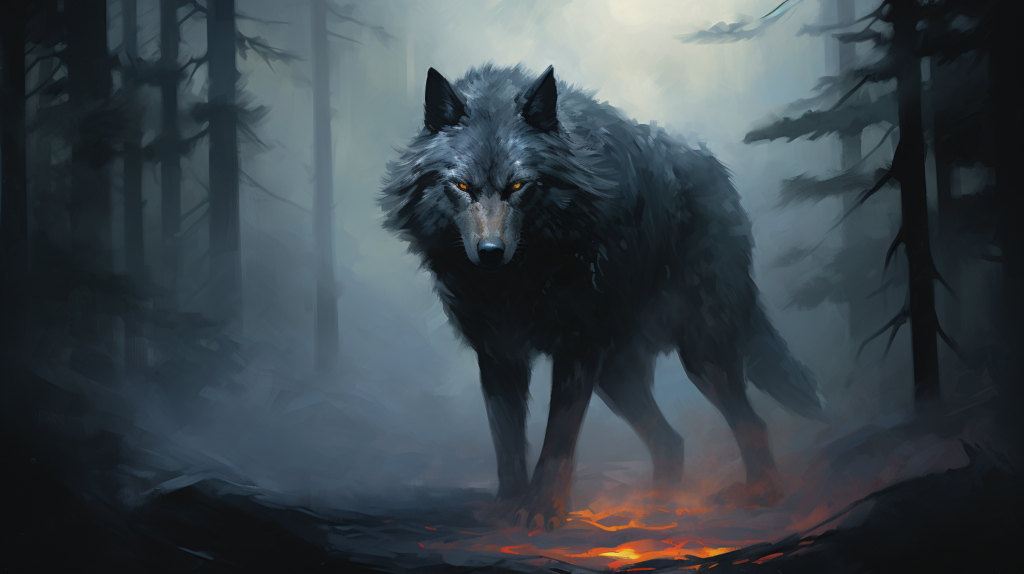
Fenrir is the colossal wolf born to Loki and Angrboða: brother of Jörmungandr and Hel, fostered among the gods, fed by Týr, deceived into Gleipnir and fated to kill Odin at Ragnarök. He is not currently roaming the worlds. He remains bound on Lyngvi in the lake Ámsvartnir, a sword wedged between his jaws, waiting for the breaking of bonds that prophecy places at the end of the present divine order.
Fenrir at a Glance
| Nature | Unique intelligent mythic wolf; monstrous child of Loki and Angrboða |
|---|---|
| Parents | Loki and Angrboða |
| Siblings | Hel and Jörmungandr |
| Status | Bound; Ragnarök has not released him |
| Prison | Lyngvi in the lake Ámsvartnir |
| Binding | Gleipnir, the impossible fetter |
| One who fed him | Týr |
| Price of the binding | Týr’s hand |
| Alignment | Chaotic Evil in the game-stat traditions; intelligent, vengeful and fully aware of the gods’ betrayal |
| Divine rank | None assigned; Fenrir is a unique mythic monster rather than an Æsir or Vanir deity |
| Foretold fate | Kills Odin at Ragnarök and is then killed by Víðarr |
Campaign Present
What Is Fenrir Doing Now?
Fenrir is still bound. Gleipnir remains fast, the sword remains between his jaws and the river Ván still marks the violence of his confinement. He can neither break the fetter by brute strength nor use the supernatural freedom that defeats ordinary restraints.
Bound does not mean mindless or dormant. Fenrir remembers Týr, Odin and every god who participated in the deception. Those who find the prison can speak to a creature with intelligence, memory and a grievance older than kingdoms. He does not need to invent lies about what happened: the gods really did trick him, and Týr really did place his hand in Fenrir’s mouth as the pledge that made the trap possible.
The immediate danger is therefore not Fenrir charging across Midgard. It is someone discovering a valid way to alter Gleipnir, the anchoring stone, the sword, the island or the prophecy governing the binding. Every faction interested in Ragnarök has a reason to search for Lyngvi.
The Binding of Fenrir
Fenrir grew so quickly among the gods that fear replaced tolerance. Týr alone was willing to feed him. The Æsir first tested the wolf with Lædingr and then Drómi. Fenrir broke both.
The gods then turned to impossible craft. Dwarven smiths made Gleipnir from things that cannot ordinarily be gathered: the sound of a cat’s footfall, a woman’s beard, mountain roots, a bear’s sinews, a fish’s breath and a bird’s spittle. The result looked like a soft ribbon rather than a chain.
Fenrir recognised the danger. He agreed to be bound only if one god placed a hand in his mouth as a pledge of good faith. Týr did so knowing what the gods intended. When Gleipnir held and the gods refused to release the wolf, Fenrir bit off Týr’s hand.
Gleipnir — The Binding That Overrides Freedom
Gleipnir is not simply a rope with very high hit points. It exists to solve one mythic problem: Fenrir can break ordinary restraints. The artifact therefore overrides abilities that would normally let him escape grapples, restraints, magical slowing or conventional confinement.
| Ruleset | Effect |
|---|---|
| 5.5e / 2024 | Fenrir is Restrained, his Speed is 0 and Unfetterable does not function. Ordinary attacks, ability checks and spells cannot break Gleipnir. |
| Pathfinder 1e | Gleipnir suppresses Unfetterable. Combat manoeuvres, Escape Artist, Strength checks, sunder and non-artifact magic cannot free him. |
| D&D 3.5e | Gleipnir overrides Unfetterable and continuous freedom of movement. Ordinary Strength, weapons and dispelling do not break it. |
A campaign that allows Gleipnir to be broken should make the method specific and consequential: an artifact, an equal cosmic law, the prophesied breaking of bonds at Ragnarök, or a carefully established vulnerability. A high Strength check is not enough.
Game Statistics
The editions below describe the same unique Fenrir at different
rules scales. The D&D 5.5e and Pathfinder treatments are
modern conversions; the D&D 3.5e version preserves the epic
legacy interpretation.
Armor Class
25 (natural armor)
Hit Points
676 (33d20 + 330)
Speed
80 ft.
30 (+10)
18 (+4)
30 (+10)
16 (+3)
22 (+6)
24 (+7)
Saving Throws
Str +19, Dex +13, Con +19, Wis +15, Cha +16
Skills
Athletics +19, Intimidation +16,
Perception +15, Survival +15
Damage Resistances
cold
Damage Immunities
poison
Condition Immunities
charmed, frightened, poisoned
Senses
darkvision 120 ft., passive Perception 25
Languages
Old Norse, Giant
Challenge
30 (155,000 XP; PB +9)
Traits
Keen Hearing and Smell.
Fenrir has Advantage on Wisdom (Perception) checks
that rely on hearing or smell.
Legendary Resistance (4/Day).
If Fenrir fails a saving throw, he can choose to
succeed instead.
Magic Resistance.
Fenrir has Advantage on saving throws against spells
and other magical effects.
Siege Monster.
Fenrir deals double damage to objects and structures.
Unfetterable.
Non-artifact magic can’t reduce Fenrir’s Speed.
At the start of each of his turns, Fenrir can end
the Grappled or Restrained condition on himself if
that condition was not caused by an Artifact.
This trait does not function against Gleipnir.
Actions
Multiattack.
Fenrir makes three attacks: one Bite and two Claws.
Bite.
Melee Attack Roll: +19, reach 20 ft.
Hit: 49 (6d12 + 10) Piercing damage.
If the target is a Huge or smaller creature, it is
Grappled (escape DC 27). Until this grapple ends,
the creature is Restrained. Fenrir can have one
creature grappled in his jaws at a time.
Claw.
Melee Attack Roll: +19, reach 15 ft.
Hit: 36 (4d12 + 10) Slashing damage.
If the target is Huge or smaller, it must succeed
on a DC 27 Strength saving throw or have the Prone
condition.
Swallow.
Fenrir makes a Bite attack against a Huge or smaller
creature he is grappling in his jaws. On a hit,
the target takes the Bite’s damage, is swallowed,
and the grapple ends.
While swallowed, a creature has the Blinded and
Restrained conditions, has Total Cover against
effects originating outside Fenrir, and takes
55 (10d10) Acid damage at the start of each of
Fenrir’s turns.
If Fenrir takes 80 or more damage during a single
turn from creatures inside him, he regurgitates all
swallowed creatures at the end of that turn.
They appear Prone in unoccupied spaces within
20 feet of him.
Dread Howl (Recharge 5–6).
Each enemy of Fenrir’s choice within 300 feet that
can hear him must make a DC 24 Wisdom saving throw.
On a failure, the creature takes 45 (10d8) Psychic
damage and has the Frightened condition for 1 minute.
On a success, it takes half as much damage and isn’t
Frightened. A frightened creature repeats the saving
throw at the end of each of its turns.
World-Shaking Pounce (Recharge 6).
Fenrir moves up to his Speed without provoking
Opportunity Attacks. At the end of this movement,
each creature on the ground within 30 feet must
make a DC 27 Dexterity saving throw, taking
45 (10d8) Bludgeoning damage and falling Prone
on a failed save, or taking half as much damage
without falling Prone on a successful save.
Bonus Actions
Ravenous Advance.
Fenrir moves up to half his Speed toward a creature
he can see that is Frightened, Grappled by him,
or below half its Hit Point maximum. This movement
doesn’t provoke Opportunity Attacks from that creature.
Reactions
Snap at the Bold.
When a creature Fenrir can see enters his Bite’s
reach, Fenrir makes one Bite attack against it.
Legendary Actions
Fenrir can take 3 Legendary Actions, choosing from
the options below. Only one option can be used at a
time and only at the end of another creature’s turn.
Fenrir regains all spent Legendary Actions at the
start of his turn.
Hunt.
Fenrir moves up to half his Speed without provoking
Opportunity Attacks.
Claw.
Fenrir makes one Claw attack.
Chomp (Costs 2 Actions).
Fenrir makes one Bite attack or uses Swallow against
a creature already grappled in his jaws.
Break the Ground (Costs 2 Actions).
Each creature on the ground within 30 feet must
succeed on a DC 27 Dexterity saving throw or take
28 (8d6) Bludgeoning damage and fall Prone.
A successful save halves the damage and prevents
the creature from falling Prone.
If Fenrir is bound by Gleipnir, the artifact’s
rules supersede Unfetterable. These combat statistics
describe Fenrir if released.
Optional Ragnarök Phase
Ragnarök Unbound.
When Fenrir is used as one of the principal creatures
in Ragnarök, the first time he is reduced to
0 Hit Points he can instead regain 338 Hit Points,
immediately recharge Dread Howl and World-Shaking
Pounce, and move up to his Speed.
Ragnarök Unbound is an encounter-phase upgrade
and is not included in the base CR 30 rating.
CE Colossal magical beast
(extraplanar, mythic, unique)
Init +13/-7;
Senses
darkvision 120 ft., low-light vision,
scent;
Perception +59
Aura
frightful presence (300 ft., DC 35)
Defense
AC
48, touch 11, flat-footed 39
(+9 Dex, +37 natural, -8 size)
hp
766 (36d10+468 plus 100 mythic)
Fort +34,
Ref +31,
Will +26;
second save
Defensive Abilities
block attacks, mythic resilience;
DR 10/epic;
Immune fear, poison;
SR 41
Offense
Speed
100 ft.
Melee
bite +42 (8d10+19/17–20/×4 plus grab),
2 claws +41 (6d10+19)
Space
30 ft.;
Reach
30 ft. (40 ft. with bite)
Special Attacks
augmented critical, feral savagery,
frightful presence, grab,
mythic power (10/day, surge +1d12),
pounce, savage, shockwave,
swallow whole, trip
Statistics
Str 36,
Dex 28,
Con 34,
Int 18,
Wis 34,
Cha 24
Base Atk +36;
CMB +57;
CMD 76 (80 vs. trip)
Feats
Alertness, Awesome Blow, Cleave,
Combat Expertise, Critical Focus,
Great Cleave, Great Fortitude,
Improved Bull Rush,
Improved Critical (bite),
Improved Initiative, Improved Trip,
Iron Will, Lightning Reflexes,
Multiattack, Power Attack,
Skill Focus (Perception),
Toughness, Weapon Focus (bite)
Mythic Feats
Great Fortitude (mythic),
Improved Critical (bite) (mythic),
Iron Will (mythic),
Lightning Reflexes (mythic),
Power Attack (mythic)
Skills
Acrobatics +48 (+76 when jumping),
Intimidate +43, Perception +59,
Sense Motive +50, Stealth +32,
Survival +48
Languages
Old Norse, Giant;
can communicate with wolves
SQ
keen senses, siege monster,
unfetterable
Mythic Abilities
block attacks, dual initiative,
feral savagery, mythic grab,
pounce, powerful blows,
second save, savage, shockwave,
unfetterable, unstoppable
Ecology
Environment
Asgardian mythic realms
Organization
solitary
Treasure
none
Special Abilities
Augmented Critical (Ex).
Fenrir’s bite has a base threat range of 19–20
and a ×3 critical multiplier. Improved Critical
expands the threat range to 17–20, while
Improved Critical (mythic) increases the
multiplier to ×4.
Block Attacks (Ex).
Once per round when Fenrir is hit by a melee or
ranged attack, he can attempt a melee attack roll
using his bite attack bonus. If his result exceeds
the attack roll that struck him, that attack misses
instead.
Dual Initiative (Ex).
Fenrir acts twice each round, once at initiative
+13 and again at initiative -7. Effects whose
duration is measured in rounds advance only on
Fenrir’s first turn each round.
Feral Savagery (Su).
Whenever Fenrir makes a full attack, he can
immediately make one additional bite attack at
his full attack bonus.
Frightful Presence (Su).
Creatures within 300 feet that are aware of Fenrir
must succeed on a DC 35 Will save or become
frightened for 5d6 rounds. A creature that succeeds
is immune to Fenrir’s frightful presence for
24 hours. The save DC is Charisma-based.
Grab (Ex).
If Fenrir hits a Gargantuan or smaller creature
with his bite, he can attempt to start a grapple
as a free action without provoking an attack
of opportunity.
Mythic Grab (Ex).
Fenrir takes no penalty for using grab while
fighting creatures smaller than himself.
By expending one use of mythic power, he can use
grab against another Colossal creature for 1 round.
Mythic Power (Su).
Fenrir can expend mythic power 10 times per day.
He has a surge die of +1d12.
Mythic Resilience (Ex).
When Fenrir succeeds at a saving throw against an
effect that normally has a reduced effect on a
successful save, he instead suffers no effect.
Pounce (Ex).
When Fenrir charges, he can make a full attack
at the end of the charge.
Powerful Blows (Ex).
Fenrir applies 1-1/2 times his Strength modifier
to damage with his claw attacks.
Savage (Ex).
Once per round when Fenrir successfully trips or
pins an opponent, he tears into the fallen creature
for an additional 12d6+19 points of slashing and
piercing damage.
Second Save (Ex).
Whenever Fenrir fails a saving throw against an
effect whose duration is longer than 1 round,
he can attempt the saving throw again at the
beginning of his next turn. A successful second
save affects him as though he had succeeded on
the original save.
Shockwave (Ex).
As a standard action, Fenrir hurls his weight
against the ground. Every other creature standing
on the ground within 100 feet must succeed on a
DC 35 Reflex save or take 20d6 points of
bludgeoning damage and fall prone. A successful
save halves the damage and prevents the creature
from falling prone. Objects and structures take
double damage. The effect resembles a localized
earthquake
but is not a spell.
Swallow Whole (Ex).
Fenrir can swallow a grappled Gargantuan or smaller
creature with a successful grapple check.
A swallowed creature takes 12d6+19 points of
bludgeoning damage plus 12d6 points of acid damage
at the beginning of Fenrir’s turn. The interior
has AC 34 and 80 hit points for the purpose of
cutting an exit.
Trip (Ex).
Whenever Fenrir hits an opponent with his bite,
he can attempt a trip combat maneuver against that
creature as a free action without provoking an
attack of opportunity.
Unfetterable (Su).
Fenrir is continuously protected as though by
freedom of movement.
As a swift action, he can expend one use of mythic
power to end one non-artifact condition or restraint
that impedes his movement. Neither benefit functions
against Gleipnir.
Unstoppable (Ex).
When Fenrir would become dazed, paralyzed,
staggered or stunned, he can expend one use of
mythic power as an immediate action to ignore
the condition until the end of his next turn.
Siege Monster (Ex).
Fenrir deals double damage to objects and structures.
(extraplanar, unique)
| Hit Dice | 88d10+2,112 (2,596 hp) |
|---|---|
| Initiative | +21 |
| Speed | 100 ft. (20 squares) |
| Armor Class |
65 (-8 size, +13 Dex, +50 natural), touch 15, flat-footed 52 |
| Base Attack/Grapple | +88/+126 |
| Attack |
Bite +103 melee (12d6+22/15–20/×3 plus 2d6 on a critical) |
| Full Attack |
Bite +103 melee (12d6+22/15–20/×3 plus 2d6 on a critical) and 2 claws +101 melee (10d6+11/19–20) |
| Space/Reach | 50 ft./40 ft. |
| Special Attacks |
Augmented critical, battle frenzy, frightful howl, improved grab, savage, shockwave, swallow whole, trip |
| Special Qualities |
Blindsight 240 ft., damage reduction 20/epic, darkvision 240 ft., fast healing 20, low-light vision, resistance to acid 30, cold 30, electricity 30, fire 30 and sonic 30, scent, unfetterable |
| Saves | Fort +76, Ref +59, Will +46 |
| Abilities |
Str 54, Dex 36, Con 59, Int 18, Wis 32, Cha 19 |
| Skills |
Hide +98, Jump +141, Listen +114, Move Silently +114, Spot +114, Survival +102* |
| Feats |
Alertness, Awesome Blow, Cleave, Combat Expertise, Combat Reflexes, Devastating Critical (bite, DC 76), Dire Charge, Dodge, Epic Fortitude, Epic Will, Great Cleave, Great Fortitude, Improved Bull Rush, Improved Critical (bite), Improved Critical (claw), Improved Initiative, Improved Overrun, Improved Sunder, Improved Trip, Iron Will, Legendary Leaper, Mobility, Multiattack, Overwhelming Critical (bite), Power Attack, Run, Spring Attack, Superior Initiative, Weapon Focus (bite), Weapon Focus (claw), Track (B) |
| Environment | Asgardian mythic realms |
| Organization | Solitary |
| Challenge Rating | 40 |
| Treasure | None |
| Alignment | Chaotic evil |
| Advancement | — |
| Level Adjustment | — |
| Languages |
Old Norse, Giant; can communicate with wolves |
Combat
Fenrir relies on overwhelming movement, reach and
physical force. He can bite, rake with both foreclaws,
hurl opponents to the ground and swallow creatures
smaller than himself. His full attack uses the bite
and both claws.
Augmented Critical (Ex).
Fenrir’s bite has a base threat range of 18–20 and
deals ×3 damage on a critical hit. Improved Critical
expands the displayed threat range to 15–20.
His epic critical feats apply normally.
Battle Frenzy (Ex).
When Fenrir is reduced to 25% or fewer of his maximum
hit points, he gains a +4 inherent bonus to Strength
and may make one additional bite attack each round
at a -5 penalty. These benefits end if he is healed
above that threshold.
Frightful Howl (Su).
As a standard action Fenrir can unleash a howl in a
1-mile-radius spread. Opponents with fewer Hit Dice
or levels than Fenrir must succeed on a DC 58 Will
save or become shaken. A successful save grants
immunity to Fenrir’s Frightful Howl for 24 hours.
The save DC is Charisma-based.
Improved Grab (Ex).
To use this ability, Fenrir must hit a Huge or smaller
opponent with his bite. He can then attempt to start
a grapple as a free action without provoking an
attack of opportunity. If he establishes a hold,
he can attempt to swallow the opponent on his next
turn.
Savage (Ex).
If Fenrir successfully trips an opponent, he can
immediately savage the fallen creature, dealing an
additional 60d6+110 points of damage. If a creature
falls prone for another reason in an area Fenrir
threatens, he may use Savage against it as his attack
of opportunity for that round.
Shockwave (Ex).
As a standard action Fenrir throws his immense body
against the ground. All other creatures within
100 feet must succeed on a DC 76 Reflex save or
fall prone. Structures in the area take 4d6 points
of damage. The effect resembles a sharply localized
earthquake,
but is extraordinary rather than spellcasting.
The save DC is Strength-based.
Swallow Whole (Ex).
Fenrir can swallow a grappled Huge or smaller
opponent by succeeding on a grapple check.
A swallowed creature takes 24d6+22 points of
crushing damage plus 12d6+26 points of acid
damage each round. A creature can cut its way
free by dealing 200 points of damage to the
digestive tract (AC 35). Once an opening is used,
muscular action closes it.
Fenrir’s gullet can contain two Huge, four Large,
eight Medium, thirty-two Small, 128 Tiny, or
512 Diminutive or smaller creatures.
Trip (Ex).
When Fenrir hits with his bite he may attempt to
trip the target as a free action, using a +38
modifier on the opposed Strength check, without
making a touch attack or provoking an attack of
opportunity. If the attempt fails, the defender
cannot attempt to trip Fenrir in return.
Unfetterable (Su).
Fenrir is continuously protected as though by
freedom of movement,
and ordinary restraints cannot hold him.
This ability cannot be dispelled or suppressed by
conventional magic.
Gleipnir specifically overrides this ability.
Skills.
Fenrir has a +10 racial bonus on
Hide,
Listen,
Move Silently
and
Spot
checks. He has a +4 racial bonus on
Survival
checks made to track by
scent.
Ragnarök — Odin and the Wolf
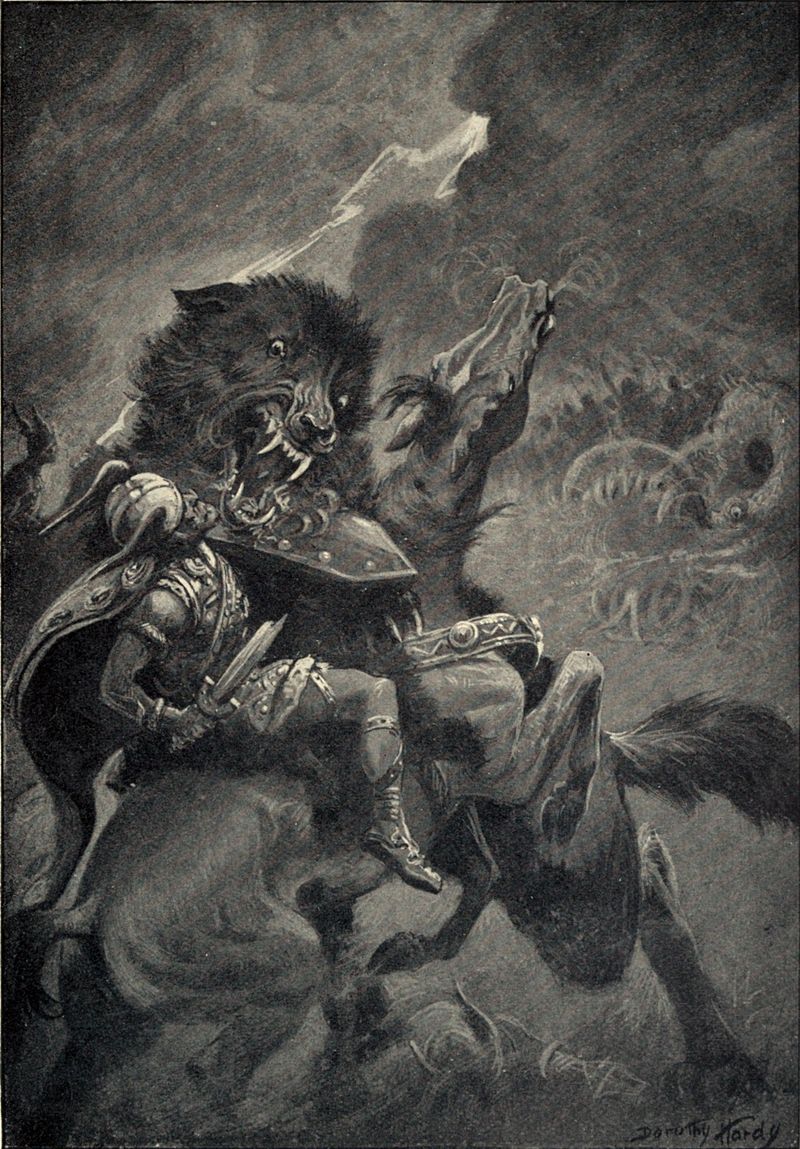
Fenrir’s release belongs to Ragnarök. When bonds fail and the old order collapses, the wolf runs free. His jaws open monstrously wide, and he meets Odin in the final battle.
Fenrir devours Odin. Víðarr then avenges his father and kills the wolf. Fenrir is not the wolf responsible for swallowing the Sun or Moon; those traditions belong to Sköll and Hati. His defining final act is the death of Odin.
The optional Ragnarök phase in the 5.5e statistics is therefore not part of Fenrir’s ordinary campaign-present encounter. Using it means the campaign has crossed into the prophesied end-war or an equivalent cosmic event.
Those Who Seek the Wolf
Fenrir has no need for a conventional priesthood, but mortals and supernatural factions still gather around his story. Some regard him as the victim of a divine betrayal. Others want a weapon against Odin or Asgard. A few seek the secret of Gleipnir because a restraint capable of holding Fenrir could hold almost anything.
Release Cults
They seek Lyngvi, fragments of dwarven craft and loopholes in the old binding. Their greatest danger is believing Fenrir owes gratitude to anyone who frees him.
Keepers of the Binding
Agents of Asgard guard routes, suppress false maps and inspect any magical craft that imitates Gleipnir’s impossible materials.
Týr’s Witnesses
Some oath-cults study the binding as a lesson in necessary betrayal and accepted cost. They insist that no one invoke Týr’s sacrifice while shifting the price onto someone else.
Fenrir’s Own Position
He does not need worshippers to validate his grievance. He wants the binding ended and remembers exactly who participated in making it permanent.
Adventure Pressure
Gleipnir Has Slack
For the first time, one finger’s width of slack appears in the binding. Fenrir has not changed size and no strand is visibly damaged.
The Second Ribbon
A dwarven vault contains another soft cord made from impossible things. It was not crafted for Fenrir, and no surviving smith admits knowing what it was meant to hold.
The Sword Moves
The sword wedged between Fenrir’s jaws shifts by itself. The river Ván briefly stops flowing.
Týr’s Hand
A divine relic claiming to be Týr’s severed hand begins pulling toward Lyngvi. Týr says the object is genuine—and that it should not exist where it has been found.
Deep Link Dive
Sources & Licensing
Gylfaginning supplies the fullest surviving narrative of Fenrir’s growth, the failed chains, Gleipnir, Týr’s pledge and lost hand, the sword in the wolf’s mouth and the river Ván. Völuspá and related Ragnarök traditions establish Fenrir’s release, Odin’s death and Víðarr’s vengeance.
The three-edition statistics are campaign game mechanics. Fenrir is treated as a unique mythic monster, not assigned an Æsir or Vanir divine rank.