
Elder Treant — Ancient Forest Colossus
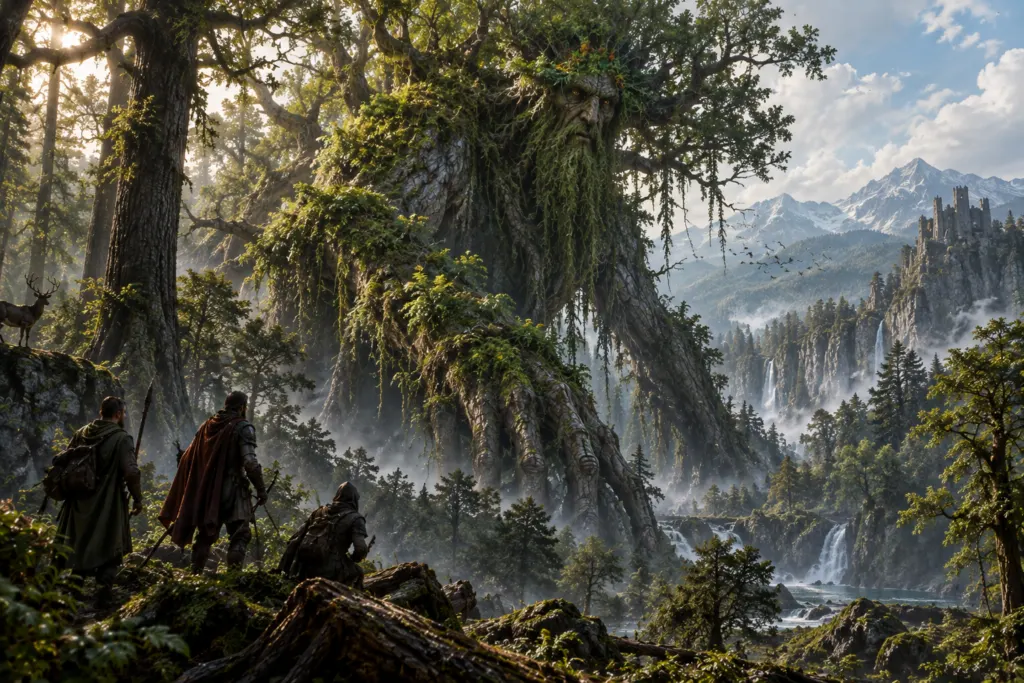
An Elder Treant is a prehistoric forest colossus: a surviving lineage from Earth’s Carboniferous forests whose attention operates at the scale of woodlands, watersheds and centuries rather than individual animals. It is not a king of ordinary treants, not a kindly grandfather-tree and not automatically a defender of everyone living beneath its canopy. Most creatures are too small and short-lived to matter unless their actions begin changing the forest itself.
What Is an Elder Treant?
Elder Treants are a separate lineage from ordinary treants. A normal treant does not become an Elder Treant merely by surviving for enough centuries, and great age alone does not grant the Elder’s scale, strength or deep-rooted memory.
Their lineage first appears in the great wet forests of the Carboniferous, long before modern forests, flowering plants, birds, mammals or human beings. Ordinary treants arise later. The distinction matters: Elder Treants remember ecosystems that no longer exist and judge present forests against cycles measured in geological time.
They do not rule treantkind. Ordinary treants may respect, fear, consult or protect an elder, but no universal hierarchy compels obedience. An Elder Treant can remain rooted and silent for centuries while younger treants make every practical decision around it.
What an Elder Treant Actually Cares About
An Elder Treant thinks in forests rather than specimens. A deer browsing shoots, a wolf killing prey, a storm dropping trees or an ordinary fire moving through fire-adapted woodland may not trouble it at all. These are processes within a living system.
Clear-cutting a valley, poisoning a watershed, burning an ancient wood to deny an enemy cover, replacing a diverse forest with a supernatural monoculture or allowing an Abyssal infestation to consume independent life is different. Those acts alter the forest’s future. They can wake an elder.
This makes Elder Treants dangerous even when they are not hostile. They do not automatically privilege a village, a druid circle or a herd of animals over the survival of the wider forest. A road, dam, mine or fortified settlement may be perfectly acceptable for generations and then become intolerable when cumulative damage crosses a threshold only the Elder has been watching.
Appearance
An Elder Treant is immense enough to be mistaken for part of the landscape. Its body resembles an ancient tree whose trunk has accumulated centuries of lightning scars, dead limbs, hollows, fungal shelves, moss and entire communities of smaller plants. Facial features are difficult to distinguish until the creature speaks or moves.
When rooted, an elder may remain motionless long enough for paths, nests and local traditions to form around it. When it finally walks, the event resembles a treefall, landslip and siege engine moving together. Roots tear free of soil, old branches sweep neighbouring trunks aside and the forest floor rises around each step.
Deep-Time History
The Elder Treant lineage belongs to the oldest great terrestrial forests. Its early history is tied to a world of giant clubmosses, seed ferns and immense swamp systems rather than the oaks, beeches and pines familiar to later peoples.

Later treants emerge after the first elders. They become the more active, socially engaged woodland people: speakers, negotiators, guardians and neighbours. Elder Treants remain rarer and more remote, increasingly associated with exceptional groves and hidden refuges rather than ordinary woodland communities.
The ancient wars against Zuggtmoy were catastrophic for the oldest forest powers. Living pillars were corrupted or destroyed, and surviving Elder Treants withdrew from exposed regions. That retreat reduced their visibility; it did not make the lineage extinct. In the campaign present, the Elder Treant Groves remain a scattered deep-time network rather than a kingdom.
Behaviour
Elder Treants are famously slow to decide because they possess more context than most creatures can imagine. They can spend days considering whether an intrusion is a temporary disturbance, decades deciding whether a settlement has become ecologically dangerous, or centuries observing a river change course.
Slow thought does not mean stupidity or passivity. Once an elder decides that a threat must end, it can act with terrifying directness. It uproots itself, wakes trees, closes routes, breaks walls and forces the problem away from the part of the forest it intends to preserve.
Natural fire does not automatically enrage an Elder Treant. Fire can clear dead growth, open seed cones and reshape woodland. Deliberate large-scale burning, magical firestorms and repeated destructive use of fire are different because they can erase the continuity the elder values. Its mechanical vulnerability to fire represents the danger of flame to its enormous living body, not an irrational terror of every spark.
Relations with Other Beings
Ordinary treants. Younger kin and the beings most likely to communicate with an Elder on terms it respects. They may defer to an Elder’s memory without accepting permanent rule.
Leshys. Small plant spirits and custodians sometimes gather in ancient groves. They can perform the close-scale work an Elder ignores.
Druids. Useful intermediaries when they understand that reverence is not ownership. An Elder may listen to a druid who can explain consequences across generations.
Animals. Usually ignored unless their population is changing the forest at an extraordinary scale. An individual animal is no more politically important to the Elder than a falling branch.
Settlements. Judged by cumulative effect rather than species or morality. A small village can coexist with an Elder for centuries; an expanding charcoal economy may eventually become intolerable.
Zuggtmoy. An existential enemy where her parasitic colonies replace an ecosystem’s independent life with a single invading will.
Game Statistics
Elder Treant
Gargantuan Plant, Neutral
AC 19 Initiative −1 (9) HP 420 (24d20 + 168) Speed 40 ft.
| STR | DEX | CON | INT | WIS | CHA |
|---|---|---|---|---|---|
| 27 (+8) | 8 (−1) | 25 (+7) | 16 (+3) | 20 (+5) | 19 (+4) |
Saving Throws Con +14, Wis +12
Skills Nature +10, Perception +12
Resistances Bludgeoning, Piercing
Vulnerability Fire
Condition Immunities Charmed, Frightened, Poisoned
Senses Tremorsense 120 ft.; Passive Perception 22
Languages Sylvan; individual elders may know ancient or regional languages learned during periods of contact
CR 21 (33,000 XP; PB +7)
Traits
False Appearance. While motionless, the Elder Treant is indistinguishable from an immense old tree.
Legendary Resistance (3/Day). If the Elder Treant fails a saving throw, it can choose to succeed instead.
Magic Resistance. The Elder Treant has Advantage on saving throws against spells and other magical effects.
Ancient Siege Monster. The Elder Treant deals triple damage to objects and structures.
Spellcasting. The Elder Treant casts the following spells, requiring no Material components and using Charisma as the spellcasting ability (spell save DC 19, +11 to hit with spell attacks):
At Will: Animal Messenger, Speak with Plants
2/Day Each: Plant Growth, Wall of Thorns
1/Day: Sunburst
Actions
Multiattack. The Elder Treant makes two Slam attacks.
Slam. Melee Attack Roll: +15, reach 15 ft. Hit: 29 (6d6 + 8) Bludgeoning damage. If the target is Huge or smaller, it must succeed on a DC 23 Strength save or be pushed up to 20 feet and fall Prone.
Hail of Bark. Ranged Attack Roll: +15, range 180 ft. Hit: 52 (8d10 + 8) Piercing damage.
Animate Grove (1/Day). The Elder Treant animates up to six trees it can see within 500 feet. Each uses the SRD Treant stat block except that it has Intelligence and Charisma 1, cannot speak and lacks Animate Trees. The trees act immediately after the Elder Treant and remain animate for 1 day, until destroyed, until the Elder Treant dies, or until they move more than 500 feet from it.
Encounter note: CR 21 represents the Elder Treant itself. A prepared grove containing several animated treants is a substantially harder encounter and should be treated as a set-piece battlefield rather than a single CR 21 creature.
Legendary Actions
The Elder Treant can take 3 Legendary Actions, one at a time, at the end of another creature’s turn. It regains all spent uses at the start of its turn.
Root Shift. The Elder Treant moves up to 20 feet without provoking Opportunity Attacks. This movement can pass through nonmagical plant Difficult Terrain.
Branch Strike (Costs 2). The Elder Treant makes one Slam attack.
Trample (Costs 3). The Elder Treant moves up to its Speed. When it enters the space of a Huge or smaller creature during this movement, that creature must succeed on a DC 23 Dexterity save or take 27 (3d12 + 8) Bludgeoning damage and fall Prone. A creature can be affected only once per use.
Elder Treant — Pathfinder 1e
CR 25 XP 1,638,400
N Colossal plant
Init +3; Senses low-light vision, tremorsense 120 ft.; Perception +64
Defense
AC 41, touch 1, flat-footed 41 (−1 Dex, −8 size, +40 natural)
hp 1,075 (50d8+850)
Fort +45, Ref +17, Will +29
DR 15/—; Immune plant traits; SR 36
Weakness vulnerability to fire
Offense
Speed 60 ft.
Melee 2 slams +49 (10d6+19/19–20)
Space 30 ft.; Reach 30 ft.
Special Attacks animate trees, trample (10d6+47, DC 54), triple damage against objects
Spell-Like Abilities (CL 23rd; concentration +35)
At will—animal messenger, command plants, speak with plants, stone tell
3/day—mass cure light wounds (plants only), plant growth, sunburst, wall of thorns
1/day—shambler
Statistics
Str 48, Dex 8, Con 42, Int 19, Wis 33, Cha 35
Base Atk +37; CMB +48; CMD 57
Feats Alertness, Blind-Fight, Combat Reflexes, Diehard, Endurance, Great Fortitude, Greater Bull Rush, Greater Overrun, Improved Bull Rush, Improved Critical (slam), Improved Initiative, Improved Iron Will, Improved Lightning Reflexes, Improved Overrun, Iron Will, Lightning Reflexes, Power Attack, Skill Focus (Knowledge [nature]), Skill Focus (Perception), Skill Focus (Sense Motive), Skill Focus (Survival), Toughness, Vital Strike, Improved Vital Strike, Weapon Focus (slam)
Skills Diplomacy +62, Knowledge (nature) +60, Perception +74, Sense Motive +71, Survival +67, Stealth +60 in forests
Languages Sylvan
Special Abilities
Animate Trees (Sp). At will, the Elder Treant can animate trees within 500 feet, controlling up to six at once. It takes a full round for a tree to uproot itself. Thereafter the tree moves and fights as a treant in all physical respects. An animated tree becomes immobile if the Elder Treant is incapacitated or moves out of range.
Trample (Ex). As a full-round action, the Elder Treant can overrun Gargantuan or smaller creatures. The trample deals 10d6+47 bludgeoning damage; a DC 54 Reflex save halves the damage. The save DC is Strength-based.
Triple Damage against Objects (Ex). An Elder Treant deals triple damage to unattended objects and structures with its slam attacks.
Forest Camouflage (Ex). In forests, an Elder Treant gains a +24 racial bonus on Stealth checks despite its enormous size.
Elder Treant — D&D 3.5e
CR 25
N Colossal plant
| Hit Dice | 50d8+920 (1,145 hp) |
|---|---|
| Initiative | +3 (−1 Dex, +4 Improved Initiative) |
| Speed | 60 ft. |
| Armor Class | 41 (−1 Dex, −8 size, +40 natural), touch 1, flat-footed 41 |
| Base Attack/Grapple | +37/+72 |
| Attack | Slam +51 melee (10d6+19/19–20 plus 1d6 on a critical hit) |
| Full Attack | 2 slams +51 melee (10d6+19/19–20 plus 1d6 on a critical hit) |
| Space/Reach | 30 ft./30 ft. |
| Special Attacks | Animate trees, trample, triple damage against objects, spell-like abilities |
| Special Qualities | Plant traits, SR 29, DR 10/— |
| Saves | Fort +45, Ref +21, Will +33 |
| Abilities | Str 48, Dex 8, Con 42, Int 19, Wis 33, Cha 35 |
| Skills | Diplomacy +61, Hide −12, Intimidate +62, Jump +31, Knowledge (any one) +57, Listen +63, Sense Motive +56, Spot +43, Survival +51 |
| Feats | Alertness, Endurance, Great Fortitude, Improved Critical (slam), Improved Initiative, Iron Will, Lightning Reflexes, Power Attack, Weapon Focus (slam) |
| Epic Feats | Epic Endurance, Epic Reflexes, Epic Toughness ×4, Epic Weapon Focus (slam), Epic Will |
| Environment | Any ancient forest |
| Organization | Solitary or associated with an elder grove |
| Treasure | Standard |
| Alignment | Usually Neutral in SpiralWorlds |
| Languages | Sylvan |
| Advancement | 51–150 HD (Colossal) |
Combat
Animate Trees (Sp). An Elder Treant can animate trees within 500 feet at will, controlling up to six trees at a time. It takes a full round for a normal tree to uproot itself. Thereafter it moves and fights as an ordinary treant in all physical respects. Animated trees lose their ability to move if the Elder Treant is incapacitated or moves out of range.
Trample (Ex). An Elder Treant can trample Gargantuan or smaller creatures for 8d20+40 damage. A creature that does not make an attack of opportunity can attempt a DC 54 Reflex save for half damage. The save DC is Strength-based.
Triple Damage against Objects (Ex). An Elder Treant that makes a full attack against an object or structure deals triple damage.
Plant Traits. The Elder Treant is immune to poison, sleep, paralysis, stunning and polymorphing and is not subject to critical hits or mind-affecting effects.
Skills. Elder Treants receive skills as though they were fey and gain a +24 racial bonus on Hide checks made in forested areas.
Spell-Like Abilities. At will—animal messenger, command plants, speak with plants, stone tell; 3/day—mass cure light wounds (plants only), plant growth, sunburst, wall of thorns; 1/day—shambler. Caster level 23rd; save DC 22 + spell level.
Ancient Grove
An Elder Treant that has remained rooted in the same forest for decades or centuries can establish an Ancient Grove. Its roots spread through the surrounding soil, mingle with those of neighbouring trees and gradually alter water, drainage, growth and the physical structure of the woodland.
An Elder Treant gains the following grove actions only while it remains within this established root network. A newly arrived Elder Treant, or one that has abandoned its grove, does not possess them.
Ancient Grove Actions
On Initiative Count 20, losing initiative ties, the Elder Treant can cause one of the following effects. It cannot use the same effect on consecutive rounds.
Roots Seize. Roots erupt through a 30-foot-radius area the Elder can see within 120 feet. Each creature of the Elder’s choice in the area must succeed on a DC 20 Strength saving throw or become Restrained until Initiative Count 20 on the following round. The area becomes Difficult Terrain until then.
The Ground Heaves. The Elder causes roots and earth to surge through a 40-foot-long, 15-foot-wide area within 120 feet. Creatures standing there must make a DC 20 Dexterity saving throw. On a failed save, a creature takes 22 (4d10) bludgeoning damage, is pushed up to 15 feet and falls Prone. On a success, it takes half damage and is not pushed or knocked Prone.
Water Remembers. A buried spring, ditch or forgotten stream suddenly breaks through the ground in an area the Elder can see within 120 feet. A 30-foot-square area becomes flooded Difficult Terrain until the next round. Creatures there must succeed on a DC 20 Strength saving throw or be moved up to 20 feet in a direction chosen by the Elder. Ordinary nonmagical flames in the area are extinguished.
Closing Canopy. Branches, roots and living trunks close around one 20-foot-radius area within 120 feet. Until Initiative Count 20 on the following round, the area provides three-quarters cover to creatures inside it and blocks sight through the vegetation beyond 10 feet.
Root Passage. The Elder Treant sinks into its own root network and emerges beside a living tree within 120 feet. This movement does not provoke Opportunity Attacks. It cannot use this action to pass through an area where the grove’s roots have been severed, burned away or magically destroyed.
Regional Effects of an Ancient Grove
The influence of an established Elder Treant can extend for roughly 6 miles, although the strongest effects occur within about 1 mile of the Elder’s resting place.
These are not commands imposed on every plant and animal. They are consequences of an ancient intelligence acting through centuries of root growth, water movement and woodland succession.
Old Paths Fade. Roads and paths that are no longer maintained gradually narrow, bend or disappear beneath roots and new growth. A frequently used road remains open unless the Elder deliberately decides that its continued existence threatens the forest.
Water Returns to Older Courses. Springs reopen, drainage ditches clog, wetlands re-form and streams slowly migrate toward channels they followed generations or centuries earlier.
Ancient Trees Endure. Mature native trees within the grove are unusually resilient against ordinary disease, drought and natural decay. This protection does not make them immune to axes, fire, magic or supernatural corruption.
Clearings Close. Abandoned logging areas, burned ground and unused fields return to woodland significantly faster than they would naturally. Deliberately maintained farmland and settlements are not instantly swallowed by trees.
The Roots Remember. Large disturbances to the land—extensive logging, mining, poisoned water, magical corruption or destructive burning—are transmitted through the Elder’s root network. The Elder becomes aware that the grove has suffered significant damage and roughly where it occurred. It does not automatically know who caused it.
The Forest Leans Toward Threats. Over weeks or months, roots, branches and new growth subtly concentrate around persistent threats to the woodland. Travellers may notice whole stands of trees gradually turning toward a mine, corrupted ruin or expanding settlement.
Deep Roots. Excavation within the inner mile may uncover enormous living roots far from any visible tree. Severing one alerts the Elder to serious damage within that part of the grove.
Natural Cycles Continue. Predation, fallen trees, flooding, storms and ordinary woodland fires continue normally. Deer do not become the Elder’s servants, wolves do not patrol its borders and birds do not automatically spy for it. An Elder Treant intervenes when a process threatens the long-term integrity of the forest, not because an individual animal has been harmed.
When the Elder Leaves
If the Elder Treant dies or permanently abandons the grove, overt supernatural effects fade over 1d10 days.
Physical changes remain. Streams do not jump back into their previous channels. Roads already broken by roots remain broken. Regrown forest remains standing. Wetlands that have returned remain wet unless someone drains them again.
Likewise, an Elder Treant can lose access to particular grove actions if enough of its root network is destroyed. Large-scale excavation, magical blight or deliberate severing of major roots can progressively isolate parts of the grove.
Signs of an Ancient Grove
Characters entering an Ancient Grove may notice the effects long before they see the Elder Treant itself: roads subtly curve away from the oldest trees; springs emerge where maps show dry ground; uprooted boundary stones are found embedded in living roots; abandoned clearings are decades ahead of the surrounding forest in regrowth; and immense roots appear in wells, mines and riverbanks miles from the Elder itself.
Running an Elder Treant
The first challenge is recognising that the Elder Treant has made a decision at all. It should not begin an encounter by roaring at trespassers. Roads become impassable. Roots lift foundations. Streams are redirected. Ordinary treants stop negotiating. Leshys abandon paths. Only then does the Elder itself move.
In combat, it uses terrain before force. Plant Growth and Wall of Thorns isolate the part of the battlefield it wants to control. Animated trees absorb movement and attention. The Elder uproots itself only when the threat cannot be contained at a distance.
Do not run it as a protector of every squirrel, deer or traveller. Its decisions should make sense only when the players understand the larger ecological pattern. The interesting question is often not “Can we kill it?” but “What changed enough to make something this old decide to walk?”
Signs an Elder Treant Is Waking
Old paths cease to exist. Roots rise through tracks that have been used for generations.
Younger treants stop arguing. Local treants suddenly abandon disputes and move toward the same ancient part of the forest.
Water moves. Springs appear, channels close or a stream begins following an older buried course.
Birds and mammals are not the warning. Ordinary animals may continue behaving normally because the Elder is not responding to them.
Large trees begin facing the same direction. Over several nights trunks and crowns subtly alter their growth.
The “hill” has roots. A landmark thought to be an ancient tree, mound or wooded rise changes position.
Elder Treants in 1454
Most people will never knowingly see one. Surviving Elder Treants are concentrated in ancient woodland refuges, hidden valleys, inaccessible forests and places protected by the Elder Treant Groves or other custodians.
The pressures most likely to wake them are cumulative rather than heroic: charcoal production spreading across a woodland, wartime burning, mining that drains old wetlands, roads cutting breeding and seed corridors, large-scale magical harvesting, or an infestation that converts diverse life into a single supernatural organism.
A village can therefore live beside an Elder Treant without knowing it exists. The crisis begins when the characters discover that the forest’s apparent “monster attack” is the final response to damage accumulated over decades.
Adventure Hooks
| The Charcoal Charter | A prince grants a vast woodland charcoal concession. Nothing happens for three years. Then every road into the cutting district closes overnight beneath newly raised roots. |
|---|---|
| The Walking Boundary | An Elder Treant begins moving directly toward a fortified town. Its path will destroy the walls, but investigation reveals the town was built across an ancient watercourse the Elder is reopening. |
| The Green Infection | A hidden grove asks for mortal help against a Zuggtmoy infestation because the Elder cannot distinguish infected roots from the wider forest without destroying both. |
| The Ancient Witness | The only living witness to a deep-time event is an Elder Treant that has not spoken for centuries. Waking it may also wake the forest around it. |
| The False Treant | A powerful druid uses Changestaff near an elder grove. The temporary guardian is mistaken for a true treant, triggering a dispute over who has authority to create obedient imitations of woodland people. |
Treasure and Remains
An Elder Treant does not maintain a treasure hoard in the ordinary sense. Valuable objects may be trapped in root systems, embedded in old bark, buried beneath centuries of leaf mould or left where previous visitors died. Removing them without understanding their history may matter more than their market value.
Dead elder wood is extraordinarily rare. It can be valuable to druids, magical craftsmen, scholars of deep time and creatures seeking ancient living material. Cutting wood from a living Elder Treant is an attack, not harvesting.
Related SpiralWorlds Entries
- World Bestiary — the complete creature catalogue.
- Treant — the later, more socially active woodland people related to but distinct from Elder Treants.
- Bugs, Amphibians and the Rise of Giants — the Carboniferous-to-Triassic deep-time chapter.
- Elder Treant Groves — the surviving deep-time arboreal network in the faction index.
- Leshy — small sentient plant custodians associated with powerful plant beings and old groves.
- Zuggtmoy — the parasitic ecosystem-replacement power tied to ancient forest catastrophe.
- Changestaff — creates a treant-like guardian but not a true treant.
- Wall of Thorns — signature battlefield-control magic.
- Animal Messenger — one of the elder’s inherited nature magics.
- Sunburst — high-level magic retained from the OGL elder treant.
- Skills and Feats — reference indexes for the legacy-system statistics.
Sources and Licensing
D&D 5.5e / 2024: The modern Treant baseline is derived from System Reference Document 5.2.1 by Wizards of the Coast LLC, used under the Creative Commons Attribution 4.0 International Licence. The Elder Treant conversion, legendary actions, campaign behaviour and deep-time integration are SpiralWorlds material.
D&D 3.5e: The Elder Treant is part of the Revised System Reference Document’s epic monster material. The 3.5e tab restores its core published OGL statistics and signature abilities while applying SpiralWorlds language and alignment canon.
Pathfinder 1e: The Pathfinder tab is a SpiralWorlds conversion of the OGL Elder Treant using Pathfinder First Edition rules conventions. Pathfinder does not require the creature to be treated as a ruler of ordinary treants.
SpiralWorlds setting: The Carboniferous origin, distinction from later treants, forest-scale awareness, hidden survivor groves, Zuggtmoy-era losses, 1454 campaign use and faction integration are SpiralWorlds campaign canon.
Open Game License v1.0a and Section 15
OPEN GAME LICENSE Version 1.0a
The following text is the property of Wizards of the Coast, Inc. and is Copyright 2000 Wizards of the Coast, Inc (“Wizards”). All Rights Reserved.
1. Definitions: (a) “Contributors” means the copyright and/or trademark owners who have contributed Open Game Content; (b) “Derivative Material” means copyrighted material including derivative works and translations (including into other computer languages), potation, modification, correction, addition, extension, upgrade, improvement, compilation, abridgment or other form in which an existing work may be recast, transformed or adapted; (c) “Distribute” means to reproduce, license, rent, lease, sell, broadcast, publicly display, transmit or otherwise distribute; (d) “Open Game Content” means the game mechanic and includes the methods, procedures, processes and routines to the extent such content does not embody the Product Identity and is an enhancement over the prior art and any additional content clearly identified as Open Game Content by the Contributor, and means any work covered by this License, including translations and derivative works under copyright law, but specifically excludes Product Identity; (e) “Product Identity” means product and product line names, logos and identifying marks including trade dress; artifacts; creatures; characters; stories, storylines, plots, thematic elements, dialogue, incidents, language, artwork, symbols, designs, depictions, likenesses, formats, poses, concepts, themes and graphic, photographic and other visual or audio representations; names and descriptions of characters, spells, enchantments, personalities, teams, personas, likenesses and special abilities; places, locations, environments, creatures, equipment, magical or supernatural abilities or effects, logos, symbols, or graphic designs; and any other trademark or registered trademark clearly identified as Product Identity by the owner of the Product Identity, and which specifically excludes the Open Game Content; (f) “Trademark” means the logos, names, mark, sign, motto, designs that are used by a Contributor to identify itself or its products or the associated products contributed to the Open Game License; (g) “Use”, “Used” or “Using” means to use, Distribute, copy, edit, format, modify, translate and otherwise create Derivative Material of Open Game Content; (h) “You” or “Your” means the licensee in terms of this agreement.
2. The License: This License applies to any Open Game Content that contains a notice indicating that the Open Game Content may only be Used under and in terms of this License. You must affix such a notice to any Open Game Content that You Use. No terms may be added to or subtracted from this License except as described by the License itself. No other terms or conditions may be applied to any Open Game Content distributed using this License.
3. Offer and Acceptance: By Using the Open Game Content You indicate Your acceptance of the terms of this License.
4. Grant and Consideration: In consideration for agreeing to use this License, the Contributors grant You a perpetual, worldwide, royalty-free, non-exclusive license with the exact terms of this License to Use, the Open Game Content.
5. Representation of Authority to Contribute: If You are contributing original material as Open Game Content, You represent that Your Contributions are Your original creation and/or You have sufficient rights to grant the rights conveyed by this License.
6. Notice of License Copyright: You must update the COPYRIGHT NOTICE portion of this License to include the exact text of the COPYRIGHT NOTICE of any Open Game Content You are copying, modifying or distributing, and You must add the title, the copyright date, and the copyright holder’s name to the COPYRIGHT NOTICE of any original Open Game Content you Distribute.
7. Use of Product Identity: You agree not to Use any Product Identity, including as an indication as to compatibility, except as expressly licensed in another, independent Agreement with the owner of each element of that Product Identity. You agree not to indicate compatibility or co-adaptability with any Trademark or Registered Trademark in conjunction with a work containing Open Game Content except as expressly licensed in another, independent Agreement with the owner of such Trademark or Registered Trademark. The use of any Product Identity in Open Game Content does not constitute a challenge to the ownership of that Product Identity. The owner of any Product Identity used in Open Game Content shall retain all rights, title and interest in and to that Product Identity.
8. Identification: If you distribute Open Game Content You must clearly indicate which portions of the work that you are distributing are Open Game Content.
9. Updating the License: Wizards or its designated Agents may publish updated versions of this License. You may use any authorized version of this License to copy, modify and distribute any Open Game Content originally distributed under any version of this License.
10. Copy of this License: You MUST include a copy of this License with every copy of the Open Game Content You Distribute.
11. Use of Contributor Credits: You may not market or advertise the Open Game Content using the name of any Contributor unless You have written permission from the Contributor to do so.
12. Inability to Comply: If it is impossible for You to comply with any of the terms herein with respect to some or all of the Open Game Content due to statute, judicial order, or governmental regulation then You may not Use any Open Game Material so affected.
13. Termination: This License will terminate automatically if You fail to comply with all terms herein and fail to cure such breach within 30 days of becoming aware of the breach. All sublicenses shall survive the termination of this License.
14. Reformation: If any provision of this License is held to be unenforceable, such provision shall be reformed only to the extent necessary to make it enforceable.
15. COPYRIGHT NOTICE
Open Game License v 1.0a Copyright 2000, Wizards of the Coast, Inc.
System Reference Document Copyright 2000–2003, Wizards of the Coast, Inc.; Authors Jonathan Tweet, Monte Cook, Skip Williams, Rich Baker, Andy Collins, David Noonan, Rich Redman, Bruce R. Cordell, John D. Rateliff, Thomas Reid, James Wyatt, based on original material by E. Gary Gygax and Dave Arneson.
Pathfinder Roleplaying Game Core Rulebook © 2009, Paizo Publishing, LLC; Author Jason Bulmahn, based on material by Jonathan Tweet, Monte Cook and Skip Williams.
Pathfinder Roleplaying Game Bestiary © 2009, Paizo Publishing, LLC; Author Jason Bulmahn, based on material by Jonathan Tweet, Monte Cook and Skip Williams.
Original SpiralWorlds setting material, campaign material, Pathfinder conversion material, page structure and editorial content Copyright © 2026 SpiralWorlds. All rights reserved except material separately identified as Open Game Content or licensed under Creative Commons Attribution 4.0 International.