
Thieves’ Tools — Lockpicks, Trap Disarming, and Burglary Gear
Thieves’ Tools — Lockpicks, Trap Disarming, and Burglary Gear
A compact roll of picks, probes, wires, wedges, files, and quiet instruments for opening what someone else meant to keep shut.
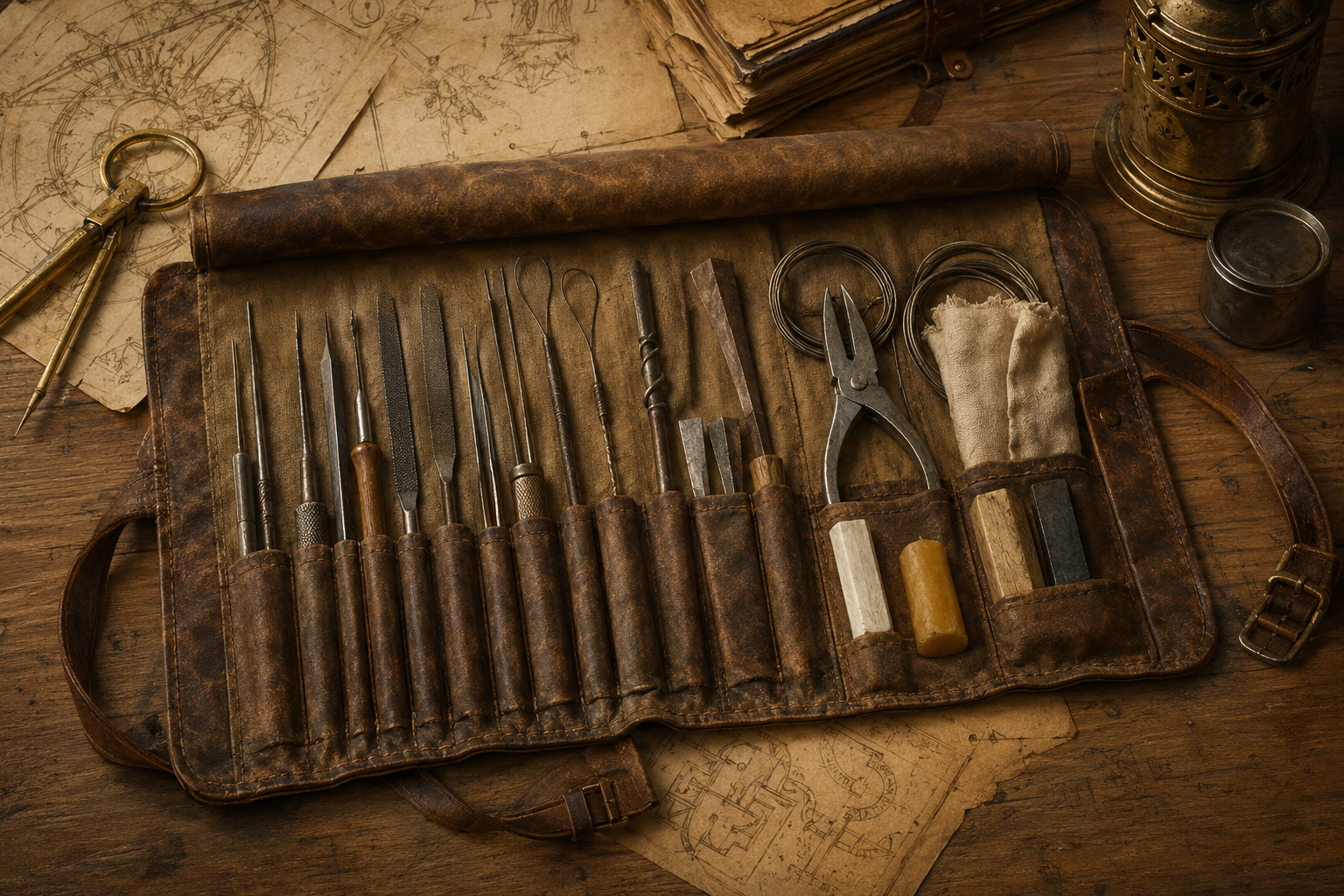
Thieves’ tools are not just burglary gear. They are instruments for crossing forbidden boundaries without breaking them: the locked door, the sealed coffer, the trapped reliquary, the noble’s desk, the prison shackle, the strongroom chest, the hidden compartment behind a household shrine.
They are used to open locks, disarm mechanical traps, manipulate hidden catches, and handle small mechanisms where force would be noisy, destructive, or dangerous. A hammer announces itself. A spell may leave a trace. A good set of thieves’ tools can leave only doubt.
Robbers and cutpurses carry them, but so do locksmiths, spies, dungeon scouts, military saboteurs, treasure-hunters, investigators, and housebreakers. What changes is the reason for carrying them, whether the law allows it, and how quickly the owner can explain them when challenged.
In play, thieves’ tools turn locked objects into decisions. A door can be smashed, bypassed, magically opened, negotiated around, or quietly picked. A coffer can be broken apart, stolen whole, or opened without obvious damage. The kit supports stealth, rescue, theft, investigation, sabotage, and careful dungeon work without making every barrier meaningless.
Physical Description
A standard set of thieves’ tools is usually kept in a leather roll, waxed cloth packet, narrow wooden case, or hidden compartment. It may include fine picks, hooked probes, tension tools, wire loops, small files, wedges, oiled cloth, wax, chalk dust, slender pliers, and narrow blades for testing gaps or teasing open catches.
Cheap tools bend easily, fit poorly, and make delicate work unreliable. Better tools are hardened, balanced, quiet, and complete enough to deal with several kinds of locks. A masterwork kit may be disguised as scribal gear, medical instruments, sewing tools, jeweller’s tools, or the harmless equipment of a travelling repairer.
Why This Item Matters
Locks mark ownership, secrecy, wealth, fear, law, and trust. A locked chest may hold tax silver, poison, a will, stolen relics, love letters, false coins, blackmail letters, or evidence of treason. A barred door may protect a household, conceal a prisoner, or keep something dangerous inside.
Thieves’ tools let characters challenge those boundaries without immediately resorting to violence or destruction. That makes them useful, but also suspicious. Being found with a concealed set near a robbed house, guildhall, noble residence, counting room, or temple vault may be enough to bring arrest, interrogation, blackmail, confiscation, or a demand to name one’s patron.
In stricter cities, a locksmith’s tools may be stamped by a guild, registered to a master, or recognised by the watch. An unmarked kit, a broken pick in a temple lock, or a copied key blank can become evidence. The tools do not merely open doors; they can connect a character to a crime.
Thieves’ Tools 5.5e / 2024
Thieves’ Tools Pathfinder 1e
Thieves’ Tools 3.5e
Thieves’ Tools 5.5e / 2024
Adventuring Gear, Tool Set
Cost: 25 gp
Weight: 1 lb.
This kit contains small picks, probes, wires, files, wedges, and other delicate tools used to open locks, disable simple mechanical traps, and manipulate small mechanisms.
A creature proficient with thieves’ tools adds its Proficiency Bonus to ability checks made with the tools. Dexterity is the usual ability for picking locks or disarming delicate mechanisms. Intelligence may apply when studying an unfamiliar device. Wisdom may apply when noticing a hidden catch, pressure plate, false keyhole, or suspicious hinge before touching it.
Without thieves’ tools, a creature must improvise with unsuitable objects. The check is normally made with Disadvantage unless the improvised tools are especially appropriate.
Typical Checks
| Task | Suggested Check |
|---|---|
| Open a poor lock or simple chest | Dexterity check with thieves’ tools |
| Open a common household or shop lock | Dexterity check with thieves’ tools |
| Open a strongbox, guild chest, or noble coffer | Dexterity check with thieves’ tools |
| Study an unfamiliar lock or mechanism | Intelligence check with thieves’ tools |
| Disable a simple mechanical trap | Dexterity check with thieves’ tools |
| Jam a latch or lock quietly | Dexterity check with thieves’ tools |
| Sabotage a small device | Dexterity or Intelligence check with thieves’ tools |
Suggested DCs
| Lock or Device | DC |
|---|---|
| Poor lock, simple latch, damaged chest | 10 |
| Common lock, household door, simple mechanical trap | 15 |
| Good lock, merchant strongbox, guarded coffer | 20 |
| Superior lock, noble chest, concealed mechanism | 25 |
| Exceptional lock, puzzle lock, master locksmith’s work | 30 |
A failed check usually means the character makes no progress. If the character is rushed, in darkness, under threat, or working on a trapped device, failure by 5 or more may bend a tool, make noise, leave visible marks, trigger part of the mechanism, or force a different approach.
Masterwork Thieves’ Tools: A superior kit grants a +1 bonus to checks made to open mundane locks or disable mechanical traps, provided the user is proficient with thieves’ tools. This bonus represents better fit, stronger metal, finer probes, and a wider selection of pieces. A masterwork kit should cost at least 100 gp and may be illegal to carry in some settlements without guild, military, or official permission.
Thieves’ Tools 3.5e
Price: 30 gp
Weight: 1 lb.
This kit contains the tools needed to use the Disable Device and Open Lock skills. Without thieves’ tools, a character must improvise and takes a –2 circumstance penalty on Disable Device and Open Lock checks.
Masterwork Thieves’ Tools
Price: 100 gp
Weight: 2 lb.
A masterwork set is finely made and more complete than a standard kit. It grants a +2 circumstance bonus on Disable Device and Open Lock checks.
Use this version for games where Open Lock remains separate from Disable Device.
Thieves’ Tools Pathfinder 1e Version
Source Core Rulebook
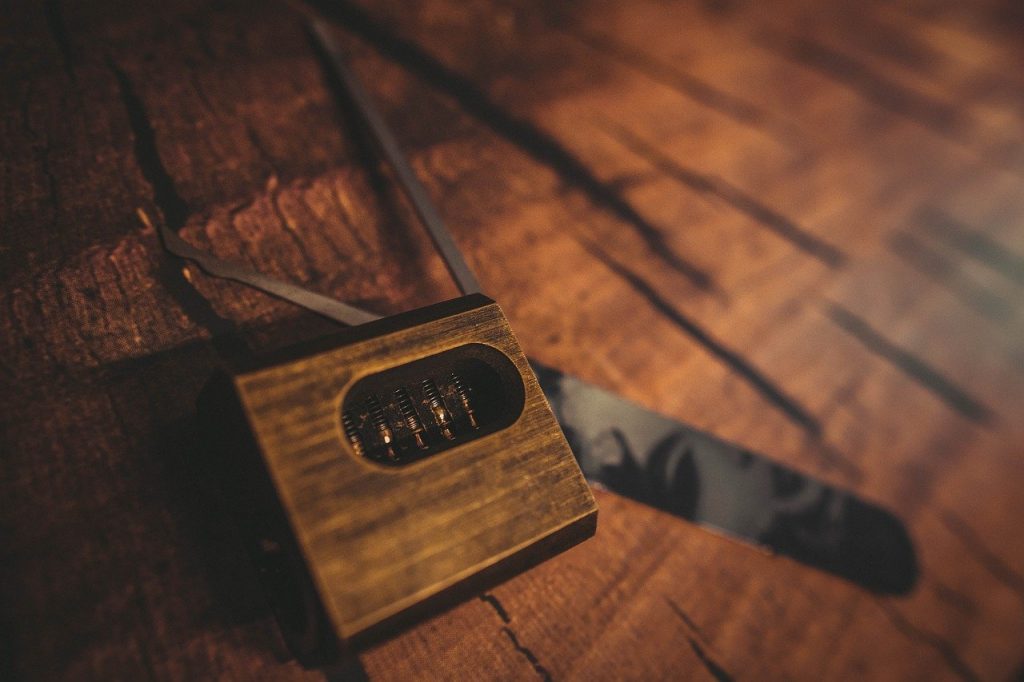
This kit contains the tools you need to use the Disable Device and Open Lock skills. Without these tools, you must improvise tools, and you take a -2 circumstance penalty on Disable Device and Open Locks checks.
Thieves’ Tools
Price: 30 gp
Weight: 1 lb.
This kit contains the tools needed to use the Disable Device skill. Without thieves’ tools, a character must improvise and takes a –2 circumstance penalty on Disable Device checks.
Masterwork Thieves’ Tools
Price: 100 gp
Weight: 2 lb.
A masterwork set is more complete, better balanced, and more reliable than a standard kit. It grants a +2 circumstance bonus on Disable Device checks.
DM Adjudication: Time, Noise, and Evidence
A thieves’ tools check should usually take long enough for the situation to matter. A simple lock might take 1 action in combat if the character is already at the lock and has tools in hand, but more often it takes 1 minute of careful work. A good lock may take several minutes. A superior lock may require 10 minutes or more, especially if the character wants to leave no visible damage.
Repeated attempts are possible, but they should change the situation. Each failed attempt may cost time, increase noise, worsen lighting conditions, bend a tool, risk discovery, or leave marks that later inspection can find. If there is no pressure and no consequence, let a proficient character eventually open ordinary locks rather than asking for empty rolls.
Noise matters. A careful attempt may be nearly silent. A rushed attempt, broken tool, forced pin, slipped wedge, or dropped roll may be heard through a door or down a corridor. In tense scenes, decide who might hear the work before the roll is made.
Evidence matters too. A picked lock may still show scratches, disturbed dust, displaced wax, a bent ward, loosened screws, or a catch that no longer sits correctly. A skilled character can try to hide such evidence, but that should usually be part of the same check or a follow-up check when it matters.
Using Thieves’ Tools in Play
Thieves’ tools work best when the lock is part of a situation, not just a roll. Opening a chest in an empty room is routine. Opening it before the guards return, while a trap clicks inside the lid, is a scene.
Use the tools when quiet access, careful sabotage, rescue, investigation, or evidence matters. They might open a door without waking a household, free a prisoner without killing the gaoler, disable a tripwire before the torch burns down, jam a lock behind the party, open a sealed coffer without breaking it, or prove that a supposedly untouched room was entered by someone skilled.
They should not bypass every obstacle. Some doors are barred from the far side. Some locks need a missing key, password, ritual, or second mechanism. Some are magically warded. Some are bait. Thieves’ tools solve physical access problems; they do not erase guards, laws, curses, witnesses, ownership, or consequences.
Failure, Risk, and Misuse
A failed check should change the situation rather than simply stop play. Use the margin of failure to decide what happens.
| Result | Consequence |
|---|---|
| Fail by 1–4 | Lost time. The lock, trap, or mechanism resists the attempt. The character makes no progress, and the attempt takes longer than expected. In a tense scene, advance the guard patrol, torch burn-down, flooding chamber, ritual countdown, or other pressure by one step. |
| Fail by 5–9 | Noise or evidence. The attempt goes wrong in a noticeable way. If stealth matters, a nearby guard, servant, dog, or creature may hear the slip, click, scrape, or dropped tool. If discovery matters later, the lock shows visible signs of tampering. |
| Fail by 10 or more | Serious complication. A tool bends or snaps, the lock jams, a secondary catch remains engaged, or part of the trap shifts. A cheap kit counts as improvised until repaired or replaced. A standard kit remains usable, but suffers a –1 penalty on related checks until repaired. |
| Natural 1 | Worst plausible complication. Use the fail-by-10-or-more result, and if the lock or device is trapped, warded, alarmed, or already unstable, it triggers or escalates immediately. Do not use this to create instant death unless the danger was clearly established before the roll. |
If the character succeeds but the DC was beaten by only 1 or 2, the lock opens or the device is disabled, but the work is not clean. It takes twice as long, makes a small sound, or leaves faint evidence of tampering.
A failed thieves’ tools check should not usually kill a character outright unless the danger was already clear. Delay, noise, evidence, damaged tools, partial triggering, suspicion, or a new complication is usually more useful than sudden death.
Value in the World
In a city, thieves’ tools are suspicious unless carried by someone with a lawful reason. Locksmiths, engineers, jewellers, military sappers, and certain guild workers may own similar instruments openly. Burglars, spies, and cutpurses hide them.
Guilds may regulate locksmiths and key-makers. Noble houses may employ trusted craftsmen and punish unauthorised copying of keys. Temples may protect reliquaries with ceremonial locks and hidden catches. Merchant houses may use double locks, false keyholes, trapped strongboxes, and chests designed to show evidence of tampering.
The watch may not need to prove a burglary to make trouble for someone carrying concealed picks after curfew. A lawful locksmith’s marked roll might be a badge of trade. An unmarked or hidden roll near a robbed house may be treated as proof enough for arrest, confiscation, interrogation, or blackmail.
Among adventurers, thieves’ tools are accepted because ruins, tombs, monster lairs, and abandoned strongholds are full of locked things whose owners are dead, missing, or hostile. In town, the same kit can become a legal problem.
Common Variants
Most thieves’ tools fall into four practical categories.
| Variant | Cost | Description | Game Use |
|---|---|---|---|
| Improvised Tools | — | Wire, knife tip, nail, hairpin, bent needle, or another unsuitable object used in place of a real kit. | You can attempt the check, but suffer the normal improvised-tools penalty. In Pathfinder 1e and 3.5e, this is a –2 circumstance penalty. In 5.5e, this usually means Disadvantage. Some complex locks or traps may still be impossible without proper tools. |
| Cheap Thieves’ Tools | 10 gp | A poor but usable kit with soft metal, missing pieces, crude picks, or bad balance. | Counts as real thieves’ tools and imposes no default penalty. If you fail by 5 or more, one important piece bends, snaps, or slips out of true. After that, the kit counts as improvised tools until repaired or replaced. |
| Standard Thieves’ Tools | 25 gp / 30 gp | A complete working kit suitable for locks, simple traps, hidden catches, and small mechanisms. | Uses the standard rules. |
| Masterwork Thieves’ Tools | 100 gp | Finely made tools with better metal, cleaner balance, more precise probes, and a fuller selection of pieces. | 5.5e: +1 bonus if proficient. Pathfinder 1e/3.5e: +2 circumstance bonus. |
A kit may still be hidden, disguised, guild-stamped, stolen, damaged, or suspiciously specialised, but those details are usually story facts rather than separate equipment entries. A locksmith’s marked roll might help explain why the character has the tools. A concealed roll might be harder to find during a search. A stolen roll might connect the character to a burglary. None of those needs a new mechanical item unless the campaign makes it important.
Adventure and Worldbuilding Hooks
The Quiet Strongbox: A noble asks the party to open a sealed strongbox without breaking the lock, cutting the wax, or leaving proof that it was touched. The job sounds like discreet inheritance work until the box opens. Inside are locks of hair tied with name-tags, a list of dead officials, and a map of small doors beneath the city that should not exist. The noble claims the seal belongs to his late father, but the wax is fresh.
The Broken Pick: A moneylender is found murdered in a locked counting room, with a snapped pick buried inside the strongroom lock. The metal bears the maker’s mark of a famous locksmith who died years ago, and every surviving set of his tools is supposed to be registered, locked away, or buried with its owner. The party must decide whether the pick is proof, a planted accusation, or evidence that someone has found the dead locksmith’s hidden master roll.
The Curfew Door: The city watch catches the party after dark with thieves’ tools in their possession. Instead of making an arrest, the watch captain takes them beneath the courthouse and offers a bargain: open one sealed door quietly, or answer for the tools before a magistrate at dawn. The captain will not say what is behind the door, only that the city cannot be seen opening it by force.
Historical Context
Locks and keys were important objects in medieval life. They protected property, marked authority, and controlled access to chests, doors, gates, storerooms, reliquaries, and private rooms. Surviving medieval examples show that locks could be practical, decorative, and technically sophisticated.
The Metropolitan Museum of Art preserves several medieval locks and keys, including a French medieval key and a French medieval lock. These examples are useful visual references for the kind of metalwork, wards, and fitted mechanisms that fantasy thieves’ tools are designed to defeat or manipulate.
For Pathfinder rules reference, see Archives of Nethys entries for thieves’ tools and Disable Device.
Keep this reference growing
If this page helped with your reading or game, you can support its upkeep or explore the curated books.
Explore the Bookshop — epics, classics and stories behind imagined worlds.