
Surgeon’s Tools
Surgeon’s Tools
Surgeon’s Tools are the healer’s knife-work: the blades, probes, clamps, needles, thread, and cautery irons used when mercy has to cut.
Overview
Surgeon’s Tools belong to the hour after violence.
The shouting has ended. The wounded are still breathing. The blood has slowed but not stopped. Someone has to decide whether the arrowhead comes out now, whether the limb can be saved, whether the wound should be stitched closed or left open to drain, and whether the patient can survive being moved.
That is what these tools are for.
A healer’s kit binds, dresses, cleans, and steadies. Surgeon’s Tools go further. They cut ruined flesh away from living flesh. They draw splinters, teeth, hooks, and arrowheads from wounds. They stitch, clamp, lance, probe, scrape, drain, and cauterise. They are not clean, gentle, or miraculous. They are the difference between a wound that closes and a wound that rots.
In the world, a set of Surgeon’s Tools marks someone as more than a bearer of bandages. Village healers may have linen, herbs, vinegar, honey, splints, and poultices. A surgeon carries blades. That distinction matters. It can win trust, provoke fear, invite legal scrutiny, or mark the owner as someone who has seen too many bodies opened and too many men kept alive screaming.
A surgeon may serve a warband, plague house, temple, monastery, ship, noble household, thieves’ quarter, execution yard, or mercenary company. Some are honoured as lifesavers. Some are treated as necessary but unclean. Some are forbidden to practise without guild licence or temple sanction. Almost all are called too late.
Physical Description
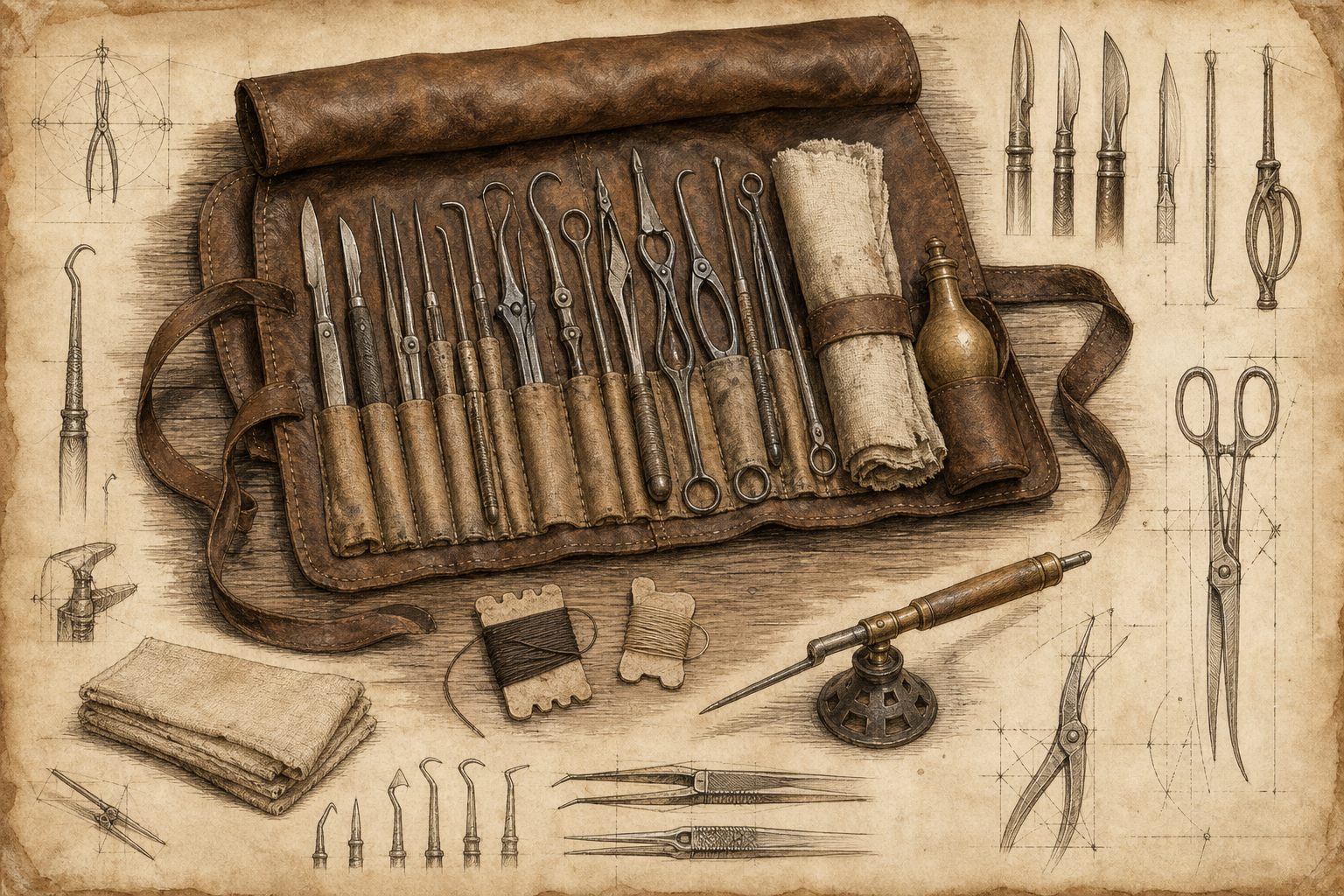
A working set of Surgeon’s Tools is usually kept in a stiff leather roll, waxed canvas wrap, wooden case, or divided travelling box. The layout matters. A surgeon working by torchlight, lantern sway, rainwater, or battlefield smoke must be able to find the right instrument by touch.
A typical set includes small surgical knives, lancets, hooked probes, forceps, clamps, wound needles, thread, narrow shears, splinter tools, cautery pieces, pins, folded linen, blade oil, waxed cord, and sometimes a small whetstone or strop.
The best sets are not decorative. Ornament traps filth. Smooth handles, tight hinges, clean edges, replaceable thread, hard cases, and washable wraps matter more than silver chasing or noble crests. A polished instrument may impress a patron. A clean one saves a life.
Good Surgeon’s Tools show use. Their blades are sharpened often. Their leather has darkened from oil and boiling water. Their case smells faintly of metal, smoke, vinegar, spirits, and old blood.
Why Surgeon’s Tools Matter
Surgeon’s Tools make injury matter without turning the campaign into bookkeeping.
They give nonmagical healing a serious place at the table. They matter when the party is far from a shrine, when spells are spent, when a temple demands payment or loyalty, when wounds are too ugly for a quick bandage, or when the problem is not hit point loss but a lodged arrowhead, torn muscle, crushed fingers, infected bite, broken rib, or battlefield fever.
They also create decisions.
Do the characters stop in hostile country and operate before the wound worsens? Do they risk moving the wounded prisoner? Do they trust the captured enemy surgeon? Do they spend magic now or save it for the next fight? Do they cut out the barbed head by torchlight or wait until dawn and risk fever?
That is where Surgeon’s Tools become more than a bonus. They turn healing into a scene.
Surgeon’s Tools 5.5e / 2024
Surgeon’s Tools, Pathfinder 1e / 3.5e
Surgeon’s Tools 5.5e / 2024
Adventuring Gear, Tool Set
Cost: 20 gp
Weight: 5 lb.
Requires: Healer’s Kit for full benefit
Surgeon’s Tools
When you use a Healer’s Kit to make a Wisdom (Medicine) check involving physical wound-care, Surgeon’s Tools grant a +1 bonus to the check.
This bonus applies to tasks such as stabilising a wounded creature, treating a deep injury, removing a lodged object, stitching a wound, draining corruption, tending battlefield trauma, or assisting recovery during a rest.
Surgeon’s Tools do not help with every Medicine check. They do not identify a disease by themselves, diagnose a supernatural curse, replace antitoxin, restore hit points, cure poison, or provide magical healing. They are instruments for physical treatment.
Healer’s Kit Requirement
Surgeon’s Tools do not replace a Healer’s Kit. The kit provides dressings, salves, poultices, bandages, splints, and expendable supplies. The tools provide precision instruments.
Using Surgeon’s Tools normally still consumes one use of a Healer’s Kit when the treatment would normally require it.
Suggested Medicine DCs
| Task | Suggested DC |
|---|---|
| Clean and stitch a simple wound during a rest | 10 |
| Remove a shallow splinter, hook, thorn, tooth, or arrow fragment | 12 |
| Treat a deep wound without worsening it | 15 |
| Remove a lodged object under pressure | 17 |
| Stabilise a badly injured creature in mud, smoke, darkness, cold, or battle conditions | 18 |
| Perform risky surgery with poor light, little time, no help, or an uncooperative patient | 20+ |
Pressure Choices
Use these when you want the tools to create tension rather than a simple roll.
| Situation | Practical Pressure |
|---|---|
| The party must keep moving | Operating now costs time; moving first may worsen the wound. |
| The wound is dirty | Treatment may need water, fire, alcohol, vinegar, clean cloth, or magic. |
| The patient is conscious | They may need restraint, trust, courage, or pain relief. |
| The area is unsafe | A proper attempt may require guards, light, shelter, and silence. |
| The object is barbed or broken | Pulling it free by force may cause extra damage. |
| The healer is distrusted | The scene may require persuasion before the knife is allowed near the wound. |
Failure Guidance
Failure should usually create consequences rather than instant death.
A failed check might cost extra time, expend an additional Healer’s Kit use, worsen the patient’s pain, reopen bleeding, leave a fragment behind, impose disadvantage on the patient’s next strenuous check, require a longer rest, or cause one level of Exhaustion if the injury is severe.
A severe failure in filthy or desperate conditions may create infection, fever, scarring, or a need for magical healing before the wound can safely close.
Surgeon’s Tools, Pathfinder 1e / 3.5e
Surgeon’s Tools
Price: 20 gp
Weight: 5 lb.
Category: Tools
Orginal Source Adventurer’s Armory
When used with a healer’s kit, Surgeon’s Tools raise the healer’s kit bonus to a +3 circumstance bonus on Heal checks.
This does not stack as a separate bonus on top of the improved healer’s kit bonus. The clean ruling is:
| Equipment Used | Heal Check Bonus |
|---|---|
| Healer’s kit only | +2 circumstance bonus |
| Healer’s kit with Surgeon’s Tools | +3 circumstance bonus |
Surgeon’s Tools are not consumed when used. The healer’s kit still expends uses as normal.
Surgeon’s Tools are most appropriate for treating wounds, treating deadly wounds, removing lodged objects, stitching injuries, cleaning battlefield trauma, and supporting long-term physical care.
How Surgeon’s Tools Are Used
Use Surgeon’s Tools when the wound is specific enough to matter.
A scout staggers back with a barbed arrowhead buried below the ribs. The shaft has snapped. Pulling it out by force may tear the wound wider.
A ship’s surgeon works below deck with a lantern swinging from a beam, boiled thread between his teeth, and the patient held down by two sailors while the ship rolls in black water.
A temple healer keeps a locked case behind the shrine, used only when prayer is not enough or when divine power must be saved for those already crossing into death.
A plague-house surgeon cuts buboes, drains corruption, burns cloth, and sleeps in a separate room because even those he saves will not share a table with him.
A mercenary company wins the field and then waits through the night to see who survives the surgeons.
This is where the item belongs: after the blow, before the fever, when survival still has to be earned.
Failure, Risk, and Misuse
Surgeon’s Tools should feel useful, not safe.
Bad surgery can push dirt deeper into a wound, snap an arrowhead, cut a vessel, damage a nerve, reopen clotting, leave ugly scars, or turn a survivable injury into a fevered one. A poor surgeon may be more dangerous than no surgeon at all.
The tools are also socially dangerous. In some cities, only licensed guild surgeons may own them. In some temples, cutting living flesh is restricted to sacred healers. In war camps, a good surgeon may be guarded like an officer. Among criminals, the same tools can remove brands, dig out crossbow bolts, disguise wounds, alter a corpse, or keep someone alive long enough to answer questions.
Do not make Surgeon’s Tools into generic torture gear. They are stronger when their main purpose remains healing. Their horror comes from the fact that healing can still require blades.
Value in the World
At 20 gp, Surgeon’s Tools are serious professional equipment. They are affordable for adventurers but expensive for common households.
A complete set may belong to a military chirurgeon, plague doctor, barber-surgeon, temple healer, ship’s surgeon, monastery infirmarian, noble household physician, or travelling medical guild. In a village, there may be only one set, and everyone knows who owns it.
Good instruments are compact, valuable, and easy to steal. During plague, siege, famine, war, or winter travel, a surgeon’s roll may be worth more than a sword. A blade that can save a lord’s son, cut infection from a knight’s leg, or keep a captain alive until dawn has value beyond its metal.
Trade, Craft, and Common Variants
Most Surgeon’s Tools variants should not have separate rules. They differ by setting, durability, and purpose.
Field Surgeon’s Roll: The standard adventuring version, kept in leather or waxed canvas. It is compact, repairable, and meant for travel, mud, rain, and battlefield use.
Typical Cost: 20 gp.
Ship Surgeon’s Case: Packed against damp and salt air, usually in a harder case with extra oilcloth, clamps, and heavy needles suited to rough work below deck.
Typical Cost: 25–30 gp.
Military Chirurgeon’s Chest: A larger camp set with duplicate blades, spare thread, cautery pieces, splints, and enough equipment to treat several wounded soldiers in succession. It is too bulky to be a normal adventurer’s belt kit.
Typical Cost: 50–100 gp.
Fine versions may exist, but they should not casually grant larger bonuses. If a campaign rewards exceptional tools, a masterwork set might reduce failure consequences, avoid disadvantage in poor conditions, or apply only to one narrow type of surgery.
Using Surgeon’s Tools in Your Game
Surgeon’s Tools work best when the campaign treats injury as a real event.
They are useful in wilderness travel, battlefield campaigns, plague towns, ship voyages, low-magic regions, mercenary companies, monster hunts, siege warfare, and dungeon expeditions where retreat to a temple is impossible.
A simple table rule is enough:
| Equipment | Use |
|---|---|
| No kit, no tools | Improvised care; higher DCs or disadvantage |
| Healer’s Kit | Basic wound-care and stabilisation |
| Healer’s Kit + Surgeon’s Tools | Serious wound-care, extraction, stitching, and risky treatment |
Do not roll for every scratch. Use Surgeon’s Tools when the injury deserves attention, when the patient matters, when the environment makes treatment difficult, or when the choice to stop and operate changes the scene.
Adventure and Worldbuilding Hooks
The Arrow That Must Not Be Removed:
A wounded prince has survived an assassination attempt, but the arrowhead inside him bears a curse, poison, maker’s mark, or tiny sealed message. Removing it may kill him. Leaving it in may condemn him. Every faction in the court wants a different surgeon at the bedside.
The Surgeon Who Saves Enemies:
After a battle, a captured chirurgeon is found treating soldiers from both armies in the same blood-soaked tent. Commanders want him punished for aiding the enemy, but the wounded on both sides know he is the only reason half of them are still alive. If the party protects him, they may inherit his enemies as well as his patients.
The Instruments Remember:
A set of old Surgeon’s Tools is found wrapped in blackened linen inside a ruined plague house. Each blade is ordinary steel, but every patient treated with it dreams of the same locked ward, the same masked healer, and the same operation no one survived. The tools are not cursed to kill; they are trying to show what was done with them.
Historical Context
Surgeon’s Tools are fantasy equipment, but they fit naturally beside medieval wound-care manuals and battlefield surgery. A useful reference is the medieval Wound Man image tradition: illustrated figures showing arrows, blades, bites, bruises, and other injuries, used to guide readers toward treatments for specific wounds.
That is exactly the kind of world Surgeon’s Tools belong to: not modern hospitals, but war, travel, accident, infection, and hard practical care after violence.
For a simple medieval reference point, see the Wound Man, a medieval surgical image tradition showing different battlefield injuries and the treatments associated with them.
Keep this reference growing
If this page helped with your reading or game, you can support its upkeep or explore the curated books.
Explore the Bookshop — epics, classics and stories behind imagined worlds.