
Arcane Lock — Seal of the Black Key
Abjuration spell guide · four edition panels
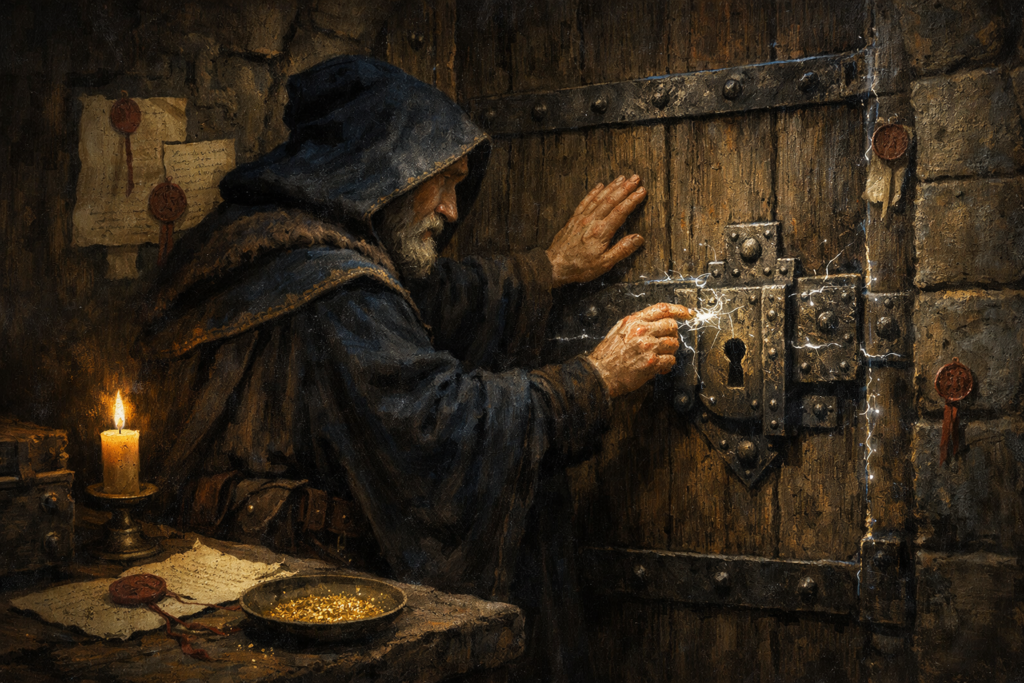
Some spells destroy, some transform, and some simply decide who may pass. Arcane Lock belongs to that last tradition: quiet defensive magic that turns an ordinary door, gate, window, hatch, or container into a boundary enforced by spellcraft.
A whispered ward settles into iron and timber, and an ordinary lock becomes a declaration: this way is closed.
Quick Rules Reference
Game Mechanics
Choose the rules edition being used. Each panel below is complete in itself; do not import lockpicking, breaking, password, or dispelling rules from another edition.
What Changed Between Editions?
- 5.5e / 2024: nonmagical means cannot unlock the magical lock.
- 5e / 2014: the DCs to break the object or pick its locks increase by 10.
- Pathfinder 1e: adds +10 to an existing lock’s opening DC, or provides a DC 20 magical lock on a lockless object.
- 3.5e: retains the breaking, Knock and dispelling procedure, without Pathfinder’s separate DC 20 lockpicking rule.
Common Rulings
- Can thieves’ tools or ordinary lockpicking open Arcane Lock in 5.5e? No. The current spell expressly prevents its magical lock from being unlocked by nonmagical means. Pathfinder 1e uses a different rule and expressly allows Disable Device to interact with the magical lock it creates.
- Does Arcane Lock make a door or chest indestructible? No. The spell magically locks the target; it does not say that the material itself becomes immune to damage. Use the active edition’s rules for damaging, breaking, or destroying objects when an intruder attacks the object rather than trying to unlock it.
- What does Knock do to Arcane Lock? Knock is the spell’s direct counterpart. In the relevant rules versions it suppresses Arcane Lock for 10 minutes rather than permanently removing it.
- What does Dispel Magic do in 5.5e? Arcane Lock is an ongoing Level 2 spell. If Arcane Lock is one of the ongoing spells on the object chosen as the target of Dispel Magic , it ends automatically because Dispel Magic ends ongoing spells of Level 3 or lower on that target.
- Can I change the creatures who are allowed through later? The current spell tells you to designate those creatures when you cast it. It does not provide a later procedure for editing that list.
- Can I use a password instead? Yes in the current 5.5e version. You can establish a password when casting. Speaking it within 5 feet unlocks the object for 1 minute.
- Can Arcane Lock affect any object? Not in the current version. Its target list is specific: a closed door, window, gate, container, or hatch. Use that list rather than treating every imaginable object as an eligible target.
Related Spells
Uses and Tactics
Secure Valuables
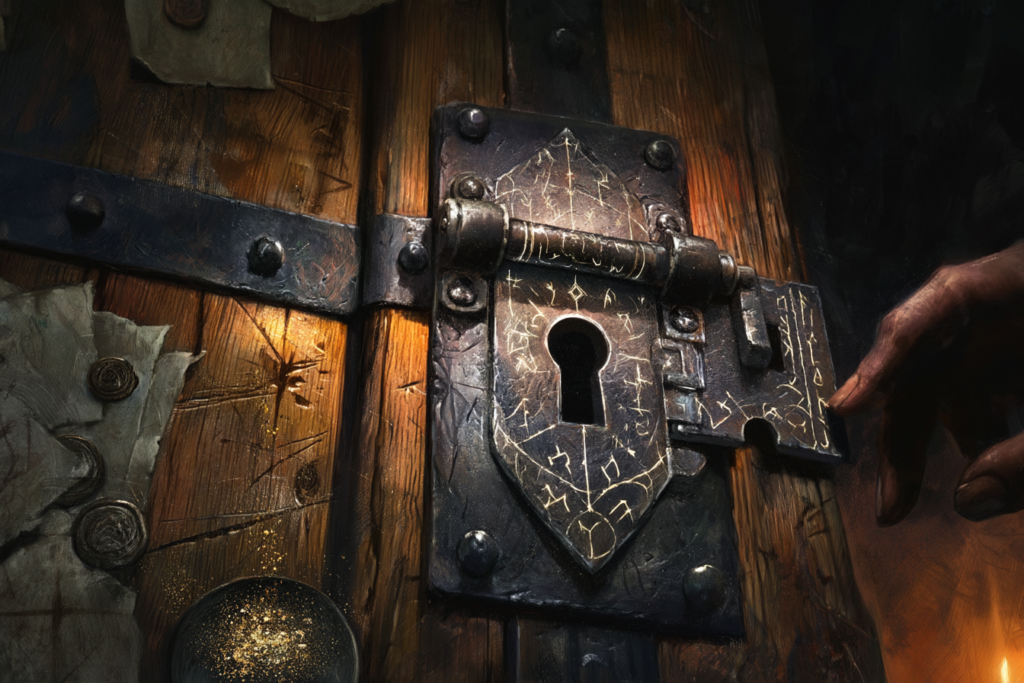
Treasure chests, ceremonial coffers, dangerous books, private strongboxes, archives, and containers holding magical objects are obvious uses. The spell matters because ordinary tampering is no longer automatically enough.
Control Access
Arcane Lock is strongest when trusted people still need to use a place. A records room, guild vault, prison hatch, inner gate, ritual chamber, or wizard’s study can remain functional for authorised users while denying easy entry to everyone else.
Buy Time
A defence does not have to be impossible to matter. A sealed threshold forces an intruder to spend time, make noise, attack the structure, or use magical resources. Guards may gather, witnesses may wake, and plans may have to change.
Build Layered Security
Arcane Lock becomes more effective when it is only one part of the defence. Alarm can reveal intrusion, Glyph of Warding can punish it, and guards, traps, strong construction, and controlled approaches can make the ward considerably harder to bypass safely.
For Players
Use Arcane Lock where delay or controlled access matters more than spectacle. An escape route, treasury, fallback chamber, dangerous cabinet, prison door, or entrance that must remain usable by allies is usually a better investment than an arbitrary doorway.
The consumed gold dust also encourages deliberate placement. The spell is strongest when the party already knows which threshold is worth protecting and who must retain access to it.
For Game Masters
Arcane Lock should tell the players something about the place that uses it. A ward on a treasury says something different from one on a prison hatch, a private archive, or a sealed cabinet in a magician’s study.
The most useful Arcane Lock is rarely a permanent dead end. It creates pressure: find another way, use magic, break something, make noise, spend time, or abandon the attempt.
Arcane Lock in the World
A locked thing in fantasy is rarely only locked. It is claimed, protected, hidden, forbidden, feared, or treasured. Arcane Lock sharpens those meanings without needing fire, thunder, or a visible guardian.
In the world of 1454, such magic is most useful where authority depends on controlled physical access: princely records, guild property, treasury rooms, city strongrooms, prison doors, temple relics, wizard laboratories, private correspondence, and containers whose contents are too valuable or dangerous to trust to an ordinary key.
There is no universal standard for how those wards are used. One household may entrust a password to a handful of officers. Another caster may designate particular companions. A cautious institution may combine magical locking with mundane guards and ordinary locks so that defeating one layer does not defeat the entire defence.
The spell’s quiet authority is its strength. It does not announce that a trespasser has been punished. It simply declares that permission has not been granted.
Mythical Context
Hermes was linked with thresholds and boundary markers. The idea that a threshold can be protected by a sign or an unseen authority suits a magically locked door, especially when a spoken password is the only lawful passage. See the historical study of Hermes and boundary signs.
Historical Context
Seals, signatures and protective amulets belonged to practical and ritual traditions across the ancient world. An engraved Late Roman gem bearing symbols and inscriptions provides an archaeological parallel for inscribing a protective sign, not proof that historical doors resisted entry through magic. See the British Museum’s Late Roman engraved amulet.
Rules Sources and Attribution
This work includes material taken from the System Reference Document 5.1 (“SRD 5.1”) by Wizards of the Coast LLC and available at https://dnd.wizards.com/resources/systems-reference-document. The SRD 5.1 is licensed under the Creative Commons Attribution 4.0 International License available at https://creativecommons.org/licenses/by/4.0/legalcode.
- SRD 5.2.1 Creative Commons attribution. This work includes material from the System Reference Document 5.2.1 (“SRD 5.2.1”) by Wizards of the Coast LLC, available at https://www.dndbeyond.com/srd . The SRD 5.2.1 is licensed under the Creative Commons Attribution 4.0 International License, available at https://creativecommons.org/licenses/by/4.0/legalcode .
- D&D 5.5e / 2024 Arcane Lock. The current rules panel uses the official Arcane Lock spell from SRD 5.2.1 / the 2024 rules.
- Pathfinder Roleplaying Game Core Rulebook — Arcane Lock. The Pathfinder 1e rules retain their own lock DC, Disable Device, breaking, dispelling and Knock interactions.
- Revised D&D 3.5 System Reference Document — Arcane Lock. The D&D 3.5e rules retain their native permanent-duration, breaking, Dispel Magic and Knock procedure.
Open Game Content designation. The Pathfinder First Edition and Revised D&D 3.5 mechanical material on this page is designated Open Game Content only to the extent that it derives from material already released as Open Game Content under the Open Game License v1.0a.
Original SpiralWorlds setting material, the Seal of the Black Key framing, the 1454 campaign material, historical framing, original explanatory prose, page design, artwork selection and editorial presentation are not designated Open Game Content.
Material derived from SRD 5.2.1 is used separately under Creative Commons Attribution 4.0 International.
Open Game License v1.0a & Section 15 Copyright Notices
OPEN GAME LICENSE Version 1.0a
The following text is the property of Wizards of the Coast, Inc. and is Copyright 2000 Wizards of the Coast, Inc (“Wizards”). All Rights Reserved.
1. Definitions: (a) “Contributors” means the copyright and/or trademark owners who have contributed Open Game Content; (b) “Derivative Material” means copyrighted material including derivative works and translations (including into other computer languages), potation, modification, correction, addition, extension, upgrade, improvement, compilation, abridgment or other form in which an existing work may be recast, transformed or adapted; (c) “Distribute” means to reproduce, license, rent, lease, sell, broadcast, publicly display, transmit or otherwise distribute; (d) “Open Game Content” means the game mechanic and includes the methods, procedures, processes and routines to the extent such content does not embody the Product Identity and is an enhancement over the prior art and any additional content clearly identified as Open Game Content by the Contributor, and means any work covered by this License, including translations and derivative works under copyright law, but specifically excludes Product Identity; (e) “Product Identity” means product and product line names, logos and identifying marks including trade dress; artifacts; creatures; characters; stories, storylines, plots, thematic elements, dialogue, incidents, language, artwork, symbols, designs, depictions, likenesses, formats, poses, concepts, themes and graphic, photographic and other visual or audio representations; names and descriptions of characters, spells, enchantments, personalities, teams, personas, likenesses and special abilities; places, locations, environments, creatures, equipment, magical or supernatural abilities or effects, logos, symbols, or graphic designs; and any other trademark or registered trademark clearly identified as Product Identity by the owner of the Product Identity, and which specifically excludes the Open Game Content; (f) “Trademark” means the logos, names, mark, sign, motto, designs that are used by a Contributor to identify itself or its products or the associated products contributed to the Open Game License by the Contributor; (g) “Use”, “Used” or “Using” means to use, Distribute, copy, edit, format, modify, translate and otherwise create Derivative Material of Open Game Content; (h) “You” or “Your” means the licensee in terms of this agreement.
2. The License: This License applies to any Open Game Content that contains a notice indicating that the Open Game Content may only be Used under and in terms of this License. You must affix such a notice to any Open Game Content that You Use. No terms may be added to or subtracted from this License except as described by the License itself. No other terms or conditions may be applied to any Open Game Content distributed using this License.
3. Offer and Acceptance: By Using the Open Game Content You indicate Your acceptance of the terms of this License.
4. Grant and Consideration: In consideration for agreeing to use this License, the Contributors grant You a perpetual, worldwide, royalty-free, non-exclusive license with the exact terms of this License to Use the Open Game Content.
5. Representation of Authority to Contribute: If You are contributing original material as Open Game Content, You represent that Your Contributions are Your original creation and/or You have sufficient rights to grant the rights conveyed by this License.
6. Notice of License Copyright: You must update the COPYRIGHT NOTICE portion of this License to include the exact text of the COPYRIGHT NOTICE of any Open Game Content You are copying, modifying or distributing, and You must add the title, the copyright date, and the copyright holder’s name to the COPYRIGHT NOTICE of any original Open Game Content You Distribute.
7. Use of Product Identity: You agree not to Use any Product Identity, including as an indication as to compatibility, except as expressly licensed in another, independent Agreement with the owner of each element of that Product Identity. You agree not to indicate compatibility or co-adaptability with any Trademark or Registered Trademark in conjunction with a work containing Open Game Content except as expressly licensed in another, independent Agreement with the owner of such Trademark or Registered Trademark. The use of any Product Identity in Open Game Content does not constitute a challenge to the ownership of that Product Identity. The owner of any Product Identity used in Open Game Content shall retain all rights, title and interest in and to that Product Identity.
8. Identification: If you distribute Open Game Content You must clearly indicate which portions of the work that you are distributing are Open Game Content.
9. Updating the License: Wizards or its designated Agents may publish updated versions of this License. You may use any authorized version of this License to copy, modify and distribute any Open Game Content originally distributed under any version of this License.
10. Copy of this License: You MUST include a copy of this License with every copy of the Open Game Content You Distribute.
11. Use of Contributor Credits: You may not market or advertise the Open Game Content using the name of any Contributor unless You have written permission from the Contributor to do so.
12. Inability to Comply: If it is impossible for You to comply with any of the terms of this License with respect to some or all of the Open Game Content due to statute, judicial order, or governmental regulation then You may not Use any Open Game Material so affected.
13. Termination: This License will terminate automatically if You fail to comply with all terms herein and fail to cure such breach within 30 days of becoming aware of the breach. All sublicenses shall survive the termination of this License.
14. Reformation: If any provision of this License is held to be unenforceable, such provision shall be reformed only to the extent necessary to make it enforceable.
15. COPYRIGHT NOTICE
Open Game License v 1.0a Copyright 2000, Wizards of the Coast, Inc.
System Reference Document Copyright 2000–2003, Wizards of the Coast, Inc.; Authors Jonathan Tweet, Monte Cook, Skip Williams, Rich Baker, Andy Collins, David Noonan, Rich Redman, Bruce R. Cordell, John D. Rateliff, Thomas Reid, James Wyatt, based on original material by E. Gary Gygax and Dave Arneson.
Pathfinder Roleplaying Game Core Rulebook © 2009, Paizo Publishing, LLC; Author: Jason Bulmahn, based on material by Jonathan Tweet, Monte Cook and Skip Williams.
Pathfinder Roleplaying Game Reference Document © 2011, Paizo Publishing, LLC.
Original Arcane Lock — Seal of the Black Key setting material, 1454 campaign material, historical framing and editorial content Copyright © 2026 SpiralWorlds. All rights reserved except material separately identified as Open Game Content or licensed under Creative Commons Attribution 4.0 International.
Keep this reference growing
If this page helped with your reading or game, you can support its upkeep or explore the curated books.
Explore the Bookshop — epics, classics and stories behind imagined worlds.