
Acid damage • Ranged cantrip • Three-edition rules
Acid Splash
A compact sphere of corrosive magic bursts where the caster directs it. In the 2024 rules it is a small area attack; in Pathfinder 1e and D&D 3.5e it is a single acidic missile resolved with a ranged touch attack.
The editions use different schools, targeting methods and defences. Choose the rules tab for the game being played and keep its terminology separate from the others.
Quick Rules Reference
The current D&D 2024 form comes first. Pathfinder 1e and D&D 3.5e retain the older single-target ranged-touch version.
- School
- Evocation cantrip
- Range
- 60 feet
- Area
- 5-foot-radius Sphere
- Defence
- Dexterity saving throw
- Damage
- 1d6 Acid; no damage on a success
- Scaling
- 2d6 at 5th, 3d6 at 11th, 4d6 at 17th level
- School
- Conjuration (creation) [acid]
- Range
- Close: 25 ft. + 5 ft./2 levels
- Targeting
- One missile; ranged touch attack
- Defence
- No saving throw; Spell Resistance no
- Damage
- 1d3 acid
- Residue
- The acid disappears after 1 round
- School
- Conjuration (creation) [acid]
- Range
- Close: 25 ft. + 5 ft./2 levels
- Targeting
- One missile; ranged touch attack
- Defence
- No saving throw; Spell Resistance no
- Damage
- 1d3 acid
- Duration
- Instantaneous; no continuing damage
Spell Mechanics
Use only the panel for the active ruleset. Saves, attack rolls, areas, scaling and Spell Resistance are not interchangeable between editions.
Acid Splash — D&D 5.5e / 2024
- Level
- Cantrip
- School
- Evocation
- Casting Time
- Action
- Range
- 60 feet
- Components
- V, S
- Duration
- Instantaneous
- Area
- 5-foot-radius Sphere
- Classes
- Sorcerer, Wizard
Choose a point within range. An acidic bubble forms there and bursts through a 5-foot-radius Sphere. Every creature in that Sphere makes a Dexterity saving throw. A creature that fails takes 1d6 Acid damage; a successful save prevents the damage.
Cantrip upgrade: the damage rises when the caster reaches the listed character levels.
Acid Splash — Pathfinder 1e
- Level
- Sorcerer/Wizard 0
- School
- Conjuration (creation) [acid]
- Casting Time
- 1 standard action
- Range
- Close: 25 ft. + 5 ft./2 levels
- Components
- V, S
- Effect
- One missile of acid
- Duration
- Instantaneous
- Save / SR
- None / No
Make a ranged touch attack against one target within range. On a hit, the missile deals 1d3 points of acid damage. The created acid disappears after 1 round and causes no automatic damage during that time.
Acid Splash — D&D 3.5e
- Level
- Sorcerer/Wizard 0
- School
- Conjuration (creation) [acid]
- Casting Time
- 1 standard action
- Range
- Close: 25 ft. + 5 ft./2 levels
- Components
- V, S
- Effect
- One missile of acid
- Duration
- Instantaneous
- Save / SR
- None / No
Make a ranged touch attack against one target within range. On a hit, the missile deals 1d3 points of acid damage. The spell has no saving throw and does not allow Spell Resistance.
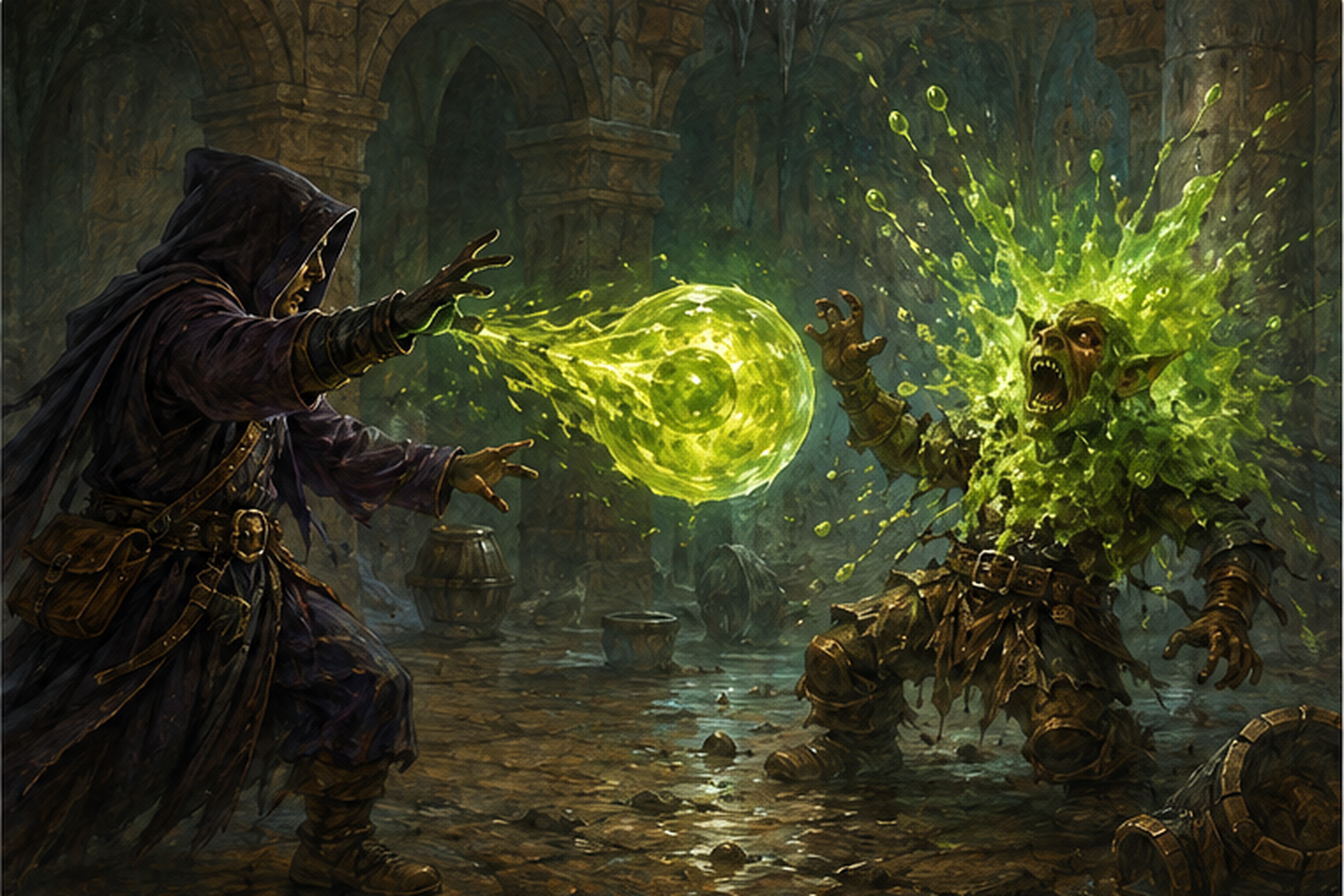
Acid Splash in Action
Edition Differences at a Glance
The name remains the same, but the 2024 spell is mechanically a different kind of attack.
| Edition | School | Resolution | Targets | Damage | Spell Resistance |
|---|---|---|---|---|---|
| D&D 5.5e / 2024 | Evocation | Dexterity save | Every creature in a 5-foot-radius Sphere | 1d6 to 4d6 by character level | Not used in this ruleset |
| Pathfinder 1e | Conjuration (creation) [acid] | Ranged touch attack | One target | 1d3 acid | No |
| D&D 3.5e | Conjuration (creation) [acid] | Ranged touch attack | One target | 1d3 acid | No |
Rules Clarifications
These rulings prevent the most common edition drift and over-reading of the spell.
D&D 2024: Point and Sphere
- The caster chooses a point within 60 feet rather than choosing an initial creature.
- Every creature in the 5-foot-radius Sphere is affected, including allies.
- The spell sets no fixed creature limit; the practical number depends on positioning and occupied spaces.
- Normal area, line-of-effect and cover rules apply from the point of origin.
D&D 2024: Save and Damage
- A successful Dexterity save prevents all damage; the spell does not deal half damage on a success.
- The spell deals only Acid damage and imposes no condition.
- Its scaling uses character level, not spellcasting-class level or spell-slot level.
- It is a cantrip and cannot be upcast with a spell slot.
Pathfinder 1e and D&D 3.5e
- The caster makes one ranged touch attack. There is no Dexterity or Reflex save.
- A miss deals no damage.
- Spell Resistance does not protect the target from this spell.
- Apply the active edition’s normal rules for cover, concealment, critical hits and attacking objects.
Instantaneous Does Not Mean Permanent Acid
Instantaneous duration means the magical discharge resolves at once. It does not create an ongoing pool, repeating damage, a permanent reduction to armour or a supply of alchemical acid. Pathfinder 1e additionally says that its acid disappears after 1 round.
Best Uses and Tactics
Acid Splash rewards careful target selection rather than raw single-target damage.
D&D 2024
- Place the Sphere to catch two or more enemies without including allies.
- Use it against clustered, lower-Dexterity creatures when a small area is more valuable than a stronger single-target cantrip.
- Aim the point around narrow passages, doorways and packed formations while respecting total cover.
- Choose another option when only one durable enemy is present or the target resists Acid damage.
Pathfinder 1e
- Use the ranged touch attack against creatures whose touch Armour Class is much lower than their full Armour Class.
- It is useful when Spell Resistance would obstruct another spell, because Acid Splash allows no Spell Resistance.
- Its 1d3 damage is best for finishing a badly wounded target or exploiting a specific weakness.
- Remember that even modest acid resistance can absorb all of the damage.
D&D 3.5e
- Target touch Armour Class and use the cantrip when conserving higher-level spells matters.
- It can threaten creatures protected by Spell Resistance, but the attack roll still has to hit.
- Cover and concealment can make the nominally easy touch attack unreliable.
- Do not expect the cantrip’s low damage to overcome significant energy resistance or object hardness by itself.
Limitations and Common Mistakes
What the Spell Does Not Add
- No ongoing damage.
- No armour corrosion or Armour Class penalty.
- No blinded, poisoned, weakened or burning condition.
- No splash damage in Pathfinder 1e or D&D 3.5e despite the spell’s name.
- No special neutralisation rule involving water, alkali, sand or mundane equipment.
Edition Drift to Avoid
- Do not use the 2024 Sphere with the PF1e/3.5e ranged touch attack.
- Do not give the 2024 spell the older Conjuration school.
- Do not add a Dexterity save to the PF1e or 3.5e version.
- Do not apply Spell Resistance in PF1e or 3.5e; both versions state that it does not apply.
- Do not use the legacy two-creature 2014 form as the current 2024 rule.
Counters and Defences
The most reliable answers operate before or during resolution. The spell is already over once its instantaneous damage has been applied.
Before or During the Casting
- A legal Counterspell or equivalent interruption can stop the spell before it resolves, using that edition’s own countering rules.
- Preventing the caster from supplying verbal or somatic components can make the spell impossible to cast.
- In 2024, spread out and avoid leaving several allies within the same small Sphere.
- In PF1e and 3.5e, cover, concealment and effects that impair ranged attacks make the touch attack less reliable.
Damage Protection
- Acid Resistance reduces the damage according to the active edition; Acid Immunity prevents it.
- In PF1e and 3.5e, Resist Energy can absorb the entire 1d3 result.
- In PF1e and 3.5e, Protection from Energy can absorb the damage while its capacity remains.
- A successful 2024 Dexterity save prevents all damage from that casting.
Dispel Magic
Dispel Magic cannot reverse Acid Splash after the damage is dealt. Acid Splash is instantaneous, so there is no ongoing spell effect left to end. Dispel Magic is relevant only where an edition expressly allows it to be used as part of countering a spell before that spell resolves.
GM Adjudication Notes
Keep the spell useful without silently turning a damaging cantrip into a universal solvent.
Objects and the Environment
In D&D 2024, the spell’s effect is written for creatures, so damaging doors, locks, weapons, armour or scenery is outside its stated effect. In PF1e and D&D 3.5e, resolve any permitted attack against an object with the edition’s ordinary attack, hardness, energy-damage and object rules. The spell gains no special corrosion exception.
Collecting or Selling the Acid
The spell provides no stable commodity. Its magic is instantaneous; Pathfinder 1e explicitly removes the acid after 1 round. Repeated casting therefore does not establish a free supply of bottled acid unless the campaign deliberately introduces a separate house rule.
Appearance
The colour, odour and visible form can vary without changing the rules. A caster might produce a green glassy bubble, yellow vapour around a clear droplet, black alchemical liquor or a pale sphere that hisses only on impact.
Consequences in the Fiction
Acid damage can leave painful burns and damaged clothing when the fiction calls for it, but cosmetic description should not create extra damage, conditions or equipment penalties. Mechanical consequences must come from the active ruleset or an openly declared house rule.
Acid Splash in SpiralWorlds
An Apprentice’s Dangerous Proof
Acid Splash is often taught as a lesson in exact control: the caster must create a destructive substance, direct it and end the working before it becomes a hazard to everyone nearby. The cantrip is simple enough for students, yet unforgiving enough to reveal poor judgement immediately.
Alchemy and Battle Magic
Alchemists recognise the spell’s resemblance to strong mineral acids, while battle-mages value its ability to threaten lightly protected foes without consuming a spell slot. The resemblance is not identity: the magical discharge follows the chosen game rules rather than the full chemistry of a laboratory reagent.
Historical and Occult Development
The spell belongs to the long imaginative history of corrosive “strong waters,” guarded recipes and the dangerous authority of the laboratory.
Aqua Fortis and the Strong Waters
Aqua fortis, literally “strong water,” was nitric acid. Historical alchemists used it to dissolve silver and many other metals, while gold resisted it. Other mineral acids were known as oil of vitriol and spirit of salt; together these substances gave corrosive liquids a practical and fearsome place in the history of alchemy.
Distillation, Secrecy and Authority
Producing strong acids demanded controlled heat, suitable vessels and specialised knowledge. The Chymistry of Isaac Newton project records nitric, sulfuric and hydrochloric acids among the mineral acids used in early modern chymistry. In fantasy, that history naturally turns a small globe of acid into a sign of trained, dangerous learning.
Occult Meaning
Corrosion is a fitting magical image for separation and reduction: a surface is stripped away, a compound is broken apart and a hidden substance is revealed. Acid magic therefore suits traditions concerned with dissolution, testing, purification through destruction and the exposure of what lies beneath appearances.
From Workshop to Cantrip
The spell compresses the labour of the laboratory into a gesture and a word. No furnace, retort or stored reagent is required. That convenience is precisely what makes the cantrip unsettling in a historical setting: a destructive product of skilled manufacture can be summoned in an instant by anyone who has learned the formula.
Mythological Parallels
The Lernaean Hydra
The closest classical parallel is not a chemical acid but the deadly venom of the Lernaean Hydra. Heracles uses the monster’s poison on his arrows, turning a creature’s lethal fluid into a portable weapon. The comparison is thematic rather than chemical: the Hydra supplies the mythic pattern of a small quantity of liquid carrying disproportionate destructive power.
Legacy Video Guide
This surviving video concerns the older fifth-edition form. It is retained for historical comparison and should not be used in place of the 2024 mechanics above.
 Legacy 2014 rules
Cantrip #1: Acid Splash (5E)
Opens on YouTube. Compare its older targeting rules with the D&D 2024 Sphere version before using it at the table.
Legacy 2014 rules
Cantrip #1: Acid Splash (5E)
Opens on YouTube. Compare its older targeting rules with the D&D 2024 Sphere version before using it at the table.
Acid Splash FAQ
Does the D&D 2024 spell damage allies?
Yes. It affects every creature in the 5-foot-radius Sphere. The caster cannot automatically exempt allies.
Does a successful D&D 2024 save take half damage?
No. A successful Dexterity save prevents the damage entirely.
Can Acid Splash damage a lock or door?
The 2024 spell is written to affect creatures, not objects. PF1e and D&D 3.5e use a ranged attack, but any object attack must still follow that edition’s ordinary object and energy-damage rules. The cantrip does not ignore hardness or automatically melt a lock.
Can the acid be collected?
No collection rule is provided. The magic is instantaneous, and Pathfinder 1e explicitly says that the acid disappears after 1 round.
Does Spell Resistance stop Acid Splash in PF1e or D&D 3.5e?
No. Both spell blocks state “Spell Resistance: No.” The caster must still hit with the ranged touch attack.
Can Dispel Magic remove the damage?
No. The spell is instantaneous and has already ended when the damage is applied. There is no ongoing Acid Splash effect for Dispel Magic to end.
Does the 2024 cantrip scale with class level?
It scales with the character’s total level: 2d6 at level 5, 3d6 at level 11 and 4d6 at level 17.
Rules Sources and Licensing
The current and legacy rules are identified separately so readers can verify each edition without mixing their mechanics.
- System Reference Document 5.2.1 — source for the current fifth-edition-compatible spell.
- Creative Commons Attribution 4.0 International — licence applied to SRD 5.2.1.
- Pathfinder Reference Document: Acid Splash — Pathfinder 1e rules source.
- d20 SRD: Acid Splash — D&D 3.5e rules source.
SRD 5.2.1 Attribution
This work includes material from the System Reference Document 5.2.1 (“SRD 5.2.1”) by Wizards of the Coast LLC, available at https://www.dndbeyond.com/srd. The SRD 5.2.1 is licensed under the Creative Commons Attribution 4.0 International License, available at https://creativecommons.org/licenses/by/4.0/legalcode.
The Pathfinder 1e and D&D 3.5e panels are independently written rules summaries linked to their reference documents. SpiralWorlds setting text, historical discussion, tactical guidance, layout and illustration are original site material.
Keep this reference growing
If this page helped with your reading or game, you can support its upkeep or explore the curated books.
Explore the Bookshop — epics, classics and stories behind imagined worlds.