
The Great Mechanism — Plane of Absolute Law
The Great Mechanism — Plane of Absolute Law
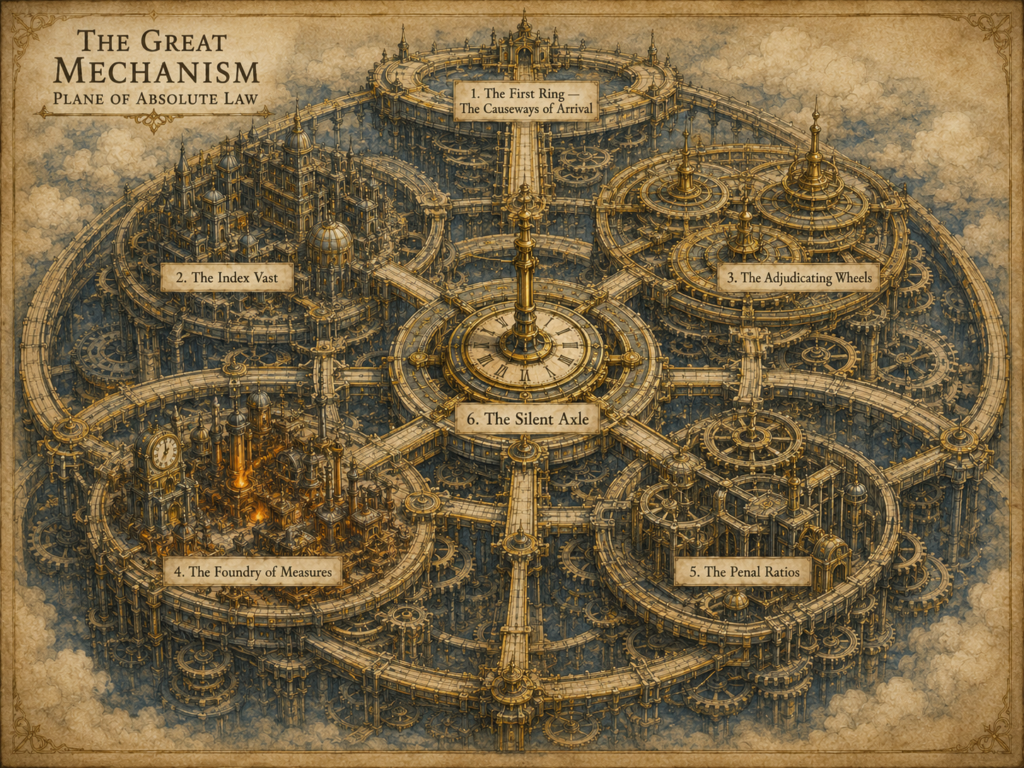
The Great Mechanism is the plane where law becomes landscape, judgement becomes motion, and every broken oath is eventually found by the turning of the gears.
- Plane Type: Outer Plane
- Moral Gravity: Lawful Neutral
- Common Names: The Great Mechanism, the Ordered Deep, the Brass Infinity, the Plane of Absolute Law, the World-Engine
- Primary Function: Cosmic law, order, contracts, oaths, hierarchy, measured punishment, lawful protection, timekeeping, civic order, divine audit, inevitability, sacred mechanism, clockwork infrastructure, cosmic maintenance, and correction without sentiment
- Usual Arrival Point: A brass causeway, tribunal platform, rotating bridge, counting hall, oath-gate, timed gate, formal receiving chamber, or jurisdictional intake platform
- Primary Inhabitants: Inevitables, arbiters, keledons, kolyaruts, maruts, law-engines, numbered servitors, oathbound petitioners, divine auditors, clockwork beasts, clockwork dragons, clockwork goliaths, clockwork leviathans, clockwork mages, clockwork servants, clockwork soldiers, clockwork spies, clockwork steeds, brass jurists, contract-keepers, permitted devils, and mortal artificer-sages
- Travel Reliability: Perfectly reliable when rules are followed; brutally dangerous when rules are broken
Overview
The Great Mechanism is not simply the plane of law. It is the plane where law becomes structure.
Order is a district. Procedure is a ministry. Oath is a chain. Judgement is a turning court. Measurement is a foundry. Protection is a sealed charter. Time is a clock large enough to contain cities. Correction is a sentence-wheel that turns until the lawful term is complete. Inevitability is not a road or a monster: it is a warrant that has matured.
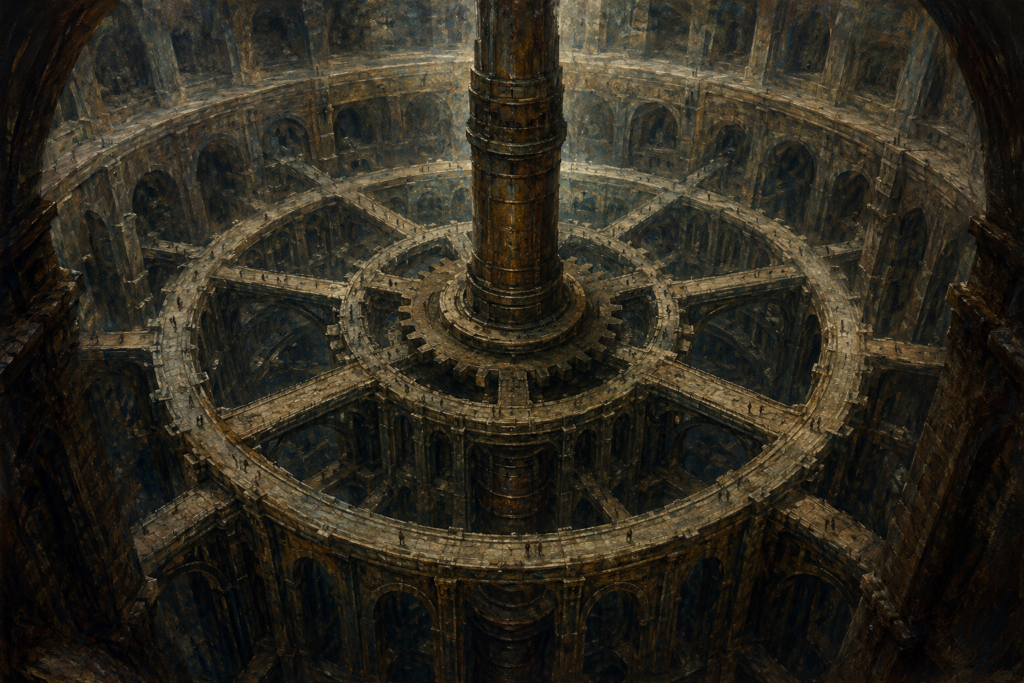
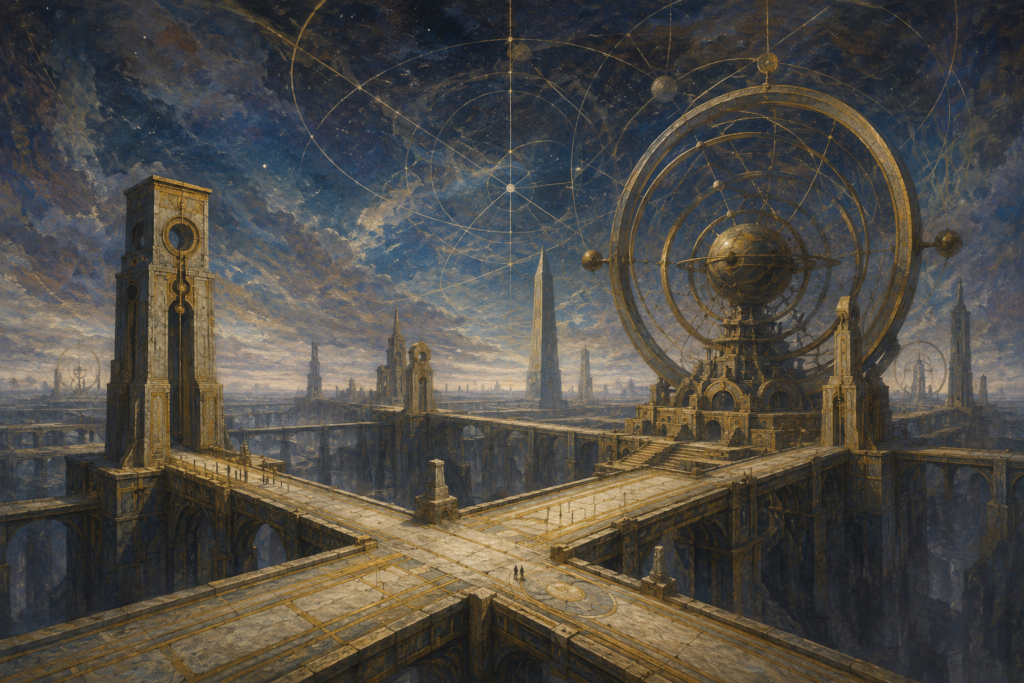
To mortal visitors, the plane first appears as an impossible clockwork country. Vast gear-fields rotate beneath a sky of brass rings. Bridges lock into place across empty gulfs. Towers advance by inches over centuries. Rivers run through canals of black iron and return to their source exactly when scheduled. Cities are built not around markets or temples, but around courts, indexes, measures, clocks, ministries, archives, tribunals, seals, and public instruments of correction.
Nothing here is accidental. Gates open because a condition has been met. Bells ring because a contract has reached its appointed clause. Rain falls as numbered droplets. Shadows lengthen by decree. A bridge may exist only for those with standing to cross it. A door may remain shut until the lawful hour. A prisoner may be released not when anyone feels pity, but when the sentence, appeal, compact, or correction reaches its lawful end.
Machinery in the Great Mechanism is not modern science, industry for profit, or invention for its own sake. It is lawful function made visible. Every engine has an office, every gear has a duty, every clock has standing, and every mechanism exists to measure, record, protect, correct, move, bind, or enforce.
The Great Mechanism does not care whether a law is kind. It cares whether a law is valid, witnessed, recorded, bounded, measured, and enforceable.
This does not mean the plane favours cruelty. A cruel sentence may stand if it is valid, but a tyrant’s appetite is not law merely because the tyrant holds power. The same machinery that counts punishments also preserves sanctuary, safe-conduct, ransom terms, lawful surrender, honest weights, widow-rights, inheritance claims, guild protections, sworn mercy, and appeals against false judgement. The Great Mechanism is cold, but it is not simply on the side of the strong.
Good souls may be protected here. Evil souls may thrive here until the law catches them. Tyrants may admire it. Judges may fear it. Devils may bargain in its outer courts, but only under permit and supervision. Merciful powers may plead for mercy, but mercy is not native to the plane unless it has lawful form. Free spirits find the Great Mechanism suffocating; oath-keepers find it beautiful.
The plane is not evil. For many travellers, it is more frightening than that: it is impersonal.
Cosmological Role
The Great Mechanism is the multiverse’s great stabiliser. It does not create every law, but it catches law, tests law, stores law, measures law, and gives law teeth.
Oaths sworn before kings, boundary stones, guild seals, treaties, sacred marriages, prison sentences, temple vows, merchant contracts, surrender terms, inheritance claims, curses of lawful vengeance, and divine judgements can all cast shadows here.
When a lawful act becomes strong enough, repeated enough, witnessed enough, or sacred enough, the Great Mechanism may record it. Once recorded, the act gains planar weight. A compact between two barons may become a brass tablet in a minor archive. The coronation oath of a realm may become a rotating crown-wheel. A treaty between species may become a bridge that cannot be crossed by oathbreakers. A betrayal of lawful surrender may ring a bell in a distant tribunal no mortal has ever seen.
The plane is also the keeper of lawful time. It does not own all time, and it is not a realm of easy time-travel, but it measures sequence, duration, term, expiry, appointment, appeal, sentence, and return. Contracts mature here. Sentences are counted here. Coronation years, prison terms, harvest dues, treaty deadlines, mourning periods, lawful truces, inheritance delays, temple calendars, and ritual hours may all cast shadows on its clocks.
A mortal kingdom may forget when a border treaty expires. The Great Mechanism does not. A baron may delay judgement until witnesses die. The Great Mechanism records the delay. A wizard may extend life beyond lawful bounds. A marut or other inevitable may eventually hear the violation as a bell struck in a distant court-engine.
The plane is also a counterweight to chaos. It resists accident, exception, improvisation, impulse, mob rule, and unmeasured change. Its native powers believe that freedom without boundary decays into predation. They also believe that mercy without record becomes favouritism, and favouritism becomes rot.
Because of this, the Great Mechanism is both necessary and dangerous. Without it, passages between worlds drift, oaths weaken, weights change, calendars lie, courts lose force, and divine law becomes opinion. With too much of it, kingdoms become engines, people become entries, and living custom is crushed beneath perfect procedure.
The plane is strongest in play when it creates hard choices rather than simple punishment. A valid law may be cruel. A local custom may be ugly but recognised. A merciful act may be unlawful if done without standing. A harsh verdict may still protect a treaty that prevents greater slaughter. The Great Mechanism does not remove moral judgement from the campaign; it forces characters to prove, challenge, appeal, obey, or break law with full knowledge of the consequences.
Named Regions of the Plane
The Great Mechanism is a single parent plane with vast named regions, not a stack of separate child planes. Its regions move, interlock, divide, and return according to cycles that can be predicted by those who understand the local law. The structure is not random; it is procedural.
The plane’s great ideas are not abstractions. Order is a district. Procedure is a ministry. Oath is a chain. Judgement is a wheel. Measurement is a foundry. Correction is a sentence-machine. Time is a clock. Inevitability is a warrant with authority behind it.
The First Ring — The Causeways of Arrival
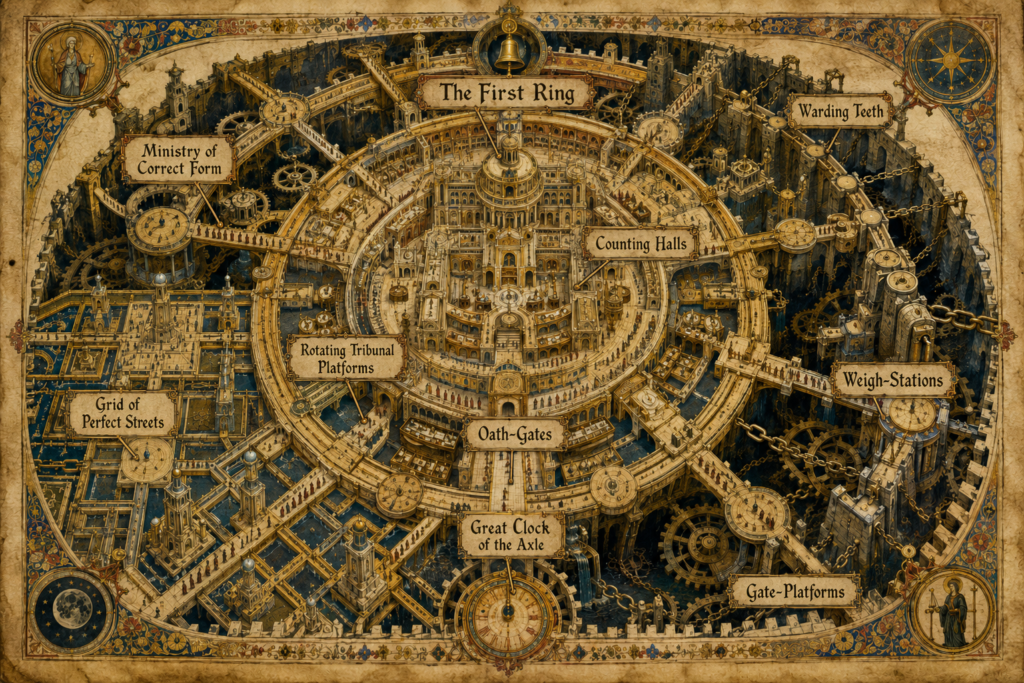
Most travellers first encounter the Great Mechanism through the First Ring. It is the plane’s arrival and intake jurisdiction: a vast system of roads, bridges, turntables, spiral ramps, weigh-stations, gate-platforms, and moving causeways. Some routes are broad enough for armies. Others are no wider than a monk’s foot.
The First Ring is not welcoming, but it is legible. Every gate has a mark. Every route has a rule. Every bridge has a condition. Travellers who stop, read, declare themselves truthfully, and obey posted procedure can survive long enough to understand where they have arrived.
The Ministry of Correct Form
At the heart of the First Ring stands the Ministry of Correct Form, a colossal bureaucratic palace of queues, counters, seal-galleries, stamping engines, brass clerk-desks, numbered windows, oath-lecterns, and doors that open only when the right form has been completed in the right order.
It is not comic bureaucracy. It is terrifying because it is correct. A traveller who fills the wrong form may not be attacked; they may simply become legally absent, unable to pass gates, claim rights, receive aid, or leave the jurisdiction.
The Ministry also protects those who know how to use it. A stamped writ can stop a guard. A recorded name can restore standing. A correctly filed petition can force a court to hear a peasant, hostage, envoy, widow, guildsman, or surrendered enemy who would otherwise be ignored by the powerful.
At the table, this is the place for identity declarations, lost status, missing forms, emergency petitions, false papers, and first procedural mistakes. Failure does not have to mean combat. It can mean being misfiled, split from the party, declared absent, delayed past a deadline, or sent to the wrong jurisdiction.
The Grid of Perfect Streets
Beyond the Ministry stretches the Grid of Perfect Streets, a district of straight avenues, square plazas, numbered towers, and re-aligning canals.
Damaged streets straighten themselves. Unauthorised shortcuts close. Processions, prisoners, envoys, witnesses, and litigants are separated by route before they understand they have been sorted.
The Grid is not the story of the plane; it is infrastructure. It sorts status, movement, and lawful separation. Witnesses are sent one way, prisoners another, envoys another, oathbreakers another, and those under protection another. A person who tries to force the wrong route may find the district itself refusing them.
At the table, the Grid is useful when the party must keep people together despite legal sorting. The challenge is not “find the road.” The challenge is proving why the party, witness, prisoner, or protected person has the standing to be processed together.
The Warding Teeth
At the breach-edges of the First Ring grind the Warding Teeth: vast gear-walls, stabilising chains, pressure-engines, and lawful barriers that resist abyssal breaches, wild magic storms, chaos incursions, and unmeasured intrusion.
They do not hate chaos. They correct it, slow it, grind it, or hold it outside the gate until it can be named.
The Warding Teeth are one of the plane’s most visible signs that law protects as well as punishes. They keep the unmeasured outside from swallowing the recorded inside. They protect travellers, courts, archives, and petitioners from chaos that would erase all standing before any case could be heard.
At the table, use the Warding Teeth when chaos threatens the plane from outside or when something unmeasured is trying to enter without name, category, witness, or status. The party may need to help classify the threat, repair a breached gear-wall, escort a petitioner through a breach alarm, or stop an enemy using chaos as cover.
The Bell-Gates
The Bell-Gates are the First Ring’s timed entrances, lifts, intake bridges, sealed doors, and turntable platforms. They answer to the Great Clock of the Axle, but they are physical structures in the First Ring: bronze arches, locked bridgehouses, rotating portcullises, bell-towers, and gate-rooms whose hinges move only at appointed hours.
A traveller may wait at a gate for hours, only to discover that the opening lasts twelve breaths at the lawful bell and no longer. Those who understand the schedule can cross without force. Those who ignore it may lose their chance without ever being attacked.
At the table, the Bell-Gates create urgency without making travel the story. The problem is the clock, the writ, the summons, or the missed standing. Characters can wait, obtain an exception, prove urgency, present a seal, or force the gate and accept the legal consequence.
Common Arrivals
Those who run, lie, jump queues, break seals, force doors, or ignore summons are marked almost immediately.
Common arrivals include brass causeways crossing gear-chasms, rotating tribunal platforms, oath-gates that demand a true name or declared purpose, counting halls where travellers are numbered before being allowed to proceed, timed gates that open only at a precise hour, and silent stations where no speech is permitted until a bell rings.
- Use at the table: Arrival, orientation, first mistakes, bureaucracy with teeth, timed gates, protective writs, anti-chaos defences, and first legal pressure.
- Tone: Clear rules, moving platforms, brass signs, vast ministries, lawful menace.
- Best encounters: Gate disputes, identity declarations, false papers, missed bells, unlawful shortcuts, chaos breach, escort duties, emergency petition.
- Failure state: The party is misfiled, delayed, separated, declared legally absent, or marked for minor correction.
The Index Vast
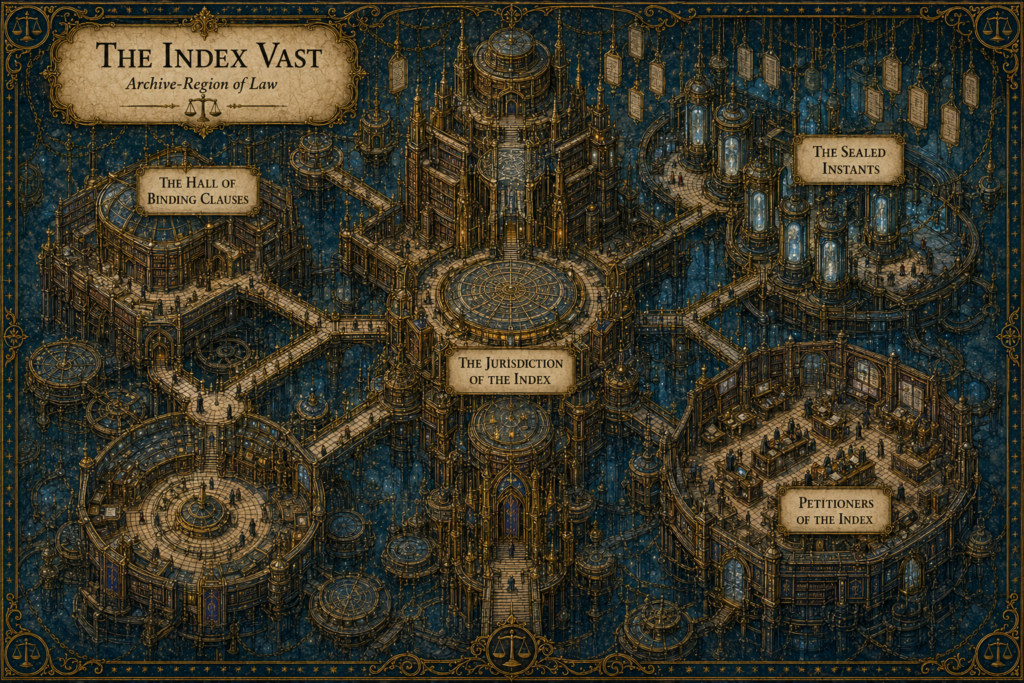
The Index Vast is an archive-region of towers, shelves, rotating stacks, suspended tablets, sealed vaults, brass scroll-racks, hour-ledgers, date-vaults, and self-writing ledgers. It records laws that have become strong enough to cast planar shadows.
Not every mortal law appears here. Petty commands, unlawful decrees, forgotten household rules, and false claims usually decay before reaching the Index. But ancient treaties, coronation oaths, river-rights, guild charters, divine vows, laws of hospitality, trial customs, boundary compacts, surrender terms, sacred prohibitions, and old contracts may all be found here in some form.
The Hall of Binding Clauses
Within the Index stands the Hall of Binding Clauses, a monumental contract-house where living parchments, brass tablets, wax seals, blood-ink clauses, devil advocates, contract-keepers, and kolyaruts test the force of bargains.
Some corridors are built from contracts so old they have become walls. Some doors are clauses. Some staircases are loopholes. Some rooms cannot be entered by anyone who has broken a term written inside them.
The Hall is dangerous because it enforces bargains, but it also protects those whom bargains were meant to shield. A surrender clause may protect a captive. A guild compact may protect a worker from false accusation. A marriage contract may preserve inheritance. A treaty may protect a creature that outsiders would otherwise call monstrous.
At the table, this is where players examine contracts, find loopholes, prove coercion, challenge false consent, or discover that a “villain” is protected by a bargain someone else swore.
The Sealed Instants
The Sealed Instants are vault-chambers where moments of legal force are preserved as brass images, frozen echoes, suspended dust, clock-face reflections, or living testimony. They record oath, murder, birth, surrender, execution, coronation, betrayal, and judgement.
A sealed instant is not a memory. It is a lawful timestamp given physical form. To steal one is not merely to hide evidence; it may move an event out of its proper sequence.
A party that recovers a sealed instant can prove who struck first, when surrender occurred, whether a sentence had expired, whether a treaty was already in force, or whether a ruler still had lawful authority at the moment they gave an order.
At the table, the Sealed Instants are evidence chambers. The pressure is custody of proof: who can read it, who can carry it, who can tamper with it, and whether the party can present it before the appeal window closes.
The Citation Vaults
The Citation Vaults are deep archive-courts where laws with current force are indexed, cited, cross-referenced, chained to precedent, and guarded by brass jurists. Shelves turn like wheels. Tablets lower from the ceiling on chains. Seals brighten when a law still has standing and darken when it has expired, been overruled, or fallen out of jurisdiction.
A law found here may still have teeth in the mortal world. A visitor who steals, alters, burns, or misfiles a citation may change nothing — or may accidentally release an old claim, revive a dead office, awaken a lawful curse, or summon an auditor.
The Citation Vaults can also save lives. The older compact that overrules a cruel sentence may be here. The treaty that protects a village may be here. The charter that limits a lord may be here. The clause that ends a punishment may be here.
At the table, this is the research dungeon. Characters are not just “looking for lore.” They are searching for the exact authority that changes what the court can do.
The Registry of Restored Names
The Registry of Restored Names is a solemn hall of brass name-plates, suspended death ledgers, erased charters, misfiled offices, disputed burials, and witness tablets waiting to be returned to the proper record.
A name erased by a tyrant, a charter hidden by a lord, a surrender term suppressed by a victorious army, or an inheritance document destroyed by rivals may survive here in brass, vellum, memory-plate, or living script.
Some petitioners in the Registry are not prisoners. They are record-keepers, bridge-scribes, oath-clerks, and witness-spirits who maintain the laws they served or failed in life. Others wait for appeal, restoration, or correction of a misfiled death, sentence, name, or office.
At the table, the Registry gives players a clear protective-law goal: restore the name, restore standing, restore testimony, or prove someone existed in law despite being erased by power.
- Use at the table: Research, ancient treaties, contracts, lost laws, sealed moments, evidence, restoration of erased claims, and dangerous records.
- Tone: Infinite archive, sacred bureaucracy, quiet dread.
- Best encounters: Missing clause, stolen charter, witness tablet, hostile record-keeper, devil advocate, altered timestamp, contract trap, restored safe-conduct.
- Failure state: The party alters, loses, awakens, or misdates a law that should have remained dormant.
The Adjudicating Wheels
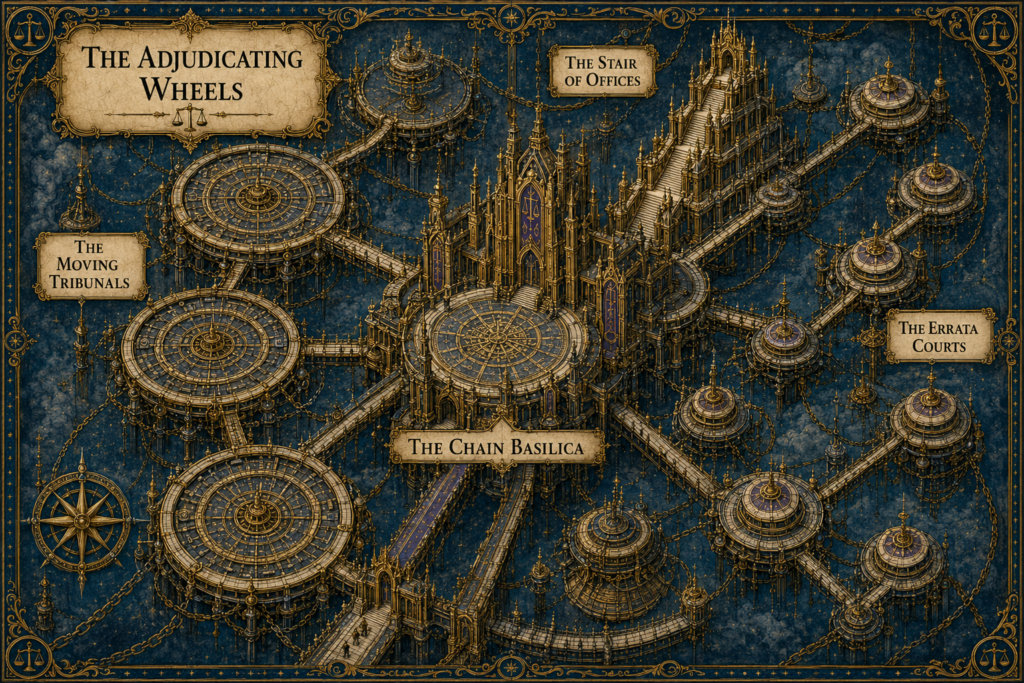
The Adjudicating Wheels are the court-region of the Great Mechanism. Each wheel is a moving tribunal, and each tribunal hears a different class of dispute.
Some courts judge oathbreaking. Some judge treason. Some judge false witness. Some judge broken surrender. Some judge contracts signed under threat. Some judge laws that contradict older laws. Some judge whether a being counts as a person under a specific custom, treaty, office, or divine compact.
The Chain Basilica
Built among the wheels is the Chain Basilica, a cathedral-like court of oath-rings, vow-chains, sworn blades, marriage cords, surrender tokens, coronation bonds, guild cords, hostage seals, and divine promise-links.
Fulfilled oaths shine. Broken oaths hang crooked. False oaths rust. Oaths sworn under duress twist around their own supports and may become evidence in a later court.
The Basilica does not only condemn oathbreakers. It can also prove that a promise was kept, a hostage was protected, a mercy was sworn, or a ruler bound themselves to limits that their heirs now deny.
At the table, the Basilica is where oaths become objects. Players can carry a broken oath-chain, repair a vow-ring, prove duress, or discover that the oath binding them was never valid.
The Stair of Offices
Rising beside the tribunals is the Stair of Offices, an immense stepped tower where lawful rank becomes architecture.
Apprentice, master, envoy, witness, petitioner, prisoner, judge, king, auditor, divine agent, and sentence-bearer each have their marked place. To climb without standing is trespass. To be forced downward under judgement is humiliation made visible.
The Stair recognises rank, but not lawlessness. A king may stand above a peasant in office, but the king still stands somewhere on the Stair. A judge may have authority to condemn, but only within the office that grants it. A war-chief may have custom, but custom has boundaries. Raw power is not a lawful step.
At the table, the Stair is used for contested authority. Who has standing to speak? Who may accuse? Who may punish? Who may appeal? A character can win here without combat by proving office, exposing false rank, or showing that authority has expired.
The Errata Courts
Orbiting the larger courts are the Errata Courts, smaller tribunals that handle misfiled law, obsolete sentences, corrupted records, invalid contracts, false testimony, wrongful personhood rulings, forged offices, and laws that contradict older binding compacts.
The Errata Courts do not forgive by sentiment. They correct by evidence, precedent, witness, measure, and standing. They are difficult to reach because the Great Mechanism does not assume error lightly.
A successful appeal here may restore a name, void a forged sentence, release a petitioner held by obsolete law, prove that a ruler exceeded office, or reopen a case everyone in the mortal world wanted buried.
At the table, the Errata Courts are the plane’s main “fix the law” location. Use them when the problem is not rebellion but correction: the wrong person, wrong law, wrong time, wrong record, wrong office, or wrong sentence.
The Courts of Due Measure
Among the Adjudicating Wheels are courts that exist not to punish, but to restrain unlawful force. These Courts of Due Measure hear cases of excessive sentence, false authority, broken sanctuary, unlawful seizure, violated safe-conduct, stolen inheritance, corrupt weights, and rulers who mistake private will for public office.
They are not merciful by sentiment. They are lawful by structure. A peasant with a valid charter may stand against a lord. A hostage protected by treaty may stand against a war-chief. A surrendered enemy may stand against a knight who killed after quarter was given. A condemned prisoner may stand if the sentence was imposed by the wrong office, at the wrong time, or under a law already overruled.
At the table, the Courts of Due Measure stop the plane becoming lawful evil. They are where law restrains tyrants, officers, judges, war-chiefs, and mobs who claim authority but exceed its limits.
The Four Open Wheels
The Four Open Wheels are the most commonly reached public tribunals of the Adjudicating Wheels. Each is a vast rotating court, open to petitioners who can prove standing.
The Wheel of Oaths hears oathbreaking, broken vows, sworn office, duress, false promises, and vow-chains.
The Wheel of Witness hears false testimony, missing evidence, altered sealed instants, erased names, and corrupted records.
The Wheel of Quarter hears surrender, hostage-right, safe-conduct, unlawful killing, false surrender, and broken protection.
The Wheel of Standing hears personhood, office, rank, custom, treaty protection, and jurisdiction.
At the table, the Four Open Wheels tell players where to go. They make court play easier to run because the party can identify the right tribunal rather than wander through abstract law.
- Use at the table: Trials, disputes, oath cases, hierarchy, appeal, sanctuary, excessive punishment, moral pressure, and hard rulings.
- Tone: Courtroom drama inside moving divine machinery.
- Best encounters: Broken surrender, unlawful killing, oath dispute, treaty interpretation, personhood case, contested office, corrupted appeal, tyrant restrained by charter.
- Failure state: The party loses standing, becomes liable, is bound by judgement, or is placed in the wrong rank.
The Foundry of Measures
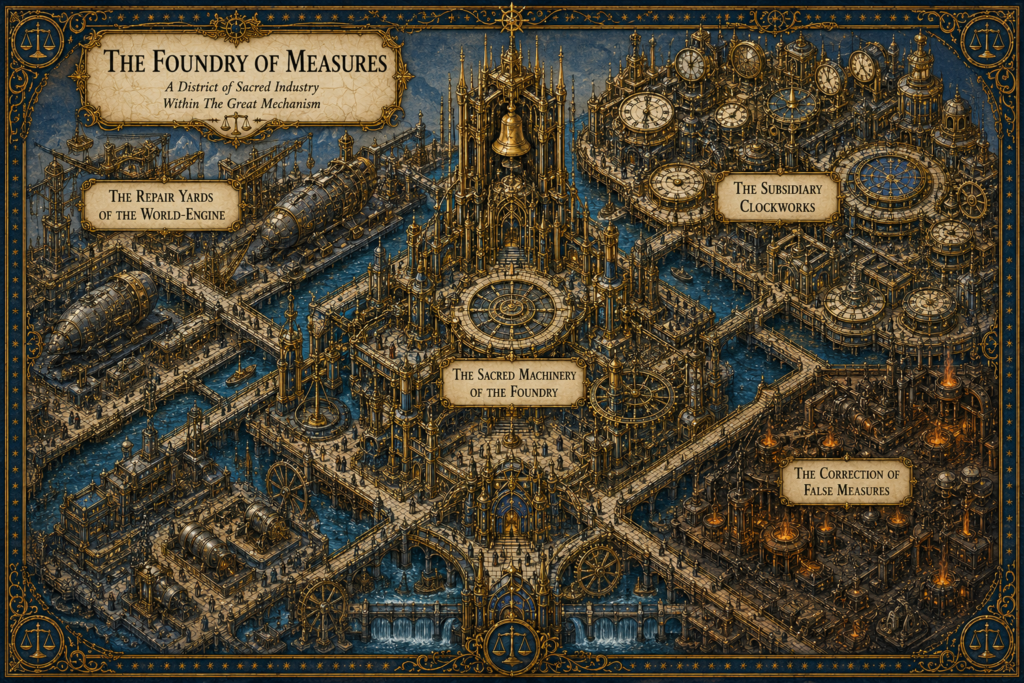
The Foundry of Measures is where standards are made, tested, and corrected. Here stand the archetypal weights, lengths, hours, bells, seals, scales, balances, coins, calendars, plumb-lines, measuring chains, boundary rods, treaty dials, prison clocks, coronation wheels, and execution mechanisms of the plane.
Mortal rulers, guilds, temple jurists, and planar powers sometimes seek access to the Foundry when their worlds fall into confusion. A kingdom whose coinage has been debased may send envoys. A city whose clocks disagree may beg for a true hour. A dwarven hold may petition for a perfect measure of stone-right. A wizard may seek the exact duration of a spell, geas, sentence, or lawful banishment.
The Repair Yards of the World-Engine
Deep within the Foundry lie the Repair Yards of the World-Engine, immense workshops where law-engines, clockwork leviathans, divine auditors, and numbered servitors maintain the infrastructure of cosmic order.
Broken planar conduits are re-cut here. Damaged calendars are recalibrated. Treaty bridges are re-riveted. False measures are melted down. Cracked seals, unstable borders, collapsed jurisdictions, and damaged oath-machines are repaired or condemned.
The Repair Yards make the plane necessary rather than merely oppressive. Without them, passages between worlds drift, ancient compacts crack, clocks lose lawful sequence, and the protections built into treaties, charters, and sanctuary laws fail along with punishments.
At the table, the Repair Yards are where characters fix a failing part of reality: a treaty bridge, broken calendar, cracked oath-machine, damaged warrant seal, or unstable jurisdiction.
The Clockwright Galleries
The Clockwright Galleries are workshops of treaty dials, prison clocks, appeal bells, calendar plates, sentence counters, coronation wheels, and lawful timepieces calibrated against the master measures of the Axle.
Not every clock in the Galleries tells ordinary time. Some count the term of a curse. Some measure the remaining force of a treaty. Some hold the age of a dead king at the instant of succession. Some preserve the exact moment a surrendered enemy was killed. Some count down to a sentence that has not yet found its prisoner.
At the table, the Clockwright Galleries create time-based problems that are not travel problems. The question is whether the clock is true, broken, falsified, or calibrated to the wrong law.
The Crucibles of False Measure
The Crucibles of False Measure are furnaces, testing pits, assay courts, map-tables, seal-vats, coin presses, and evidence galleries where counterfeit weights, lying coins, doctored maps, forged seals, broken clocks, fraudulent calendars, shortened prison terms, stolen years, and unlawful delays are brought to be melted, corrected, or used as evidence.
False measures are not minor errors here. A light weight can steal from a market for generations. A false map can erase a boundary. A broken calendar can void a ritual term. A false prison clock can hold a captive past sentence or release a condemned offender early.
At the table, the Crucibles turn objects into proof. The party may need to test a coin, melt a forged seal, prove a map was doctored, or show that a prison clock lied.
The Hall of True Instruments
The Hall of True Instruments is a sacred chamber of archetypal scales, rods, plumb-lines, coins, bells, seals, chains, astrolabes, balances, waterwheels, and measure-wheels. These are not merely tools; they are standards against which lesser instruments are judged.
The machinery of the Hall is sacred infrastructure, not industry for wealth. Its instruments exist because the multiverse needs things to remain countable, repairable, and enforceable.
At the table, the Hall is where characters seek the true measure: the real weight, real boundary, real hour, real seal, or real term. Success may solve the case. Failure may reveal that the truth is worse than the lie.
- Use at the table: Craft, standards, coinage, clocks, maps, calendars, deadlines, cosmic maintenance, and exact magical calibration.
- Tone: Industrial sacred order, sparks, bells, scales, molten brass, and the terror of the correct hour.
- Best encounters: Forged seal, false coinage, stolen measure, broken calendar, delayed judgement, damaged planar conduit, unlawful immortality, artificer bargain, honest measure restored.
- Failure state: The party leaves with a corrected but dangerous truth, or discovers that the true hour has already passed.
The Penal Ratios
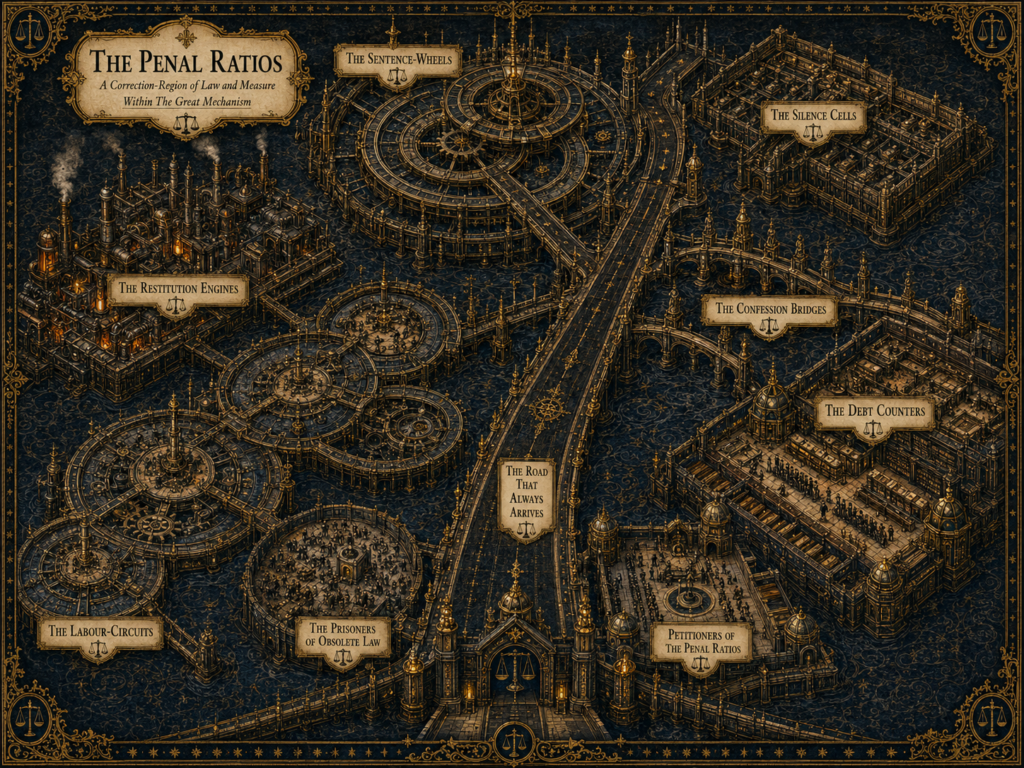
The Penal Ratios are correction-regions, not simple prisons. They contain sentence-wheels, labour-circuits, silence cells, restitution engines, compelled galleries, confession bridges, debt counters, warrant chambers, and repetitive tasks that embody lawful consequence.
The Penal Ratios are harsh, but they are not an infernal prison by another name. The infernal planes claim souls shaped by evil law: tyranny, domination, cruelty, exploitation, infernal bargain, corruption, and hierarchy used to consume others. The Penal Ratios claim something colder and narrower: unfinished law.
Unfinished Law
Death ends many mortal obligations. A prison term, fine, ordinary debt, exile, labour sentence, or corporal punishment may simply end when the condemned person dies, if that is what the governing law recognises. The Great Mechanism does not automatically continue every mortal punishment beyond the grave.
But some legal things survive death. A debt may pass to an estate, surety, bond, guarantor, family holding, guild account, hostage compact, pledged property, or sworn heir. A sentence may continue as forfeiture, dishonour, outlawed burial, attainder, posthumous judgement, curse, office-stripping, or restitution owed to the injured. An oath may bind the name, office, tomb, heir, weapon, land, or sworn company even after the oath-maker dies.
The Penal Ratios do not claim every debtor, prisoner, or condemned soul. They claim unresolved legal force: a sentence that has not lawfully ended, restitution that has not been assigned, an office that was never surrendered, testimony required before death, an oath whose form survives the body, a punishment wrongly recorded as complete, or a legal wound that still has standing.
A dead debtor whose estate is properly settled does not belong here. A prisoner who dies under a sentence that ends at death does not belong here. But a judge who dies before correcting a false sentence, a hostage killed before treaty terms are resolved, a ruler who dies before lawful abdication, or an oathbreaker whose vow explicitly binds beyond death may leave a case in the Penal Ratios.
The rule is simple: ordinary punishment may end at death; unfinished law does not always do so.
The Sentence-Wheels
The Sentence-Wheels are vast rotating machines of correction: punishment courts, labour circuits, silence chambers, confession drums, restitution counters, and term-measuring engines.
Punishment here is rarely emotional. It is measured. A betrayer may be made to carry the same message until it reaches every injured party. A false judge may be forced to hear every case they corrupted. A forger may spend centuries engraving true seals. A tyrant may be reduced to a clerk in the archive of their own decrees.
Some sentences count ordinary hours. Others count only truthful speech, completed labour, named victims, repaid restitution, lawful acknowledgement, or circuits walked without complaint. A prisoner is not held because suffering is desired. A prisoner is held because the sentence, record, oath, or surviving obligation has not reached its lawful end.
At the table, the Sentence-Wheels make punishment concrete. Characters can interrupt, appeal, complete, falsify, or expose a sentence. The danger is not suffering for its own sake; it is a correction that may be valid, obsolete, excessive, or wrongly recorded.
The Warrant Engine
The most feared instrument in the Penal Ratios is the Warrant Engine.
It is not a prison, a hunter, or a road. It is a lawful enforcement system that begins when a judgement has matured and ordinary summons has failed. A warrant may first appear as a black seal on a document, a bell heard only by the offender, a clerk’s mark on a shadow, or a line of brass script moving across a wall.
If ignored, the Warrant Engine assigns auditors, seals exits, opens tribunal access, dispatches arbiters, calls kolyaruts or maruts, and turns local machinery against evasion. It may create a bridge, corridor, gate, or passage where one is needed, but these are only instruments. The threat is not the route. The threat is enforceable judgement.
The Warrant Engine does not chase quickly. It makes avoidance less possible. Each ignored summons reduces the offender’s lawful choices until surrender, appeal, restitution, lawful combat, testimony, or judgement remains.
At the table, the Warrant Engine gives pressure without railroading. It should always leave meaningful choices: answer the summons, prove the warrant is wrong, satisfy the obligation, surrender under terms, appeal to the right court, or break the system knowingly.
The Old Sentence Vaults
The Old Sentence Vaults are sealed blocks of cells, ledgers, sentence-wheels, punishment bells, and labour-circuits holding cases under laws that may have expired, been overruled, lost standing, or become monstrous by later custom.
Not all punishment in the Penal Ratios is just by mortal standards. Some sentences are ancient, excessive, or trapped inside legal structures no living court would now defend.
Freeing a prisoner from such a place may be an act of mercy, rebellion, or catastrophic legal vandalism depending on the case. The safest path is not always escape. Sometimes it is appeal, proof that the law has expired, evidence that the sentence was fulfilled, or discovery that a higher compact has already overruled the punishment.
At the table, the Old Sentence Vaults are rescue locations with legal teeth. The question is not simply “can we free them?” but “what happens if we do?”
The Completion Yards
The Completion Yards are work courts where failed guardians, negligent watchmen, oath-bound messengers, sureties, executors, clerks, soldiers, sentries, and officials complete surviving obligations.
Not everyone here is a villain. Some accept correction because they believe the sentence is deserved. Some do not want rescue. They want completion.
At the table, the Completion Yards complicate heroic assumptions. A petitioner may refuse escape, ask the party to complete a task instead, or warn that release without fulfilment will mature the warrant rather than end it.
The Infernal Distinction
The infernal planes claim evil law. The Penal Ratios claim unfinished law.
A tyrant whose life was defined by cruelty and domination belongs to the infernal planes, but one unfinished coronation oath, broken surrender, forged charter, unlawful sentence, or surviving office may remain here as a separate matter. The Penal Ratios do not always need to own the whole soul. They may hold the sentence, the estate-claim, the office, the record, the restitution, the oath, or the unresolved legal wound.
- Use at the table: Rescue, appeal, punishment, restitution, surviving obligations, enforceable warrants, grim justice, and lawful horror.
- Tone: Repetition, sentence, labour, correction without hatred.
- Best encounters: Excessive sentence, rightful prisoner, false conviction, escaped oathbreaker, prison-machine, mature warrant, debt that refuses to end, obsolete law overturned.
- Failure state: The party frees someone who was lawfully contained, abandons someone trapped by unjust law, or causes a warrant to mature against themselves.
The Silent Axle
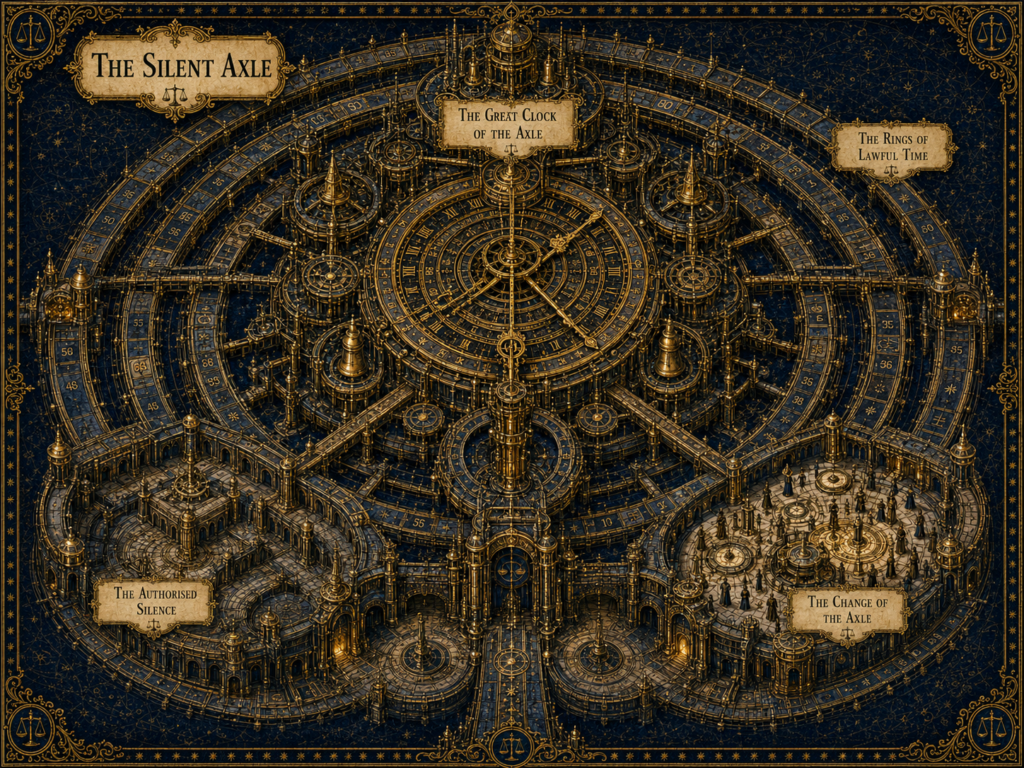
The Silent Axle is the hidden centre around which much of the plane turns. It is not easy to reach, and many scholars argue whether it is a place, a principle, a court, a godless throne, or the first law of the plane.
The Great Clock of the Axle
Set around the Axle, and in part built into it, stands the Great Clock of the Axle: a colossal clock-engine of nested brass dials, turning calendar rings, counterweighted hands, bell-chambers, and measure-wheels large enough to be mistaken for districts.
It does not govern all time everywhere, but within the Great Mechanism it measures lawful sequence, appointed hours, sentence terms, treaty deadlines, appeal limits, reigns, offices, banishments, and the opening and closing of countless gates, bridges, courts, and tribunals.
At the table, the Great Clock is the authority behind deadlines. It should matter when a treaty expires, a gate opens, an appeal ends, a sentence completes, a reign changes, or a warrant matures.
The Calendar Rings
The Calendar Rings are physical rings around the Great Clock. Some mark ordinary hours. Others measure reigns, contracts, sentence terms, appeal windows, treaty anniversaries, banishments, coronation intervals, and appointed moments of lawful force.
A traveller who understands the Calendar Rings may pass through doors that armies cannot force. A traveller who ignores them may lose standing without realising why.
At the table, the Calendar Rings are where characters can prove timing: the sentence had ended, the appeal was still open, the king’s order came too late, the treaty had already begun, or the execution happened before lawful authority existed.
The Court of Authorised Silence
The Court of Authorised Silence is a chamber near the Axle where sound itself requires standing. No voice carries unless recognised. No lie can be spoken unless the lie is part of a recognised proceeding. No weapon may be drawn except by a being with standing to enforce a judgement.
Silence here is not emptiness. It is the pause before lawful sequence resumes.
At the table, this is a no-combat pressure chamber. Players must gain permission to speak, present the correct witness, use signs, invoke office, or risk losing the chance to be heard.
The Chamber of Final Standing
The Chamber of Final Standing is a hidden axial court where those who reach the centre may be changed by the law they came to invoke.
They may become incapable of breaking an oath. They may hear every contract they sign as a bell inside the skull. They may see the hidden clause in every law. They may perceive what came first, what followed, what was delayed, what was broken, and what must now occur. They may lose the ability to forgive without process.
At the table, the Chamber of Final Standing is for high-level consequences. Winning here should matter, but it should cost something: a duty to enforce the verdict, a binding oath, a loss of easy mercy, or a permanent awareness of lawful sequence.
- Use at the table: High-level revelation, final judgement, divine law, appointed hours, and metaphysical consequence.
- Tone: Stillness at the centre of impossible motion, broken only by the measured authority of the Great Clock.
- Best encounters: No-combat trial, oath of cosmic weight, final appeal, clock-reading challenge, encounter with a supreme auditor.
- Failure state: The party wins the case but becomes bound to enforce the result, or misses the appointed hour and loses the right they came to claim.
Laws of the Plane
Law Is Terrain
The Great Mechanism does not merely contain laws. Law forms its geography. A bridge may exist only for those with permission to cross. A gate may be solid to oathbreakers and open to witnesses. A chamber may appear around someone under lawful arrest. A seal may shut a door more securely than iron.
Procedure Has Power
Correct procedure matters. Declaring a name, giving a purpose, waiting for a bell, using the proper entrance, carrying a seal openly, answering in order, and respecting silence can all provide real protection.
Improvised shortcuts are dangerous. Kicking down a door, interrupting a tribunal, stepping over a boundary chain, or refusing to identify oneself may awaken the plane’s enforcement.
Time Has Standing
Time is a recognised force in the Great Mechanism. Hours, dates, terms, delays, cycles, deadlines, anniversaries, and appointed moments can all have legal weight. A claim may fail because it was made too late. A gate may open because a bell has rung. A prisoner may be released because a sentence has reached its final counted instant. A king may lose a crown because the lawful hour of succession has passed.
This makes timekeeping dangerous. Travellers who ignore clocks, bells, calendars, rotations, and posted hours may not merely be late; they may be out of standing. Those who understand the schedule can pass through doors that armies cannot force.
Truth Is Not the Same as Justice
The Great Mechanism values record, testimony, evidence, order, and enforceable judgement. It does not automatically produce moral justice. A truthful law may be cruel. A valid treaty may be oppressive. A properly witnessed sentence may be excessive.
This is one of the plane’s central dangers: it can make cruelty look clean.
Law Protects as Well as Punishes
Law in the Great Mechanism is not only punishment, custody, and sentence. It is also protection, recognition, boundary, office, inheritance, sanctuary, safe-conduct, and appeal.
A valid charter may protect a village from its lord. A surrender term may protect an enemy from slaughter. A guild seal may protect a craftsman from false accusation. A marriage contract may protect inheritance. A hostage compact may restrain both captor and captive. A treaty may protect a creature that outsiders call monstrous. A court record may restore the name of someone erased by power.
The Great Mechanism does not automatically make the weak safe. It makes protection enforceable when protection has lawful form.
Oaths Become Visible
Oaths, vows, contracts, and sworn offices may appear as marks, chains, rings, brands, written shadows, halo-like seals, or hovering clauses. A character who has sworn many promises may find themselves visibly burdened here.
Broken oaths are heavier. They drag at the body, slow travel, attract auditors, and may open proceedings of correction.
Error Can Be Corrected
The Great Mechanism is not merciful by instinct, but it can correct error. A false record can be voided. An obsolete sentence can be challenged. A forged office can be stripped. A misfiled soul can be restored to standing. A law that contradicts an older binding compact can be narrowed or overturned.
Correction requires form. Evidence, witness, precedent, measure, standing, and lawful appeal matter more than outrage. A good cause badly presented may fail. A hard truth properly brought may make the wheels pause.
Chaos Has Friction
Creatures strongly bound to chaos find the plane exhausting. Their movements mistime. Their jokes land wrong. Their magic stutters. Their lies require effort. Their instinctive improvisations create small errors that the plane notices.
This does not make chaotic creatures helpless, but it does mean the Great Mechanism fights them constantly.
Mercy Requires Form
Mercy is possible here, but it must be written, argued, witnessed, granted, or built into the law being applied. A visitor who simply says “show mercy” may be ignored. A visitor who finds an exception, invokes an older compact, proves standing, or offers lawful restitution may succeed.
Divine Powers and Sacred Realms
No single god owns the Great Mechanism. The plane is older and colder than most divine courts, and its central law does not bend easily to personality, worship, or miracle.
Lawful deities, oath-gods, gods of justice, city-gods, craft-gods, judge-gods, timekeepers, boundary spirits, ancestral lawgivers, and divine scribes may maintain courts, embassies, workshops, or sealed archives here. These realms are usually precise, limited, and jurisdictional rather than sprawling divine kingdoms.
A god of kingship may possess a coronation court but not the whole plane. A goddess of truth may hold an evidence hall but not every judgement. A smith-god may maintain a measuring foundry but not command the Silent Axle. A death-god may send clerks to confirm rightful execution, but the Great Mechanism does not become a death-plane for them.
Devils are sometimes present under strict permit. They come as contract specialists, advocates, debt-holders, witnesses, and claimants. They are dangerous because they understand procedure. They do not rule the plane, and they can be seized, indexed, or punished if they violate the law of the jurisdiction that permits them.
Powers of mercy and protection find the plane useful but uncomfortable. They come to argue for lawful mercy, expose false judgement, defend sanctuary, restore erased names, protect surrendered captives, release petitioners trapped by obsolete law, and prove that authority has exceeded its bounds. They do not always win, but when they do, the verdict has teeth.
Relations with Other Powers
The infernal planes respect the Great Mechanism when contracts are valid, but constantly look for leverage inside its procedures. Devils prefer recognised standing, enforceable clauses, permitted advocacy, and lawful debt. They are dangerous here because they know how to make cruelty look properly filed.
The Abyss hates the Great Mechanism. Abyssal breaches, chaos storms, and appetite without boundary are exactly the kind of unmeasured force the Warding Teeth exist to resist. Where the Abyss breaks gates by violence, the Great Mechanism closes gates by rule.
Merciful and protective planes use the Great Mechanism cautiously. They bring appeals, plead for lawful mercy, expose false judgement, and try to rescue petitioners trapped by valid but obsolete law. They also fear the plane’s coldness, because a correct sentence is not always a good one.
Mortal kingdoms, guilds, temples, armies, courts, and families all cast small shadows into the plane when they swear oaths, draw boundaries, sign treaties, issue sentences, recognise offices, accept surrenders, or keep calendars. Most never know the Great Mechanism has noticed them until something goes wrong.
Inhabitants
The inhabitants of the Great Mechanism are defined by function, rank, jurisdiction, and recognised purpose. The plane does not sort beings by beauty, bloodline, or sentiment. It asks what they are for, what office they hold, what law recognises them, and what duty binds them.
Inevitables: Inevitables are among the plane’s most feared native powers. They are not ordinary constructs and not simple guardians. Each inevitable embodies a class of cosmic enforcement: broken oaths, violated contracts, unlawful escape from death, false judgement, failed duty, or disruption of the order that keeps worlds from collapsing into exception and appetite. They do not act out of anger. They act because a case has ripened into consequence.
Arbiters: Arbiters are lesser inevitables used as messengers, witnesses, assistants, and minor adjudicators. They appear in counting halls, tribunal platforms, archive courts, and oath-gates. An arbiter may seem small compared with greater enforcers, but its testimony can condemn a king if the record supports it.
Keledons: Keledons serve as formal speakers, heralds, announcement-bearers, singers of edict, and living instruments of lawful declaration. In the Great Mechanism, a keledon’s voice may open a court, seal a verdict, repeat a binding clause, or carry a judgement across impossible distance. They are especially common in the First Ring, the Adjudicating Wheels, and processional courts.
Kolyaruts: Kolyaruts enforce bargains, contracts, oaths, and sworn agreements. They pursue those who break solemn terms, betray lawful bargains, violate surrender clauses, forge consent, or twist a contract while pretending obedience. A kolyarut is not interested in whether the guilty party feels remorse. It wants fulfilment, restitution, lawful loophole, appeal, or sentence.
Maruts: Maruts are the heavy enforcers of inevitability, most often associated with those who cheat death, unlawfully extend life, violate mortal limits, or flee a cosmic sentence that has already been recognised. A marut does not stalk like an assassin. It arrives like a verdict. Even in the Great Mechanism, other inhabitants make way when one begins to walk.
Law-Engines and Numbered Servitors: Law-engines are native machine-spirits that maintain courts, seals, locks, bridges, measures, warrants, and mechanisms of correction. Some are no larger than insects. Others are fortress-sized intelligences with hundreds of limbs, bells, and writing arms.
Numbered servitors are orderly construct-spirits arranged in ranks, sequences, and offices. They deliver notices, repair gears, escort petitioners, witness proceedings, enforce local silence, and carry judgements between regions.
Clockwork Creatures: Clockwork servants, soldiers, spies, steeds, mages, goliaths, dragons, and leviathans are the plane’s practical machinery given creature-form. Some are native. Others are built by lawful artificers, divine courts, oath-bound guilds, or ancient jurisdictions inside the Foundry of Measures.
A clockwork spy may follow a suspected perjurer for years. A clockwork soldier may guard a sealed bridge until the clause that created it expires. A clockwork dragon may coil around a treaty-vault, not because it loves treasure, but because the treaty inside has not yet lost force.
Brass Jurists: Brass jurists are court-beings who interpret law. They may appear as masked advocates, many-armed scribes, robed machines, faceless magistrates, or rotating columns of tablets. Some are wise. Some are narrow. Some have not changed their legal reasoning in ten thousand years.
Oathbound Petitioners: Oathbound petitioners are souls whose afterlives are shaped by vow, office, sentence, protection, or contract. Some are peaceful clerks, bridge-keepers, jurors, bell-ringers, recorders, seal-bearers, and route-guides. Others labour under correction until a surviving obligation is satisfied. Some wait for appeal. Some serve because completion matters more to them than release.
Permitted Devils: Permitted devils appear as advocates, contract specialists, debt-holders, witnesses, and claimants. They are dangerous because they understand procedure. They do not rule the plane, and they can be seized or punished if they violate the law of the jurisdiction that permits them.
Mortal Artificer-Sages: Mortal artificer-sages visit in search of perfect measures, lawful engines, calendrical truths, or machines that can make kingdoms more orderly. They often leave with more than they intended.
Personhood and Law
The Great Mechanism does not use one universal mortal definition of personhood, legality, punishment, or fairness. It asks colder questions: what status does the relevant law recognise, what jurisdiction applies, what custom has standing, what punishment is authorised, what office has authority, and whether any higher compact overrules the local rule?
Status matters here, but it does not create lawlessness. A king, slave, outlaw, hostage, prisoner, knight, envoy, guild-master, or condemned criminal may stand under different laws, duties, protections, and punishments, but none stand outside law. The Great Mechanism does not recognise “the powerful may do as they wish” as law unless that power has valid form, lawful jurisdiction, and recognised limits.
A human knight, hobgoblin envoy, dwarf guild-master, elf oath-singer, orc hostage, awakened beast, bound spirit, talking idol, river-guardian, intelligent construct, or intelligent undead may all be treated differently depending on treaty, office, custom, jurisdiction, surrender, sentence, and standing.
This makes the plane dangerous for simple assumptions. A killing that looks monstrous in one land may be lawful in another. A duel that seems unfair to outsiders may be valid under orc custom if challenge, witness, status, weapon, and submission rites were properly observed. A fair duel fought openly in a human city where duelling is forbidden may still be unlawful killing, regardless of courage, consent, or honour.
The Great Mechanism does not ask first whether an act felt fair. It asks what law had force, whether the participants had standing, whether the custom was recognised, whether the place had authority, whether the proper forms were followed, whether the punishment matched the recognised offence, and whether any superior treaty, office, oath, or divine compact overruled the local rule.
A traveller who kills a creature here cannot rely on the excuse that it looked monstrous, dishonourable, weak, guilty, dangerous, low-born, foreign, enslaved, outlawed, or politically inconvenient. The court will ask whether the being had standing, whether it was under protection, whether it had surrendered, whether it bore a seal, whether it was acting under office, whether there was immediate threat, whether local custom allowed the act, and whether the killer had authority.
Mindless hazards, vermin, hostile automata, and unpersoned dangers may be cleared with little consequence. But a being recognised by law, oath, custom, treaty, surrender, sentence, or office can trigger serious judgement if harmed unlawfully.
Status, Rank, and Office
The Great Mechanism recognises status, but it does not treat status as an escape from consequence. Rank changes duties, procedures, penalties, and remedies. It does not erase accountability.
A noble may have the right to trial by peers, ransom, formal accusation, or execution by a particular method. A commoner may fall under a town court, guild court, manor court, military court, or customary penalty. An envoy may be protected by safe-conduct. A hostage may be protected by treaty. A slave may be treated as property under local law, but still protected by office, compact, custom, owner-liability, temple law, or higher authority. An outlaw may lose certain protections, but not every act against them is automatically lawful everywhere.
The court asks whether the status was real, whether it applied at the time, whether the person claiming authority had standing, and whether the action stayed within the limits of that law. A lord who punishes within lawful office may stand. A lord who invents a charge, exceeds sentence, ignores a higher compact, or uses office as private appetite may draw judgement as surely as a peasant murderer.
There is no simple two-tier law here. There are many laws, many jurisdictions, and many recognised statuses — but each must have form, boundary, witness, and consequence.
Power Is Not Law by Itself
The Great Mechanism recognises rank, office, custom, and jurisdiction, but it does not recognise raw power as lawful authority. A ruler, war-chief, judge, priest, guild-master, or noble may have powers that others do not, but those powers must have recognised form and limits.
A king who sentences within lawful office may stand. A king who uses office as private appetite may be judged. A war-chief who acts under recognised custom may stand. A war-chief who breaks treaty, hostage-right, or surrender term may be judged. A judge who condemns under valid law may stand. A judge who sells verdicts, invents charges, or ignores binding appeal may be judged.
Status changes what law applies. It does not place anyone outside law.
Custody, Prison, and Punishment
The Great Mechanism does not assume modern ideas of prison, trial, or punishment. In the mortal world of the campaign, gaols, dungeons, castle cells, town lockups, hostage-keeping, ransom, surety, fines, public penance, exile, outlawry, forced labour, corporal punishment, and capital punishment may all exist as recognised legal tools depending on place, rank, crime, custom, and authority.
Prison is often not a single category. A captive may be a lawful prisoner, a hostage, a surrendered enemy, a debtor, a condemned criminal, a slave under local law, an outlaw, a monster held for judgement, a person awaiting ransom, or a protected witness. Each status carries different protections and different dangers.
Capital and corporal punishments can be lawful where a recognised authority imposes them under valid custom, sentence, or statute. A hanging, beheading, mutilation, branding, flogging, ordeal, forced labour, or public punishment may be lawful in one jurisdiction and murder, cruelty, corruption, or unlawful excess in another.
The Great Mechanism does not reject harsh punishment simply because it is harsh. It asks whether the punishment was authorised, witnessed, proportionate under the relevant law, applied to the correct status, and carried out by the proper office at the proper time. It also asks whether the sentence was corrupted, excessive beyond its own law, imposed by a false authority, or forbidden by a higher compact.
This makes punishment dangerous ground. A lord who executes a thief under local law may have standing. A mob that kills the same thief without authority may not. A war-chief who mutilates a captive under recognised custom may be protected by that custom unless a treaty, surrender term, hostage compact, or higher law forbids it. A magistrate who uses a lawful punishment against the wrong person, wrong status, wrong office, wrong time, or wrong sentence may draw the attention of the Adjudicating Wheels.
Surrender and False Surrender
Surrender is powerful here, but it is not a trick that protects treachery. A creature that clearly submits under a valid sign, phrase, treaty-form, battlefield custom, or official command may become protected. Killing such a captive can draw immediate attention from the plane, even if that creature would be treated as a monster elsewhere.
But surrender must keep its form. A creature that surrenders and then attacks, escapes under false parole, harms captors, breaks hostage terms, or uses surrender to lure enemies into danger may lose that protection and create a new offence. The Great Mechanism may treat the later attack as false surrender, broken quarter, treachery under custody, or oathless violence, depending on the law and custom that applied.
This matters especially with chaotic creatures and chaotic cultures. Some beings may surrender sincerely in one moment and attack in the next because fear, rage, hunger, instinct, or opportunism overrules form. The court does not assume that every surrender remains valid forever. It asks whether the surrender was recognised, whether the creature understood it, whether protection was granted, whether protection was broken, and whether the defenders acted within lawful necessity.
A party that kills a surrendered foe for convenience may face judgement. A party that restrains a surrendered foe may be protected. A party that fights back after false surrender, renewed attack, or hostage-breach may have a lawful defence, provided their response does not exceed the threat or violate the governing custom.
Where a custom does not recognise surrender in the same way, the Great Mechanism may still ask whether a superior law applies. A warband may claim that no captive-right exists under its custom. A treaty may say otherwise. A battlefield office may say otherwise. A divine compact may say otherwise. The judgement depends on standing, jurisdiction, witness, and breach.
Undead and Special Legal Status
Undead are not persons by default. However, an undead witness, oath-wight, revenant claimant, legally bound ancestor, executed criminal under sentence, corpse animated as evidence, or dead ruler preserved for legal testimony may have specific lawful status.
Destroying such a being without authority may count as tampering with testimony, violating sentence, obstructing judgement, unlawfully ending a recognised legal function, or interfering with a punishment that has not yet completed its term.
The danger of the Great Mechanism is not that it makes everyone equal in the same way. It is that it remembers which law applied, who had standing, what office had authority, what punishment was authorised, whether the form was kept, and who broke it.
Travel and Arrival
Reaching the Great Mechanism usually requires a lawful route, a recognised summons, a timed gate, or a machine built according to impossible measures. Accidental arrival is rare but possible after powerful oaths, broken contracts, botched planar travel, cursed legal proceedings, divine summons, or contact with a mechanism that briefly aligns with the plane.
Common entrances include courtroom doors opened at the moment of final judgement, boundary stones marked with ancient lawful signs, guild vaults containing perfect measures, execution clocks that strike thirteen times, bridges built under treaty between enemies, contracts signed in blood, silver, and true name, clock towers struck by lightning during a lawful coronation, and labyrinthine machines whose gears briefly align with the outer plane.
Arrival is usually orderly. Travellers appear on a platform, bridge, dock, court-step, receiving chamber, gatehouse, or waiting hall. They are rarely attacked immediately unless they arrive unlawfully, concealed, or already under sentence.
The first danger is often not combat. It is declaration. The plane may require names, offices, purposes, allegiances, sworn obligations, and legal status. A character who lies at this stage may survive, but the lie becomes part of the record.
Leaving the plane is easy only when the exit condition is clear. Some portals open hourly. Some require a stamped travel writ. Some require completion of testimony. Some open only after a surviving obligation is acknowledged. Some refuse oathbreakers entirely.
Planar Effects
Measured Motion
Distances in the Great Mechanism are exact but not always intuitive. A bridge may be one mile long for everyone, while the gear-field beneath it rotates through several jurisdictions during the crossing. A person who leaves the marked way may discover that the surrounding machinery has moved their destination out of reach.
Navigation based on instinct or wilderness sense is less useful than maps, schedules, posted signs, calculation, and observation.
Lawful Time
Time in the Great Mechanism is precise, but not always comfortable. Clocks agree within a jurisdiction, bells ring at exact intervals, and official hours carry real force. A traveller may feel time less as weather and more as pressure: appointments approaching, sentences counting down, terms maturing, and old delays becoming visible.
Some regions run on different lawful cycles. A tribunal may pause the surrounding hour until testimony is complete. A prison-wheel may count sentence-time only while the guilty party speaks truth. A gate may open once per century but remain open for exactly twelve breaths. These effects are not random distortions. They are schedules.
The Weight of Oaths
Sworn promises gain pressure here. A character who has knowingly broken a serious oath may feel physically heavier, suffer recurring bell-tones, cast a marked shadow, or attract minor auditors. Characters who fulfil lawful obligations may find some gates easier and some officials quicker to recognise their standing.
Indexed Speech
Formal speech carries more power than casual speech. A sworn statement, witnessed declaration, plea, verdict, confession, or properly phrased challenge may affect reality. Idle remarks usually do not.
This can be used well or badly. Characters who know the right formula can claim rights. Characters who speak carelessly in a tribunal may bind themselves by accident.
Lawful Magic Is Stable
Spells and effects based on binding, warding, truth, repair, measurement, contracts, timekeeping, banishment, abjuration, glyphs, and summons tend to behave cleanly here.
Magic based on wild chance, uncontrolled transformation, raw chaos, emotional frenzy, or reality-warping improvisation may become unstable, delayed, weakened, or redirected into a lawful form.
Planar Weather
The Great Mechanism has weather, but it behaves like procedure.
Bell-storms roll across the sky when thousands of distant judgements ring at once.
Gear eclipses occur when immense wheels pass before the lawful light.
Audit fog gathers around disputed records, revealing seals, debts, hidden standing, missing names, and old obligations.
Clock-silence falls when all visible motion pauses before the next lawful instant.
Brass rain falls during major recalibrations, each harmless droplet briefly marked with a number before it melts into the floor, bridge, or court-step.
Correction Attracts Correction
Once the plane begins correcting a traveller, further violations become easier to detect. A minor trespass may lead to warning marks. Ignoring the marks may lead to summons. Ignoring summons may lead to a mature warrant. Attacking the enforcer may create a larger case.
Mechanics Tabs
The rules below are mechanics compatible for different game editions.
The Great Mechanism 5.5e
The Great Mechanism Pathfinder 1e / 3.5e
The Great Mechanism 5.5e-Compatible Rules
Planar Trait: Absolute Law
The Great Mechanism is a Lawful Neutral Outer Plane. It does not automatically punish alignment, but it reacts strongly to broken procedure, oathbreaking, unlawful violence, forged authority, missed appointed hours, false surrender, and chaotic magic.
When a creature knowingly violates a posted or clearly declared planar law, the DM may assign one Infraction Mark.
Common causes include lying during formal declaration, ignoring a lawful summons, crossing a sealed boundary, attacking a protected petitioner, witness, envoy, or surrendered creature, forging a seal or writ, interrupting a tribunal after warning, escaping lawful custody, missing a declared appointed hour, using false surrender to gain advantage, or using magic to alter evidence, memory, testimony, timekeeping, or official records.
Infraction Marks are not ordinary conditions. They are planar notices.
- 1 Mark: Minor auditors can identify the creature. The creature has disadvantage on Charisma checks made to deceive native officials.
- 2 Marks: Gates, platforms, lifts, clerks, and officials delay the creature. Once per hour, the DM may impose a lawful complication.
- 3 Marks: An inevitable, inevitability-spirit, auditor, or enforcement party is assigned to the case.
- 4 Marks: The creature is under active planar warrant. Native law-engines may attempt arrest, containment, forced appeal, or forced removal.
- 5 Marks: The creature is treated as a major violator. The plane itself may close exits, redirect mechanisms, and call a tribunal.
A mark can be removed by lawful restitution, successful appeal, completion of assigned correction, formal pardon, recognised surrender, or leaving the plane through an authorised exit. Marks should not replace story judgement; they are a pressure tool.
Planar Trait: Ordered Terrain
While travelling through marked streets, bridges, platforms, canals, lifts, or gear-paths, creatures have advantage on checks made to follow posted directions, read schedules, or navigate by visible signs.
Creatures that leave marked routes must succeed on a DC 15 Wisdom (Survival), Intelligence (Investigation), or tool check using cartographer’s tools, navigator’s tools, or tinker’s tools. On a failure, they lose 1d4 hours, arrive at the wrong jurisdiction, become misfiled, or trigger a minor procedural encounter.
Planar Trait: The Appointed Hour
Some events in the Great Mechanism occur only at a lawful time: a bell, rotation, sentence marker, court hour, treaty anniversary, or posted interval.
When characters follow a correct schedule, arrive at an appointed hour, or invoke a valid deadline, they may gain advantage on one relevant check to pass a gate, present a claim, avoid delay, or resist unlawful obstruction.
When characters knowingly miss, ignore, falsify, or magically tamper with an appointed hour, the DM may impose one of the following consequences: the party loses standing in the current jurisdiction, a gate refuses passage until the next lawful interval, a relevant claim is delayed or challenged, the offending creature gains 1 Infraction Mark, or an arbiter, clockwork servant, or inevitable records the violation.
This rule works best when players have been clearly warned of the time limit.
Planar Trait: Formal Speech
In courts, archives, oath-gates, and tribunal platforms, formal declarations matter.
A creature that makes a sworn statement while knowingly lying must succeed on a Charisma saving throw or gain 1 Infraction Mark. The DC is usually 15, or 18 in major tribunals.
A creature that states a true claim using proper legal form may gain advantage on one relevant Charisma, Intelligence, or Wisdom check made before that court or official.
Planar Trait: Lawful Appeal
When characters attempt to correct a misfiled law, obsolete sentence, false record, invalid contract, excessive punishment, broken sanctuary, or wrongful judgement, the DM may run a lawful appeal as a group challenge.
Useful checks might include Intelligence (Investigation), Wisdom (Insight), Charisma (Persuasion), Intelligence (History), tool checks with calligrapher’s supplies or forgery kit, or relevant magic used to reveal truth without altering the record.
Success may remove an Infraction Mark, restore standing, reopen a gate, suspend a sentence, protect a petitioner, release a captive, or send the case to the Errata Courts. Failure may narrow the appeal, delay it until the next lawful hour, or add a complication rather than simply ending the case.
Planar Trait: Lawful Protection
When a creature has a valid writ, surrender term, safe-conduct, sanctuary seal, hostage compact, charter right, or recognised office, the DM may allow that protection to block or complicate hostile action.
A creature that knowingly violates a recognised protection may gain 1 Infraction Mark. If the protection was forged, expired, or broken by false surrender, the protection may fail and the offender may gain standing to respond.
Planar Trait: Lawful Magic
Spells that create wards, bindings, glyphs, zones of truth, protective circles, contracts, repairs, banishments, or orderly barriers are unusually stable here. At the DM’s discretion, a caster who uses such a spell in a lawful proceeding, defence, repair, or properly authorised act may gain advantage on one spellcasting ability check related to maintaining or applying the spell.
Planar Hazard: Chaotic Interference
When a creature casts a spell that relies on random transformation, uncontrolled chaos, wild magic, emotional frenzy, or reality-warping improvisation, the DM may call for a spellcasting ability check.
DC: 10 + the spell’s level.
On a failure, the spell is delayed until the start of the caster’s next turn, adjusted to the nearest lawful pattern, or noticed by a minor auditor. If the spell violates a local rule, the caster may also gain 1 Infraction Mark.
Use this sparingly. The aim is to make the plane feel lawful, not to shut down a player’s character.
Planar Hazard: Gear Shear
Gear-fields, rotating bridges, and moving causeways can crush careless travellers.
A creature caught between moving mechanisms must make a Dexterity saving throw.
- DC 15: ordinary gear-path or moving platform.
- DC 18: heavy industrial gear-field.
- DC 21: major axial engine or battle-damaged mechanism.
On a failure, the creature takes damage based on the hazard’s severity.
- Minor: 2d10 bludgeoning damage and knocked prone.
- Serious: 6d10 bludgeoning damage and restrained until freed.
- Extreme: 12d10 bludgeoning damage, restrained, and the mechanism continues moving.
A restrained creature can escape with a successful Strength (Athletics) or Dexterity (Acrobatics) check against the hazard DC. Another creature can free them with a successful Strength (Athletics), Dexterity check using thieves’ tools, or Intelligence check using tinker’s tools.
Planar Boon: Writ of Passage
A party that wins a lawful ruling, fulfils a contract, protects a recognised captive, restores a damaged record, repairs a damaged measure, or completes a tribunal task may receive a Writ of Passage.
While carrying a valid writ, the party gains advantage on checks made to pass through ordinary gates in the issuing jurisdiction, advantage on Charisma checks made to request directions from lawful natives, and one automatic success on a minor procedural obstacle, after which the writ is stamped, narrowed, or consumed.
A writ is valid only within its stated jurisdiction.
Planar Curse: Bound by Clause
A creature that signs, swears, or accepts a clause without understanding it may become bound.
Until the clause is fulfilled, appealed, or lawfully broken, the creature suffers one of the following effects: it cannot willingly speak a direct lie about the contract, it has disadvantage on checks made to leave the relevant jurisdiction, it hears a bell whenever it knowingly approaches violation, or it gains 1 Infraction Mark if it violates the clause.
Remove Curse can suppress this effect for 24 hours, but it does not erase the lawful obligation. Greater magic, formal appeal, or fulfilment is required to end it cleanly.
Planar Hazard: The Mature Warrant
When a creature has three or more Infraction Marks, has fled a mature judgement, has broken a major contract, or has ignored repeated lawful summons, the DM may introduce a Mature Warrant.
The warrant may manifest as a black-brass seal, a bell only the offender hears, a marked shadow, a locked gate, a tribunal summons, a sealed exit, an assigned arbiter, a closing mechanism, or an inevitable’s approach. In some regions it may create a corridor, bridge, or passage, but these are only instruments of enforcement. The threat is not the route. The threat is judgement with standing.
A creature under a Mature Warrant can delay or resolve it through lawful appeal, restitution, fulfilment, surrender, proof of mistaken identity, proof that the sentence expired, or successful challenge before the proper court. The Mature Warrant should not be used as unavoidable punishment unless the campaign has made the offence clear and the target has knowingly refused lawful remedy.
The Great Mechanism Pathfinder 1e / 3.5e-Compatible Rules
Planar Traits
Alignment Trait: Strongly lawful-aligned.
Gravity: Normal on streets, bridges, platforms, courts, and inhabited regions; directional or objective gravity may apply on gear-fields and axial engines.
Time: Normal by default, but certain courts, archives, sentence-regions, and timed gates operate under fixed lawful cycles.
Shape and Size: Infinite or effectively infinite. Individual regions are finite but move in vast repeating cycles.
Magic Trait: Lawful, abjuration, binding, glyph, contract, repair, truth, and timekeeping-related magic is stable. Chaotic magic is impeded in formal jurisdictions.
Lawful-Aligned Plane
Chaotic creatures take a –2 circumstance penalty on Charisma-based checks made against native officials, auditors, tribunal entities, and law-engines unless they possess a valid writ, recognised standing, or lawful office.
Strongly chaotic outsiders or creatures with a chaos subtype may also take a –1 penalty on attack rolls and saving throws while inside major court-regions, correction-regions, or the Silent Axle. Do not apply this penalty in every wilderness gear-field unless the campaign wants a harsher plane.
Infraction Marks
When a creature knowingly violates a local planar law, the GM may assign 1 Infraction Mark.
1 Mark: Native officials can identify the offender; –2 penalty on Bluff checks against them.
2 Marks: The offender takes a –2 penalty on checks to navigate gates, lifts, court access, and jurisdictional boundaries.
3 Marks: A lawful enforcement encounter is triggered when dramatically appropriate.
4 Marks: The offender is under planar warrant; portals may require successful checks, writs, or hearings.
5 Marks: The offender becomes a major violator; a tribunal, powerful auditor, inevitable, or sentence-engine takes notice.
Infraction Marks may be removed through restitution, judgement, fulfilment of sentence, lawful pardon, recognised surrender, or authorised departure.
Ordered Terrain
Following marked streets, posted schedules, and lawful routes grants a +2 circumstance bonus on Knowledge (planes), Survival, Linguistics, Profession (barrister), Profession (scribe), Profession (engineer), or relevant Craft checks used to navigate the plane.
Leaving marked routes requires a DC 20 Knowledge (planes), Survival, or relevant Profession check. Failure causes delay, wrong arrival, minor damage from moving terrain, misfiling, or a procedural encounter.
The Appointed Hour
Some gates, courts, contracts, prison-wheels, and treaty passages operate only at fixed lawful intervals. Characters who arrive at the correct time, present a claim before expiry, or act within a valid term gain a +2 circumstance bonus on relevant Diplomacy, Knowledge, Profession, Linguistics, Use Magic Device, or caster level checks.
Characters who knowingly miss, falsify, or magically tamper with an appointed hour may lose standing, suffer a –2 penalty on checks in that jurisdiction, gain 1 Infraction Mark, or trigger a lawful enforcement encounter at the GM’s discretion.
Formal Speech
In a tribunal, archive, oath-gate, or court-region, a knowingly false sworn statement requires a Will save.
DC: 15 in minor jurisdictions, 20 in major courts, 25 at the Silent Axle or before high auditors.
On a failed save, the creature gains 1 Infraction Mark and may suffer a visible sign of perjury, such as a written shadow, ringing voice, blackened seal, or brass brand.
A properly phrased true claim may grant a +2 circumstance bonus on Diplomacy, Knowledge, Linguistics, or Profession checks relevant to the proceeding.
Lawful Appeal
When characters attempt to correct a misfiled law, obsolete sentence, false record, invalid contract, excessive punishment, broken sanctuary, or wrongful judgement, the GM may run a lawful appeal as a skill challenge.
Useful checks may include Knowledge (planes), Knowledge (history), Diplomacy, Sense Motive, Linguistics, Profession (barrister), Profession (scribe), or appropriate Craft checks.
Success may remove an Infraction Mark, restore standing, reopen access, suspend a sentence, protect a petitioner, release a captive, or send the case to the Errata Courts. Failure may delay the appeal, narrow the claim, impose a –2 penalty on future checks in that jurisdiction, or trigger a lawful complication.
Lawful Protection
A valid writ, surrender term, safe-conduct, sanctuary seal, hostage compact, charter right, or recognised office may grant a +4 circumstance bonus on checks made to resist unlawful seizure, prove standing, request official protection, or challenge hostile action.
Knowingly violating such protection may assign 1 Infraction Mark. If the protection was forged, expired, or broken by false surrender, the protection may fail.
Impeded Chaotic Magic
Spells with the chaotic descriptor are impeded in formal jurisdictions. To cast such a spell, the caster must succeed on a caster level check.
DC: 15 + the spell level.
On a failure, the spell is lost. In less severe regions, the GM may instead delay the spell by 1 round or cause an auditor to notice.
Wild magic, uncontrolled transformation, and reality-warping effects may also require a caster level check at the GM’s discretion.
Gear Shear Hazard
Moving gear-fields, crushing axles, rotating courts, and industrial causeways function as mechanical hazards.
Minor Gear Shear: CR 3; Reflex DC 15; 2d6 bludgeoning damage; knocked prone on failure.
Serious Gear Shear: CR 8; Reflex DC 20; 6d6 bludgeoning damage; pinned or entangled on failure.
Axial Gear Shear: CR 14; Reflex DC 25; 12d6 bludgeoning damage; pinned, crushed, or carried into another hazard on failure.
A pinned creature can escape with Escape Artist, Strength, Disable Device, or appropriate Craft checks against the same DC.
Writ of Passage
A valid writ grants a +4 circumstance bonus on Diplomacy checks with native officials in the issuing jurisdiction and a +4 bonus on checks made to pass ordinary gates, prove standing, or request directions.
A writ may be expended, stamped, narrowed, challenged, or revoked if misused.
Bound by Clause
A creature that signs or swears a planar clause may be affected as though by a lawful geas, lesser geas, mark of justice, or bestow curse effect, depending on the clause’s strength.
Remove curse or break enchantment may suppress the immediate magical pressure, but does not erase the legal force of the obligation unless the spell is paired with appeal, restitution, loophole, or fulfilment.
The Mature Warrant
When a creature has three or more Infraction Marks, flees a mature judgement, breaks a major contract, or ignores repeated lawful summons, the GM may introduce a Mature Warrant as a planar pursuit hazard.
The warrant may appear as a black-brass seal, a bell only the offender hears, a marked shadow, a locked gate, a tribunal summons, a sealed exit, an assigned arbiter, or an inevitable’s approach. It increases the chance of lawful enforcement encounters and may impose a –2 penalty on checks made to hide from inevitables or planar auditors.
The warrant can be delayed or resolved through lawful appeal, restitution, surrender, fulfilment, proof of mistaken identity, proof that the sentence expired, or successful challenge before the proper court.
Running the Plane
The Great Mechanism should feel fair before it feels dangerous. It should usually tell the characters what the rule is. The drama comes from what the rule costs.
The plane should never feel like paperwork alone. Its bureaucracy is only one face of a wider order: clocks that decide standing, seals that protect the vulnerable, chains that remember oaths, foundries that repair cosmic measures, courts that rotate toward judgement, protections that bind the powerful, and inevitables that arrive when consequence has matured.
Roads, routes, bridges, and causeways are infrastructure unless the adventure is specifically about travel. Do not make the road the villain. The pressure of this plane should come from judgement, standing, clocks, records, oaths, warrants, measures, appeals, protected writs, violated charters, sentence-wheels, oath-chains, assigned inevitables, and the Great Clock striking the appointed hour.
Do not run the plane as random bureaucracy for comedy unless the campaign deliberately needs relief. The Great Mechanism is not funny paperwork. It is cosmic procedure with teeth.
The Great Mechanism is strongest when law and morality do not perfectly align. Good characters should not be able to dismiss it as evil. Chaotic characters should not be able to dismiss it as stupid. Lawful characters should not be allowed to assume it is always right.
Do not let the plane become lawful evil by accident. It should punish oathbreakers, false witnesses, and unlawful killers, but it should also restrain tyrants, expose corrupt judges, protect envoys, uphold sanctuary, enforce surrender terms, correct false records, and free those held under law that has lost standing. The plane is cold because it demands form; it is not evil because form can protect the vulnerable as well as bind the guilty.
Use clear signs, bells, stamps, seals, measures, gates, and witnesses. Let careful players gain real advantages by reading, asking, preparing, and arguing well. Let reckless players survive at first, then feel the mechanism closing around them.
The plane should not be only courts. Mix the Ministry of Correct Form, timed gates, archive-delves, contract houses, oath chains, moving tribunals, Errata Court appeals, foundry hazards, clock readings, prisoner rescues, damaged world-engine parts, Warding Teeth breaches, devil advocates, sanctuary claims, surrender disputes, and old treaties with modern consequences.
Playtest Guidance
Every legal pressure should give players at least one meaningful route forward.
- A misfiled status can be corrected by finding a clerk, seal, witness, or appeal route.
- A wrongful sentence can be challenged in the Errata Courts.
- A broken oath can be answered with restitution, confession, fulfilment, or lawful loophole.
- A timed gate can be solved by learning the schedule, waiting, or obtaining a writ.
- A mature warrant can be delayed by appeal, surrender, restitution, or proof of mistaken target.
- A Penal Ratios sentence can be completed, appealed, expired by higher compact, or proven wrongly recorded.
- A tyrant’s abuse can be challenged by showing that office exceeded lawful bounds.
The plane should create pressure, not paralysis. If the players understand the rule, they can choose whether to obey it, exploit it, appeal it, fulfil it, or knowingly break it.
Using Bestiary Creatures Here
Use Inevitables as the plane’s signature enforcers. Arbiters suit low-level summons, warnings, and legal witnessing. Keledons suit proclamations, courtly processions, and spoken edicts. Kolyaruts suit broken contracts, false surrender, oathbreaking, and treaty violations. Maruts suit high-level cases involving unlawful immortality, evasion of death, or defiance of an already recognised cosmic sentence.
Use clockwork creatures as the plane’s body rather than its soul. Clockwork servants, soldiers, spies, steeds, mages, goliaths, dragons, and leviathans are excellent guardians, transport, patrols, foundry-defenders, archive sentries, bridge wardens, and siege-scale enforcement tools.
Do not overfill the plane with random constructs. Every creature should have an office, case, sentence, jurisdiction, protection, warrant, or maintenance function.
Adventure Hooks
The Treaty That Protects the Enemy
A border village hires the party after a hobgoblin envoy is murdered under surrender. The locals insist the killing was justice, but the Great Mechanism has summoned witnesses to an old tribunal.
If the party proves the envoy had lawful protection, the village owes restitution. If they suppress the case, every treaty on that frontier may weaken. If they prove the envoy broke surrender first, the village may be spared — but only if the evidence survives the Index.
The Prisoner in the Perfect Sentence
A mortal hero is trapped in the Penal Ratios, repeating a punishment for a crime committed under a law that no longer has standing in the mortal world. The sentence is valid by the old record, but monstrous by present custom.
To free them, the party must find the obsolete law, prove it has expired or been overruled, and survive those who benefit from keeping ancient punishments intact.
The Clock That Rewrites the Crown
A royal clock repaired with metal from the Foundry of Measures begins striking the true legal succession of a kingdom — and it does not name the reigning monarch.
Factions race to seize, silence, or validate the clock. The party must decide whether the revealed law is truth, trap, outdated claim, or lawful catastrophe.
Historic and Mythic Context
The Great Mechanism is a campaign-facing Outer Plane built from broad mythic and philosophical ideas of cosmic order, necessity, measure, oath, and law. It is not presented as a real-world afterlife, and it deliberately avoids older fantasy-plane names that carry either religious baggage or publisher-specific identity.
Many cultures imagined order as more than ordinary rulekeeping. In ancient Egyptian thought, Ma’at personifies truth, justice, balance, and cosmic order. The Great Mechanism is not an Egyptian plane, but Ma’at is useful source context for the idea that law can be cosmic rather than merely civic.
Greek myth and philosophy preserve another useful pressure: necessity. Ananke represents necessity or fate personified, a force by which even divine freedom can be limited. The Great Mechanism draws on that mythic pressure without making Ananke its ruler. Its laws bind roads, souls, gates, sentences, and worlds because the plane itself gives necessity a place to stand.
The plane also draws on the early modern image of a measurable, mechanical cosmos. The concept of mechanism became an important organising principle in science and philosophy from the early modern period onward. The Great Mechanism turns that idea into mythic geography: gears become mountains, courts become weather, measures become relics, and procedure becomes supernatural force.
In play, the Great Mechanism should not be reduced to comic bureaucracy. It is the frightening beauty of order without sentiment: a place where a promise can become a road, a forged seal can become a monster, a broken surrender can become a summons, and mercy must find lawful form before it can change the sentence.