
Poisons and Toxins — RPG Rules, Venoms and the Poisoner’s Art
The Silent Assassins

One poisoned cup can matter more than a hundred swords.
Poisons turn food, drink, weapons, traps, monster venom and apparently harmless objects into threats that cannot always be defeated by armour or brute strength. For adventurers, the immediate questions are practical: How is the poison delivered? What save or check does it use? How long does it remain active? Can it be detected? Can it be neutralised?
Those answers change significantly between rulesets. D&D 5.5e / 2024, D&D 5e / 2014, Pathfinder 1e and D&D 3.5e do not use interchangeable poison mechanics. Choose the edition used at your table below.
In SpiralWorlds, poison is also part of the living campaign world. Apothecaries recognise dangerous substances. Physicians compare symptoms. Courts employ tasters and trusted servants. Alchemists guard their reputations. Monster hunters may discover that a slain creature is worth more for its venom than for its hide.
Game and historical reference: this page treats poison as an RPG mechanic, campaign subject and historical theme. It does not provide instructions for manufacturing real-world toxic substances.
Poison Rules by Edition
Choose your ruleset. Each mechanics panel is self-contained. Do not transfer save DCs, action economy, dose stacking, duration rules or poison tables between editions unless the Games Master deliberately adopts a house rule.
Poison Mechanics — 5.5e / 2024
The 2024 rules give each named poison its own effect. A poison does not automatically inflict the Poisoned condition merely because it deals Poison damage.
Basic Poison
| Rule | 5.5e / 2024 Mechanic |
|---|---|
| Cost | 100 GP |
| Application | Bonus Action |
| Targets | One weapon or up to three pieces of ammunition |
| Trigger | The coated weapon or ammunition deals Piercing or Slashing damage |
| Damage | Extra 1d4 Poison damage |
| Saving Throw | None |
| Potency | 1 minute or until the poison deals its damage |
Basic Poison does not call for a Constitution save and does not automatically inflict the Poisoned condition.
Poisoner’s Kit
| Property | 5.5e / 2024 Rule |
|---|---|
| Cost | 50 GP |
| Weight | 2 lb. |
| Associated Ability | Intelligence |
| Detect a poisoned object | DC 10 |
| Craft | Basic Poison |
Food and Drink
Cook’s Utensils can detect spoiled or poisoned food at DC 15. Brewer’s Supplies can detect a poisoned drink at DC 15. The Poisoner’s Kit provides its own DC 10 check to detect a poisoned object.
Harvesting Monster Venom
A character can attempt to harvest poison from a venomous creature that is dead or has the Incapacitated condition. The process takes 1d6 minutes and requires a DC 20 Intelligence (Nature) check using a Poisoner’s Kit.
- Success: harvest one dose. No additional poison can be harvested from that creature.
- Failure: no poison is extracted.
- Failure by 5 or more: the harvester is subjected to the creature’s poison.
Poison Delivery Types
| Type | How Exposure Works |
|---|---|
| Contact | Exposure occurs when qualifying skin contact is made with the poison. |
| Ingested | The poison takes effect after it is swallowed. |
| Inhaled | Released poison can affect creatures in its area; holding the breath does not automatically prevent exposure. |
| Injury | Applied to a weapon, ammunition or similar object and delivered through qualifying damage. |
5.5e / 2024 Poison Reference
| Poison | Type | Price | Save | Effect |
|---|---|---|---|---|
| Assassin’s Blood | Ingested | 150 GP | Con DC 10 | 1d12 Poison damage and Poisoned for 24 hours on a failure; successful save takes half damage only. |
| Burnt Othur Fumes | Inhaled | 500 GP | Con DC 13 | 3d6 Poison damage on failure; repeated saves at the start of turns, with 1d6 Poison damage on subsequent failed saves. Ends after three successful saves. |
| Crawler Mucus | Contact | 200 GP | Con DC 13 | Poisoned for 1 minute and Paralyzed while Poisoned; repeat the save at the end of each turn. |
| Essence of Ether | Inhaled | 300 GP | Con DC 15 | Poisoned for 8 hours and Unconscious while Poisoned. Damage or another creature waking the victim ends the unconsciousness. |
| Malice | Inhaled | 250 GP | Con DC 15 | Poisoned for 1 hour and Blinded while Poisoned. |
| Midnight Tears | Ingested | 1,500 GP | Con DC 17 | No immediate effect. At midnight, 9d6 Poison damage on failure or half on success unless neutralised first. |
| Oil of Taggit | Contact | 400 GP | Con DC 13 | Poisoned for 24 hours and Unconscious while Poisoned; damage wakes the victim. |
| Pale Tincture | Ingested | 250 GP | Con DC 16 | 1d6 Poison damage and Poisoned on failure. Save again every 24 hours; failed saves repeat the damage. Poison damage cannot be healed while the condition persists. Ends after seven successful saves. |
| Purple Worm Poison | Injury | 2,000 GP | Con DC 21 | 10d6 Poison damage on failure, half on success. |
| Serpent Venom | Injury | 200 GP | Con DC 11 | 3d6 Poison damage on failure, half on success. |
| Spider’s Sting | Injury | 200 GP | Con DC 13 | Poisoned for 1 hour. Failure by 5 or more also causes Unconscious while Poisoned; damage or an action to wake the victim ends the unconsciousness. |
| Torpor | Ingested | 600 GP | Con DC 15 | Poisoned for 4d6 hours; Speed is halved while Poisoned. |
| Truth Serum | Ingested | 150 GP | Con DC 11 | Poisoned for 1 hour and unable to knowingly communicate a lie. |
| Wyvern Poison | Injury | 1,200 GP | Con DC 14 | 7d6 Poison damage on failure, half on success. |
No Pathfinder dose stacking: repeated exposure does not automatically give a poison +2 to its save DC in 5.5e. Use the individual poison’s rules.
Poison Mechanics — 5e / 2014
The original fifth-edition rules use a different version of Basic Poison and several named poisons differ from their 2024 counterparts.
Basic Poison
| Rule | 5e / 2014 Mechanic |
|---|---|
| Cost | 100 GP |
| Application | Action |
| Targets | One slashing or piercing weapon or up to three pieces of ammunition |
| Saving Throw | DC 10 Constitution |
| Failed Save | 1d4 poison damage |
| Successful Save | No poison damage |
| Potency | 1 minute after application |
Basic Poison does not deal half damage on a successful save and does not automatically impose the poisoned condition.
The Four Poison Types
| Type | Delivery |
|---|---|
| Contact | Exposure through uncovered skin. |
| Ingested | The creature consumes the poison in food, drink or another substance. |
| Inhaled | Powders and gases affect creatures in the released area. |
| Injury | Delivered through piercing or slashing damage from a poisoned object. |
5e / 2014 Poison Reference
| Poison | Type | Price | Save | Effect |
|---|---|---|---|---|
| Assassin’s Blood | Ingested | 150 GP | Con DC 10 | 1d12 poison damage and poisoned for 24 hours on failure; half damage and no poisoned condition on success. |
| Burnt Othur Fumes | Inhaled | 500 GP | Con DC 13 | 3d6 poison damage on failure, followed by repeated saves; each later failure deals 1d6 poison damage. Ends after three successful saves. |
| Crawler Mucus | Contact | 200 GP | Con DC 13 | Poisoned for 1 minute and paralyzed while poisoned; repeat save at the end of each turn. |
| Drow Poison | Injury | 200 GP | Con DC 13 | Poisoned for 1 hour. Failure by 5 or more also causes unconsciousness while poisoned. |
| Essence of Ether | Inhaled | 300 GP | Con DC 15 | Poisoned for 8 hours and unconscious while poisoned; damage or an action to wake the victim ends unconsciousness. |
| Malice | Inhaled | 250 GP | Con DC 15 | Poisoned for 1 hour and blinded while poisoned. |
| Midnight Tears | Ingested | 1,500 GP | Con DC 17 | No immediate effect. At midnight, 9d6 poison damage on failure or half on success. |
| Oil of Taggit | Contact | 400 GP | Con DC 13 | Poisoned for 24 hours and unconscious while poisoned. |
| Pale Tincture | Ingested | 250 GP | Con DC 16 | 1d6 poison damage and poisoned; repeat the save every 24 hours. Damage caused by the poison cannot be healed until the effect ends after seven successful saves. |
| Purple Worm Poison | Injury | 2,000 GP | Con DC 19 | 12d6 poison damage on failure, half on success. |
| Serpent Venom | Injury | 200 GP | Con DC 11 | 3d6 poison damage on failure, half on success. |
| Torpor | Ingested | 600 GP | Con DC 15 | Poisoned for 4d6 hours and incapacitated while poisoned. |
| Truth Serum | Ingested | 150 GP | Con DC 11 | Poisoned for 1 hour and unable to knowingly speak a lie. |
| Wyvern Poison | Injury | 1,200 GP | Con DC 15 | 7d6 poison damage on failure, half on success. |
Edition lock: Pathfinder’s cumulative +2 save-DC rule is not part of 2014 fifth edition.
Poison Mechanics — Pathfinder 1e
Pathfinder treats poison as an affliction described by its delivery type, Fortitude save DC, onset, frequency, effect and cure.
Reading a Pathfinder Poison
| Entry | Meaning |
|---|---|
| Type | Contact, ingested, inhaled or injury. |
| Save | Usually a Fortitude saving throw. |
| Onset | Delay before periodic effects begin. |
| Frequency | How often the poison resolves and how long it remains active. |
| Effect | The damage, ability damage, drain, condition or other consequence. |
| Cure | The successful saves required to end the affliction. |
Applying Poison
Applying poison to a weapon or one piece of ammunition is normally a standard action. A character who applies or readies poison normally has a 5% chance of accidental exposure. A natural 1 when attacking with a poisoned weapon also exposes the wielder. A character with the Poison Use class feature avoids these normal accidental-poisoning risks.
Multiple Doses
Pathfinder specifically allows active doses of the same poison to stack. Each additional dose increases the save DC by +2 and extends the total duration by half the poison’s listed duration. These increases are cumulative. The cure requirement does not increase.
Crafting Poison
Poisons can be created with Craft (alchemy). The Craft DC equals the poison’s Fortitude save DC. A natural 1 on the Craft check exposes the crafter unless an applicable Poison Use ability prevents that risk.
Pathfinder 1e Poison Reference
This table restores the complete established SpiralWorlds Pathfinder poison reference rather than reducing it to a short selection.
| Poison | Type | Fort DC | Onset | Frequency | Effect | Cure | Price |
|---|---|---|---|---|---|---|---|
| Arsenic | Ingested | 13 | 10 min. | 1/min. for 4 min. | 1d2 Con | 1 save | 120 gp |
| Azure Lily Pollen | Inhaled | 15 | — | 1/min. for 2 min. | Nauseated 1 min. / paralyzed 2d4 hours | 1 save | 1,500 gp |
| Belladonna | Ingested | 14 | 10 min. | 1/min. for 6 min. | 1d2 Str; see poison entry | 1 save | 100 gp |
| Black Adder Venom | Injury | 11 | — | 1/round for 6 rounds | 1d2 Con | 1 save | 120 gp |
| Black Lotus Extract | Contact | 20 | 1 min. | 1/round for 6 rounds | 1d6 Con | 2 saves | 4,500 gp |
| Bloodroot | Injury | 12 | 1 round | 1/round for 4 rounds | 1 Con and 1 Wis; see poison entry | 1 save | 100 gp |
| Blue Whinnis | Injury | 14 | — | 1/round for 2 rounds | 1 Con / unconscious 1d3 hours | 1 save | 120 gp |
| Burnt Othur Fumes | Inhaled | 18 | — | 1/round for 6 rounds | 1 Con drain / 1d3 Con | 2 saves | 2,100 gp |
| Dark Reaver Powder | Ingested | 18 | 10 min. | 1/min. for 6 min. | 1d3 Con and 1 Str | 2 saves | 800 gp |
| Deathblade | Injury | 20 | — | 1/round for 6 rounds | 1d3 Con | 2 saves | 1,800 gp |
| Dragon Bile | Contact | 26 | — | 1/round for 6 rounds | 1d3 Str | — | 1,500 gp |
| Drow Poison | Injury | 13 | — | 1/min. for 2 min. | Unconscious 1 min. / 2d4 hours | 1 save | 75 gp |
| Giant Wasp Poison | Injury | 18 | — | 1/round for 6 rounds | 1d2 Dex | 1 save | 210 gp |
| Greenblood Oil | Injury | 13 | — | 1/round for 4 rounds | 1 Con | 1 save | 100 gp |
| Green Prismatic Poison | Spell | Varies | — | 1/round for 6 rounds | Death / 1 Con | 2 saves | — |
| Hemlock | Ingested | 18 | 10 min. | 1/min. for 6 min. | 1d6 Dex; see poison entry | 2 saves | 2,500 gp |
| Id Moss | Ingested | 14 | 10 min. | 1/min. for 6 min. | 1d3 Int | 1 save | 125 gp |
| Indigo Dreams | Ingested | 13 | 10 min. | 1/min. for 6 min. | 1d3 Wis | 2 saves | 150 gp |
| Insanity Mist | Inhaled | 15 | — | 1/round for 6 rounds | 1d3 Wis | 1 save | 1,500 gp |
| King’s Sleep | Ingested | 19 | 1 day | 1/day | 1 Con drain | 2 saves | 5,000 gp |
| Large Scorpion Venom | Injury | 17 | — | 1/round for 6 rounds | 1d2 Str | 1 save | 200 gp |
| Lich Dust | Ingested | 17 | 10 min. | 1/min. for 6 min. | 1d3 Str | 2 saves | 400 gp |
| Malyass Root Paste | Contact | 16 | 1 min. | 1/min. for 6 min. | 1d2 Dex | 1 save | 250 gp |
| Medium Spider Venom | Injury | 14 | — | 1/round for 4 rounds | 1d2 Str | 1 save | 150 gp |
| Nightmare Vapor | Inhaled | 20 | — | 1/round for 6 rounds | 1 Wis and confused 1 round | 2 saves | 1,800 gp |
| Nitharit | Contact | 13 | 1 min. | 1/min. for 6 min. | 1d3 Con | 1 save | 650 gp |
| Oil of Taggit | Ingested | 15 | 1 min. | — | Unconscious 1d3 hours | 1 save | 90 gp |
| Purple Worm Poison | Injury | 24 | — | 1/round for 6 rounds | 1d3 Str | 2 saves | 700 gp |
| Sassone Leaf Residue | Contact | 16 | 1 min. | 1/min. for 6 min. | 2d12 hp / 1 Con | 1 save | 300 gp |
| Shadow Essence | Injury | 17 | — | 1/round for 6 rounds | 1 Str drain / 1d2 Str | 1 save | 250 gp |
| Small Centipede Poison | Injury | 11 | — | 1/round for 4 rounds | 1 Dex | 1 save | 90 gp |
| Striped Toadstool | Ingested | 11 | 10 min. | 1/min. for 4 min. | 1d3 Wis and 1 Int | 1 save | 180 gp |
| Swampseer Poison | Ingested | 18 | 10 min. | 1/min. for 3 min. | 1d4 Wis / 1d2 Wis and confusion 1 min. | 2 saves | 400 gp |
| Tears of Death | Contact | 22 | 1 min. | 1/min. for 6 min. | 1d6 Con and paralyzed 1 min. | — | 6,500 gp |
| Terinav Root | Contact | 16 | 1 min. | 1/min. for 6 min. | 1d3 Dex | 1 save | 400 gp |
| Ungol Dust | Inhaled | 15 | — | 1/round for 4 rounds | 1 Cha drain / 1d2 Cha | 1 save | 1,000 gp |
| Violet Venom | Contact | 13 | — | 1/min. for 6 min. | 1d2 Str and 1d2 Con | 1 save | 800 gp |
| Wasp Swarm Poison | Injury | 13 | — | 1/round for 4 rounds | 1 Dex damage | 1 save | — |
| Wolfsbane | Ingested | 16 | 10 min. | 1/min. for 6 min. | 1d3 Con | 1 save | 500 gp |
| Wyvern Poison | Injury | 17 | — | 1/round for 6 rounds | 1d4 Con | 2 saves | 3,000 gp |
Pathfinder only: onset, frequency, cure and cumulative +2 save-DC dose stacking belong to Pathfinder 1e and must not leak into either fifth-edition panel.
Poison Mechanics — D&D 3.5e
D&D 3.5e usually resolves poison in two stages. The first failed Fortitude save causes the listed initial damage. A second Fortitude save is normally required 1 minute later to avoid the listed secondary damage.
Core Poison Sequence
| Stage | 3.5e Mechanic |
|---|---|
| Exposure | Contact, ingestion, inhalation or injury exposes the creature. |
| First Save | Fortitude save against the listed DC. |
| Failed First Save | Take the listed initial damage. |
| Second Save | Normally made 1 minute later. |
| Failed Second Save | Take the listed secondary damage. |
Perils of Using Poison
- Applying or readying poison: 5% accidental-exposure chance.
- Natural 1 with a poisoned weapon: DC 15 Reflex save or the wielder poisons themselves.
- Natural creature poison DC: normally 10 + half racial Hit Dice + Constitution modifier, unless the creature entry says otherwise.
3.5e Poison Reference
| Poison | Type / DC | Initial Damage | Secondary Damage | Price |
|---|---|---|---|---|
| Nitharit | Contact DC 13 | 0 | 3d6 Con | 650 gp |
| Sassone Leaf Residue | Contact DC 16 | 2d12 hp | 1d6 Con | 300 gp |
| Malyss Root Paste | Contact DC 16 | 1 Dex | 2d4 Dex | 500 gp |
| Terinav Root | Contact DC 16 | 1d6 Dex | 2d6 Dex | 750 gp |
| Black Lotus Extract | Contact DC 20 | 3d6 Con | 3d6 Con | 4,500 gp |
| Dragon Bile | Contact DC 26 | 3d6 Str | 0 | 1,500 gp |
| Striped Toadstool | Ingested DC 11 | 1 Wis | 2d6 Wis + 1d4 Int | 180 gp |
| Arsenic | Ingested DC 13 | 1 Con | 1d8 Con | 120 gp |
| Id Moss | Ingested DC 14 | 1d4 Int | 2d6 Int | 125 gp |
| Oil of Taggit | Ingested DC 15 | 0 | Unconsciousness | 90 gp |
| Lich Dust | Ingested DC 17 | 2d6 Str | 1d6 Str | 250 gp |
| Dark Reaver Powder | Ingested DC 18 | 2d6 Con | 1d6 Con + 1d6 Str | 300 gp |
| Ungol Dust | Inhaled DC 15 | 1 Cha | 1d6 Cha + 1 Cha permanent drain | 1,000 gp |
| Insanity Mist | Inhaled DC 15 | 1d4 Wis | 2d6 Wis | 1,500 gp |
| Burnt Othur Fumes | Inhaled DC 18 | 1 Con permanent drain | 3d6 Con | 2,100 gp |
| Black Adder Venom | Injury DC 11 | 1d6 Con | 1d6 Con | 120 gp |
| Small Centipede Poison | Injury DC 11 | 1d2 Dex | 1d2 Dex | 90 gp |
| Bloodroot | Injury DC 12 | 0 | 1d4 Con + 1d3 Wis | 100 gp |
| Drow Poison | Injury DC 13 | Unconsciousness | Unconsciousness for 2d4 hours | 75 gp |
| Greenblood Oil | Injury DC 13 | 1 Con | 1d2 Con | 100 gp |
| Blue Whinnis | Injury DC 14 | 1 Con | Unconsciousness | 120 gp |
| Medium Spider Venom | Injury DC 14 | 1d4 Str | 1d4 Str | 150 gp |
| Shadow Essence | Injury DC 17 | 1 Str permanent drain | 2d6 Str | 250 gp |
| Wyvern Poison | Injury DC 17 | 2d6 Con | 2d6 Con | 3,000 gp |
| Large Scorpion Venom | Injury DC 18 | 1d6 Str | 1d6 Str | 200 gp |
| Giant Wasp Poison | Injury DC 18 | 1d6 Dex | 1d6 Dex | 210 gp |
| Deathblade | Injury DC 20 | 1d6 Con | 2d6 Con | 1,800 gp |
| Purple Worm Poison | Injury DC 24 | 1d6 Str | 2d6 Str | 700 gp |
Poison Immunity in 3.5e
The 3.5e rules explicitly give poison immunity to several creature categories, including constructs, undead and elementals, with additional categories such as oozes and plants also normally immune. This is an edition-specific rule and should not be projected automatically into 5e or 5.5e.
Edition lock: D&D 3.5e uses initial and secondary poison damage. Do not replace this with Pathfinder’s onset, frequency and cure system.
Using Poison in Play
Poison is most interesting when it creates a decision rather than appearing as unexplained damage. A suspicious cup, a needle hidden in a lock, a discoloured weapon, a venomous monster carcass or a suddenly ill companion can all provide clues before the saving throw is rolled.
Detecting Poison
The appropriate detection mechanic depends on edition. Tools, skills and magic may all provide answers.
See Detect Poison for the SpiralWorlds multi-edition spell treatment.
Delaying and Neutralising Poison
Older-edition campaigns may use Delay Poison or Neutralize Poison where appropriate to their ruleset.
The Moly Herb provides a separate magical method of purifying poisoned liquids before they are consumed.
Clues Before the Save
A poison encounter does not have to begin with the Games Master announcing a saving throw. Fictional clues might include disturbed wax around a bottle, an unusual stain on a weapon, an unexpectedly nervous cupbearer, a missing apothecary label, a dead insect beside a cup or symptoms that do not match the victim’s visible wound.
Resistance and Immunity
Outside editions that explicitly establish broad creature-type poison immunity, use the creature’s actual statistics rather than assuming that every member of a category is automatically immune.
Poisons in the World of 1454
Poison sits where medicine, alchemy, hunting, monster lore, crime and politics overlap. The same apothecary who prepares a legitimate treatment may recognise a suspicious substance. The hunter who knows how to survive a venomous beast may also know that its remains have considerable value. Courts that fear poisoned wine employ trusted servants, physicians and tasters because magic cannot watch every plate, cup, door latch and blade.
| Source | Campaign Role | Typical Complication |
|---|---|---|
| Apothecary substances | Medicine, investigation and trade | A legitimate substance becomes evidence in a murder inquiry. |
| Plant toxins | Wilderness danger and herbal knowledge | A dangerous plant is mistaken for an ordinary species. |
| Monster venom | Hunting and specialist trade | The carcass must survive the battle in usable condition. |
| Alchemical poison | Urban crime and covert warfare | The maker leaves behind a distinctive container or residue. |
| Supernatural toxin | Bestiary encounters and magical contamination | Ordinary medicine recognises the symptoms but not their cause. |
| Poisoned weapon | Ambush and assassination | The wound itself is only the beginning of the danger. |
Apothecaries and Physicians
An apothecary is not automatically a poisoner. Most survive by selling useful preparations and preserving the confidence of customers, guilds, patrons and local authorities. Supplying murderers can ruin a livelihood or bring far worse consequences.
Illicit trade therefore tends to pass through intermediaries: corrupt servants, travelling merchants, criminal brokers, monster hunters or alchemists willing to risk their reputations.
Courts and Great Houses
Fear of poisoning changes behaviour even when no poison is present. Food may be watched from kitchen to table. Cups may remain under supervision. Tasters may be used. Visiting cooks may be excluded. Physicians may stay close to rulers during important feasts.
The accusation itself can become a political weapon. A forged poisoning plot can destroy a rival or transform an ordinary death into a crisis.
Monster Venoms
A dangerous creature may be valuable after death. Giant spiders, monstrous serpents, wyverns and stranger predators give adventurers a reason to preserve bodies rather than simply abandoning them.
Use the harvesting system appropriate to the selected edition. The 5.5e / 2024 procedure appears in its mechanics tab above.
Law, Reputation and the Black Market
There is no single universal poison law across SpiralWorlds. A frontier settlement surrounded by venomous monsters may tolerate substances that an Imperial city regards as evidence of criminal intent.
The useful campaign question is therefore not merely whether poison is legal. It is who possesses it, why they possess it, what kind it is and which authority has discovered it.
Campaign principle: poison should create investigation, danger and consequences. A vial can be evidence. A missing vial can matter even more. An antidote becomes priceless when the nearest capable healer is days away.
Adventure Hooks
- The Empty Bottle: a noble collapses at a banquet, but the cup contains nothing suspicious. Someone has already removed the true vessel.
- The Venom Contract: a monster hunter offers exceptional pay if one particular creature can be brought back intact enough for its venom to be harvested.
- The False Poisoner: an apothecary is accused of murder because one of the shop’s bottles was found beside a corpse. The bottle is genuine. The accusation may not be.
- The Silent Kitchen: every servant who handled a diplomatic feast disappears before the guests arrive.
- The Wrong Antidote: a victim is treated for ordinary poison, but their condition worsens because the true cause is supernatural.
- The Poison Ledger: an alchemist’s private records list customers, dates and payments. Several prominent names belong to people who deny ever meeting the alchemist.
- The Unpoisoned Cup: a ruler becomes convinced that an assassin is poisoning the household. Every test is negative, yet members of the court continue to die.
- The Monster Market: preserved venom from a rare creature appears for sale in a city where the creature has supposedly never been seen.
Poison in Myth and Legend
Poison, enchanted drugs and protective herbs appear throughout classical myth. These stories blur the boundary between toxin, medicine and magic — exactly the ambiguity that makes poison useful in a fantasy campaign.
Circe, Moly and the Poisoned Cup
In Homer’s Odyssey, Book 10, Circe prepares a drugged drink intended to overcome Odysseus. Hermes gives him the mysterious herb moly, which protects him from her enchantment.
The episode is especially useful for SpiralWorlds because it treats a single substance as both herb and supernatural countermeasure. That idea survives in the campaign through the Moly Herb.
Medea, Theseus and Aconite
Classical tradition repeatedly associates Medea with dangerous herbs, drugs and poison. After Theseus reaches Athens, Medea persuades Aegeus to treat the unknown young hero as an enemy. Aegeus is about to give Theseus a poisoned draught when he recognises his son and strikes the cup away.
The episode appears in Apollodorus, Epitome, Book E. Later tradition, including Ovid, specifically identifies the poison with aconite.
These stories make poison more than a mundane weapon. It becomes part of a wider mythic vocabulary of transformation, hidden knowledge, dangerous plants, witchcraft, antidotes and divine intervention.
Poison in History and Legend
Historical poisoning is difficult to separate from accusation, political propaganda and later storytelling. Sudden illness and unexplained death have repeatedly produced poison stories even when no forensic evidence survives. That uncertainty is also useful in play: suspicion can destabilise a court whether the suspected poison existed or not.
Ancient Rome — Locusta, Claudius and Britannicus
Lucretia, who appeared incorrectly in the older version of this page as a poison-using Roman empress, belongs to an entirely different Roman tradition and was not an empress.
A stronger historical example is Locusta, a woman described by ancient writers as a convicted poisoner associated with the imperial court. Tacitus, Annals XIII describes Nero arranging poison for Britannicus through Locusta.
These are ancient literary accounts rather than modern forensic reports, but they show how strongly poison, secrecy and imperial politics were linked in Roman historical tradition.
Renaissance Courts and the Medici Reputation
Renaissance politics accumulated many stories of covert poisoning, but later reputation frequently turned suspicion into certainty. The Medici became particularly associated with tales of secret toxins, murder and intrigue.
That reputation should not simply be projected backwards into the campaign present. Catherine de’ Medici, for example, belongs to the sixteenth century, and several famous accusations surrounding her — including stories of poisoned objects — are treated by modern historians as unsupported or heavily embellished.
For a modern examination of how that reputation developed, see Smithsonian Magazine — The Many Myths of Catherine de’ Medici.
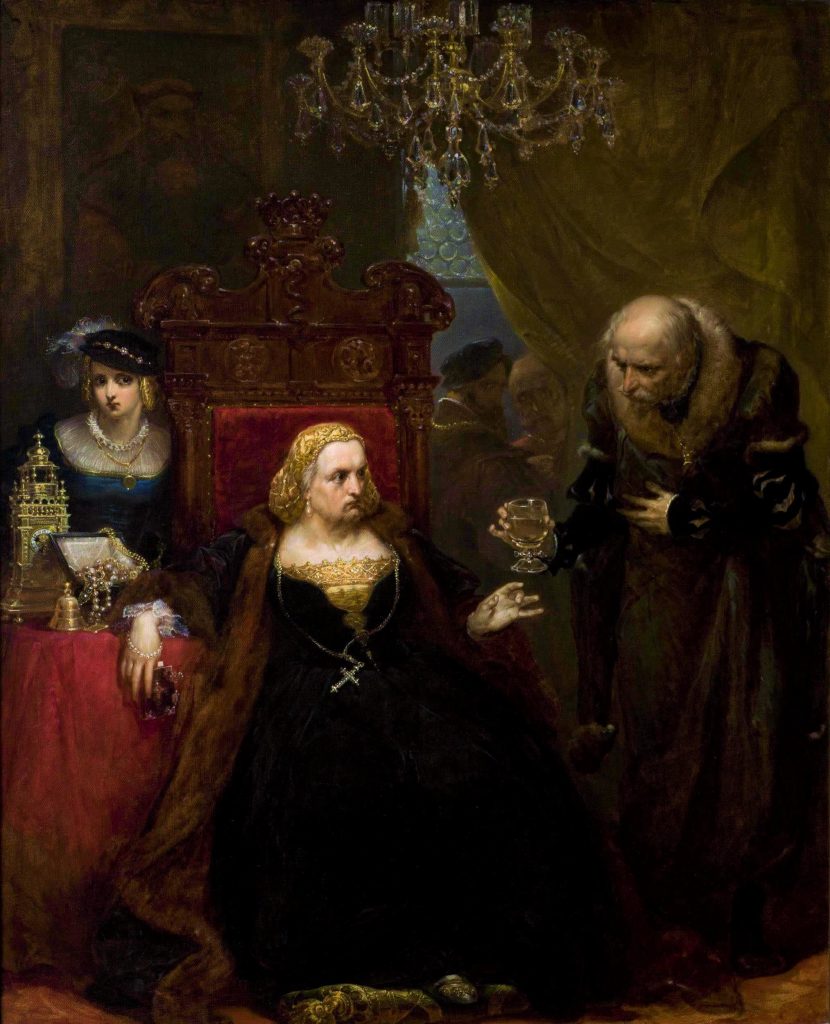
Queen Bona and the Poison Story
Queen Bona Sforza lived after the campaign present, so Matejko’s painting is used here as historical illustration rather than evidence for events in 1454. Its value is thematic: the cup, the suspicious attendant, the vulnerable ruler and the instant before certainty.
Curare and European Chronology
The older version of this page stated that curare was first discovered by Western scientists in the nineteenth century. That chronology was too late.
Indigenous knowledge in South America long predates European study. One of the earliest documented European encounters is associated with exploration of the Lake Maracaibo region in 1548. More systematic botanical and physiological investigation came much later.
See the historical review of the early history of curare in PubMed for the documented chronology.
This distinction also keeps campaign chronology clean: later European documentation does not make curare ordinary European scientific knowledge in 1454.
Poison Rules and Worldbuilding Videos
These two videos are retained from the earlier version of the page as supplementary viewing. They sit below the actual mechanics rather than replacing them.
Pathfinder Poison Guide
Foraging & Crafting Poisons & Medicine
Frequently Asked Questions
How does Basic Poison work in D&D 5.5e / 2024?
A vial costs 100 GP. Applying it to one weapon or up to three pieces of ammunition takes a Bonus Action. When the coated weapon or ammunition deals Piercing or Slashing damage, the target takes an extra 1d4 Poison damage. Basic Poison itself has no saving throw. It remains potent for 1 minute or until it deals its damage.
Does 2024 Basic Poison impose the Poisoned condition?
No. Basic Poison adds Poison damage but does not itself impose the Poisoned condition.
What is the Poisoner’s Kit detection DC in 5.5e?
The 2024 Poisoner’s Kit uses Intelligence and lists DC 10 to detect a poisoned object.
What happens if a 5.5e venom-harvesting check fails badly?
A failed DC 20 Intelligence (Nature) check extracts no poison. If the check fails by 5 or more, the harvester is subjected to the creature’s poison.
How is 2014 Basic Poison different?
Applying it takes an Action. A creature exposed through the coated weapon makes a DC 10 Constitution saving throw and takes 1d4 poison damage on a failure. A successful save avoids the poison damage.
Do repeated poison doses automatically raise the DC in fifth edition?
No. The cumulative +2 rule on this page belongs to Pathfinder 1e.
How do repeated doses work in Pathfinder 1e?
Each additional active dose of the same poison increases its save DC by +2 and extends its duration by half the listed duration. These increases are cumulative, but the cure requirement does not increase.
How does D&D 3.5e poison differ from Pathfinder?
D&D 3.5e normally uses initial damage followed by a second saving throw about 1 minute later against secondary damage. Pathfinder instead commonly uses onset, frequency, effect and cure.
Can magic detect poison?
Yes. See Detect Poison for the edition-specific SpiralWorlds treatment.
Can magic neutralise or delay poison?
Depending on the edition, see Delay Poison and Neutralize Poison.
Can characters harvest monster venom?
Yes where the relevant edition permits it. The 5.5e / 2024 procedure appears in the mechanics tab above; other systems use their own creature, poison and skill rules.
Are the historical poisoning stories on this page all proven facts?
No. Ancient and premodern poisoning allegations are often difficult to verify. The historical section distinguishes ancient accounts, later reputation and artistic interpretation rather than treating every accusation as established fact.
Sources, Attribution & Licensing
Rules Sources
- D&D 5.5e / 2024: System Reference Document 5.2.1.
- D&D 5e / 2014: System Reference Document 5.1 and the 2014 fifth-edition poison framework.
- Pathfinder 1e: Pathfinder Roleplaying Game rules and poison material, including Ultimate Equipment.
- D&D 3.5e: Revised System Reference Document poison and special-ability rules.
Historical and Mythological Sources
- Homer, Odyssey, Book X, for Circe, the drugged cup and moly.
- Apollodorus, Epitome, Book E, for Medea’s attempt to poison Theseus; later classical tradition identifies the poison as aconite.
- Tacitus, Annals, Books XII–XIII, for the ancient accounts concerning Locusta, Claudius and Britannicus.
- Suetonius, Life of Nero, for a separate ancient account of Locusta and Britannicus.
- Modern historical reassessments of Catherine de’ Medici and the later poison mythology associated with her reputation.
- Historical scholarship on the early European record of curare, including the 1548 Lake Maracaibo episode.
Artwork
Hero: Poisons and Toxins — The Silent Assassins, SpiralWorlds, 2026.
Historical illustration: Jan Matejko, Poisoning of Queen Bona, 1859.
Creative Commons Attribution — SRD 5.2.1
This work includes material from the System Reference Document 5.2.1 (“SRD 5.2.1”) by Wizards of the Coast LLC, available at https://www.dndbeyond.com/srd. The SRD 5.2.1 is licensed under the Creative Commons Attribution 4.0 International License, available at https://creativecommons.org/licenses/by/4.0/legalcode.
Creative Commons Attribution — SRD 5.1
This work includes material taken from the System Reference Document 5.1 (“SRD 5.1”) by Wizards of the Coast LLC and available at https://dnd.wizards.com/resources/systems-reference-document. The SRD 5.1 is licensed under the Creative Commons Attribution 4.0 International License available at https://creativecommons.org/licenses/by/4.0/legalcode.
Designation of Open Game Content
The Pathfinder 1e and D&D 3.5e rules mechanics presented in their respective mechanics panels are designated Open Game Content to the extent required by the Open Game License Version 1.0a.
Designation of Product Identity
Except for material already designated Open Game Content, released under Creative Commons, or in the public domain, SpiralWorlds-original setting material, 1454 campaign material, historical commentary, adventure hooks, examples, editorial prose, artwork, captions, CSS, layout, visual presentation and site identity are not designated Open Game Content.
Open Game License v1.0a + Applicable Section 15 Notices
OPEN GAME LICENSE Version 1.0a
The following text is the property of Wizards of the Coast, Inc. and is Copyright 2000 Wizards of the Coast, Inc (“Wizards”). All Rights Reserved.
1. Definitions: (a) “Contributors” means the copyright and/or trademark owners who have contributed Open Game Content; (b) “Derivative Material” means copyrighted material including derivative works and translations (including into other computer languages), potation, modification, correction, addition, extension, upgrade, improvement, compilation, abridgment or other form in which an existing work may be recast, transformed or adapted; (c) “Distribute” means to reproduce, license, rent, lease, sell, broadcast, publicly display, transmit or otherwise distribute; (d) “Open Game Content” means the game mechanic and includes the methods, procedures, processes and routines to the extent such content does not embody the Product Identity and is an enhancement over the prior art and any additional content clearly identified as Open Game Content by the Contributor, and means any work covered by this License, including translations and derivative works under copyright law, but specifically excludes Product Identity; (e) “Product Identity” means product and product line names, logos and identifying marks including trade dress; artifacts; creatures characters; stories, storylines, plots, thematic elements, dialogue, incidents, language, artwork, symbols, designs, depictions, likenesses, formats, poses, concepts, themes and graphic, photographic and other visual or audio representations; names and descriptions of characters, spells, enchantments, personalities, teams, personas, likenesses and special abilities; places, locations, environments, creatures, equipment, magical or supernatural abilities or effects, logos, symbols, or graphic designs; and any other trademark or registered trademark clearly identified as Product identity by the owner of the Product Identity, and which specifically excludes the Open Game Content; (f) “Trademark” means the logos, names, mark, sign, motto, designs that are used by a Contributor to identify itself or its products or the associated products contributed to the Open Game License by the Contributor; (g) “Use”, “Used” or “Using” means to use, Distribute, copy, edit, format, modify, translate and otherwise create Derivative Material of Open Game Content; (h) “You” or “Your” means the licensee in terms of this agreement.
2. The License: This License applies to any Open Game Content that contains a notice indicating that the Open Game Content may only be Used under and in terms of this License. You must affix such a notice to any Open Game Content that you Use. No terms may be added to or subtracted from this License except as described by the License itself. No other terms or conditions may be applied to any Open Game Content distributed using this License.
3. Offer and Acceptance: By Using the Open Game Content You indicate Your acceptance of the terms of this License.
4. Grant and Consideration: In consideration for agreeing to use this License, the Contributors grant You a perpetual, worldwide, royalty-free, non-exclusive license with the exact terms of this License to Use, the Open Game Content.
5. Representation of Authority to Contribute: If You are contributing original material as Open Game Content, You represent that Your Contributions are Your original creation and/or You have sufficient rights to grant the rights conveyed by this License.
6. Notice of License Copyright: You must update the COPYRIGHT NOTICE portion of this License to include the exact text of the COPYRIGHT NOTICE of any Open Game Content You are copying, modifying or distributing, and You must add the title, the copyright date, and the copyright holder’s name to the COPYRIGHT NOTICE of any original Open Game Content you Distribute.
7. Use of Product Identity: You agree not to Use any Product Identity, including as an indication as to compatibility, except as expressly licensed in another, independent Agreement with the owner of each element of that Product Identity. You agree not to indicate compatibility or co-adaptability with any Trademark or Registered Trademark in conjunction with a work containing Open Game Content except as expressly licensed in another, independent Agreement with the owner of such Trademark or Registered Trademark. The use of any Product Identity in Open Game Content does not constitute a challenge to the ownership of that Product Identity. The owner of any Product Identity used in Open Game Content shall retain all rights, title and interest in and to that Product Identity.
8. Identification: If you distribute Open Game Content You must clearly indicate which portions of the work that you are distributing are Open Game Content.
9. Updating the License: Wizards or its designated Agents may publish updated versions of this License. You may use any authorized version of this License to copy, modify and distribute any Open Game Content originally distributed under any version of this License.
10. Copy of this License: You MUST include a copy of this License with every copy of the Open Game Content You Distribute.
11. Use of Contributor Credits: You may not market or advertise the Open Game Content using the name of any Contributor unless You have written permission from the Contributor to do so.
12. Inability to Comply: If it is impossible for You to comply with any of the terms of this License with respect to some or all of the Open Game Content due to statute, judicial order, or governmental regulation then You may not Use any Open Game Material so affected.
13. Termination: This License will terminate automatically if You fail to comply with all terms herein and fail to cure such breach within 30 days of becoming aware of the breach. All sublicenses shall survive the termination of this License.
14. Reformation: If any provision of this License is held to be unenforceable, such provision shall be reformed only to the extent necessary to make it enforceable.
15. COPYRIGHT NOTICE
Open Game License v 1.0a Copyright 2000, Wizards of the Coast, Inc.
System Reference Document Copyright 2000–2003, Wizards of the Coast, Inc.; Authors Jonathan Tweet, Monte Cook, Skip Williams, Rich Baker, Andy Collins, David Noonan, Rich Redman, Bruce R. Cordell, John D. Rateliff, Thomas Reid, James Wyatt, based on original material by E. Gary Gygax and Dave Arneson.
Pathfinder Roleplaying Game Core Rulebook. Copyright 2009, Paizo Publishing, LLC; Author: Jason Bulmahn, based on material by Jonathan Tweet, Monte Cook, and Skip Williams.
Pathfinder Roleplaying Game Reference Document © 2011, Paizo Publishing, LLC; Author: Paizo Publishing, LLC.
Pathfinder Roleplaying Game Ultimate Equipment © 2012, Paizo Publishing, LLC; Authors Dennis Baker, Jesse Benner, Benjamin Bruck, Ross Byers, Brian J. Cortijo, Ryan Costello, Mike Ferguson, Matt Goetz, Jim Groves, Tracy Hurley, Matt James, Jonathan H. Keith, Michael Kenway, Hal MacLean, Jason Nelson, Tork Shaw, Owen KC Stephens, and Russ Taylor.
Poisons and Toxins. Copyright 2026, SpiralWorlds.
END OF LICENSE
Keep this reference growing
If this page helped with your reading or game, you can support its upkeep or explore the curated books.
Explore the Bookshop — epics, classics and stories behind imagined worlds.