
Portable Artificer’s Lab – Magic Item Crafting Gear
Portable Artificer’s Lab – Magic Item Crafting Gear
A compact travelling workshop for magic-item crafters who need to keep working when the road will not wait.
Overview
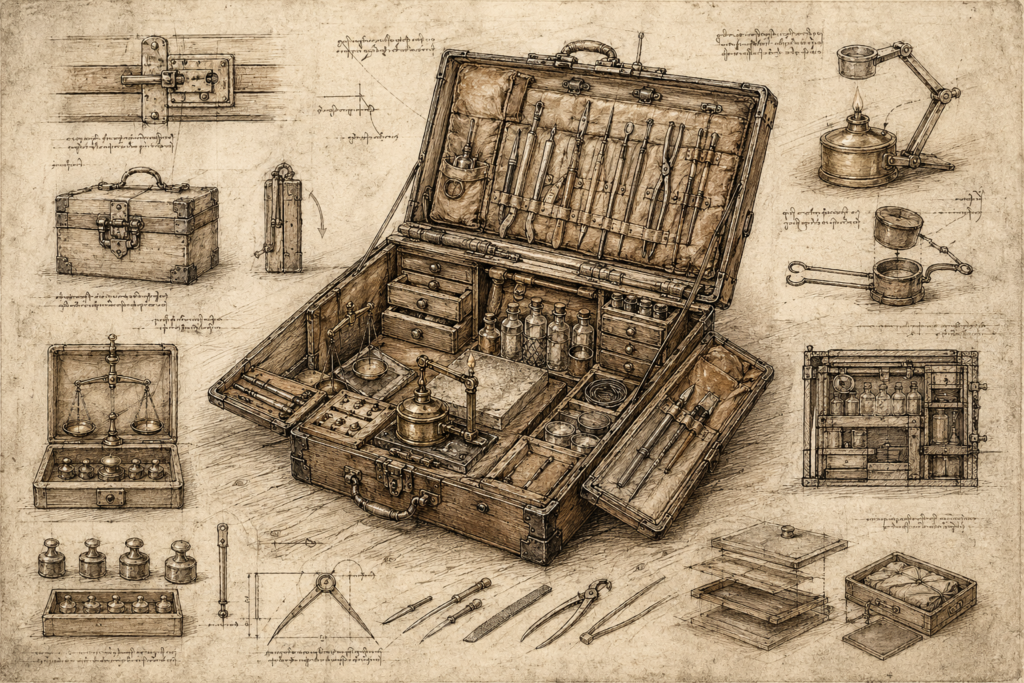
A Portable Artificer’s Lab is a folding case of small tools, clamps, lenses, burners, vials, powders, wires, waxes, and measuring instruments used to continue magic-item crafting away from a proper workshop.
It is not a full laboratory. It is a compromise.
A real artificer’s workshop has stable benches, clean surfaces, heat control, storage, ventilation, silence, lighting, assistants, guarded doors, and enough room to lay out fragile work. A Portable Artificer’s Lab has only what can fit into a reinforced travelling chest. It lets a crafter preserve momentum on the road, but every stage of work done with it carries the risk of cramped tools, bad light, smoke, damp, dust, interruption, fatigue, and poor control.
That is what makes the item useful. It lets an adventuring crafter keep working during journeys, sieges, ship voyages, wilderness expeditions, and long dungeon operations without pretending that campfire craft is as safe or precise as a proper sanctum.
Physical Description
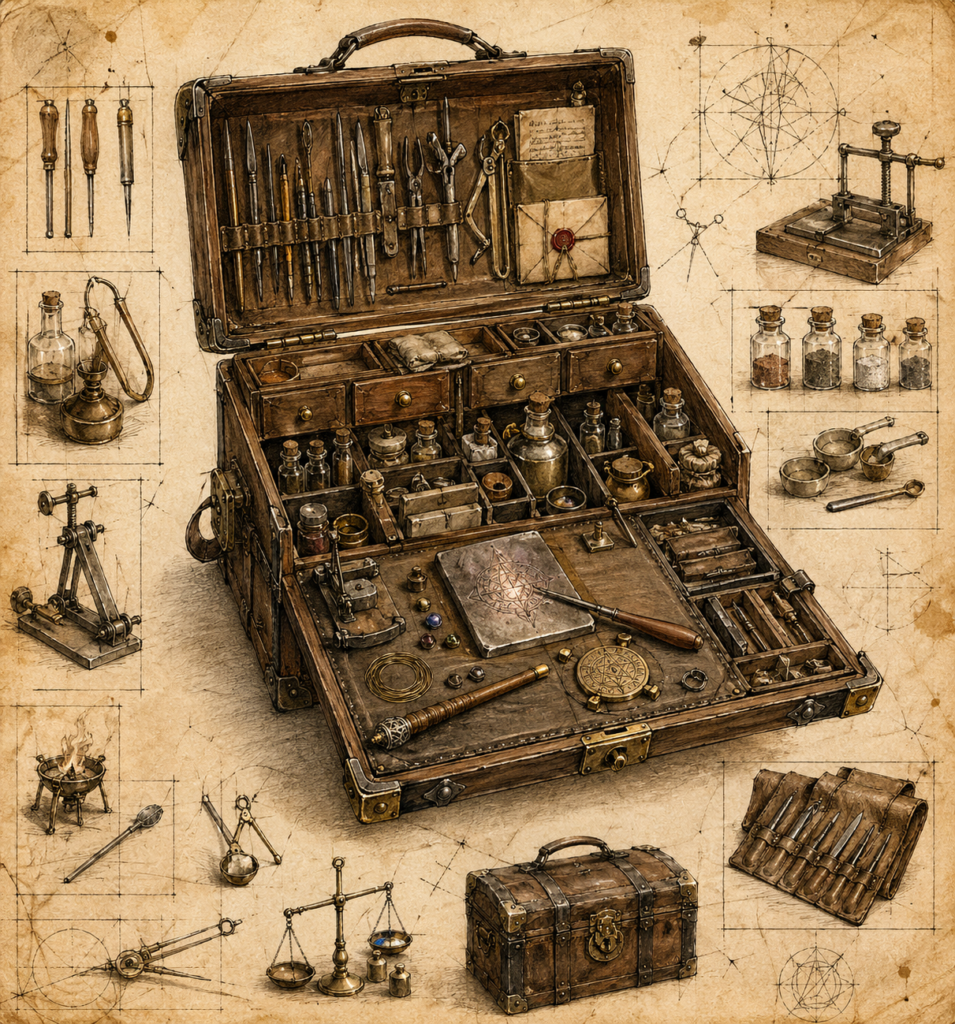
A Portable Artificer’s Lab usually appears as a reinforced chest, satchel-case, or nested wooden box bound in leather and metal. Better examples unfold into small drawers, trays, clamps, hook-arms, measuring rails, and heatproof tiles. Cheap or battered versions are little more than crowded toolboxes padded with oiled cloth.
Inside, the lab is arranged like a miniature workshop. One compartment holds fine hand tools: files, awls, burins, pliers, forceps, needles, and small tongs. Another carries the tools of heat and preparation: a folding lamp or spirit burner, a wax pot, tiny crucibles, funnels, stoppered bottles, and glass vials wrapped against breakage. A third section holds measuring and inscription gear: lenses, callipers, weights, chalk, charcoal, wax tablets, sealing wax, copper wire, thread, and prepared guides for keeping marks straight.
The remaining space is packed with practical consumables: resin, pitch, powdered minerals, filings, ash, salt, gum, binding agents, soft leather pads, iron pins, hooks, clamps, and small heatproof plates. Nothing is large. Nothing is ideal. Every tool has more than one purpose, and every drawer is full.
A used lab smells of old wax, lamp oil, scorched leather, bitter reagents, hot metal, powdered stone, and the faint tang of failed experiments.
Why This Item Matters
The Portable Artificer’s Lab turns travel time into partial crafting time.
Without it, magic-item creation belongs in towers, temples, guild houses, smithies, libraries, sanctums, and guarded workrooms. With it, a crafter can continue a project during an expedition, provided the party can secure enough quiet time and accept the risk of imperfect work.
The item is strongest in campaigns where journeys matter. It gives artificers, enchanters, rune-cutters, alchemists, and other magical craftsmen a reason to care about campsites, inns, watch rotations, weather, storage, light, and interruption.
It should not make workshops obsolete. Its whole purpose is to let work continue under bad conditions, not to make bad conditions ideal.
Edition Tabs
Portable Artificer’s Lab 5.5e / 2024
Portable Artificer’s Lab, Pathfinder 1e / 3.5e
Portable Artificer’s Lab 5.5e / 2024
Adventuring Gear
Also Known As: Artificer’s Lab, Portable
Cost: 300 gp
Weight: 20 lb.
A Portable Artificer’s Lab is a compact travelling kit used for limited magic-item crafting, repair, inscription, reagent preparation, and delicate arcane work away from a proper workshop.
When you spend at least 4 hours using the lab during a long rest, camp period, voyage, or other stretch of secured downtime, you may count that effort as 3 hours of magic-item crafting progress.
The place of work must be reasonably stable. You need enough light, space, quiet, and safety to use small tools, open flame, fragile materials, notes, and prepared components.
If any part of a magic item’s creation was completed using a Portable Artificer’s Lab, the final ability check, tool check, spellcasting check, or other completion test required by the DM takes a –5 penalty.
The lab does not replace rare ingredients, formulae, spells, tool proficiencies, gold costs, special materials, crafting prerequisites, or a proper workshop when the DM rules that a specific item requires one.
The DM may rule that the lab cannot be used in especially poor conditions, such as heavy rain, violent ship movement, freezing hands, choking smoke, unstable ground, combat pressure, lack of light, magical interference, or a campsite that cannot remain secure for several hours.
Portable Artificer’s Lab, Pathfinder 1e / 3.5e
Adventuring Gear
Cost: 300 gp
Weight: 20 lb.
This portable lab contains the basic equipment needed to create magic items while travelling, though many of the tools are crude, small, or designed to serve several functions at once.
A character using a Portable Artificer’s Lab may spend 4 hours crafting each night while adventuring and count that effort as 3 hours of work toward creating a magic item, instead of 2 hours of effective work under ordinary travelling conditions.
However, because the lab lacks the space, stability, quiet, and specialised tools of a proper workshop, any magic item that had part of its work completed using a Portable Artificer’s Lab takes a –5 penalty on the final skill check made to complete the item.
The lab does not remove the need for item creation feats, spells, formulae, raw materials, gold costs, XP costs if used in the campaign, special components, or any other normal requirement for crafting magic items.
The GM may rule that some items are too large, dangerous, unstable, or specialised to be made with a portable lab except for minor preparation, repair, measurement, or inscription work.
Original Source: Pathfinder Advanced Race Guide
How a Portable Artificer’s Lab Is Used
A Portable Artificer’s Lab belongs in scenes where the party has time, but not comfort.
A travelling enchanter opens the case in a rented loft and spends the evening laying silver wire into the grip of a half-finished wand. A dwarf runesmith checks the marks on a shield boss beside a watch-fire. A temple crafter on pilgrimage uses the lab to repair a reliquary clasp, grind sanctified pigment, and preserve the next stage of a protective charm until a real shrine can be reached.
The item works best in fortified camps, guarded ruins, ship cabins, military tents, caravan stops, borrowed workrooms, roadside inns, and expedition bases.
It is not useful in a running fight, a wet ditch, a collapsing tunnel, a panicked retreat, or a cave where monsters may return at any moment.
Failure, Risk, and Misuse
A portable lab encourages dangerous impatience.
The crafter may rush an inscription because the fire is dying. A vial may crack in cold weather. A clamp may slip where a proper bench vise would have held firm. Camp ash may spoil a powder. Rain may swell a wooden fitting. A companion may kick the table during a bad dream. A guard shift may interrupt the work just before the correct moment.
The –5 penalty represents these accumulated compromises. It is not simply a punishment for using cheap tools. It reflects the fact that magic-item crafting depends on stability, timing, precision, concentration, and controlled conditions.
The lab lets the work continue. It does not make the work safe.
Value in the World
A Portable Artificer’s Lab is expensive because it compresses several specialised crafts into one travelling case. A single lab may contain reduced versions of tools used by jewellers, scribes, alchemists, lens-grinders, locksmiths, miniature smiths, seal-cutters, wax-workers, and ritual assistants.
These labs are most often owned by travelling artificers, expedition mages, military enchanters, temple craftsmen, guild agents, merchant-house specialists, and adventurers who craft between expeditions.
Guilds may distrust them because they allow skilled work to leave supervised workshops. Noble patrons may prize them because they keep a valuable specialist useful on campaign. Thieves may see one as a box full of small, expensive tools.
Trade, Craft, and Common Variants
A Portable Artificer’s Lab is usually built to order. The buyer tells the maker what kind of work the lab must survive: road travel, shipboard use, military campaign, dungeon expeditions, guild inspection, temple service, or discreet private work.
The best versions are made by toolmakers, jewellers, locksmiths, alchemists, scribal suppliers, and fine metalworkers working together. They have fitted trays, padded compartments, balanced scales, cleanly cut drawers, replaceable clamps, covered glassware, and enough reinforcement to survive being packed, dropped, or carried on a mule.
Cheaper versions are cramped and unreliable. They may use dull tools, warped drawers, smoky burners, poor hinges, badly stoppered bottles, uneven weights, or glass too thin for hard travel. Such a lab may still function, but it makes the existing crafting penalty feel obvious rather than arbitrary.
Common variations are practical rather than decorative. A military lab may sacrifice glassware for stronger fittings and heavier clasps. A shipboard lab may use waxed cases, tighter stoppers, and extra padding against motion. A noble or guild lab may include better locks, maker’s seals, and compartments for permits, formulae, and contracts. A clandestine lab may disguise its tools as writing gear, physician’s instruments, or merchant scales.
These differences rarely need separate rules. They give the lab provenance, condition, and story: who built it, who paid for it, what sort of work it was meant to support, and how much punishment it has already survived.
Adventure and Worldbuilding Hooks
- The Unfinished Charm: A dead artificer’s portable lab contains a half-made item. Completing it requires discovering whether the last owner died because of the item, the commission, or the patron who ordered it.
- The Guild-Sealed Case: A crafting guild bans portable labs after flawed travelling work produces dangerous counterfeit magic items. The party must find the maker before another unstable item reaches market.
- The Nightly Work: An NPC ally spends four hours each night using a portable lab. The party may benefit from the finished item, but the light, smell, noise, and distraction make their camps easier to find.
Using This Item in Your Game
Use the Portable Artificer’s Lab when you want crafting to continue during adventure travel without removing the value of workshops.
It works well in campaigns with long roads, dangerous wilderness, military expeditions, shipboard journeys, caravan routes, sieges, or large dungeon sites where the party can establish temporary safe rooms. It rewards players who think about downtime, guards, weather, lighting, storage, and the practical demands of making magic away from home.
The clean ruling is this: the lab lets a crafter keep working, but the work remains compromised.
Do not let it bypass major requirements. If an item needs a forge, temple altar, astronomical observatory, bound elemental furnace, sacred pool, royal licence, masterwork bench, or full laboratory, the portable lab may help with preparation or maintenance, but it should not replace the real requirement.
Historical Context
A Portable Artificer’s Lab is a fantasy item, not a direct historical object. Its historical grounding lies in the tool-dense world of medieval and early modern craft: goldsmiths, jewellers, metalworkers, scribes, seal-cutters, alchemists, armourers, and other specialists whose work depended on small tools, controlled heat, precise measurement, prepared surfaces, and steady hands.
The important comparison is not a modern portable toolkit. It is a full workshop forced into a travelling chest. A real craft space offered benches, furnaces, lamps, tongs, files, trays, scales, apprentices, ventilation, storage, and room to work. The Portable Artificer’s Lab imitates that world in miniature, but loses the stability and control that made careful work reliable.
For a useful visual reference, see the British Museum’s collection entry for Étienne Delaune’s engraving of a goldsmith’s workshop. Although later than the high medieval period, it shows the kind of specialised bench, furnace, tools, and workshop environment that a portable artificer’s lab is trying to compress into field equipment.