
North America — RPG Location & Adventure Guide
North America at a Glance
Enter North America
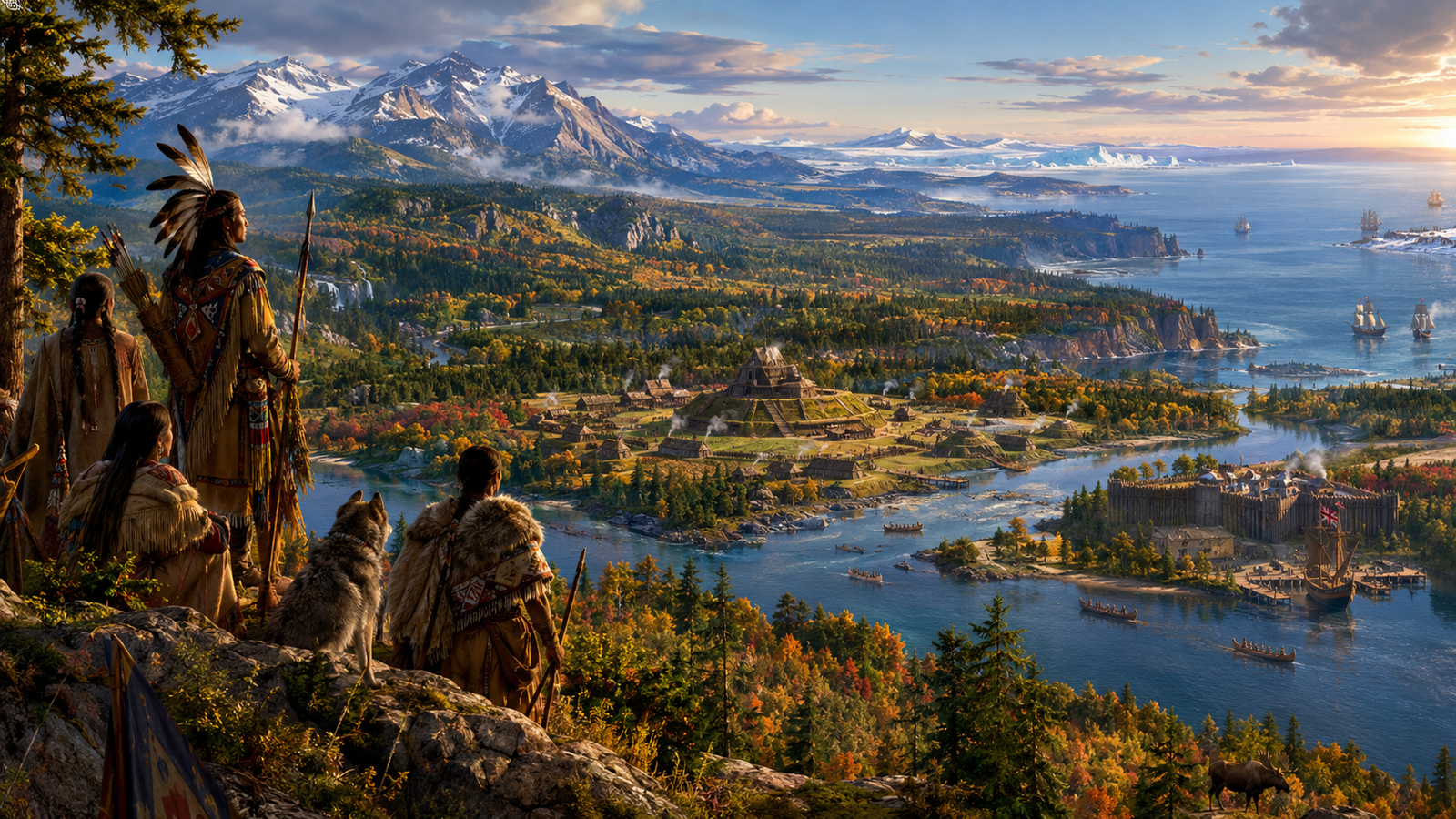
North America is not waiting to be discovered. Great rivers are already highways, forests contain known roads and hunting territories, towns stand beside fields and earthworks, and generations of diplomacy determine who may cross a valley, use a portage, hunt a herd or enter a sacred place.
Then there is the frontier.
Foreign settlements have existed long enough for locally born generations to push far beyond the Atlantic shore. Fortified markets, ranches, mining camps, caravan depots and rough new towns spread inland faster than distant governments can control them.
Some still obey colonial governors. Others answer to merchant councils, locally chosen marshals or whichever armed faction actually keeps the roads open. Still others survive because neighbouring Indigenous powers permit them to remain.
Gunslingers ride beside warriors carrying bows and spears. A French river trader can share a campfire with a Norse navigator, a gnome gunsmith, an Indigenous diplomat and an outlaw wanted in three settlements whose warrants mean nothing in the fourth.
North America is where the Wild West arrives centuries early.
Why Adventurers Come Here
Go Beyond the Map
Governors, merchants, scholars and explorers pay well for reliable knowledge of rivers, passes, settlements, monster territories and routes that exist only as rumours on coastal maps.
Take a Bounty
Criminals cross jurisdictions faster than officials can negotiate their return. A skilled company may be hired to bring back an outlaw, a stolen payroll or evidence that the person named on a warrant is innocent.
Ride the Frontier
Stagecoaches, cattle drives, Pony Express riders, prospectors and emigrant caravans need escorts through country threatened by weather, monsters, outlaws and political disputes.
Hunt a Monster
Every region has its own dangerous beings. Successful hunters learn what a creature is, where it belongs and who understands it before choosing a weapon.
Negotiate Where Armies Cannot
A small adventuring company can cross boundaries and enter settlements without creating the crisis that might follow an armed column.
Find What Vanished
Ships disappear. Mines go silent. Settlements are abandoned overnight. Expeditions fail to return. Sometimes the answer is weather or violence. Sometimes it is not.
What Is Happening Right Now?
The Atlantic Colonies Are Growing
Virginia, Massachusetts, New Hampshire, Maryland, Connecticut and Rhode Island coexist uneasily with New Netherland, Norse Delaware, New France and the older North Atlantic worlds of Vinland and Greenland.
The Frontier Is Moving Faster Than Government
River ports, ranches, mining camps and caravan towns appear beyond effective colonial administration. Some display a governor’s flag while ignoring that governor whenever orders become inconvenient.
The Gunsmith Exiles Are Changing Warfare
North American gnome workshops make revolvers, precision rifles and a small number of repeating firearms that give individual fighters previously impossible firepower.
The Great River Powers Remain Strong
Cahokia’s decline did not empty the Mississippi world. Agricultural communities, river towns, mound centres and political networks remain active along the great waterways.
Indigenous Powers Decide Which Roads Stay Open
Foreign expansion moves through inhabited political worlds. Local governments control crossings, food, waterways, hunting rights and much of the information required to survive inland.
The Supernatural Frontier Moves Too
New roads, mines and settlements disturb territories occupied by spirits, monsters and sacred powers. Expansion creates supernatural consequences as readily as political ones.
The Gunsmith Exile
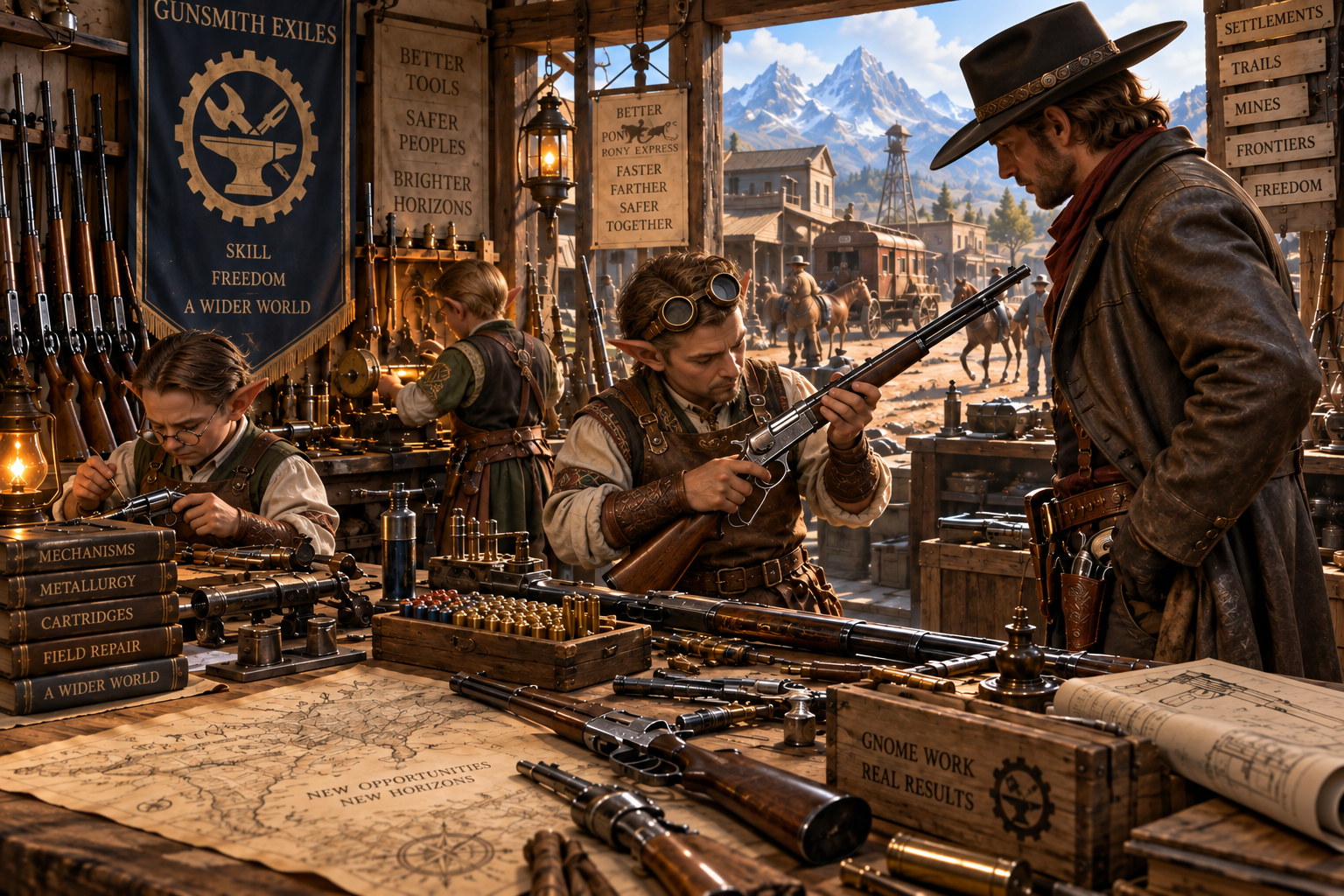
North America’s unusually advanced firearms begin with a diaspora of gnome gunsmith families, precision metalworkers, powder-makers and apprentices driven from parts of the Old World after refusing princely and guild attempts to control their work.
Firearms themselves are not their invention. Handguns, muskets, bombards and other powder weapons already exist. What makes the exiles extraordinary is their command of precision mechanisms, dependable springs, improved breeches, protected ignition systems and increasingly accurate measurements.
Attempts to confiscate workshops, seize designs and force master craftsmen into exclusive service drove some families across the Atlantic. They carried tools, gauges, patterns and practical knowledge that could not simply be copied from a captured weapon.
North America gives those workshops ores, timber, charcoal, customers and distance from the guild monopolies that once restrained them. Frontier demand then pushes the technology toward compact weapons, rapid follow-up shots, reliable field repairs and firearms capable of surviving long journeys.
The Gnome Cartridge
The decisive breakthrough is the self-contained cartridge. The finest workshops manufacture carefully fitted copper or brass cases containing projectile, measured powder and primer.
Producing them consistently requires the same precision tooling that makes the advanced firearms possible. A revolver may therefore be an extraordinary weapon while suitable ammunition remains valuable enough to count and protect.
Why the Old World Cannot Simply Copy Them
A skilled armourer can dismantle an imported revolver or repeating rifle and may even produce an individual imitation.
What is difficult to reproduce is the whole craft system behind it: gauges, boring equipment, master patterns, spring-making, heat treatment, ammunition tolerances and generations of practical workshop knowledge.
That is why North America can possess revolvers and repeating rifles without every army in Europe immediately possessing them as well.
The loose North American Gnome Gunsmith Compact helps workshops protect their technical independence while allowing enough cooperation to keep frontier weapons supplied and repairable.
See also Firearms and the Gunsmith’s Kit.
The American Frontier — Wild West
Beyond the strongest colonial governments lies a country of ranches, mines, isolated farms, river towns, trading posts, caravan depots and boom settlements where written authority weakens with every day’s travel.
This is the Wild West of SpiralWorlds .
Gunsmith Exile technology has placed extraordinarily effective firearms in the hands of people whom distant governments struggle to control. Marshals enforce laws whose authority may end at the edge of town. Bounty hunters pursue fugitives across jurisdictions. Prospectors disappear into monster country following rumours of gold. Outlaws attack stagecoaches, payroll caravans and river cargoes.
The saloon has become one of the frontier’s great institutions: tavern, gaming house, hiring hall, information exchange, informal courtroom and occasional neutral ground between people who would otherwise shoot one another.
Indigenous nations remain major powers throughout frontier country. A colonial charter or mining claim does not erase existing sovereignty, and many supposedly independent settlements survive only because neighbouring peoples permit them to do so.
The Pony Express
The Pony Express is a network of mounted couriers and relay stations built to move messages faster than wagons, caravans or ordinary travellers.
Without telegraphy to replace it, the service is exceptionally important. Government dispatches, warrants, maps, military orders, financial papers, private letters and intelligence pass from rider to rider through isolated stations.
The Oregon Trail
The Oregon Trail is the most famous overland corridor toward the western interior and Pacific country.
It is not a single engineered road. It is a shifting network of older trails, wagon tracks, ferries, river crossings, grazing points, wells, forts, markets, graves and dangerous shortcuts.
Tombstone
Tombstone begins with a prospector warned that the only thing waiting in the country ahead is his tombstone. The name survives after a rich mineral discovery turns the joke into a settlement.
Dodge City
Dodge City stands where livestock routes, traders, armed travellers and frontier law meet.
The Black Hills
The Black Hills rise from the Great Plains like an island of forest and stone. They are sacred country, strategic high ground and the subject of persistent rumours concerning rich veins of gold.
Devils Tower
Devils Tower dominates the surrounding country with the unsettling appearance of something built rather than formed. Stories differ over its origin. In SpiralWorlds, several may be true enough to be dangerous.
Choose Your Adventure Region
Arctic & Far North
Sea ice, tundra, islands and winter darkness create campaigns where weather can kill as efficiently as monsters. Inuit communities possess the knowledge required to travel through country outsiders often describe as impassable.
Vinland & the Northern Atlantic
Vinland belongs to an older Atlantic settlement tradition than the newer colonies.
Pacific Northwest
Great forests, islands, rivers and a deeply maritime coast create dense political geography. Canoes, fisheries and coastal routes bind communities whose knowledge of the sea matters more than foreign maps.
Rocky Mountains
The Rocky Mountains divide watersheds and turn passes into strategic assets. Mines, hidden valleys and monster territories make them ideal expedition country.
Great Basin
Water determines the map. Springs, mountain valleys and seasonal routes matter more than straight-line distance.
The Southwest
Pueblo communities, irrigated agriculture, canyon settlements and inherited Hohokam landscapes create a living world of desert engineering.
The Great Plains
Immense herds, river settlements, agricultural communities and mobile hunting peoples share the Plains. Earlier horse reintroduction is changing travel and warfare, but there is no single Plains culture.
Great Lakes & St Lawrence
The Great Lakes and St Lawrence form one of the continent’s greatest water-road systems. Portages, river mouths and islands become natural places for trade, diplomacy and conflict.
Eastern Woodlands
Fields, villages, forests, hunting territories and waterways overlap in a landscape outsiders frequently mistake for empty wilderness.
Appalachians
Long forested ridges separate the coastal colonies from the interior. One dependable pass can make a settlement wealthy.
Mississippi River World
The Mississippi, Missouri, Ohio and their tributaries connect agricultural towns, markets, mound centres and regional alliances.
Gulf Coast & Louisiana
Wetlands, storms, bayous and river mouths link the interior to the Gulf and Caribbean.
The Atlantic Colonies
The densest foreign settlements occupy parts of the eastern seaboard, but their political claims extend far beyond their ability to rule.
Mexico & Mesoamerica
Central Mexico contains great cities, tribute systems, agricultural regions and states vastly larger than any northern Atlantic colony.
Geography, Rivers & Travel
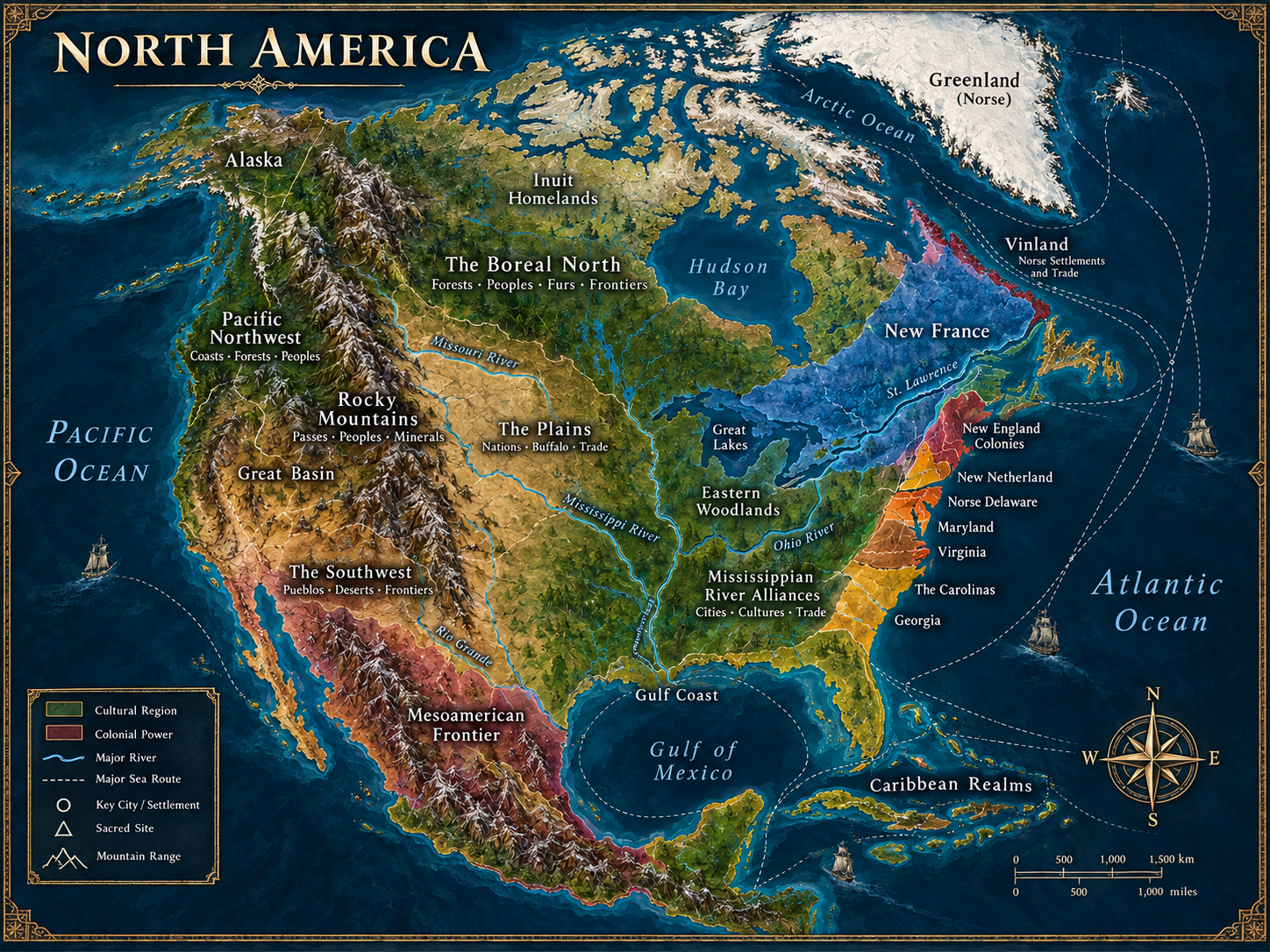
North America’s scale defeats anyone who treats it as one wilderness. Arctic ice, boreal forest, enormous freshwater lakes, grasslands, deserts, mountain chains, wetlands, subtropical coasts and Mesoamerican highlands create radically different campaigns.
Water is often the fastest road. The St Lawrence and Great Lakes connect the northeast to the continental interior, while the Mississippi and its tributaries bind enormous agricultural and trading worlds together.
Rivers Are Roads
Canoes, ferries and river craft move people and cargo along routes used for generations. Confluences, portages and river mouths naturally become markets, meeting grounds, fortified settlements and places worth fighting over.
Trails Belong to Someone
A path through apparently empty forest may connect villages, seasonal camps, hunting territories or sacred places. Travellers who assume a road is free because nobody built a toll gate may begin a political crisis before reaching their destination.
Sea Routes Join Different Worlds
Northern ships connect Greenland and Vinland. Atlantic vessels sail between European ports and the colonies. Coastal craft link settlements, fisheries and river mouths while the Caribbean draws the Gulf and Atlantic worlds into its own commercial and military struggles.
Horses Are Valuable, Not Universal
Sustained earlier Atlantic contact has returned horses to parts of North America sooner than in ordinary history. Breeding and trade are spreading them through selected regions, but canoes, walking, dogs, river craft and human portage remain essential.
There Is No Common Language
Common is not a real language. Indigenous languages, English, Dutch, French, Norse and local trade languages all matter. An interpreter can be more important than another armed guard.
Indigenous Nations & Political Worlds
Indigenous North America is not one culture, one government, one religion or one faction.
The continent contains Arctic hunting and maritime communities, Northwest Coast societies, Plains peoples, Pueblo worlds, Great Lakes nations, Eastern Woodlands communities, Mississippian towns, Gulf societies and the great political worlds of Mexico, among many others.
Authority may rest with councils, chiefs, clan institutions, hereditary leaders, town governments, confederacies, military societies, ritual offices, merchant networks or combinations that do not fit neatly into European categories.
Agricultural land, settlement jurisdiction, hunting rights, seasonal routes, sacred responsibilities, tributary relationships and kinship obligations can overlap. A foreign charter therefore does not transform an area into colonial property simply because somebody across the Atlantic drew a line around it.
Diplomacy Before Exploration
A route that looks open on a map may already belong to someone. A river landing may require permission. Hunting in the wrong valley may violate an agreement the travellers never knew existed.
The Mississippian River World
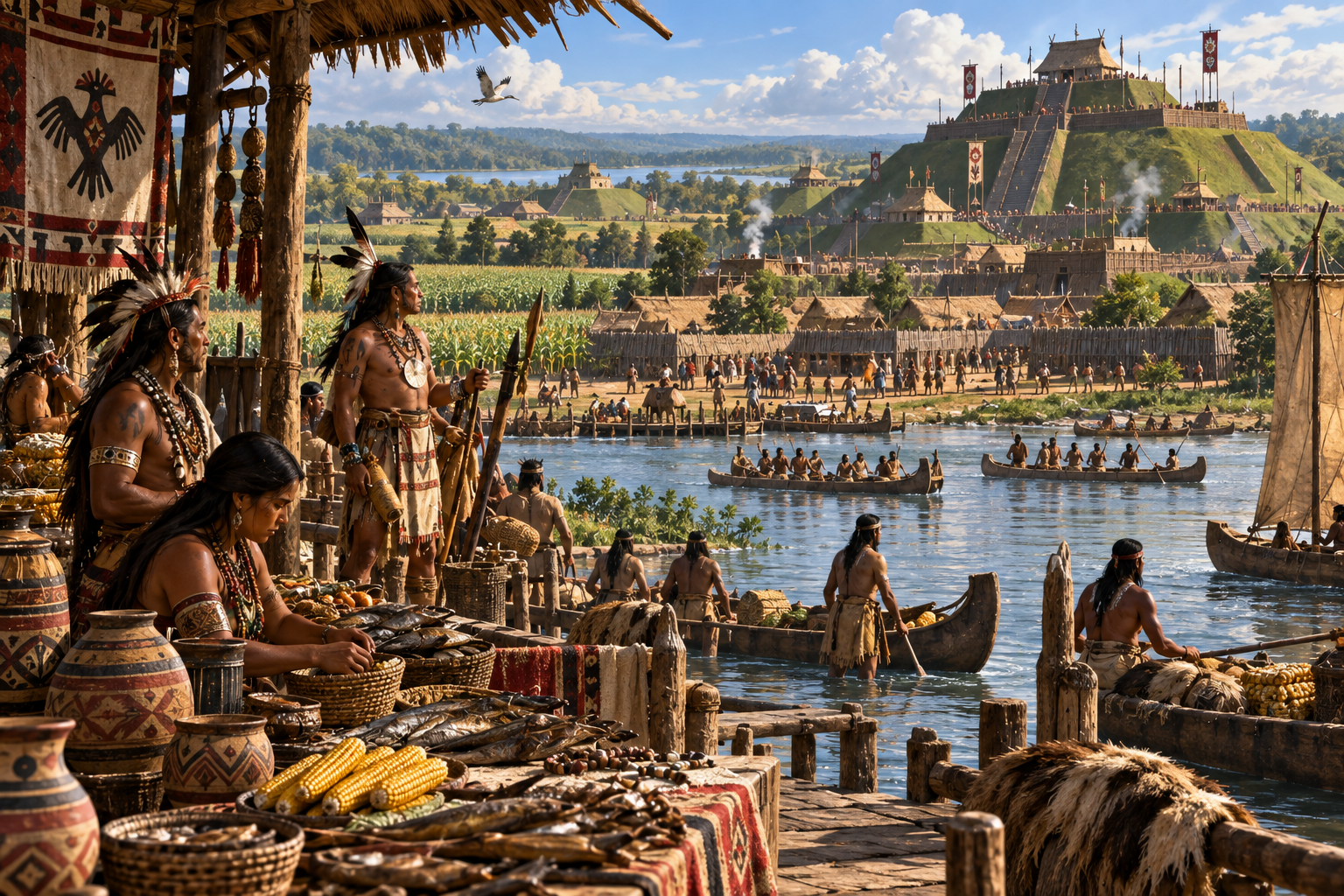
Cahokia is no longer the overwhelming centre it once was, but the wider Mississippian world has not vanished.
Agricultural towns, ceremonial centres, markets, fisheries, cultivated fields and political alliances remain active throughout the great eastern waterways. Communities reorganise as populations move and political centres rise or decline.
The Mississippian River Alliances are not one empire. They are overlapping networks capable of cooperation, competition and rapid movement along river routes.
Colonies & Foreign Powers
The Six English Colonies
Virginia, Massachusetts, New Hampshire, Maryland, Connecticut and Rhode Island form six separate English colonial projects whose laws, economies, military customs and relationships with neighbouring peoples differ considerably.
Explore The Colonies, the Colony of Virginia, Jamestown and Massachusetts Bay.
New Netherland
New Netherland is a Dutch commercial colony shaped by Atlantic shipping, river access and trade.
New Amsterdam is its principal port, while Sleepy Hollow demonstrates how quickly settlement can encounter supernatural problems it does not understand.
New France
New France follows the St Lawrence and associated waterways. Its influence reaches much farther than continuous French settlement because boats, traders, forts and alliances can move through river systems where roads scarcely exist.
Norse Delaware
Norse Delaware is an Atlantic trading colony distinct from both New Netherland and the English settlements. Its merchants participate in the colonial frontier while retaining ties to the older northern Norse world.
Vinland & Greenland
Vinland is not a forgotten ruin. It belongs to a surviving North Atlantic settlement tradition connected through Greenland and older Norse sea-roads.
Roanoke
Roanoke remains one of the continent’s most notorious vanished settlements. People still want to know what happened there.
Places Adventurers Can Go
Vinland
Norse settlements, Atlantic voyages, old claims and dangerous northern wilderness.
New France
River forts, traders, alliances and contested routes through the St Lawrence world.
Virginia
Tidewater rivers, growing settlements, forests, swamps and the approaches to the Appalachians.
New Netherland
Dutch commerce and strategic river routes along the Atlantic frontier.
New Amsterdam
A growing harbour full of merchants, sailors, officials, smugglers and foreign agents.
Massachusetts Bay
New England settlement, maritime trade, magical tensions and hard northern winters.
Tombstone
Mines, gunfighters, disputed claims and sudden fortunes.
Dodge City
Frontier law, livestock, caravans, gamblers and armed travellers.
Mississippi River
The great river highway through towns, agricultural worlds, wetlands and supernatural country.
Louisiana
French Gulf interests, river politics, wetlands and routes toward the Caribbean.
New Orleans
A major river port where Gulf commerce, magic, smugglers and competing powers meet.
Rocky Mountains
Great passes, mineral country, hidden valleys and dangerous expeditions.
People of the Frontier
Lawmen, outlaws, scouts, marksmen, explorers and larger-than-life characters move through North America’s frontier. Adventurers may meet them as allies, employers, rivals, quarry or enemies.
Lawmen, Gunslingers & Outlaws
Wyatt Earp
Frontier lawman and formidable peace officer.
Doc Holliday
Dentist, gambler and deadly gunfighter.
Billy the Kid
Young outlaw, gunslinger and wanted man.
Annie Oakley
Extraordinary marksman known as Little Sure Shot.
Bass Reeves
Relentless lawman and hunter of dangerous fugitives.
Judge Roy Bean
Frontier magistrate and self-styled Law West of the Pecos.
Calamity Jane
Rider, scout, adventurer and outlaw.
Butch Cassidy
Charismatic outlaw and leader of a highly capable criminal band.
Frontiersmen, Leaders & Adventurers
Buffalo Bill
Hunter, scout, rider and frontier showman.
Daniel Boone
Explorer, hunter and pathfinder of the wilderness frontier.
Jim Bowie
Frontiersman, explorer and formidable fighter.
Geronimo
Apache warrior and determined resistance leader.
Black Hawk
Sauk leader, warrior and political figure.
Hiawatha
Peacemaker, diplomat and political unifier.
Explore the complete Western NPC collection.
Factions & Rival Powers
North American Gnome Gunsmith Compact
A loose craft network descended from the Gunsmith Exile. Workshops cooperate where necessary while fiercely protecting their independence.
Mississippian River Alliances
Overlapping political, commercial and defensive networks connecting communities throughout the great river systems.
Company Adventurers to the New Found Land
A Bristol-linked exploration concern seeking fisheries, routes, settlements, trade agreements and valuable intelligence.
Norse Atlantic Sea-Road Network
Merchants, navigators and families linking Greenland, Vinland and the wider northern settlement world.
Browse the wider Guilds, Factions & Organisations archive.
Gods, Spirits & Sacred Powers
Myth is real, but North America has no single universal pantheon. Sacred powers belong to particular peoples, stories and landscapes.
Arctic & Northern Powers
Sedna
Mistress of sea animals and the northern ocean.
Asiaq
A northern sacred power associated with weather.
Arnakuagsak
A sea-mother associated with marine life and hunting.
Eastern Woodlands & Great Lakes
Glooscap
Culture hero and transformer within Wabanaki traditions.
Atahensic
An important figure within Haudenosaunee creation traditions.
Michabo
A powerful culture-hero figure of Algonquian traditions.
Plains Sacred Powers
Iktomi
Spider-trickster figure of Lakota tradition.
White Buffalo Calf Woman
A deeply important sacred teacher within Lakota tradition.
Southwest & Pueblo Traditions
Spider Grandmother
Teacher, helper and sacred figure within Southwestern traditions.
Iyatiku
A Pueblo creator and mother figure.
Northwest Coast Powers
Qamaits
A powerful Nuxalk sacred figure.
Explore the complete North American Pantheon and sacred-power collection.
Beings, Monsters & Frontier Legends
Every region has dangers of its own. The creature encountered beside Arctic sea ice should not feel interchangeable with one stalking an Appalachian road or descending upon a Rocky Mountain mining camp.
Arctic & Northern Country
Akhlut
A terrifying wolf-orca being associated with Yup’ik tradition.
Ijiraq
An elusive and dangerous being of Inuit tradition.
Chenoo
A monstrous being of Wabanaki traditions associated with terrible hunger and cold.
Great Lakes & Eastern Woodlands
Baykok
A supernatural hunter associated with Anishinaabe traditions.
Deer Woman
A powerful being appearing in several distinct regional traditions.
Jogah: Ga-hon-ga
A Haudenosaunee traditional being adapted for fantasy play.
Pacific Northwest
Sisiutl
A mighty supernatural being of Northwest Coast traditions.
Sasquatch
A legendary wild humanoid of the great western forests.
Greater Thunderbird
A powerful game adaptation drawing upon distinct Thunderbird traditions.
Southwest & Desert Country
Avanyu
A powerful being associated with Tewa and other Pueblo traditions.
Delgeth
A terrible being from the Diné Nayééʼ tradition.
Chupacabra
A blood-draining predator stalking ranch country and isolated livestock settlements.
Frontier Folklore
Hodag
A horned and vicious monster of the northern lumberwoods.
Slide-Rock Bolter
An enormous predator of Rocky Mountain tall tales.
The regional bestiary currently contains nearly two hundred creatures, ranging from traditional beings and folklore to cryptids, animals, prehistoric fauna and campaign monsters.
Explore the complete North American Beings, Monsters & Cryptids bestiary.
Services, Markets & Frontier Supplies
Atlantic Ports
Imported weapons, armour, ship supplies, maps, books, alchemical goods and European manufactured goods are easiest to obtain here.
River Markets
Food, canoes, guides, regional trade goods, interpreters, medicines and information may be more valuable than exotic weapons.
Frontier Towns
Blacksmiths, saloons, stables, wagon repairers, stores, boarding houses, gambling rooms, bounty offices and outfitters support travellers.
Gnome Workshops
Advanced firearm repairs, specialised cartridges and repeating mechanisms may require a compatible Gunsmith Exile workshop.
Magic
There is no universal magic shop. Magical services come from named practitioners, scholars, healers, ritual specialists and other people embedded in particular traditions.
Guides & Interpreters
Across much of the continent, the best investment an expedition can make is hiring someone who knows the route, languages and local politics.
Character Options
Existing SpiralWorlds character material associated with the continent includes the Totem Warrior, Dog Warrior and Ghost Dancer.
These character pages retain their own cultural framing, rules and licensing. Their presence here does not imply that one character tradition represents every Indigenous people in North America.
Frontier Arms & Equipment
North American equipment deliberately combines traditional weapons, ordinary black-powder arms and rare Gunsmith Exile technology.
Revolvers and repeating rifles do not mean that the continent has become industrial. The most advanced firearms are expensive works of precision craft dependent upon specialist tools, maintenance and ammunition.
Law, Bounties & Jurisdiction
There is no single law of North America. A warrant issued in Tombstone may mean nothing in an Indigenous jurisdiction. A New Netherland merchant may hold a contract Virginia refuses to recognise. A Norse settlement may invoke customs older than the colonial administration trying to tax it.
Frontier lawmen therefore depend upon reputation, negotiation and local cooperation as much as written authority.
Bounties
Bounty hunting flourishes because criminals can cross from one jurisdiction into another faster than governments can negotiate their return. Some bounties are legitimate. Others are private killings disguised as justice.
A Charter Is Not Ownership
Colonial governments frequently grant territory they cannot actually control. Such a document can be legally meaningful inside a colony and worthless—or insulting—to the people who already possess rights over the land.
Treaties Can Mean Different Things
Two parties can sign the same agreement while understanding settlement, travel, hunting, inheritance and land use differently.
An interpreter, witness or surviving copy of an old treaty can therefore become more important than an army.
Dangers & Rumours
A shipment of gnome cartridges disappeared between two workshops. Identical ammunition is now appearing in outlaw attacks hundreds of miles away.
A Pony Express station has received a message from the next station west even though every rider sent there has vanished.
A colonial survey labels an inhabited valley as vacant land and several hundred settlers are already moving toward it.
An old mound beside the Mississippi shines with blue light after sunset. Nearby communities disagree over whether anyone should enter.
A gunsmith claims somebody in Europe has duplicated the gnome cartridge. Foreign agents are hunting him.
Gold has supposedly been found in the Black Hills. Nobody agrees whether the sample is genuine, but prospectors are already moving.
A notorious outlaw has surrendered voluntarily and insists the thing wearing his face in Dodge City is not him.
A section of the Oregon Trail appears on no map and can only be seen after sunset.
A western river changes course overnight and leaves an important trading settlement miles from navigable water.
A monster driven away by a fortified frontier town has entered neighbouring territory and begun killing people who had nothing to do with the settlement.
Adventure Hooks
The Broken Treaty Road
A newly built frontier road crosses land covered by two agreements granting apparently incompatible rights. The party has three days to find the surviving witnesses before somebody starts a war.
The Master Gunsmith
A Gunsmith Exile has perfected a new repeating mechanism. A foreign prince wants the craftsman alive while an outlaw gang wants the prototype.
Ride for Dawn
A dying Pony Express rider hands the party a sealed dispatch. If it reaches the next relay before dawn, a frontier settlement survives.
The Empty Mound
People entering an apparently abandoned mound centre return remembering a great city no living traveller has seen.
The Tombstone Claim
Two prospecting companies claim the same mine. Then both crews vanish underground.
The Oregon Shortcut
A guide offers to cut twelve days from the journey west. Every survivor who previously followed the route refuses to discuss its midpoint.
The Delaware Question
English, Dutch, Norse and Indigenous interests recognise different rights around the same river mouth. The only interpreter trusted by all sides has been murdered.
The Forty Cartridges
A frontier marshal has ammunition for one serious fight and three different enemies approaching town.
Running North America at the Table
Build the Adventure Around a Place, Not a Continent
- Choose one destination: a harbour, settlement, river, mountain pass, sacred place, mine or frontier town.
- Decide who already controls access: never assume the location is politically empty.
- Add one travel problem: weather, water, ammunition, horses, river conditions, food or distance.
- Add one political problem: a treaty, jurisdiction, rivalry, disputed claim or incompatible obligation.
- Make the supernatural belong to the place: the monster, haunting or sacred restriction should reveal something about the region.
- Let the expedition change something: a road becomes known, a treaty fails, a settlement gains weapons or someone remembers a favour.
Historical & Mythic Context
SpiralWorlds begins with the real geography and deep histories of North America and deliberately changes the chronology where campaign canon requires it.
The continent is already inhabited by complex agricultural, maritime, hunting, trading and urban societies. The contraction of one political centre does not mean that its people or wider civilisation disappeared.
Mississippian societies continue after Cahokia’s decline. Southwestern communities adapt to drought, migration and changing political centres. The Great Lakes, Eastern Woodlands, Plains, Pacific coast, Arctic and Mesoamerica remain inhabited political worlds.
The great campaign divergences are sustained Atlantic settlement centuries earlier than ordinary history and the later Gunsmith Exile, which allows advanced portable firearms to develop without producing nineteenth-century industrial society.
For the wider chronology, see Artillery, Colonies and Rival Powers .
Explore North America
The Colonies
The Atlantic colonial gateway.
Virginia
English settlement along the Chesapeake and inland approaches.
Jamestown
A major Virginia settlement.
New Netherland
Dutch commercial and river interests.
New Amsterdam
Principal harbour of New Netherland.
Sleepy Hollow
Settlement and supernatural danger.
Massachusetts Bay
New England settlement and magical tensions.
Salem
Coastal trade, witchcraft, fear and local politics.
Roanoke
The lost-colony mystery.
New France
French influence through the St Lawrence world.
Vinland
The older Norse North American settlement world.
American Frontier — Wild West
Gunslingers, marshals, prospectors, saloons and frontier settlements.
Pony Express
The mounted courier network.
Oregon Trail
The great western overland corridor.
Rocky Mountains
Passes, mines and wilderness expeditions.
Tombstone
Mining, guns, gambling and disputed claims.
Dodge City
Frontier law, livestock and gunslingers.
Mississippi River
The great river highway through the interior.
Louisiana
French Gulf and Mississippi interests.
New Orleans
River port, Gulf crossroads and supernatural city.
North American Bestiary
Traditional beings, folklore, cryptids, fauna and campaign monsters.
North American Pantheon
Distinct gods, spirits and sacred traditions.
Western NPCs
Lawmen, outlaws, scouts, adventurers and frontier legends.
Caribbean
The contested maritime world beyond the Gulf.
Factions
Organisations operating across the continent and beyond.
World Geography
Return to the complete SpiralWorlds atlas.
History, Legends & Inspiration
These videos provide historical, archaeological and cultural inspiration for North America’s peoples, settlements, sacred landscapes and deliberately altered frontier.
North America Campaign FAQ
Why does North America have a Wild West in 1454?
Permanent Atlantic settlement begins much earlier in SpiralWorlds, allowing inland towns, ranches, mines and trade routes to develop centuries early. The Gunsmith Exile accelerates portable firearm technology.
Why are revolvers and lever-action rifles available?
Gnome gunsmith families possess precision mechanisms and cartridge-making techniques beyond the manufacturing ability of most Old World workshops. The weapons remain expensive and specialised.
Does that mean North America is industrialised?
No. The firearm revolution is a specialised craft divergence. Railways, telegraphy and industrial mass production do not automatically follow.
Is North America mostly colonial territory?
No. Indigenous nations, communities and political systems remain the dominant reality across most of the continent. Colonial maps routinely claim more territory than colonial governments actually control.
Does the Pony Express exist?
Yes. It develops as a mounted relay network connecting distant frontier settlements. Without telegraphy, fast riders remain exceptionally valuable.
Is North American mythology treated as one pantheon?
No. The Pantheon and Bestiary hubs act as gateways to distinct peoples, regions and traditions.
Sources, Attribution and Licensing
Historical & Geographic Reference
The historical foundation draws upon archaeological and geographical scholarship concerning Indigenous North American societies, Mississippian cultures, Southwestern settlement change, North Atlantic voyages and the physical geography of the continent.
Geographic reference includes NASA Earth observation and United States Geological Survey mapping. Archaeological context includes material published by the Smithsonian Institution and National Park Service.
SpiralWorlds Campaign Divergence
Early permanent English, Dutch, French and expanded Norse colonisation; Norse Delaware; the Gunsmith Exile; gnome cartridge technology; the early Wild West; advanced frontier firearms and supernatural campaign events are deliberate SpiralWorlds alternate-history elements.
Artwork
North America campaign hero, North America campaign symbol, definitive North America campaign map, Gunsmith Exiles frontier workshop and Mississippian river civilisation scene: SpiralWorlds.
SRD 5.2.1 Attribution
This work includes material from the System Reference Document 5.2.1 (“SRD 5.2.1”) by Wizards of the Coast LLC, available at https://www.dndbeyond.com/srd . The SRD 5.2.1 is licensed under the Creative Commons Attribution 4.0 International License .
Open Game Content Designation
Mechanical rules material inside the Pathfinder 1e and D&D 3.5e mechanics panels is designated Open Game Content only to the extent that it derives from material already released as Open Game Content under the Open Game License version 1.0a.
No other portion of this page is designated Open Game Content. SpiralWorlds setting material, historical synthesis, encounter material, adventure hooks, original modern mechanics, explanatory prose, artwork, CSS, page design and editorial presentation are excluded from that designation.
Material derived from SRD 5.2.1 is used separately under Creative Commons Attribution 4.0 International and is not designated Open Game Content by this notice.
Open Game License v1.0a & applicable Section 15 notices
OPEN GAME LICENSE Version 1.0a
The following text is the property of Wizards of the Coast, Inc. and is Copyright 2000 Wizards of the Coast, Inc (“Wizards”). All Rights Reserved.
1. Definitions: (a) “Contributors” means the copyright and/or trademark owners who have contributed Open Game Content; (b) “Derivative Material” means copyrighted material including derivative works and translations (including into other computer languages), potation, modification, correction, addition, extension, upgrade, improvement, compilation, abridgment or other form in which an existing work may be recast, transformed or adapted; (c) “Distribute” means to reproduce, license, rent, lease, sell, broadcast, publicly display, transmit or otherwise distribute; (d) “Open Game Content” means the game mechanic and includes the methods, procedures, processes and routines to the extent such content does not embody the Product Identity and is an enhancement over the prior art and any additional content clearly identified as Open Game Content by the Contributor, and means any work covered by this License, including translations and derivative works under copyright law, but specifically excludes Product Identity; (e) “Product Identity” means product and product line names, logos and identifying marks including trade dress; artifacts; creatures characters; stories, storylines, plots, thematic elements, dialogue, incidents, language, artwork, symbols, designs, depictions, likenesses, formats, poses, concepts, themes and graphic, photographic and other visual or audio representations; names and descriptions of characters, spells, enchantments, personalities, teams, personas, likenesses and special abilities; places, locations, environments, creatures, equipment, magical or supernatural abilities or effects, logos, symbols, or graphic designs; and any other trademark or registered trademark clearly identified as Product identity by the owner of the Product Identity, and which specifically excludes the Open Game Content; (f) “Trademark” means the logos, names, mark, sign, motto, designs that are used by a Contributor to identify itself or its products or the associated products contributed to the Open Game License by the Contributor; (g) “Use”, “Used” or “Using” means to use, Distribute, copy, edit, format, modify, translate and otherwise create Derivative Material of Open Game Content; (h) “You” or “Your” means the licensee in terms of this agreement.
2. The License: This License applies to any Open Game Content that contains a notice indicating that the Open Game Content may only be Used under and in terms of this License. You must affix such a notice to any Open Game Content that you Use. No terms may be added to or subtracted from this License except as described by the License itself. No other terms or conditions may be applied to any Open Game Content distributed using this License.
3. Offer and Acceptance: By Using the Open Game Content You indicate Your acceptance of the terms of this License.
4. Grant and Consideration: In consideration for agreeing to use this License, the Contributors grant You a perpetual, worldwide, royalty-free, non-exclusive license with the exact terms of this License to Use, the Open Game Content.
5. Representation of Authority to Contribute: If You are contributing original material as Open Game Content, You represent that Your Contributions are Your original creation and/or You have sufficient rights to grant the rights conveyed by this License.
6. Notice of License Copyright: You must update the COPYRIGHT NOTICE portion of this License to include the exact text of the COPYRIGHT NOTICE of any Open Game Content You are copying, modifying or distributing, and You must add the title, the copyright date, and the copyright holder’s name to the COPYRIGHT NOTICE of any original Open Game Content you Distribute.
7. Use of Product Identity: You agree not to Use any Product Identity, including as an indication as to compatibility, except as expressly licensed in another, independent Agreement with the owner of each element of that Product Identity. You agree not to indicate compatibility or co-adaptability with any Trademark or Registered Trademark in conjunction with a work containing Open Game Content except as expressly licensed in another, independent Agreement with the owner of such Trademark or Registered Trademark. The use of any Product Identity in Open Game Content does not constitute a challenge to the ownership of that Product Identity. The owner of any Product Identity used in Open Game Content shall retain all rights, title and interest in and to that Product Identity.
8. Identification: If you distribute Open Game Content You must clearly indicate which portions of the work that you are distributing are Open Game Content.
9. Updating the License: Wizards or its designated Agents may publish updated versions of this License. You may use any authorized version of this License to copy, modify and distribute any Open Game Content originally distributed under any version of this License.
10. Copy of this License: You MUST include a copy of this License with every copy of the Open Game Content You Distribute.
11. Use of Contributor Credits: You may not market or advertise the Open Game Content using the name of any Contributor unless You have written permission from the Contributor to do so.
12. Inability to Comply: If it is impossible for You to comply with any of the terms of this License with respect to some or all of the Open Game Content due to statute, judicial order, or governmental regulation then You may not Use any Open Game Material so affected.
13. Termination: This License will terminate automatically if You fail to comply with all terms herein and fail to cure such breach within 30 days of becoming aware of the breach. All sublicenses shall survive the termination of this License.
14. Reformation: If any provision of this License is held to be unenforceable, such provision shall be reformed only to the extent necessary to make it enforceable.
15. COPYRIGHT NOTICE
Open Game License v 1.0a Copyright 2000, Wizards of the Coast, Inc.
System Reference Document. Copyright 2000, Wizards of the Coast, Inc.; Authors Jonathan Tweet, Monte Cook, Skip Williams, based on material by E. Gary Gygax and Dave Arneson.
Pathfinder Roleplaying Game Reference Document. © 2011, Paizo Publishing, LLC; Author: Paizo Publishing, LLC.
Pathfinder Roleplaying Game Core Rulebook. © 2009, Paizo Publishing, LLC; Author: Jason Bulmahn, based on material by Jonathan Tweet, Monte Cook, and Skip Williams.
Original North America — RPG Location & Adventure Guide setting material, alternate-history synthesis, Gunsmith Exile material, adventure material, 5.5e original mechanics and editorial content Copyright © 2026 SpiralWorlds. All rights reserved except material separately identified as Open Game Content or licensed under Creative Commons Attribution 4.0 International.