
New Netherland — Rivers, Forests and Atlantic Harbours
At a Glance
| Region | The North River, the Atlantic estuaries and trading settlements on the eastern coast of North America |
|---|---|
| Campaign Year | 1454 CE |
| Main Harbour | New Amsterdam, at Manhattan’s southern end |
| European Connections | Holland and the Burgundian Low Countries, other Atlantic seaports, neighbouring colonies |
| Colonial Government | Merchant-backed harbour administration, local factors and scattered garrisons; no control over the wider Indigenous nations |
| Peoples | Independent Lenape, Wappinger and other river communities; Dutch merchants and settlers, gnome craftsmen, dwarven workers and other travellers |
| Languages | Dutch, Munsee and other Indigenous languages of the river valleys, Mahican, and Norse in neighbouring sea trade; interpreters are indispensable. There is no universal Common tongue. |
| Livelihoods | River transport, fishing, farming, furs, timber, boatbuilding, crafts and overland trade |
| Major Risks | Disputed passage, armed smugglers, shifting river channels, winter storms and wars between competing interests |
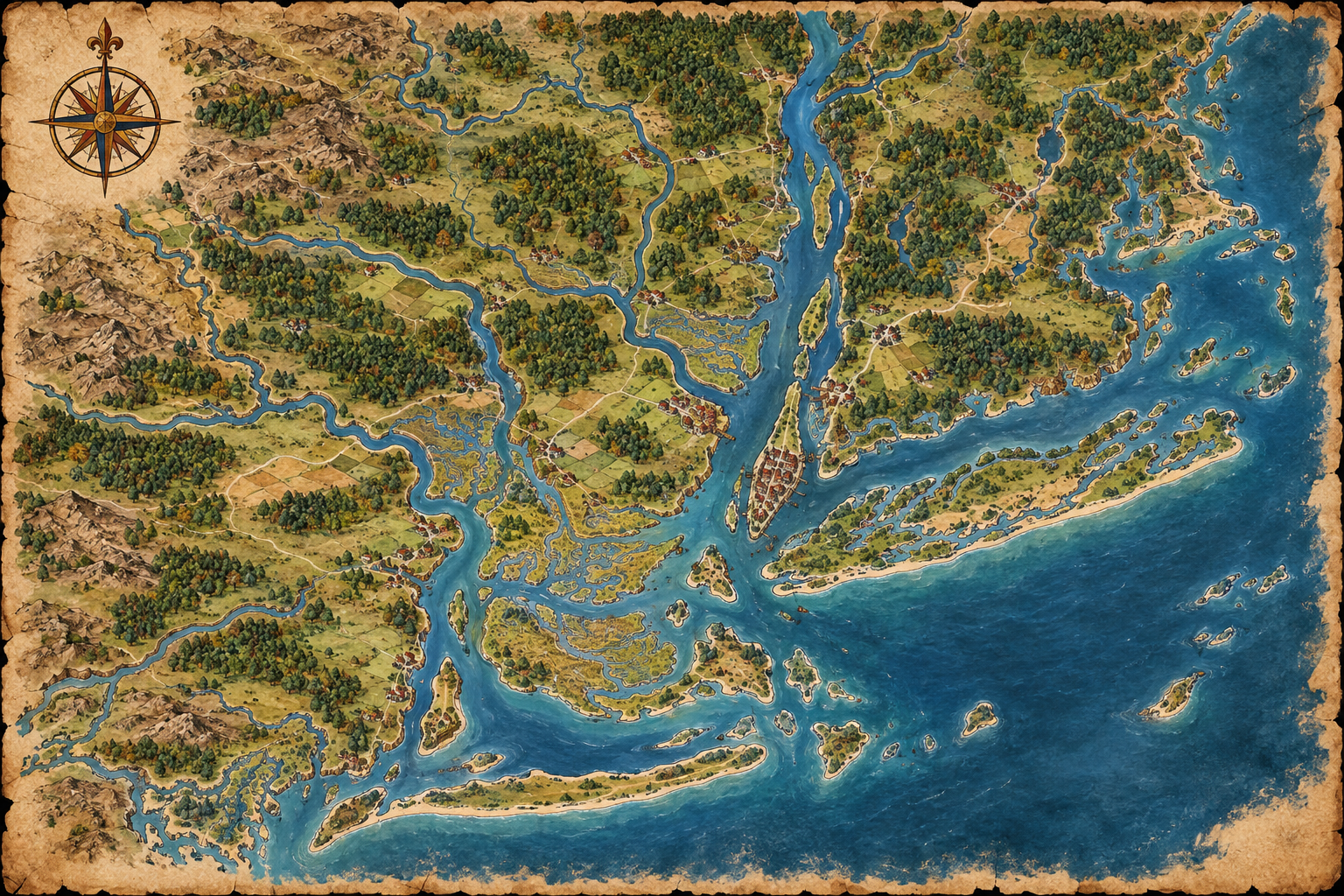
Map of the Rivers and Coastal Settlements
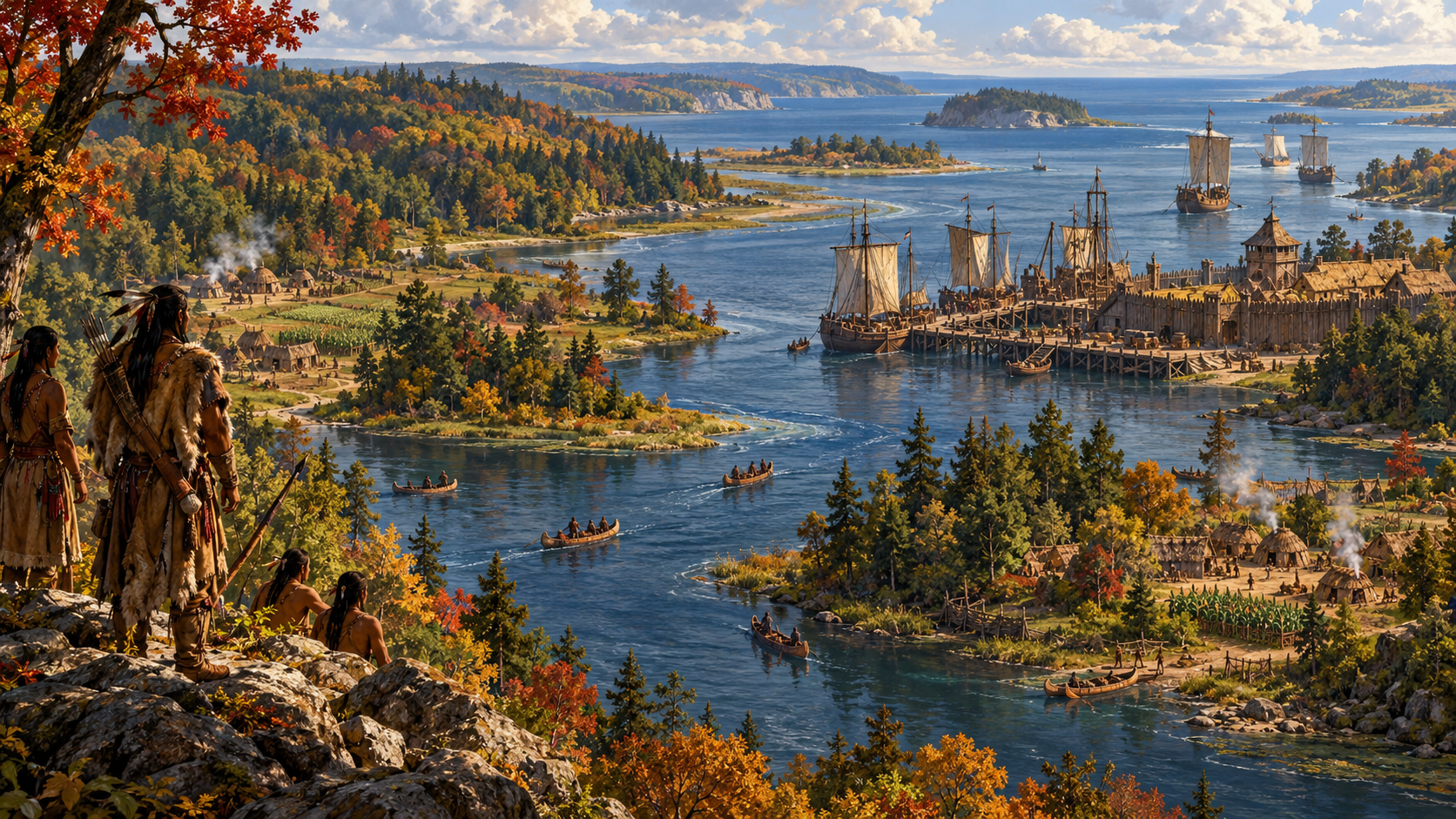
The North River is never quiet. A canoe crosses a wide reach of water towards a village garden while a heavy Dutch cargo boat waits for the tide. A man on the far bank waves a warning that the sailors cannot understand. Somewhere upstream a rifle cracks once, and then there is only the sound of paddles, wind and the creak of a laden hull.
New Netherland is the name Dutch merchants give their chain of harbours, trading stations and hoped-for holdings. The river valleys themselves are inhabited and governed by many peoples with their own histories and alliances. Colonists who treat a cargo agreement as permission to seize land often discover the difference too late. Travellers who listen, hire a reliable guide and honour their undertakings find far more doors open.
What Is Happening Right Now?
The Upper River Has Gone Silent
Two supply boats have failed to return from upriver. Claes Diederiksz, a worried merchant, thinks the cargo has been stolen; Honon, a river guide, knows the boats passed into dangerous shallows just before a storm. A good rescue crew can earn both families’ gratitude, but first they must persuade rival sponsors to put their accusations aside.
Three Riders, One Broken Promise
A horseman arrives carrying a contract marked by three different trading households. One party has sold goods pledged to another. Wenita, a Lenape negotiator, demands the goods be returned before the next seasonal market; a Dutch factor insists the disputed price has already been paid. The written tally is genuine, but the interpreter who translated it has disappeared.
The Gunsmith’s Caravan
A small convoy of tools and precision firearms has left the gnome workshops near the coast. Its makers intended the weapons for guards protecting a village route. A band of opportunistic riders wants the cargo for an armed robbery before the convoy reaches its destination. Tracking the riders may be easier than proving who paid them.
The Rivers and Their Country
The North River
The wide tidal river leads from the ocean towards wooded highlands and far-off inland waterways. Near the coast, merchants hire shallow craft and local pilots; farther upstream, canoes and portage routes matter more than a deep-hulled ship. Munsee-speaking Lenape communities inhabit lower river lands, with other peoples, including Wappinger and Mahican communities, along the greater valley. Their political interests are not interchangeable, and no single messenger speaks for every settlement.
The South River and Coastal Marshes
The southern waterways lead through tidal flats, islands, wooded banks and fishing grounds towards the Delaware basin. The lands are not open country awaiting Dutch claims: independent communities determine access to camps, fields, crossings and landings. The Norse settlements farther along the Delaware coast have their own interests and armed crews. A Dutch captain may cooperate with them on a rescue one week and compete for the same cargo the next.
Woodlands, Farms and Trails
Beyond the estuaries stand oak and chestnut woods, small clearings, river farms and well-known footpaths. Native farmers cultivate fields and manage seasonal resources. Settlers maintain gardens and working farms near their own towns, while hunters and traders follow established routes between communities. Weather can erase a shallow ford or prevent passage across a tidal creek for days.
Harbours, Settlements and Encounters
New Amsterdam — The River’s Atlantic Door
New Amsterdam is the busiest Dutch harbour: a wooden fort above ships, a crowded fur quay, lodgings, a smiths’ lane and a merchant council more interested in a delayed cargo than a distant governor’s ambitions. It is the best place to hire a shipwright or arrange Atlantic passage, though even here a foreign captain needs interpreters and trusted local partners.
The Upper River Trading Houses
Small protected storehouses and river landings maintain connections with inland routes. Their factors can mend a paddle, weigh a cargo and offer a dry loft, but they depend on neighbouring peoples for food, information and safe passage. A post that loses trust may be abandoned even if its walls remain sound.
Sleepy Hollow — The Haunted River Settlement
Not every upriver place is a trading house. Dutch families farm near the secluded Hollow, where Ichabod Crane teaches and investigates tales that trouble his neighbours. The Headless Horseman is more than a distant story: travellers fear the dark road after the harvest gatherings. People also speak of the dullahan, but the Hollow’s own haunting has a history and victims of its own. The Van Tassel household and Brom Bones are local names worth knowing before approaching the schoolmaster.
The Eastern Shore and Island Landings
Fishing boats, coastal sloops and canoes come and go with the tides. Several islands have inhabited shorelines and sacred places; their names and affiliations matter more to local residents than the labels on an Atlantic merchant’s chart. Keep boats above the tide line and ask permission before establishing camp beside cultivated land.
The South River Frontier
At the southern margins, Dutch merchants meet travellers connected to Norse Delaware, local river peoples and independent settlements. A convoy may hire escorts, a healer, a navigator or a mediator. No one can settle a claim simply by producing a map showing a fort’s flag over a hundred miles of river.
People, Powers and Rivalries
Established Figures Across the Colony
Captain Kidd — the privateer (lawful neutral). The captain knows the New Amsterdam waterfront and its investors, though his voyages also take him to other oceans. His name opens doors and attracts creditors. If his papers are forged or a captured prize disputed, he wants the evidence settled before he puts to sea again.
Mother Mandelbaum — the Manhattan crime boss (neutral evil). Her Criminal Exchange launders stolen cargo and buys information about river shipments. She rewards loyal thieves and helps selected households to purchase silence and obligation, while the people robbed by her organisation receive neither protection nor mercy. She prefers extortion, bribery and betrayal to needless bloodshed, but will sacrifice a trading family to secure her profits.
Boss Tweed — the political patron (lawful evil). His circle seeks influence over harbour appointments, contracts and the people who inspect cargo. Upriver merchants distrust the favours demanded by his agents, while those agents insist that his influence keeps trade moving.
Bill the Butcher — the violent street leader (chaotic neutral). Poole’s followers can be found wherever New Amsterdam’s docks and poor streets offer men to intimidate or recruit. His loyalty to his own gang makes him a dangerous enemy and an unreliable protector.
Ichabod Crane — the schoolmaster of Sleepy Hollow (lawful good). He lives upriver among Dutch farming families, teaching children and investigating disturbing local stories. Merchants passing the Hollow may know him as a curious scholar rather than a man to hire as an armed guard.
Laurens de Graaf — a Caribbean buccaneer (chaotic neutral). He is not a resident of New Netherland; his voyages and interests in the Brethren of the Coast make him a name heard from captains crossing the Atlantic approaches. His crew can seek supplies or information in northern waters, but no local harbour official commands him.
River Guides, Merchants and Independent Peoples
Claes Diederiksz, lawful neutral merchant. Records every debt and wants the missing boats found. He will accept a proven loss and pay contracted wages, but not surrender cargo on rumour alone.
Wenita, neutral good negotiator. Protects her community’s goods and travelling households and will end a partnership that repeatedly breaks its word. She is not a representative for all Lenape communities.
Honon, neutral river guide. Reads dangerous shallows and the weather that coastal merchants ignore. He is loyal to passengers who treat him as a partner, not hired property.
Hendrik Staal, lawful evil customs captain. Uses legitimate harbour power to reward friends and punish rivals, and is vulnerable to pressure from Tweed’s political agents.
The Dutch merchant houses compete for profitable cargo but do not share one conscience. Lenape, Wappinger, Mahican and other communities retain their own authority, customs and alliances: each must be encountered as a particular people rather than assigned an alignment for an entire culture. Gnome workshops supply selected firearms and precision tools while resisting forced contracts. Sea raiders operate by ship and crew, not as the secret rulers of every river settlement.
Where to Find Food, Shelter and Assistance
In New Amsterdam: The Old Rope inn offers meals and beds; the quay has chandlers, boatwrights and hired labour. Armour, locks, vessels and common firearms can be repaired in the craft lanes. Rare magic is not sold from a single universal counter.
Along the river: A traveller may find a trade house, a landing with shelter, a visiting healer or a place to borrow a canoe by making a fair arrangement with its owners. River guides, interpreters, hunters and people who understand the local terrain are often more valuable than another armed guard.
Protective rites belong to particular traditions and households. A healing practitioner might help an injured traveller without agreeing to accompany a dangerous expedition. Remote pools and streams can also harbour creatures such as a nixie, whose defence of her water must be taken seriously.
Sailors from the Low Countries may carry offerings for Nehalennia, protector of voyages and homecomings, or pray to Hludana when fishing grounds become dangerous. A traveller cannot assume an Indigenous river settlement shares those devotions. Its own religious authorities, obligations and sacred places are part of its life, not an extension of the Dutch trading houses.
Dangers, Rumours and Adventures
The False Land Sale. A Dutch trader presents a signed grant covering an inhabited fishing ground; the people named as signers say they agreed only to seasonal trade. Boss Tweed’s agents offer to make the problem disappear for a price. The party must find the interpreter and expose the alteration before armed men arrive.
A Schoolmaster’s Warning. Ichabod Crane writes from Sleepy Hollow: a missing traveller was last seen on the road watched by the Headless Horseman. Brom Bones dismisses the danger as a prank but refuses to travel the road alone. Find the traveller before another night falls.
Wings Above the Pines. Along the southern coastal forests and marshes, livestock vanish and boat crews hear the screaming of the Jersey Devil. A trader blames rival settlements, but a frightened child saw a winged shape above the bog. Discover what truly hunts there without turning the villages against each other.
A Disputed Prize. Captain Kidd is named as the taker of a vessel that was still carrying passengers. The ship’s mark resembles the signals used by privateers associated with the Brethren of the Coast. The captain demands the logbook; the survivors want their families returned, not a quarrel over prizes.
Crossing New Netherland
Ocean passage: Ships bound for Holland sail when repairs, weather, cargo and crews permit. The Atlantic crossing is dangerous enough without privateers or monsters.
River passage: Tide, current and draft determine what vessel can pass. Always find a pilot for an unfamiliar reach. Landings may be privately or communally controlled and passage needs agreement.
Overland: Trails link farming places, rivers and coastal communities. Local travellers know which paths are maintained, which crossings flood and where visitors must ask permission. Firearms offer protection against some threats, but do not make a hostile crossing safe.
Running the River Country
A disputed cargo, a missing boat and a river rescue each create a decision: recover the crew, expose the altered papers, or secure passage without drawing neighbouring communities into a fight.
North River Crossing
A DC 13 Wisdom (Survival) check locates a safe landing after a flood. A DC 15 Intelligence (Investigation) check finds the cargo mark that proves the shipment was altered. A DC 15 Charisma (Persuasion) check persuades two merchants to meet with a neutral interpreter; it does not bind an independent community. Use a Guard for a trained escort and a Bandit for a low-level robber. Rescuing a boat crew or restoring trust can end the scene without a fight.
North River Crossing
Wisdom (Survival) DC 13 finds a stable landing after flooding; Intelligence (Investigation) DC 15 reveals altered cargo markings; Charisma (Persuasion) DC 15 obtains an impartial hearing. A standard Guard or Bandit fits a minor armed opponent. Recovering a missing pilot and settling the dispute are successful outcomes even if no combat occurs.
North River Crossing
Survival DC 15 identifies a passable bank; Appraise DC 15 identifies a suspect cargo price; Sense Motive DC 15 catches evasive testimony; Diplomacy DC 15 earns time for neutral mediation. Ordinary 1st-level warriors represent armed caravan guards. The missing boatmen may be rescued with sound plans rather than a required fight.
North River Crossing
Survival DC 15 finds the suitable landing; Forgery DC 15 recognises an altered mark; Sense Motive DC 15 reveals an evasive witness; Diplomacy DC 15 buys time for a hearing. Use warrior 1 for guards and commoner 1 for untrained labourers. The encounter’s objective is the missing cargo and its crew, not killing the opposition.
How the Dutch Trading Coast Grew
New Netherland began with maritime contacts, negotiated trade and scattered settlements established earlier in the world’s chronology. By 1454, the sheltered harbour at Manhattan serves as New Amsterdam, the principal Dutch port of the region. Small posts reach along the rivers, but the Dutch presence is a network of local holdings and relationships rather than mastery of the coast.
The merchants’ European ties lead principally to the County of Holland, ruled by Philip the Good in 1454. A later Dutch republic, the West India Company, the seventeenth-century colonial governors and the English takeover do not belong to this period. Their historical names must not displace the contemporary river peoples, trade networks and settlements.
Historical Sources
The Dutch National Archives records the historical early seventeenth-century beginnings of Dutch New Netherland. The Smithsonian National Museum of the American Indian documents the Lenape, Mahican and other Indigenous trading worlds that predate and surround the Dutch presence. The colony’s earlier establishment and named current incidents belong to the 1454 campaign world.
Other Locations
New Amsterdam · North America · Holland · Factions and Organisations
Keep this reference growing
If this page helped with your reading or game, you can support its upkeep or explore the curated books.
Explore the Bookshop — epics, classics and stories behind imagined worlds.