
Sleepy Hollow — The Haunted Valley of New Netherland
At a Glance
| Location | A sheltered tributary valley of the North River, in New Netherland |
|---|---|
| Campaign Year | 1454 CE |
| Settlement | Scattered Dutch households and farms among the independent lands and older routes of the Weckquaesgeck |
| Work | Orchards, grain, fishing, boat repair, ferry crossings, timber and household trades |
| Languages | Dutch among settlers; Munsee-speaking river communities nearby; interpreters for other visitors |
| Known Residents | Ichabod Crane, Katrina and Baltus Van Tassel, Abraham “Brom Bones” Van Brunt |
| Haunting | The Headless Horseman on the old bridge road |
| Immediate Trouble | A missing ferryman, conflicting eyewitness accounts and a cart seen beside the river |
Map of Sleepy Hollow
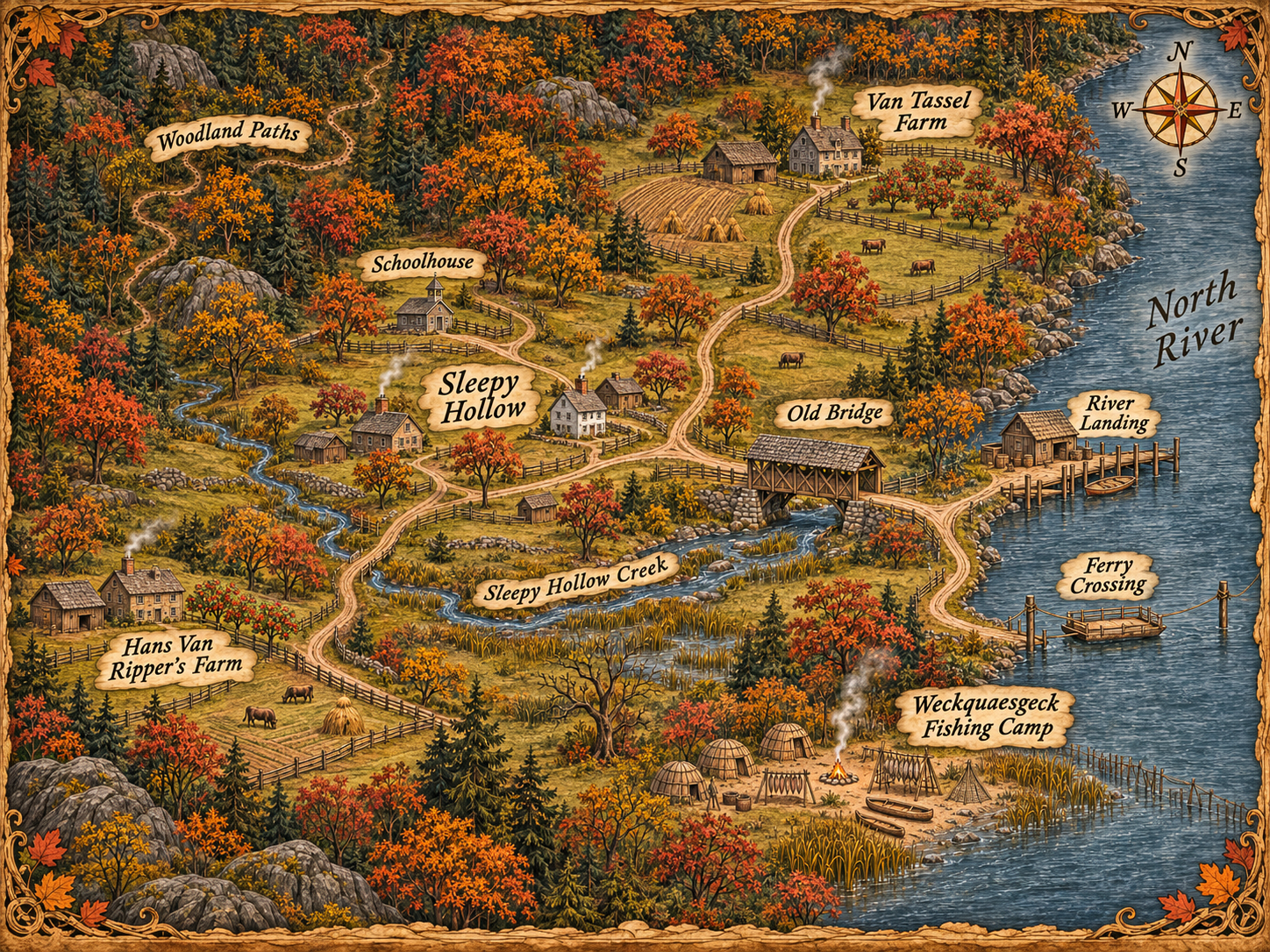
The ferry is late, and Ichabod Crane has copied three different descriptions of the rider who crossed the bridge. One witness saw a horse without a head, another a man carrying a covered lantern. A third heard wheels on the river track after the last boat came in. Ichabod wants someone braver than himself to walk the road before dusk.
Sleepy Hollow is a sheltered valley of orchards, small farms and wooded paths, not a walled town. The river brings travellers and trade; the creek can trap a cart after a heavy rain. Neighbours remember who offered shelter, who broke a promise and who last passed the old crossing at night.
What Is Happening Right Now?
The empty ferry. A boat drifted to the lower bank with its cargo still tied down. The missing ferryman’s pole is gone. A child heard hoofbeats; a mill-hand saw an unlit cart; neither agrees where the rider went.
The demands. Katrina Van Tassel wants the ferryman found. Brom Bones wants his name cleared of a prank he denies playing. The ferryman’s family wants the crossing restored but will not risk another life on the same road.
The first clue. The boat’s side bears a fresh mark from a warehouse hook. Ichabod can show the players his notes, the ferry schedule and the names of witnesses, but he will not follow the trail without company.
Places in the Hollow
The Schoolhouse
Ichabod teaches here, records each household’s children and keeps a ferule and birch rod for harsh school discipline. Three leaves have been torn from his register, each naming a family near the river.
The Van Tassel Farm
Baltus Van Tassel’s well-kept orchards, granary and harvest table make the household a meeting place. A feast here can draw traders, rivals and witnesses into one room without a formal court.
The Old Bridge
A narrow timber crossing above the creek, reached by a tree-lined path. A traveller may meet a prankster in costume and, on the same night, a genuine rider who leaves no tracks.
The River Landing
Small craft, fishing boats and ferries connect the valley to the North River. Floods can make the track impassable; a missing ferry operator strands households and their provisions.
The Older Forest Paths
Weckquaesgeck communities and their neighbours know routes through their own woodlands and fishing grounds. Their territory is neither empty nor subject to Dutch merchants’ papers. A guide is engaged by agreement.
People, Relationships and Motives
Ichabod Crane — schoolmaster. Learned, vain, strict and superstitious, he knows family records and ghost stories. His help is valuable, but his fear can turn a rumour into a false certainty.
Katrina Van Tassel — independent host. Confident and observant, she wants the missing ferryman found and is tired of having other people’s rivalries imposed upon her.
Baltus Van Tassel — prosperous farmer. His grain, hospitality and influence keep neighbours talking. He fears an accusation made without evidence will split the valley.
Abraham “Brom Bones” Van Brunt — local rider. Brave, proud and capable of cruel jokes. He has frightened Ichabod before but also knows the woodland roads well enough to find a living culprit.
Weckquaesgeck neighbours — independent river people. Their households, councils and guides decide their own agreements about travel, fishing, woodland use and trade. They are neither colonists’ subjects nor collective suspects in the haunting.
The Headless Horseman — the real danger. A headless rider is reported near the crossing. Some sightings have mortal causes; others do not. He is not automatically the same creature as a dullahan from another tradition.
Shelter, Work and Unusual Help
Farm households may offer a meal and bed, river workers can arrange a crossing, and a local guide can be hired for woodland paths. Supplies are modest: food, rope, lamp oil, basic repairs and horse care. There is no large market, magical academy or resident shopkeeper selling enchanted weapons.
Ichabod copies letters, consults records and identifies the owners of familiar carts. Ordinary healers treat sickness and injuries; neighbours sometimes hang folk charms against bad luck. Such customs matter to them but do not make a house magically proof against a ghost.
River spirits appear in some stories, but travellers must investigate what they actually encounter rather than assuming every odd ripple comes from a nixie.
Dangers and Consequences
The false rider. A smuggler’s cloak, false head and muffled lantern can clear a bridge of witnesses without any supernatural power.
The true rider. The Headless Horseman may appear with no breath or hoofprints, driving travellers towards the dangerous crossing. A direct confrontation can overwhelm a low-level party.
River flood. Cold water, slippery banks and fallen trees threaten careless travellers. Even a short detour can force a group to travel after dark.
Trust and conduct. Guests who steal, threaten neighbours or disregard the rights of nearby independent communities lose guides, lodging and testimony. Brom’s intimidating pranks are not rendered harmless by his popularity.
Adventure Hooks
The Missing Pages
Three leaves stolen from Ichabod’s school register identify households whose children saw stolen cargo unloaded. A buyer from New Amsterdam is searching for the same witnesses. Recover the pages before the families are pressured into silence.
Two Riders on One Road
A false Horseman keeps travellers away from the river, but another rider leaves no hoofprints at all. The characters must distinguish the smuggler’s disguise from the genuine haunting and locate what has been hidden under the bridge.
Gunpowder Returns Alone
Gunpowder, borrowed from Hans Van Ripper, returns riderless. Ichabod is hiding in a riverside shed, and a living pursuer is closing on him. Rescue the schoolmaster and question the pursuer before the ferry investigation goes cold.
Travel and Local Customs
Small boats carry travellers down the North River towards New Amsterdam and the rest of New Netherland. Footpaths and muddy cart tracks connect the farms. Rain, fallen timber and river floods change a journey far more than an official timetable.
Ask before entering another household’s fields or taking a forest path through community lands. Local guidance is a matter of mutual agreement. After sunset villagers travel in pairs, carry lanterns and avoid the bridge when hoofbeats are heard with no rider in sight.
Running the Old Bridge
Three linked problems drive the scene: stolen cargo, contradictory witness accounts and a genuine supernatural presence. The goal is to recover the ferryman and identify the mortal culprit, not to defeat the Horseman. Bring in the Headless Horseman entry only if the haunting attacks.
Bridge at Dusk
Follow the tracks. DC 13 Wisdom (Survival) locates the cart trail; DC 14 Intelligence (Investigation) finds a warehouse-hook scar on the ferry pole.
Win a witness. DC 13 Wisdom (Insight) recognises a rehearsed claim; DC 13 Charisma (Persuasion) helps a frightened villager tell the whole story. A DC 13 Strength (Athletics) check secures a rope across the flooded creek. Failure costs time rather than automatic damage.
Bridge at Dusk
Find the evidence. Wisdom (Survival) DC 13 tracks the cart; Intelligence (Investigation) DC 14 finds a splinter from the missing pole.
Cross safely. Wisdom (Insight) DC 13 catches inconsistent testimony, Charisma (Persuasion) DC 13 reassures the witness, and Strength (Athletics) DC 13 helps secure the crossing. Failed checks change the situation without demanding combat.
Bridge at Dusk
Trace the cart. Survival DC 15 follows the ruts; Perception DC 15 reveals the warehouse-hook damage; Knowledge (local) DC 15 identifies the owner.
Resolve the scene. Sense Motive DC 15 catches rehearsed testimony, Diplomacy DC 15 earns cooperation, and Climb DC 15 permits passage along the wet bank with a fixed rope. The haunting has its own rules if encountered.
Bridge at Dusk
Trace the cart. Survival DC 15 follows the tracks; Search DC 15 identifies the pole fragment; Gather Information DC 15 locates the household that hired the cart.
Find a way through. Sense Motive DC 15 catches evasive testimony; Diplomacy DC 15 secures help; Use Rope DC 15 anchors a line and Climb DC 15 helps cross the bank. The reward is rescuing a witness and learning the truth.
The Valley and Its Later Legend
Weckquaesgeck communities and other river peoples have long used the tributaries, fishing places and wooded routes of the North River. In the campaign year the Dutch farms are newer neighbours within their established homelands, not rulers over the entire valley.
Historical Dutch New Netherland dates from the seventeenth century, and Washington Irving’s The Legend of Sleepy Hollow appeared in 1820. The colony, its schoolmaster and the haunting exist earlier in this setting. The later Philipsburg manor, the Old Dutch Church, Revolutionary War soldiers and Major André are not events already past in 1454. The Horseman’s story is older and has a different local history here.
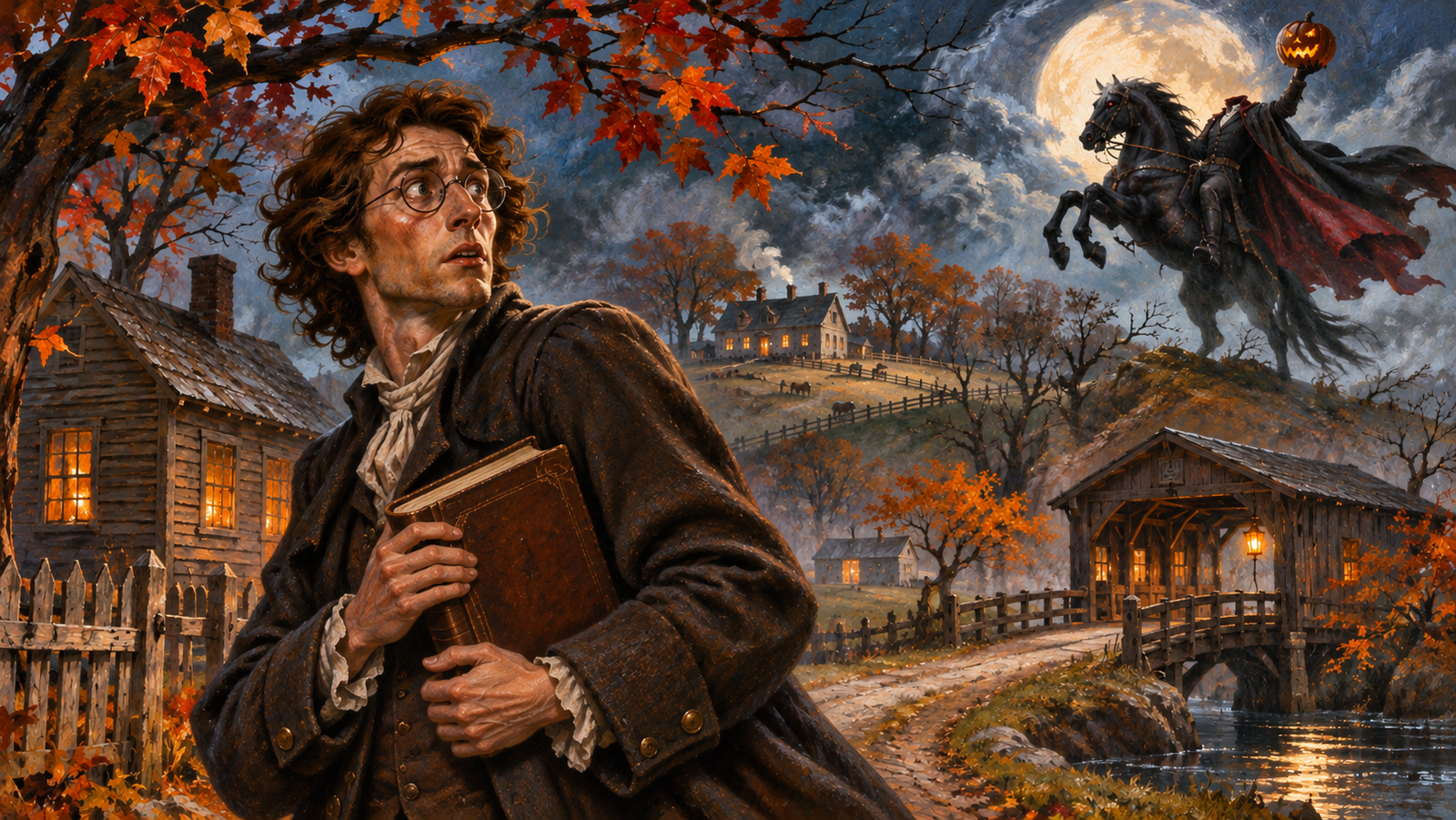
The Legend in Paint

Historical Sources
Sleepy Hollow village history discusses the valley’s later settlement and the Weckquaesgeck; the New York State Museum researches Indigenous names along the Pocantico; and the Dutch National Archives provides the historical date of New Netherland. Read Irving’s original story for the later literary source.
Further Along the River
New Netherland · New Amsterdam · North America · Ichabod Crane · Headless Horseman · Dullahan
Keep this reference growing
If this page helped with your reading or game, you can support its upkeep or explore the curated books.
Explore the Bookshop — epics, classics and stories behind imagined worlds.