
New Amsterdam — Harbour of New Netherland
At a Glance
| Place | New Amsterdam, principal port of New Netherland |
|---|---|
| Campaign Year | 1454 CE |
| Where | Southern Manhattan, between the North River and the eastern tidal strait |
| Government | A harbour governor, a merchant council and the fort garrison; local agreements also matter |
| Connections | County of Holland, Atlantic ships, neighbouring Munsee-speaking Lenape communities and upriver traders |
| Work | Fur trading, fisheries, timber, coastal shipping, river freight, ship repairs and small workshops |
| Peoples | Dutch sailors and settlers, Lenape neighbours and merchants, visitors from other Atlantic ports, dwarven artisans and gnome gunsmiths |
| Dangers | Storm tides, fire, smuggling, rival trading claims and treacherous river crossings |
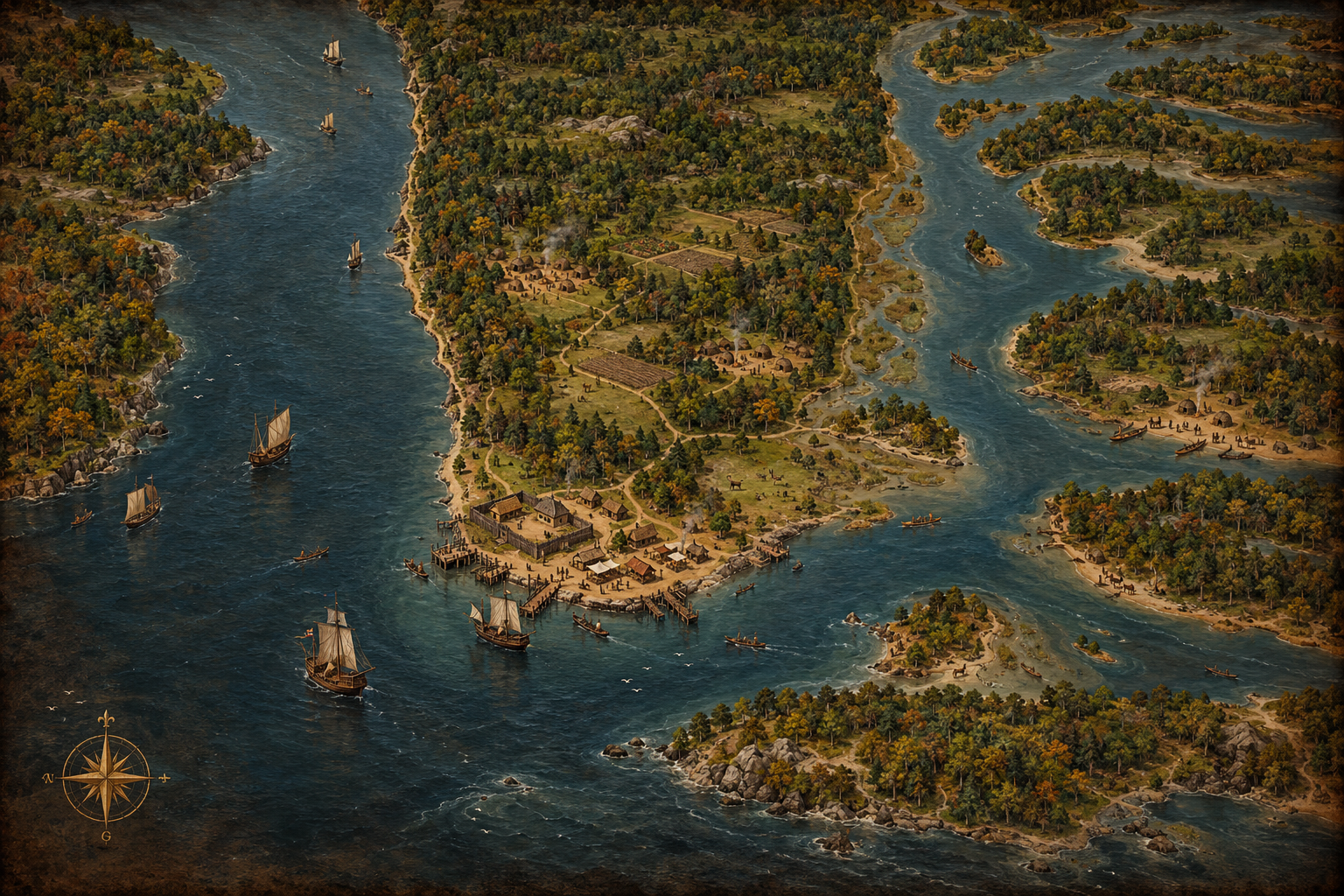
Map of New Amsterdam
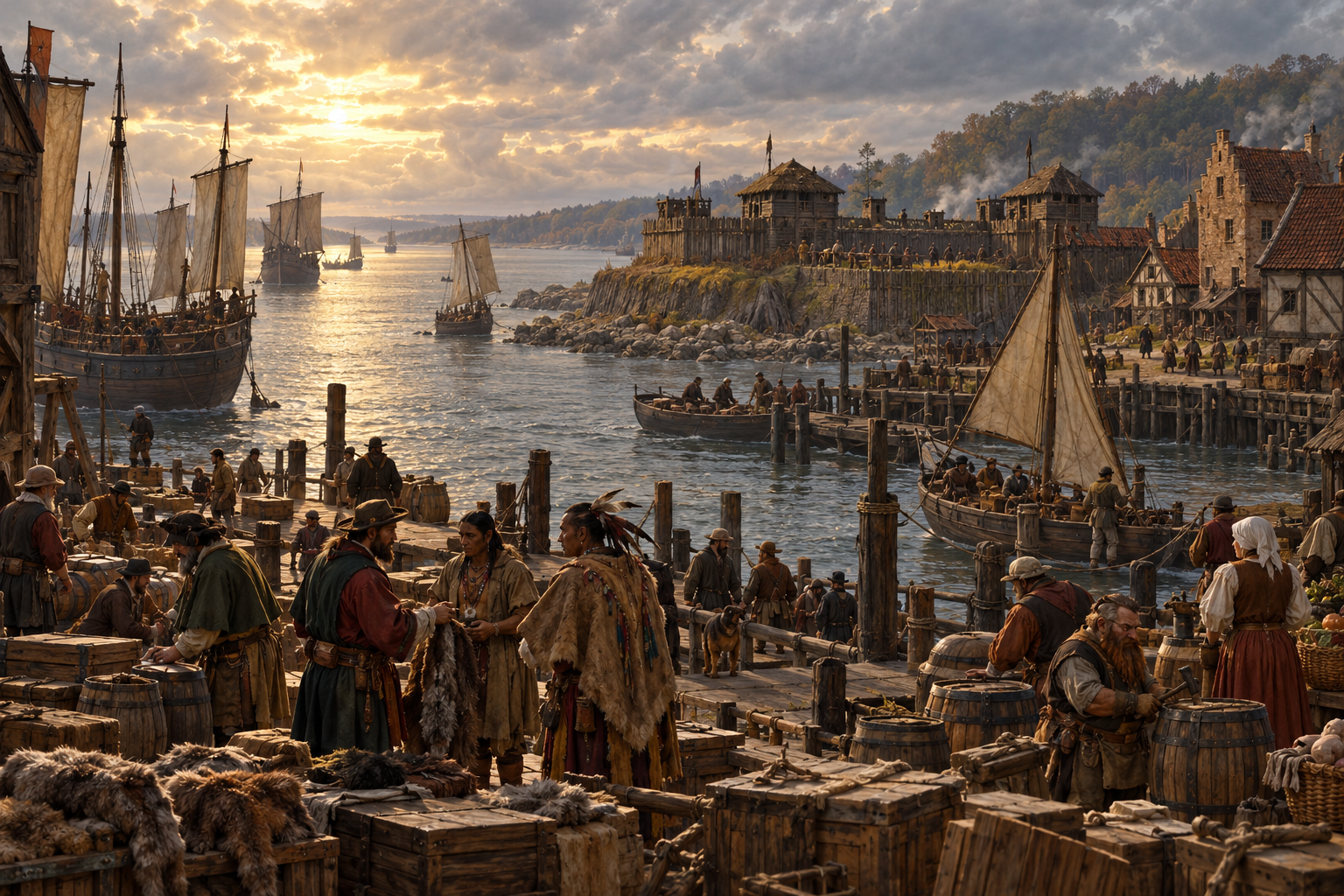
A boat rocks against the landing while a quarrel spreads across the quay. Dockhands are weighing bundles of beaver skins, shipwrights are caulking a leaking hull, and a captain is looking for the interpreter who promised to meet him at dawn. A timber fort watches the anchorage. Smoke rises over storehouses, gardens and crowded lanes, but beyond the last shed the shore belongs to a much older world.
New Amsterdam is a port where a ship can find repairs, a trader can buy passage and a stranger can become involved in a dispute before finishing breakfast. Its Dutch inhabitants depend upon partnerships with the Munsee-speaking Lenape communities around Manhattan and the waterways. Their villages, cultivated lands, fisheries, routes and governments are not possessions of the fort. A Dutch ship’s papers may be impressive on the quay and meaningless inland.
Manhattan Harbour and the North River
New Amsterdam occupies the southern end of Manhattan. The North River carries small boats, dugout canoes and traders towards upstream settlements and existing Indigenous routes. The eastern channel reaches other island shores and tidal creeks. Ocean-going vessels need the deeper harbour approaches; smaller craft can reach landings a ship’s master will never see. A river pilot is paid for knowing particular shallows, currents and people, not merely for knowing north from south.
The fort overlooks wharves and sheltered storehouses. Gardens and small fields occupy the firmer ground behind the town. Forest, streams and inhabited country extend beyond. The harbour connects to the wider North American network without controlling it.
What Is Happening Right Now?
The Boat with Two Owners
A cargo boat arrives with furs, meal and a dead helmsman. Maerten Voss holds a bill of sale; Wenita, a Lenape negotiator, says the goods were entrusted for another journey. Mother Mandelbaum has offered to purchase the cargo, but insists the signatures must first be checked. The missing witness was last seen entering a warehouse watched by Bill Poole’s men. The buyers, sellers and river partners have different claims; only recovering the witness can prevent the loss of trust.
A Captain’s Unsigned Commission
Captain Kidd has returned to port seeking crew and repairs. Someone is selling letters of commission in his name; a seized vessel’s master swears Kidd personally authorised the attack. Kidd wants the forgery traced before another ship is lost. Boss Tweed’s clerks control the evidence and offer to release it only after a useful favour.
Powder for an Unknown Buyer
Tove Brasspin has been commissioned to finish six fine firearm mechanisms. The customer wants delivery to an unnamed vessel at night. Mandelbaum knows the intended recipient but will not betray a client without proof of imminent harm. Tove will abandon the sale if the weapons are destined for the riders robbing river families.
Places Worth Visiting
Fort Amsterdam
The timber and earthwork fort commands the anchorage. Its small garrison watches approaching ships, guards the powder store and escorts sensitive messages. It can defend the harbour but cannot enforce orders throughout the interior.
The Fur Quay
Bales of skins, grain sacks and barrels pass between the scales and the waterfront. Boatmen, visiting families, interpreters and merchants negotiate prices. It is the best place to obtain a river guide, news of a missing cargo or a berth on a departing boat.
De Oude Touw — The Old Rope
Geertruyd van Rijn keeps an inn near the shipwrights’ sheds. She sells rye bread, fish stew, beer, shared loft beds and one lockable private room. Sailors exchange news over a long table. She can introduce reliable labourers and knows who tried to leave port under an assumed name.
Mandelbaum’s Dry-Goods House
Mother Mandelbaum receives customers in a respectable shop, while stolen cargo moves through guarded back rooms. Her thieves are paid promptly; dispossessed owners are offered ruinous bargains for their own property. Her informants notice everyone who asks questions, and anyone who threatens her business may discover that debts, witnesses and watchmen can all be turned against them.
The Waterfront Ward and the Butchers’ Yard
Bill Poole and his street followers gather near the slaughter stalls, hiring out their fists and defending their territory. Boss Tweed cultivates support among neighbouring traders and officials, and neither side can fully control the other. A young dockhand pressed to work for both may become the most dangerous witness in the harbour.
The North River Landing
Shallow craft load tools, food, firewood and textiles for upriver trade. The crews will not promise safe passage through unfamiliar stretches merely because a customer offers more coin.
Smiths’ Lane
Dwarven metalworkers, Dutch wheelwrights and gnome precision craftsmen work beside one another. Repairs to tools, armour, boats and common firearms can be bought; intricate weapons require a specialist’s workshop and time.
People, Factions and Their Rivalries
Established Figures in New Amsterdam
Fredericka “Mother” Mandelbaum — the Queen of Thieves (neutral evil). Her dry-goods shop fronts a criminal empire of fences, smugglers and informants. She pays loyal thieves, buys the silence of witnesses and gives selectively to the poor, but knowingly profits when working families lose their possessions. A missing shipment may pass through her stores; she will return it only for a favour, a rival’s name or a price its rightful owner can scarcely afford. She favours blackmail and dependency over unnecessary killing because both preserve her profits.
William “Boss” Tweed — political patron (lawful evil). Tweed’s Tammany Hall connections are a powerful part of the city’s political underworld. In the harbour, he cultivates clerks, ward officers and contractors whose livelihoods depend on his favour. His opponents lose permits, jobs and witnesses while every decision appears regular on the books. He wants access to the waterfront’s profits without accepting responsibility for its failures.
William “Bill the Butcher” Poole — waterfront enforcer (chaotic neutral). Poole’s Bowery Boys live by violent loyalties and street reputation rather than careful ledgers. He may defend his own men with genuine courage while threatening newcomers and rival gangs. He and Tweed can use one another, but neither trusts the other’s claim to command the streets. A party looking for dockside muscle will find him easier to hire than to control.
William “Captain Kidd” Kidd — privateer and returning sea captain (lawful neutral). Kidd knows the harbour from his early life and is familiar with the ocean routes beyond it. He returns for repairs, investors, an informant or a berth when his voyages bring him north; he does not live permanently at the quay. He prefers a defensible commission and a worthwhile prize to needless killing, but creditors and rivals know how to turn that calculation against him.
Residents, Trading Partners and Working People
Maerten Voss — lawful neutral harbour factor. He keeps careful accounts, pays contracted wages and impounds cargo when the records fail. Mandelbaum can offer him an apparently legitimate purchaser, but he will demand a credible bill of sale.
Wenita — neutral good river negotiator. She protects the goods, travel agreements and safety of the people who have entrusted her with a negotiation. She will help stranded strangers without selling away another community’s rights. Neither Tweed’s influence nor Poole’s threats give the harbour power over her homeland.
Tove Brasspin — chaotic good gnome gunsmith. She teaches apprentices and refuses commissions for predatory raids. Her precision weapons make her valuable to merchants, criminals and privateers alike; she will dismantle an order before knowingly arming river robbers. Her craft belongs to the gnome workshop traditions of the wider frontier.
Geertruyd van Rijn — neutral innkeeper. She keeps the Old Rope supplied with hot food and honest dockside news, shelters injured sailors and refuses to hide a murderer for payment.
Hendrik Staal — lawful evil customs captain. His seizures enrich favoured traders and informers. He has dealings with Tweed’s patrons, but fears losing his authority to Poole’s street violence or Mandelbaum’s quieter bribery.
The harbour council maintains the port but quarrels over influence. Mandelbaum’s Criminal Exchange, Tweed’s political clients and Poole’s street followers are separate organisations with conflicting interests, not a single criminal fraternity. Upriver partnerships speak for their own communities and need not obey any of them.
Food, Lodging, Equipment and Magic
De Oude Touw offers food and sleeping space; the chandlers sell rope, sailcloth, lamp oil and fittings. The shipwrights repair hulls and the smiths mend everyday gear. A captain can be hired for a sea voyage, but weather decides the departure. An experienced guide, interpreter or pilot is essential for many river journeys.
Healers treat rope burns, broken bones, fever and wounds from dockside work. Sacred practitioners belong to particular communities; their services depend on relationship and obligation, not a universal magic shop. River pools beyond the settlement may be guarded by creatures such as a nixie, but most dangerous currents are ordinary tidal hazards.
Alongside their household faiths, some sailors from Holland and Zeeland honour Nehalennia before an Atlantic passage and offer thanks to Hludana for a safe fishing catch. Their rites travel with their ships; they do not supersede the sacred traditions of the Indigenous communities whose waters and lands they visit.
Dangers and Adventure Hooks
The Missing Interpreter. A key witness to a river agreement disappears before a visiting delegation arrives. Find the captive before a false accusation becomes bloodshed.
Forty Cartridges. Stolen gnome ammunition appears in a smuggler’s purse. The smith wants it recovered; the customs captain wants a scapegoat.
Water Under the Powder. Deliberate damage to a sluice threatens the fort’s magazine. The party can save the trapped workers and find the saboteur.
False Fur Marks. Someone has forged the mark of a respected upriver trading partner. The real traders face retaliation unless the counterfeit goods are traced.
Travel and Authority
By sea: Merchants arrive from Holland, other Atlantic harbours and the Caribbean. Privateers, storms and seasonal weather interrupt passage. By river: A local pilot can explain channels and the agreements governing specific landings. On foot: Trails pass through farms, woods and communities whose rights do not depend on the fort’s approval.
The harbour watch can detain thieves and settle ordinary market quarrels. Outside its immediate reach, a contract from a New Amsterdam clerk is not a claim of sovereignty over someone else’s villages, fields or fishing places.
Running New Amsterdam at the Table
Use the harbour dispute, warehouse fire or smuggling investigation with the ruleset at your table. Each panel stands alone.
New Amsterdam — D&D 2024
The disputed cargo: DC 13 Intelligence (Investigation) reveals an altered tally; DC 15 Wisdom (Insight) identifies withheld information without proving guilt; DC 13 Charisma (Persuasion) convinces the factor to postpone a seizure while witnesses are found. Warehouse rescue: DC 15 Strength (Athletics) forces a smoke-jammed door; a character who proposes another sound method can attempt an appropriate DC 15 ability check. Use the Guard and Bandit stat blocks for ordinary watchmen and attackers. Reward recovery of evidence, rescue and negotiation as viable solutions.
New Amsterdam — D&D 2014
The disputed cargo: DC 13 Intelligence (Investigation) exposes the false tally, DC 15 Wisdom (Insight) detects evasive testimony and DC 13 Charisma (Persuasion) earns time for a hearing. Warehouse rescue: DC 15 Strength (Athletics) breaks the blocked doorway, or another suitable DC 15 check handles an imaginative rescue. Guard and Bandit stat blocks are suitable for an encounter that turns violent; the objective is to save people and recover testimony rather than defeat every opponent.
New Amsterdam — Pathfinder 1e
The disputed cargo: Linguistics DC 15 identifies an altered ledger entry, Appraise DC 15 exposes a suspect valuation, Sense Motive DC 15 spots evasive testimony and Diplomacy DC 15 gains a hearing. Warehouse rescue: a DC 15 Strength check forces the door. Use 1st-level commoners for dockworkers and 1st-level warriors for trained watchmen; prepare their normal stat blocks if combat becomes necessary. Finding the missing witness resolves the underlying conflict.
New Amsterdam — D&D 3.5e
The disputed cargo: Forgery DC 15 recognises an altered cargo mark, Appraise DC 15 identifies a false valuation, Sense Motive DC 15 catches evasive testimony and Diplomacy DC 15 secures time for a hearing. Warehouse rescue: Strength DC 15 opens the jammed door. Use commoner 1 for untrained dockworkers and warrior 1 for ordinary watch soldiers. The opposing faction wants property or influence, not necessarily a fight to the death.
How New Amsterdam Came to the River
Earlier Atlantic settlement and sustained trade brought merchant interests from the Low Countries to Manhattan. The original waterside factorij became a working town beside Fort Amsterdam, with New Netherland’s main harbour at its southern end. In 1454 the merchants’ home ports belong to the political world of Philip the Good’s Holland; trade and local governance here are not administered by the seventeenth-century Dutch West India Company or a later Dutch republic.
The people of the surrounding river country possess their own histories, laws, alliances and means of enforcing them. The fort survives because ships and markets create valuable partnerships, and those partnerships can fail when either side refuses to hear the other.
Historical Sources
The Dutch National Archives records the historical Dutch arrival in the 1620s, while the New York City historical account provides later background on the fort and settlement. The famous Castello Plan dates to the 1660s; it is not a map of the settlement in 1454. The named residents, incidents and earlier colonial development are part of this setting.
Nearby Lands and Further Reading
New Netherland · North America · Holland · Factions and Organisations · Nixie
Keep this reference growing
If this page helped with your reading or game, you can support its upkeep or explore the curated books.
Explore the Bookshop — epics, classics and stories behind imagined worlds.