
Gnoll – Hyena-Headed Raider, Slaver and People-Eater
Gnoll – Hyena-Headed Raider, Slaver and People-Eater
Harsh laughter rolls through the darkness. Tall, slope-backed figures rise from the grass with hide shields forward and spears levelled. Hyenas circle behind them, waiting for the first wounded creature to fall.
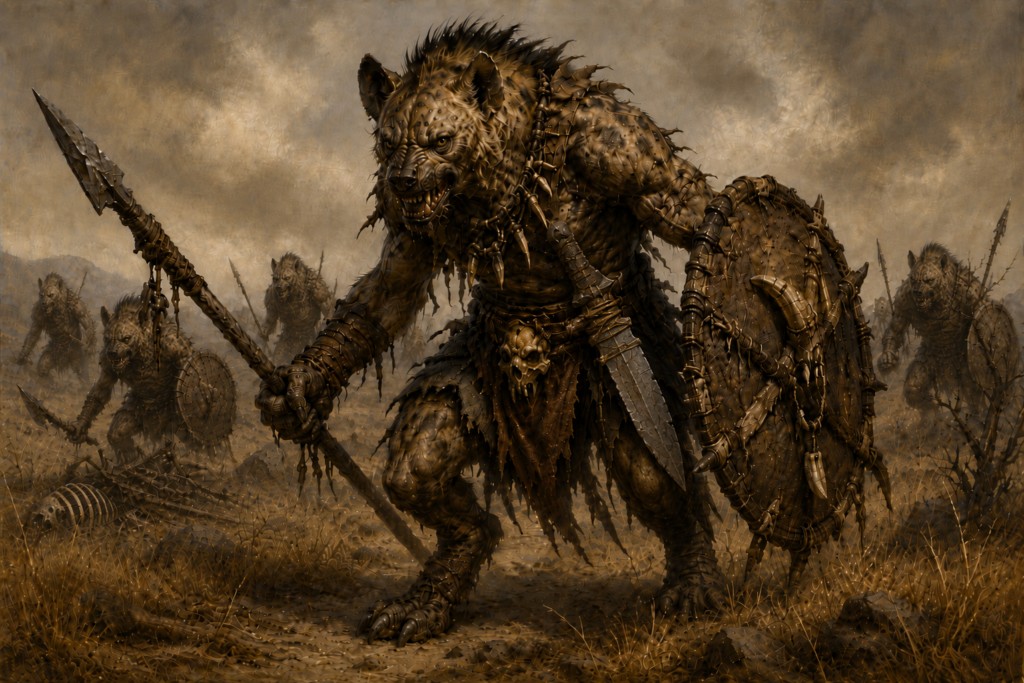
Gnolls are powerful hyena-headed humanoids whose ancestors have inhabited the grasslands, dry woodlands and desert margins of Africa and Eurasia since the Ice Ages. They live as hunters, herders, raiders, slavers, mercenaries and rulers of fortified dens, pastoral kingdoms and predatory tribute states.
Most gnoll societies are usually chaotic evil. Raiding, enslavement, livestock theft, tribute-taking and violence against weaker neighbours are common foundations of gnoll power. Many gnolls also eat other people. Enemy dead, condemned captives and prisoners considered more valuable as meat than labour may be butchered and consumed.
Gnolls are intelligent mortal persons, but the average gnoll possesses less abstract intelligence than the average human. Gnolls readily learn hunting methods, local terrain, pack hierarchy, animal handling and familiar weapons, but most struggle with advanced engineering, written administration, complicated mathematics and crafts requiring long apprenticeships.
Gnoll states therefore rely upon direct authority, oral law, visible tribute, enslaved scribes, subject craftspeople and unusually capable rulers. Their equipment favours simple, powerful and easily repaired weapons rather than complex armour, firearms or elaborate machinery.
Most established clans are matrilineal and female-dominated. Rank and territorial rights commonly pass through maternal lines, while adult males often leave their birth clan and enter another at low status. This pattern influences inheritance and clan politics without determining every gnoll culture; mercenary companies, cult hosts, displaced packs and foreign client regimes may follow different forms of leadership.
The most destructive packs worship Yeenoghu, the Demon Prince of Gnolls. Yeenoghu did not create gnollkind. He claimed and corrupted an existing mortal people, transforming predatory customs into doctrines of limitless hunger, wasteful killing and self-destruction.
Gnoll at a Glance
- Creature Type: Humanoid (gnoll)
- Typical Alignment: Usually chaotic evil
- Average Intelligence: Lower than human; practically cunning but poorly suited to abstract scholarship and complex manufacture
- Social Structure: Pack- and clan-based; many established clans are matrilineal and female-dominated
- Deep Origin: Eastern and northeastern Africa during the later Shattered Crown
- Ancestral Lineage: Ancient hyaenid stock that flourished as grasslands spread during the Age of Open Lands
- Typical Habitat: Savannah, dry grassland, scrub, semi-desert, badlands, dry woodland, rocky uplands and frontier ruins
- Principal Distribution: Africa, Arabia, the Levant, Persia, Central Asia and western or central India
- Common Roles: Hunter, raider, slaver, herder, tracker, scavenger, mercenary, frontier soldier or tribute collector
- Diet: Omnivorous, with a strong preference for meat, marrow and fat; many packs consume other humanoids
- Languages: Gnoll and regional languages learned through trade, conquest, slavery or military service
- Common Arms: Spear, javelin, club, greatclub, battleaxe, heavy cleaver, shortbow and crude polearm
- Common Armour: Quilted cloth, layered hide, rough leather, bone reinforcement and hide-covered wooden shields
- Rare Armour: Scavenged mail shirts or simple scale armour worn by wealthy leaders, mercenaries and guards
- Household and Working Animals: Hyenas
- Elite Mounts and War-Beasts: Hyaenodons
- Despised Dependants: Pugwampis
- Savage Associates: Leucrottas, crocottas, ghuls and werehyenas
- Common Enemies: Rival gnoll clans, Yeenoghu cults, settled frontier states, merchant leagues, hobgoblin empires, orc confederacies, minotaurs and slave-taking kingdoms
- Common Signs: Crushed bones, butchered remains, crude scent boundaries, gnawed shields, digitigrade tracks mixed with hyena prints and laughing calls after sunset
Appearance
A typical adult gnoll stands approximately seven to eight feet tall and weighs around 260 to 360 pounds. Long arms, heavy shoulders, a sloping back and digitigrade legs give the creature a forward-leaning posture and a powerful, ground-covering stride.
Female gnolls average somewhat taller and more robust than males, but the ranges overlap widely. A gnoll’s rank depends more upon clan standing, alliances, reputation and recognised authority than physical size alone.
Gnoll fur may be tawny, yellow, reddish-brown, grey, black or pale sand-coloured. Spots, stripes and irregular markings are common. A ridge of longer hair usually runs from the crown down the neck and upper back, rising when the gnoll is alarmed, excited or preparing to attack.
The head has a long muzzle, broad jaws and large mobile ears. Gnoll jaws can crack smaller bones and reduce carcasses that many other humanoids would leave untouched. Their eyes reflect weak light, while their hearing and sense of smell make them difficult to surprise in open country.
Gnolls decorate weapons, armour and shields with dyed hide, carved bone, teeth, copper rings, feathers, enemy hair and trophies taken during important hunts. Clan leaders display inherited ornaments, territorial marks and trophies associated with the dens, wells and bloodlines they control.
Game Statistics
Each gnoll variation is followed immediately by its D&D 5E, Pathfinder 1E and D&D 3.5E versions. Rules from one system do not apply to another unless deliberately converted.
Gnoll Leadership Titles
Gnoll titles describe what a leader controls rather than a universal hereditary hierarchy. A title remains valid only while the leader possesses enough followers, resources and reputation to enforce it.
| Title | Authority | Typical Function | Mechanical Use |
|---|---|---|---|
| Pack-Fang | A household, hunting pack or raiding band | Veteran warrior, disciplinarian and immediate battlefield leader | Use the Gnoll Pack-Fang statistics |
| Hunt-Captain | Several packs, a mercenary company or a body of riders | Scout commander, pursuit leader and regional hyaenodon rider | Use the Gnoll Hunt-Captain statistics |
| Den-Mother | An established clan, sacred den or several related households | Senior matriarch, judge, genealogist and guardian of the young | Use a Pack-Fang, Carrion-Seer or Well-Lord according to the individual |
| Carrion-Seer | A shrine, sacred hunting ground, plague camp or cult | Priest, oracle, druid, corpse-reader or interpreter of supernatural omens | Use the Gnoll Carrion-Seer statistics |
| Well-Lord | A permanent settlement, several wells or a tributary territory | Chieftain, fortress ruler, pastoral monarch or mercenary prince | Use the Gnoll Well-Lord statistics |
Some old matrilineal clans use Well-Mother as a traditional alternative to Well-Lord. It is an office title and does not require the holder to have borne or raised young.
Mechanics 5E — 2024, Pathfinder 1E
Gnoll
Gnoll Pack-Fang
Gnoll Hunt-Captain
Gnoll Carrion-Seer
Gnoll Well-Lord
Gnoll
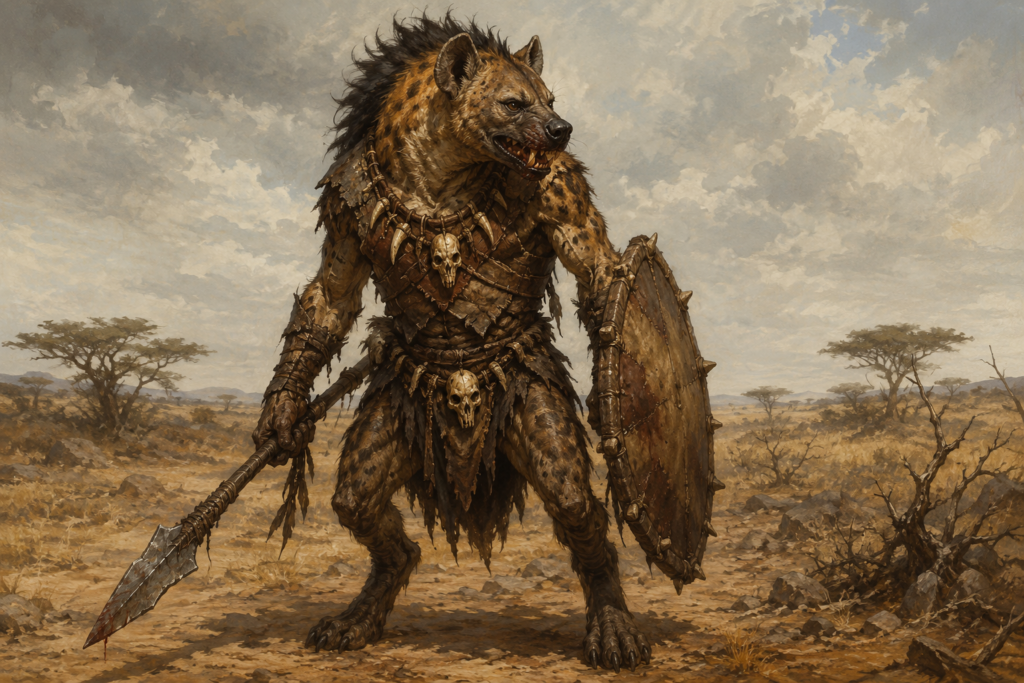
The ordinary gnoll is a hunter, herder, raider, guard or lightly equipped warrior. Most fight beneath the direction of a Pack-Fang or stronger leader.
D&D 5E — 2024-Compatible Gnoll
Medium Humanoid (Gnoll), Chaotic Evil
Armor Class 15 (hide armor, shield)
Initiative +1 (11)
Hit Points 22 (5d8)
Speed 30 ft.
| STR | DEX | CON | INT | WIS | CHA |
|---|---|---|---|---|---|
| 14 (+2) | 12 (+1) | 11 (+0) | 6 (−2) | 10 (+0) | 7 (−2) |
Senses darkvision 60 ft., passive Perception 10
Languages Gnoll
Challenge 1/2 (100 XP; PB +2)
Bonus Actions
Rampage. When the gnoll reduces a creature to 0 Hit Points with a melee attack on its turn, the gnoll moves up to half its Speed and makes one Bite attack.
Actions
Bite. Melee Attack Roll: +4, reach 5 ft. Hit: 4 (1d4 + 2) Piercing damage.
Spear. Melee or Ranged Attack Roll: +4, reach 5 ft. or range 20/60 ft. Hit: 5 (1d6 + 2) Piercing damage, or 6 (1d8 + 2) Piercing damage when used with two hands in melee.
Longbow. Ranged Attack Roll: +3, range 150/600 ft. Hit: 5 (1d8 + 1) Piercing damage.
Equipment Use
A gnoll using its longbow cannot actively use its shield; its Armor Class is 13 until it readies the shield again.
A gnoll using its spear with two hands also has Armor Class 13 while its shield is not readied. A spear used in one hand deals 1d6 + 2 damage and allows the gnoll to retain Armor Class 15.
Many gnoll hunters replace the longbow with a shortbow or several javelins when fighting in scrub, ruins or broken ground.
Tactics
- Spear-and-shield gnolls advance while hunters fire from cover.
- Gnolls concentrate upon isolated, wounded or lightly armoured enemies.
- Rampage is used to reach another vulnerable target.
- Gnolls follow simple plans and become disorganised when their leader falls.
- Ordinary gnolls retreat when defeat becomes clear.
Pathfinder 1E Gnoll CR 1
XP 400
CE Medium humanoid (gnoll)
Init +0; Senses darkvision 60 ft.; Perception +2
Defense
AC 15, touch 10, flat-footed 15 (+2 leather armor, +1 natural, +2 heavy wooden shield)
hp 11 (2d8+2)
Fort +4, Ref +0, Will +0
Offense
Speed 30 ft.
Melee spear +3 (1d8+3/×3) or battleaxe +3 (1d8+2/×3)
Ranged spear +1 (1d8+2/×3) or shortbow +1 (1d6/×3)
Statistics
| STR | DEX | CON | INT | WIS | CHA |
|---|---|---|---|---|---|
| 15 (+2) | 10 (+0) | 13 (+1) | 8 (−1) | 11 (+0) | 8 (−1) |
Base Atk +1; CMB +3; CMD 13
Feats Power Attack
Skills Perception +2
Languages Gnoll
Ecology
Environment warm plains or desert
Organization solitary, pair, hunting party (2–5 gnolls and 1–2 hyenas), band (10–100 adults plus young and one Pack-Fang per 20 adults), or clan (20–200 gnolls, several Pack-Fangs, one senior leader, 7–12 hyenas and 4–7 hyaenodons)
Treasure NPC gear
Equipment Adjudication
- Spear: Melee spear +3 (1d8+3/×3), or ranged spear +1 (1d8+2/×3) if thrown; the shield is not used, reducing AC to 13.
- Battleaxe and Shield: Melee battleaxe +3 (1d8+2/×3); AC remains 15.
- Shortbow: Ranged shortbow +1 (1d6/×3); the shield is stowed or dropped, reducing AC to 13.
Tactics
Before Combat: Gnolls use darkness, scrub, ruins or broken ground to conceal their approach.
During Combat: Gnolls flank isolated opponents and concentrate attacks upon visible leaders. A gnoll using Power Attack with a two-handed spear attacks at +2 and deals 1d8+6 damage.
Morale: Ordinary gnolls retreat when half their number have fallen, their leader is defeated or victory is clearly impossible.
D&D 3.5E Gnoll
Medium Humanoid (Gnoll)
Hit Dice 2d8+2 (11 hp)
Initiative +0
Speed 30 ft. (6 squares)
Armor Class 15 (+1 natural, +2 leather armor, +2 heavy wooden shield), touch 10, flat-footed 15
Base Attack/Grapple +1/+3
Attack battleaxe +3 melee (1d8+2/×3) or shortbow +1 ranged (1d6/×3)
Full Attack battleaxe +3 melee (1d8+2/×3) or shortbow +1 ranged (1d6/×3)
Space/Reach 5 ft./5 ft.
Special Attacks —
Special Qualities darkvision 60 ft.
Saves Fort +4, Ref +0, Will +0
| STR | DEX | CON | INT | WIS | CHA |
|---|---|---|---|---|---|
| 15 | 10 | 13 | 8 | 11 | 8 |
Skills Listen +2, Spot +3
Feats Power Attack
Environment warm plains
Organization solitary, pair, hunting party, band or clan
Challenge Rating 1
Treasure standard
Alignment usually chaotic evil
Advancement by character class
Level Adjustment +1
Equipment Note
When the gnoll attacks with its two-handed shortbow, its shield must be slung, dropped or otherwise not used; its Armor Class is therefore 13. The battleaxe-and-shield loadout retains Armor Class 15.
Gnoll Pack-Fang
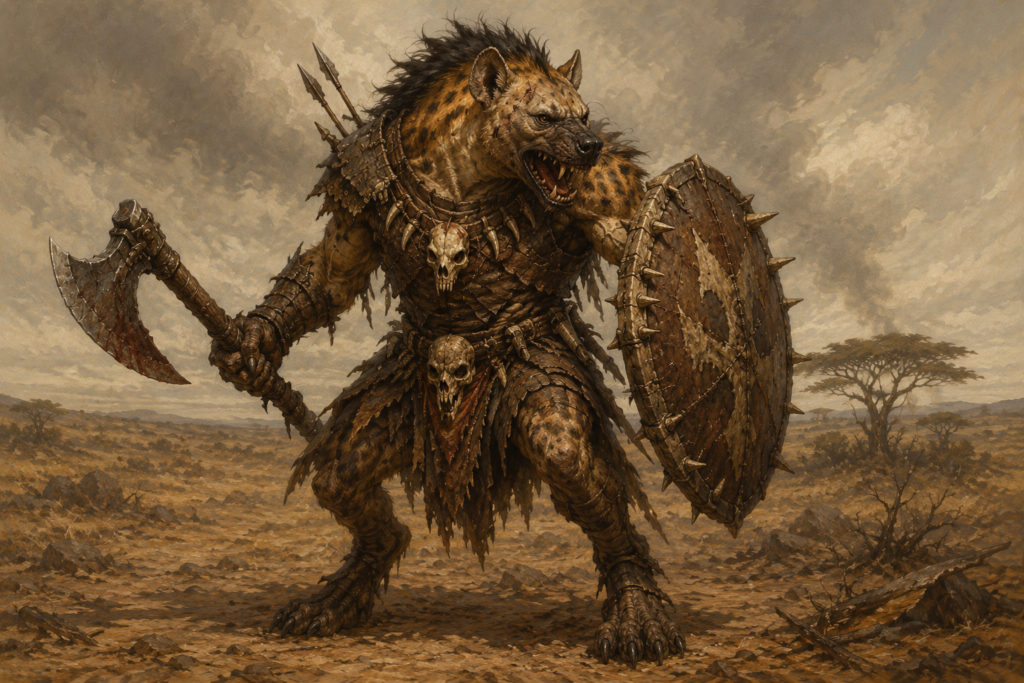
A Pack-Fang is an experienced raider or veteran warrior entrusted with the immediate control of a hunting pack, household or small warband. Pack-Fangs enforce discipline through violence, reputation and visible success rather than complicated tactical instruction.
D&D 5E — 2024-Compatible Gnoll Pack-Fang
Medium Humanoid (Gnoll), Chaotic Evil
Armor Class 15 (layered hide, shield)
Initiative +1 (11)
Hit Points 52 (8d8 + 16)
Speed 30 ft.
| STR | DEX | CON | INT | WIS | CHA |
|---|---|---|---|---|---|
| 16 (+3) | 12 (+1) | 14 (+2) | 8 (−1) | 11 (+0) | 10 (+0) |
Saving Throws Str +5, Con +4
Skills Intimidation +2, Perception +2, Survival +2
Senses darkvision 60 ft., passive Perception 12
Languages Gnoll and one regional language
Challenge 2 (450 XP; PB +2)
Traits
Pack Authority. Allied gnolls within 10 feet of the Pack-Fang have Advantage on saving throws against the Frightened condition while the Pack-Fang is conscious.
Actions
Multiattack. The Pack-Fang makes two attacks, using Battleaxe, Spear or Bite in any combination.
Bite. Melee Attack Roll: +5, reach 5 ft. Hit: 6 (1d6 + 3) Piercing damage.
Battleaxe. Melee Attack Roll: +5, reach 5 ft. Hit: 7 (1d8 + 3) Slashing damage.
Spear. Melee or Ranged Attack Roll: +5, reach 5 ft. or range 20/60 ft. Hit: 6 (1d6 + 3) Piercing damage, or 7 (1d8 + 3) Piercing damage when used with two hands in melee.
Javelin. Melee or Ranged Attack Roll: +5, reach 5 ft. or range 30/120 ft. Hit: 6 (1d6 + 3) Piercing damage.
Bonus Actions
Rampage. When the Pack-Fang reduces a creature to 0 Hit Points with a melee attack on its turn, the Pack-Fang moves up to half its Speed and makes one Bite attack.
Drive the Pack (Recharge 5–6). One allied gnoll the Pack-Fang can see within 30 feet may use its Reaction to move up to its Speed and make one melee attack.
Tactics
A Pack-Fang remains close enough to ordinary gnolls to maintain control but avoids becoming the first target. The Pack-Fang directs followers towards isolated enemies, wounded opponents and spellcasters.
Pathfinder 1E Gnoll Pack-Fang CR 3
XP 800
CE Medium humanoid (gnoll)
Init +5; Senses darkvision 60 ft.; Perception +6
Defense
AC 17, touch 11, flat-footed 16 (+3 armor, +1 Dex, +1 natural, +2 shield)
hp 32 (2d8+2d10+12)
Fort +9, Ref +1, Will +1
Offense
Speed 30 ft.
Melee battleaxe +8 (1d8+4/×3) or spear +7 (1d8+6/×3)
Ranged javelin +4 (1d6+4)
Special Attacks
Drive the Pack (Ex): As a swift action once per round, the Pack-Fang chooses one allied gnoll within 30 feet that can hear it. That gnoll gains a +2 morale bonus on its next melee attack roll made before the beginning of the Pack-Fang’s next turn.
Special Qualities
Pack Authority (Ex): Allied gnolls within 10 feet of the Pack-Fang gain a +1 morale bonus on saving throws against fear effects.
Statistics
| STR | DEX | CON | INT | WIS | CHA |
|---|---|---|---|---|---|
| 18 (+4) | 13 (+1) | 16 (+3) | 8 (−1) | 12 (+1) | 10 (+0) |
Base Atk +3; CMB +7; CMD 18
Feats Cleave, Improved Initiative, Power Attack, Weapon Focus (battleaxe)
Skills Intimidate +7, Perception +6, Survival +6
Languages Gnoll and one regional language
Ecology
Environment warm plains or desert
Organization solitary or command group (1 Pack-Fang and 4–20 gnolls)
Treasure NPC gear
D&D 3.5E Gnoll Pack-Fang
Medium Humanoid (Gnoll)
Hit Dice 2d8+2d10+12 (32 hp)
Initiative +5
Speed 30 ft. (6 squares)
Armor Class 17 (+1 Dex, +1 natural, +3 studded leather, +2 heavy wooden shield), touch 11, flat-footed 16
Base Attack/Grapple +3/+7
Attack battleaxe +8 melee (1d8+4/×3) or javelin +4 ranged (1d6+4)
Full Attack battleaxe +8 melee (1d8+4/×3) or javelin +4 ranged (1d6+4)
Space/Reach 5 ft./5 ft.
Special Attacks drive the pack
Special Qualities darkvision 60 ft., pack authority
Saves Fort +9, Ref +1, Will +1
| STR | DEX | CON | INT | WIS | CHA |
|---|---|---|---|---|---|
| 18 | 13 | 16 | 8 | 12 | 10 |
Skills Intimidate +7, Listen +6, Spot +6, Survival +6
Feats Cleave, Improved Initiative, Power Attack, Weapon Focus (battleaxe)
Environment warm plains
Organization solitary or command group (1 Pack-Fang and 4–20 gnolls)
Challenge Rating 3
Treasure standard
Alignment usually chaotic evil
Drive the Pack (Ex)
Once per round as a swift action, the Pack-Fang grants one allied gnoll within 30 feet a +2 morale bonus on its next melee attack roll made before the beginning of the Pack-Fang’s next turn.
Pack Authority (Ex)
Allied gnolls within 10 feet of the Pack-Fang gain a +1 morale bonus on saving throws against fear effects.
Gnoll Hunt-Captain
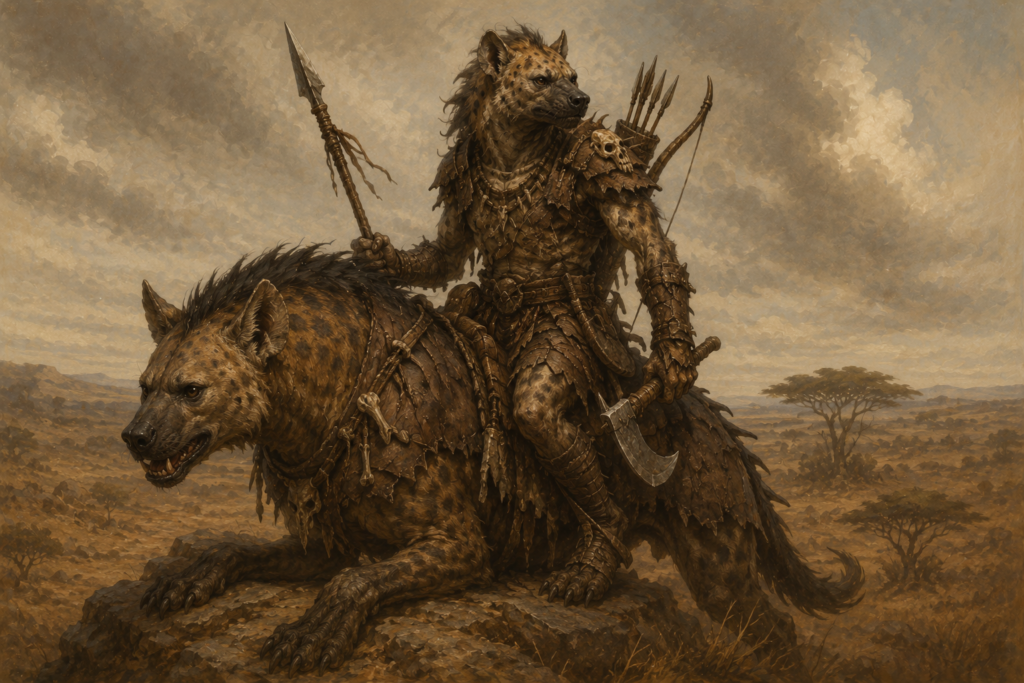
A Hunt-Captain commands scouts, outriders, pursuit troops, caravan raiders or regional hyaenodon cavalry. Hunt-Captains are selected for endurance, terrain knowledge and control of dangerous animals rather than administrative ability.
Most Hunt-Captains wear layered hide or rough leather and carry a light spear, javelins, shortbow and handaxe. Their equipment remains light enough to preserve the speed of a hyaenodon mount.
D&D 5E — 2024-Compatible Gnoll Hunt-Captain
Medium Humanoid (Gnoll), Chaotic Evil
Armor Class 15 (layered hide, shield)
Initiative +2 (12)
Hit Points 65 (10d8 + 20)
Speed 30 ft.
| STR | DEX | CON | INT | WIS | CHA |
|---|---|---|---|---|---|
| 16 (+3) | 14 (+2) | 14 (+2) | 8 (−1) | 14 (+2) | 10 (+0) |
Saving Throws Dex +4, Wis +4
Skills Animal Handling +4, Perception +4, Stealth +4, Survival +6
Senses darkvision 60 ft., passive Perception 14
Languages Gnoll and one regional language
Challenge 3 (700 XP; PB +2)
Traits
Mounted Hunter. The Hunt-Captain has Advantage on ability checks and saving throws made to remain mounted or control a frightened mount.
While mounted, if the mount moves at least 20 feet straight towards a creature immediately before the Hunt-Captain hits that creature with a Spear attack, the attack deals an extra 4 (1d8) Piercing damage.
Blood Trail. The Hunt-Captain has Advantage on Wisdom (Perception) and Wisdom (Survival) checks made to locate or follow a wounded creature.
Actions
Multiattack. The Hunt-Captain makes two attacks, using Spear, Javelin or Shortbow in any combination.
Bite. Melee Attack Roll: +5, reach 5 ft. Hit: 6 (1d6 + 3) Piercing damage.
Spear. Melee or Ranged Attack Roll: +5, reach 5 ft. or range 20/60 ft. Hit: 6 (1d6 + 3) Piercing damage, or 7 (1d8 + 3) Piercing damage when used with two hands in melee.
Javelin. Melee or Ranged Attack Roll: +5, reach 5 ft. or range 30/120 ft. Hit: 6 (1d6 + 3) Piercing damage.
Shortbow. Ranged Attack Roll: +4, range 80/320 ft. Hit: 5 (1d6 + 2) Piercing damage.
Bonus Actions
Direct the Hunt (Recharge 5–6). One allied Beast or gnoll the Hunt-Captain can see within 30 feet may use its Reaction to move up to half its Speed and make one attack.
Reactions
Guard the Mount. While mounted, when the Hunt-Captain’s mount is targeted by an attack, the Hunt-Captain imposes Disadvantage on that attack roll.
Tactics
A Hunt-Captain circles an enemy rather than charging directly into a prepared shield wall. The Hunt-Captain uses ranged attacks, speed and hyaenodon pursuit to separate stragglers from the main formation.
If an enemy breaks or begins retreating, the Hunt-Captain directs its mount and accompanying beasts towards the slowest or most valuable fugitives.
Pathfinder 1E Gnoll Hunt-Captain CR 5
XP 1,600
CE Medium humanoid (gnoll)
Init +2; Senses darkvision 60 ft.; Perception +11
Defense
AC 17, touch 12, flat-footed 15 (+2 armor, +2 Dex, +1 natural, +2 shield)
hp 49 (2d8+4d10+18)
Fort +10, Ref +3, Will +3
Offense
Speed 30 ft.
Melee spear +9 (1d8+6/×3) or handaxe +9 (1d6+4/×3)
Ranged composite shortbow +7 (1d6+4/×3) or javelin +7 (1d6+4)
Special Attacks
Direct the Hunt (Ex): Three times per day as a swift action, the Hunt-Captain chooses one allied gnoll or animal within 30 feet that can hear it. That creature gains a +2 morale bonus on its next attack roll and weapon damage roll made before the beginning of the Hunt-Captain’s next turn.
Mounted Pursuit (Ex): When the Hunt-Captain charges while mounted and hits with a spear, the attack deals an additional 1d8 points of piercing damage.
Special Qualities
Favoured Terrain (Ex): The Hunt-Captain gains a +2 bonus on Initiative, Perception, Stealth and Survival checks while in plains or desert terrain.
Wild Empathy (Ex): The Hunt-Captain can improve the attitude of animals as a 4th-level ranger.
Statistics
| STR | DEX | CON | INT | WIS | CHA |
|---|---|---|---|---|---|
| 18 (+4) | 14 (+2) | 16 (+3) | 8 (−1) | 14 (+2) | 10 (+0) |
Base Atk +5; CMB +9; CMD 21
Feats EnduranceB, Mounted Archery, Mounted Combat, Ride-By Attack, TrackB
Skills Handle Animal +9, Perception +11, Ride +13, Stealth +10, Survival +11
Languages Gnoll and one regional language
Ecology
Environment warm plains, desert or steppe
Organization solitary, patrol (1 Hunt-Captain, 2–8 gnolls and 1–4 hyenas), or mounted patrol (1 Hunt-Captain, 2–5 mounted gnolls and an equal number of hyaenodons)
Treasure NPC gear
Mount: A Hunt-Captain and its hyaenodon are separate creatures. Add the mount’s full XP value when calculating the encounter.
D&D 3.5E Gnoll Hunt-Captain
Medium Humanoid (Gnoll)
Hit Dice 2d8+4d10+18 (49 hp)
Initiative +2
Speed 30 ft. (6 squares)
Armor Class 17 (+2 Dex, +1 natural, +2 leather armor, +2 heavy wooden shield), touch 12, flat-footed 15
Base Attack/Grapple +5/+9
Attack spear +9 melee (1d8+6/×3), handaxe +9 melee (1d6+4/×3), composite shortbow +7 ranged (1d6+4/×3), or javelin +7 ranged (1d6+4)
Full Attack spear +9 melee (1d8+6/×3), handaxe +9 melee (1d6+4/×3), composite shortbow +7 ranged (1d6+4/×3), or javelin +7 ranged (1d6+4)
Space/Reach 5 ft./5 ft.
Special Attacks direct the hunt, mounted pursuit
Special Qualities darkvision 60 ft., favoured terrain, wild empathy
Saves Fort +10, Ref +3, Will +3
| STR | DEX | CON | INT | WIS | CHA |
|---|---|---|---|---|---|
| 18 | 14 | 16 | 8 | 14 | 10 |
Skills Handle Animal +9, Hide +10, Listen +9, Move Silently +10, Ride +13, Spot +9, Survival +11
Feats EnduranceB, Mounted Archery, Mounted Combat, Ride-By Attack, TrackB
Environment warm plains, desert or steppe
Organization solitary, patrol or mounted patrol
Challenge Rating 5
Treasure standard
Alignment usually chaotic evil
Direct the Hunt (Ex)
Three times per day as a swift action, the Hunt-Captain grants one allied gnoll or animal within 30 feet a +2 morale bonus on its next attack roll and weapon damage roll made before the beginning of the Hunt-Captain’s next turn.
Mounted Pursuit (Ex)
When the Hunt-Captain charges while mounted and hits with a spear, the attack deals an additional 1d8 points of piercing damage.
Favoured Terrain (Ex)
The Hunt-Captain gains a +2 bonus on Initiative, Hide, Listen, Move Silently, Spot and Survival checks while in plains or desert terrain.
Wild Empathy (Ex)
The Hunt-Captain can improve the attitude of animals as a 4th-level ranger.
Gnoll Well-Lord
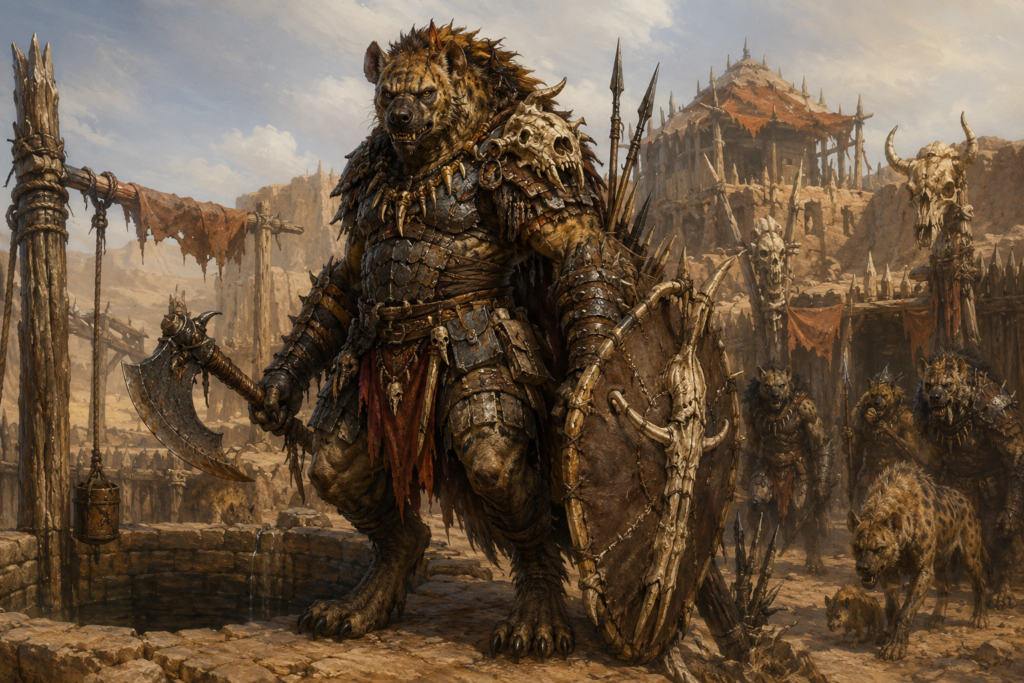
A Well-Lord controls a permanent settlement, important water source, tributary territory or mercenary state. Most are unusually strong, intelligent, well-connected or charismatic by gnoll standards.
A Well-Lord rules through subordinate Pack-Fangs, Hunt-Captains, hostages, public punishments and control of food or water. The strongest maintain Carrion-Seers, hyaenodon riders and subject settlements that provide skilled labour.
D&D 5E — 2024-Compatible Gnoll Well-Lord
Medium Humanoid (Gnoll), Chaotic Evil
Armor Class 16 (reinforced scale, shield)
Initiative +1 (11)
Hit Points 112 (15d8 + 45)
Speed 30 ft.
| STR | DEX | CON | INT | WIS | CHA |
|---|---|---|---|---|---|
| 20 (+5) | 12 (+1) | 16 (+3) | 10 (+0) | 14 (+2) | 14 (+2) |
Saving Throws Str +8, Con +6, Wis +5, Cha +5
Skills Intimidation +5, Perception +5, Survival +5
Senses darkvision 60 ft., passive Perception 15
Languages Gnoll and two regional languages
Challenge 6 (2,300 XP; PB +3)
Traits
Lord of the Pack. Allied gnolls within 20 feet of the Well-Lord have Advantage on saving throws against the Frightened condition and gain a +2 bonus to Initiative rolls while the Well-Lord is conscious.
Claim the Weak. Once on each of its turns, the Well-Lord deals an extra 4 (1d8) damage when it hits a creature that is below its Hit Point maximum.
Actions
Multiattack. The Well-Lord makes three attacks, using Heavy Battleaxe, Spear or Bite in any combination.
Bite. Melee Attack Roll: +8, reach 5 ft. Hit: 8 (1d6 + 5) Piercing damage.
Heavy Battleaxe. Melee Attack Roll: +8, reach 5 ft. Hit: 9 (1d8 + 5) Slashing damage.
Spear. Melee or Ranged Attack Roll: +8, reach 5 ft. or range 20/60 ft. Hit: 8 (1d6 + 5) Piercing damage, or 9 (1d8 + 5) Piercing damage when used with two hands in melee.
Javelin. Melee or Ranged Attack Roll: +8, reach 5 ft. or range 30/120 ft. Hit: 8 (1d6 + 5) Piercing damage.
Bonus Actions
Rampage. When the Well-Lord reduces a creature to 0 Hit Points with a melee attack on its turn, the Well-Lord moves up to half its Speed and makes one Bite attack.
Commanding Howl (Recharge 5–6). Up to three allied gnolls the Well-Lord can see within 60 feet may use their Reactions to move up to half their Speeds without provoking Opportunity Attacks. One of those gnolls may then make one melee attack.
Tactics
A Well-Lord enters combat surrounded by Pack-Fangs, shield-bearing gnolls, trusted retainers, hyenas and other dependants. The Well-Lord uses Commanding Howl to surround exposed opponents, withdraw wounded followers or open a route towards an enemy commander.
Pathfinder 1E Gnoll Well-Lord CR 7
XP 3,200
CE Medium humanoid (gnoll)
Init +5; Senses darkvision 60 ft.; Perception +10
Defense
AC 19, touch 11, flat-footed 18 (+5 armor, +1 Dex, +1 natural, +2 shield)
hp 74 (2d8+6d10+32)
Fort +12, Ref +3, Will +6
Offense
Speed 20 ft.
Melee battleaxe +13/+8 (1d8+7/×3)
Ranged javelin +8 (1d6+5)
Special Attacks
Commanding Howl (Ex): Once per day as a swift action, the Well-Lord grants allied gnolls within 30 feet a +2 morale bonus on attack rolls and weapon damage rolls and a +10-foot enhancement bonus to their base speed. These bonuses last for 3 rounds.
Claim the Weak (Ex): The Well-Lord deals 1d6 additional damage on its first successful melee attack each round against a creature below half its maximum hit points.
Special Qualities
Lord of the Pack (Ex): Allied gnolls within 20 feet of the Well-Lord gain a +2 morale bonus on saving throws against fear effects and a +1 morale bonus on Initiative checks.
Statistics
| STR | DEX | CON | INT | WIS | CHA |
|---|---|---|---|---|---|
| 20 (+5) | 12 (+1) | 18 (+4) | 10 (+0) | 14 (+2) | 14 (+2) |
Base Atk +7; CMB +12; CMD 23
Feats Cleave, Great Cleave, Improved Initiative, Iron Will, Power Attack, Weapon Focus (battleaxe), Weapon Specialization (battleaxe)
Skills Intimidate +13, Perception +10, Ride +12, Survival +10
Languages Gnoll and two regional languages
Ecology
Environment warm plains or desert
Organization command group (1 Well-Lord, 1–3 Pack-Fangs and 10–40 gnolls) or court (1 Well-Lord, 2–6 Pack-Fangs, 1–3 Hunt-Captains, 1 Carrion-Seer, 20–100 gnolls, hyenas, hyaenodons and dependants)
Treasure NPC gear plus tribute
D&D 3.5E Gnoll Well-Lord
Medium Humanoid (Gnoll)
Hit Dice 2d8+6d10+32 (74 hp)
Initiative +5
Speed 20 ft. (4 squares)
Armor Class 19 (+1 Dex, +1 natural, +5 scale mail, +2 heavy wooden shield), touch 11, flat-footed 18
Base Attack/Grapple +7/+12
Attack battleaxe +13 melee (1d8+7/×3) or javelin +8 ranged (1d6+5)
Full Attack battleaxe +13/+8 melee (1d8+7/×3) or javelin +8 ranged (1d6+5)
Space/Reach 5 ft./5 ft.
Special Attacks claim the weak, commanding howl
Special Qualities darkvision 60 ft., lord of the pack
Saves Fort +12, Ref +3, Will +6
| STR | DEX | CON | INT | WIS | CHA |
|---|---|---|---|---|---|
| 20 | 12 | 18 | 10 | 14 | 14 |
Skills Intimidate +13, Listen +10, Ride +12, Spot +10, Survival +10
Feats Cleave, Great Cleave, Improved Initiative, Iron Will, Power Attack, Weapon Focus (battleaxe), Weapon Specialization (battleaxe)
Environment warm plains
Organization command group or court
Challenge Rating 7
Treasure standard plus tribute
Alignment usually chaotic evil
Claim the Weak (Ex)
The Well-Lord deals an additional 1d6 points of damage on its first successful melee attack each round against a creature below half its maximum hit points.
Commanding Howl (Ex)
Once per day as a swift action, the Well-Lord grants allied gnolls within 30 feet a +2 morale bonus on attack rolls and weapon damage rolls and a +10-foot enhancement bonus to their base speed for 3 rounds.
Lord of the Pack (Ex)
Allied gnolls within 20 feet of the Well-Lord gain a +2 morale bonus on saving throws against fear effects and a +1 morale bonus on Initiative checks.
Gnoll Carrion-Seer
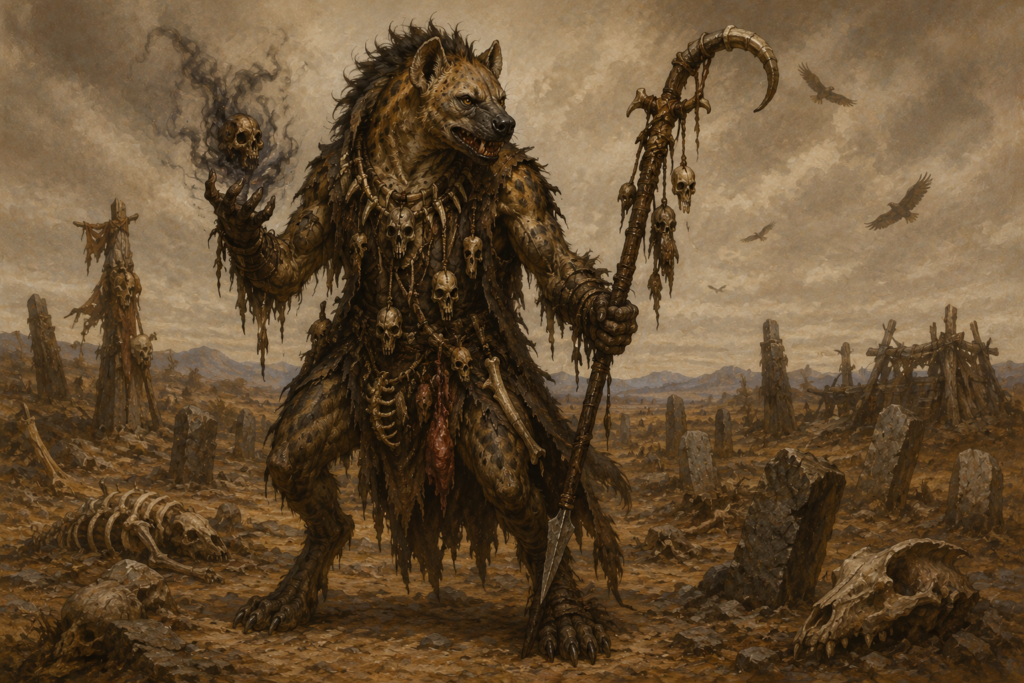
A Carrion-Seer is a priest, spirit-reader, druid, corpse-diviner or cult oracle. Carrion-Seers interpret omens in scavenger behaviour, blood, entrails, dreams, weather, disease and the condition of the dead.
Traditional Carrion-Seers preserve sacred dens, remember clan genealogies and negotiate with predatory spirits. Carrion-Seers devoted to Yeenoghu preach limitless hunger, ritual killing and the destruction of restraints that preserve the pack.
Carrion-Seers normally carry a ritual spear, hooked staff, bone charms, dried organs, marked hides and bags of teeth. Their magic favours fear, curses, darkness, divination, animal communication and the dead.
D&D 5E — 2024-Compatible Gnoll Carrion-Seer
Medium Humanoid (Gnoll), Chaotic Evil
Armor Class 14 (hide armor, bone charms)
Initiative +1 (11)
Hit Points 75 (10d8 + 30)
Speed 30 ft.
| STR | DEX | CON | INT | WIS | CHA |
|---|---|---|---|---|---|
| 14 (+2) | 12 (+1) | 16 (+3) | 9 (−1) | 18 (+4) | 12 (+1) |
Saving Throws Con +5, Wis +6
Skills Insight +6, Perception +6, Religion +2, Survival +6
Senses darkvision 60 ft., passive Perception 16
Languages Gnoll and one regional language
Challenge 4 (1,100 XP; PB +2)
Traits
Blood-Scented Omens. The Carrion-Seer has Advantage on Wisdom (Perception) and Wisdom (Survival) checks made to locate a wounded creature or identify the direction in which it travelled.
Spellcasting. The Carrion-Seer casts one of the following spells, using Wisdom as the spellcasting ability (spell save DC 14, +6 to hit with spell attacks):
- At Will: guidance, thaumaturgy
- 2/Day Each: bane, command, darkness, speak with animals
- 1/Day Each: bestow curse, fear, speak with dead
Actions
Carrion Bolt. Ranged Spell Attack Roll: +6, range 90 ft. Hit: 18 (4d8) Necrotic damage. The target cannot regain Hit Points until the start of the Carrion-Seer’s next turn.
Ritual Spear. Melee or Ranged Attack Roll: +4, reach 5 ft. or range 20/60 ft. Hit: 5 (1d6 + 2) Piercing damage.
Bite. Melee Attack Roll: +4, reach 5 ft. Hit: 5 (1d6 + 2) Piercing damage.
Bonus Actions
Pack Omen (Recharge 5–6). Up to two allied gnolls the Carrion-Seer can see within 30 feet gain 7 Temporary Hit Points and may immediately move up to 10 feet without provoking Opportunity Attacks.
Reactions
Foretold Misfortune (3/Day). When a creature the Carrion-Seer can see within 30 feet makes an attack roll or saving throw, the Carrion-Seer rolls 1d4 and subtracts the result from the creature’s roll. The Carrion-Seer must use this Reaction after the roll is made but before its outcome is determined.
Tactics
The Carrion-Seer remains behind ordinary gnolls and uses Pack Omen to strengthen the first line or reposition wounded followers. The Carrion-Seer uses bane, darkness and fear to disrupt organised enemies before directing Carrion Bolt against wounded targets.
Pathfinder 1E Gnoll Carrion-Seer CR 6
XP 2,400
CE Medium humanoid (gnoll)
Init +4; Senses darkvision 60 ft.; Perception +10
Defense
AC 16, touch 10, flat-footed 16 (+3 armor, +1 natural, +2 shield)
hp 53 (7d8+21)
Fort +9, Ref +1, Will +8
Offense
Speed 30 ft.
Melee ritual spear +6 (1d8+3/×3) or bite +6 (1d6+2)
Ranged javelin +4 (1d6+2)
Special Attacks
Bleeding Touch (Sp): Seven times per day as a melee touch attack, the Carrion-Seer causes a living creature to take 2 points of bleed damage. The bleeding continues until stopped by magical healing or a successful DC 15 Heal check.
Carrion Omen (Su): Three times per day as a swift action, the Carrion-Seer chooses one allied gnoll within 30 feet. That gnoll gains a +2 morale bonus on attack rolls, weapon damage rolls and saving throws against fear effects until the beginning of the Carrion-Seer’s next turn.
Channel Negative Energy (Su): The Carrion-Seer channels negative energy 4 times per day, dealing 3d6 points of damage to living creatures in a 30-foot burst. A successful DC 13 Will save halves the damage.
Domain Powers
Speak with Animals (Sp): The Carrion-Seer may use speak with animals seven times per day.
Cleric Spells Prepared
Caster Level 5th; Concentration +9
- 3rd— animate deadD, bestow curse (DC 17), speak with dead
- 2nd— darkness, death knellD (DC 16), hold person (DC 16), spiritual weapon
- 1st— bane (DC 15), cause fearD (DC 15), command (DC 15), divine favor, obscuring mist
- 0— bleed (DC 14), detect magic, guidance, stabilize
D Domain spell; Domains Animal and Death.
Statistics
| STR | DEX | CON | INT | WIS | CHA |
|---|---|---|---|---|---|
| 15 (+2) | 10 (+0) | 14 (+2) | 8 (−1) | 18 (+4) | 12 (+1) |
Base Atk +4; CMB +6; CMD 16
Feats Combat Casting, Improved Initiative, Spell Focus (necromancy), Toughness
Skills Heal +11, Knowledge (religion) +7, Perception +10, Spellcraft +7, Survival +8
Languages Gnoll and one regional language
Ecology
Environment warm plains, desert, graveyard or ruined settlement
Organization solitary, shrine (1 Carrion-Seer and 4–12 gnolls), or cult host (1 Carrion-Seer, 1–3 Pack-Fangs and 10–40 gnolls)
Treasure NPC gear, ritual objects and offerings
A Carrion-Seer usually possesses five levels in the cleric class. Traditional variants may instead use druid or shaman abilities.
D&D 3.5E Gnoll Carrion-Seer
Medium Humanoid (Gnoll)
Hit Dice 7d8+14 (46 hp)
Initiative +4
Speed 30 ft. (6 squares)
Armor Class 16 (+1 natural, +3 hide armor, +2 heavy wooden shield), touch 10, flat-footed 16
Base Attack/Grapple +4/+6
Attack ritual spear +6 melee (1d8+3/×3), bite +6 melee (1d6+2), or javelin +4 ranged (1d6+2)
Full Attack ritual spear +6 melee (1d8+3/×3), bite +6 melee (1d6+2), or javelin +4 ranged (1d6+2)
Space/Reach 5 ft./5 ft.
Special Attacks carrion omen, death touch, rebuke undead, spells
Special Qualities darkvision 60 ft., speak with animals
Saves Fort +9, Ref +1, Will +8
| STR | DEX | CON | INT | WIS | CHA |
|---|---|---|---|---|---|
| 15 | 10 | 14 | 8 | 18 | 12 |
Skills Concentration +10, Heal +11, Knowledge (religion) +7, Listen +8, Spellcraft +7, Spot +8, Survival +8
Feats Combat Casting, Improved Initiative, Spell Focus (necromancy)
Environment warm plains, desert, graveyard or ruined settlement
Organization solitary, shrine or cult host
Challenge Rating 6
Treasure standard plus ritual objects
Alignment usually chaotic evil
Carrion Omen (Su)
Three times per day as a swift action, the Carrion-Seer grants one allied gnoll within 30 feet a +2 morale bonus on attack rolls, weapon damage rolls and saving throws against fear effects until the beginning of the Carrion-Seer’s next turn.
Death Touch (Su)
Once per day, the Carrion-Seer may make a melee touch attack against a living creature. If the attack succeeds, roll 5d6. If the total equals or exceeds the target’s current hit points, the target dies.
Rebuke Undead (Su)
The Carrion-Seer may rebuke or command undead 4 times per day as a 5th-level cleric.
Speak with Animals (Sp)
The Carrion-Seer may use speak with animals once per day.
Cleric Spells Prepared
Caster Level 5th
- 3rd— animate deadD, bestow curse (DC 17), speak with dead
- 2nd— darkness, death knellD (DC 16), hold person (DC 16), spiritual weapon
- 1st— bane (DC 15), cause fearD (DC 15), command (DC 15), divine favor, obscuring mist
- 0— detect magic, detect poison, guidance, resistance, virtue
D Domain spell; Domains Animal and Death.
Gnoll Encounter Scaling
The following table combines equivalent gnoll encounters across D&D 5E, Pathfinder 1E and D&D 3.5E. The level bands assume a standard four-character party.
| Level Band | D&D 5E | Pathfinder 1E | D&D 3.5E | Complication |
|---|---|---|---|---|
| 1 | 2 gnolls (200 XP) | 1 gnoll (400 XP) | 1 gnoll, EL 1 | The scouts attempt to escape and warn or summon the rest of their pack. |
| 2–3 | 4 gnolls (400 XP) | 2 gnolls (800 XP) | 2 gnolls, EL 3 | One gnoll attacks from cover while the others advance. The pack seeks captives rather than fighting to the death. |
| 4 | 1 Pack-Fang and 3 gnolls (750 XP) | 1 Pack-Fang and 2 gnolls (1,600 XP) | 1 Pack-Fang and 2 gnolls | The Pack-Fang sends part of the pack around a flank and attempts to isolate the weakest character. |
| 5–6 | 1 Hunt-Captain and 3 gnolls (1,000 XP before mounts) | 1 Hunt-Captain and 2 gnolls (2,400 XP before a mount) | 1 Hunt-Captain and 2 gnolls | The Hunt-Captain fights as a mobile skirmisher and withdraws if trapped. |
| 6–7 | 1 Carrion-Seer, 1 Pack-Fang and 3 gnolls (1,850 XP) | 1 Carrion-Seer, 1 Pack-Fang and 2 gnolls (4,000 XP) | 1 Carrion-Seer, 1 Pack-Fang and 2 gnolls | The Carrion-Seer begins behind cover and uses darkness, fear and curses to break party cohesion. |
| 7–8 | 1 Well-Lord, 1 Pack-Fang and 4 gnolls (3,150 XP) | 1 Well-Lord, 1 Pack-Fang and 4 gnolls (5,600 XP) | 1 Well-Lord, 1 Pack-Fang and 4 gnolls | The Well-Lord withdraws if the Pack-Fang and half the ordinary gnolls are defeated. |
| 8–9 | 1 Well-Lord, 1 Carrion-Seer, 2 Pack-Fangs and 6 gnolls (4,900 XP) | 1 Well-Lord, 1 Carrion-Seer, 2 Pack-Fangs and 6 gnolls (8,000 XP) | 1 Well-Lord, 1 Carrion-Seer, 2 Pack-Fangs and 6 gnolls | The leaders coordinate several attack groups. Add every animal, mount and supernatural associate separately. |
Hyenas, hyaenodons, pugwampis, leucrottas, crocottas, ghuls and werehyenas retain their own statistics, actions, Challenge Ratings and XP values.
A rider and mount count as separate creatures unless a specific combined stat block states otherwise. The full hyaenodon is a dangerous combatant in its own right and substantially increases encounter difficulty.
Intelligence and Practical Culture
Most gnolls possess less abstract intelligence than humans, elves, dwarves or hobgoblins. They are impatient learners, poor record-keepers and unreliable planners when a task extends far beyond an immediate season, hunt or campaign.
This limitation does not make gnolls mindless. They display considerable practical cunning in areas central to survival and violence:
- Reading tracks, scents and disturbed vegetation.
- Remembering wells, caves, grazing routes and ambush sites.
- Recognising rank, fear, submission and weakness.
- Coordinating simple pack attacks through calls and gestures.
- Maintaining familiar weapons, hides and animal tack.
- Judging whether a captive is more valuable as labour, ransom or food.
- Learning repeated military drills beneath a strong leader.
Gnolls are less capable when dealing with complicated mathematics, written law, advanced siegecraft, intricate metalwork, accounting or machinery. A large gnoll state normally obtains these skills from enslaved specialists, tributary settlements, foreign mercenaries or an unusually intelligent ruling caste.
Gnoll administration is direct and physical. Tribute is counted in visible herds, sacks, captives or weapons. Boundaries are marked with stones, bones, scents and guarded wells. Laws are remembered through genealogy, precedent, scars, spoken judgements and public punishment.
Origin and Deep History
The Age of Open Lands
The distant ancestors of the gnolls emerge during the Age of Open Lands, when expanding savannahs and steppes transform Africa and Eurasia. Ancient hyaenid lineages develop powerful bone-crushing jaws, endurance and the ability to exploit almost every part of a carcass.
Gnolls are the sapient descendants of this ancient stock. Their emergence belongs to natural history within an already magical world. Ambient magic, ancestral spirits and the pressures of survival influence their development, but no god, demon or mortal wizard creates the species.
The Shattered Crown
Recognisably sapient gnoll peoples emerge in eastern and northeastern Africa during the Shattered Crown. Their oldest traditions place the first remembered packs around the eastern savannahs, Rift valleys, upper Nile, Horn of Africa and Red Sea highlands.
These early gnolls follow great herds, occupy caves and rocky dens, guard carcass grounds and compete with other predators and peoples. They develop stone tools, controlled fire, complex spoken languages, territorial rites and customs governing the distribution of meat.
Living gnolls descend from several related Ice Age populations rather than a single founding tribe. Their oldest genealogies describe First Mothers, sacred dens and remembered migrations, but no universal gnoll creation story exists.
Ice Age Migrations
Repeated glacial advances lower sea levels and open grassland corridors. Gnoll populations follow prey, rivers and seasonal grazing into northern Africa, the Nile valley, Arabia, the Levant, Anatolia, Persia, Central Asia and the Indian subcontinent.
Other populations reach southern and central Europe alongside Ice Age herds. Most European populations later disappear, migrate or become isolated as forests expand, prey changes and human settlement intensifies.
Gnolls encountered in late-medieval Europe usually descend from mercenaries, captives, sailors, exiles or packs that migrated through North Africa, the Black Sea or eastern Mediterranean. Large surviving European populations are unusual.
Yeenoghu’s Claim
Yeenoghu enters gnoll history after the species and its earliest cultures already exist. His cults spread most successfully among packs broken by famine, defeat, displacement and supernatural catastrophe.
Yeenoghu’s priests call him the Father of Gnolls, but the oldest gnoll genealogies remember ancestors who lived before his name was known. His claim is conquest disguised as creation.
The cult teaches that restraint is cowardice, preservation is waste and every living creature exists to be hunted. It replaces obligation to kin with obedience to the strongest killer and transforms practical consumption into a sacrament of destruction.
Historical Development
Early Settlement
As the Ice Ages end, gnoll populations spread across the greener Sahara, Sahel, Nile territories, Arabia and western India. Some remain mobile hunters and herders. Others establish seasonal or permanent settlements near wells, caves, migration bottlenecks and defensible uplands.
The spread of agriculture creates conflict over water, pasture, hunting grounds and river access. Gnolls raid weak farming settlements, while expanding states fortify wells and displace packs from older territories.
The First Well-Lordships
During the Rooting Age, powerful gnoll clans begin controlling permanent wells, dry-season pastures and caravan crossings. Their Well-Lords demand livestock, food, labour and hostages from weaker communities.
These early states possess little formal administration. Rulers maintain authority through armed retainers, captive workers, marriage ties, public punishment and remembered tribute agreements.
Gnoll slavery develops in both directions. Gnoll packs seize captives for herding, agriculture, quarrying and construction, while expanding kingdoms capture gnolls for mines, armies and dangerous frontier labour.
Cities, Kingdoms and Empires
As cities and long-distance trade develop during the Blooming Cities, gnolls become known as caravan guards, raiders, hide traders, slavers, scouts and frontier auxiliaries.
Gnoll warbands create principalities around wells, mountain passes, river crossings and caravan tracks. These states depend upon tribute, enslaved agricultural populations and subject communities allowed to retain their own craftspeople and local officials.
Large empires recruit, deport, enslave or destroy gnoll communities according to circumstance. Gnolls acquire reputations as trackers, night fighters and pursuit troops, but employers distrust them near treasuries, powder stores, capitals and civilian populations.
Gnolls readily use simple captured weapons. They have greater difficulty maintaining complex armour, siege engines, firearms and administrative systems after the foreign specialists who introduced them have departed.
Named Wars and Campaigns
| Conflict | Period and Region | Combatants | Outcome |
|---|---|---|---|
| War of the Seven Wells | Rooting Age; upper Nile and Horn of Africa | A gnoll confederation against fortified pastoral settlements and rival well-holders | Gnoll victory. Seven major dry-season wells were captured, creating the earliest remembered gnoll well-lordships. The confederation later divided into rival principalities. |
| The Red Grass Wars | Blooming Cities; Nile–Sahel frontier | Gnoll migrants against river kingdoms, fortified farmers and allied herders | Gnoll defeat. Fortified wells, organised archers and river-borne supplies forced the packs from the richest grazing lands. Many survivors were enslaved or recruited as auxiliaries. |
| The Iron Collar Revolt | Iron Ascendancies; Red Sea mines and frontier districts | Enslaved gnoll soldiers, miners and labourers against imperial garrisons | Costly gnoll victory. Most rebels died, but several mines and forts remained independent. Survivors founded the Iron Collar Freeholds. |
| The War of Broken Spears | Wars of Dominion; southern Arabia and the Levantine frontier | Gnoll auxiliaries against an employer who withheld their pay and attempted to disarm them | Gnoll victory. The mutineers seized two frontier fortresses, several wells and a caravan route. Their captains founded the Broken Spear Principality. |
| The War of the Empty Dens | Early Age of Severed Crowns; Horn of Africa and upper Nile | Traditional gnoll clans against a federation of Yeenoghu cults | Pyrrhic traditionalist victory. The cult armies were broken, but ancestral dens and entire clans were destroyed. |
| The Black Standard War | Age of Severed Crowns; eastern Persian frontier and Caucasus marches | A gnoll pastoral confederation against an expanding hobgoblin frontier empire | Gnoll defeat. Hobgoblin cavalry, engineers and permanent garrisons captured the confederation’s forts and wells. Survivors became mercenaries, mountain raiders and refugees. |
| The Carrion Marches | 1348–1352; Maghreb, Egypt and eastern Mediterranean | Gnoll warbands exploiting plague-weakened territories against local rulers, militias and mercenary coalitions | Initial gnoll victories followed by strategic defeat. Gnolls occupied abandoned villages and pasture but failed to hold major towns after regional armies reorganised. |
Patterns of Victory and Defeat
Gnoll armies are most successful when they can move rapidly through dry country, seize livestock, destroy supplies, attack after dark and force enemies to defend several wells or settlements at once.
They frequently defeat divided enemies, unpaid mercenary forces and isolated frontier garrisons. Gnoll scouts can outmanoeuvre heavier armies, while the threat of enslavement or consumption may cause poorly defended settlements to surrender without battle.
Gnolls are less successful in long sieges, densely cultivated river valleys and wars requiring sophisticated logistics. Confederations often fracture when a leader dies, plunder runs short or rival packs disagree over succession.
Gnoll states overcome these weaknesses by forcing subject farmers to provide food, enslaving craftspeople, hiring foreign specialists or placing unusually intelligent leaders over important strongholds.
Gnolls in 1454
In the campaign present, gnolls remain most numerous across Africa, Arabia and western Asia. They range from mobile packs and pastoral clans to fortified settlements, mercenary colonies and predatory principalities.
The Seven Wells Principalities remain divided but wealthy. Their rulers control dry-season water, grazing and routes linking the upper Nile to the Red Sea hinterlands.
The Iron Collar Freeholds survive as crude fortified mining and mercenary settlements. Their rulers fiercely oppose outside attempts to enslave gnolls while freely enslaving captured enemies and debtors.
The Broken Spear Principality controls part of a caravan route between southern Arabia and the Levantine frontier. Its gnoll captains rely upon enslaved clerks, subject merchants and foreign armourers to manage responsibilities beyond toll-taking and military force.
Refugees from the Black Standard War serve in foreign armies or raid the mountain frontiers of western Asia. Survivors of the Carrion Marches occupy plague ruins and abandoned grazing lands around the Mediterranean.
Gnolls are uncommon but familiar in European and Mediterranean ports, where they appear as sailors, guards, slaves, escaped captives, caravan workers or foreign mercenaries.
No single gnoll empire dominates the species. Most gnolls owe allegiance to a local clan, Pack-Fang, Hunt-Captain, Den-Mother, Carrion-Seer or Well-Lord rather than to a distant sovereign.
Distribution and Demographics
No reliable world census of gnolls exists. Mobile packs conceal their numbers, frontier settlements avoid taxation and many gnoll territories lie beyond regular administration.
Campaign estimates place the global gnoll population somewhere between one and three million. This is a working demographic range rather than a precise count.
| Region | Relative Presence | Typical Communities |
|---|---|---|
| Horn of Africa, upper Nile and eastern African grasslands | Very numerous | Ancient clans, pastoral settlements, hill dens, mercenary companies and cult territories |
| Sahel and western African savannahs | Very numerous | Mobile packs, tributary strongholds, livestock raiders and military confederations |
| Central and southern African grasslands | Numerous but dispersed | Hunters, herders, fortified dens and isolated clans |
| Maghreb and Sahara margins | Regionally numerous | Oasis rulers, mountain dens, caravan raiders and hired desert trackers |
| Arabia and the Levant | Regionally numerous | Well-holding clans, mercenary bands, pastoral packs and fortified settlements |
| Persia, Caucasus and Central Asia | Scattered | Mountain packs, military settlers, refugees and displaced warbands |
| Sindh, western India and the Deccan | Scattered to regionally numerous | Dry-forest clans, plateau settlements and military companies |
| Europe and maritime diasporas | Uncommon | Mercenaries, captives, exiles, sailors and small migrant communities |
Population Units
| Community | Typical Population | Composition |
|---|---|---|
| Hunting party | 2–8 gnolls | Hunters, scouts or foragers, sometimes accompanied by hyenas |
| Raiding band | 10–30 combatants | Armed adults beneath a Pack-Fang or Hunt-Captain |
| Pack or clan | 25–120 members | Related households, young gnolls, dependants, captives and working animals |
| Permanent settlement | 100–600 inhabitants | Several packs, slaves, craftspeople, livestock and working animals |
| Major stronghold | 600–2,000 inhabitants | Several packs ruled by a Well-Lord, council, werehyena or priesthood |
| Confederation | 1,000–5,000 members | Multiple clans assembled for war, migration or defence |
| Principality or pastoral kingdom | 5,000–30,000 subjects | Gnoll rulers, subordinate packs, tributary settlements and enslaved populations |
A warband is not an entire settlement. Stable communities include young gnolls, herders, injured veterans, elderly pack members, slaves, working animals and the limited number of individuals capable of specialised crafts.
Between one-quarter and one-third of a stable settlement is normally below fighting age. A population composed almost entirely of armed adults is a military expedition, slave camp, cult host or community suffering demographic collapse.
Life Cycle
- Gnolls usually bear one or two young at a time.
- Young gnolls walk early but remain dependent upon the pack for several years.
- Social adulthood normally begins between fourteen and sixteen.
- Full physical maturity is reached during the late teenage years.
- Gnolls commonly live for approximately fifty to sixty-five years.
- Individuals protected from warfare, disease and hunger can survive beyond seventy.
Pack, Clan and Kinship
The pack is the central gnoll social unit. It may consist of a household, extended family, military company, hunting group or settlement faction. Blood ancestry matters, but adoption, oath, marriage, enslavement and shared warfare can also create pack relationships.
Most long-established clans are matrilineal and female-dominated. Daughters commonly remain within their birth clan and inherit its social connections, while adult males often leave and seek acceptance elsewhere. An immigrant male normally begins beneath established clan members and builds influence through hunting success, specialised skill, loyalty or political patronage.
This arrangement is influential rather than universal. Mercenary companies may rank members by experience and payment, Yeenoghu cults may elevate the most violent killer, and displaced packs may follow any leader capable of finding food and territory.
Den-Mothers preserve genealogies, determine the status of young gnolls and arbitrate disputes over inherited wells, dens and grazing grounds. Pack loyalty does not imply compassion towards outsiders. A gnoll may risk death for a clanmate while calmly enslaving, selling or eating a stranger.
Leadership
Gnoll leaders gain authority through strength, intimidation, hunting success, ancestry, wealth and the ability to keep followers supplied. Good judgement matters, but followers are more likely to recognise visible success than subtle planning.
Challenges may take the form of ritual combat, hunting contests, public accusations, desertion or assassination. Successful rulers reduce internal violence by distributing plunder and directing ambitious followers towards external enemies.
Leaders with human-level or greater intelligence possess an enormous advantage. Such individuals may use written contracts, maintain permanent supply stores, direct siege operations or employ specialists more effectively than ordinary gnolls.
Internal Law
Gnoll law protects the pack before the individual. Theft from an enemy may be praised, while theft from common stores can result in mutilation, exile or death.
Rank, ancestry and usefulness influence punishment. Established pack members possess greater protection than slaves, captives and tributary subjects. A recognised leader may authorise killings that would otherwise begin a blood-feud.
Most gnoll law is oral. Witnesses, scars, scent-marked objects, inherited ornaments, severed trophies and public recitation preserve agreements. Mercenary companies dealing with settled powers may use enslaved or hired scribes to produce written contracts.
Gnoll States and Nations
Gnolls can establish states, but their nations remain uncommon, decentralised and dependent upon direct force. They arise where powerful packs gain permanent control of water, pasture, fortifications, trade routes or agricultural subjects.
Gnoll rulers rarely create elaborate ministries or legal systems. Authority is exercised through subordinate Pack-Fangs, Hunt-Captains, tribute collectors, hostages, military patrols and public punishment.
Gnoll Principality
A gnoll principality is ruled from a fortress, ruined city, oasis or mountain stronghold. Its ruling pack extracts livestock, grain, labour, captives and coin from surrounding settlements.
Many such states contain more non-gnoll subjects than gnoll citizens. A few hundred armed gnolls may dominate thousands of farmers, herders and craftspeople whose work sustains the ruling pack.
Pack Confederacy
A confederacy unites several clans beneath a dominant Well-Lord or council of senior leaders. It can control a broad territory and mobilise thousands of warriors, but often fragments after defeat, disputed succession or failure to distribute plunder.
Mercenary State
A mercenary state begins when a foreign ruler grants land, grazing rights or fortresses to a gnoll company. Its captains gradually become territorial rulers and seize tolls and tribute in their own name.
Such states frequently depend upon inherited foreign fortifications and subject administrators. Their physical defences may outlast the gnolls’ ability to repair them properly.
Pastoral Kingdom
A pastoral kingdom consists of mobile herders who recognise a royal lineage, sacred den or seasonal assembly. It possesses territory and customary law but few permanent towns. Authority travels with the ruler, army and herds.
Yeenoghu Dominion
A Yeenoghu dominion is a cult-controlled war state created through terror, famine and forced conversion. Such realms expand rapidly but rarely endure because they consume livestock, captives, dependants and followers faster than they can replace them.
Enemies and Rivalries
Other Gnolls
The most frequent enemies of gnolls are other gnolls. Packs fight over wells, pasture, hunting grounds, captives, tribute, inherited claims and the right to lead confederations.
Succession disputes can divide a strong principality into hostile territories within a single season. Victorious claimants may enslave, absorb or consume members of defeated factions.
Yeenoghu Cults
Conflicts between traditional clans and Yeenoghu cults are especially bitter. Traditional gnolls may be brutal raiders and slavers, but they preserve young, livestock, ancestral remains and food stores. Yeenoghu’s followers treat such restraint as weakness.
Settled Kingdoms and Farming Communities
Gnoll raids, livestock theft, slave-taking and competition for water make settled frontier states natural enemies. Farming communities fortify wells, build watchtowers and hire soldiers to prevent gnoll packs from seizing harvests or captives.
Peace is possible where a strong ruler can enforce tribute, boundaries and safe-conduct. Such peace normally rests upon mutual fear rather than trust.
Caravan Cities and Merchant Leagues
Gnoll states frequently compete with merchants for control of passes, wells and caravan routes. A gnoll ruler may protect merchants who pay tolls while attacking trade networks that refuse recognition.
Merchant leagues sometimes fund punitive expeditions against gnoll toll-forts. Gnolls answer by taking caravans, hostages and trade officials.
Hobgoblin Empires
Hobgoblin rulers demand taxation, registration, military obedience and permanent control over conquered territory. Gnoll packs resist such authority unless they receive land, plunder or recognised military status.
Hobgoblin discipline, engineers and organised supply systems pose a serious threat to gnoll strongholds. Gnolls answer with ambushes, livestock theft and attacks upon isolated convoys.
Orc Confederacies
Gnolls and orcs compete over herds, seasonal grazing, captives and frontier routes. Temporary alliances occur when they face a wealthier settled enemy, but disputes over plunder commonly end such coalitions.
Minotaurs and Baphomet’s Cults
The hatred between Yeenoghu and Baphomet spreads among their mortal followers. Gnolls and minotaurs contest cult territories, hunting grounds and ruined labyrinths.
Slave-Taking States
Neighbouring kingdoms capture gnolls for mines, galleys, arenas and military service. Gnoll packs retaliate with raids intended to free captives, seize hostages or destroy slave markets.
The memory of the Iron Collar Revolt makes enslavement a powerful cause around which otherwise hostile gnoll clans may unite.
Economy, Raiding and Slavery
Gnoll economies combine hunting, herding, scavenging, trade, mercenary service, tribute and raiding. A successful pack uses every part of a carcass: meat is eaten or dried, hide becomes leather, sinew becomes cord, fat becomes fuel and bone becomes tools or ornaments.
Raiding
Typical targets include livestock, grain stores, metal tools, weapons, pack animals, captives, wells and trade routes. A leader distributes captured goods among followers to secure loyalty and prestige.
Established gnoll states regulate raiding. Protected merchants and tributary villages are spared because destroying them would reduce future income. Packs are instead directed against enemies or communities outside recognised boundaries.
Slavery
Slavery is widespread in many gnoll societies. Captives herd livestock, cultivate fields, carry supplies, mine, dig fortifications, tan hides and perform skilled work that most gnolls cannot or will not learn.
A captive’s value determines whether that person is enslaved, sold, ransomed or eaten. Smiths, healers, scribes, builders and strong labourers are likely to be kept alive. The injured, rebellious or unwanted may be butchered.
Gnoll slaveholders use hostage-taking, mutilation, family separation, collective punishment and the threat of consumption to maintain control.
Gnolls are also enslaved by neighbouring powers and used as trackers, mine workers, galley slaves, arena fighters and expendable soldiers. Escaped gnoll slaves frequently become mercenaries, raiders or founders of new packs.
Tribute and Protection
Subject settlements may provide grain, livestock, salt, weapons, labourers, hostages or military auxiliaries. In return, the gnoll ruler protects them from rival packs and external enemies.
This protection is coercive but real. A village beneath a powerful Well-Lord may be safer than one lying between several independent raiding bands.
Mercenary Service
Gnolls serve as scouts, trackers, frontier guards, caravan escorts, pursuit troops and forces used to suppress rebellion.
They are less useful as engineers, siege specialists or disciplined missile troops unless led and trained by experienced officers.
Their contracts commonly specify payment, grazing rights, plunder and ownership of prisoners. An employer who refuses payment may find the company taking hostages, seizing estates or turning to open raiding.
Trade and Tolls
Gnolls trade hides, leather, bone, glue, salt, livestock, trained hyenas, captives, military service and information about roads and water.
They import grain, simple metal weapons, cloth, armour, tools and luxury goods. Captured equipment is highly valued because gnoll metalworking rarely matches that of established human, dwarven or hobgoblin centres.
Eating Other People
Many gnolls regard other humanoids as potential food. Humans, elves, dwarves, halflings, goblins and other peoples may be hunted, butchered and eaten just as animals are.
This practice is not limited to Yeenoghu’s followers. Ordinary gnolls commonly eat enemy dead, condemned slaves and prisoners considered too troublesome or weak to retain.
Gnolls do not eat every person they defeat. Captives may be worth more as labourers, hostages, ransom or merchandise. A practical leader decides whether a prisoner is more valuable alive or butchered.
- Food: Humanoid flesh provides meat during migration, famine and warfare.
- Terror: Public butchery may force neighbouring communities to surrender.
- Punishment: Traitors, rebels and serious offenders may be sentenced to consumption.
- Humiliation: Eating an enemy prevents ordinary burial and demonstrates complete victory.
- Ritual: A warrior may eat part of a respected enemy to claim courage or strength.
Some gnoll states prohibit the consumption of protected merchants, envoys, tributaries and valuable slaves. Unauthorised killing may be punished when it damages the ruler’s wealth or reputation.
Gnolls also eat their own dead. A distinguished Pack-Fang, Den-Mother, Hunt-Captain, Carrion-Seer or Well-Lord may receive a brief prayer, ceremonial butchery or careful cooking, but many packs regard an ordinary dead gnoll as meat that should not be wasted.
Yeenoghu cultists turn these practices into spectacles of domination, forcing subordinates to consume defeated rivals, ancestors or fallen companions as proof that no obligation stands above hunger.
Religion
Gnoll religion predates Yeenoghu. Older traditions honour ancestral hunters, First Mothers, den spirits, carrion spirits, powerful beasts and the forces of drought, storm, darkness and open land.
These traditions are often cruel. They may sanctify vengeance, conquest, blood-feud, slavery and the ritual consumption of enemies. They nevertheless impose duties to kin, territory, young gnolls and future generations.
Traditional Carrion-Seers
Traditional Carrion-Seers interpret animal movement, disease, dreams, weather, entrails and the speech of scavenger spirits. They preserve taboos surrounding sacred dens, ancestral bones, old water sources and the consumption of distinguished leaders.
A Carrion-Seer may serve as healer, judge, diviner and keeper of oral history. Such a seer can restrain a ruler whose appetite threatens the survival of the clan.
Yeenoghu Cults
Yeenoghu teaches that restraint is weakness and consumption proves ownership. His followers kill more than they can use, destroy food they cannot carry and slaughter dependants who slow the pack.
His cults can be recognised by iron flail symbols, ritual starvation, trophy spikes, scarification, cannibal feasts and the desecration of ancestral remains.
Even a cruel ordinary pack may resist Yeenoghu when his Carrion-Seers threaten its young, livestock, food stores or inherited territory.
Related Creatures and Dependants
The creatures found around a gnoll pack reveal its wealth, leadership and religious character. Most communities keep hyenas. Wealthy rulers may control hyaenodons. Pugwampis gather around gnolls as worshipful dependants. Leucrottas, crocottas, ghuls and werehyenas belong to more dangerous or supernatural associations.
Hyenas
Hyenas serve as pets, household companions, hunting animals, trackers, camp guards and scavengers.
Some gnolls raise individual hyenas beside their own young and treat them as members of the household. Others maintain working packs around livestock enclosures, rubbish pits and military camps.
Trained hyenas locate wounded prey, warn of approaching strangers, pursue fugitives and guard captives. Wild hyenas do not obey gnolls automatically and must be raised, fed and trained like other dangerous animals.
Hyaenodons
Hyaenodons are larger, faster and more dangerous than ordinary hyenas. Powerful rulers, wealthy clans and specialised military companies capture or breed suitable animals as elite mounts, shock beasts, execution animals and fortress guardians.
Only unusually large and carefully trained hyaenodons can bear fully armed gnolls. Such animals are rare enough to be inherited, offered as diplomatic gifts or demanded as tribute.
Mounted Hunt-Captains serve as scouts, raiders, messengers, pursuit troops and personal retainers. They avoid dense infantry formations unless attacking a broken flank or fleeing enemy.
Pugwampis
Pugwampis are cowardly gremlins that admire gnolls as idealised examples of strength and savagery.
Gnolls generally despise pugwampis. Their weakness, fawning behaviour and constant attempts to gain approval disgust most packs. Gnolls nevertheless exploit them as servants, trap-makers, bait, scouts and living sources of supernatural misfortune.
Leucrottas
Particularly savage packs may associate with leucrottas. These intelligent predators imitate humanoid voices, lure travellers into ambushes and delight in tormenting intelligent prey.
A leucrotta is not a pet or trained war animal. It may act as an ally, adviser, chosen steed or rival leader, but remains treacherous and independent.
Crocottas
Crocottas are hyena-like predators with wide jaws, powerful bone ridges and voices capable of imitating humanoids.
They are less intelligent than leucrottas and may sometimes be raised from young as fierce companions. Adult wild crocottas remain difficult and dangerous to control.
Ghuls
Some plague-ridden or Yeenoghu-controlled packs associate with ghuls. These shapeshifting supernatural corpse-eaters haunt deserts, graveyards, necropolises, plague pits and ruined settlements.
Ghuls are intelligent beings rather than pets. They may act as priests, prophets, necromancers, guides, spies or rivals to Carrion-Seers.
Werehyenas
Werehyenas are particularly common among gnolls. Many packs interpret lycanthropy as a supernatural blessing and treat natural or infected werehyenas with fear and respect.
A gnoll werehyena often rises as a chieftain, Carrion-Seer, champion or ruler. Its greater cunning and supernatural resilience allow it to dominate ordinary gnolls more easily than a normal warrior could.
Associated Creatures at a Glance
| Creature | Relationship | Typical Role | Reliability |
|---|---|---|---|
| Hyena | Pet, companion or trained animal | Guard, tracker, hunter and pursuit beast | Reliable when raised and fed |
| Hyaenodon | Rare mount or trained war-beast | Elite mount, shock beast, guardian or execution animal | Dangerous but trainable |
| Pugwampi | Despised worshipper and dependant | Trap-maker, bait, servant and source of unluck | Cowardly and unreliable |
| Leucrotta | Independent ally, leader or chosen steed | Deceptive scout, ambusher, terror weapon or pack leader | Treacherous and never domesticated |
| Crocotta | Rare trained predator or wild associate | Guard, tracker and ambush beast | Fierce and difficult to control |
| Ghul | Priest, rival or supernatural ally | Corpse-eater, shapeshifter and graveyard guide | Intelligent, ambitious and unreliable |
| Werehyena | Spirit-touched leader or rival | Chieftain, shaman, infiltrator and champion | Powerful but often domineering |
Weapons and Armour
Equipment Doctrine
Gnoll equipment reflects their physical strength, lower average intelligence, limited craftsmanship and preference for immediate practical results. Most weapons are simple enough to manufacture, repair or replace without specialised tools.
Gnolls readily steal superior equipment, but possession does not guarantee proper maintenance. Captured gear is often used until it breaks and then stripped for metal, straps and trophies.
Common Weapons
| Weapon | Typical Users | Reason for Use |
|---|---|---|
| Spear | Hunters, guards and ordinary warriors | Cheap, durable, easily repaired and effective against large prey or mounted enemies |
| Javelin | Hunters, riders and skirmishers | Simple to make and useful before closing into melee |
| Club or greatclub | Poor packs, guards and young warriors | Requires little metalworking and exploits gnoll strength |
| Battleaxe or heavy cleaver | Pack-Fangs and shield-bearing warriors | Powerful, direct and useful for butchery as well as combat |
| Shortbow | Hunters and Hunt-Captains | More manageable than a longbow in scrub, ruins and mobile warfare |
| Crude polearm | Stronghold guards and formation troops | Extends reach and can be assembled from a simple blade fixed to a long shaft |
| Flail | Yeenoghu cultists | Religious symbol and terror weapon; uncommon among ordinary packs |
The spear and broad shield form the most practical standard loadout. Battleaxes, cleavers and clubs suit close raiding. Shortbows are used by dedicated hunters, while longbows are normally captured weapons rather than products of gnoll craft traditions.
Crossbows may appear among mercenary companies or fortress guards supplied by foreign employers, but most packs cannot manufacture or repair their mechanisms. Firearms are not standard gnoll equipment.
Common Armour
| Armour | Typical Users | Construction |
|---|---|---|
| Quilted cloth | Hunters and poorer raiders | Several layers of coarse cloth or felt stitched together |
| Layered hide | Ordinary warriors | Overlapping pieces of tough animal hide tied to a leather backing |
| Rough leather | Established packs | Thick leather coat reinforced at the chest and shoulders |
| Bone- or horn-reinforced hide | Pack-Fangs and ritual guards | Hide fitted with crude plates of bone, horn or salvaged metal |
| Scavenged mail shirt | Wealthy leaders and mercenaries | Captured mail cut apart and crudely extended |
| Simple scale armour | Well-Lords and elite stronghold guards | Imported or slave-made scales attached to a heavy backing |
Plate armour is not part of normal gnoll military culture. It requires precise fitting, advanced metalworking, regular maintenance and trained armourers beyond the ability of most packs.
Even wealthy rulers favour hide, scale or scavenged mail. A gnoll wearing complex captured armour is likely to have obtained it from a subject armourer, foreign employer or defeated enemy.
Gnoll helmets are simple iron caps, hide hoods or open-faced helmets with space for the ears and muzzle. Fully enclosed helmets restrict hearing, scent and jaw movement.
Armour rarely encloses the digitigrade lower legs. Gnolls use leather wrappings, knee guards and open-backed greaves. Human boots do not fit them.
Mounted Equipment
Hyaenodon riders use light equipment. Heavy armour exhausts the mount and makes a fallen rider vulnerable.
A typical Hunt-Captain carries javelins, a light spear, a shortbow, a handaxe and a small hide-covered shield. Saddles and harnesses are made from hide, rope, wood and bone unless foreign craftspeople are available.
Communication and Behaviour
Gnolls communicate through speech, posture, scent, ear movement and a wide range of growls, yelps, whoops and laughing calls. Their laughter may express triumph, warning, excitement, mockery, submission or recognition.
Distant calls allow hunters to coordinate across open country. Changes in rhythm announce prey, danger, territorial claims, a successful kill or the presence of strangers.
Subordinate gnolls use ritual posture and vocalisation when approaching dominant leaders. A failed display of submission may be interpreted as a challenge.
Gnolls are intensely social and dislike prolonged isolation. A solitary gnoll is usually a scout, exile, messenger, escaped slave, migrant or survivor of a destroyed pack.
Boasts, threats and displays of appetite continually test rank. Stable packs direct this competition towards hunting and war. Unstable packs collapse into feuds, killings and desertion.
Most gnolls are lazy when another creature can perform difficult work for them. They prefer scavenging, theft, intimidation and slave labour to sustained craft or agriculture.
Law and Personhood
Gnolls are mortal persons capable of understanding law, oath, surrender and consequence. Their lower average intelligence, cruelty and consumption of other people do not make them animals.
A recognised envoy, hired soldier or traveller under safe-conduct may possess legal protection. A gnoll who commits murder, kidnapping or unlicensed raiding can be prosecuted as a brigand rather than killed solely for being a gnoll.
Gnoll rulers make similar distinctions. Protected merchants and envoys are valuable; unclaimed travellers may be treated as captives or prey.
Hunting and Warfare
Gnolls prefer battles in which they control the timing, terrain or numbers. Scouts and trained hyenas locate prey before archers and javelin throwers disrupt its formation. Shield-bearing warriors then close with spears, axes and clubs.
Gnoll plans are usually simple. A typical attack relies upon concealment, a sudden rush, flanking groups and pursuit animals rather than complex manoeuvres or carefully timed reserves.
Pack-Fangs drill gnolls into rough formations. Hunt-Captains coordinate scouts and pursuit troops. Carrion-Seers weaken enemy morale, while Well-Lords determine whether a battle is worth the likely losses.
In open country, elite riders use specially trained hyaenodons to pursue fugitives, attack exposed flanks and drive livestock away from enemy camps.
Packs accompanied by pugwampis may drive the gremlins towards enemy formations or place them near traps where their supernatural misfortune causes the greatest harm.
The most savage packs may be led by leucrottas or werehyenas. Packs allied with ghuls use graveyards, plague ruins and shapeshifting infiltrators to conceal their movements.
Gnolls attack animals, supplies and dependants to force stronger enemies out of position. They follow wounded enemies by scent and attack again after dark.
Gnolls do not regard withdrawal as cowardice when it preserves the pack. They flee when victory becomes clearly impossible unless driven by Yeenoghu’s magic or a leader they fear more than the enemy.
Defeated enemies may be killed for meat, enslaved or accepted for ransom. A practical ruler stops a massacre when prisoners are worth more alive.
Adventure Hooks
The Pugwampi Screen
A gnoll raiding band drives chained pugwampis towards a fortified village. The gremlins’ unluck causes bows to misfire, ladders to collapse and defenders to stumble, while the gnolls remain unaffected. Freeing the pugwampis could remove the aura, but the terrified gremlins still worship their abusive captors.
The Hunt-Captain’s Toll
A Hunt-Captain and its hyaenodon riders seize a vital water source and demand livestock, weapons and three hostages from every caravan. The riders avoid decisive battle, striking messengers and supply parties whenever a larger force approaches.
The Carrion-Seer’s Prophecy
A Carrion-Seer announces that a dead Well-Lord will return when the pack consumes the ruler’s heart. Three rival heirs each possess part of the corpse, while a ghul claims that the prophecy was deliberately mistranslated.
Historical and Literary Context
The fantasy name gnoll descends from the “gnoles” in Lord Dunsany’s story “How Nuth Would Have Practised His Art upon the Gnoles”, published in The Book of Wonder.
The earliest fantasy roleplaying description presented gnolls as a mixture of gnome and troll. Later roleplaying material established the tall, hyena-headed humanoid now associated with the name.
Their campaign prehistory draws upon the former distribution of hyaenids across Africa and Eurasia. The matrilineal element of gnoll clan organisation is inspired specifically by spotted hyena societies rather than being treated as a universal feature of every hyena species.
Spotted hyenas form complex matrilineal clans in which maternal social relationships strongly influence status and most males disperse into other clans. Gnoll culture adapts these biological inspirations into a broader humanoid society shaped by language, war, religion, migration and political choice.
The leucrotta and crocotta descend from ancient and medieval descriptions of human-voiced, hyena-like beasts that lure people to their deaths.
Sources and Open-Content Notes
- The D&D 5E standard gnoll statistics derive from the legacy Open Game Content entry. Reference: 5e SRD, Gnoll.
- The Pathfinder 1E standard gnoll derives from the Pathfinder Roleplaying Game Bestiary. Reference: Archives of Nethys, Gnoll.
- The D&D 3.5E standard gnoll and racial traits derive from the Open Game Content entry. Reference: Hypertext d20 SRD, Gnoll.
- The Pack-Fang, Hunt-Captain, Den-Mother, Carrion-Seer and Well-Lord titles and leader variants are original campaign material.
- Lord Dunsany’s The Book of Wonder is available through Project Gutenberg.
- For spotted hyena matrilines and carnivore social evolution, see Holekamp and Sawdy, “The Evolution of Matrilineal Social Systems in Fissiped Carnivores”.
- For male dispersal in spotted hyenas, see Höner and others, “The Fitness of Dispersing Spotted Hyaena Sons Is Influenced by Maternal Social Status”.