
Eon XXXVII – The Shattered Crown (Quaternary)
The Pleistocene Ice Age, the Breaking of the Elder Kingdoms and the Rise of New Peoples
Time Frame: 2.58 million years ago–c. 9700 BCE
Common Name: The Pleistocene
Geological Period: The Quaternary
Theme: Repeated ice ages remake the Earth while giant successor kingdoms, enslaved dwarves, emerging orcs, eastern elven realms, hobgoblin dominions, human peoples and ancient nonhuman powers struggle over the inheritance of the elder world.
The Shattered Crown is the age in which the old rulers of the Earth lose the power to hold their inheritance together.
Ice sheets advance and retreat. Seas fall and expose immense plains before rising again to drown them. Forests become steppe, grasslands become tundra and rivers abandon valleys occupied for thousands of years. Titan roads disappear beneath glaciers, giant fortresses become isolated and coastal kingdoms lose entire provinces to the sea.
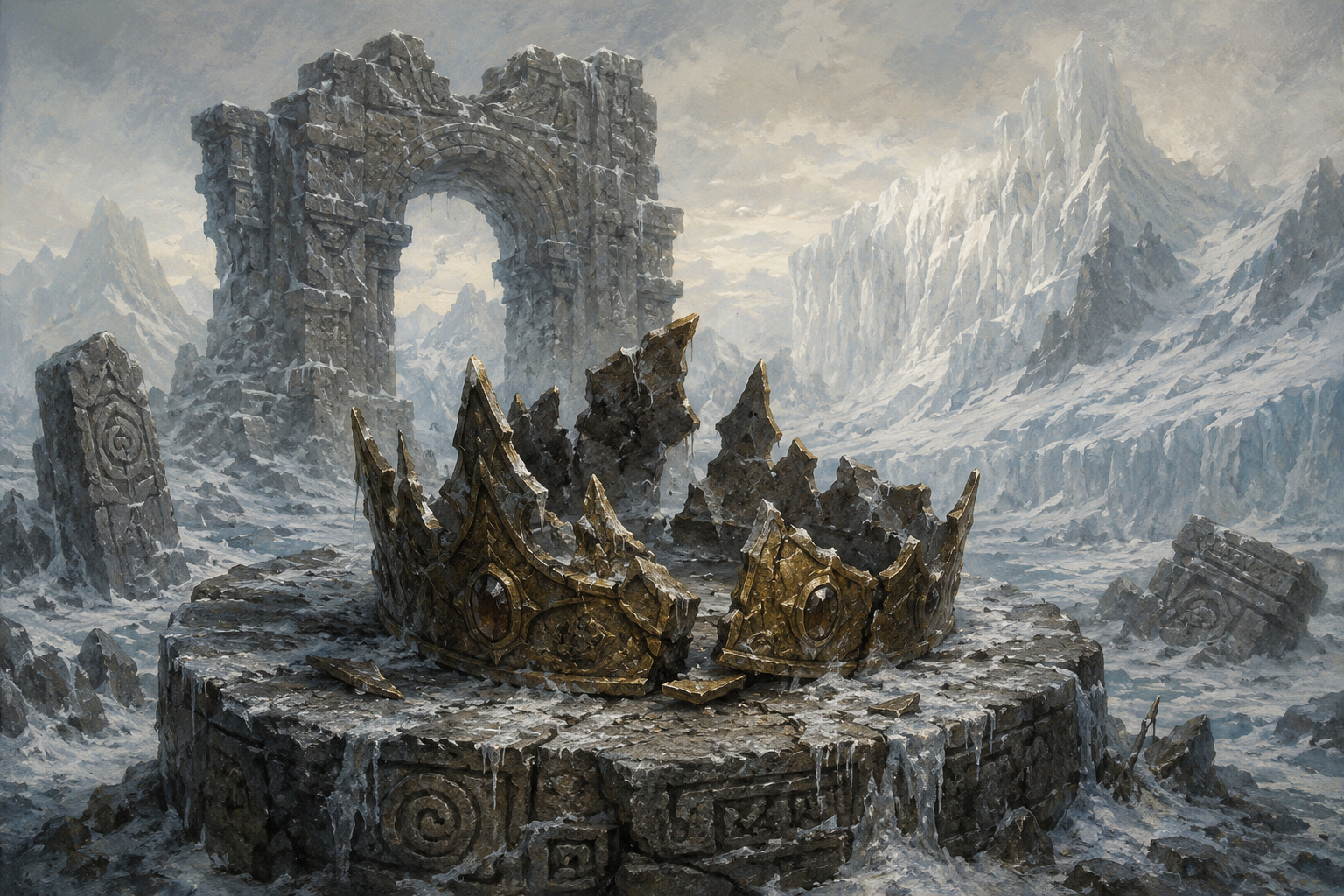
The crown that shatters belongs to no single ruler. It is the inherited authority of the elder world: Titan roads, ancient bloodlines, divine commands, dragon territories, elven sovereignties, serpent dynasties and the belief that conquest can establish permanent ownership of the Earth.
Giant kings claim the estates of the Primal Titans. Elven successor realms preserve fragments of older continental power. Dragons hold volcanic mountains and isolated plateaux. Serpent rulers retain hidden cities and cults. Elder Things withdraw into Antarctica, the oceans and the depths beneath the Earth. Hobgoblins attempt to replace every independent people with one militarised imperial order.
Every claim is broken, divided or driven into retreat.
The Shattered Crown begins when the Neogene ends 2.58 million years ago. It closes around 9700 BCE as the Pleistocene ends, the great ice retreats and the Dawning Age begins.
For play: this is the age in which many claims later peoples call primordial become disputed history. A giant fortress may stand on a Titan road, above a dwarven slave-work, beside an elven boundary and over a cave already used by humans. In 1454, ownership of such a place can still be argued through bloodline, treaty, liberation, conquest, sacred law or simple possession.
At the table: ruins from the Shattered Crown should rarely be empty. Give them surviving claimants, inherited grudges and practical value—an ice-buried road, a foundry only dwarven craft can restart, a sealed Yithian archive, a giant reservoir or a pass whose old wards still decide who may cross.
Chronology Note: The dates of glaciation, volcanism, sea-level change, animal life and human emergence follow the natural chronology of the Earth. The dates of kingdoms, wars, gods, elder peoples and supernatural catastrophes follow established SpiralWorlds history. Where an exact year is unknown, the event remains factual and is placed within its established period.
Key Events Timeline
2.58 Million Years Ago – The Pleistocene Begins
Global cooling establishes repeated cycles of glacial advance and retreat. Ice sheets expand across northern lands, mountain glaciers grow and immense quantities of water become locked within ice.
The Earth never becomes continuously frozen. Long glacial phases alternate with warmer intervals, repeatedly changing coastlines, rivers, forests, grasslands and migration routes.
The Shattered Crown inherits the open plains, widening steppes and increasingly familiar mammalian ecosystems of the Age of Open Lands. Titan estates, giant strongholds, dragon territories, Fey domains and elder ruins already divide the inhabited world.
Early Pleistocene – The Great Beasts
Mammoths, mastodons, woolly rhinoceroses, elasmotherium, giant deer, cave lions, sabre-toothed cats, great bears, giant sloths, glyptodonts and numerous other formidable animals flourish across the continents.
Falling seas expose continental shelves and land connections. Herds cross newly opened plains. Predators follow them. Peoples and monsters enter territories that later disappear beneath the water.
Early Pleistocene – The Giant Successor Kingdoms
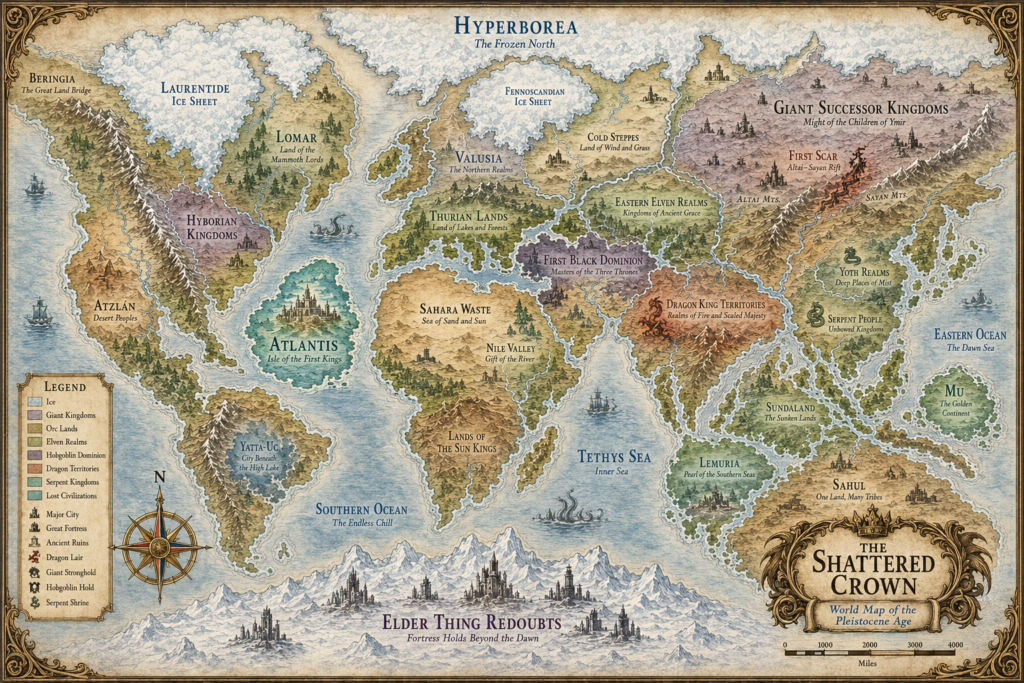
Rival giant dynasties control parts of northern and central Asia, Anatolia, the Caucasus, Upper Mesopotamia, western Iran and several great mountain systems.
Frost, fire, stone, storm, cloud, hill and other giant peoples descend from Titan soldiers, builders, smiths, wardens and governors. They inherit fortresses, roads, mines, reservoirs and foundries built during the elder ages.
The strongest giant kingdoms depend upon:
- Titan-built fortresses commanding mountain passes and river valleys;
- roads capable of carrying enormous armies and heavy loads;
- mines, quarries, reservoirs and foundries inherited from earlier eons;
- storehouses designed to survive long winters and military isolation;
- subject herders, hunters, porters, labourers and soldiers;
- enslaved dwarven miners, engineers, masons and smiths.
The giants possess the infrastructure of the Primal Titans without preserving their former unity or complete knowledge. Each generation repairs less than the last, while rival houses exhaust themselves fighting over roads, mines, fortresses, herds and enslaved populations.
Early Pleistocene – Dwarves in Bondage
Large populations of dwarves live as slaves within the giant successor kingdoms.
The bondage has a religious history as well as an economic one. Dwarven ancestors had long revered the Primal Titans as world-shaping powers of earth, fire, stone, metal, mountains and the deep world. Giant kings inherit Titan estates and claim authority as descendants, servants, heirs or appointed guardians of those powers. In some regions dwarven service begins within that older sacred order before giant rulers turn inherited obligation into coercion, hereditary labour and slavery.
They mine ore, carve roads, repair citadels and operate foundries their giant masters cannot maintain alone. Giant rulers value dwarven skill while controlling movement, weapon ownership, family life and access to the deeper knowledge preserved within the workshops.
Dwarven resistance grows through hidden craft traditions, damaged tools, concealed refuge chambers, stolen maps and carefully disguised weaknesses built into giant structures.
Free dwarven communities emerge through local revolt, flight and the seizure of individual mines and foundries. No united dwarven kingdom yet possesses the strength to wage a continental war.
Early Pleistocene – The First Golems
Dwarven artificers become the first mortal people on Earth to formalise true golem-making. Older cosmic powers, outsiders and alien civilisations had already created constructs and artificial servitors, but the enduring mortal tradition of a crafted body, bound animating force and standing command structure begins in dwarven workshops.
The first golems are built for protection rather than conquest. Refuge communities place them at gates, workshops, escape tunnels, water stores, clan archives and chambers where children, elders and wounded fugitives shelter while living defenders fight or flee.
The invention becomes part of dwarven liberation culture: a community should not need to surrender itself to a stronger ruler merely to survive the night. Later peoples copy, steal, purchase or independently reconstruct portions of the craft, but dwarves remain its first mortal masters. Some prehistoric guardians continue to stand watch long after the clans that made them have moved, divided or vanished. See Golems.
c. 2 Million Years Ago – The Elder Things Withdraw
The surviving Elder Thing civilisations withdraw towards Antarctica, abyssal refuges and sealed subterranean colonies.
Some installations remain active. Others fall to shoggoths, escaped biological creations and living systems that continue performing ancient tasks without supervision.
Early members of the human genus spread more widely through Africa and Eurasia. Stone-tool traditions develop across immense spans of time, and fire becomes an increasingly important part of survival, protection and social life.
c. 1.7 Million Years Ago – Ithaqua Enters the North
Ithaqua becomes openly active in the far north.
Its storms hunt travellers, settlements and migrating peoples. Supernatural winter, disappearance and cult warfare accelerate the decline of the voormis and weaken the northern kingdoms.
c. 1 Million Years Ago – The Deepening Cold
Ithaqua, Aphoom Zhah and other powers of destructive cold intensify the suffering caused by the glacial world.
Cold, famine, sorcery and war break northern trade routes and isolate cities. Giant kingdoms retreat towards geothermal valleys, defended mountain caverns and functioning Titan storehouses.
c. 1 Million–750,000 Years Ago – Hyperborea and Lomar Fall
Hyperborea, Lomar and the other polar civilisations break apart.
The voormis are killed, enslaved, transformed or driven into caves, mountains and remote forests. Surviving Serpent People retreat into underground sanctuaries. Elder Things withdraw farther beneath the ice and Earth.
Giant rulers seize abandoned fortifications wherever occupation remains possible. Elsewhere, glaciers cover cities, roads and shrines that have endured since earlier eons.
c. 750,200 Years Ago – Eibon of Hyperborea
Eibon becomes one of the greatest sorcerers of dying Hyperborea.
He studies Tsathoggua, distant worlds, forbidden gates and powers preserved beneath the northern ice. After his disappearance, copies and fragments of his writings spread among cults, magicians and surviving Hyperborean enclaves.
These writings become the foundation of the Book of Eibon. Later copyists add commentaries, errors and deliberate traps, but the original Hyperborean knowledge remains within the text.
Early-to-Middle Pleistocene – The First Scar Opens
Giant mining, Titan machinery and warfare over the foundations of northern Asia tear open the First Scar.
The Scar stretches through the Altai and Sayan country as a broken landscape of collapsed mines, exposed stone, poisoned valleys, ruined fortifications and shattered mountains.
The first recognised orc peoples emerge around this wounded land.
Orcs are a distinct nonhuman people with a prehuman origin. They are not transformed humans, corrupted elves, altered dwarves or creations of a later mortal ruler.
Their earliest culture forms amid failing giant estates, exposed steppe, abandoned fortresses and violent competition for herds, weapons, shelter and defensible ground.
The First Orc–Dwarf Conflicts
The oldest wars between orcs and dwarves begin inside the failing giant slave system.
Orc warbands attack giant mines, storehouses and fortified estates. They kill overseers, seize food and weapons and capture dwarven workers. Dwarven slaves defend escape routes, sabotage captured workshops and destroy foundries rather than allow another conqueror to possess them intact.
Further wars begin when escaped dwarves and orc clans seek the same abandoned mines, mountain refuges and Titan ruins. Possession of one functioning forge determines whether entire communities survive the winter.
Dwarves remember orcs as raiders who turn revolt into massacre and seize the workshops for which enslaved dwarves have suffered. Orcs remember dwarves as fortress-keepers and saboteurs who deny them weapons and strongholds won through blood.
Later massacres, destroyed settlements and stolen relics transform these conflicts into the oldest enduring hatred of both peoples.
Middle Pleistocene – The Eastern Elven Successor Realms
Before the Great Elven Fragmentation, most major terrestrial elven polities ultimately answer to one Supreme Continental Elven Empire. A genuinely disputed succession divides imperial legitimacy while a wider natural and cosmic crisis destabilises the empire’s magical infrastructure. Rival claimant blocs adopt incompatible responses, and their competing interventions become weapons of civil war that magnify the crisis into a magical-geological cascade.
By the Middle Pleistocene the universal imperial order has shattered. Powerful elven successor states remain across Anatolia, the Caucasus, northern Mesopotamia, western Iran and other territories, but they are separate dynasties, sacred territories and regional powers rather than continuations of several coequal original empires. They control forests, rivers, mountain valleys, hidden roads and crossings into the domains of the Fey. The directly governed imperial heartland is effectively lost, and later elven traditions disagree over where its centre once stood.
Elven rulers fight giant dynasties, dragon powers, serpent cults and expanding hobgoblin fortress societies.
Middle Pleistocene – Varkesh and the First Muster
Hobgoblin clans inhabit Anatolia, the Caucasus, Upper Mesopotamia and the western Iranian uplands. They practise collective warfare, guarded storage, slavery and fortified settlement, but their alliances depend upon individual war leaders.
Varkesh, remembered as the First Muster, transforms these clans into the first permanent hobgoblin military civilisation.
He establishes recognised ranks, standard measures, population counts, military storehouses, hostage law, institutional slavery and chains of command capable of surviving the death of a chief.
Warriors from related clans are divided among mixed formations. Officers receive authority from the state. Households owe labour, soldiers, animals, grain or skilled service according to recorded obligation.
The First Black Dominion
Varkesh establishes the First Black Dominion across the eastern Mediterranean hinterland, Anatolia, the Caucasian approaches, Upper Mesopotamia and western Iran.
The Dominion expands through planned conquest. Its armies seize giant citadels, dwarf-worked foundries, fertile valleys, elven crossings and strategic uplands. Fortified settlements and captured storehouses support each new campaign.
Every conquered population is classified according to its value to the state.
- Useful communities are taxed, enslaved, conscripted or absorbed into military households.
- Skilled workers are assigned to armouries, workshops, granaries, transport and siege labour.
- Selected children are separated from their former loyalties and raised within controlled military institutions.
- Local rulers survive while they enforce Dominion law and supply its armies.
- Communities that continue organised resistance are starved, massacred, dispersed locally or destroyed through scorched-earth campaigns.
The Dominion acts upon conquered peoples where they live. Fields, workshops, roads and labour are incorporated directly into its military economy.
Varkesh intends to replace independent kingdoms, ancestral bloodlines, local laws, temples and sacred territories with one militarised imperial system.
The War of the Broken Standards
The First Black Dominion threatens every major independent power within its reach.
Eastern elven successor realms resist the occupation of their valleys, sacred crossings and ancestral territories. Surviving giant kingdoms oppose the seizure of Titan fortresses and tributary lands. Dwarven slaves sabotage the foundries upon which Dominion armies depend. Conquered populations revolt against taxation, enslavement and the destruction of their local orders.
The coalition against Varkesh consists of:
- eastern elven successor realms;
- surviving giant successor kingdoms;
- rebellious subject peoples;
- escaped and revolting slaves;
- local powers defending sacred and ancestral territories.
Human populations have not yet become a significant political force in these lands.
Dwarven participation takes the form of revolt, sabotage, escape and the opening of giant and hobgoblin fortresses from within. Independent dwarven kingdoms do not lead the coalition.
Serpentfolk, dragons, Catfolk, xulgaths and troglodytes do not join the alliance.
The Dominion Breaks
The coalition attacks the institutions that allow hobgoblin armies to remain in the field.
- Elven powers close hidden crossings and isolate invading formations.
- Giant rulers destroy fortresses and bridges rather than surrender them intact.
- Dwarven slaves disable forges, siege engines and defensive gates.
- Rebellious subjects burn grain stores and kill isolated officials.
- Captured standards and false orders spread confusion between distant commands.
- Rival hobgoblin generals preserve their own formations instead of rescuing one another.
Eastern elven warriors kill Varkesh during the final breaking of his central army.
Varkesh dies before his commanders agree upon a successor. Governors declare themselves sovereign, generals accuse one another of treason and military settlements turn upon neighbouring formations.
Dominion standards are captured, destroyed and cut apart so that broken regiments cannot be identified and reorganised. The conflict becomes the War of the Broken Standards.
Varkesh Enters Acheron
The accumulated oaths, conquests and disciplined violence surrounding Varkesh draw his spirit into Acheron.
There he becomes a Lawful Evil god of command, conquest, mustering and the institutional exploitation of subject peoples.
His mortal empire is already too divided to obey him. Later hobgoblin conquerors interpret the collapse as proof that rank must become more absolute, obedience harsher and independent loyalties more completely destroyed.
The Long Savagery
The fall of the First Black Dominion begins the Long Savagery.
Central government disappears, but hobgoblin discipline and cruelty remain. Fortress clans preserve rank, formation fighting, enslavement and military punishment. Isolated governors convert former provinces into hereditary holdings. Regiments become tribes while retaining fragments of Varkesh’s order.
Writing and large-scale record keeping disappear from many regions. Chiefs raid, enslave captives and establish local dominions that collapse through succession disputes, famine, overextension and rebellion.
Every successful warlord claims to restore Varkesh’s standard. None possesses enough of the original system to hold a continental Dominion together.
c. 500,000 Years Ago – Nemedis Wars Against the Dragon Kings
The mortal kingdom of Nemedis wages a prolonged war against the Dragon Kings.
The Dragon Kings rule fortified southern territories through monstrous armies, serpent servants and ancient sorcery. Nemedian campaigns drive them south and break their northern control.
The Serpent People establish a renewed Valusia. Other survivors withdraw into concealed cities, underground sanctuaries and hidden cult networks.
These wars remain separate from the War of the Broken Standards.
c. 300,000 Years Ago – Homo sapiens Appears
Homo sapiens emerges in Africa.
Human communities inherit ancient tool traditions and develop increasingly varied relationships with forests, grasslands, deserts, rivers, coasts, mountains and cold environments.
Human expansion moves through inhabited worlds. Migrating communities encounter other human populations, elves, Fey, giants, dwarves, orcs, goblinoids, serpent peoples, spirits and ruins whose builders have withdrawn rather than vanished.
Thousands of separate languages, ritual traditions, alliances and territorial identities develop. Humanity becomes a permanent force without becoming one united people or political order.
c. 200,000 Years Ago – Mu Reaches Its Height
Mu reaches the height of its power.
Its rulers command monumental cities, formal sorcery, sea routes and knowledge older than most later human civilisations. Its priesthoods bind the state to alien powers whose purposes remain hostile to mortal life.
173,148–161,844 Years Ago – Ghatanothoa Rules Mu
Ghatanothoa rises to supremacy in Mu.
The priest T’yog challenges its rule. His protection fails, and Ghatanothoa destroys him through living petrification.
The attempt to release Ythogtha brings further devastation. Mu’s political order breaks, leaving drowned sites, petrified victims, displaced cults and dangerous relics across the surviving world.
c. 115,000 Years Ago – The Last Glacial Period Begins
Ice expands again across northern regions. Rainfall, temperature and vegetation change far beyond the ice sheets.
Human, orc, giant, dwarf and other populations adapt through migration, altered food gathering, fortified refuges and new alliances. Communities unable to move or replace lost resources disappear.
c. 74,000 Years Ago – Toba Erupts
Toba erupts in Sumatra.
Ash destroys nearby lands, darkens the skies across southern Asia and disrupts food supplies far beyond the eruption. Human and nonhuman populations abandon affected territories, compete over surviving rivers and forests and carry stories of the blackened sky into distant regions.
c. 70,000–40,000 Years Ago – Human Worlds Expand
Human communities spread across larger parts of Africa, Eurasia, Sahul and other inhabited regions.
Coastal travel, watercraft, hunting, gathering, exchange, ritual and specialised technologies take increasingly varied regional forms.
Some communities serve older powers or settle under their protection. Others raid their holdings, occupy abandoned land or form alliances against common enemies.
c. 50,000 Years Ago – Drowning Lands and Great Migrations
Earthquakes, coastal collapse and rising waters weaken several ancient realms.
Atlantis and Lemuria lose further territory. Their inhabitants establish colonies, refugee communities and competing lines of succession.
Relics, cults and fragments of technical knowledge spread far beyond the political borders of the kingdoms that create them.
c. 33,000 Years Ago – Human and Fey Settlements
Human and Fey peoples establish shared settlements, ritual centres, exchange routes, marriages and military alliances in several regions.
Other Fey courts oppose human settlement, close their crossings and withdraw more deeply into the Fey World.
These relationships create lasting bloodlines, obligations, feuds and territorial agreements that survive after the shared settlements disappear.
c. 26,500–19,000 Years Ago – The Last Glacial Maximum
Ice sheets reach the greatest extent of the final glacial period. Sea level stands far below its later position, exposing immense continental shelves.
- Beringia connects Asia and North America.
- Britain remains joined to continental Europe.
- Sundaland links much of maritime Southeast Asia.
- Australia and New Guinea form the larger landmass of Sahul.
- Broad coastal plains support animals, settlements, roads and sacred sites.
These lowlands become some of the most heavily travelled and contested territories of the age.
c. 24,000 Years Ago – The City of the Golden Gates Falls
The City of the Golden Gates sinks and the central authority of old Atlantis breaks.
Atlantean survivors disperse among colonies, refugee communities and rival successor traditions. No later ruler inherits the entire Atlantean state, population or body of knowledge.
c. 20,000 Years Ago – The Thurian Kingdoms Rise
Human kingdoms dominate the Thurian lands. Valusia passes into human hands, although Serpent People, cults and concealed bloodlines survive beneath the new political order.
Atlantis, Lemuria and other surviving realms remain important powers until the catastrophe that ends the Thurian world.
c. 18,000 Years Ago – The Great Cataclysm
A geological and magical catastrophe destroys the old Thurian geography. Lands sink, mountains rise and surviving peoples migrate into unfamiliar territories.
The Hyborian Age develops from this destruction. Aquilonia, Nemedia, Cimmeria, Stygia, Zamora, Acheron and other kingdoms rise within the altered world.
The Hyborian kingdoms occupy only part of the Earth. Orc territories, hobgoblin fortress societies, eastern elven realms, dwarf strongholds, giant enclaves, Catfolk lands, dragon domains and other nonhuman powers continue beyond and between them.
Late Pleistocene – Orzhal and the Second Standard
Orzhal, remembered as the Second Standard, arises long after Varkesh’s death and before the final collapse of the Hyborian world.
He gathers surviving fortress clans, military households and keepers of fragmentary Varkeshite traditions.
Through conquest, recovered archives and revelation from Varkesh, Orzhal restores written law, permanent rank, standard measures, census-taking, military storehouses, siege engineering and regulated slave institutions.
The resulting Second Dominion contains fortress cities, armouries, grain depots, military estates and organised markets capable of supporting campaigns beyond the territories of individual clans.
Orzhal proves that hobgoblin imperial civilisation can recover from the Long Savagery.
c. 12,900–11,700 Years Ago – The Final Cold Reversal
A severe return to colder conditions disrupts ecosystems and settlements across much of the northern world.
Communities alter migration routes, abandon exposed territories or become more dependent upon fisheries, stored food and defended refuges.
c. 9700 BCE – The Pleistocene Ends
The final major cold phase ends and the Holocene begins. Temperatures rise, ice retreats and forests spread into former tundra and open grassland.
Rising water covers lowland settlements, river valleys and ancient roads. Glacial lakes burst, rivers change course and coastal plains disappear.
The geological boundary opens a prolonged period of flood, migration and political collapse. The Hyborian kingdoms and Orzhal’s Second Dominion continue briefly into the Dawning Age before the final post-Hyborian catastrophe destroys their remaining order.
The Crown That Shatters
The Shattered Crown is the authority inherited from the elder Earth.
- Giants claim the estates and commands of the Primal Titans.
- Dwarves preserve the craft required to maintain those works.
- Dragons defend territories held since far older geological ages.
- Fey powers preserve boundaries formed when forests and rivers occupied different lands.
- Orcs seize ruins, herds, weapons and strongholds around the First Scar.
- Elven successor realms defend ancestral territories and sacred crossings.
- Hobgoblins attempt to transform conquest into a universal imperial order.
- Human kingdoms inherit lands, relics and enemies from older peoples.
- Lost civilisations preserve magic and technical knowledge beyond the reach of most contemporary societies.
Giant kingdoms fragment. Dwarven slaves escape. Orc clans remain divided. Varkesh’s Dominion falls. Hyperborea, Mu, Atlantis and the Thurian world are destroyed. The Hyborian kingdoms and Orzhal’s Second Dominion approach their final ruin.
The age ends with many survivors and no uncontested heir.
Titans, Giants and the Elder Inheritance
The Primal Titans
The Primal Titans are the elder world-shaping powers who command the earliest kingdoms and construct vast prehistoric systems.
Most are dead, bound, sleeping, withdrawn or confined to remote places by the beginning of the Pleistocene. Others survive through dreams, inherited commands, imprisoned servants and rare awakenings.
Their roads, mines, fortresses, reservoirs and ritual estates remain after direct Titan rule ends. Later peoples occupy and repair these works without understanding how to reproduce them.
The Primal Titans are distinct from later divine generations such as the Hellenic Titans. Similar titles do not make every Titan part of one pantheon or bloodline.
Later Titan-Kind
The SpiralWorlds Bestiary records Elder, Chthonian, Elysian, Fomorian, Wild and other Titan beings.
These are separate lineages, descendants, regional manifestations and later powers bearing an ancient title. They are not automatically members of the original Primal generation.
The Giant Successor Kingdoms
Giant rulers claim authority as descendants, servants, heirs and appointed guardians of the Titans.
Frost giants dominate sections of the northern world. Fire giant houses preserve foundries near volcanic regions. Stone giants hold caverns, quarries and mountain roads. Storm and cloud giant dynasties occupy isolated heights. Hill giants control fertile margins through tribute and raiding.
Ettins and other divided giant peoples serve as border lords, mercenaries, raiders and remnants of failed giant military systems.
The connected giant world fragments through glaciation, dynastic war, slave revolt, orc attacks, dragon conflict and the loss of Titan infrastructure.
Individual giant kingdoms, hidden courts and ancestral claims survive into later ages.
Dwarves Under Giant Rule
Dwarven civilisation during the early Shattered Crown develops under bondage, but not from cultural emptiness. Dwarven clans already carry Titan-era rites, craft lineages and inherited sacred obligations. What changes is their judgement of authority: giant rulers who claim the Titans’ inheritance prove that sacred ancestry does not make coercion legitimate.
Dwarves maintain roads, mines, siege works and foundries their masters cannot operate alone. This dependence makes dwarven labour extremely valuable and gives workers opportunities to conceal knowledge and undermine the system.
Dwarven resistance includes:
- preserving forbidden craft traditions through family memory;
- concealing weaknesses inside giant construction;
- stealing tools, maps and weapons from guarded workshops;
- creating refuge chambers and escape tunnels;
- building the first golem guardians to hold gates, protect refuges and defend communities too small to keep enough living warriors on watch;
- sheltering fugitives in abandoned excavations;
- destroying a foundry before an enemy can capture it;
- seizing mines when a giant household becomes isolated;
- forming temporary alliances with other enslaved populations.
Free dwarf communities emerge in captured workshops, mountain refuges and sealed underground complexes.
Different communities escape under different circumstances and preserve separate histories of bondage, liberation and betrayal. The dwarves possess no single universal homeland.
The Great Betrayal — The Deep Clans Are Sealed Below
As revolts spread through the giant mines, several escaping dwarf groups seal shafts, gates and military roads behind them to stop giant forces, orc warbands and other pursuers from following into the upper workings. The decision allows thousands of rebels and families to reach freedom.
It also traps entire dwarf clans in the deepest complexes.
The clans that escape remember the sealing as a desperate military necessity: leaving the roads open would have allowed the revolt to be crushed. The clans left below remember the same act as the Great Betrayal. Their kin escaped the slave system and closed the way behind them.
The abandoned clans survive in giant slave mines, forgotten deep roads and under-realms reaching toward Svartalfaheim. Some seize workshops and fortifications. Some bargain with powers of the deep earth. All endure generations of darkness, poison, scarcity and subterranean war. Their descendants become the Duergar.
Other dwarf clans also remain underground for immense spans of time without undergoing the same transformation. These deep dwarves remain part of the wider dwarven people. Depth alone does not make a dwarf Duergar.
The First Scar and the Orcs
The First Scar is the defining ancestral landscape of the orcs.
Its ruined mines, broken mountains and abandoned military works teach early orc clans that survival depends upon immediate possession. Food, shelter, weapons and land belong to those capable of taking and defending them.
Orc leaders retain authority while they bring victory, secure resources and protect the clan. A powerful chief may gather thousands, but succession commonly returns the host to division and feud.
Early orc warfare is destructive and direct. Warbands raid settlements, kill organised resistance, seize captives and strip useful property. Stores that cannot be carried are burned to prevent an enemy’s recovery.
Payment delays an attack without purchasing lasting safety. Wealth offered as tribute reveals the resources available to later raiders.
Mhurak Stone-Blood belongs to a much later age. He is the orc founder and unifier of the Great Muster, not the creator of the orc people or the source of the First Scar.
Varkesh and Hobgoblin Civilisation
Varkesh transforms hobgoblins from a collection of disciplined fortress clans into a civilisation organised for permanent conquest.
His doctrine establishes that:
- every hobgoblin belongs within a recognised chain of command;
- permanent officers outrank temporary war chiefs;
- written obligation replaces personal favour;
- conquest produces garrisons, stores, labour and revenue;
- useful populations are preserved and exploited;
- resistance is classified, isolated and destroyed;
- a ruler unable to enforce command forfeits authority;
- all independent institutions ultimately serve the Dominion.
The First Black Dominion is more than a large raiding confederation. It seeks to replace every independent people, law, cult, bloodline and sacred order within its reach.
This ambition draws opposition from gods as well as mortal rulers. The Dominion destroys shrines, enslaves worshippers, seizes sacred ground and places surviving priesthoods beneath military authority.
Even cruel and warlike gods oppose a state that intends to reduce every cult to an instrument of conquest.
The Long Savagery
The Long Savagery returns hobgoblins to local fortress rule without erasing their military character.
Clans retain discipline, hierarchy, enslavement and the expectation of conquest. They lose the administrative network that allows numerous settlements and armies to act as one state.
The Second Dominion
Orzhal restores the missing institutions. The Second Standard recreates writing, measurement, census-taking, supply administration, permanent service and siege organisation.
The Second Dominion remains vulnerable to regional rivalry and succession conflict. Its recovery nevertheless ensures that hobgoblin imperial civilisation survives into the Hyborian Age and beyond.
The later Ninefold Dominion inherits this tradition through reconstructed laws, cult memory and surviving military institutions rather than uninterrupted government from Varkesh’s age.
The Eastern Elven Realms
The older continental elven empires have already fragmented by the time of Varkesh, but powerful successor realms survive throughout Anatolia, the Caucasus, northern Mesopotamia and western Iran.
These realms control forests, rivers, mountain valleys, concealed roads and crossings between the mortal Earth and ancient Fey territories.
They remain independent states rather than one united elven empire. Their dynasties frequently disagree, but Varkesh’s expansion threatens every realm that values ancestral sovereignty.
Dominion forces fortify elven roads, clear forests around concealed settlements, enslave specialists and assign military households to conquered land.
Elven participation in the War of the Broken Standards preserves the independence of these realms without restoring the older continental elven order.
Dragons and the Old Highlands
Dragons remain among the oldest sovereign creatures of the Earth.
Ancient dragons retain volcanic regions, high mountain chains, isolated plateaux and deep caverns throughout the Pleistocene. Some rule alone. Others command lesser dragons, reptilian peoples, cult servants and subject monsters.
Dragons fight giants over highland fortresses and Titan estates. They fight Fey powers over sacred mountains and hidden crossings. They fight Serpent People over ruins, relics and competing claims to reptilian antiquity.
Northern dragon lineages consolidate their power around volcanic refuges as the climate becomes colder.
The wars against Nemedis break several Dragon King domains without eliminating dragons from the world.
Fey Courts and Ancient Wild Domains
Fey territories change as forests contract, rivers alter course and grasslands spread.
Forest courts retreat with ancient woodland or preserve isolated green territories through magic. Plains Fey, wind spirits and herd powers claim newly opened landscapes. River courts follow changing waterways and defend channels associated with older agreements.
Some Fey protect springs, migration routes and seasonal abundance. Others hunt travellers, demand tribute from moving peoples and enforce boundaries invisible to mortal eyes.
The Pleistocene produces repeated conflicts among Fey courts, giants, dragons, elves and mortal communities. These struggles use armies, curses, altered rivers, blighted land and monstrous predators.
The shared human and Fey cultures of the Late Pleistocene grow from particular alliances and settlements rather than universal peace between the two peoples.
Humanity and the Inhabited World
Human history develops across landscapes already shaped by nonhuman power.
Human communities encounter:
- giant estates seeking tribute and labour;
- orc clans seeking captives, resources and territory;
- free and enslaved dwarven communities;
- elven realms controlling ancient valleys and crossings;
- Fey courts enforcing seasonal and ancestral laws;
- hobgoblin fortress societies;
- dragon domains and reptilian cults;
- Serpent People and concealed successor kingdoms;
- elder ruins whose builders have withdrawn rather than died;
- gods and spirits whose territorial claims predate human settlement.
Human expansion succeeds through adaptability rather than one universal empire.
Communities exchange knowledge, raid, trade, migrate, intermarry and form alliances. Some serve older powers. Others overthrow them. Many occupy land abandoned by one people but still claimed by that people’s gods, descendants and surviving rulers.
By the Late Pleistocene, humanity is a permanent force across the inhabited world, but political dominance remains regional.
Elder Civilisations and Hidden Survivors
Elder Things
Elder Things retain Antarctic, abyssal and subterranean colonies.
Their visible civilisation declines, but their withdrawal preserves cities, laboratories and transport systems beneath environments hostile to younger peoples.
Shoggoths
Shoggoths survive within Elder Thing installations, deep caverns and abandoned biological complexes.
Some remain controlled. Others escape, outlive their creators and establish territories around machinery and living systems they only partly understand.
The Great Race of Yith
The Great Race continues its exchanges across time, space and species.
Yithian minds observe the Pleistocene through borrowed bodies and gather knowledge from civilisations destined to fall. Their records unite histories separated by millions of years.
Deep Ones and Yatta-uc
Deep Ones inhabit seas, drowned coasts, flooded caverns and concealed inland waters.
Yatta-uc beneath Lake Titicaca continues from the Age of Open Lands. Its temples, settlements and hidden waterways make it one of the greatest inland centres of Deep One civilisation.
Changing water levels alter its routes and borders but do not destroy the city.
Serpent People and the Ruins of Yoth
Serpent People survive the destruction of Yoth through underground cities, hidden sanctuaries, disguised bloodlines and competing cult networks.
Yothian laboratories contain preserved eggs, unfinished servant species, breeding records and devices designed for the control of living populations.
Yig loyalists and Tsathogguan factions continue their ancient religious war within the underworld and the remnants of Hyperborea.
The Voormis
The voormis begin the Pleistocene as heirs to a surface kingdom created through uprisings against Serpent People masters.
Ithaqua, supernatural cold, renewed enslavement and the destruction of Hyperborea break this kingdom.
Surviving voormis withdraw into mountain caves, ancient forests and subterranean refuges. Some preserve the worship of Tsathoggua. Others reject every external cult as another form of bondage.
Mi-Go Enclaves
Mi-Go use remote mountains, polar isolation and mineral-rich regions for extraction, experimentation and concealed travel.
Their sites consist of hidden mines, laboratories, observation posts and temporary colonies rather than large visible kingdoms.
Settlements interfering with their work are infiltrated, altered or removed.
The Moon-Beasts and Sarkomand
The moon-beasts carry away the people of Sarkomand.
The abandoned roads, temples and ports preserve the marks of a civilisation destroyed by enemies who arrive through dream and the night sky.
Rhan-Tegoth
Rhan-Tegoth remains in the Arctic after arriving during the closing Neogene.
Its sacrificial cult declines until worship fails and stillness overtakes the being. Rhan-Tegoth enters dormancy rather than death.
Theem’hdra
The ruins of Theem’hdra survive from a humanlike civilisation founded millions of years before Homo sapiens.
Its structures, inscriptions and tools possess proportions compatible with later humanity. Sealed chambers preserve the magic of Teh Atht and the traditions gathered into the Legends of the Olden Runes.
Named Figures of the Shattered Crown
Varkesh, the First Muster
Varkesh founds the First Black Dominion and transforms conquest into permanent hobgoblin military government.
Elven forces kill him during the War of the Broken Standards. After death, he becomes an Acheronian god of command and universal conquest.
Orzhal, the Second Standard
Orzhal restores hobgoblin writing, measurement, census-taking, siege organisation and military administration after the Long Savagery.
His Second Dominion proves that the institutions of Varkesh can return after an immense period of political fragmentation.
Eibon of Hyperborea
Eibon is one of the greatest sorcerers of dying Hyperborea.
His writings survive through incomplete copies, occult commentaries and traditions gathered into the Book of Eibon.
T’yog of Mu
T’yog is the priest who challenges Ghatanothoa.
His destruction demonstrates that ritual knowledge, divine office and magical preparation provide no protection against a Great Old One whose power exceeds the civilisation worshipping it.
Gods, Great Old Ones and Cult Powers
The gods remain active throughout the Shattered Crown. Their authority is regional, contested and connected to worship, sacred law, ancestral relationships and holy places.
Ithaqua
Ithaqua hunts the far north through predatory winter, disappearance and storm.
Its activity contributes directly to the fall of Hyperborea and the scattering of the voormis.
Aphoom Zhah
Aphoom Zhah embodies destructive supernatural cold and the hostility of the polar world.
Its influence intensifies the ruin of northern civilisations already weakened by glaciation, famine and war.
Tsathoggua
Tsathoggua is bound to Hyperborean sorcery, the history of the voormis and the religious schism that destroys Yoth.
Its worship persists in caves, subterranean temples and copies of Hyperborean magical texts.
Yig
Yig remains central to Serpent People civilisation.
Yig loyalists preserve hidden sanctuaries, bloodlines and records after the destruction of Yoth and the decline of open serpent rule.
Ghatanothoa
Ghatanothoa rules Mu through terror and living petrification.
Its cult places an alien power at the centre of a mortal political system without changing the being’s hostility to mortal life.
Rhan-Tegoth
Rhan-Tegoth survives in Arctic dormancy after the disappearance of its worshippers.
Its body remains capable of awakening when sacrifice and worship return.
Varkesh
Varkesh begins as a mortal hobgoblin prophet and conqueror and becomes a god in Acheron.
His cult teaches that defeat results from divided command, incomplete obedience and the survival of independent loyalties.
Other Powers of the Age
- Cold gods and winter spirits gain influence during glacial advances.
- Fire, hearth and shelter powers protect communities living near the limits of survival.
- Hunt, herd and migration gods follow animals and peoples across changing landscapes.
- Mountain and cavern powers receive dwarven worship from workshops and hidden refuges.
- Orc gods gather around strength, conquest, survival, storm, steppe and the First Scar.
- Elven gods defend bloodlines, forests, rivers, uplands and sacred crossings.
- Giant rulers claim ancestry or authority from Titans and primordial landscape powers.
- Dragon cults serve ancient rulers associated with mountains, treasure, fire and territorial sovereignty.
- Sea and flood powers gain sacred territories as coastlines move inland.
Other beings among the Great Old Ones act through dreams, cults and hidden sites whenever their influence reaches the Earth.
Creatures of the Shattered Crown
The Pleistocene supports immense and regionally varied animal communities. Each continent possesses its own great herbivores, predators and supernatural survivals.
Northern Eurasia
- Mammoths and mastodons cross tundra, cold steppe and open woodland.
- Woolly rhinoceroses and elasmotherium inhabit cold grasslands and steppe margins.
- Cave lions hunt large herbivores across open country.
- Homotherium ranges widely as a specialised predator.
- Megantereon survives during the earlier Pleistocene.
- Giant deer inhabit woodland, forest margins and open country.
- Aurochs and bison form powerful and dangerous herds.
- Dire wolves and other great canids compete with human and nonhuman hunters.
- Musk oxen endure the tundra and glacial margins.
The Americas
- Mastodons and mammoths inhabit woodland, grassland and cold northern environments.
- Arctodus and other great bears dominate extensive territories.
- Smilodon hunts large prey in open woodland and grassland.
- Dire wolves form powerful social hunting groups.
- Megatherium and other giant ground sloths inhabit South America.
- Castoroides occupies North American wetlands and river systems.
- Glyptodonts and other heavily armoured herbivores inhabit warmer American regions.
Sahul
- Megalania is an immense terrestrial predator.
- Thylacoleo hunts among woodland, scrub and broken country.
- Diprotodon and other great marsupial herbivores occupy plains and open woodland.
- Large flightless birds, reptiles and marsupial predators create ecosystems distinct from those of Eurasia and the Americas.
Monstrous Beasts
Natural megafauna share the age with supernatural and monstrous creatures.
Giant rulers breed, capture and employ great animals for labour, warfare and hunting. Orc clans follow migrating herds and adopt powerful predators as clan symbols, rivals and mounts.
Elven and Fey territories preserve animals that vanish from neighbouring mortal lands. Dragon territories contain altered beasts, cult guardians and creatures shaped by elemental power.
Magic, divine protection, hidden valleys and access to other planes allow many species to survive beyond their natural ranges.
The Thurian and Hyborian Worlds
The Late Pleistocene contains two major mortal political orders divided by catastrophe.
The Thurian world includes Valusia, Atlantis, Lemuria and other kingdoms. Human rulers take Valusia from serpent dynasties, although serpent populations and cults remain.
The Great Cataclysm destroys this geography and begins the Hyborian Age.
The Hyborian kingdoms possess cities, armies, commerce, metalworking and formal sorcery. Their organisation represents one portion of the contemporary world. Mobile hunters, fishers, gatherers, herders and smaller settled communities continue across other regions.
The Hyborian Age continues briefly across the boundary into the Dawning Age. Its final wars, the rule of its last great kings and the post-Hyborian flood belong to the succeeding page.
Technology and Magic
Everyday Materials
Most communities rely upon stone, wood, bone, antler, hide, sinew, shell and woven fibre.
Spears, projectile weapons, traps, nets, baskets, clothing, shelters, storage equipment and watercraft support life across widely different environments.
Fire
Fire provides warmth, cooking, light, protection, landscape management, craft and ritual focus.
The preservation and transport of embers becomes both a practical responsibility and a sacred duty. Many traditions treat the hearth as a living inheritance carried between camps and settlements.
Metal and Elder Craft
Advanced metalworking exists within giant, dwarven, Atlantean, Thurian, Hyborian and other specialised civilisations long before it becomes widely available to most human communities.
A metal weapon, suit of armour or functioning foundry requires trained specialists, ore, fuel, transport, political protection and inherited knowledge.
Advanced craft remains concentrated within particular kingdoms, workshops, slave systems and hidden traditions.
Magic
Magic takes the form of dream, oath, spirit negotiation, burial, blood, carved image, song, sacrifice, weather-working, ancestral memory and instruction received from gods and older peoples.
Lost civilisations preserve written sorcery, laboratories, enchanted machinery and formal magical institutions. These systems depend upon specialists, rare materials, sacred locations and states capable of supporting them.
Survivors retain spells, relics and fragments of knowledge after losing the civilisation required to reproduce them.
What Changes During the Shattered Crown
- Repeated glaciation remakes climates, coastlines, rivers and migration routes.
- Great Ice Age animals flourish across tundra, steppe, forest, mountain, wetland and grassland.
- Giant successor kingdoms lose much of the connected Titan infrastructure supporting their rule.
- Dwarven populations escape giant slavery and establish separate refuges and strongholds.
- Orcs emerge around the First Scar and become a major power of northern and central lands.
- The ancient orc–dwarf hatred develops within the collapse of the giant slave system.
- Terrestrial elven successor kingdoms become major political powers.
- Varkesh creates the First Muster and the First Black Dominion.
- The War of the Broken Standards destroys Varkesh’s mortal empire.
- Varkesh becomes a divine power in Acheron.
- Hobgoblin civilisation enters the Long Savagery and later recovers through Orzhal.
- Homo sapiens appears and human communities spread across increasingly varied environments.
- Dragon powers lose open territories while preserving mountain and volcanic domains.
- Hyperborea, Mu, Atlantis and the Thurian kingdoms rise, decline and fall.
- The Hyborian world and Orzhal’s Second Dominion continue towards their final destruction.
- The Pleistocene ends as the ice retreats and the Holocene begins.
What Survives
- Titan roads buried beneath later trade and military routes;
- giant fortresses isolated in mountains, tundra and volcanic regions;
- dwarven foundries first established as slave workshops;
- orc sacred sites surrounding the First Scar;
- weapons and standards associated with the earliest orc clans;
- fragments of Varkesh’s laws and population records;
- broken standards preserved as elven, dwarven and subject-peoples’ victory relics;
- hobgoblin fortress clans claiming descent from the First Muster;
- Acheronian cults of Varkesh;
- Orzhalic fortresses and administrative records;
- dragon citadels and ancient territorial claims;
- Hyperborean ruins beneath ice, sea and northern wilderness;
- copies and corrupt fragments of the Book of Eibon;
- Elder Thing colonies and abandoned laboratories;
- independent shoggoth territories;
- Yithian records;
- Deep One cities beneath seas and inland waters;
- Theem’hdran ruins and Yothian laboratories;
- Atlantean, Lemurian, Thurian and Hyborian relics carried by survivors;
- Serpent People cults descended from Yothian and Valusian traditions;
- human settlements and sacred sites beneath flooded continental shelves;
- Fey roads closed when shared Ice Age cultures end;
- divine and ancestral claims to lands occupied during periods of low sea level;
- memories of moving ice, drowned plains and vanished kingdoms.
Campaign Legacies
The Forge Beneath the Giant Road
A later fortress stands above a Titan road and a foundry maintained for generations by enslaved dwarves. Orcs, dwarves and giant heirs each claim ownership through a different episode of its history.
The Last Black Standard
Excavators uncover a standard that survives the War of the Broken Standards. Hobgoblin rulers seek to authenticate it, while elven and dwarven powers demand possession of the relic.
The Second Standard’s Archive
An Orzhalic fortress contains records identifying military bloodlines, conquered settlements and enslaved populations whose descendants still inhabit the region.
The First-Scar Weapon
An orc clan recovers a weapon associated with its earliest ancestors. Dwarven inscriptions reveal that it was made in a slave foundry and taken during a massacre remembered differently by both peoples.
The Reopened Fey Crossing
A route closed since the shared human–Fey settlements of the Ice Age opens again. The court beyond it expects the descendants of former allies to fulfil an ancient agreement.
The Glacial Colony
A retreating glacier reveals an Elder Thing installation, giant burial estate or settlement abandoned during the final cold reversal. Its inhabitants have been waiting rather than dead.
The Sleeping Northern God
An expedition finds a cult site associated with Ithaqua, Aphoom Zhah or Rhan-Tegoth. The site was abandoned to end worship and force the power into dormancy.
The Shoggoth Road
A buried Titan route remains clear of ice because an ancient living maintenance system still moves beneath it. Dwarven records identify the system as something even the giant kings feared to awaken.
The Record of Borrowed Minds
A Yithian record contains accounts of kingdoms that will not exist for thousands of years. One passage describes the adventurers discovering it.
The Treaty of Yatta-uc
A Deep One delegation produces a treaty proving that a surface kingdom occupies territory granted to Yatta-uc before the rise of humanity.
The Dragon King’s Boundary
An ancient dragon claims that a mountain realm remains subject to an agreement made with a giant dynasty during the Pleistocene. The giant signatories are dead, but their descendants and dwarven witnesses survive.
Ending State and Transition
By c. 9700 BCE, the connected political world of the Pleistocene has been broken beyond restoration.
The largest giant kingdoms have fragmented. Dwarven populations have established free refuges, although memories of slavery remain central to their laws and enmities. Orcs hold broad territories around the steppe and mountain worlds of the First Scar. Elven successor realms survive without recovering their former continental unity.
Dragon powers retain remote mountains, caverns and volcanic territories. Fey courts preserve hidden roads and sacred boundaries. Elder Things, shoggoths, Deep Ones, Serpent People, Mi-Go, Yithians and other elder survivors remain concealed beneath ice, earth, water and dream.
The First Black Dominion has fallen and Varkesh has become a god. Orzhal has rebuilt hobgoblin imperial civilisation, but the Second Dominion faces the floods and wars of the coming age.
Atlantis and the Thurian world are gone. The Hyborian kingdoms survive briefly within the changing post-glacial world and carry their old rivalries towards final ruin.
Human communities inhabit Africa, Eurasia, Sahul, the Americas and numerous islands. Many remain mobile, while others return repeatedly to productive coasts, rivers, springs, hunting grounds and sacred places.
As the climate warms, forests spread, coastlines move inland and inherited migration routes disappear beneath water. Communities must move, defend familiar territories or establish more permanent relationships with the changing land.
The Shattered Crown passes into the Dawning Age: an age of flood, post-glacial settlement, drowned inheritance, communal monuments and increasingly sustained cultivation and domestication.
Sources and Inspirations
The Shattered Crown combines Earth’s Pleistocene chronology with the established history of SpiralWorlds.
Glacial cycles, changing sea levels, Pleistocene animals, Toba, human emergence and continental migration provide the natural framework of the age.
The giant successor kingdoms, First Scar, Varkesh, Orzhal, First Black Dominion, War of the Broken Standards, Long Savagery and Second Dominion belong to original SpiralWorlds canon.
Hyperborea, Eibon, Mu, Ghatanothoa, Atlantis, Valusia and the Hyborian world draw upon the works of Clark Ashton Smith, H. P. Lovecraft, Hazel Heald, Robert E. Howard and related literary traditions.
Within SpiralWorlds, these civilisations, beings and events are factual parts of Earth’s history.
Continue Exploring SpiralWorlds
- The Complete SpiralWorlds Timeline
- Previous Age – The Age of Open Lands
- Next Age – The Dawning Age
- Orcs – Stone-Born Warriors of the First Scar
- Hobgoblins – Conquerors of the Ninefold Dominion
- Dwarves
- Dragons
- The Faerie Courts
- Acheron – The Infinite Battlefield
- Gods and Pantheons
- Other Gods
- Great Old Ones
- World Bestiary
Selected Scientific and Literary References
- International Commission on Stratigraphy – International Chronostratigraphic Chart
- Smithsonian Human Origins Program – Homo sapiens
- Smithsonian Human Origins Program – Climate Effects on Human Evolution
- Smithsonian Global Volcanism Program – Toba
- NOAA Ocean Exploration – Submerged Landscapes
- H. P. Lovecraft – At the Mountains of Madness
- H. P. Lovecraft and Hazel Heald – Out of the Aeons
- Clark Ashton Smith – The Door to Saturn
- Robert E. Howard – The Hyborian Age
- W. Scott-Elliot – The Story of Atlantis
Keep this reference growing
If this page helped with your reading or game, you can support its upkeep or explore the curated books.
Explore the Bookshop — epics, classics and stories behind imagined worlds.