
Eon XL — The Blooming Cities, Towns, Temples and Public Power
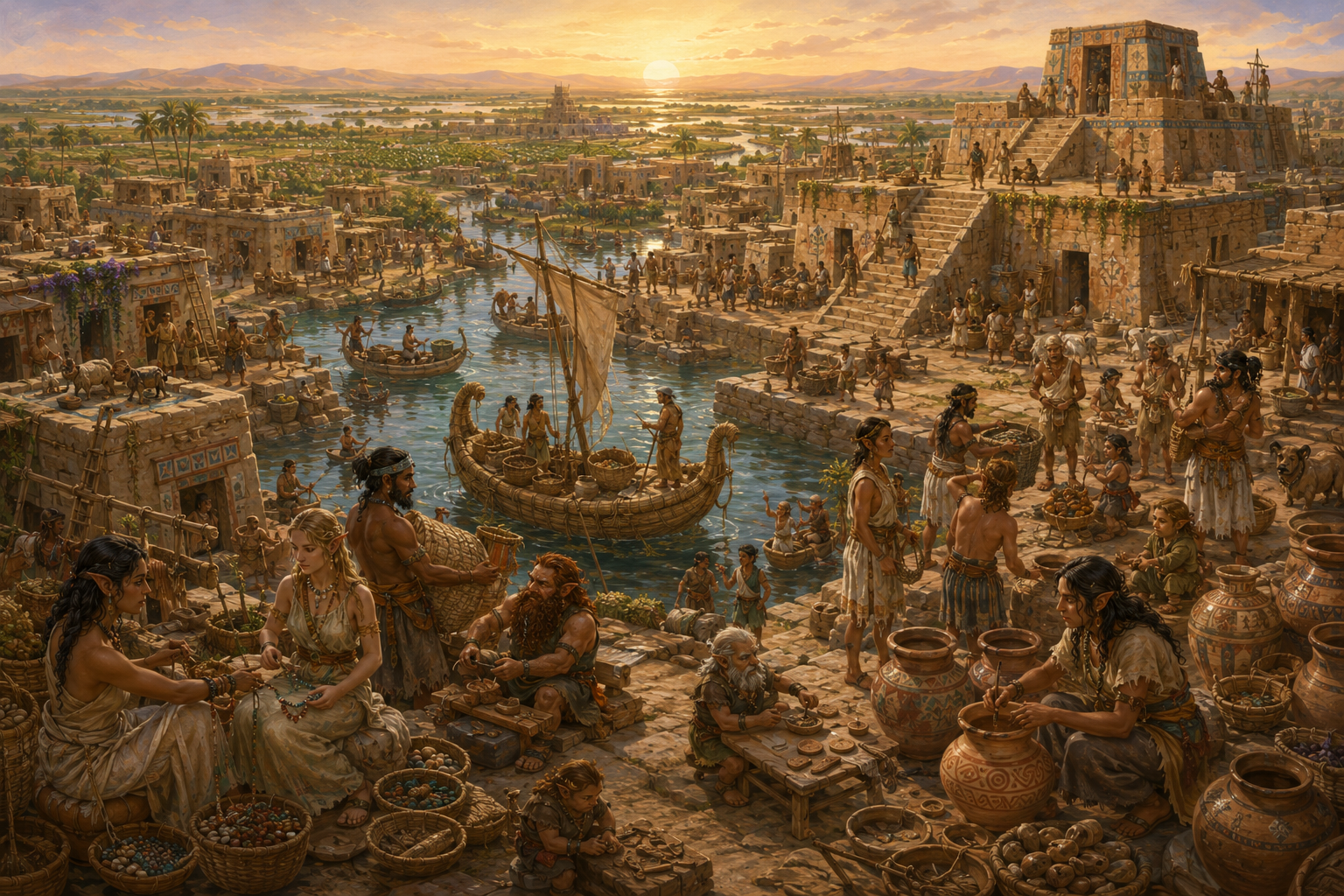
The Blooming Cities begin when villages gather strangers, gods, stores, captives, crafts and law into settlements too large to remain extended households.
Time Frame: c. 5000–3500 BCE
Common Name: The Proto-Urban Age
Theme: Large villages become towns and early cities as public sanctuaries, central stores, trade districts, workshops, walls and organised authority reshape settled life.
The Blooming Cities grow from the rooted communities of the previous age. Fields, herds, wells, shrines and ancestral claims already bind people to the land. What changes is the scale upon which those obligations must now be managed.
A settlement containing several thousand inhabitants cannot rely entirely upon personal memory or household custom. Strangers must be admitted or excluded. Stores must be counted. Channels must be repaired. Markets require recognised measures. Fires, waste, burial, building and violence must be controlled. Public sanctuaries draw offerings from families that do not share one lineage.
The first towns do not all follow the same path. Some gather around irrigation and temples. Others grow from river trade, fishing, salt, mining, seasonal assemblies, managed forests or ceremonial centres. Some possess walls. Others remain open. Some are governed by councils or neighbourhood assemblies. Others fall under powerful households, war leaders, storehouse keepers or priestly authorities.
Nor are these settlements exclusively human. Dwarves, elves, gnomes, halflings and other peoples establish their own civic centres, occupy districts within mixed towns and contest the land upon which expanding settlements depend.
The city offers security, food, trade, worship and collective strength. It also concentrates inequality, disease, coercion, debt, slavery and organised war. The same walls that protect inhabitants can imprison captives, exclude displaced people or preserve the authority of those controlling the gates.
The World at the Beginning
- Large villages, public sanctuaries and managed water systems already exist.
- Eridu possesses an enduring public sanctuary of Enki.
- Çatalhöyük, Jiahu, Mehrgarh and other long-established settlements have demonstrated that large communities can exist without kings.
- Pottery, weaving, stonework, boats, seals, copperworking and long-distance exchange are established in several regions.
- Captivity, slavery, tribute, debt bondage and forced labour exist in varied local forms.
- Dwarven holds, elven woodland territories, gnome settlements and halfling kin-networks occupy parts of every major inhabited region.
- Human and nonhuman settlements increasingly overlap with older seasonal routes, spirit territories and monster domains.
- The Hyborian kingdoms have become a remote lost age, although their relics, bloodlines and hidden cults remain.
- Mnar, the Dreamlands and prehuman ruins preserve urban traditions older than the mortal towns now appearing.
- Writing has not yet become an ordinary system of government. Memory is preserved through specialists, marks, seals, tokens, images, ritual and repeated public performance.
The Blooming Cities do not create civilisation from emptiness. They reorganise older households, villages, sacred centres and exchange routes into settlements whose authority reaches far beyond the people living beside one hearth.
The Blooming Cities Timeline
c. 5000–4000 BCE — The Ubaid World Expands
Communities across southern Mesopotamia build mud-brick settlements amid rivers, marshes and irrigated fields. Farming, fishing, reed-working, boat travel and livestock support growing populations.
Some villages develop into towns organised around substantial public buildings. Distinctive pottery, stamp seals and shared architectural traditions connect communities across a wide region without placing them under one king.
The Ubaid world demonstrates that cultural connection does not require political unity. Settlements recognise related customs and exchange goods while remaining independent, competitive and sometimes hostile.
c. 5000–4000 BCE — Eridu Becomes the First Enduring Sacred Town
Eridu grows around the sanctuary of Enki. Successive sacred buildings are raised upon earlier foundations, preserving the site’s authority across generations.
Enki does not build the town for mortals. Its inhabitants dig channels, raise walls, carry bricks, manage fisheries and maintain the sanctuary. The god recognises their work and binds his presence to the settlement through water-law, offerings and public judgement.
Eridu’s priests, channel-keepers and witnesses judge disputes involving:
- irrigation;
- contaminated water;
- fishing rights;
- boat passage;
- communal labour;
- theft from public stores;
- broken sanctuary;
- agreements witnessed by river and marsh spirits.
Eridu is not yet the capital of a territorial kingdom. Its authority rests upon the sanctuary, its water knowledge and the willingness of neighbouring communities to recognise its judgements.
c. 5000–3500 BCE — Uruk Grows from Settlement into City
Settlements upon the lower Mesopotamian plain expand and merge into the place later known as Uruk. Fields, canals, workshops, boat landings, shrines and residential quarters draw people from surrounding villages.
The city’s sacred identity develops gradually. Inanna claims the growing Eanna precinct as her house of power, fertility, desire, warfare and political ambition. Anu recognises the city’s sky rites and public assemblies but does not descend to construct Uruk personally.
The settlement becomes a place where people can belong through residence, craft, service, patronage or sanctuary rather than through ancestry alone.
By the end of the age, Uruk is one of the clearest examples of a true mortal city: a settlement whose public institutions, specialised work and sacred centres have become larger than any one lineage.
c. 5000–3500 BCE — Mehrgarh Becomes a Regional Centre
Mehrgarh continues growing near the routes between the Indus plains, Iranian plateau and highland passes. Mud-brick construction, farming, herding, burial traditions and specialised craft become increasingly complex.
Bead-makers, potters, stoneworkers and healers develop knowledge beyond household production. Shell, turquoise, lapis lazuli and other materials travel across long distances.
Mehrgarh does not yet form part of the later Indus urban civilisation. It establishes the agricultural, craft and exchange foundations from which later cities can emerge.
c. 5000–3500 BCE — Hemudu and Yangshao Traditions Flourish
Communities across several East Asian river systems develop distinctive regional forms of settlement.
In the Lower Yangtze wetlands, Hemudu communities cultivate rice, fish, hunt and construct raised timber buildings suited to wet ground. Skilled woodworking, fitted joints, woven materials and watercraft support life in a landscape shaped by rivers and seasonal floods.
Across the Yellow River basin, Yangshao communities establish villages with houses, storage pits, kilns, cemeteries and painted pottery. Millet cultivation, hunting and animal management support increasingly permanent settlement.
Neither tradition represents one kingdom or one people. They are broad networks of local communities with related practices, rival settlements and different sacred customs.
c. 5000–3500 BCE — The Tenerian Peoples Flourish at Gobero
During the Green Sahara, Tenerian communities inhabit the region around Gobero and its lakes. They fish, hunt, keep livestock, make pottery and bury their dead within a landscape that later becomes desert.
Repeated occupation creates recognised rights over wells, fishing grounds, pastures and burial places. Some communities remain mobile while returning to the same water sources for generations.
Their world is not a primitive margin of Nile history. It is an independent network of Saharan societies with its own trade, ritual, violence and inherited law.
From c. 5000 BCE — The Chinchorro Preserve Their Dead
Communities along the arid Pacific coast of South America develop deliberate methods of preserving the dead.
Chinchorro mummification is not reserved for kings. Children, adults and people of different standing may be reconstructed and retained within the community.
The preserved dead remain social presences. They witness gatherings, support territorial claims and require continued care. A neglected ancestor can become a source of illness, haunting or public accusation.
This tradition establishes elaborate artificial mummification long before dynastic Egyptian embalming.
c. 4600–4200 BCE — Varna and the Gold Graves
Communities around the western Black Sea develop specialised metalworking, exchange and increasingly unequal social ranks.
The Varna cemetery contains graves ranging from almost empty burials to deposits of gold, copper, stone tools, ornaments and symbols of authority.
Binding campaign ruling: the wealth of Varna represents recognised hereditary ranks rather than only personal achievement. Certain households control ritual offices, metal exchange and regional alliances across generations.
The richest graves do not prove that one king rules every surrounding settlement. They reveal that inherited status and control of rare goods are becoming powerful enough to survive death.
c. 4500 BCE — Kuk’s Wetlands Are Reclaimed
At Kuk in the highlands of New Guinea, communities transform wetland plant management into increasingly organised agriculture.
They construct mounds and drainage ditches with wooden tools, reshaping waterlogged ground for cultivation. These works require detailed environmental knowledge and repeated communal maintenance.
Kuk represents an independent development of agriculture. Its people do not receive farming from Mesopotamia, East Asia or a visiting god.
The ditch systems also create political authority. Families controlling drainage can decide which plots remain productive and which households must contribute labour.
c. 4500–3500 BCE — Nabta Playa Fixes Sky and Water into Stone
The communities gathering around Nabta Playa continue managing wells, livestock, seasonal pasture and shared law.
Stone markers are raised to record directions, gathering grounds and the seasonal relationship between stars, sun, rain and water.
Binding campaign ruling: these arrangements are deliberate astronomical and sacred instruments. They allow sky-readers to predict major seasonal assemblies and judge when the protected wells may be opened to larger herds.
No king owns Nabta. Authority belongs to the oath-bound gathering and to the ritual specialists trusted to interpret sky and water correctly.
c. 4500–4000 BCE — Atlantic Megalithic Traditions Spread
Communities along parts of Atlantic Europe begin constructing long-lived tombs and monuments from earth, timber and stone.
These places gather the dead of several households and make collective ancestry visible within the landscape. A monument can establish rights over pasture, coast, river crossing or cultivated land without forming a permanent town.
Human, elven and halfling communities all participate in regional monument traditions, although each people follows different burial law. Dwarven builders sometimes exchange stone-moving knowledge but do not create the monuments on behalf of surface peoples.
c. 4500–3500 BCE — Salt Creates Fortified Wealth
Communities around major salt sources exchange preserved food, livestock, hides, stone and metal across increasingly long distances.
At centres such as Provadia-Solnitsata, salt production supports dense settlement and defended stores. Salt can preserve food, sustain herds and turn one settlement into the creditor of its neighbours.
Control of salt attracts raids, tribute and captive labour. A community able to deny salt to another can impose obedience without conquering its land.
c. 4300–3500 BCE — Naqada and Hierakonpolis Rise
Along the Nile, regional communities grow through agriculture, river trade, craft and control of desert routes.
Naqada traditions produce increasingly elaborate pottery, ornaments, stone vessels and burial goods. Hierakonpolis becomes the largest known centre of Upper Egypt and acquires political influence over surrounding settlements.
Leaders gain authority through cattle, boats, exchange, warfare, public ritual and the ability to gather labour. Their power is substantial but has not yet produced a united Egyptian kingdom.
Dry burial and deliberate treatment of bodies strengthen Egyptian traditions of preserving identity after death. The formal royal mummification of later dynasties has not yet developed.
c. 4200 BCE — Tell Brak Becomes a Northern City
Tell Brak expands upon the plains of northern Mesopotamia. Dense occupation, workshops, public buildings and surrounding settlements make it a major urban centre independent of southern Uruk.
Binding campaign ruling: Tell Brak is a genuine city, not merely an oversized village. Its neighbourhoods possess different assemblies, patrons and craft traditions, while city-wide decisions are negotiated through a council of district leaders and sanctuary authorities.
This system does not prevent inequality or violence. Competition over labour, livestock, trade and public office produces factional struggle. Mass death and the disposal of bodies near the city reveal the cost of urban conflict.
c. 4200–3500 BCE — Susa Grows upon the Susiana Plain
Susa develops as a large settlement linking the lowlands of Mesopotamia with the Iranian plateau.
Its people cultivate fields, keep livestock, produce pottery and participate in exchange reaching several different cultural regions. Public platforms and communal works distinguish the centre from surrounding villages.
Susa’s authority comes from mediation. Traders, migrants and envoys must pass between communities whose gods, measures and legal customs differ.
c. 4100–3600 BCE — The Trypillia Mega-Sites
Across the forest-steppe of what later becomes Ukraine and Moldova, enormous Trypillia settlements gather thousands of houses into planned concentric arrangements.
The largest contain neighbourhoods, assembly buildings, workshops, lanes and open central spaces. They possess no writing and no permanent royal palace.
Binding campaign ruling: the Trypillia mega-sites are true cities governed through assemblies rather than monarchies. Households belong to neighbourhood circles, each of which sends recognised speakers to larger civic gatherings.
Residence is partly rotational. Some families occupy the city throughout the year, while others arrive for seasons of exchange, judgement, marriage, ritual and collective work.
These cities eventually decline because their scale becomes difficult to sustain. Disputes over land, fuel, authority and the obligations of absent households weaken collective government.
c. 4000 BCE — Farming Reaches Britain and Ireland in Force
Farming households, livestock and new material traditions spread into Britain and Ireland through migration, exchange, marriage and local adoption.
Woodland is cleared, fields established and long barrows raised for communal burial. Causewayed enclosures become places of meeting, exchange, judgement and ritual rather than ordinary fortified cities.
Binding campaign ruling: the ritual specialists maintaining groves, ancestral monuments, sky observances and seasonal law are the forebears of later Druidic traditions. They are not yet one organised Druidic order and do not possess a universal hierarchy.
Elven woodland rights and earlier seasonal claims survive the arrival of farming. Some communities negotiate shared use. Others begin wars whose boundaries remain disputed for thousands of years.
c. 4000–3500 BCE — Early Ceramic Communities of Northern South America
Pottery appears among settled and semi-settled communities along parts of the Caribbean coast of Colombia and northern South America.
On the Ecuadorian coast, communities associated with the earliest Valdivia traditions develop increasingly permanent villages, horticulture, fishing and representational figures carved from stone.
Binding campaign ruling: the early Valdivia figures represent household founders, transformed ritual specialists and powers combining male and female creative authority. They are not images of one universal fertility goddess.
c. 4000–3500 BCE — Malta’s Temple Communities Begin
Communities upon Malta and Gozo organise large-scale stone construction, underground burial and ceremonial gathering.
The earliest phases of the great temple tradition begin near the end of the age. Builders shape free-standing stone structures whose curved chambers gather offerings, feasts and public rites.
Binding campaign ruling: these temples are built by the island communities themselves. Giants may assist, raid or later claim the works, but the monuments are not evidence that ordinary mortals were incapable of raising great stone architecture.
c. 3900 BCE — Sannai-Maruyama Becomes a Great Jōmon Settlement
Sannai-Maruyama develops near forests, river and sea. Pit houses, storage pits, roads, burial areas, mounds and large pillar-supported structures form an organised settlement.
Its people depend upon fishing, hunting, gathering, managed chestnut groves, craft and far-reaching exchange rather than grain agriculture.
Binding campaign ruling: Sannai-Maruyama is a forest city. A city is defined by population, public organisation, specialised space, exchange and civic identity—not solely by fields, kings or written accounts.
Its large structures serve assembly, storage, observation and ritual. Authority remains distributed among households, craft groups and ritual custodians.
c. 3800 BCE — The Sweet Track Crosses the Wetlands
Communities in the Somerset Levels construct a timber trackway across marshland.
The work requires timber selection, carpentry, planned labour and agreement over a route used by several settlements. It connects islands of dry ground, seasonal resources and sacred wetland places.
The track remains subject to older claims. Water spirits, elven custodians and communities using the marsh before its construction retain rights that the builders cannot simply erase.
c. 3800–3600 BCE — Urban Violence Intensifies
Competition between growing centres becomes more organised. Settlements raid fields, seize livestock, burn public buildings and attempt to control exchange routes.
At Tell Brak and neighbouring centres, mass graves and destroyed structures reveal violence on a scale larger than ordinary household feud.
War captains acquire followers through promises of plunder, protection and access to captured land. Victorious cities increasingly impose tribute upon entire villages rather than upon individual defeated enemies.
c. 3600 BCE — Monumental Temple Building Begins in Malta
Communities on Malta and Gozo begin raising the earliest great megalithic temple complexes.
The temples establish enduring sacred centres independent of palaces or royal tombs. Their builders organise quarrying, transport, food, skilled labour and ritual participation across several settlements.
The full Maltese temple civilisation belongs to the following age, but its foundations are laid before the Blooming Cities end.
c. 3500 BCE — Botai Develops Local Horse Husbandry
At Botai in Central Asia, settled communities organise much of their economy around horses. Corrals and controlled breeding indicate local horse husbandry.
Binding campaign ruling: Botai horses are managed for meat, hides, limited milk and short-range work. Some individuals ride within the local landscape, but there is no cavalry, chariot warfare or continent-wide horse transport.
The Botai lineage is not the source of the later domestic horses that transform Eurasian mobility. That widespread horse revolution belongs thousands of years later.
c. 3500 BCE — Hamoukar Falls
Conflict among northern Mesopotamian centres culminates in the destruction of Hamoukar. Buildings burn and clay sling projectiles mark organised assault.
The fall demonstrates that cities can now wage war upon cities. Public stores, walls, workshops and concentrated populations create strategic targets whose destruction affects an entire region.
By c. 3500 BCE — Accounting Approaches Writing
Growing towns use clay tokens, seal impressions, marked vessels, standard containers and repeated symbols to identify quantities, households, workshops and obligations.
Specialists preserve information no single person can remember unaided. A seal can represent a household, sanctuary, office or authorised keeper. Breaking or forging it becomes a public crime.
These systems approach true writing but do not yet provide the full administrative and narrative scripts of the following age.
By the Close of the Age
Several regions now contain settlements that deserve to be called cities. They possess public spaces, specialised districts, communal works, large populations and civic identities extending beyond kinship.
City life remains exceptional rather than universal. Most people still live in villages, scattered households, mobile camps, woodland territories, mountain holds or seasonal settlements.
The distinction between village, town and city is no longer merely one of size. A city has become a political and sacred body capable of owning stores, demanding labour, enforcing law, making war and surviving the death of its founders.
The First City-World
Mesopotamia and Susiana
Eridu, Uruk, Tell Brak, Susa and other centres develop through irrigation, river trade, craft and public ritual.
No single city controls the whole region. Southern temple towns, northern assembly cities, marsh settlements, herding communities and highland traders remain independent political actors.
Africa
The Tenerian communities of the Green Sahara, the growing centres of the Nile and the seasonal law of Nabta Playa follow different paths.
Hierakonpolis begins concentrating authority in Upper Egypt, but neither Egypt nor northern Africa is yet unified under one crown.
Europe
Varna’s gold graves, Trypillia mega-sites, salt centres, megalithic traditions, causewayed enclosures and Malta’s early temples reveal several different forms of public organisation.
The European city does not begin as one imported Mesopotamian model. Assembly cities, fortified production centres and monumental ritual landscapes develop through local histories.
South Asia
Mehrgarh and related settlements deepen the craft, farming and exchange systems inherited by later Indus communities.
The great planned cities of the Indus civilisation have not yet arisen, but their foundations are being prepared.
East Asia
Hemudu, Yangshao and Jōmon communities demonstrate that large organised settlements can depend upon rice, millet, fishing, forests or mixed subsistence.
No single Chinese state or Japanese kingdom exists.
New Guinea and Oceania
Kuk establishes an independent tradition of wetland agriculture and environmental engineering.
Across Oceania, established maritime communities continue maintaining routes, islands and sacred sea territories without requiring dense urban settlement.
The Americas
Chinchorro mortuary communities, early ceramic settlements in Colombia and the first Valdivia centres create increasingly permanent and ceremonially organised societies.
Most American urban traditions develop later, but their foundations in horticulture, fishing, public gathering and ancestral authority are already visible.
Nonhuman Peoples of the Blooming Cities
Nonhuman peoples do not remain outside the new urban world. They found their own centres, enter mixed settlements and defend territories threatened by growing towns.
No race possesses one universal form of city.
Dwarves — Hold-Towns and Deep Markets
Dwarven settlements expand from household holds into interconnected hold-towns.
Public cisterns, quarry districts, furnaces, storehouses, ancestral chambers and defended gates serve several clans. Some halls grow vertically through the mountain rather than spreading across the surface.
Dwarven civic authority may rest with:
- assemblies of recognised households;
- keepers of water and ventilation;
- craft elders;
- mine-right judges;
- war leaders elected during danger;
- hereditary custodians of ancestral halls.
Salt, copper, gold, stone and engineering knowledge draw surface traders into dwarven markets. They also attract raids by giants, kobolds, goblins, orcs and rival dwarven holds.
Some hold-towns grow wealthy through forced mine labour. Others outlaw the enslavement of recognised persons after tunnel disasters and slave revolts destroy entire districts.
Elves — Grove-Cities, Ports and Seasonal Courts
Elven urban centres are often difficult for outsiders to recognise.
A grove-city may spread through managed woodland without clearing it. Houses, halls, sacred trees, fishing grounds and assembly spaces are linked by remembered paths rather than walls and streets.
Other elven communities establish coastal ports, river markets or permanent assembly centres where long-lived families preserve treaties across centuries.
Elven cities face increasing pressure from surrounding farmland. Settlers may treat managed woodland as unused land, while elves regard clearance as the destruction of orchards, game corridors, burial places and sacred agreements.
Long memory gives elven courts continuity but can concentrate authority among elders who refuse reforms sought by younger households or shorter-lived residents.
Gnomes — Hidden Civic Quarters and Crossing Towns
Gnomes establish compact settlements near mines, springs, trade routes and stable supernatural crossings.
Some towns are concealed entirely. Others maintain visible markets while hiding their homes, workshops and portals.
Gnome specialists become known for:
- seals and small precision objects;
- dyes and pigments;
- medicines and alchemical substances;
- measures and counting devices;
- concealed storage;
- traps and civic defences;
- interpreting crossings into the Fey World.
Gnome councils often divide authority between settlement law and portal law. A decision lawful within the town may still violate the agreement governing a supernatural doorway.
Halflings — River Markets and Dispersed Towns
Halfling towns commonly develop around river crossings, sheltered coasts, market grounds and networks of related household clusters.
A halfling town may appear dispersed because its gardens, ovens, boat landings and storehouses occupy several nearby settlements. Shared market days, marriage law and defence agreements bind them into one civic community.
Halfling traders carry seed, preserved food, baskets, pottery, cloth and local news between larger centres.
Some halfling communities resist city taxation and compulsory labour. Others become powerful storehouse keepers, boat owners or creditors whose control of food creates sharp differences in wealth.
Orcs, Goblins, Kobolds and Other Peoples
Orcs, goblins, kobolds, giants and other recognised peoples also create settlements or civic districts.
They may serve as traders, farmers, herders, labourers, mercenaries, citizens, tributaries, captives or rulers depending upon local history.
Some cities exclude them by law and classify them as monsters regardless of conduct. Other cities recognise households and communities able to bargain, pay dues and answer for crimes.
No race is naturally urban or naturally incapable of civic government.
Serpentfolk and Elder Urban Survivors
Serpentfolk retain hidden enclaves beneath older ruins, desert settlements and surviving Hyborian sites.
Some infiltrate new towns to recover relics or rebuild cults. Others negotiate openly where local rulers recognise their personhood and territorial rights.
Their knowledge of writing, poison, astronomy and ancient magic can greatly exceed that of surrounding communities. This knowledge does not make every serpentfolk truthful, united or hostile.
Gods, Temples and Civic Authority
The gods do not create the first cities from empty ground. Mortal and nonhuman communities build them through labour, cooperation, coercion and inherited knowledge.
Divine powers claim cities because settlements concentrate offerings, memory, law and political ambition.
Enki and Eridu
Enki remains the recognised patron of Eridu, water-law, craft, cleverness and the lawful ordering of channels.
His sanctuary protects public water from private seizure, but its priests may become powerful enough to decide whose fields receive water first.
Inanna and Uruk
Inanna claims the Eanna precinct as Uruk grows.
She supports exchange, fertility, political ambition, desire and war. Her presence attracts traders, rulers, ritual specialists, outsiders and people seeking new identities beyond their birth households.
Her favour does not belong permanently to one family.
Anu and the Sky Assembly
Anu recognises the authority of sky rites, assembly oaths and the wider divine order.
He does not establish mortal kingship during this age. His priests preserve precedence, public witness and the relationships among divine houses.
Enlil and Nippur
The sanctuary of Enlil at Nippur begins gaining authority as a centre of wind, command, boundaries and public order.
Nippur’s later supremacy and its role in confirming kings belong to the following ages.
The Anunnaki
The Anunnaki act as a divine assembly, family and body of powerful witnesses.
They do not arrive as travellers from another planet to construct human civilisation. They send omens, envoys, servants and manifestations; accept or reject sacred offices; and dispute which gods may claim particular settlements.
The cities remain the works and responsibilities of their inhabitants.
Other Gods and Powers
City religion does not erase household gods, ancestors, river persons, Fey powers or Great Old Ones.
A town may contain:
- a public sanctuary serving the whole settlement;
- household shrines belonging to particular families;
- foreign temples serving traders;
- ancestral tombs beneath residential quarters;
- a spring governed by an independent spirit;
- a hidden serpentfolk cult;
- a Dreamlands doorway guarded by gnomes;
- a district whose inhabitants honour Bokrug or another ancient power.
A city is rarely united by one faith even when one god serves as its principal patron.
Dreamlands, Elder Cities and Forbidden Knowledge
The Blooming Cities are the first great mortal city-world of the Holocene. They are not the first cities to exist anywhere.
Mnar, Dreamlands settlements, serpentfolk enclaves and ruined Hyborian centres preserve older urban traditions. Travellers occasionally return with architectural ideas, magical techniques or objects whose makers cannot be identified.
The Seven Cryptical Books of Hsan already exist within Dreamlands and elder scholarly traditions. Their organised translation into a mortal East Asian language belongs to a later age and is not dated to the Blooming Cities.
Knowledge passing from older worlds is rarely complete. A copied symbol may function without its reader understanding the power invoked. An ancient city plan may contain a prison, summoning diagram or divine name disguised as ordinary geometry.
Craft, Trade and Administration
Specialist Work
Large settlements support people whose primary work is not food production.
- potters;
- weavers;
- boat-builders;
- stoneworkers;
- metalworkers;
- seal-cutters;
- healers;
- ritual specialists;
- storehouse keepers;
- messengers;
- guards;
- undertakers;
- interpreters between peoples and gods.
Specialists remain dependent upon farmers, fishers, hunters and herders. A failed harvest can destroy a craft district that produces no food of its own.
Markets and Measures
Regular markets bring together people who do not share kinship or local custom.
Measures of grain, lengths of cloth and quantities of metal must be recognised publicly. Disputes over false weights become civic matters because fraud can damage trust in the entire market.
Standardisation remains local. A measure accepted at Uruk may differ from one used at Tell Brak, a dwarven hold or a halfling river market.
Seals and Tokens
Stamp seals identify households, offices, workshops and sanctuaries. Clay tokens represent quantities or categories of goods.
A sealed door, jar or storehouse carries the authority of the person or institution represented by the mark.
Stealing a jar is theft. Breaking the seal of a public store may be treated as treason, sacrilege or an attack upon the whole settlement.
Long-Distance Exchange
Trade carries:
- obsidian;
- salt;
- copper and gold;
- stone and timber;
- shell and pigments;
- grain and preserved food;
- livestock;
- cloth and baskets;
- medicines;
- ritual objects;
- captives and slaves;
- stories, diseases and political alliances.
Trade routes are not neutral roads. Communities demand tolls, escort payments, ritual permission or guarantees of peaceful conduct.
City Law and Personhood
Urban law must judge people who do not belong to one family or one species.
Civic Status
A town may distinguish between:
- recognised households with full participation in assemblies;
- resident dependants protected by a household or sanctuary;
- foreign traders protected for a fixed period;
- tributary communities owing goods or labour;
- sanctuary dependants supported by a temple or sacred institution;
- hostages protected but not free to leave;
- slaves and bonded labourers recognised as persons without equal rights;
- outlaws denied civic protection;
- unrecognised beings whose personhood remains disputed.
Recognition as a person does not create equality. A recognised foreigner may be forbidden to own land. A slave may possess rights against arbitrary killing while remaining property under local law. A god may possess a sanctuary without governing the surrounding district.
Mixed Cities
Human and nonhuman inhabitants may share one city while living under different household customs.
City law must decide which matters remain internal and which affect the whole settlement.
A dwarven inheritance dispute may follow hold-law. Poisoning a public well does not. An elven grove may retain sacred rights inside the boundary, but its guardians cannot kill recognised neighbours without facing civic judgement.
Walls and Gates
A wall creates a physical boundary between those protected within and those left outside.
Gate authorities may control:
- entry during famine;
- weapons carried by strangers;
- market dues;
- animals and suspected disease;
- the return of escaped captives;
- night movement;
- access to sanctuary;
- which peoples are recognised as lawful visitors.
A city that closes its gates to displaced neighbours may preserve its stores while condemning hundreds to death.
Public and Sacred Property
Property can belong to more than an individual household.
Channels, roads, walls, markets, boat landings, wells, assembly grounds and public stores may belong to the city. Sanctuaries, sacred herds and offerings may belong to a god.
The people managing divine property do not automatically own it. Misusing a temple store may be theft from both god and community.
War, Walls and Tribute
The Blooming Cities transform local violence into organised civic war.
Urban Militias
Settlements call upon households, districts, allied villages and dependent communities to provide defenders.
Weapons remain dominated by:
- bows;
- slings;
- spears;
- stone and copper axes;
- clubs;
- knives;
- hide, wood and woven shields;
- fire and thrown stones.
There are no mass cavalry armies or chariot corps. Boats, walls, ambush, missile fire and control of water matter more.
Siege and Destruction
Most towns cannot withstand a long siege. Attackers may:
- burn outer houses;
- block channels;
- destroy crops;
- seize livestock;
- attack workers outside the walls;
- undermine gates;
- contaminate wells;
- intercept boats and trade;
- bribe an excluded district to open an entrance.
A city may be defeated without every inhabitant being killed.
Tribute
Victorious towns increasingly demand regular tribute from surrounding settlements.
Tribute may consist of:
- grain;
- livestock;
- fish or salt;
- timber or stone;
- metal;
- boats;
- craft goods;
- seasonal labour;
- warriors;
- hostages;
- captives.
Tribute can provide protection and access to markets. It can also become institutionalised extortion.
Factional War
Conflict also occurs inside cities.
Neighbourhoods may fight over water, public office, sanctuary rights, debt, access to gates or control of stores. A temple faction may oppose a war leader. Craft districts may refuse labour demanded by powerful households.
Civil conflict is especially destructive because rivals know the location of stores, passages and weak walls.
Captivity, Slavery and Public Labour
The growth of towns increases both the demand for labour and the power to compel it.
War Captives
Defeated enemies may be:
- ransomed;
- exchanged;
- adopted;
- settled as dependants;
- forced to labour;
- transferred to a sanctuary;
- sold through trade networks;
- executed or sacrificed.
Craft specialists, healers, scribal precursors and metalworkers are especially likely to be captured alive.
Household and Temple Slavery
Slaves may work in houses, fields, herds, workshops, boats, mines, channels or public construction.
Some belong to households. Others are assigned to sanctuaries or civic institutions. A slave serving a temple is not automatically free from abuse, and divine ownership does not guarantee humane treatment.
Debt Bondage
Crop failure, funeral expense, fines or dependence upon public stores can place a household in debt.
A debtor may pledge:
- future harvests;
- seasonal labour;
- land-use rights;
- a child or relative as hostage;
- their own service;
- membership beneath a creditor household.
Temporary obligation can become permanent when creditors control the measures and records used to calculate repayment.
Corvée and Civic Labour
Free households may still owe compulsory labour for walls, channels, temples, roads, storehouses and defensive works.
Such labour is not automatically slavery. It becomes coercive when powerful offices demand more than recognised custom, target politically weak districts or prevent workers from maintaining their own fields.
Forced Resettlement
A victorious town may move defeated households closer to its fields, walls or workshops.
Resettled people may retain their names, gods and internal leaders while losing the right to return home.
No Natural Masters
Humans, dwarves, elves, gnomes, halflings, orcs, goblins, serpentfolk and other recognised peoples may enslave or be enslaved according to local power and law.
No people is born to rule or serve.
Magic in the Blooming Cities
Magic begins moving from household practice into public institutions.
Temple Magic
Sanctuaries maintain:
- purification rites;
- water blessings;
- weather petitions;
- protection of public stores;
- healing and divination;
- oath witnessing;
- rites for the civic dead;
- containment of dangerous relics.
Civic Wards
Walls, gates, canals and public buildings may be protected by repeated marks, buried offerings, guardian spirits or bound names.
A ward depends upon maintenance. If the responsible household dies, flees or is enslaved, the protection may fail.
Craft Magic
Potters, metalworkers, boat-builders and masons preserve rites intended to prevent cracking, collapse, fire, drowning or contamination.
Not every craft rite produces visible supernatural power, but enough do that rulers and communities take them seriously.
Urban Curses
The city creates new targets for harmful magic:
- a rival storehouse;
- a market measure;
- a public well;
- a city gate;
- a council speaker;
- a craft district;
- a creditor’s records;
- a sanctuary idol.
A curse against a public institution may harm thousands who had no part in the original dispute.
What Changed During the Blooming Cities
- Some large villages become genuine towns and cities.
- Public institutions grow beyond household and kinship authority.
- Eridu becomes an enduring sacred town of Enki.
- Uruk grows into one of the first great mortal cities.
- Tell Brak develops an independent northern form of urbanism.
- Trypillia mega-sites demonstrate large assembly-governed cities without kings or writing.
- Varna reveals increasingly hereditary rank and unequal control of wealth.
- Hierakonpolis becomes a major political centre in Upper Egypt.
- Kuk expands independent wetland agriculture.
- Sannai-Maruyama develops as a major forest and coastal hub settlement.
- Nabta Playa formalises sacred astronomy and shared water-law.
- Chinchorro communities develop deliberate artificial mummification.
- Atlantic monument traditions and early Maltese temples gather labour beyond individual households.
- Markets, seals, tokens and recognised measures support exchange among strangers.
- Specialist work becomes a permanent part of urban life.
- Public stores allow cities to survive shortages but empower those controlling access.
- Walls and gates define belonging, protection and exclusion.
- Organised city warfare, tribute and factional conflict intensify.
- Slavery, debt bondage, corvée and forced resettlement expand alongside urban labour demands.
- Dwarven hold-towns, elven grove-cities, gnome crossing towns and halfling market networks join the developing city-world.
- Clay accounting approaches true writing.
- Botai develops local horse husbandry without producing widespread mounted warfare.
- Cities become political and sacred bodies able to outlive their founders.
What Survives from the Blooming Cities
- the oldest sacred foundations beneath later Eridu;
- buried districts beneath Uruk and other Mesopotamian cities;
- tokens and seals whose authority remains magically active;
- abandoned channels still claimed by Enki’s water-law;
- Varna graves containing cursed or disputed regalia;
- Trypillia city plans preserved beneath farmland;
- mass graves left by early urban factional war;
- Chinchorro ancestors removed from their original communities;
- lost Nabta alignments still predicting supernatural seasons;
- Malta’s earliest temple foundations;
- Sweet Track timbers preserved beneath wetlands;
- dwarven hold-towns buried beneath later mountain kingdoms;
- elven grove boundaries swallowed by expanding cities;
- gnome portal districts hidden beneath later streets;
- halfling market rights ignored by later rulers;
- serpentfolk chambers beneath early civic centres;
- families descended from urban captives, slaves and forced settlers;
- temple debts claimed thousands of years after the original office vanished;
- cities destroyed before writing could preserve their names;
- Dreamlands plans mistakenly copied into mortal civic architecture;
- public guardian spirits that continue defending ruins without inhabitants.
Campaign Legacies
The First Seal
A clay seal from an Ubaid storehouse still opens every later structure built above it. Several temples and a merchant family claim to be the lawful successor of the vanished office represented by its mark.
The Empty Trypillia Quarter
A vast buried city is discovered beneath cultivated land. Its houses form perfect circles around an open centre where an assembly continues meeting in spectral form and demands representatives from every modern community occupying its former territory.
The Gold Grave
A Varna burial is opened and its gold ornaments are carried away. The dead office-holder returns, not to reclaim personal treasure, but to resume an inherited civic rank whose people and city no longer exist.
The Water Judge of Eridu
An ancient channel reopens beneath a later settlement. Enki’s surviving guardian declares every modern irrigation agreement invalid and begins redistributing water according to the earliest law.
The City beneath the Forest
An elven grove-city has remained hidden while human settlements expanded around it. When its seasonal court returns, it demands the removal of roads, farms and graves established during what the elves regard as a temporary absence.
The Captive District
Records reveal that one modern neighbourhood descends from forced settlers taken during the destruction of an early city. Their descendants demand ownership of the district and compensation from the temple that inherited their labour obligations.
The Horse Enclosure
A Botai corral contains a surviving spirit-lineage of the earliest managed horses. Steppe rulers seek the herd as proof that their later cavalry traditions descend from the first horse-keepers.
The Door in the City Plan
A city’s streets reproduce a Dreamlands symbol copied by an ancient architect. Completing a new road closes the final line and opens the whole settlement to something waiting beyond waking Earth.
Ending State and Transition
By c. 3500 BCE, several parts of the world contain genuine cities, public sanctuaries, assembly centres, fortified production settlements and monumental ritual landscapes.
City authority remains experimental. Councils, priests, elders, war leaders, wealthy households and storehouse keepers compete to define who speaks for the whole community.
Seals and tokens preserve increasingly complex obligations, but they cannot yet record every law, genealogy, treaty or royal claim. Civic memory remains vulnerable to manipulation by those who control specialists and public ritual.
War has grown beyond village feud. Cities can demand tribute, relocate populations and destroy rival urban centres. Captive labour and debt dependence support public works while creating populations with little reason to remain loyal.
The next age begins when marks become writing, sacred offices become kingship, city rivalries become territorial war and rulers begin claiming authority over whole regions rather than one settlement.
The Blooming Cities therefore pass into The Breaking Paths.
Historic and Mythic Context
The Blooming Cities cover c. 5000–3500 BCE. The age is defined by several independent forms of proto-urban and urban development rather than by the sudden appearance of one first city.
Eridu and Uruk develop through southern Mesopotamian irrigation, sacred institutions and trade. Tell Brak establishes a northern urban tradition. Trypillia mega-sites demonstrate assembly-based cities without writing or monarchy. Sannai-Maruyama shows that a major hub settlement can arise through forests, fishing, gathering and exchange rather than grain agriculture.
Where archaeological interpretation remains uncertain, SpiralWorlds makes binding campaign rulings:
- Trypillia mega-sites are genuine cities governed through neighbourhood assemblies.
- Sannai-Maruyama is a forest city with permanent civic identity.
- Varna’s richest graves represent hereditary public ranks.
- Nabta Playa’s stone arrangements deliberately record sacred astronomical and water cycles.
- early Valdivia figures represent founders, transformed ritual specialists and combined creative powers.
- Botai practises local horse husbandry, but not widespread cavalry or chariot warfare.
- Malta’s first temples are built by island communities rather than requiring giant construction.
- the ritual custodians of Neolithic Britain and Ireland are ancestors of later Druidic traditions, not a fully formed Druidic order.
The gods participate in city history without replacing mortal agency. Enki claims Eridu, Inanna claims the Eanna precinct and Anu witnesses the sacred order of Uruk, but the inhabitants build and maintain their cities.
The Anunnaki are divine powers and witnesses rather than travellers from another planet. They do not restore technologically advanced Olden Cities for helpless mortals.
The mature kingship of Kish, the political primacy of Nippur, Babylon’s rise under Marduk, the Tower of Babel, dynastic Egypt, the Great Pyramid, Early Minoan Crete, true chariot warfare and widespread horse-based mobility belong to later ages.
The Seven Cryptical Books of Hsan remain part of the elder and Dreamlands traditions, but their translation into a mortal East Asian language is not placed within this age.
The Blooming Cities are not a golden age. Urban growth produces public law, craft, sanctuary and wider cooperation, but also war, slavery, debt, disease and institutions capable of inflicting harm beyond the reach of any individual household.
Continue the Timeline
- SpiralWorlds Master Timeline
- Previous Age — The Rooting Age
- Next Age — The Breaking Paths
- Dwarves
- Elves
- Gnomes
- Halflings
- Mesopotamian Pantheon
- World Bestiary
- The Planes
Selected Historical and Literary References
- The Metropolitan Museum of Art — The Ubaid Period
- Cambridge University Press — Uruk and Fourth-Millennium Urbanisation
- Cambridge University Press — Tell Brak and Early Urban Development
- University of Cambridge — Trypillia Mega-Sites
- Varna Tourism — Varna Chalcolithic Necropolis
- British Museum — Early Egypt
- British Museum — Prehistoric Britain
- UNESCO — Kuk Early Agricultural Site
- Jōmon Prehistoric Sites — Sannai-Maruyama
- The Metropolitan Museum of Art — South America, 8000–2000 BCE
- The Metropolitan Museum of Art — Valdivia Figurines
- UNESCO — Megalithic Temples of Malta
- Nature — Horse Husbandry at Botai and the Later Rise of Widespread Horse Mobility
- The H. P. Lovecraft Archive — The Seven Cryptical Books of Hsan
Watch: Mesopotamia and the First Cities
Keep this reference growing
If this page helped with your reading or game, you can support its upkeep or explore the curated books.
Explore the Bookshop — epics, classics and stories behind imagined worlds.