
Eon XXXIX — The Rooting Age: The First Homelands
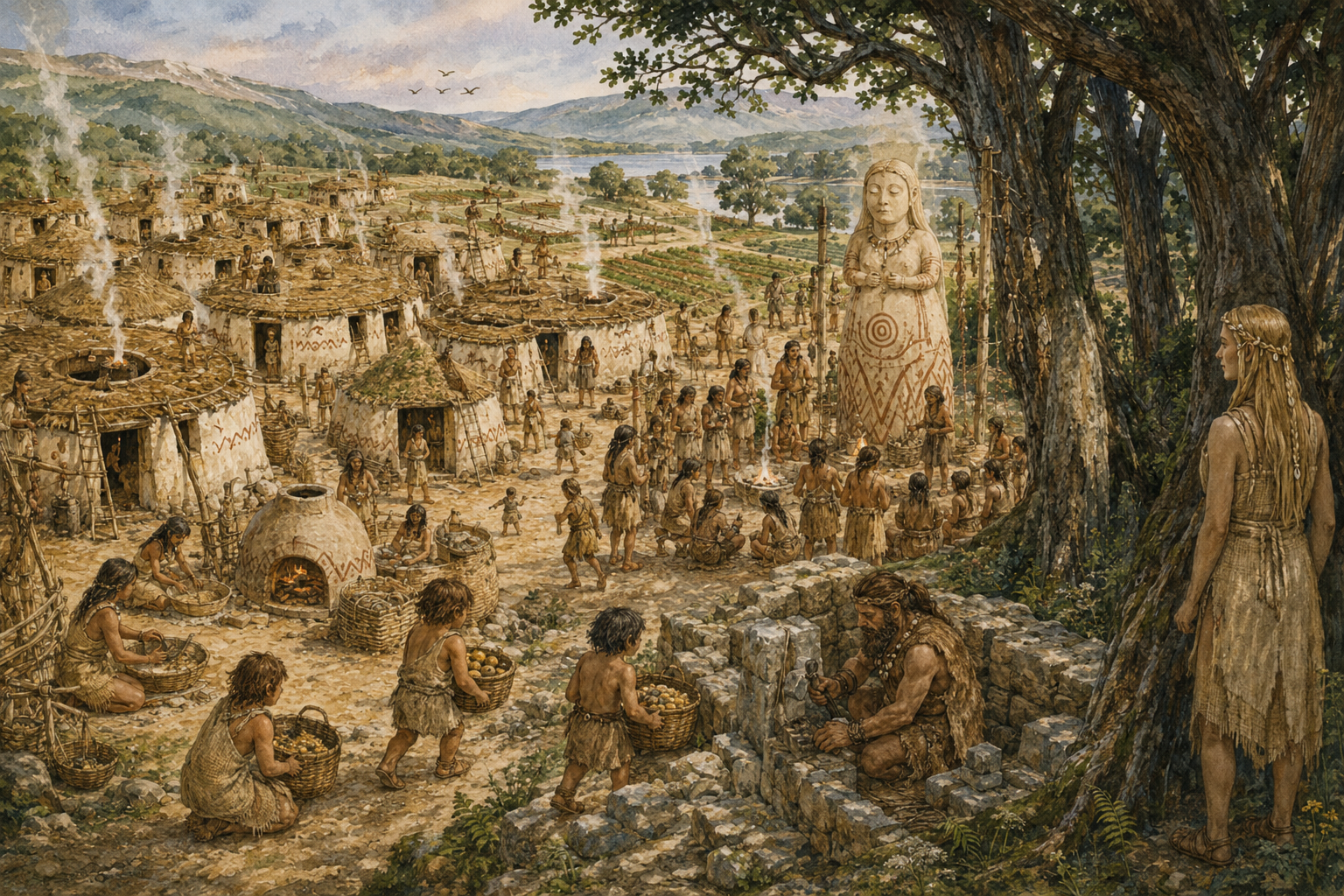
The peoples of the world cease merely passing through the land. They bury their dead within it, name its rivers, inherit its fields and begin wars their descendants will continue long after the first cause is forgotten
Time Frame: c. 7000–5000 BCE
Common Name: The Later Neolithic and, in parts of Eurasia, the Early Chalcolithic
Theme: The birth of homelands, inherited memory and institutions powerful enough to outlive their founders.
The Dawning Age opens the warming world. Peoples spread into forests, grasslands, river valleys, islands and newly exposed coasts. During the Rooting Age, many cease merely returning to favoured places and begin binding their names, ancestors and futures to them.
Houses rise over older houses. Children grow old beside the graves of their grandparents. Paths become remembered roads. Forest clearings become orchards. Fishing grounds, shell beds, pastures and gathering places pass from one generation to the next. A settlement is no longer only where people live. It becomes the place from which they believe they come.
This change brings security, craft, abundance and beauty. It also gives power a permanent dwelling. The sealed grain-pit preserves a village through winter, but in years of hunger those who hold its keys begin commanding neighbours who once called them equals. A war leader chosen for one season refuses to surrender authority when the danger passes. A shrine raised for communal worship becomes the seat of a priestly household. A wall built against raiders becomes a boundary used to exclude former friends.
Custom preserves memory. It determines who may rebuild a house, inherit a field, graze animals, fish a river or disturb an ancestral grave. Yet custom can harden into privilege, and privilege into domination. Institutions created to protect a people can slowly become masters over them.
Unrestrained freedom brings its own terror. Flood, fire, migration, divine anger, supernatural crossings and sudden war can destroy communities that appear eternal. Mobile peoples preserve ways of life that settled rulers cannot easily control, yet warbands and raiders also bring massacre, slavery and ruin.
The Rooting Age belongs to the whole world. Human farmers, fishers, hunters, gatherers and herders create different kinds of homeland. Dwarves seize the first free holds from giant masters. Orcs claim broken roads, winter camps and scarred hills. Hobgoblin commanders preserve empire after their empires have fallen. Elves watch younger peoples rename landscapes they have known for centuries. Gnomes conceal settlements from the expanding mapped world. Halflings create dispersed homelands that later conquerors repeatedly mistake for empty country.
The gods also become more closely bound to place. A power once met beside many rivers becomes guardian of one sacred spring. A travelling ancestor is housed beneath a permanent hearth. A god’s shrine survives the priest who first raised it and gathers authority across generations.
By the age’s end, every rooted people possesses something it fears losing. From that fear grow loyalty, memory, fortification, feud, conquest and empire.
The World at the Beginning
- Permanent villages and repeated seasonal centres already exist across many regions.
- Cultivation, herding, fishing, hunting, gathering and forest management support distinct regional ways of life.
- Stone, bone, antler, wood, shell, fibre and pottery remain the principal materials of daily life.
- Sea levels continue drowning low plains, dividing islands and reshaping coasts.
- Most human authority remains divided among households, elders, assemblies, ritual specialists and temporary war leaders.
- The Hyborian kingdoms have fallen, leaving ruined citadels, scattered descendants, broken cults and relics that later peoples cannot reproduce.
- Giant successor lords retain isolated mines, roads, quarries and fortress valleys inherited from the age of the Primal Titans.
- Many dwarves remain enslaved under giant rule, while others begin winning freedom through revolt, escape and the seizure of ancient works.
- Orc peoples of the First Scar occupy northern interiors, grasslands, wooded steppe, highlands and ruined road systems.
- Hobgoblin survivors preserve ranks, censuses, slave systems, armouries and military law from shattered dominions.
- Elven peoples hold forests, coasts, uplands and ancient crossings in many parts of the world.
- Gnome and halfling communities maintain hidden, dispersed or seasonal homelands often overlooked by centralised powers.
- Serpentfolk, trolls, goblins, kobolds and other peoples occupy ruins, caves, forests and borderlands.
- Gods, ancestors, spirits and supernatural beings remain active participants in history.
- Crossings into the Fey World, Dreamlands, Ethereal Plane and Shadow Plane remain tied to particular groves, caves, dreams, ruins and graves.
The age does not begin with one discovery spreading from one centre. It begins through thousands of local decisions: to rebuild rather than depart, to plant where an ancestor planted, to return to the same shore, to defend the same valley and to teach children the names of the same hills.
The Rooting Age Timeline
c. 7000–5200 BCE — The Houses Above the Dead
Çatalhöyük grows into one of the greatest human settlements of the age. Its closely packed houses form dense neighbourhoods entered mainly through their roofs. Domestic rooms contain ovens, platforms, painted walls, reliefs, tools and the remains of ancestors buried beneath occupied floors.
A house is therefore more than shelter. It is a chamber of lineage. To rebuild it is to inherit not only walls but obligations to the dead beneath them.
Authority remains divided among powerful households, neighbourhood gatherings, ritual custodians and skilled craftspeople. No king commands the whole settlement. Influence comes from ancestry, generosity, craft, alliance and the ability to gather support.
Bull powers, feline guardians, household ancestors and beings of birth, death and the hunt receive offerings within the settlement. Different households preserve different relationships with the powers represented upon their walls.
As generations pass, disputes arise over who may rebuild upon older foundations, who belongs among the buried dead and whether a household that abandons its rooms retains any right to return.
c. 7000–6000 BCE — The Burial of the Plaster Ancestors
‘Ain Ghazal becomes one of the largest settlements of the southern Levant. Its inhabitants cultivate crops, keep animals and maintain exchange with neighbouring valleys and uplands.
The community creates large plaster figures with carefully shaped faces and bodies. These figures serve as ritual vessels for communal ancestors, guardians and powers whose authority extends beyond any one household.
When their visible service ends, they are buried deliberately. Their concealment is not destruction. It returns them to the hidden foundations of the settlement.
Later generations inherit the duty of deciding when such beings should remain buried and when they must be brought again into the light.
c. 7000–5700 BCE — The Carrying of the Crane Flutes
Jiahu flourishes in central China. Its people build substantial houses, fire pottery, work stone and bone, cultivate plants, fish local waters and bury their dead with care.
Flutes fashioned from crane wing-bones accompany ceremony, healing, mourning and seasonal gathering. Their music becomes inseparable from the identity of the settlement.
When families depart Jiahu or establish related communities elsewhere, some carry flutes made in the old manner. The songs change as they travel, yet each retains phrases said to belong to the first players beside the river.
Marked shells and ritual objects preserve memory and divination. These signs belong to Jiahu’s own tradition rather than standing merely as imperfect beginnings of later writing.
Seventh–Sixth Millennia BCE — Mehrgarh and the Pass of Many Roads
Communities near the Bolan Pass maintain mud-brick houses and combine cultivation with the keeping of sheep, goats and cattle.
Their position links the Kachi Plain, Iranian plateau, Indus drainage and distant highland routes. Shell, turquoise, lapis lazuli, stone and other materials move through the settlement.
Mehrgarh grows through contact rather than conquest. Traders, herders, healers, craftspeople and marriage partners carry knowledge between regions divided by mountain and desert.
The settlement becomes one of South Asia’s deepest rooted centres and part of the long regional history from which later Indus civilisations emerge.
Seventh–Sixth Millennia BCE — The Westward Carrying of Seed and Herd
Farming and herding communities move through Anatolia, the Aegean, the Balkans and central Europe. Crops, livestock, pottery and house-building traditions travel through migration, marriage and exchange.
They enter lands already occupied by hunters, fishers, gatherers, elves and other peoples. Some newcomers are accepted into existing communities. Some negotiate fields and shared grazing. Others burn woodland, seize territory, erect boundaries and call older inhabitants intruders.
The movement is remembered differently by every people. Later farming communities sing of brave founders carrying sacred seed into empty country. Elven songs remember axes entering woods whose trees bore names before the newcomers’ ancestors were born.
Seventh–Sixth Millennia BCE — The Rooted Gardens of New Guinea
In the highlands of New Guinea, communities intensify the management of useful plants, wet ground, forest clearings and productive edges.
Their landscapes are shaped through repeated cutting, planting, drainage, tending and return. Each generation inherits not a wild valley but a living arrangement between people, plants, weather and spirits.
This is an independent centre of cultivation with its own crops, techniques and sacred relationships.
Near the age’s end, increasingly deliberate work in wetlands prepares the greater agricultural landscapes of later millennia.
c. 7000–5000 BCE — The Jōmon Coasts
Across the islands later called Japan, Jōmon communities maintain permanent and semi-permanent settlements supported by fishing, shellfish gathering, hunting, nut processing, forest management and regional exchange.
Substantial houses, storage pits and pottery allow communities to remain deeply rooted without depending upon grain farming.
Coasts, forests, rivers, shell beds and offshore routes form connected homelands. Boats carry stone, shell, food, marriage partners and ritual objects between settlements.
The sea gives generously, but it is never treated as empty. Coastal powers, drowned ancestors and great creatures possess their own claims upon the same waters.
c. 6500–5000 BCE — Painted Vessels and the Village Worlds of Mesopotamia
Across northern Mesopotamia, communities later grouped as Hassuna, Samarra and Halaf develop distinctive pottery, architecture, storage practices and ritual traditions.
Painted vessels carry patterns associated with households, exchange, ancestry and sacred order. A vessel can travel farther than the person who made it and preserve the memory of a settlement among strangers.
Farther south, early Ubaid settlements expand through river plains and marshes. Farming, fishing, reed-working, animal keeping and boat travel support growing communities.
Those who organise shared work gain influence. At first they coordinate repairs, harvests and defence. In later generations, their descendants begin treating temporary responsibilities as inherited rights.
Seventh–Sixth Millennia BCE — The Great Gatherings of Nabta
Communities return repeatedly to the lakes and wells of Nabta Playa in the eastern Sahara. They hunt, fish, gather plants, keep animals, make pottery and move between dependable water sources.
Nabta is not an empire or city. It is a meeting place where mobile peoples gather to exchange goods, arrange marriages, perform rites, resolve feuds and share knowledge of weather, stars and distant routes.
Sky watchers study the movement of the sun, stars and seasonal rains against the horizon. Their knowledge determines when scattered peoples should return.
In later ages, some descendants remember Nabta as a place where many peoples met beneath the same sky without surrendering their names to one ruler.
c. 6300–5900 BCE — The River Faces of Lepenski Vir
Communities at the Iron Gates of the Danube build carefully arranged houses, shrines and burial places beside one of Europe’s great river corridors.
Fishing, navigation and seasonal water shape every household. Monumental stone sculptures combine human and fish-like features.
These are not decorations. They portray transformed ancestors, river persons and other beings recognised as powers of the Danube.
The settlement’s people do not claim the river as dead property. They inhabit it alongside beings whose memory is older than their houses.
c. 6200 BCE — The Retreat from Drowned Doggerland
A vast submarine collapse sends a catastrophic sea-wave across parts of the North Atlantic and North Sea coasts.
Settlements, forests, fishing grounds, burial places and lowland roads vanish beneath the water. Entire communities are destroyed before warning can spread.
Survivors flee towards Britain, continental Europe and higher islands. Human, elven and halfling refugees arrive among peoples already struggling to preserve their own land.
Some carry stones from drowned hearths. Others carry the names of villages whose locations can no longer be seen. For generations, children are taught that their true homeland lies beneath the sea.
Rare tides, dreams and supernatural disturbances sometimes reveal roads and roofless settlements below the waves.
Sixth Millennium BCE — The Green Sahara
The Sahara remains a country of lakes, wetlands, grasslands and seasonal rivers. Hunters, fishers, herders and gatherers move between camps, burial grounds and gathering places.
The Nile is one great corridor among many. Trade and migration carry cattle, stone, shell, pigments, hides and ritual knowledge across northern Africa.
Local gods and ancestral powers guard lakes, hills, caves and animal routes.
As some waters begin slowly retreating, elders argue over whether to remain faithful to ancestral ground or lead their people towards lands their ancestors never knew.
Sixth Millennium BCE — East African Lakes and Highland Paths
Communities around the Rift lakes, Ethiopian highlands, upper Nile systems and eastern savannahs maintain traditions of fishing, hunting, herding, gathering and plant management.
Obsidian, salt, hides, livestock and sacred objects travel between uplands and lowlands.
Some highland roads pass through giant ruins or lands claimed by dangerous creatures. Others are protected by remembered agreements with local gods, ancestors and nonhuman peoples.
Sixth Millennium BCE — The Coasts Become Roads
Communities around the Pacific, Atlantic, Mediterranean, Indian Ocean and enclosed seas deepen their knowledge of fish, shellfish, seabirds, marine mammals and estuarine plants.
Landing places, islands, straits and sheltered bays become centres of exchange and conflict.
Boats carry people, goods, songs, diseases, captives and gods farther than many overland travellers can imagine.
The coast becomes both homeland and road. Control of one narrow strait can enrich a settlement or provoke generations of war.
c. 5500 BCE Onward — The First House of Enki
Ubaid settlements spread through southern Mesopotamia. Their communities combine cultivation, fishing, reed-working, animal keeping and boat travel.
At Eridu, successive sacred buildings establish an enduring sanctuary of Enki.
The sanctuary begins as a place of communal offering and divine presence. Its custodians preserve rites, stories, craft knowledge and remembered judgement.
Enki answers through dreams, fresh water, inspired craft and the recovery of knowledge hidden beneath older ruins. He teaches without making every answer safe. Gifts taken from the deep can improve a settlement or awaken powers buried before humanity.
As surrounding communities increasingly turn to Eridu for ceremony and counsel, the keepers of the sanctuary gain authority beyond their own households.
The house of a god becomes an institution capable of surviving every priest who serves within it.
c. 5500–5000 BCE — The Nile Settlements Deepen
Farming and herding become increasingly established in Lower Egypt, the Faiyum and the Nile Delta.
Annual flooding supports fertile land but demands observation, storage and coordinated labour. Fishing, hunting and gathering remain important.
Nile communities trade and intermarry with Saharan herders, highland travellers and coastal peoples. Pottery, burial and local ritual become increasingly distinctive.
Older Stygian ruins remain scattered through the wider region. Some are feared and avoided. Others attract cults, treasure-seekers and those who mistake ancient power for forgotten wisdom.
c. 6200–5000 BCE — The First Copper Flames
Communities in the Balkans collect coloured copper minerals, work native copper and experiment with increasingly intense heat.
By the age’s close, specialists at places such as Belovode repeatedly transform ore into copper.
Metal remains rare. Stone, bone, antler, wood, shell and fibre provide nearly all ordinary tools and weapons.
Copper objects pass as ornaments, sacred gifts, heirlooms and symbols of prestige. Their value lies as much in wonder as in usefulness.
Dwarven craftspeople possess deeper traditions of mining and metalworking, much of it preserved through generations of forced labour under giants.
Sixth Millennium BCE — The Flight of the Seven Dwarven Houses
Across northern mountain systems and giant-controlled territories, dwarven slaves revolt, escape or seize portions of the works they were forced to maintain.
One remembered migration becomes known as the Flight of the Seven Houses. The refugees carry tools, children, ancestral remains and fragments of hold-law through passages cut by their own enslaved forebears.
Several houses are lost during the flight. Later dwarven traditions disagree over whether they were destroyed, betrayed or deliberately remained behind to delay pursuit.
The survivors establish a defended refuge around a captured forge and deep cistern.
Sixth Millennium BCE — The Lighting of the First Free Flame
Within one seized giant forge, free dwarves kindle a furnace for themselves rather than for a master.
The first flame becomes a sacred symbol of liberation. Its keepers swear that no outsider will ever again command dwarven labour within the hold.
The oath preserves the community through siege and hardship. In later generations, its wording hardens. Some keepers begin treating every foreign visitor, mixed family and dissenting dwarf as a possible threat to freedom.
A law created to prevent slavery begins becoming a reason to deny trust.
Sixth Millennium BCE — The First War of the Broken Road
Orc clans of the First Scar claim ruined Titan roads, abandoned fortresses and giant slave routes across northern interiors.
They are an ancient nonhuman people with their own origins and histories. Mhurak Stone-Blood belongs to a far later age and does not create the orcs.
Conflict intensifies when dwarf refugees close a mountain road leading to a captured forge. Orcs regard the road as spoil taken from the fallen giant order. Dwarves regard it as the route through which their enslaved ancestors were driven.
Neither people remembers the road as neutral.
The war spreads through raids, ambushes, massacres and burned refuges. Each side preserves the other’s worst deeds and forgets its own first provocation.
The hatred becomes older than any surviving kingdom.
Sixth Millennium BCE — The March of the Ash Standard
Varkesh’s First Black Dominion has already fallen in the War of the Broken Standards. The restored order associated with Orzhal has also been shattered by the convulsions following the Hyborian world.
Hobgoblin survivors remain scattered across old roads, quarries, forts and former subject territories.
One commander gathers soldiers, armourers, scribes, slaves and dependent families beneath an ash-darkened remnant of an older standard.
The marching column occupies a ruined fortress and counts every living person within reach. Households are assigned labour, tribute and military obligations. Captives are recorded by skill, age and usefulness.
The system brings order to a region devastated by raiding and famine. Roads are cleared. Stores are guarded. Bandits are killed.
Then the counts become permanent. Temporary service becomes hereditary. Shrines are subordinated. Children inherit duties assigned to dead grandparents.
Varkesh is honoured as the First Muster and founder of the lost order. His cult grows during this age, but his complete apotheosis and established divine rule in Acheron belong to later history.
The muster-state survives because it reduces every person and every cult to a recorded function.
Sixth Millennium BCE — The Burning of the Elder Grove
In a western forest, an expanding settlement clears trees to create new fields and pasture.
Its people believe they are making unused land productive. Elven keepers recognise the same place as an ancestral grove planted and tended over many mortal generations.
Negotiation fails. During the fighting, fire spreads beyond the cleared boundary and destroys trees remembered in elven song from before the first human houses in the region.
The forest powers withdraw from the burned ground. One river changes course. Animals abandon the valley for a generation.
The settlement survives and prospers. The elves retreat.
Centuries later, the descendants of the settlers remember only that their heroic founders defeated hostile forest spirits. The elven descendants remember the valley by a name meaning the Place Where Memory Burned.
Sixth Millennium BCE — East Asian Village Traditions Multiply
Settlements spread through the Yellow River, Yangtze, coastal wetlands and interior valleys.
Different communities develop distinct crops, pottery, house forms, burial customs, songs and relationships with local spirits.
Exchange connects distant settlements without erasing their languages or identities.
Some villages grow powerful through generosity and craft. Others dominate neighbours through control of stores, routes or armed followers.
Sixth Millennium BCE — Rooted Peoples of the Americas
Across North, Central and South America, communities deepen traditions of fishing, hunting, gathering, cultivation, forest management and wetland use.
In southern Mexico, the long domestication of maize continues. Early maize remains one plant among many managed foods.
Along the Pacific coast of South America, rich marine environments support increasingly settled communities with boats, nets, food stores and sacred places.
Andean routes connect coast, valley and highland. In Amazonia and other tropical lowlands, communities manage useful trees, palms, soils, fisheries and forest clearings.
Across North America, river, woodland, coastal and wetland peoples maintain inherited gathering grounds, burial places and seasonal centres.
Their rootedness does not require walls or grain fields. A people can belong to a network of rivers, forests and seasonal roads as deeply as another belongs to one village mound.
Sixth Millennium BCE — The Ancestral Paths of Australia
Across Australia, peoples maintain homelands through inherited routes, fire, seasonal movement, ceremony, story and custodianship.
The land is not an empty surface awaiting ownership. It is a network of places shaped and inhabited by ancestral beings whose journeys establish animals, waters, hills, obligations and sacred traditions.
No single account governs the continent. Each people preserves its own sacred geography and responsibilities.
Around 5000 BCE — The First Hemudu Communities
Settlements develop in the wetlands of the Lower Yangtze.
Their inhabitants cultivate rice, fish, hunt and construct raised timber buildings suited to wet ground and seasonal flooding.
Sophisticated woodworking allows houses to endure where ordinary mud-brick construction fails.
Hemudu stands near the age’s closing threshold, when some regional settlements become large and specialised enough to support permanent public authority.
By c. 5000 BCE — The First Towns
Some settlements now contain public sanctuaries, central stores, specialist workshops and defended boundaries.
Works must be maintained beyond the lifespan of those who first build them. Surplus must be counted. Ritual duties must be inherited. Armed followers must be fed.
Institutions begin surviving their founders.
The village created to preserve a people becomes capable of commanding them.
Geography of the Rooting Age
No single empire dominates the human world. Most power remains local: a large settlement, a sacred centre, a seasonal gathering, a fortified road, a hidden hold or a strong household able to gather followers.
Older peoples retain fragments of imperial geography. Giant lords occupy isolated fortress valleys. Hobgoblin commanders preserve sections of broken dominions. Serpentfolk remain hidden in ruins and sealed sanctuaries. Orc clans and dwarven refugees fight over roads and works inherited from the giant age.
Africa
The Green Sahara remains a world of lakes, grasslands, wetlands and seasonal rivers. Nabta Playa draws mobile peoples into repeated gatherings.
The Nile Valley and Delta support increasingly rooted farming and fishing communities. The upper Nile, Ethiopian highlands, Rift lakes and eastern savannahs sustain their own regional networks.
No single African centre governs the continent. Cattle, salt, hides, stone, pigments, shell and sacred traditions move through many overlapping worlds.
Southwest Asia and Anatolia
Çatalhöyük, ‘Ain Ghazal, Eridu and numerous Mesopotamian and Anatolian settlements form one of the age’s densest concentrations of permanent human life.
Obsidian, shell, timber, pigments, bitumen and rare metals move through old routes.
Hyborian ruins, serpentfolk enclaves, giant roads and hidden nonhuman settlements remain scattered through mountains, plateaus and deserts.
South Asia and the Iranian Plateau
Mehrgarh and neighbouring communities connect the Kachi Plain, Bolan Pass, Iranian plateau, Indus drainage and highland mineral regions.
Farming, herding and exchange grow together.
Mountain passes are contested by human communities, dwarven refugees, giant remnants and other peoples.
Central Asia and the Northern Interior
Grasslands, wooded steppe, uplands, mountain corridors and interior rivers support hunters, fishers, herders and mobile communities.
Orc clans control many ancient roads, winter camps and ruined fortresses. Hobgoblin muster-states occupy selected bridges, quarries, passes and strongholds.
Dwarven fugitives seek refuge in mountain systems still claimed by giants, orcs, goblins and trolls.
This is one of the principal theatres of the ancient dwarf–orc war.
East Asia
Jiahu and many other settlements develop along the Yellow River, Yangtze, interior valleys and coastal wetlands.
Different communities cultivate different plants while continuing to fish, hunt and gather.
At the age’s close, Hemudu rises within the Lower Yangtze wetlands.
Southeast Asia
River valleys, tropical forests, coasts, uplands and island passages support communities skilled in fishing, boating, plant management and seasonal exchange.
Settlements form around caves, river mouths, reefs, sheltered bays and forest clearings.
Dense vegetation conceals older ruins, supernatural crossings and nonhuman settlements.
Europe
Farming and herding communities expand through southeastern and central Europe. Hunting, fishing and gathering remain powerful across northern, Atlantic and forest regions.
Lepenski Vir holds an important Danube corridor. Balkan craftspeople develop early copper smelting.
Doggerland is drowned. Britain and Scandinavia retain substantial elven territories, while giant, troll and linnorm domains survive in mountains, islands and forests.
The Americas
North, Central and South American communities develop distinct traditions based on fishing, hunting, gathering, cultivation, forest management and wetland use.
Maize domestication continues in southern Mexico. Pacific coastal peoples deepen maritime lifeways. Andean routes link coast, valley and highland.
Amazonian communities shape forests, fisheries and productive soils. North American peoples maintain river, woodland, wetland and coastal homelands.
Australia, New Guinea and Oceania
Australian peoples maintain extensive traditions of seasonal movement, fire use, sacred geography and inherited custodianship.
New Guinea highland communities intensify cultivation and landscape modification.
Coastal and island peoples sustain navigation, fishing and exchange across Oceania.
Rising seas divide older landscapes, but boats preserve connections between many of their descendants.
Mnar and the Dreamlands Border
Mnar occupies an exceptional region where waking Earth lies close to the Dreamlands.
Sarnath has been destroyed. Ilarnek preserves the idol and cult of Bokrug.
Dream routes lead from Mnar to distant sleepers, lost cities and hidden regions. Time, distance and memory become unreliable near particular lakes, ruins and roads.
Realms and Powers
The Giant Successor Strongholds
Giant lords retain isolated mountain valleys, islands, mines, quarries and fortress roads inherited from the age of the Primal Titans.
Some continue commanding dwarven slaves, goblin workers, human tributaries and other subject peoples.
Many still enforce orders written by rulers long dead. A quarry may continue cutting stones for a fortress whose foundations were never laid. Dwarven slaves may be commanded to extend a tunnel towards a destination forgotten centuries earlier.
The giant world has become a machine unable to understand that its age is ending.
The Dwarven Free-Hold Chains
Free dwarven communities form broken chains through mountain systems, cavern routes and former giant industrial regions.
No single empire unites them. Each hold descends from a particular revolt, escape, migration or captured stronghold.
Their laws preserve hard-won freedom, yet isolation and fear can turn those laws against outsiders and dissenters.
A hold founded to protect fugitives can become a fortress that refuses refuge to later fugitives.
The First-Scar Orc Territories
Orc peoples dominate extensive northern interiors without forming one lasting empire.
Clan territories are bound by migration routes, burial hills, sacred scars, winter camps, feud and temporary war leaders.
Where dwarves root identity in the reclaimed forge, many orc clans root identity in the site of victory, vengeance or conquest.
Their named places include hills where enemies were slaughtered, fords where ancestors crossed under fire and roads seized from giants.
The Hobgoblin Muster-States
Hobgoblin military regimes survive across old roads, uplands and former dominion territory.
Each muster-state is governed through rank, census, ration, compulsory service, slavery and military discipline.
Their strength lies in preserving institutions when neighbouring peoples depend upon individual leaders and fragile custom.
Their horror lies in allowing those institutions to define every person’s purpose.
Hobgoblin commanders do not need to destroy a village physically. They can preserve its houses while erasing its gods, ancestry, language and independence.
Elven Woodland and Coastal Realms
Elven peoples maintain substantial territories in forests, coasts and wooded uplands, especially in Britain and Scandinavia.
These are not one empire. They are kin realms, groves, coastal settlements, seasonal assemblies and ancient paths.
Elven memory gives them claims that younger peoples struggle to understand. A human family may have cultivated a clearing for three generations. An elf may remember planting the trees around it before that family’s people entered the region.
Both claims can be real. Neither can always be reconciled.
The Great Sanctuary and Settlement Centres
Çatalhöyük, ‘Ain Ghazal, Jiahu, Mehrgarh, Nabta Playa, Lepenski Vir and Eridu influence surrounding peoples through population, craft, gathering, trade and religion.
They do not rule empires. Their importance lies in becoming places whose names survive beyond the households that founded them.
Places of Interest
| Place | Region | Legacy | Campaign Possibility |
|---|---|---|---|
| Çatalhöyük | Anatolia | Roof-entered houses built above generations of buried ancestors | A collapsed chamber contains dead claimed by several rival households |
| ‘Ain Ghazal | Southern Levant | Settlement of the buried plaster ancestors | A guardian awakens and rejects the present custodians |
| Jiahu | Central China | Home of the crane-bone flutes and marked ritual objects | An ancient flute answers a voice from beneath the river |
| Mehrgarh | Kachi Plain | Deep centre of farming, herding and highland exchange | A burial ornament contains a map to a lost dwarven route |
| Nabta Playa | Eastern Sahara | Great seasonal gathering place of mobile peoples | Rival communities arrive during a drought and each claims the old gathering ground |
| Lepenski Vir | Iron Gates of the Danube | Settlement of the river persons | A stolen sculpture causes fish to vanish and drowned bodies to return |
| Eridu | Southern Mesopotamia | First enduring sanctuary of Enki | An older shrine is uncovered beneath the occupied sanctuary |
| Belovode | Balkans | Early centre of extractive copper smelting | A furnace opens into a sealed giant workshop |
| Hemudu | Lower Yangtze | Wetland settlement of raised timber houses and rice cultivation | A flooded ancestral house remains inhabited by its dead |
| Kuk Highlands | New Guinea | Independent centre of cultivation and landscape transformation | New work uncovers a buried supernatural crossing |
| The Drowned Doggerland Roads | North Sea | Submerged settlements, paths and ancestral places | A road rises during an impossible low tide |
| The First Free Forge | Northern mountains | Dwarven stronghold of the first free flame | Its keepers refuse refuge to escaped slaves, claiming ancient law forbids outsiders |
| The Broken Titan Road | Central Asian interior | Ancient route contested by orcs, dwarves and hobgoblins | Repairing one bridge could restore trade or enable conquest |
| The Ash Standard Camp | Eastern uplands | Hobgoblin muster-state preserving dominion institutions | Its census tablets claim several neighbouring peoples as hereditary subjects |
| The Elder Grove | Western forests | Elven homeland destroyed during settlement expansion | The grove begins growing again beneath a prosperous human town |
| Ilarnek | Mnar | Keeper of Bokrug’s idol after the destruction of Sarnath | Dreamers begin seeing Sarnath standing once more |
Peoples of the Rooting Age
Dwarves — The People of the First Free Flame
Dwarves begin the age scattered across giant mines, quarries, roads and fortress systems.
Many remain enslaved. Others escape, revolt or seize the works they were forced to build.
The first free holds are not kingdoms. They are refuges defended by families who carried children, tools and ancestral remains through dangerous tunnels.
Their furnaces become symbols of recovered labour. Their walls preserve memories of captivity. Their laws arise from a vow that no master will ever again command them.
Yet the same fear that protects them can harden into suspicion, exclusion and rigid authority.
Their war with orcs becomes foundational. Dwarves remember fugitives slaughtered on the roads. Orcs remember being denied access to spoils seized from giant masters.
Each generation inherits the injury more clearly than the cause.
Giants — Lords of a Dead Order
Giants inherit roads, fortresses, mines and machines from the age of the Primal Titans.
Their power remains immense, but their world is fragmented.
Some giant lords continue demanding tribute from settlements that no longer remember why payment began. Others command empty halls and dying slave populations.
They preserve commands and institutions long after their original purpose has vanished.
Their tragedy is not simply that their kingdoms fall. It is that many cannot imagine a world in which their commands no longer matter.
Orcs — Stone-Born Peoples of Scar and Vengeance
Orcs are ancient nonhuman peoples whose origins lie in the First Scar.
They are not transformed humans, and Temüjin belongs to a far later age.
Rooting Age orcs inhabit grasslands, wooded steppe, uplands, northern forests, river crossings and ruined giant territories.
Their homelands centre upon burial hills, migration ranges, winter camps, captured roads, scars in the earth and sites of remembered victory.
Many clans preserve history through feud. The place where an ancestor was killed becomes as important as the place where another was born.
Orc conquest commonly brings raiding, slavery, massacre and scorched-earth destruction. Tribute may delay violence but does not guarantee peace.
Their resistance to imposed rule can break tyrannies. Their own unchecked violence can destroy every weaker community around them.
Hobgoblins — Empire Preserved as Procedure
Hobgoblins preserve the institutions of fallen dominions after their territories have shattered.
Their strongest communities are disciplined, hierarchical, patriarchal and institutionally cruel.
Rank, census, ration, military service and slavery define their settlements.
A hobgoblin commander can bring safety to a ravaged district by clearing roads, guarding stores and killing bandits. The price is that every household becomes part of the military machine.
Children inherit service. Shrines lose independence. Captured peoples are counted by use.
The gods oppose these regimes because hobgoblin dominion seeks not merely tribute but the replacement of every local order with one command structure.
Elves — Keepers of Lands Too Old for One Claim
Elves are mortal peoples whose long lives preserve memories of drowned coasts, ancient forests and the last generations of the Hyborian world.
Their communities remain strong in forests, coasts and wooded uplands, especially in lands later called Britain and Scandinavia.
Elven homelands are shaped through rivers, groves, orchards, coasts, game routes and agreements with spirits.
Younger peoples often mistake these landscapes for wilderness because elven labour does not always resemble fields, walls or roads.
Elven memory can become wisdom, but also refusal. Some communities defend genuine sacred obligations. Others invoke ancient claims to deny younger peoples any place of their own.
They show wisdom when they distinguish stewardship from possession, but become oppressive when age alone is treated as unquestionable ownership.
Gnomes — Custodians of the Hidden World
Gnomes occupy hills, root-filled caverns, forests and concealed valleys.
They protect their homes through illusion, traps, misleading paths and agreements with local spirits.
Their hidden settlements preserve medicines, pigments, precise tools, decorative arts and knowledge of supernatural crossings.
As roads and expanding settlements make more of the world visible, gnomes increasingly fear that mapping is the first stage of conquest.
Some guide trustworthy travellers. Others conceal entire valleys so completely that later peoples remember them only as missing lands.
Halflings — The Dispersed Homelands
Halflings maintain settled, seasonal and mobile communities in river valleys, lake country, wooded meadows, lowlands and sheltered coasts.
Many combine gardens, fishing, trapping, orchards, livestock, basketry and seed preservation.
Their homelands are often scattered among related households rather than concentrated within one wall.
Later conquerors repeatedly mistake this dispersed geography for absence and describe occupied country as empty.
Halfling memory survives through paths, guest-right, seed varieties, family stories and seasonal return.
Their resistance favours concealment, ambush, traps and attacks upon supplies rather than open battle.
Other Peoples
- Goblins occupy warrens, forests, ruined settlements and scavenger camps.
- Kobolds establish trapped settlements around mines, caverns and places linked to dragons.
- Serpentfolk preserve hidden enclaves and cults from prehuman and Hyborian ages.
- Trolls hold caves, forests, bridges and remote borderlands.
- Linnorms claim remote territories and demand tribute, sacrifice or complete avoidance.
- Brownies form household relationships through food, secrecy, service and reciprocal respect.
The Gods and Sacred Powers of the Rooting Age
The gods do not begin with the Rooting Age. They already possess ancient histories, enemies, desires and territories. What changes is the relationship between divine power and permanent settlement.
A travelling cult can become a hereditary priesthood. A sacred stone can become the centre of a village. A power associated with many rivers can become guardian of one sanctuary. Local traditions grow deeper while expanding settlements bring formerly separate cults into contact.
Later peoples often gather older local gods beneath familiar names and genealogies. In the Rooting Age, many of these powers are known through titles, regional forms and sacred functions that differ from one community to the next.
Mesopotamia
Enki becomes especially powerful at Eridu, where wisdom, craft, fresh water and divine knowledge gather around an enduring sanctuary.
Powers later known more widely as Ninhursag, Inanna, Utu and Nanna are also active. They are honoured through local names, rites and relationships that later cities organise into more settled pantheons.
Ninhursag’s older forms protect birth, living earth and the continuity of communities. Inanna’s forms move through desire, fertility, conflict and dangerous authority. Utu’s light witnesses travel, wrongdoing and judgement. Nanna’s moon measures night journeys and the return of time.
The Nile and Green Sahara
Solar, cattle, hunting, fertility, river and desert powers are honoured throughout the Nile lands and Green Sahara.
Some are later known as Ra, Hathor, Min, Neith and Khnum, but their Rooting Age cults remain local and varied. They are not yet gathered beneath one royal theology or one ruling temple order.
Beyond their growing spheres remain many lake, rain, cattle, mountain and ancestral gods whose names never enter later royal records.
South Asia and the Iranian Plateau
River mothers, serpent guardians, cattle lords, mountain beings and sacred fire powers dominate regional cults.
Some later gods inherit their titles, stories and sacred places, but no single later name contains every power worshipped around Mehrgarh, the Indus approaches and the highland routes.
East Asia
World-mending mothers, divine ancestors, seed-teachers, river powers and masters of signs appear through numerous regional traditions.
Some are later remembered under names such as Nüwa, Fuxi and Shennong. These later names gather together older encounters and stories that remain distinct during the Rooting Age.
Japan and the Jōmon Coasts
Kami inhabit mountains, islands, forests, storms, hearths, animals, stones and the sea.
They are not arranged into one universal hierarchy. Each settlement honours the powers upon which its survival depends. A mountain guardian may protect one community while denying passage to another.
Later traditions preserve some of these beings under widely recognised names, while countless local kami remain tied to drowned or forgotten places.
Europe
River persons, forest mothers, animal lords, hearth guardians, sky powers, smithing spirits and the divine dead shape local worship.
The beings honoured beside the Danube differ from those of northern forests, Mediterranean coasts and Atlantic islands. Later European pantheons inherit only fragments of this older sacred landscape.
The Americas
Maize powers, rain serpents, mountain lords, sea mothers, thunder beings, tricksters, cave gods, underworld guardians and ancestral animals receive worship across the continents.
Some later civilisations preserve these beings under famous names. Others disappear from later records with the peoples who knew them. No single pantheon governs the whole hemisphere.
Australia, New Guinea and Oceania
Ancestral beings shape routes, waters, animals, plants and sacred responsibilities. Great rainbow-serpent powers create and guard rivers, rain and fertile ground through many different local traditions.
New Guinea highland communities honour ancestors, plant teachers, wetland spirits and mountain powers. Island and coastal peoples worship sea guardians, storm beings and divine navigators.
Nonhuman Gods
Dwarven communities invoke gods of forge, stone, ancestry, endurance and liberation. Their cults remain divided between the free holds, with each preserving names and traditions lost to others.
Orc clans worship war gods, predatory powers, scar spirits and deified ancestors. No single orc priesthood governs every clan.
Hobgoblins honour Varkesh as the First Muster and founder of the lost dominion. His cult grows steadily, but his full apotheosis in Acheron and established status as a god belong to later history.
Elven gods and ancestral powers remain bound to forests, coasts, stars, seasonal cycles and long memory. Gnome communities honour hidden powers of craft, root, illusion and threshold. Halfling cults preserve household, road, seed and hospitality spirits across dispersed kin-networks.
Elder and Dreaming Powers
Bokrug remains active in Mnar after the destruction of Sarnath.
Other elder powers survive in sealed ruins, dreams, deep waters and forgotten regions. They are not symbols or misunderstood natural forces. They possess will, memory and the ability to act upon the world.
Household, Village and Institution
The Household
The household becomes one of the age’s most enduring communities.
It contains food stores, tools, sleeping places, workshops, shrines and sometimes the dead.
A household may include close kin, adopted outsiders, captives, servants, dependants and enslaved people. Their rights differ greatly.
Inheritance preserves continuity but can also bind descendants to debts, feuds and duties they did not choose.
The Village
Villages coordinate defence, rebuilding, storage, ritual and communal labour.
Some are compact and crowded. Others are dispersed through fields, forests, riverbanks or grazing land.
Authority usually remains divided among elders, household leaders, assemblies, ritual specialists and successful warriors.
The danger begins when temporary authority learns to reproduce itself.
Mobile Peoples
Permanent settlement does not replace mobility.
Hunters, herders, fishers and gatherers continue travelling through inherited territories.
Many village peoples also move seasonally to hunt, fish, gather or graze animals.
Mobile life preserves flexibility and freedom from fixed rulers, but it does not guarantee peace. Mobile warbands can devastate settled communities, while settled rulers often close routes older peoples depend upon.
The Granary and the Key
Granaries, pits, jars, baskets and sealed rooms preserve food through winter, drought and failed harvest.
Stored food supports larger populations and specialist craftspeople.
It also creates a new kind of power.
In years of abundance, the keeper of the granary is a servant of the community. In years of hunger, the same keeper decides who eats, who works, who fights and who leaves.
The Shrine
Household worship remains strong, but some sacred places now serve entire settlements or regions.
Those who preserve ritual, divine names and sacred objects gain lasting authority.
A shrine can unite unrelated households. It can also become an institution demanding labour, offerings and obedience long after its founding purpose is forgotten.
Craft and Memory
Potters, stoneworkers, weavers, healers, builders, boat-makers and ritual specialists devote increasing time to skilled work.
Craft is taught through family, apprenticeship, marriage and captivity.
A well-made object can carry the name of a vanished settlement across generations. A painted bowl, flute, copper ornament or carved stone may preserve memory after every house has fallen.
Magic and Technology
Everyday Magic
- Protective marks guard doors, boats, stores and workshops.
- Burial rites maintain relationships between ancestors and descendants.
- Healing combines plants, touch, song, ritual and practical knowledge.
- Weather and fertility rites support fields, herds, fisheries and gathered foods.
- Dreamers communicate with spirits, ancestors and Dreamlands beings.
- Curses target fertility, food, lineage, livestock and settlement security.
- Elven magic preserves groves, coasts and migration routes.
- Gnome illusion conceals paths, settlements and supernatural crossings.
- Dwarven rites strengthen stone, forge, door and ancestral hall.
- Orc scar rites bind warbands to leaders, ancestors and remembered victories.
- Hobgoblin oath-magic reinforces rank, service and punishment.
Magic remains personal, communal and regional. Formal schools and state-controlled magical institutions belong largely to later urban civilisations.
Tools and Materials
Stone remains the principal material for tools and weapons. Flint, obsidian and other stones are worked into blades, points, scrapers, axes and sickles.
Bone, antler, wood, shell, fibre and leather remain equally important.
Pottery improves cooking, storage and transport. Weaving and basketry support clothing, shelter, carrying and food preservation.
Metal
Native copper and early smelted copper remain rare.
Metal does not replace stone during the Rooting Age.
Copper objects are usually ornaments, ritual objects, gifts, heirlooms or exceptional tools.
Dwarves possess deeper mining and metalworking traditions, but their knowledge remains scattered and fiercely guarded.
Boats and Navigation
Dugout canoes, reed boats, skin boats and other local watercraft support fishing, travel and exchange.
Coastal and river peoples navigate through current, stars, landmarks, animal movement and inherited memory.
Building
Communities build with mud-brick, timber, stone, earth, reeds and plaster.
Large communal buildings, shrines, workshops and stores appear in several regions, but palaces and monumental royal complexes remain rare.
War, Raiding and Captivity
Warfare remains largely local, yet a local war can destroy an entire small people.
Conflicts begin over land, grazing, fisheries, routes, stolen livestock, captives, marriage, graves, sacred objects, insult and vengeance.
Raiding
Small warbands attack herds, fields, fishing camps, travellers and isolated workers.
Raiders seek food, livestock, tools, boats, specialists, captives and prestige.
Every successful raid creates new wealth and a new grievance.
Village War
Settlements defend themselves with ditches, walls, fences, difficult approaches, watch posts and concealed paths.
Stone axes, spears, bows, slings, clubs, knives and shields dominate ordinary warfare.
Fire remains one of the most destructive weapons of the age. A night raid can erase houses, stores and fields built over generations.
Slavery and Forced Labour
Captivity takes many forms, including war slavery, household servitude, agricultural labour, construction gangs, debt bondage, hostages, captive adoption and hereditary slavery.
Humans and nonhuman peoples can enslave and be enslaved. Power, war and local custom determine status.
Giant slave systems remain among the largest forms of forced labour. Dwarven revolt against those systems shapes the age.
Hobgoblin muster-states preserve organised slavery and compulsory service as central institutions.
Orc warbands commonly seize captives during raids and conquest.
Institutions created to organise labour repeatedly become institutions designed to possess people.
Ecology, Climate and Disaster
Rising Seas
Post-glacial seas continue reshaping coastlines, islands, estuaries and low plains.
The drowning of Doggerland becomes one of the age’s defining sorrows.
The Green Sahara
Northern Africa remains much wetter than in later ages.
Lakes, grasslands and wetlands support large populations, but gradual change already alters routes and settlement patterns.
Forests and Clearance
Settlement, cultivation and managed burning alter forests in many regions.
Clearance creates fields and grazing. It also reduces game, increases erosion and destroys landscapes sacred to older peoples.
Disease
Larger settlements increase exposure to contaminated food, refuse, smoke, parasites and diseases associated with managed animals.
Healers deepen traditions of plant use, wound care, childbirth and sanitation.
Famine
Drought, flood, crop failure, animal disease and war produce severe local famines.
Famine drives migration, raiding, abandonment, enslavement and submission.
It also reveals whether communal institutions remain servants of the people or have become masters over them.
What Changes During the Rooting Age
- Permanent and semi-permanent settlements spread through more regions.
- Houses are rebuilt on inherited ground.
- Ancestors become tied physically and spiritually to occupied places.
- Farming, herding, fishing, hunting and forest management deepen through independent regional traditions.
- Pottery, weaving, woodworking, stoneworking and specialist craft become increasingly sophisticated.
- Food storage supports larger populations and greater inequality.
- Trade routes carry goods, people, beliefs, diseases and feuds across greater distances.
- Local cultures become more distinctive while remaining connected.
- Public shrines and communal rites grow beyond household worship.
- Named gods become increasingly associated with enduring sanctuaries and regions.
- Eridu develops an enduring sanctuary of Enki.
- Nabta Playa becomes a great seasonal gathering place.
- Lepenski Vir preserves the memory and authority of the river persons.
- Doggerland is drowned, creating generations of refugees and lost homelands.
- Early copper smelting develops in the Balkans.
- Dwarven slaves establish the first free holds.
- Giant successor realms contract into isolated strongholds.
- Orc clans claim broken roads, uplands and former giant territories.
- The ancient dwarf–orc conflict intensifies.
- Hobgoblin muster-states preserve empire as rank, census and procedure.
- The cult of Varkesh develops while his later apotheosis remains in the future.
- Elven territories face expanding clearance and irreconcilable claims.
- Gnome communities conceal settlements and guarded knowledge.
- Halfling kin-networks preserve dispersed homelands through paths, seed and seasonal return.
- Temporary offices begin becoming hereditary power.
- Some villages become towns with permanent institutions able to outlive their founders.
What Survives
- Settlement mounds containing generations of rebuilt houses.
- Ancestors buried beneath later homes, streets and temples.
- Plaster figures hidden beneath ‘Ain Ghazal.
- Crane-bone flutes carrying songs older than later kingdoms.
- Trade routes through Mehrgarh and the Bolan Pass.
- Seasonal gathering places in the Green Sahara.
- Stone river persons at Lepenski Vir.
- The earliest sacred foundations beneath Eridu.
- Drowned settlements and roads beneath the North Sea.
- Rare copper objects and forgotten smelting sites.
- Dwarven cisterns, tunnels, forges and refugee paths.
- Giant slave mines containing unrecovered dead.
- Orc burial hills beside broken Titan roads.
- Hobgoblin census tablets still assigning duties to vanished households.
- Early standards and relics of Varkesh’s growing founder-cult.
- Elven grove boundaries preserved beneath later towns and kingdoms.
- Gnome doors opening according to forgotten seasons.
- Halfling seed stores containing plants no longer grown elsewhere.
- Household agreements with brownies and other domestic Fey.
- Dreamlands crossings guarded by hereditary custodians.
- Forgotten shrines to gods whose names vanish with their peoples.
- Hyborian relics preserved after their histories are forgotten.
- Mass graves, burned villages and abandoned fields.
- Bloodlines descended from captives, refugees and adopted outsiders.
- The warning of Sarnath carried far beyond Mnar.
Campaign Legacies
The First Free Flame
A dwarven hold still keeps a furnace said to descend from the first free flame. Its ancient law forbids any outsider from entering the forge. Escaped slaves arrive seeking refuge, and the keepers must choose between the literal oath and the freedom it was created to defend.
The Ash Standard Census
Hobgoblin tablets uncovered beneath a ruined fortress classify several modern settlements as hereditary labour districts. A new warlord invokes them as lawful title.
The Voice Beneath the Standard
A forgotten hobgoblin standard begins issuing commands in the voice of Varkesh. Whether the voice is the dead founder, an Acheronian power anticipating his later apotheosis or a deceiving spirit remains uncertain. Its orders are precise, effective and ruinous to every free people nearby.
The River Person’s Return
A sculpture from Lepenski Vir is removed and sold. Fish vanish, boats overturn and drowned bodies begin returning to shore.
The House Beneath the House
A collapsed floor reveals generations of burials belonging to several peoples. An elven ancestor wears halfling ornaments beside a human child buried with a dwarven key.
The Drowned Road
A road through Doggerland rises during an impossible low tide. Refugees, spirits and descendants of the drowned attempt to cross before the sea returns.
The Last Seed House
A halfling store contains a crop able to survive an approaching drought. Several communities demand access, while the guardians insist that the seed belongs to a people thought extinct.
The First Sanctuary of Eridu
Workers beneath a later shrine uncover Eridu’s earliest sacred building. Something beneath its floor still answers prayers made in Enki’s oldest name.
The Elder Grove
An ancient forest begins growing beneath the foundations of a prosperous town. Elven claimants demand that the settlement be abandoned, while the inhabitants insist their ancestors have lived there for centuries.
The Broken Titan Road
Orcs, hobgoblins, dwarves and human settlements compete to restore an ancient bridge. Whoever completes it will control trade and invasion across the region.
The Forgotten God
A shrine is uncovered beneath a village mound. The god within remembers every household that once worshipped there, but no living person remembers the god’s name or the bargain made with it.
Ending State and Transition
By c. 5000 BCE, rooted settlement has become a permanent force across much of the world.
Large villages support specialist crafts, inherited rites, food storage, defended boundaries and long-distance exchange. Mobile peoples continue controlling immense territories through herding, fishing, hunting, gathering and seasonal return.
Human and nonhuman homelands increasingly overlap. Farms meet ancient forests. New roads reach giant fortresses. Dwarven holds close passages used by orcs. Hobgoblin forts count villages that have never accepted their rule.
Every people preserves memories of what it has built and what it has lost.
The gods become increasingly connected to permanent sanctuaries, inherited priesthoods and regional identities. A divine cult can survive the death or dispersal of its founders, while a priesthood can accumulate authority in the god’s name.
Institutions now outlive their creators. The granary remains after the generous keeper is dead. The shrine survives its first priest. The fortress continues enforcing a vanished ruler’s command. Emergency duties become inherited ranks.
Order protects communities from famine, war and destruction. It also begins creating the machinery of hierarchy and empire.
The Rooting Age ends when some settlements become large enough that household memory and temporary leadership can no longer govern them alone.
Towns, sanctuary-centres, workshops, stores and armed retainers gather beneath permanent authorities.
The first homelands prepare to become the first new cities.
The Rooting Age passes into Eon XL — The Blooming Cities.
Historical and Mythic Context
SpiralWorlds treats the events of c. 7000–5000 BCE as lived world history. The people of Çatalhöyük, Jiahu, Mehrgarh, Nabta Playa, Lepenski Vir, Eridu, Hemudu and countless unnamed settlements act within a world where gods, spirits, nonhuman peoples, elder ruins and supernatural crossings are real.
Modern terms such as Neolithic, Chalcolithic, Ubaid, Halaf and Jōmon are later classifications. The peoples of the age use their own names, languages and identities.
The age develops through many independent centres. Southwest Asian farming settlements do not stand for the whole world. African lake and pastoral communities, East Asian river settlements, Jōmon coasts, New Guinea highlands, American cultivation traditions, European river societies and Australian sacred landscapes follow their own histories.
The named gods included in this entry are not inventions of later civilisations. They already exist, though many are worshipped through local titles and traditions not yet organised into the familiar pantheons of later history.
Dwarven liberation from giant slavery, First-Scar orc expansion, hobgoblin muster-states, elven territorial loss, Mnar and the surviving inheritances of the Hyborian world belong to the same global history.
The age is remembered through both creation and sorrow. Peoples establish homes, songs, shrines, gardens and craft traditions. They also create borders, inherited privilege, slavery, ancestral feuds and institutions capable of ruling long after their original purpose has vanished.
Its central truth is that the peoples of the world learn to love particular lands—and therefore learn both to preserve them and to kill for them.
Continue the Timeline
- SpiralWorlds Master Timeline
- Previous Age — Eon XXXVIII: The Dawning Age
- Next Age — Eon XL: The Blooming Cities
- Dwarves
- Elves
- Gnomes
- Halflings
- Orcs
- Hobgoblins
- Gods and Pantheons
- World Bestiary
- The Planes
Selected Historical and Literary References
- UNESCO — Neolithic Site of Çatalhöyük
- The Metropolitan Museum of Art — Jiahu, c. 7000–5700 BCE
- UNESCO — Archaeological Site of Mehrgarh
- UNESCO — Kuk Early Agricultural Site
- University College London — Nabta Playa
- Smithsonian Institution — Early Evidence for Maize Domestication
- H. P. Lovecraft — The Doom That Came to Sarnath
- Robert E. Howard — The Hyborian Age
Keep this reference growing
If this page helped with your reading or game, you can support its upkeep or explore the curated books.
Explore the Bookshop — epics, classics and stories behind imagined worlds.