
Eon XXXVI – The Age of Open Lands: Neogene Prehistory
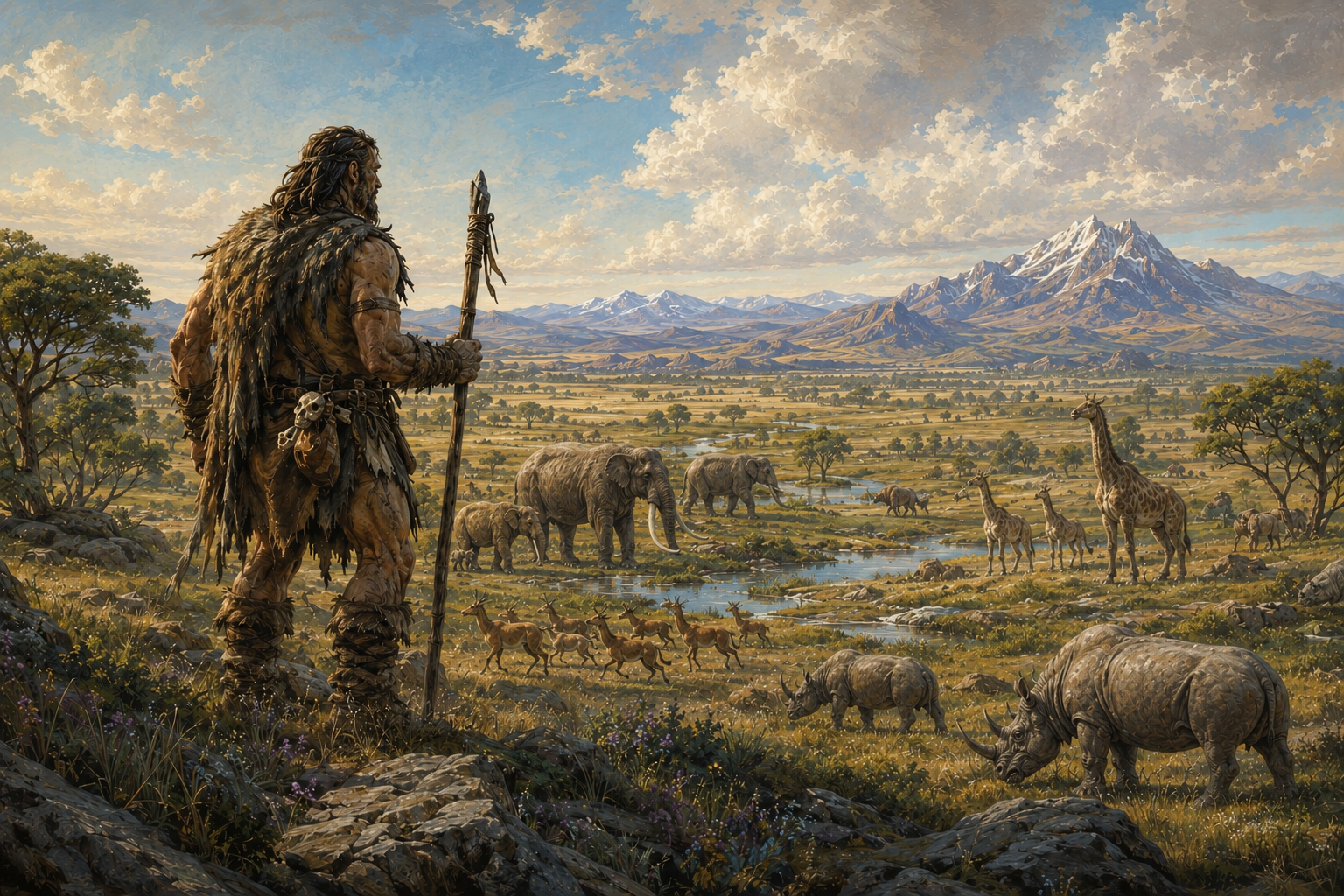
The World Opens
The forests no longer own the horizon. Across continent after continent, woodland breaks into grassland, scrub, steppe, volcanic upland and long river corridors. Herds begin to travel over distances that make old territorial boundaries unreliable. Predators follow them. So do giants, dragons, fey courts, refugees from elder kingdoms and, eventually, the first hominins.
This is the age in which Earth becomes easier to cross and harder to possess. Ancient roads emerge from retreating forests. Mountain passes become strategic again. Rivers change course. Sacred territories lose the landscapes that once protected them, while peoples able to follow herds, water and seasonal grass acquire new power.
For a campaign, the Neogene matters because the open world creates routes that remain important millions of years later. A Titan road can survive beneath a medieval track. A Yothian laboratory can lie below a later shrine. A migratory corridor first contested by giants and dragons can still determine where armies, monsters and caravans move in 1454.
Time Frame: 23.03–2.58 million years ago
Common Name: The Neogene
Theme: Open lands spread, modern animal communities take shape, elder civilisations struggle over the inheritance of gods and Titans, and the first hominins approach the threshold of human history.
Chronology Note: Scientific dates follow the recognised geological sequence. Dates assigned to lost civilisations, divine interventions and Mythos events are SpiralWorlds campaign dates.
Key Events
The Miocene
- 23.03 million years ago: The Neogene begins. The Earth remains warmer than in later ages, but long-term cooling, drying and stronger seasonal differences continue to reshape the continents.
- Early Miocene: Forests remain extensive, but the grasslands and open country established during the Ashen Dawn continue to expand and diversify.
- Early to Middle Miocene: A warmer climatic interval strengthens forests and subtropical ecosystems before renewed cooling and drying favour more open environments.
- Throughout the Miocene: Grasslands, savannahs, scrublands and steppes spread across broad regions of the Earth, creating immense new paths of migration, pursuit and seasonal movement.
- Throughout the Neogene: Surviving Elder Things retain Antarctic, oceanic and subterranean enclaves. Their civilisation remains formidable but becomes increasingly isolated from the changing surface world.
- Throughout the Neogene: Shoggoths endure in Elder Thing colonies, abandoned laboratories and deep caverns. Some remain enslaved, while others survive beyond the control of their creators.
- Throughout the Neogene: The ancient Lemurians preserve Shamballah and its hidden dependencies behind desert roads, mountain sanctuaries and powerful wards.
- Throughout the Neogene: Ancient mi-go enclaves continue to exploit remote mountains, polar territories and concealed mineral seams.
- Throughout the Neogene: Surviving Flying Polyps occupy sealed subterranean regions and remain enemies of the Great Race of Yith.
- Early Neogene: Fey courts, river spirits, giant rulers and ancient dragons engage in repeated regional conflicts as forests retreat, grasslands spread and rivers change course.
- Early to Middle Neogene: Rival giant dynasties fight over abandoned Titan roads, mines, fortresses, foundries and enslaved populations.
- c. 20 million years ago: An elder humanlike people founds the lost land of Theem’hdra. Their civilisation eventually collapses, but the fate of surviving communities and descendants remains uncertain; the wizard Teh Atht leaves behind the manuscript later known as Legends of the Olden Runes.
- Miocene: Apes diversify across Africa and Eurasia. Near the end of the epoch, the earliest hominin lineages begin adapting to changing forests and increasingly open country.
- c. 7–6 million years ago: The earliest known hominin lineages begin separating from the other great apes, opening the long evolutionary road that will eventually produce humanity.
- c. 6 million years ago: A member of a race of insect-philosophers from one of Jupiter’s moons exchanges minds with one of the Great Race of Yith.
- 5.97–5.33 million years ago: Restricted exchange with the Atlantic transforms the Mediterranean during the Messinian Salinity Crisis. Vast salt deposits form, water levels fluctuate severely and exposed margins create temporary routes between regions normally divided by sea.
- c. 5 million years ago: The Serpent People city of Yoth flourishes under the guidance of Yig. Its sciences create servant species including the gyaa-yothn and the voormis.
- c. 5 million years ago: The Yothian Schism begins when part of the Serpent People population abandons Yig for Tsathoggua. Loyalists and apostates fight through the city’s temples, laboratories and slave districts.
- c. 5 million years ago: Yig intervenes directly and destroys Yoth. Surviving Yig-worshippers establish a new civilisation in Hyperborea, while Tsathoggua’s cult spreads through the northern caverns.
- c. 5 million years ago: The Deep One city of Yatta-uc beneath Lake Titicaca enters its great age. Other Deep One communities occupy ocean trenches, drowned caverns, inland waters and hidden coastal settlements.
The Pliocene
- 5.33 million years ago: The Pliocene begins as the Mediterranean reconnects fully with the Atlantic and the exposed lands of the salinity crisis are drowned.
- Throughout the Pliocene: Continued continental movement, regional uplift and changing sea levels alter coastlines, climates and migration routes across the world.
- Throughout the Pliocene: The formation of the Isthmus of Panama increasingly joins North and South America. The Great American Interchange brings long-separated animal communities together and transforms both continents.
- c. 4.4 million years ago: Early hominins combine strong climbing adaptations with increasingly habitual upright movement. They remain creatures of woodland, broken forest and open-country margins.
- c. 3.3 million years ago: Some Pliocene hominins begin deliberately making stone tools. Technology has appeared, but humanity has not yet become a dominant force.
- c. 3 million years ago: Voormis uprisings destroy Serpent People breeding houses, laboratories and isolated successor strongholds across parts of Hyperborea.
- c. 3 million years ago: The voormis establish a surface kingdom in Hyperborea beneath the worship of Tsathoggua. Their new realm remains divided by clan, cult and the inherited violence of slavery.
- c. 3 million years ago: Rhan-Tegoth comes from Yuggoth to dwell in the Arctic, receiving blood, sacrifice and worship from peoples who later abandon him.
- Late Pliocene: Northern Hemisphere glaciation intensifies. Seasons sharpen, cold grasslands widen and competition increases over geothermal valleys, mountain refuges, protected forests and ancient underground roads.
- Late Pliocene: Northern and high-altitude giant lineages develop traits suited to tundra, glacial margins and severe mountain climates.
- 2.58 million years ago: The Neogene closes as the world enters the repeated glacial cycles of the Shattered Crown.
Overview
Eon XXXVI was an age in which the land opened. Dense forests and lingering warmth did not disappear, but they no longer defined the whole face of the Earth. Cooling climates, stronger seasons and expanding open country created plains, savannahs, scrublands, steppes and long migratory roads.
The age did not merely continue the mammalian rise of the Ashen Dawn. It carried that rise into a broader, harsher and more mobile world.
Yet the Neogene was not an empty stage awaiting mammals and humanity. Civilisations, gods, monsters and peoples inherited from much older ages continued to occupy the Earth. Some adapted to the open lands. Others withdrew beneath ice, mountain, forest, desert or sea. Many fought to retain control of roads, rivers, mines, fortresses and sacred places that had belonged to them for millions of years.
The Opening of the Land
Grasslands had already begun spreading during the Oligocene, but the Neogene saw them expand, divide and mature across immense regions. Forests withdrew from some continental interiors, fragmented into seasonal woodland in others and survived in great strength wherever climate, altitude and rainfall allowed.
Open country never replaced every forest. Instead, it became one of the defining landscapes of the age.
These changes created new laws of survival. Distance mattered more. Herds followed rain, grass and seasonal water. Predators learned to pursue prey across exposed ground. Burrowing animals gained protection beneath landscapes that offered little cover, while climbing species adapted to broken woodland, cliffs, scrub and forest edge.
The changing land also created new political and supernatural boundaries. Forest courts lost territories that had remained green for millions of years. River spirits followed altered channels. Giant communities fought over mountain passes and watering grounds. Dragons claimed cliffs, volcanic uplands and isolated plateaux.
The Rise of Modern Mammalian Faunas
Across the widening lands, many older mammalian dynasties declined while forms recognisable to later ages became increasingly prominent. Horses grew larger, swifter and better adapted to long movement across open ground. Elephant-kind diversified into numerous tusked and trunked forms. Giraffes, antelopes and other grazing or browsing animals spread through seasonal environments.
The predators changed with them. Cats, wolves, foxes, bears and other hunters took on forms increasingly familiar to later peoples. Some hunted through speed and endurance, others through ambush, strength or cooperation. The struggle between pursuit and escape sharpened across the plains.
Birds and insects followed the same broad transformation. Open-country birds spread through grasslands, wetlands and scrub, while pollinating insects adapted to changing flowering ecosystems. Older strange forms survived in isolated regions, magically protected territories and hidden valleys, but they no longer defined the whole living world.
The Neogene was therefore not simply an age of abundant beasts. It was an age in which the Earth trained life towards many of the forms, movements and ecological relationships inherited by the later world.
Gods of the Opening World
The gods did not wait for humanity to appear before acting upon the Earth. Divine powers already possessed realms, rivalries and ancient worshippers among giants, dragons, fey, Serpent People and other nonhuman civilisations.
The spread of open land enlarged the domains of gods and spirits associated with plains, herds, migration, hunting, wind and seasonal abundance. Forest gods resisted the loss of ancient woodland, while river powers fought to preserve or redirect waterways altered by uplift, drought and changing rainfall.
Mountain gods strengthened as ranges rose and glaciers later formed upon their heights. Sea powers contested changing coastlines, inland waters and the Mediterranean during its great salinity crisis. Storm and cold powers gained increasing influence as the Pliocene approached its end.
These beings were not necessarily known through the names later given to them by human religions. Some later gods already existed, but their human cults, titles, myths and institutions had not yet developed. During the Neogene they were worshipped through nonhuman languages, ancient divine names and traditions later lost.
Yig’s destruction of Yoth was one of the clearest divine interventions of the age. Tsathoggua gained influence through the ruins of Yoth and the liberation of the voormis. Rhan-Tegoth entered the Arctic and established a sacrificial cult among northern peoples.
The Titan Inheritance
The great age of the Primal Titans had ended long before the Neogene. Most were dead, bound, sleeping, withdrawn from the Earth or confined to remote places.
A small number remained active in inaccessible mountains, deep caverns, polar wastes and hidden realms. Their rare awakenings or commands could still destroy settlements, redirect rivers, raise mountains or condemn entire peoples.
Their works remained everywhere.
Titan roads crossed mountain chains and open interiors. Titan fortresses guarded passes whose original enemies had been forgotten. Titan mines descended into mineral seams beyond the reach of ordinary engineering. Foundries, quarries, reservoirs, ritual estates and slave settlements continued to support later kingdoms.
Giant rulers claimed these works as descendants, servants, heirs or appointed guardians of the Titans. Rival houses fought over abandoned estates and contradictory Titan commands. Some possessed genuine ancestral authority; others forged sacred lineages to justify conquest.
Early dwarven communities also preserve rites addressed to the Primal Titans, especially powers associated with earth, fire, stone, metal, mountains and the deep world. In regions controlled by giant successors, that shared sacred inheritance initially makes giant claims of stewardship intelligible to dwarven clans. Over generations, however, inherited service, tribute and workshop obligation harden into coercion.
No single Titan empire ruled the Neogene Earth. The Titan inheritance instead sustained regional powers, slave systems and conflicts long after the Titans themselves had ceased to govern openly.
Conflicts of the Changing Wild
The expansion of grasslands and seasonal environments caused repeated regional conflicts across the age.
Ancient forest courts tried to halt the retreat of woodland or redirect it around their sacred domains. Plains fey, wind spirits and herd powers claimed newly opened territories. River courts fought over altered channels and seasonal waters. Mountain giants seized elevated roads, while dragons claimed cliffs, volcanic regions and isolated plateaux.
Some struggles were fought by armies of fey, giants and subject peoples. Others took the form of curses, diverted rivers, blighted forests, migrations driven into enemy territory or the deliberate release of predators and monstrous beasts.
No single side won. These conflicts established the divided wild world inherited by later ages: forests guarded by old courts, plains ruled by wandering spirits, mountains occupied by giants and dragons, and river valleys contested by every power that required water, fertile ground or passage.
Survivors of the Elder World
The rise of familiar animals and younger peoples did not erase the civilisations of earlier eons. The Earth remained old, inhabited and contested.
The Elder Things
The Elder Things retained settlements beneath Antarctic ice, in the deep ocean and within remote subterranean regions. Their greatest period of terrestrial dominion had passed, but their surviving colonies still possessed sciences and biological arts beyond the understanding of later peoples. Their earlier terrestrial history appears in Bugs, Amphibians and the Rise of Giants.
During the Neogene they increasingly consolidated rather than expanded. Surface installations were abandoned where climate, tectonic movement or rival powers made them costly to maintain. Antarctic and undersea cities became more isolated, while inland laboratories were sealed or left under the control of shoggoth servitors.
The Elder Things were no longer rulers of the visible Earth, but neither were they extinct. Their continuing decline belongs to later ages.
Shoggoths
The shoggoths survived the ancient rebellions that had broken the power of their creators. Many remained enslaved within Elder Thing colonies, compelled to build, excavate and defend.
Others occupied abandoned cities, polar tunnels and deep caverns where their creators no longer held power. Some became solitary predators, while others formed strange communities whose motives remained incomprehensible to surface peoples.
Elder Things remembered the ancient shoggoth rebellion and treated every independent population as a possible source of renewed catastrophe.
The Lemurians of Shamballah
The ancient Lemurians preserved Shamballah and the hidden dependencies established during the Ashen Dawn. Their civilisation stood apart from the migrations and ecological struggles of the surface world, protected by concealed roads and powerful wards.
As climates changed around them, Lemurian communities withdrew from exposed colonies and concentrated their strength in mountain sanctuaries, desert strongholds and observatories. Their scholars continued to chart the heavens, study elder ruins and maintain records extending far beyond the memory of later humanity.
Shamballah did not conquer the Neogene world. It survived it.
Mi-go Enclaves
Ancient mi-go outposts remained active in remote mountains, polar lands and mineral-rich regions. Their interest lay less in the surface ecology of the Neogene than in rare metals, unusual biological specimens and the maintenance of routes between Earth and other worlds.
They operated concealed mines, laboratories, temporary colonies and observation stations rather than large visible empires. Settlements that interfered with their work could be infiltrated, altered or removed without leaving any obvious explanation.
The Great Race and the Flying Polyps
The destruction of the Great Race’s major terrestrial centres did not end its influence. The earlier history of the Great Race of Yith and the Flying Polyps stretches back into the first green ages of the Earth.
Yithian minds continued to cross time, space and species, occupying bodies in distant eras and alien worlds. The exchange involving the insect-philosophers of Jupiter demonstrates that the Great Race remained active throughout the Neogene. Its agents continued to observe the Earth, recover lost records and preserve knowledge in archives inaccessible to ordinary travellers.
The Flying Polyps remained among their greatest enemies. Surviving Polyps occupied sealed regions beneath the Earth, where ancient barriers, buried cities and unnatural winds confined them. Whenever those barriers weakened, they hunted Yithian minds and destroyed anything that stood between them and their prey.
Fey Courts and Ancient Wild Domains
The spread of open country transformed the domains of the Fey World. Courts bound to ancient forests retreated with the trees or fought to preserve isolated green realms. Others established new powers among grasslands, seasonal rivers, thorn scrub, upland meadows and the great paths followed by migrating animals.
Some fey became guardians of watering places or spirits of annual abundance. Others hunted travellers across open plains, demanded tribute from migrating herds or laid claim to invisible boundaries between forest and grassland.
The competing powers and environmental claims of these realms are described among the Faerie Courts.
These ancient fey domains survive into the following age. Terrestrial elven kingdoms arise later within the wider prehuman chronology and should not be treated as established Neogene states.
Giants and the Titan Slave World
Surviving giant lineages occupied fragments of the older Titan-built world. Their realms were no longer universal, but many still controlled mountain roads, subterranean halls, fortresses, quarries, slave settlements and ceremonial sites inherited from their former masters.
Mountain giants prospered in newly uplifted ranges. Forest giants withdrew with older woodlands. Plains giants followed great herds or demanded tribute from peoples travelling through their territories. Subterranean giants maintained foundries, mines and slave systems beneath the changing surface.
Their kingdoms rested upon forced labour. Captive peoples mined ore, quarried stone, maintained roads, forged weapons and worked the machinery of Titan estates.
Dwarven craft communities are increasingly drawn into these estates as hereditary miners, masons, engineers and smiths. In some regions the relationship begins as tribute or sacred service to rulers claiming Titan authority; by the late Neogene it is hardening into the coercive labour systems that become widespread dwarven bondage during the Shattered Crown.
Rival giant dynasties fought over mines, fortresses, livestock and enslaved populations. Defeated rulers were killed, driven into remote lands or forced to recognise stronger claimants as heirs of the Titans.
As the climate cooled, some northern and high-altitude giant populations developed traits suited to tundra, glacial margins and severe mountain climates.
Dragons and Ancient Dragon Dynasties
Dragons remained among the oldest sovereign creatures of the Earth. Their ancestors had ruled territories during ages when mammals were small and the continents followed different shapes.
During the Neogene, ancient dragon lineages retained volcanic regions, mountain chains, isolated plateaux and deep caverns. Some ruled alone. Others commanded lesser dragons, reptilian peoples, cult servants and subject monsters.
Dragons fought giants for highland fortresses and Titan estates. They fought fey powers over sacred mountains, hidden crossings and ancient wild territories. They fought Serpent People over ruins, relics and rival claims to reptilian antiquity.
As northern climates grew colder, several dragon dynasties consolidated control over defensible mountain and volcanic territories. Later traditions remembered some of these ancient rulers among the Dragon Kings.
The major wars between younger peoples and the Dragon Kings belong to later ages.
The Underworld Peoples
Beneath the expanding plains and forests lay a second world of caverns, buried cities and abandoned laboratories. Serpent People factions, giant-held slave settlements, shoggoth territories, created servitor races and forgotten subterranean peoples contested this hidden geography.
The destruction of Yoth did not empty the underworld. It scattered surviving Serpent People into rival communities and left behind sealed laboratories, captive populations and abandoned creations.
Some underworld realms traded with surface powers. Others raided, enslaved or experimented upon anything entering their territories. Many remained unknown until erosion, earthquake or deliberate excavation opened their sealed roads.
The Hominin Threshold
Apes diversified widely during the Miocene. Some flourished in forests, while others occupied woodland margins and increasingly seasonal environments. Near the end of the epoch, the earliest hominin lineages began to separate from the other great apes.
These first hominins were not humans in the later historical sense. Their bodies retained strong climbing adaptations, and their lives remained bound to woodland, broken forest and open-country margins. Increasingly habitual upright movement nevertheless altered how they travelled, watched for danger, gathered food and carried objects.
By c. 3.3 million years ago, some Pliocene hominins deliberately struck stone to create useful cutting edges. This was an important threshold, but it did not place the world under human rule.
The toolmakers remained one vulnerable lineage among predators, elder peoples, giant kingdoms, fey domains and dragon territories.
The Neogene stands near the threshold of human history without yet becoming a human age. Wider migrations, more regular tool traditions, the control of fire and the appearance of Homo sapiens belong principally to the Shattered Crown.
The Lost Land of Theem’hdra
Natural evolution was not the only source of sapient life. At c. 20 million years ago, an elder humanlike people founded the lost land of Theem’hdra.
They were one of the ancient mortal-shaped peoples produced by the Earth’s earlier and stranger experiments.
Their civilisation did not endure. Its cities and political traditions vanished so thoroughly that even later elder peoples knew little of them. Whether any communities or bloodlines survived elsewhere is unknown. The wizard Teh Atht nevertheless preserved fragments of their history in the manuscript later called Legends of the Olden Runes.
The ruins of Theem’hdra remain possible sources of prehistoric inscriptions, sealed magical traditions and relics built for hands like those of humanity but created millions of years before any human kingdom.
Yoth and the Serpent People Schism
At c. 5 million years ago, the Serpent People city of Yoth flourished beneath the guidance of Yig. It was a place of ancient science, controlled breeding, slavery and ritual power.
Its savants produced servant species including the gyaa-yothn and the voormis, treating living beings as instruments of dynastic survival.
Yoth’s unity failed when part of its population abandoned Yig and turned towards Tsathoggua. What began as secret worship became political conspiracy, revolt and civil war.
Yig loyalists controlled the principal temples, priesthoods and state institutions. Tsathogguan factions gained support among dissident nobles, hidden cults, escaped servants and those seeking forbidden knowledge.
The schism spread through laboratories, slave districts, caverns and ritual centres. Created peoples were forced into both armies.
Yig answered the rebellion with divine destruction. Yoth was cast down, its chambers broken and its population scattered.
Surviving Yig-worshippers established a new civilisation in Hyperborea. Tsathoggua followed the apostates and exiles into the northern world, carrying his cult into black sanctuaries beneath the land.
The Voormis Uprisings
The destruction of Yoth did not immediately free the voormis. Surviving Serpent People factions continued to use them as labourers, soldiers, experimental subjects and sacrificial victims.
Over generations, escaped voormis formed hidden clans in caverns, forests and mountain valleys. They raided laboratories, destroyed breeding records and freed captives from isolated strongholds.
At c. 3 million years ago, these uprisings destroyed Serpent People breeding houses and successor settlements across parts of Hyperborea.
Tsathogguan cults supported many of the rebels, although their aid carried new obligations. The uprisings succeeded because the Serpent People remained divided by religious schism and by conflicts with neighbouring powers.
The voormis established a surface kingdom of their own. Freedom did not produce peace. Their realm inherited clan feuds, religious division and the violence of the system that had created them.
Yatta-uc and the Deep Ones
During the same broad age, the Deep One city of Yatta-uc beneath Lake Titicaca stood in its greatness. Its presence showed that Deep One civilisation was not confined to ocean coasts.
Inland waters, submerged caverns and ancient channels supported temples, settlements and hidden routes connecting distant bodies of water.
Beyond Yatta-uc, Deep Ones occupied ocean trenches, drowned continental margins, volcanic islands and flooded cavern systems. Their communities differed in patronage, ancestry and political loyalty.
Some honoured ancient powers associated with the deepest seas. Others maintained treaties with surface cults, Elder Thing remnants or neighbouring underworld peoples.
Yatta-uc continued into the Shattered Crown, when glaciation, changing waters and the rise of younger peoples placed its ancient order under increasing pressure.
The Great Roads Between Continents
The Neogene was an age of journeys on a continental scale. Tectonic movement, mountain building, changing climates and fluctuating seas repeatedly altered the routes available to living creatures and elder peoples.
Land connections opened, narrowed or disappeared, allowing animals, monsters and ancient races to enter regions their ancestors had never known.
The formation of the Isthmus of Panama gradually restricted the waters between the Americas and established a terrestrial connection between North and South America. Earlier animals had already crossed in limited numbers, but the main Great American Interchange intensified near the end of the Pliocene.
Predators, grazers, browsers, scavengers and burrowers entered unfamiliar worlds. Some flourished, while others failed before new competitors, diseases and environments.
The interchange was not a single march across a completed bridge, but a long biological reordering created by land, water and climate changing together.
The Mediterranean underwent an equally dramatic transformation between 5.97 and 5.33 million years ago. Restricted exchange with the Atlantic caused intense salinity changes and the deposition of vast salt layers.
Exposed shelves, narrowed channels and altered coastlines created temporary migratory routes around the basin. Giants, dragons, fey powers and other ancient peoples contested some of these passages.
At the end of the crisis, Atlantic waters returned and restored a connected Mediterranean, drowning exposed landscapes, fortifications, settlements and sacred sites unable to escape the rising sea.
The Coming Cold
During the later Pliocene, global cooling intensified. Northern ice expanded, seasons sharpened and cold grasslands widened.
The changing climate did not immediately create one permanent winter. It placed increasing pressure upon every civilisation occupying northern lands.
Giants competed for geothermal valleys, mountain caverns and Titan fortresses. Dragons claimed volcanic refuges and highland territories. Voormis defended their kingdom against Serpent People remnants. Fey courts followed shrinking forests and altered rivers.
Elder Thing colonies withdrew beneath ice and sea. Mi-go settlements moved deeper into remote mountains and polar lands.
At c. 3 million years ago, Rhan-Tegoth arrived from Yuggoth and established himself in the Arctic. He fed upon sacrifice and worship until later peoples abandoned him and his cult failed.
His arrival belonged to the Neogene, but his decline and long stillness continued into later ages.
Younger Peoples Beyond the Neogene
The giant kingdoms, Titan estates, ancient fey domains and dragon territories of the Neogene survive into the Shattered Crown.
Within that following age, the coercive relationship between giant heirs and dwarven craft communities hardens into widespread bondage, the First Scar opens and the orcs emerge, terrestrial elven kingdoms become major powers, and the first hobgoblin fortress societies arise.
The conflicts between dwarves and orcs begin inside the giant slave system through revolt, flight, competition for captured forges and violence between captive or fugitive groups. Independent dwarven holds and formal wars between free dwarven and orc powers develop only after dwarven liberation.
Hobgoblin civilisation later reaches its first great transformation under Varkesh, whose First Muster creates the First Black Dominion. The eastern elven successor realms, surviving giant kingdoms and rebellious subject peoples eventually unite against him in the War of the Broken Standards.
What the Age Leaves Behind
- Fossil beds: Ravines, mines and caves expose the bones of immense Neogene beasts, some retaining magical contamination, ancestral spirits or evidence of deliberate alteration.
- Elder Thing colonies: Antarctic, oceanic and subterranean ruins contain biological machinery, sealed laboratories and shoggoth-controlled chambers.
- Independent shoggoths: Deep colonies and solitary creatures survive beyond Elder Thing authority.
- Lemurian roads: Hidden routes lead towards abandoned observatories, desert sanctuaries and the concealed dependencies of Shamballah.
- Yithian archives: Sealed repositories preserve observations written by minds occupying alien bodies during the Neogene.
- Polyp prisons: Ancient barriers hold Flying Polyps beneath regions later settled by younger peoples.
- Fey boundaries: Stones, rivers and groves preserve territorial agreements made when forests and grasslands occupied different regions.
- Titan estates: Roads, mines, fortresses and foundries remain valuable enough to cause conflicts millions of years after their builders vanished.
- Giant strongholds: Mountain roads, underground foundries and slave settlements survive as centres of inherited power.
- Dragon territories: Mountain citadels and volcanic strongholds preserve the claims of ancient dragon dynasties.
- Theem’hdran ruins: Structures built for an elder humanlike people contain scripts, tools and wards disturbingly compatible with later humanity.
- Yothian laboratories: Buried chambers contain preserved eggs, unfinished servant species and forbidden Serpent People devices.
- Voormis battle sites: Burned breeding houses and shattered laboratories preserve evidence of the uprisings that founded their kingdom.
- Deep One settlements: Yatta-uc and related cities preserve treaties, relics and territorial claims older than human settlement.
- Rhan-Tegoth cult sites: Arctic sacrificial grounds mark the beginning of a worship that later fails, leaving its god dormant rather than destroyed.
- Drowned roads: Routes exposed during ancient changes in sea level now lie beneath straits, lakes and coastal waters.
Legacy of the Age
Eon XXXVI was the Age of Open Lands in full truth: an age of widening roads, harder seasons, modernising beasts and the slow approach of humanity.
It was also an age of inheritance and conflict. Giants fought over Titan estates. Fey courts struggled to preserve ancient domains. Dragons defended territories inherited from far older ages. Elder Things, shoggoths, mi-go, Deep Ones and Serpent People continued their hidden histories beneath ice, earth and water.
Gods intervened in the affairs of nonhuman peoples long before human temples existed. Enslaved peoples revolted, ancient kingdoms fragmented and every expanding road became a path for migration, trade, conquest or escape.
The first stone tools had appeared, but their makers were not yet masters of the world. The Neogene ended with older powers still dominant and the younger peoples of the following age still waiting beyond the threshold.
The world had not become ordinary. It had become legible.
Timeline Navigation
- Previous Age: Eon XXXV – The Ashen Dawn
- Next Age: Eon XXXVII – The Shattered Crown
- Master Chronology: The Spiral Worlds Timeline
- Earlier Yithian History: The Age of Awakening
- Earlier History of the Elder Things, Serpent People and Deep Ones: Bugs, Amphibians and the Rise of Giants
Related SpiralWorlds Pages
- Gods and Pantheons
- The Primal Titans and the Cosmic Reckoning
- The Fey World
- The Faerie Courts
- Dragons
- Shoggoths
- Deep Ones
- Great Old Ones
- Tsathoggua
Scientific Sources and Further Reading
- International Commission on Stratigraphy – International Chronostratigraphic Chart
- Smithsonian Human Origins Program – Climate Effects on Human Evolution
- Smithsonian Human Origins Program – Early Stone Age Tools
- United States Geological Survey – How Old Is the Isthmus of Panama?
- Nature Reviews Earth & Environment – Causes and Consequences of the Messinian Salinity Crisis
Mythos and Literary Foundations
- H. P. Lovecraft: The Great Race of Yith, the Flying Polyps and the surviving histories of prehuman Earth.
- H. P. Lovecraft and Zealia Bishop: Yig, Yoth and the subterranean Serpent People traditions associated with The Mound.
- H. P. Lovecraft and Hazel Heald: Rhan-Tegoth and the Arctic cult preserved in The Horror in the Museum.
- Clark Ashton Smith: Tsathoggua, the voormis and the prehistoric traditions of Hyperborea.
- Brian Lumley: The lost land of Theem’hdra and the traditions associated with Teh Atht.
Keep this reference growing
If this page helped with your reading or game, you can support its upkeep or explore the curated books.
Explore the Bookshop — epics, classics and stories behind imagined worlds.