
Mercury — The Sunward World
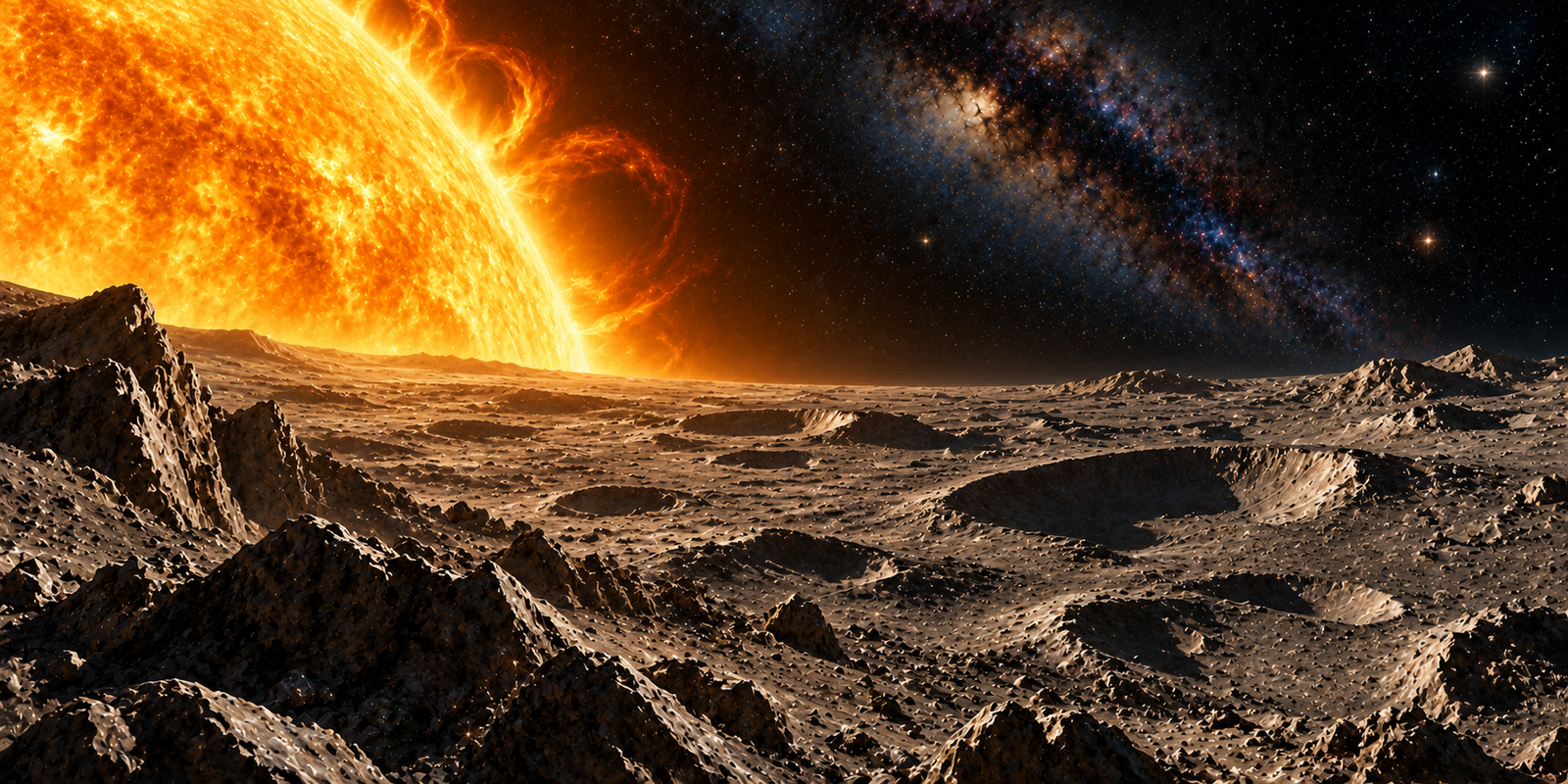
First planet from the Sun · The cratered world.
Mercury circles closest to the Sun. From afar it is a small, elusive light seldom seen far from dawn or dusk. From the surface it is a field of battered rock, long crater shadows and horizons ruled by the great nearby star. It has neither an ordinary breathable atmosphere nor a moon to light its nights.

A land of heat and shadow
In sunlight the surface can approach 430°C. In darkness it can fall below −180°C. With virtually no atmosphere to carry or retain warmth, crossing the boundary between light and shadow changes a traveller’s immediate danger. The airless ground carries scars from countless impacts; bright rays spread from some younger craters, while great ridges mark where the shrinking planet’s crust buckled.
Near the poles, deep craters contain places the Sun never reaches. Ice can survive in some of those permanently shadowed interiors. This is among the most valuable facts on any expedition’s chart, though an icy crater floor is not a safe harbour. The cold, the descent and the journey back out remain serious obstacles.
Finding the way home
Mercury’s short orbit means its position against the Sun changes rapidly as seen from Earth. A mariner who has learned the stars may recognise its brief appearances; a voyager needs far more exact navigation to arrive there. A magical crossing avoids much of that distance, but may still open onto unprotected rock under the full force of sunlight.
A survey party reaches a permanently shadowed crater only to find that its lifting device has failed. Supplies are adequate for the party, not for bringing back the entire recovered cargo. The group must choose between returning with the instrument records, salvaging its rare metal samples, or attempting repairs while the available time dwindles.
Earth’s swift messenger
Mercury’s name recalls the Roman messenger god. Earthly traders and astrologers associate the wandering light with journeys, exchange and quick decisions. The god’s worship, however, belongs to living cults and other realms; this battered planet is not thereby a divine palace.
Continue to Venus, the Sun or the Solar System. Environmental hazards: Outer Space Terrain.
Physical astronomy reference: NASA — Mercury facts.
Keep this reference growing
If this page helped with your reading or game, you can support its upkeep or explore the curated books.
Explore the Bookshop — epics, classics and stories behind imagined worlds.