
Saturn
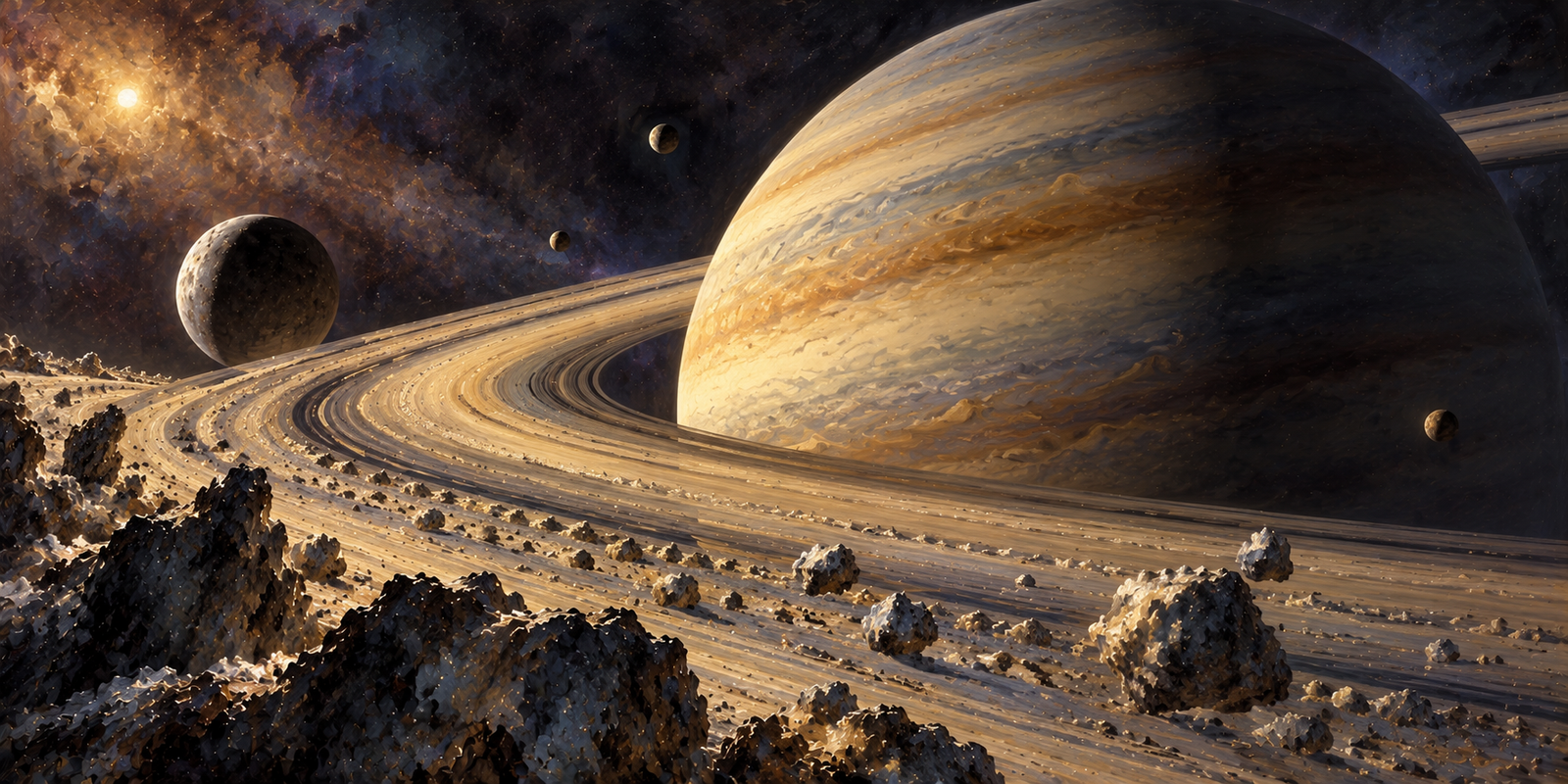
Sixth planet from the Sun · The ringed giant.
Saturn’s rings make it the most recognisable of the distant planets. In an observatory on Earth they are a difficult sight; to a vessel approaching the planet they become an immense, thin arrangement of orbiting ice and rock. Saturn itself is a gas giant. The ground an expedition seeks is more likely to lie on one of its moons than beneath the golden clouds.

The rings are not a road
What looks like a solid band from afar is made of countless moving fragments, from fine grains to substantial icy blocks. Each ring follows its own orbit. A traveller cannot walk around Saturn upon this bright bridge; even a ship crossing the ring plane must carefully choose its path. The Cassini Division is a broad gap between major rings, not an empty, guaranteed-safe corridor.
Below the rings, Saturn’s vast atmosphere offers no ordinary landing ground. Hydrogen and helium make up most of the gas, while winds and pressure intensify with descent. The planet’s splendour is best observed from a protected craft or a moon with solid terrain.
The moons worth a voyage
Titan has a thick, hazy atmosphere, broad plains and lakes of liquid methane and ethane. Its lakes are not water and its air cannot be breathed without protection. A landing team must navigate strange shorelines that may look inviting from afar but offer none of the familiar necessities of an earthly port.
Enceladus is much smaller, with bright icy ground and jets that eject water-rich material from fractures near its south pole. Its plumes offer a way to examine matter from an ocean hidden beneath the ice without digging directly through its frozen shell. Other moons vary from cratered ice to irregular, battered bodies, each with different approach hazards.
A choice beyond the rings
An expedition reaches Enceladus as a fresh plume throws icy particles across the planned approach. The vessel can collect material at a distance, attempt a closer pass for better samples, or land and risk losing its only safe departure route. Rival investors may value the same discovery differently: an intact scientific record, a costly physical sample or proof of a dependable return passage.
Elsewhere, Titan’s haze conceals the exact shoreline shown on an old chart. The vessel has enough supplies to survey one inlet, not all of them. An old claim of a sheltered landing place must be weighed against the crew’s actual observations before the methane weather closes in.
When the Ring Records Return
An old navigation log recovered in the Indian Ocean describes a broad silver arc beyond the Sun’s familiar planets. Its captain named no ruler, but recorded the position of a small moon and a signal heard beneath a veil of ice. When a modern expedition arrives near Enceladus, a second signal answers from a different direction. The crew have provisions for a return, not for searching every moon.
Some patrons want to claim the discovery as their own; others would trade a dependable coordinate for safe passage among distant worlds. The mystery lies in the source and meaning of the signal, not in a claim that Saturn’s rings form a solid bridge or that the god Saturn inhabits its clouds. A vessel carrying a disputed chart may also attract the attention of those who knew the route before Earth’s fleets existed. See the Space Atlas and the older inhabited cosmos.
Saturn and the heavens of Earth
Courts and temples track Saturn as a slow wandering light. Its Roman namesake is associated with sowing, old dominion and an earlier golden age; those sacred traditions belong to worshippers and their history, not to a confirmed divine court within the gas giant. Follow the god Saturn separately from the planetary geography.
Return to the Solar System or continue inward to Jupiter.

Physical astronomy: NASA — Saturn facts.
Keep this reference growing
If this page helped with your reading or game, you can support its upkeep or explore the curated books.
Explore the Bookshop — epics, classics and stories behind imagined worlds.