
Solar System
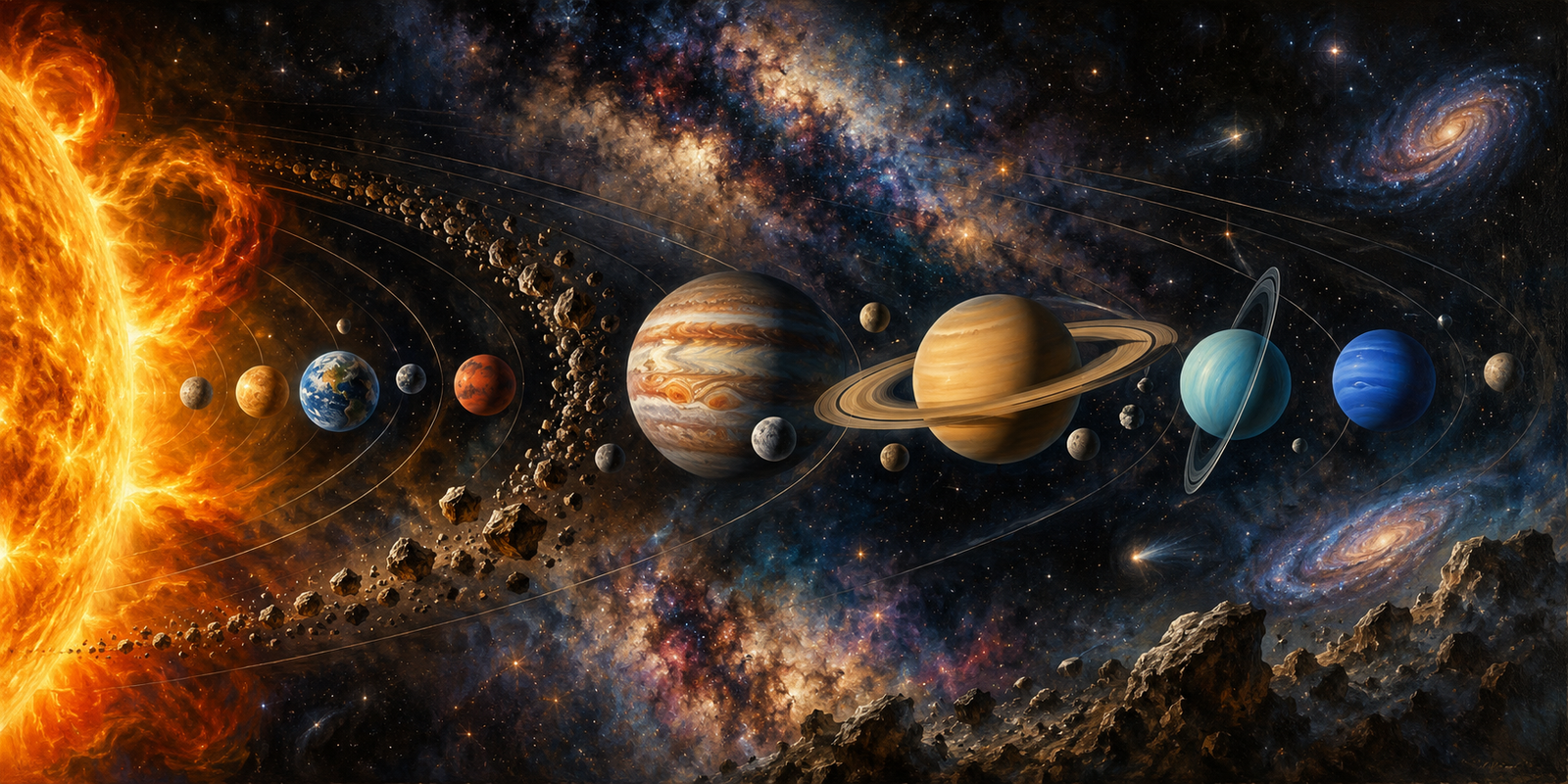
Material Plane · The Sun’s planetary system
Eight major planets circle the Sun, accompanied by dwarf planets, moons, asteroids and comets. Each follows its own orbit. Between them stretches a wilderness unlike any sea on Earth: a voyage can be measured in millions or billions of miles, with few places for a crew to find shelter.
The rocky worlds occupy the inner reaches. Farther out, giant planets command families of moons and ring systems; beyond Neptune lie icy bodies and the uncertain limits of the known planetary realm.

The inner worlds and the outer giants
Mercury, Venus, Earth and Mars are the four rocky planets. The Moon belongs to Earth’s neighbourhood, while the asteroid belt lies chiefly between Mars and Jupiter.
Jupiter and Saturn are gas giants; Uranus and Neptune are ice giants. Their moons may be more accessible to an expedition than the planets’ immense atmospheres. Farther still, Pluto is a dwarf planet among the icy bodies of the outer Solar System.
Voyages Between Worlds in 1454
The Moon is the nearest obvious destination for aether vessels leaving Earth. Its exposed ground is airless, but an ancient passage may open into a protected sanctuary. A failed lunar landing can end an expedition before it reaches the more distant planets. The Moon is therefore both a proving ground and a place where older powers can refuse entry. Three-Marks Refuge is a small Ming lunar outpost in an older sealed chamber. Its garrison and provisions belong to the imperial expedition; it is not a shared waystation.
Mars draws mapmakers hunting signs of water, old settlements and the people described by John Carter. Venus offers a more immediate test of a captain’s judgment: the upper atmosphere might be surveyed, but a descent to the deadly surface can destroy even an exceptionally protected ship. The great outer planets are approached chiefly for their moons, stolen records and ancient crossings, not for ports beneath their clouds.
Six earthly powers now pursue these journeys differently. Ming China guards working aetherships; Prague’s astronomers refine experimental courses; the temples of Kemet preserve older gates. The Ninefold Dominion recovers seized apparatus, Richelieu’s agents steal navigational secrets and Majapahit’s merchant navigators seek profitable passages. None owns the worlds to which its ships arrive.
The distance alone does not decide whether a voyage is worthwhile. A dwarf may travel to a remote asteroid to recover a particular metal, while a Ming admiral spends the same treasure on safe charts and a diplomatic landing. An old gatekeeper may decline every offer to open a passage. The six best-documented earthly programmes, their tools and their likely destinations are described in Spacefaring Powers of 1454.
What Every Expedition Needs
A destination, a date of arrival, breathable air, food and water, repairs, protections against the void and a credible return course. An ancient gate may cover the distance instantly but can open only at one site, under the control of another power. A long vessel voyage may outlast its original crew. These risks cannot be made to disappear by the existence of a sophisticated telescope or enchanted drive.
Beyond the charted worlds
The disputed Planet Nine belongs to a real astronomical hypothesis, but its existence is unconfirmed. Nibiru carries a name from ancient Mesopotamian star lore and later fictional planetary accounts; it is not an established extra planet in the modern astronomical census.
Among Earth’s magical scholars, possible routes between worlds are prized knowledge. A passage through an ancient gate may be faster than a vessel travelling through the void. Neither passage should be mistaken for travel to the Outer Planes, which lie beyond ordinary physical geography. For journeys, see Outer Space Terrain.
The Solar System circles within the Milky Way. Earth’s planetary formation and the older histories of inhabited worlds are recorded in The Dawn of Earth and Toward Earth and Beyond.
Keep this reference growing
If this page helped with your reading or game, you can support its upkeep or explore the curated books.
Explore the Bookshop — epics, classics and stories behind imagined worlds.