
Venus
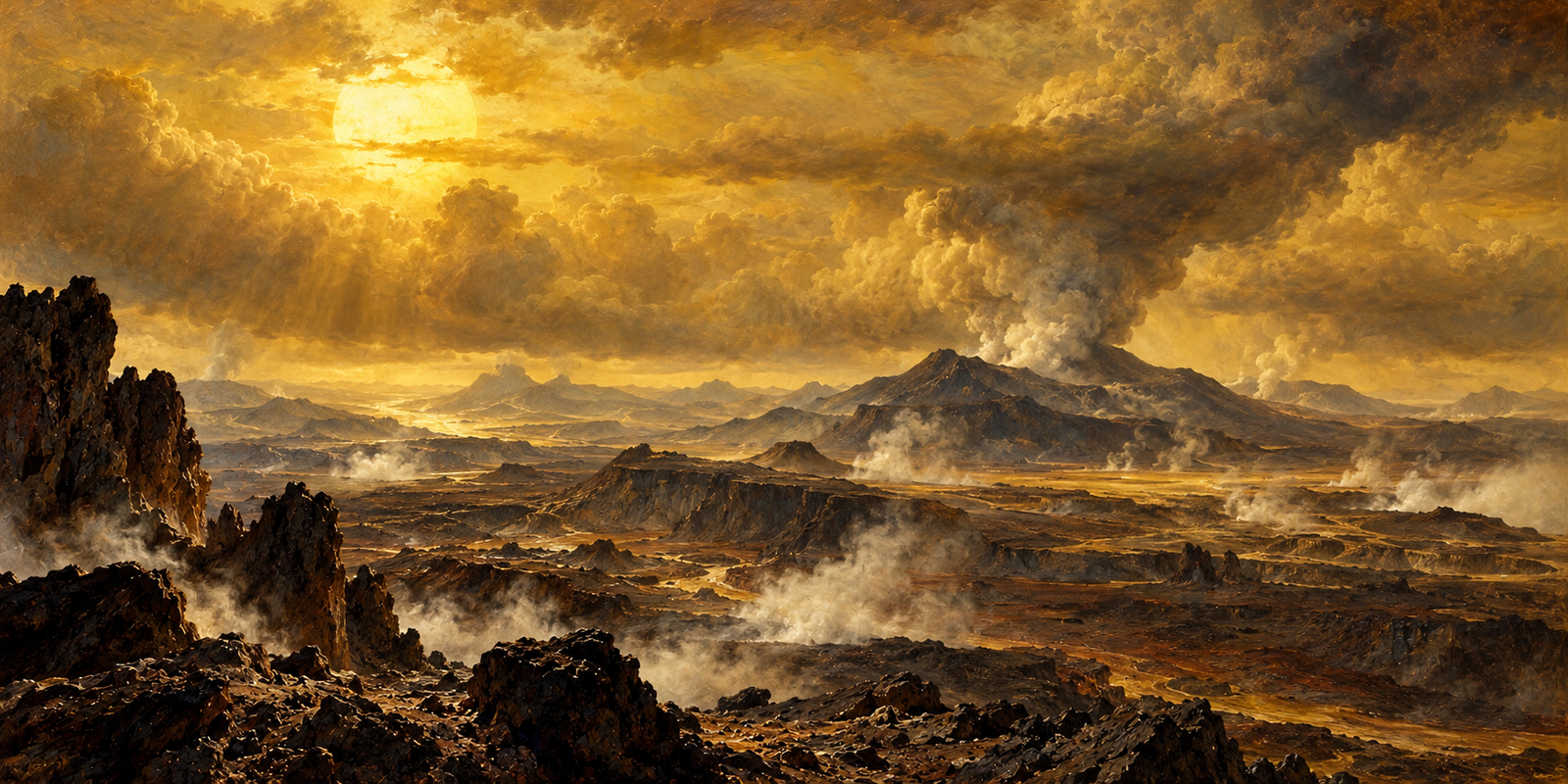
Second planet from the Sun · The morning and evening star.
Venus is the bright wanderer seen before dawn or shortly after sunset. Earthbound astrologers and navigators have watched it for generations, but its gleaming cloud cover conceals one of the most hostile landscapes in the Solar System. Beneath the clouds lie volcanic plains, ancient uplands and an atmosphere heavy enough to crush an unprotected traveller.

The world behind the light
The reflected light visible from Earth comes from clouds, not oceans or gleaming cities. Sulphuric acid droplets hang in the upper cloud decks. On the ground, heat is sufficient to melt lead, and the pressure is roughly ninety times that at sea level on Earth. No traveller could step from an ordinary vessel here and live.
Mountainous highlands rise above broad plains, though even the highest summits remain beneath the heavy atmosphere. A crew descending through the pale cloud layers must judge altitude by instruments or magic. When the ground finally becomes visible, there is little time to discover whether the landing craft can survive it.
Two appearances, one planet
To the astronomers of Earth, Venus is sometimes the morning star and sometimes the evening star. These are not rival heavenly bodies, but different appearances of the same planet as it moves relative to the Sun. Temples and courts may attach different omens or divine titles to those appearances. A priest’s interpretation can change a ruler’s plans without altering the course of the planet itself.
It bears the Roman goddess’s name in many charts, yet the realms of the gods are not reached merely by descending into the planet’s clouds. Sacred journeys and voyages through physical space follow different routes.
The Veiled Survey of 1454
Two sealed instruments have returned from a passage above the clouds of Venus. One agrees with the observations made by Kepler and the astronomers of Prague. The other records a signal rising from the lower atmosphere at a time when no living crew could have survived there unaided. The survey’s sponsor wants the second instrument opened; its custodian insists the contents remain untouched until a protection rite can be devised.
No nation has established a public, safe surface port on Venus. Aetherships may attempt observation from a protected orbit; a vessel that descends into the dense clouds needs exceptional shielding and a means of ascent. The possibility of an ancient device or concealed sanctuary does not make the outside air breathable or the heat harmless. A party could escort a guarded instrument back to its makers, investigate who altered the returned logs, or prevent a patron from ordering a fatal landing merely to win a claim of discovery.
The Space Atlas identifies the rival sponsors of interplanetary voyages, while the Solar System places Venus between Mercury and Earth.
Passage through the cloud veil
A survey vessel’s heat shielding begins to fail during descent. The crew can climb back to safety and abandon a lost instrument package, or attempt one short landing and risk losing the entire ship. The package contains observations made below the opaque cloud deck—information that cannot be recovered from an observatory on Earth.
A second expedition proposes staying high above the lethal surface instead, where conditions are less extreme. It still needs a dependable method of remaining aloft, a supply of breathable air and a way to return through the corrosive clouds. No permanent settlement is established by these proposals alone.
Return to the Solar System or Space atlas. See Outer Space Terrain for travel hazards.
Physical astronomy reference: NASA — Venus facts.
Keep this reference growing
If this page helped with your reading or game, you can support its upkeep or explore the curated books.
Explore the Bookshop — epics, classics and stories behind imagined worlds.