
Outer Space Terrain

The most common means of travel between worlds are portals, spells, and space-faring vessels and creatures.
Ancient planetary portals survive on many known worlds, but no kingdom has mapped them all. A gate’s destination, guardians and means of activation are as important as its location. The Space Atlas follows the earthly powers now attempting to regain these routes.
Most spells, even those with conventionally unlimited range, fail to cross interplanetary distances unless they can also cross between planes. Spells like interplanetary teleport, miracle, and wish can allow travel between worlds, although the latter two sometimes fail according to the vagaries of divine will or magic in the void.
Vessels such as aetherships and massive space creatures such as oma, outer dragons, and shantaks can also convey travelers through the void. However, space-faring vessels and creatures are the most difficult means of interplanetary travel, since such voyages may take years or even generations, and travelers must contend with the utter lack of available air, food, and water if trouble arises or the voyage goes off course. Water can be provided by one or more wands of create water in order to keep payloads manageable. Short periods without air can be addressed with compressed air, but longer periods require planetary adaptation spells or magic items that provide breathable air. Astronomical equipment like cosmograms, orreries, and telescopes is often used to avoid becoming lost. Characters can use Knowledge (geography) to recall information about space and the other planets.
Gravity
Gravity in this game is separated into four general categories. (For other gravities, GMs may wish to use the closest category or create custom ones.)
Standard Gravity (×1): The gravity mimics that of most common worlds.
Low Gravity (×1/2): Characters can jump twice as high and as far and can lift twice as much. Movement speed is unaffected. Each range increment for ranged weapons is doubled. Creatures that fall within an area of low gravity take 1d6 points of damage for every 20 feet fallen.
High Gravity (×2): Characters can move at no more than half speed, jump no more than half as high or as far as normal, and lift no more than half as much as normal. Each range increment for ranged weapons is halved. Creatures that fall within an area of high gravity take 1d6 points of damage for every 5 feet fallen.
No Gravity (×0): Without magical flight, moving in an area with no gravity is difficult. A character with a surface to push off from can move up to half speed in any direction. A double move or charge can be performed this way, but not a run. A character can move at his full climb speed or his full land speed by succeeding at a DC 20 Climb check as long as he remains adjacent to a surface with sufficient handholds. He adds his Dexterity modifier (minimum 0) on this Climb check in addition to his Strength modifier. Once a character starts moving, he continues moving at the same speed in the same direction each round without using an action until he latches onto an object to stop himself, pushes off in another direction, or creates thrust somehow (each of which requires a move action). Creatures with nonmagical means of flight lose the ability to fly for 2d6 rounds after entering a no gravity area. A character in a no gravity environment can lift and carry 10 times his normal limit. Ranged weapons have no maximum range, and their range increment distances are multiplied by 10.
Vacuums
Vacuum presents particular difficulties to spellcasters. Vacuum uses the same rules as underwater, except instead of creating steam, fire effects last long enough to deal damage instantaneously before dissipating. Airless environments require Silent Spell or other forms of voiceless spellcasting. Spellcasters can also have trouble timing their preparation of spells; a traveler’s pocket watch, or an orrery combined with a sextant, can be used to determine time.
GMs are encouraged to adjust environmental rules as appropriate for each campaign, and players should work with their GM to clarify ambiguities.
Most astronomers focus on the handful of planets and other bodies that make up their solar system. Yet over the ages, a few have looked farther outward, into the interstellar darkness and the sea of stars. Many of the following details are known only to those exceptionally skilled in Knowledge (geography) or (arcana), or to those in possession of rare books.
Other Stars

Stars are immense physical bodies of burning plasma, governed by gravity and the laws of the Material Plane. Some also harbour or approach extraordinary Positive Energy Plane star-gates, protected by jyoti who guard the passage of life. Whether every star possesses such an opening is disputed even among ancient scholars. Exceptional solar wounds may also intersect the Plane of Fire, attracting beings able to withstand the photosphere. Such crossings are not ordinary openings in a starship route, nor do they replace the star’s natural physical structure.
Though civilized races have long drawn constellations, and some eccentric astrologers seek to name and number every light in the sky, most scholars prefer to focus on the “moving stars”—other planets in the solar system, which have more easily observable qualities.
Celestial Bodies

There’s more out there than just stars and planets. Below are a few of the stranger phenomena found in the endless dark.
Black Holes:

A black hole is an extreme gravitational object from which even light cannot escape once it passes the event horizon. Some black holes are also associated with breaches toward the ancient Negative Energy Plane, but that primordial realm predates the formation of stars and is not created by a collapsing one. Its portals, if present, are exceptional cosmic wounds rather than an automatic feature of every singularity. Near such a wound, undead and enormous nightshades may gather, and sceaduinar may guard a crossing that no ordinary vessel can safely reach. The gravity and tidal hazards remain real whether the planar gate exists or not.
Not every black hole conceals a planar threshold. Even the oldest charts cannot distinguish every singularity from one containing an imprisoned power, a relic, or a boundary between realities. An expedition should regard any report of a traversable centre as a perilous claim requiring independent proof, not as an established route through the Material Plane.
Galaxies:
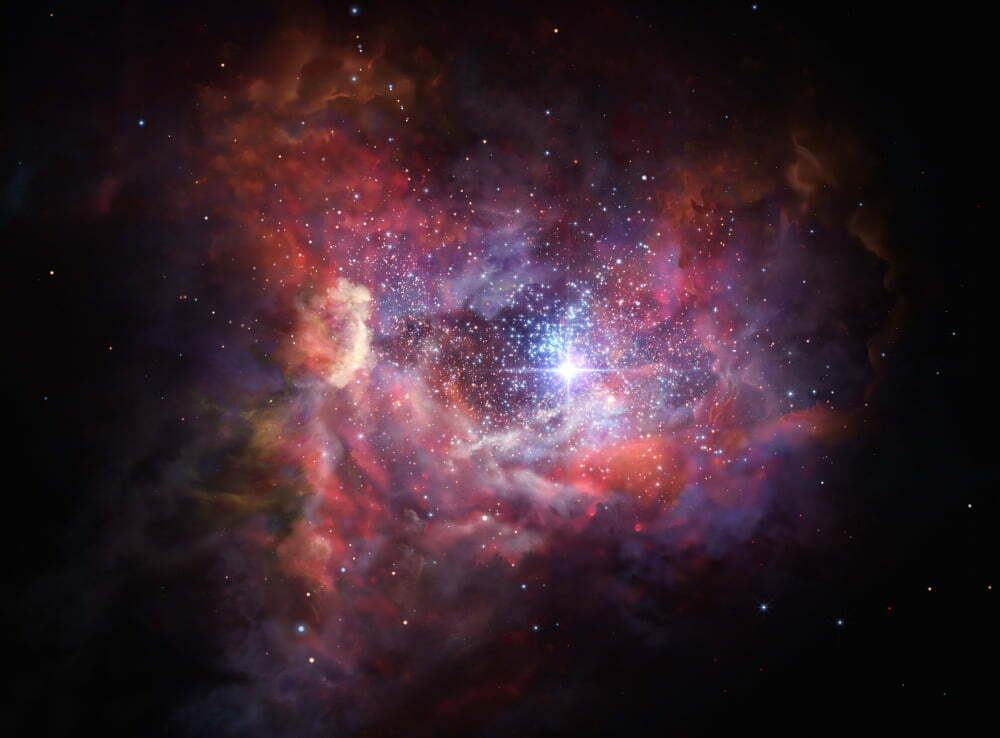
These collections of many millions of solar systems are almost unimaginably vast, but so distant that only a few distinct ones are visible via telescope. Much like constellations, these galaxies are often named for their shapes or observable qualities.
Wormholes:

Like a black hole, a wormhole is a channel drilled through the fabric of reality by gravity, creating a one-way tunnel to another part of the Material Plane. Most scholars believe that such portals can—and perhaps have—been used to move creatures through both space and time, yet the powerful magic required to avoid being crushed, turned into molecule-thin threads of matter, and slowed in relative time by the tidal forces involved make this a difficult means of travel for most mortals.
Hazards
Radiation is a common hazard when exploring outer space.
Section 15: Copyright Notice Pathfinder Campaign Setting: Distant Worlds © 2012, Paizo Publishing, LLC; Author: James L. Sutter. Pathfinder Player Companion: People of the Stars © 2014, Paizo Inc.; Authors: Ethan Day-Jones, Jim Groves, Jonathan H. Keith, Andrew Romine, David N. Ross, and James L. Sutter.
Keep this reference growing
If this page helped with your reading or game, you can support its upkeep or explore the curated books.
Explore the Bookshop — epics, classics and stories behind imagined worlds.