
Mars — The Red Planet
Fourth planet from the Sun · The red world
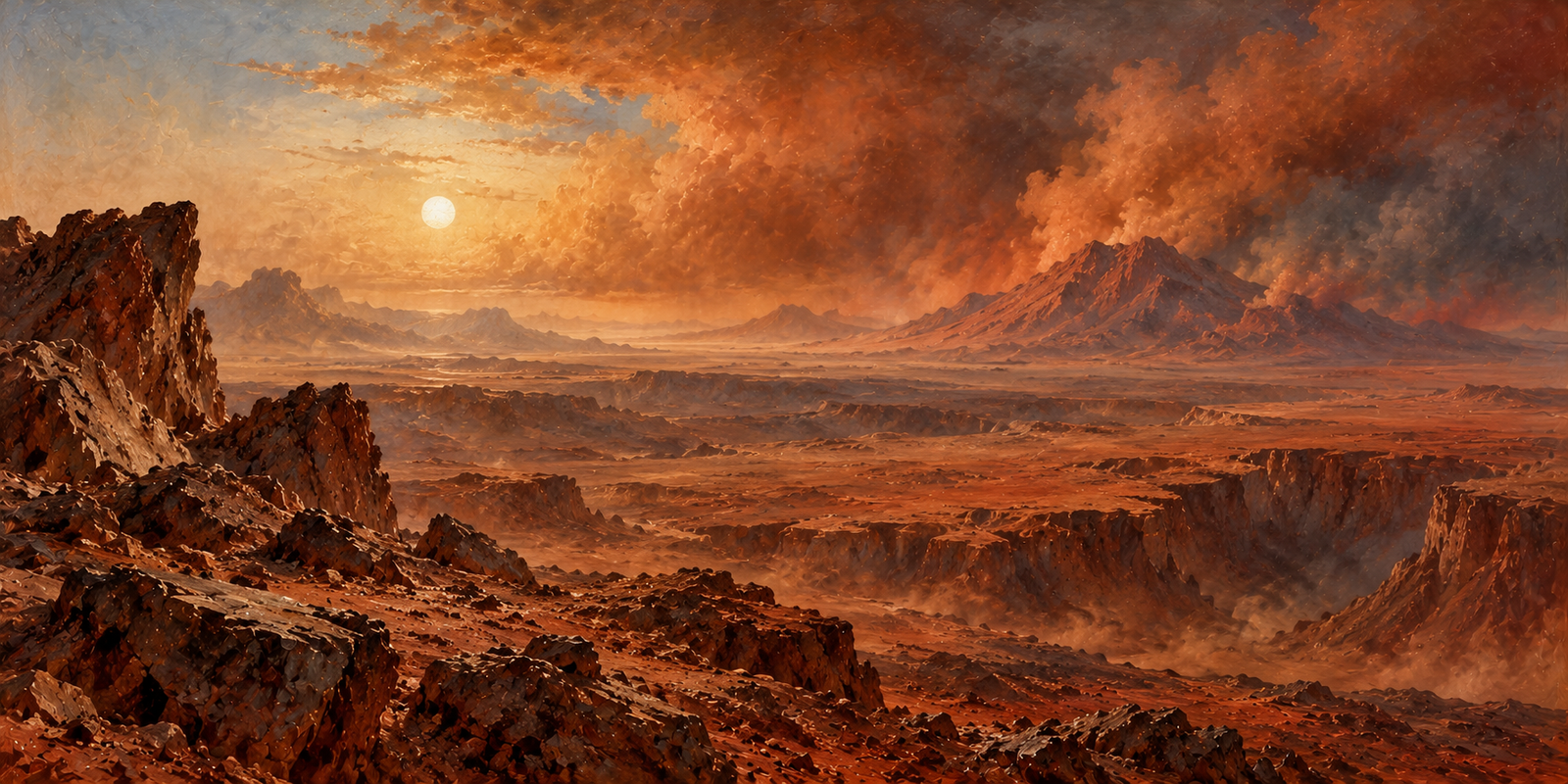
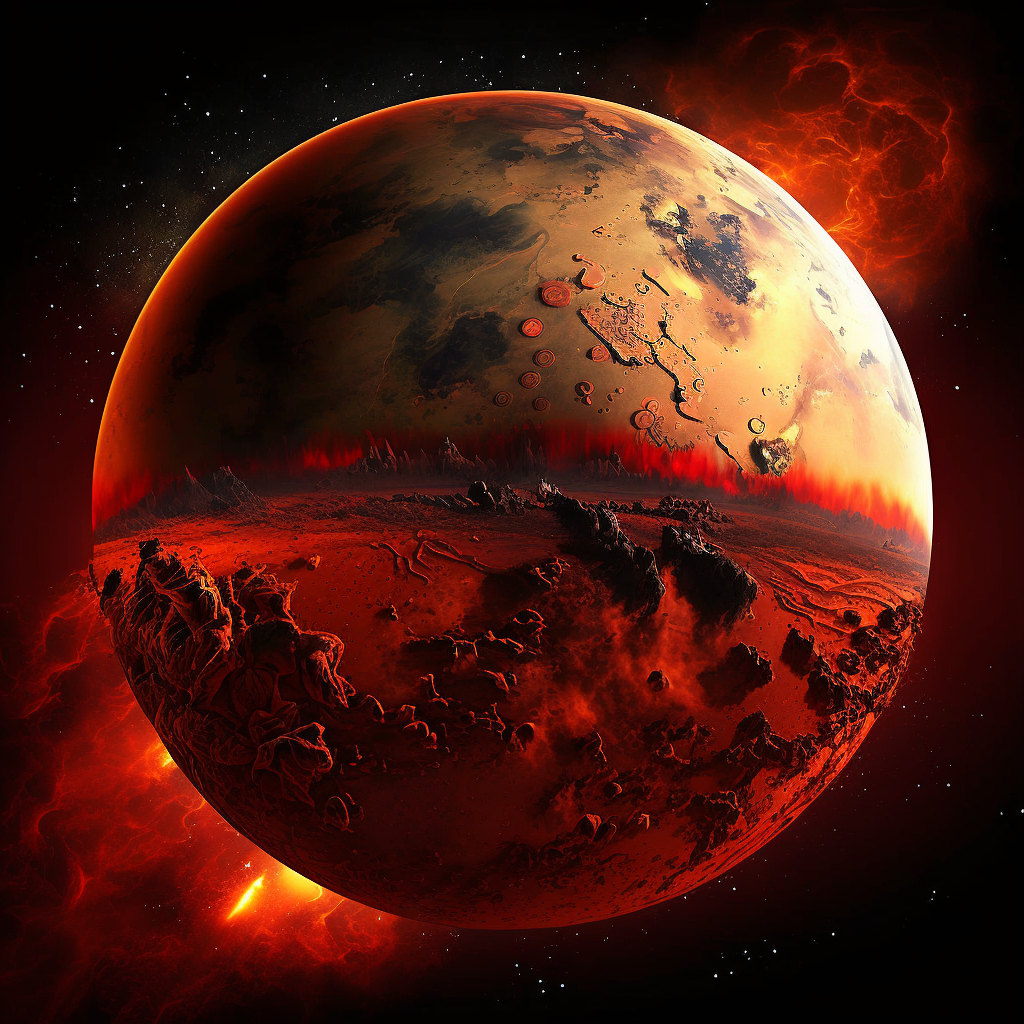
Mars is a cold desert of rust-coloured stone, immense volcanoes and canyons cut into a landscape older than any earthly city. From Earth it appears as a wandering red light; to a visitor it is a difficult world of thin air, storms of fine dust and water locked largely in ice and underground deposits.
Its namesake, the god of war, inspires earthly interpretations of the planet. Whether the god himself ever set foot on its surface is a very different question.
At a glance
- Terrain: cold desert plains, dry river valleys, high volcanic shields, rugged canyons and polar ice
- Air: extremely thin and chiefly carbon dioxide; ordinary unprotected breathing is impossible
- Nearest satellites: Phobos and Deimos, two small moons
- Known earthly visitor: John Carter, whose accounts of this world are disputed on Earth
The lands of Mars
Olympus Mons towers above the surrounding plains, an enormous extinct shield volcano with slopes spread across hundreds of miles. Far away, the canyon system of Valles Marineris cuts deep into the crust. The dark slopes, pale dust and long sunset shadows make distance difficult to judge. A traveller who trusts the horizon rather than a measured bearing can spend an entire day approaching a ridge that seemed an hour away.
Water has shaped the surface in earlier ages. Dried channels and mineral deposits still record its course. Beneath the present desert, ancient buried ice and sheltered hollows may give a stranded expedition a reason to search rather than turn back. That is a dangerous decision where every hour uses the crew’s remaining air.
John Carter’s Mars
The Earthborn traveller John Carter knows Barsoom as an inhabited part of Mars, with cities, peoples and rival kingdoms whose wars have nothing to do with Earth’s young celestial fleets. Ancient works preserve breathable conditions within guarded territories and sheltered routes, while the open red deserts remain deadly to ordinary visitors. Carter’s extraordinary passage brought him safely into that inhabited world; it did not teach him how to land an unprotected vessel on any stretch of Martian rock. Earthly astronomers dispute his account because their instruments cannot yet reveal those refuges, but the people of Barsoom have their own history and political claims.
Anyone arriving with a tale of Carter must answer questions. Where did he land? Which settlements did he know? Could those places still exist? His evidence offers a possibility of shelter and human contact, not a guarantee of either.
Visitors to Mars in 1454
A sealed canister arrives in Prague holding red dust, a scratched metal plate and a fragment of speech recorded by an unknown hand. The plate marks a position beside a canyon; the recorded words resemble a name in one of John Carter’s accounts. The measurements are genuine, yet they offer no proof that an unprotected traveller can breathe on the planet’s exposed surface.
Competing earthly expeditions want the canister for different reasons. Prague’s scholars seek a dependable landing calculation. The Ming officers ask whether its makers knew a passage back to Earth. Richelieu’s agents are interested in the plate itself, which has not corroded despite its apparent age. The people Carter describes are neither property nor prospective subjects of any Earthly crown. Whoever seeks their aid must first find them and earn a hearing.
Some ancient testimony points to shelters, sealed settlements and hidden crossings; no map yet establishes a safe route between all of them. A crew may enter a protected chamber while a storm strips its aethership of the supplies needed to return. See the Space Atlas for the powers pursuing Mars and the Solar System for its position among the inner worlds.
Journeys and decisions
The broken survey: after a dust storm, an expedition’s landmarks no longer match its chart. A sheltered depression promises relief from the wind but lies away from the safest return course. The crew must choose whether to spend precious supplies investigating it or preserve enough air to reach the departure gate.
A contested account: a map attributed to Carter marks a passage across a canyon where modern measurements show no bridge. It may preserve the location of a collapsed work, a hidden route, or a crossing that opens only under particular conditions. Two expeditions want the original; neither can afford a fruitless search.
Use Outer Space Terrain for environmental hazards and travel. Return to the Solar System or the Space atlas.
Astronomical reference: NASA — Mars facts. The named terrain is real; Carter’s journeys belong to the campaign fiction.
Keep this reference growing
If this page helped with your reading or game, you can support its upkeep or explore the curated books.
Explore the Bookshop — epics, classics and stories behind imagined worlds.