
The Moon
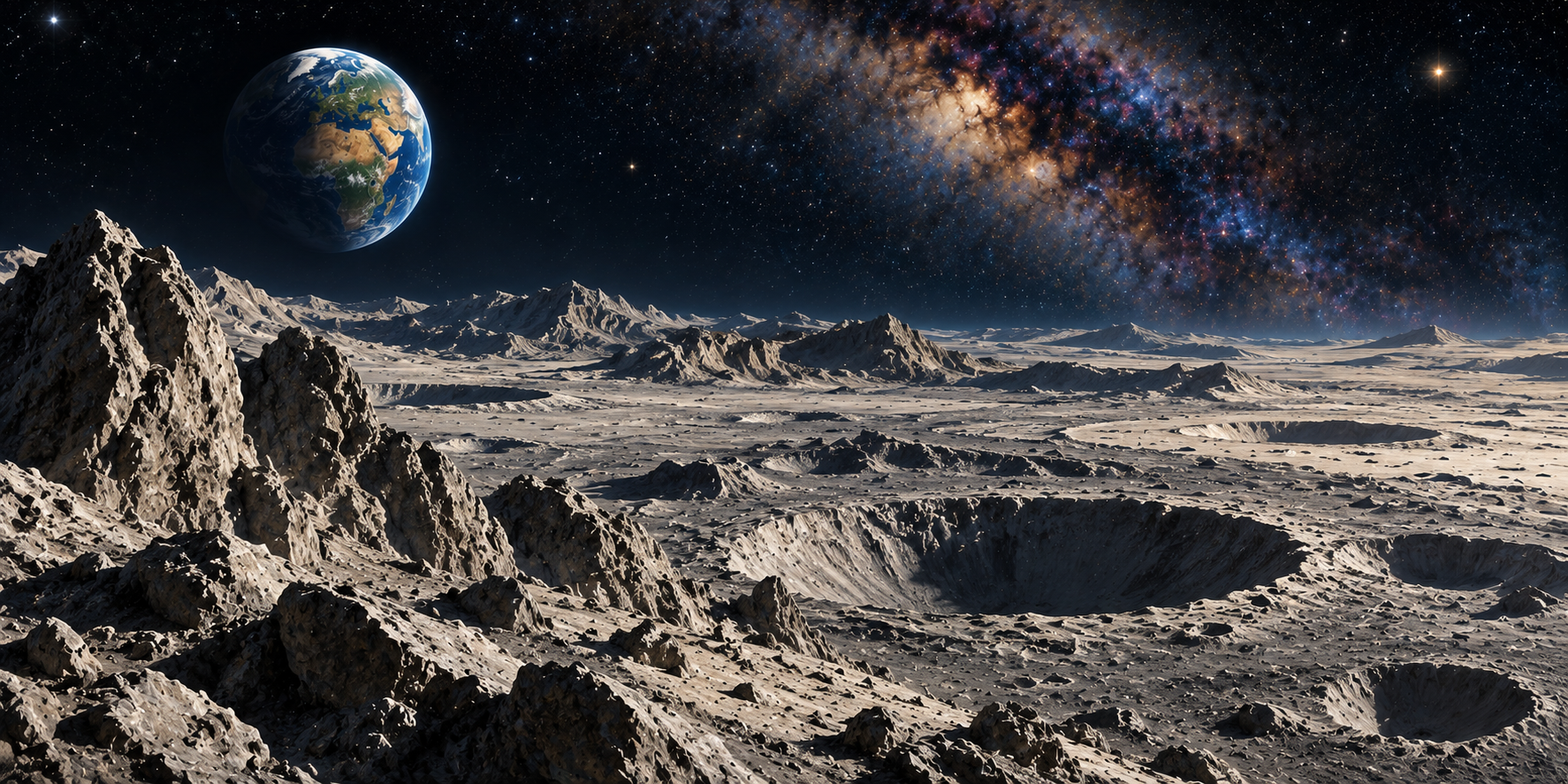
Earth’s companion · The nearer celestial world
From Earth the Moon is a changing lantern; upon its surface it is a silent land of stone, dust and sharp shadows. Its light guides travellers and marks the calendar, while its pull governs the tides that every coastal harbour must reckon with.
There is no open forest covering the Moon. Across the visible ground lie craters, ancient lava plains and mountain rims under a nearly airless sky. Yet accounts of silver groves and palaces reached by moonlit roads have persisted for ages. Such places belong to hidden sanctuaries and crossings rather than the bare plains seen by ordinary astronomers.
At a glance
- Nature: Earth’s only permanent natural moon, orbiting within the Material Plane
- Landscape: dusty plains, highlands, crater walls and deep shadows
- Conditions: negligible breathable atmosphere, weak gravity and extreme changes in temperature
- Arrival: a protected vessel, a reliable portal or a dangerous exceptional crossing
Dark craters, hidden paths
On the bright side of a crater rim, the Sun throws a hard shadow into a basin that may never see direct light. A lost traveller cannot judge depth from colour alone. Old Earthbound star charts preserve the phases of the Moon; they are poor guides to a landing site, where every hill and patch of dust matters.
Accounts of silver forests give some lunar pilgrims another destination entirely. A grove glimpsed beyond a shining gateway may be part of an otherworld sanctuary, not a natural woodland growing in vacuum. The distinction determines whether a traveller prepares for the cold surface or seeks a ritual threshold. A closed portal can leave a pilgrim on the wrong side of that choice.
The Lunar Crossings in 1454
On the dark floor of a crater, a traveller has found a metal marker engraved in three scripts. One belongs to a catfolk custodian of a Kemetite gate; another matches a recent Ming navigator’s tally. The third is so old that neither expedition can read it. The marker does not prove the two parties used the same route. It proves that someone else reached this place first.
Earthly patrons value the Moon as a proving ground for aetherships, observations and short-range return passages. An officer may commission a chart of a visible crater while a priest seeks a sanctuary accessible only through a silver threshold. Both can be speaking of genuine places and still be leading a crew toward entirely different environments. A pilot who lands expecting a temple’s breathable chamber may open the hatch onto bare vacuum.
The marker now gives its name to Three-Marks Refuge, a small, guarded lunar station maintained by eight Ming sailors and craftsmen, two of whom are missing outside. The Kemetite sign on an older marker belongs to a separate, earlier visit. The Ming garrison does not operate a public refuge or an open gateway. An ice-recovery sled has disappeared into permanent shadow, putting even those meagre services at risk.
A party can protect the marker, recover the missing workers or escort envoys to the old sealed threshold. The Space Atlas names the nations contesting these routes; the Solar System records the physical journey.
Lunar powers and their worshippers
On Earth, worshippers honour Artemis beneath the night sky, turn to Hecate at dangerous crossings, and address the Moon through the powers of Selene and Arianrhod. Their temples, divine realms and sacred routes are not interchangeable with the physical lunar surface. Different cults may hold rival accounts of which threshold leads where.
When a lunar eclipse darkens a shrine’s pool, the priesthood may close its gate rather than permit passage. A vessel waiting in lunar orbit cannot depend upon that same gate to remain open. Priests and navigators therefore have reasons to negotiate long before the eclipse begins.
The Moon from Earth

Return to Earth and the Solar System. For exposed travel, see Outer Space Terrain.
Astronomical reference: NASA — Moon facts.
Keep this reference growing
If this page helped with your reading or game, you can support its upkeep or explore the curated books.
Explore the Bookshop — epics, classics and stories behind imagined worlds.