
Rostock — The Hanseatic City of Ships and Scholars
Rostock holds the mouth of the Warnow with merchant ships, guarded quays and a civic council proud of its privileges. Grain, beer, timber and cloth move between the market halls and the harbour, while a university founded within living memory attracts scholars from across the Hanseatic world. Duke Henry IV of Mecklenburg is Rostock’s sovereign, but no visitor should mistake his authority for ownership of the city’s warehouses, guilds or schools.
At a Glance
| Status | Hanseatic port of the Duchy of Mecklenburg, with its own civic council and charter rights. |
|---|---|
| Landscape | The Warnow estuary and Baltic entrance at Warnemünde, with merchant quarters behind the riverfront. |
| Charter | Lübeck-style city rights confirmed in 1218 and reaffirmed in 1252. |
| Quarters | Old Town, Middle Town and New Town, linked by shared markets, walls and municipal administration. |
| Commerce | Baltic ships, timber, beer, grain, wax, furs, cloth, fishing and the work of coopers and shipwrights. |
| Learning | University of Rostock, founded 1419 and returned after the upheavals of 1437–43. |
| Connections | The Hanseatic League, Wismar, Lübeck and the inland estates of Mecklenburg. |
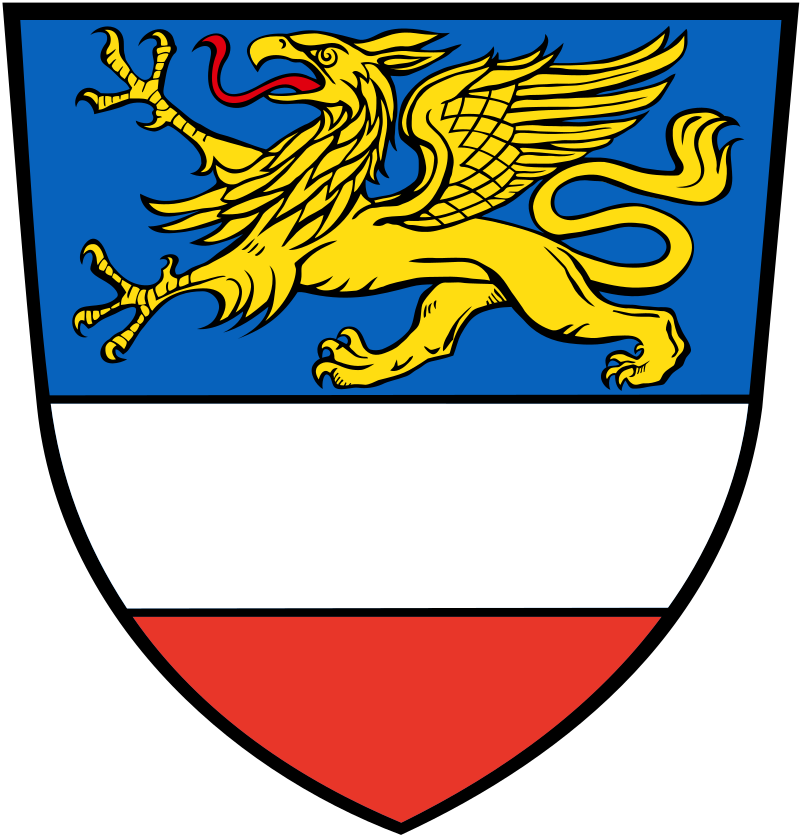
| Arms | Golden griffin on blue above silver and red; merchant seals and craft marks also appear in the city. |
Harbour on the Warnow
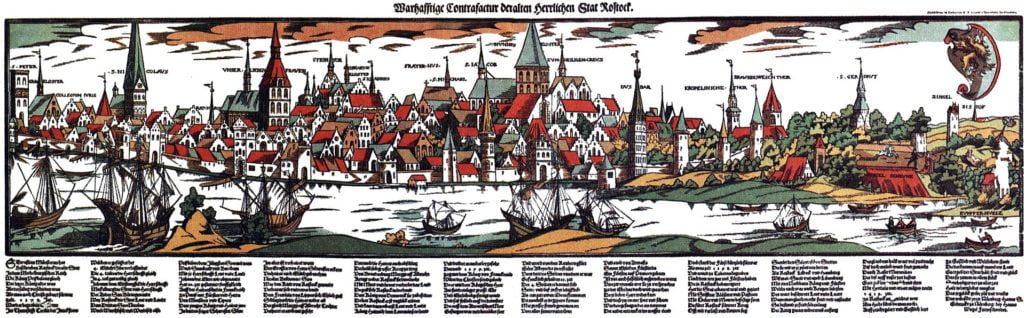
Rostock’s working harbour lies along the river, sheltered from the open Baltic. To reach it, vessels pass Warnemünde, the fishing village and harbour approach bought by the town in 1323. Pilots know the estuary’s changing shallows; harbour officers know which quays have room for grain, fish and timber. A ship delayed outside the entrance spends money on wages and food even when the cargo is sound.
The city bought rights in the Rostock Heath in 1252, gaining wood used for ships, roofs and fuel. Forest keepers and merchants therefore have a keen interest in timber marks. A flawed mast may cost a voyage, while an unauthorised cutting takes income from the city itself. Ship carpenters often have more influence over the timing of a convoy than any distant noble.
Three Towns behind One Wall
Older Rostock grew around three communities. The Old Town keeps its established trades, the Middle Town is rich with merchants’ houses, and the New Town brings craftsmen and markets toward the western approaches. Their separate beginnings remain visible in the streets, even as one council governs the gates and principal civic institutions. Brick gables, sheds and workrooms crowd together behind defences built for a wealthy port.
The council adjudicates weights, harbour dues and disputes among traders. Guilds may support it when convoys succeed and challenge it when new taxes threaten the workshops. Mecklenburg’s duke can press his own claims, but Rostock is not an imperial-free city simply because it trades on equal terms with distant ports. Its privileges have to be protected in negotiations and sometimes in the streets.
The University Comes Home
The university opened in 1419 to teach law, medicine and the arts to students who would otherwise travel far beyond the Baltic. It required cooperation between the town and its Mecklenburg rulers. Civic unrest drove the masters to Greifswald in 1437; teaching there faltered, and they returned to Rostock in 1443. Their new security remains dependent on patrons, lodgings, books and a town council that can protect their liberties without bankrupting the market.
Students seek work as copyists and assistants, while masters are hired to examine contracts, inheritance questions and difficult wounds. A learned visitor can find help here, but a spellcaster claiming an entire faculty’s authority is likely to face the scrutiny of those who keep the university’s actual records.
Stories at the Sea Gate
Families keep offerings to harbour and storm powers beside their ancestral shrines. Sailors sometimes speak of a small light that goes out ahead of boats leaving Warnemünde when a gale approaches. Some call it a spirit, while old pilots warn that the harbour’s reflections deceive the eye. All advise listening to the depth-sounder rather than chasing a light across shoals. The warning is remembered because the estuary can wreck careless men without assistance from any monster.
What Is Happening Right Now?
A newly fitted ship has failed its timber inspection: the mast bears the stamp of the city’s own heath, but the wood is cracked and full of fresh beetle holes. The shipwright insists a rival supplier has copied the mark. The shipowner cannot sail until the mast is replaced, and the convoy will depart without him. A search from the timber yard to the forest clearing must begin before the witnesses scatter to other harbours.
At the university, a law student has discovered that several pages in an old court register were replaced in another clerk’s hand. The altered rulings award a warehouse to a merchant family now trying to sell it. Her tutor wants the original witnesses found before any accusation is made; the last notary to handle the register sailed for Wismar yesterday. His return may settle the case, or reveal why he left so hurriedly.
Using Rostock
Rostock offers Baltic shipping, competent carpenters, warehouse services, river pilots, learned clerks and guides for the routes through Mecklenburg. A merchant should begin at the quays, a petitioner at the town hall and a scholar at the university. Travellers who expect the duke’s warrant to overrule every guild or the council’s protection to hold across every ducal estate will soon discover the limits of each.
Historical Sources
Rostock — History and Harbour; Rostock City Archive — Charter of 1218; University of Rostock — Chronicle; City of Rostock — Heraldic History.
Keep this reference growing
If this page helped with your reading or game, you can support its upkeep or explore the curated books.
Explore the Bookshop — epics, classics and stories behind imagined worlds.