
Breslau (Wrocław) — Merchant City of Silesia
Oder River · Lower Silesia · Bohemian Crown · Hanseatic merchants
At a Glance
- Realm
- Kingdom of Bohemia, within the Holy Roman Empire
- Setting
- Lower Silesia, on the branching waters of the Oder (Odra)
- King
- Ladislaus the Posthumous, through the rights of the Bohemian Crown
- Government
- Powerful civic council and merchant patricians; nearby princely and temple jurisdictions retain their own privileges
- Population
- About 40,000 inhabitants
- Languages and peoples
- German- and Polish-speaking Silesians, Czech and distant merchants, dwarven craft workers and river travellers
- Notable places
- The Ring and Town Hall, Świdnica beer cellars, Salt Market, Oder wharves, older sacred island, guild streets and city gates
- Character
- Wealthy, well defended and fiercely protective of civic law
- Best for
- Trade disputes, river journeys, guild mysteries, dangerous records, political bargaining and missing people
- Immediate danger
- A disputed river cargo threatens the council, merchant houses and city watch

The City Where Every Road Has a Price
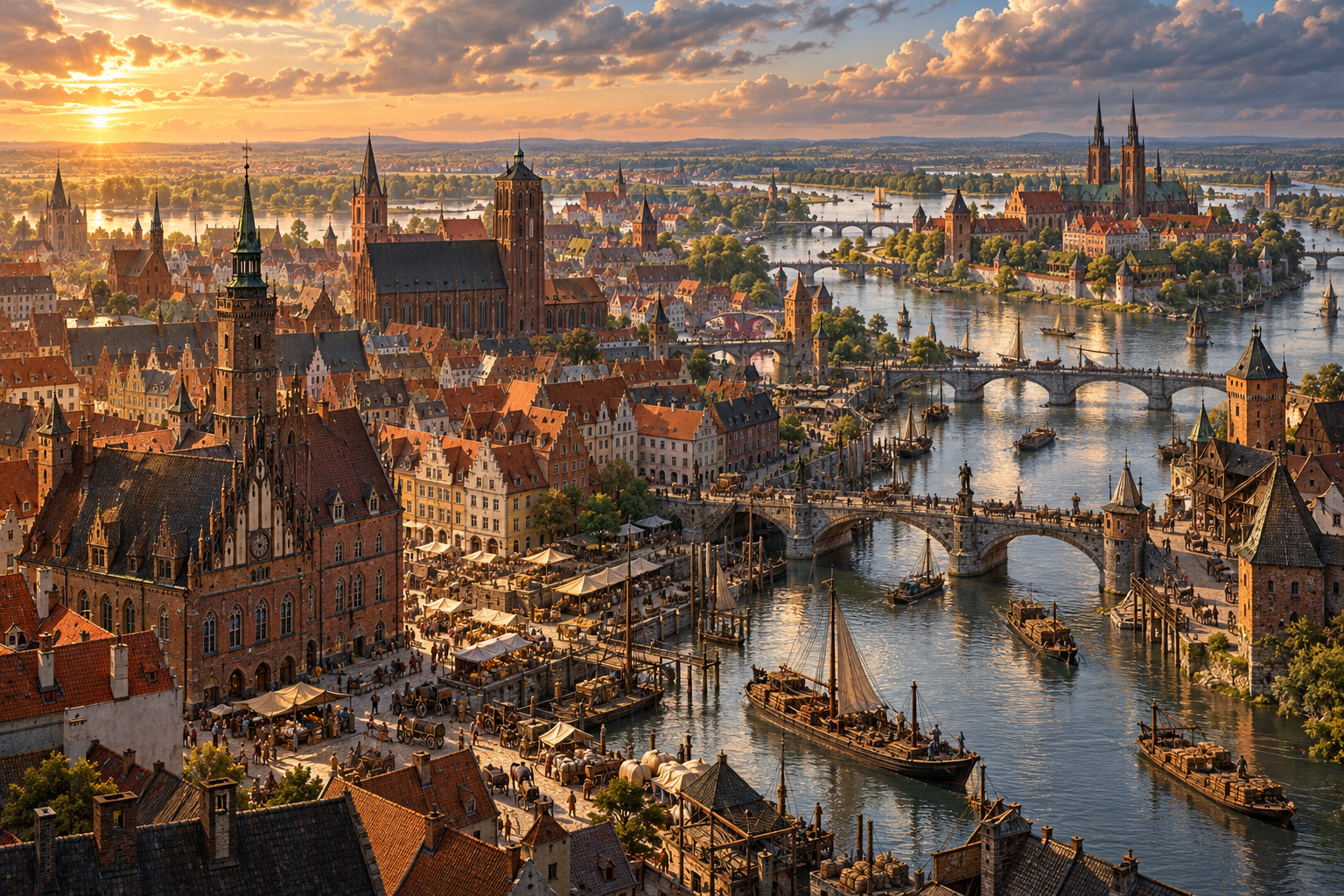
The Oder brings Breslau its wealth—and gives every guild, boatman and councillor something worth defending. Barges pass between the low islands with timber, salt, grain and cloth. Wet ropes creak at the wharves; counting-house clerks quarrel over measures; traders crowd the Ring beneath the tall roofs of the Town Hall.
The city owes allegiance to the Bohemian Crown, but its merchants and councillors hold tightly to their privileges. A sealed royal letter may open a gate without winning a lawsuit. For a visitor, a trusted witness, a guild introduction or the services of a river pilot may matter more than an armed escort. In the cellars below the Town Hall, beer from Świdnica flows while the day’s bargains and betrayals are quietly arranged.
What Is Happening Right Now?
The Barge with Three Owners
A barge carrying salt and dyed cloth has been seized below the eastern quays. Its captain bears a signed cargo order; a guild creditor has a claim for an unpaid loan; and the widow of a dead merchant insists that his agent sold the goods without authority. The customs clerk who witnessed the loading has disappeared, leaving all three with documents they swear are genuine.
The council wants the wharves moving, the creditor wants payment and the crew fears losing its vessel to a prolonged hearing. The missing clerk can settle the matter—if he has not already sold his testimony. A company can follow the accounts, protect a witness, negotiate a settlement or steal the cargo; every choice changes who controls the next shipment.
Two Lords of the Sand Gate
A royal officer has arrived demanding passage for a guarded wagon over the Sand Bridge without paying the customary dues. The gate captain holds a contrary instruction from the council. Neither will yield while merchants gather behind the barricade. The wagon’s master will pay for an alternative route, but refuses to say what he carries to the sacred precinct on Temple Island.
The Voice Beneath the Millwheel
Mill hands have heard someone calling names from the water at dusk, and a young apprentice has gone missing. The miller suspects a rival of frightening off his workers; ferrymen say a thing in the channel knows who has drowned there. Search the millrace, question the bargemen or bargain with the unseen speaker before the water rises.
Places Adventurers Will Visit
The Ring and Town Hall
The Ring is Breslau’s busy market square and the council’s public stage. Merchants sell cloth and metalwork under tall gabled roofs, while petitioners wait at the Gothic Town Hall with witnesses, sealed debts and complaints about false weights. The clerks inside keep the records by which fortunes are won or lost.
The Świdnica Beer Cellars
In vaulted rooms beneath the Town Hall, visitors drink strong beer brought from Świdnica. Brokers meet journeymen, river crews swap news and the council’s servants can listen without attracting attention. A pilot sits alone by the stairs; he knows why an unmarked barge passed through a supposedly closed channel, but will not put his crew at risk for coin alone.
The Salt Market
Immediately southwest of the Ring lies the Salt Market. Dealers guard their weights, stamped tallies and storage rights. A disputed measure can ruin a merchant’s credit, while a trusted warehouse factor can arrange discreet transport through half the city. A locked cellar here has already brought two authorities into dispute.
Nowy Targ and the New Town
The New Market at Nowy Targ is a place for food sellers, carriers and neighbours who deal less often with the wealthy houses of the Ring. Farther east, the New Town holds workshops and crowded yards. The old Brick Gate marks the passage between city districts: a watcher can observe messengers here without needing to stand beside a guarded outer gate.
The Sand Bridge and Temple Island (Ostrów Tumski)
The northern road passes the Sand Gate, crossing the Oder channels towards Sand Island and Temple Island, the ancient Ostrów Tumski precinct known in historical records as Cathedral Island. The island preserves a former Piast stronghold, long-held sacred privileges, temples, archives, residences and protected houses of learning. Its custodians maintain a jurisdiction independent of the merchant council. A city watchman pursuing a suspect across the water may find his warrant carries no force without a negotiated surrender.
The Wharves, Mills and Gates
Barges crowd the northern quays; waterwheels grind grain and river pilots read the changing shallows. To the south the Świdnica Gate opens towards the Bohemian roads. The Ruska and Mikołajska gates serve western approaches, and the Oława road runs eastwards. Each gate has toll books, guards and people who know how to recognise a forged pass.
Who Holds Power in Breslau?
The Council and Merchant Houses
The council controls urban tolls, watch patrols and market rules. Breslau’s wealthy merchant households lend money, own warehouses and argue over whose coin should repair the defences. A trader may finance a gatehouse one season and face a court summons the next.
The Bohemian Crown and Silesian Nobles
Ladislaus the Posthumous wears the crown, yet his officers must reckon with liberties the city has defended for generations. Nearby lords need Breslau’s loans and river trade; the councillors need safe passage across those lords’ estates. Royal authority begins a negotiation, but does not always end it.
Guilds, Sacred Custodians and River People
Guild elders can deny craft work to an outsider, temple custodians offer sanctuary under ancient privileges, and pilots can bring trade to a standstill by refusing a dangerous crossing. Breslau’s merchants participate in the commercial networks of the Hanseatic League, but the city’s association is loose: its councillors neither surrender municipal law to Lübeck nor promise to join every boycott. A merchant travelling under Hanseatic credentials may still need a separate Breslau guarantor.
People Adventurers May Actually Meet
The Sand Gate captain has orders to hold a royal wagon and fears a riot if he obeys. A junior customs clerk vanished after witnessing a suspicious cargo transfer. A dwarven locksmith knows who commissioned a duplicate key to a merchant’s vault. A ferrywoman can guide travellers through a side channel after dark, but refuses to carry armed pursuers without a convincing reason. Each has a reason to bargain and a reason to keep silent.
Markets, Learning and Magical Services
Smiths, armourers, rope sellers, booksellers, scribes, stablekeepers and warehouse factors do brisk business around the Ring and quays. Ordinary supplies are easy to find. A fine lock, unusual ink, difficult repair or discreet passage requires an introduction, a deposit and time. Skilled river pilots may charge more than the boat that carries a traveller.
Temple attendants and learned practitioners offer healing, divination or advice on a disputed oath when their duties permit. Exceptional magic depends on the patron and practitioner, not a published price list. Stories from the millrace might point to a water weird or a well spirit. The miller’s testimony needs checking before anyone sends armed men into the current.
Dangers and Adventure Hooks
- The Locksmith’s Other Key. A merchant finds a perfect duplicate of his vault key hanging on his door. The locksmith swears he made only one. Find the missing apprentice before the vault is opened.
- The Ferry at Moonrise. A ferryman is paid to carry a sealed chest across the Oder after the watch closes the crossing. A rival claimant waits on each bank. Protect the cargo, discover its owner or persuade the rivals to meet.
- The Broken Grain Wheel. A mill stops just before a large flour delivery is due. The millwright suspects sabotage, the guild insists on its contract and hungry neighbours need the mill turning again.
- The Unwelcome Witness. A courier arrives with evidence against a respected merchant. His escort disappeared outside the Oława Gate. Bring him safely to court, negotiate a hearing or conceal him in a protected precinct.
Travel and Law
Along the Oder: river barges carry salt, timber, cloth and grain, but floods, shifting channels and winter ice make a seasoned pilot invaluable. The islands have their own landings and watched crossings. Ask where a vessel unloaded before asking whose cargo it carried.
At the gates: the Świdnica road runs south towards the Bohemian lands, western routes lead into the Silesian duchies, and the Oława road heads east. Toll clerks demand declarations for sealed freight and may count weapons before granting passage.
Within the walls: the city council enforces market law, contracts and public order. Guild charters and the rights of sacred precincts complicate even a royal warrant. A sealed document and a trustworthy witness can accomplish what threats cannot.
Peoples of the City and River
German- and Polish-speaking Silesians bargain with travellers from Bohemia, Poland and the western Empire. Dwarven craftsmen work in guild shops; elven, halfling and other visitors find employers, lodgings and patrons through their skills and acquaintances. At the wharves, a capable crew matters more than its ancestry.
River families pass down stories of drowned bargemen, old shrines and warning voices in the channels. Some are cautions about dangerous currents; others conceal bargains that the council never recorded.
Deeper History
Breslau grew from a guarded Oder crossing into one of Silesia’s foremost trading cities. After the death of the last Piast duke of Breslau in 1335, it passed under the Bohemian Crown while preserving important civic privileges. Its merchants and councillors have spent generations defending them against princes and rival towns.
The craftsmen’s uprising of 1418 and the punishments that followed have not been forgotten. The earthquake of 1443 damaged buildings and shook confidence in the city’s stone walls. Masons still repair old fractures; guild elders remember which merchant houses took sides, and the river brings fresh rivals to the quays every season.
Pathfinder 1e — Settlement Mechanics
Breslau — LN metropolis (council). Suggested campaign qualities: Prosperous, Strategic Location, Rumormongering Citizens. The alignment describes civic institutions for this rules subsystem, not every inhabitant.
| Trait | Value |
|---|---|
| Population | 40,000 (campaign estimate) |
| Corruption / Crime | +4 / +4 |
| Economy / Law | +6 / +3 |
| Lore / Society | +4 / +7 |
| Danger | +10 |
| Base Value / Purchase Limit | 22,400 gp / 150,000 gp |
| Spellcasting | Up to 8th level when an appropriate practitioner is actually available |
| Items | Nearly all minor; 4d4 medium; 3d4 major, subject to the rules |
The values combine the metropolis baseline with LN alignment, council government and the listed qualities under the settlement rules; they do not apply to every roll made inside the walls.
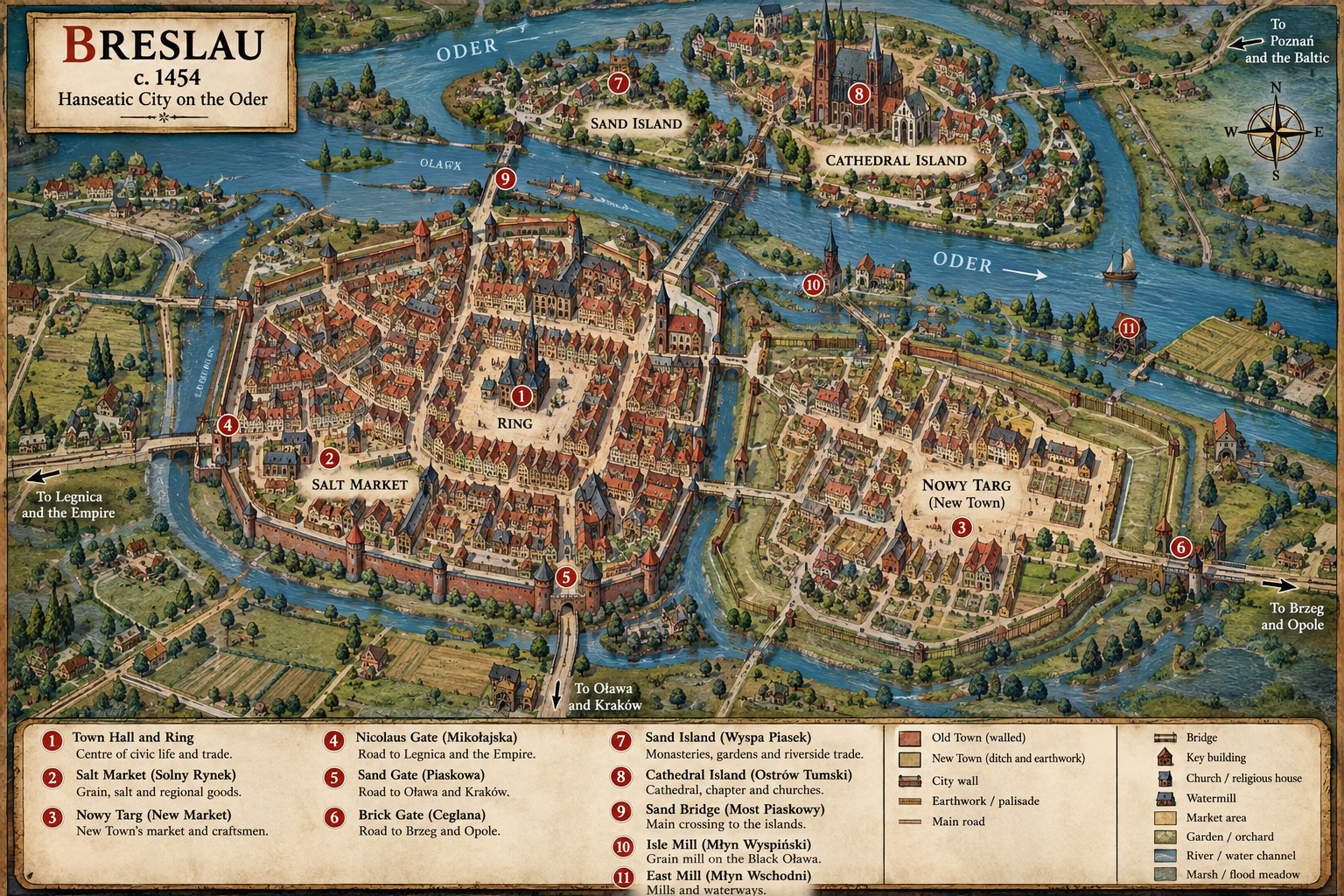
Breslau Campaign Map
The illustrated reconstruction shows the Oder waterways, Sand Island and Temple Island (historically Cathedral Island), the Old and New Towns, the Ring, Town Hall, Salt Market, city gates, bridges, mills and principal trade approaches. Buildings, distances and minor streets are schematic rather than survey-accurate.
Sources and Further Reading
The Breslau civic chronology covers the Bohemian connection and construction phases; academic research on Breslau’s position among the Bohemian Crown lands explains its political importance. The Świdnicka Cellar dating review distinguishes the traditional opening year from securely attested evidence. The Pathfinder GameMastery Guide provides settlement mechanics. The supernatural reports and adventure hooks belong to the campaign; the historical places and dates are drawn from the references above.
Keep this reference growing
If this page helped with your reading or game, you can support its upkeep or explore the curated books.
Explore the Bookshop — epics, classics and stories behind imagined worlds.