
Lübeck
Hanseatic City of Salt and Sea Roads
Merchants, ships, salt and stubborn freedom on the Trave.
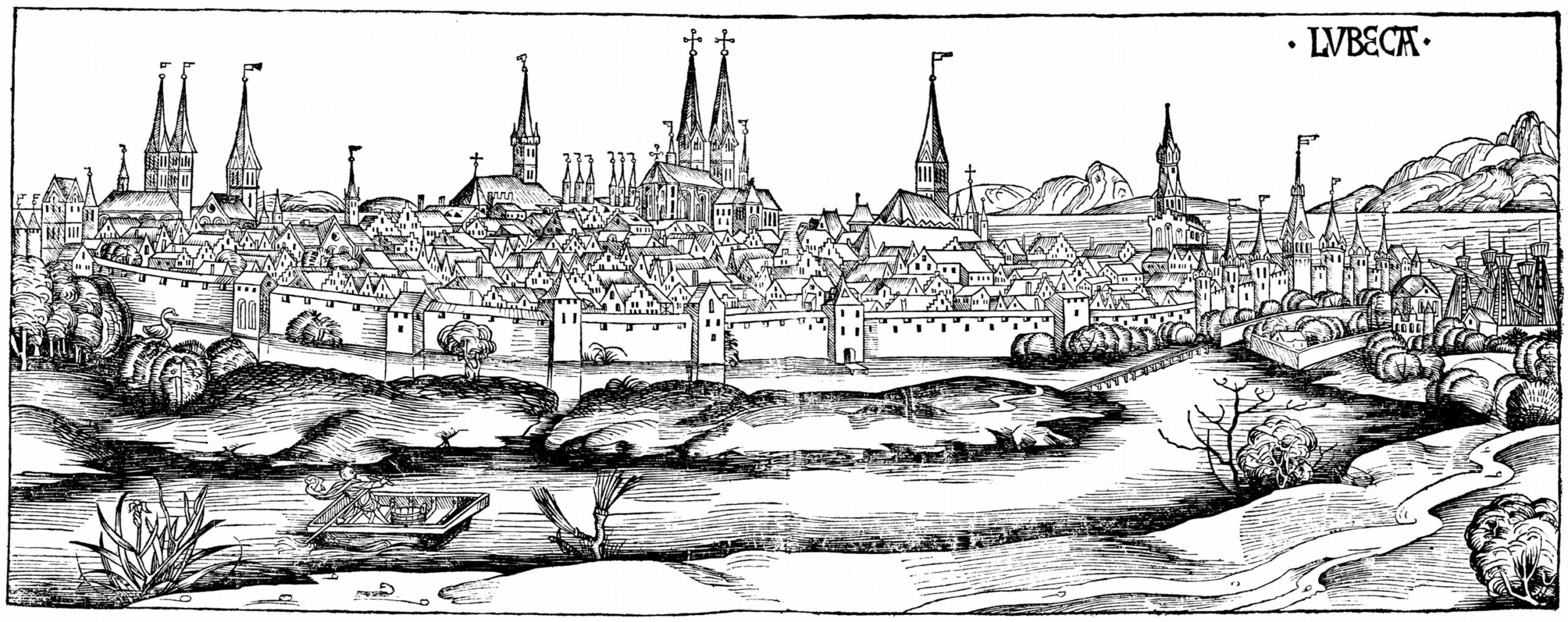
Historical view from Hartmann Schedel’s 1493 chronicle (public domain); a later depiction, not a contemporary view of the campaign opening.
At a Glance
| Standing: | Free Imperial City, answerable to the Empire but governed by its own council, magistrates and merchant families. |
|---|---|
| Place: | an island of high ground between the Trave and Wakenitz, with river landings and a sea outlet at Travemünde. |
| Government: | civic council and burgomasters; Emperor Frederick III is imperial overlord, not resident ruler. |
| Commercial alliance: | leading meeting city of the Hanseatic League, whose other members keep their own councils and interests. |
| Livelihoods: | salt, herring, grain, timber, furs, wax, cloth, shipping, shipbuilding, credit and warehousing. |
| Routes: | Baltic passage through Travemünde; the Trave and Stecknitz waterway to Lüneburg‘s salt trade and the Elbe; roads towards Hamburg. |
| Neighbours: | Holstein lords and the separate sacred principality of Lübeck, whose court has its own lands around Eutin. Neither governs the city. |
| Immediate pressures: | war in Prussia, Danish Sound tolls, uncertain cargoes, convoy costs and rival claims to riverside storage. |

Overview
Salt barges nudge against the Trave quays while Baltic shipmasters shout for porters and a clerk checks the seals on their cargo. A merchant’s fortune may lie aboard a ship beyond the Sound, in a London warehouse or in a ledger under lock at the Rathaus. Lübeck leads the Hanseatic merchants, but its own council must still bargain with guilds, pilots, princes and rival ports. The city is rich because so many roads and sea lanes meet here; it is vulnerable for precisely the same reason.
A free city of merchants, shipwrights and lawyers, Lübeck lives by routes it cannot wholly control. Its council must keep Baltic allies, salt suppliers and the imperial crown sufficiently satisfied without surrendering the freedom that makes its harbour prosperous.

What Is Happening Right Now?
A cargo ship out of Danzig reaches the Trave with its seals scraped away. The captain claims the grain was purchased before the Prussian cities rose against the Teutonic States. His lenders demand unloading; the harbour officers want the ship held until its papers can be compared with the cargo marks. Meanwhile two merchant households claim to have financed the same shipment. Every day the holds remain closed, the market price of grain rises.
On the Stecknitz waterway, three salt barges have stopped at a narrow passage. The canal’s boatmen insist that a mill-owner’s dam has cut the flow; the mill-owner says the canal carriers have neglected the banks and now expect him to bear the losses. Lüneburg’s merchants are threatening to divert their salt, and fish merchants need it before their next Baltic catch spoils. The town council needs a repair that can be defended in court, not another armed escort.
Streets, Quays and Gates
The Markt and council hall. The Rathaus stands amid warehouses, merchant houses and the busiest civic business. Here the council hears petitions over weights, ship debts, harbour dues and privileges won from distant rulers. Envoys from other Hanseatic cities arrive with conflicting instructions; even an agreed decision may need months of letters and bargaining to become effective.
The Trave waterfront. Goods move between river craft, seagoing cogs and warehouses whose merchants employ porters, accountants, coopers and guards. A missed tide or an unpaid berth can matter more than a nobleman’s threat. Along the narrow lanes and courtyard passages behind the grand trading houses, craftsmen and poorer tenants live close to the people whose business feeds the port.
The northern Burgtor. This fortified approach carries travellers towards the lands beyond the city. Guards inspect dangerous loads and men travelling under dubious safe-conducts. To the east the Wakenitz and its water defences impede an easy assault. On the western approach, older defences still stand; the monumental twin-towered Holstentor familiar to later ages has not yet been built.
Travemünde and the sea road. Ships going to or from the Baltic pass through Lübeck’s outlet at Travemünde. Pilots there know the sandbanks and the weather that can hold a convoy at anchor while merchants argue over who must pay for idle crews.
The caulkers’ warning. In the yards, shipwrights sometimes hear hammer blows from a closed hold after the crew has gone ashore. Sailors call it the work of a ship-kobold, a household spirit of the vessel: welcome when it warns of a leaking plank, feared when it falls silent. One newly hired captain has forbidden his carpenter to speak of the knocking before the next departure. The carpenter can point to the exact seam that needs opening, but doing so will delay a lucrative convoy.
Who Holds Power?
Lübeck won imperial freedom in 1226. In practice, the council and merchant elite make everyday decisions: who can sell at market, whose testimony counts in a commercial dispute, when armed ships are fitted out and which allied towns will be asked to contribute. Guilds, shipmasters and hired labourers are vital to those decisions, even when they have no equal seat at the council table. A rich merchant can lose an argument when the pilots refuse to sail or the warehouse hands refuse to work.
The Hanseatic League is a network of cities, not Lübeck’s overseas kingdom. Its delegates often meet in the Rathaus, but a Bremen councillor, a Wismar skipper and a Rostock merchant may want different answers to a question about embargoes or convoy fees. In 1454, news of the Prussian rebellion makes those differences urgent. Ships with mixed ownership are especially dangerous to seize: confiscating one cargo may turn three allied ports against the city.
The sacred estate of Lübeck is another jurisdiction altogether. Its leading household keeps its territorial residence at Eutin, though sacred institutions and property within Lübeck still have their own local privileges. A summons bearing the sacred lord’s seal is not automatically an order to the free city’s magistrates. The council watches such claims closely without pretending its own law reaches every neighbouring estate.
Salt, Money and the Northern Routes
The Stecknitz canal, completed in 1398, joins the Trave with the Elbe water system and gives Lübeck access to Lüneburg’s salt and to commerce travelling west towards Hamburg. Salt preserves the fish that feed Baltic and inland markets. Timber, grain, wax and furs come through the north and east; western cloth and finished goods move in the opposite direction. A ship may carry cargo belonging to several households and paid for by creditors in three cities.
Merchants hire guards, weighers, translators, boatmen, repairers and witnesses. The council’s scribes can record an obligation, but they cannot guarantee that a Danish toll officer will honour it at the Sound. Travellers can book Baltic passage, seek an escort, find a moneychanger or petition for a commercial judgement. They should ask what a safe-conduct covers before taking it beyond the city walls.
Magic at the quays. Shipmasters pay for weather signs, healing after rope and winch accidents, charms against spoiling cargo and careful examination of suspicious seals. Such services are not a licence to ignore the council’s rules: a witnessed spell may establish that wax was altered, but it cannot tell a magistrate which creditor has the better legal claim. River pilots also trade warnings about nixies at shallow landings; wise captains ask what the local boatmen have actually seen rather than treating every bad current as a monster.
Connections beyond the harbour. Eastbound merchants trade with Novgorod and ports now caught up in the war around the Teutonic States. A traveller carrying one city’s letter of credit may need a different guarantor in the next port. Lübeck’s warehouses, scribes and shipowners are useful intermediaries, but not neutral in every dispute.
Matters for Adventurers
- The second seal. The Danzig cargo’s original bill of lading survives in a merchant’s private archive, but opening the chest containing it would also expose loans the owner’s family concealed from the council. The captain needs a public judgement before the grain rots.
- The lost salt season. A boatman has the measurements needed to prove where the canal bank failed, but his crew was paid to alter the record. With winter provisions at stake, the damage must be repaired whether or not the council can establish who is liable.
- A ship without a convoy. A captain offers good pay to take sealed letters to a Baltic ally before the next Hanseatic meeting. Several councillors want the letters intercepted, not because they are forged, but because they may commit the city to a war levy it cannot afford.
Legacy Pathfinder 1e Settlement Figures
Optional site adaptation retained from the older page, not a claim about historical government or an official Pathfinder city stat block. Lawful neutral large city; campaign population estimate 19,000; merchant plutocracy. Corruption +4, Crime +8, Economy +9, Law +1, Lore +1, Society +0; Danger +15. Qualities: Free City, Guilds, Prosperous, Trading Post and Legendary Marketplace. Base Value 12,000 gp; Purchase Limit 150,000 gp; Spellcasting 7th level; minor items 4d4, medium items 3d4, major items 2d4. These are game-market assumptions, not a promise that every item is available in every shop.
Historical Sources
- City of Lübeck: the path to imperial freedom in 1226
- City of Lübeck: Hanseatic trade, the 1398 Stecknitz canal and Hanseatic assemblies
- UNESCO: historic Lübeck’s town plan and merchant quarters
- Lübeck Museums: the present Holstentor dates from 1464–1478
- City of Lübeck: the northern Burgtor completed in 1444
- Schleswig-Holstein Heraldry Register: the civic eagle and white-and-red shield
- Göttingen Academy: Eutin as the separate sacred ruler’s residence
Keep this reference growing
If this page helped with your reading or game, you can support its upkeep or explore the curated books.
Explore the Bookshop — epics, classics and stories behind imagined worlds.