
Horus — Falcon God of Kingship and the Sky
Pharaonic Pantheon • Greater Deity • Divine Rank 18
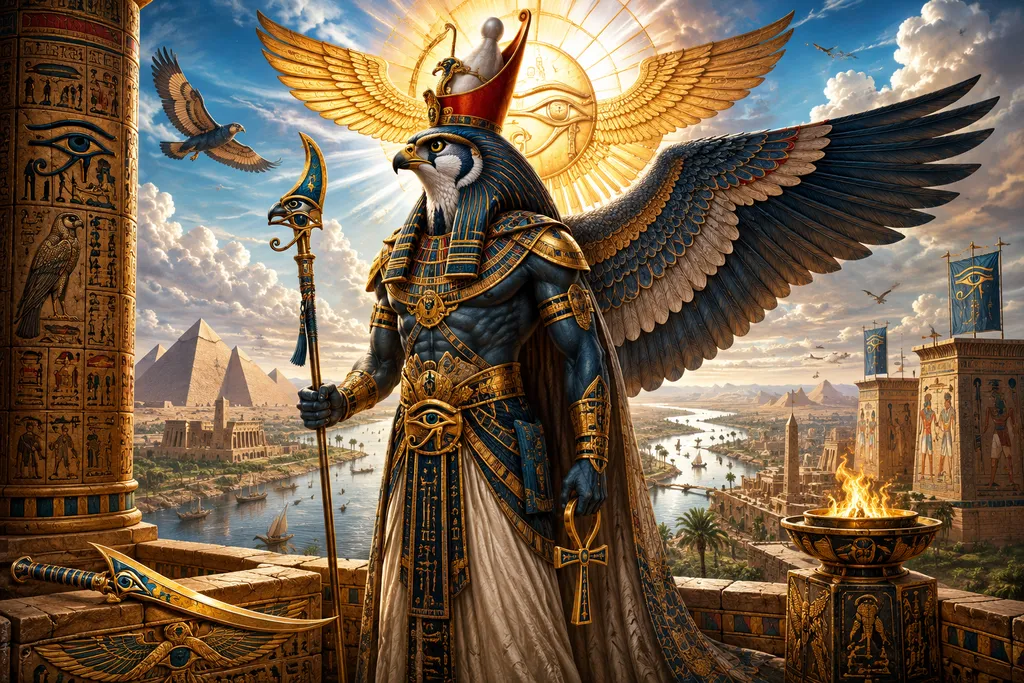
Horus is the great falcon power of the Egyptian heavens and the divine pattern of legitimate living kingship. He is the high eye that sees across the horizon, the protector who stands over the throne, the heir who contests unjust succession, and the restored god whose wounded eye becomes whole again. In SpiralWorlds he remains one of the mightiest powers of the Pharaonic Pantheon, ruling his own divine estate within Arcadia‘s Duat while continuing to judge the conduct of mortal sovereigns in 1454 CE.
Divine Identity
- Names
- Horus, Hor, Heru, Har and Her; historical transliterations and spellings vary.
- Divine Standing
- Greater Deity; Divine Rank 18.
- Alignment
- Lawful Good.
- Portfolio
- Living kingship, the sky, lawful succession, royal protection, victory, the horizon, restored wholeness and righteous authority.
- Pantheon
- Pharaonic Pantheon.
- Home Plane
- Arcadia.
- Layer
- Buxenus.
- Divine Realm
- Duat.
- Personal Estate
- The Court of the Living Falcon.
- Divine Symbol
- Sacred falcon.
- Sacred Animal
- Falcon.
- Artifact
- The Eye of Horus, or Wedjat.
- Favoured Weapon
- Khopesh.
- Favoured Classes
- Cleric, Fighter and Paladin.
- Worshippers
- Rulers who accept the burdens of office, royal heirs, judges, soldiers, temple guardians, administrators, falcon keepers and defenders of lawful succession.
- Major Cult Centres
- Edfu/Behdet, Nekhen/Hierakonpolis, Qus and other local centres of Horus worship.
- Holy Observances
- The Festival of the Living Falcon, the Feast of the Joyous Union, coronation rites and local ceremonies renewing royal legitimacy.
Game Statistics
Horus is calibrated as a Greater Deity of Divine Rank 18. His statistics deliberately exceed ordinary mortal and monster limits. Each rules implementation is native to its edition rather than a numerical conversion of another version.
Horus
Medium Celestial (Deity), Lawful Good
Armor Class 31 (divine panoply)
Hit Points 891 (54d8 + 648)
Speed 60 ft., fly 180 ft. (hover)
Saving Throws Str +23, Dex +21, Con +23, Int +20, Wis +22, Cha +23
Skills Athletics +23, History +20, Insight +22, Perception +33, Persuasion +23, Religion +20
Damage Resistances cold, fire, lightning, necrotic; bludgeoning, piercing and slashing from non-artifact, non-divine attacks
Damage Immunities poison, radiant
Condition Immunities blinded, charmed, exhaustion, frightened, paralyzed, petrified, poisoned
Senses truesight 360 ft., passive Perception 43
Languages all languages; telepathy 1 mile
Challenge 37 (SpiralWorlds epic extension)
Proficiency Bonus +11
Divine Rank 18
Horus has divine expertise in Perception; the printed +33 modifier includes twice his proficiency bonus.
Divine Traits
Greater Deity. Horus does not require food, drink, air or sleep. He cannot be aged against his will, and mundane disease, poison and environmental extremes cannot harm him. Effects that would permanently alter his body or soul fail unless produced by another deity, a divine artifact or similarly transcendent power.
Legendary Resistance (5/Day). If Horus fails a saving throw, he can choose to succeed instead.
Magic Resistance. Horus has advantage on saving throws against spells and other magical effects.
Falcon-Eyed Sovereignty. Horus cannot be surprised while conscious. Magical darkness does not impede his vision, he automatically perceives invisible and ethereal creatures within his truesight, and he knows the direction and distance to any creature that openly invokes his name within 1 mile.
Crowned Authority. Horus and allies of his choice within 120 feet have advantage on saving throws against being charmed or frightened. An allied creature that begins its turn in the aura while frightened can immediately repeat its saving throw, ending the effect on itself on a success.
Manifest Divine Weapon. Horus’s khopesh is a +3 divine weapon for his attacks. If destroyed, disarmed or taken beyond his reach, it vanishes and reappears in his hand at the start of his next turn.
Divine Spellcasting. Horus’s spellcasting ability is Charisma (spell save DC 31, +23 to hit with spell attacks). He requires no material components.
At will:
bless,
daylight,
dispel magic
3/day each:
control weather,
greater restoration,
plane shift,
sunbeam
1/day each:
holy aura,
sunburst,
mass heal,
true resurrection
Actions
Multiattack. Horus makes three attacks with the Khopesh of the Two Horizons.
Khopesh of the Two Horizons. Melee Weapon Attack: +26 to hit, reach 10 ft., one target. Hit: 24 (2d8 + 15) slashing damage plus 27 (6d8) radiant damage. Against a creature that has knowingly violated a sworn duty of protection, legitimate succession or sanctuary, the radiant damage becomes 36 (8d8).
Eye of Horus (Recharge 4–6). Horus opens the full sight of the Wedjat in a 300-foot-long, 10-foot-wide line. Hostile creatures in the line must make a DC 31 Constitution saving throw, taking 78 (12d12) radiant damage and becoming blinded until the end of Horus’s next turn on a failed save. On a successful save, a creature takes half as much damage and is not blinded. Horus may instead restore an ally caught within the line, causing that creature to regain 40 hit points and ending blindness on it.
Judgement of the Living Crown (Recharge 5–6). Horus chooses any number of creatures he can see within 120 feet. Each hostile target must make a DC 31 Wisdom saving throw. On a failure, it takes 77 (14d10) radiant damage, is knocked prone and cannot take reactions until the end of its next turn. A creature that has seized legitimate authority through betrayal, murder or sacrilege has disadvantage on this save. On a success, it takes half damage and suffers no other effect.
Bonus Actions
Horizon Step. Horus teleports up to 120 feet to an unoccupied space he can see that is in open air, sunlight or bright light. Until the start of his next turn, opportunity attacks against him are made with disadvantage.
Restorative Wedjat (3/Day). Horus or one creature he can see within 120 feet regains 100 hit points. Horus can also end one of the following conditions on that creature: blinded, charmed, frightened, paralyzed or poisoned.
Reactions
Royal Intercession. When a creature Horus can see within 120 feet takes damage, Horus reduces the damage by 40. He may then move that creature up to 30 feet to an unoccupied space it can see without provoking opportunity attacks.
Legendary Actions
Horus can take 3 legendary actions, choosing from the options below. Only one option can be used at a time and only at the end of another creature’s turn. Horus regains spent legendary actions at the start of his turn.
Falcon Step. Horus moves up to half his flying speed without provoking opportunity attacks.
Khopesh Strike. Horus makes one Khopesh of the Two Horizons attack.
Restoring Glance (Costs 2 Actions). Horus chooses a creature within 120 feet. An ally regains 50 hit points, or an enemy must succeed on a DC 31 Constitution saving throw or take 45 (10d8) radiant damage and be blinded until the end of its next turn.
Solar Mandate (Costs 2 Actions). Each hostile creature of Horus’s choice within 30 feet must succeed on a DC 31 Wisdom saving throw or take 36 (8d8) radiant damage and be pushed up to 20 feet away.
Mythic Trait — The Wedjat Made Whole
The Wedjat Made Whole (1/Day; Mythic). If Horus is reduced to 0 hit points while the Eye of Horus remains part of his divine manifestation, he does not die or fall unconscious. Instead, the broken eye becomes whole: Horus regains 446 hit points, ends every removable condition affecting him, and immediately recharges Eye of Horus and Judgement of the Living Crown.
For the remainder of the encounter, Horus has 4 legendary actions per round. His Khopesh of the Two Horizons deals an additional 9 (2d8) radiant damage, and a creature that begins its turn within 20 feet of Horus takes 10 radiant damage if it has damaged one of Horus’s allies since the end of its previous turn.
Defeating Horus after this transformation ends his manifested form normally. Permanent destruction of the deity requires divine-scale circumstances beyond merely reducing this manifestation to 0 hit points.
Divine Estate Actions — Court of the Living Falcon
While Horus is within his personal divine estate in Duat, he can invoke one estate action on initiative count 20, losing initiative ties. He cannot use the same effect in consecutive rounds.
Crowned Horizon. A line of dawn light 120 feet long and 20 feet wide appears from a point Horus can see. Hostile creatures in it make a DC 31 Dexterity saving throw, taking 44 (8d10) radiant damage on a failure or half as much on a success. Allies in the line gain 20 temporary hit points.
Falcon Wind. A royal wind sweeps a 60-foot-radius area Horus can see. Horus may move each willing creature in the area up to 30 feet without provoking opportunity attacks. Hostile flying creatures must succeed on a DC 31 Strength saving throw or be driven 40 feet in a direction Horus chooses and knocked prone.
Wholeness of the Eye. Horus chooses up to three creatures in the estate. Each regains 30 hit points and may immediately repeat one saving throw against an ongoing effect that allows repeated saves.
Horus Domain Spell Cycle — 5.5e
Horus is most naturally represented through Light and War, with Order or Protection appropriate in campaigns using those divine-domain traditions.
| Spell Level | Horus Domain Spells |
|---|---|
| 1st | Bless, shield of faith |
| 2nd | Aid, lesser restoration |
| 3rd | Daylight, dispel magic |
| 4th | Banishment, freedom of movement |
| 5th | Flame strike, greater restoration |
| 6th | Heal, true seeing |
| 7th | Plane shift, sunbeam |
| 8th | Holy aura, sunburst |
| 9th | Mass heal, true resurrection |
The Eye of Horus — 5.5e Artifact
Wondrous Item, Artifact (requires attunement by a non-evil creature). The Wedjat is not merely jewellery or a painted eye. It is the divine pattern of something wounded and made whole.
- The bearer has truesight to 120 feet and cannot be blinded.
- The bearer has advantage on Wisdom (Perception) checks and saving throws against illusions.
- Restoring Eye (3/Day). The bearer can cast greater restoration without material components or restore 70 hit points to a touched creature.
- Eye of the High Sky (1/Day). The bearer can cast sunbeam.
- Sound Again (1/Day). When the bearer would be reduced to 0 hit points, it may instead drop to 1 hit point, end the blinded, charmed, frightened, paralyzed and poisoned conditions on itself, and immediately move up to half its speed without provoking opportunity attacks.
Horus does not use the mortal bearer version of Sound Again. His own mythic expression is the stronger Wedjat Made Whole trait in his deity stat block.
Regional Translation — 5.5e
- Within an actively manifested Horus-region, creatures have advantage on Wisdom (Perception) and Wisdom (Survival) checks made to navigate by the horizon or locate distant outdoor landmarks.
- A creature that completes a long rest spanning sunrise while sheltering or protecting another creature may end either the frightened condition or one level of exhaustion.
- Within a properly consecrated sanctuary of Horus, creatures acting in defence of another gain advantage on saving throws against being charmed or frightened.
Horus
CR 37 / MR 10 • Male Greater Deity • LG Medium Outsider (Good, Lawful, Mythic)
Divine Rank 18
Mythic Rank 10
Init +26M; Senses darkvision 120 ft., divine sight, true seeing; Perception +77
Aura crowned authority 120 ft.
Defense
AC 59, touch 35, flat-footed 46 (+12 Dex, +1 dodge, +24 natural, +8 deflection, +4 sacred)
hp 1,175 (50d10 + 750 plus 100 mythic plus 50 Toughness)
Fort +58, Ref +55, Will +57
Defensive Abilities divine grace, divine immortality, mythic recuperation
DR 20/epic and chaotic
SR 48
Resist acid 30, cold 30, electricity 30, fire 30
Immune ability damage, ability drain, blindness, charm, compulsion, death effects, disease, energy drain, fear, paralysis, petrification, poison, sleep, stunning
Save calculation: Horus’s outsider base saves are +27. Great Fortitude, Lightning Reflexes and Iron Will increase the appropriate saves, and divine grace adds his +14 Charisma modifier to all three, producing Fort +58, Ref +55 and Will +57.
Offense
Speed 60 ft., fly 180 ft. (perfect)
Melee +5 holy axiomatic khopesh +75/+70/+65/+60 (1d8+21/17–20 plus 2d6 vs. evil and 2d6 vs. chaotic)
Space 5 ft.; Reach 5 ft.
Special Attacks Eye of Horus, judgement of the living crown, mythic power (10/day, surge +1d12), sacred royal challenge
Spell-Like Abilities CL 35th; concentration +49; save DC 34 + spell level
Constant:
true seeing
At will:
bless,
daylight,
dispel magic,
protection from evil
3/day:
banishment,
control weather,
greater restoration,
plane shift,
sunbeam
1/day:
holy aura,
heal,
sunburst,
miracle
Statistics
Base Atk +50; CMB +66; CMD 101
Feats Alertness, Blind-Fight, Combat Casting, Combat Expertise, Combat Reflexes, Critical Focus, Diehard, Dodge, Flyby Attack, Great Fortitude, Greater Spell Penetration, Greater Weapon Focus (khopesh), Improved Critical (khopesh), Improved Initiative, Iron Will, Lightning Reflexes, Mobility, Power Attack, Quicken Spell, Skill Focus (Perception), Spell Focus (evocation), Spell Penetration, Spring Attack, Toughness, Weapon Focus (khopesh)
Mythic Feats Improved InitiativeM, Iron WillM, Power AttackM, Spell Focus (evocation)M, Weapon Focus (khopesh)M
Skills Acrobatics +65, Diplomacy +67, Fly +73, Heal +67, Intimidate +67, Knowledge (history) +64, Knowledge (nobility) +64, Knowledge (planes) +64, Knowledge (religion) +64, Perception +77, Sense Motive +71, Spellcraft +64, Survival +67
Languages all languages; telepathy 1 mile
The five +2 ability-score increases granted by MR 10 are already incorporated into Horus’s printed ability scores.
Mythic Abilities
Horus has eleven mythic-ability selections for MR 10. Restored Wedjat consumes two selections.
- Amazing Initiative
- Crowned Authority
- Divine Spell-Like Ability
- Eye of Horus
- Judgement of the Living Crown
- Mythic Magic 3/day
- Recuperation
- Restorative Wedjat
- Restored Wedjat — counts as two mythic abilities
- Sacred Royal Challenge
Special Abilities
Amazing Initiative (Ex). Horus gains a +10 bonus on initiative checks from his mythic rank. Combined with Dexterity +12 and Improved Initiative +4, his initiative modifier is +26. He may expend one use of mythic power instead of rolling initiative to treat the die result as a natural 20.
Divine Grace (Su). Horus adds his Charisma bonus (+14) as a sacred bonus on all saving throws.
Divine Immortality (Ex). Horus does not age and does not require food, water, air or sleep. Destroying this stat-block manifestation does not by itself establish the permanent death of the greater deity.
Crowned Authority (Su). Allies of Horus within 120 feet gain a +4 sacred bonus on saving throws against charm, compulsion and fear. An ally that begins its turn under a fear effect may immediately attempt a new saving throw against that effect.
Divine Sight (Ex). Horus cannot be blinded. He ignores miss chances caused by magical concealment short of total physical obstruction and automatically notices invisible or ethereal creatures within 300 feet.
Divine Spell-Like Ability (Su). Horus adds his mythic rank to the saving throw DC of his divine spell-like abilities. Their saving throw DC is therefore 10 + spell level + his Charisma modifier (+14) + mythic rank (+10), or DC 34 + spell level.
Eye of Horus (Su). Once every 1d4 rounds, Horus projects a 300-foot line of restored solar power. Hostile creatures in the line take 20d6 sacred damage, Reflex DC 49 half. A creature that fails is blinded for 1d4 rounds; a successful save reduces this to dazzled for 1 round. Horus may exclude any number of creatures from the effect. The save DC is Charisma-based: 10 + half Horus’s Hit Dice + his Charisma modifier.
Judgement of the Living Crown (Su). As a standard action once every 1d4 rounds, Horus judges creatures in a 60-foot-radius burst within 300 feet. Enemies take 18d8 sacred damage and are knocked prone. A Will save DC 49 halves the damage and negates the prone condition. Creatures that knowingly gained political or supernatural authority through betrayal, regicide or desecration take a –4 penalty on this save.
Mythic Magic (Su). Three times per day, when Horus casts a spell that has a mythic version available, he may expend one use of mythic power to cast the mythic version instead.
Mythic Power (Su). Horus has 10 uses of mythic power per day. He may expend one use as an immediate action after making a d20 roll to add a +1d12 surge to that roll.
Recuperation (Ex). After 8 hours of rest, Horus returns to full hit points if not dead. By expending one use of mythic power and resting for 1 hour, he restores half his maximum hit points and refreshes eligible daily class abilities, but not mythic power or daily mythic abilities.
Restorative Wedjat (Su). Five times per day as a swift action, Horus heals himself or one creature within 120 feet for 150 hit points and ends blindness, confusion, fear, paralysis or poison affecting it.
Restored Wedjat (Mythic, Su). This exceptionally powerful ability counts as two of Horus’s mythic abilities. Once per day when Horus would be reduced below 0 hit points, he instead remains conscious, regains 587 hit points, ends all temporary negative conditions affecting him and immediately recharges Eye of Horus and Judgement of the Living Crown. The ability does not function if the Wedjat has been severed from his manifestation by a major artifact, deity of comparable power or similarly transcendent effect.
Sacred Royal Challenge (Su). As a swift action Horus designates one creature he can perceive within 300 feet. For 1 minute he gains a +8 sacred bonus on weapon damage against that target, and the target takes a –4 penalty on attack rolls against creatures other than Horus. A successful Will save DC 49 negates the penalty but not Horus’s damage bonus.
Divine Spellcasting
Horus casts divine spells as a 30th-level cleric, using Wisdom as his spellcasting ability. He may spontaneously substitute cure spells and spells that directly defend a creature, sanctuary or legitimate charge. His ordinary cleric spell save DC is 24 + spell level before feats or other modifiers.
Domains — Pathfinder 1e
Air is not part of Horus’s PF1e domain suite. His celestial identity is represented through Glory, Sun and his native divine abilities rather than by treating the falcon god as an elemental-air power.
Horus Domain Spell Cycle — Pathfinder 1e
| Level | Horus Domain Spell Cycle |
|---|---|
| 1st | Bless, sanctuary |
| 2nd | Aid, spiritual weapon |
| 3rd | Daylight, dispel magic |
| 4th | Discern lies, air walk |
| 5th | Flame strike, righteous might |
| 6th | Heal, blade barrier |
| 7th | Sunbeam, control weather |
| 8th | Holy aura, sunburst |
| 9th | Gate, storm of vengeance |
The Eye of Horus — Pathfinder 1e Artifact
Major Artifact. The Wedjat grants its accepted bearer the following powers while carried or worn:
- Constant true seeing.
- Immunity to blindness.
- A +6 sacred bonus on Perception checks and saving throws against illusion effects.
- 3/day: heal or greater restoration.
- 1/day: sunbeam.
- Sound Again (Su; 1/day): when reduced below 0 hit points, the bearer instead immediately regains 150 hit points and may end blindness, confusion, fear, paralysis and poison affecting it.
Horus’s own Restored Wedjat ability supersedes the ordinary bearer version.
Realm Powers — Pathfinder 1e
While within the Court of the Living Falcon, Horus may invoke one realm power as a free action at the start of his turn, once per round. He cannot invoke the same realm power on consecutive rounds.
Crowned Horizon (Su). Horus creates a 120-foot line of solar force. Hostile creatures in the line take 12d10 sacred damage, Reflex DC 49 half. Allies in the line instead gain 30 temporary hit points.
Falcon Wind (Su). Willing creatures in a 60-foot-radius area Horus can perceive may immediately move up to 30 feet without provoking attacks of opportunity. Hostile flying creatures must succeed on a Fortitude save DC 49 or be driven 40 feet in a direction Horus chooses and fall prone.
Wholeness of the Eye (Su). Up to three allies within the estate regain 40 hit points and may immediately attempt a new saving throw against one ongoing effect that normally permits a saving throw.
Regional Translation — Pathfinder 1e
- Creatures gain a +4 circumstance bonus on Perception and Survival checks made to navigate by the horizon or identify distant outdoor landmarks.
- Natural healing is doubled for a creature whose uninterrupted rest spans sunrise while it is sheltering or guarding another creature.
- Within a functioning sanctuary of Horus, defenders gain a +2 sacred bonus on saving throws against charm, compulsion and fear.
Horus
Greater Deity • Divine Rank 18 • Paladin 20 / Cleric 20 / Divine Champion 5 / Outsider 20
Medium Outsider (Good, Lawful)
Divine Rank 18
Hit Dice 20d8 + 20d10 + 20d8 + 5d10 + 585 (1,155 hp)
Initiative +13
Speed 60 ft., fly 180 ft. (perfect)
Armor Class 79 (+9 Dex, +18 divine, +31 natural, +11 deflection), touch 48, flat-footed 70
Base Attack/Grapple +43/+54
Attack +5 holy axiomatic speed khopesh +82 melee (1d8+16/17–20 plus 2d6 vs. evil and 2d6 vs. chaotic)
Full Attack +5 holy axiomatic speed khopesh +82/+82/+77/+72/+67 melee
Space/Reach 5 ft./5 ft.
Special Attacks domain powers, salient divine abilities, smite evil, turn undead, divine blast, spells
Special Qualities divine immunities, DR 30/epic, fast healing 38, fire resistance 23, SR 50, divine aura, remote sensing, portfolio sense, greater teleport at will, plane shift at will
Saves Fort +72, Ref +72, Will +79
Attack calculation: effective epic attack bonus +43, Strength +11, Divine Rank +18, +5 weapon enhancement, Weapon Focus +1 and Divine Weapon Focus +4 produce the printed +82 attack bonus. The speed property creates the second +82 attack.
Save calculation: Horus combines his outsider base saves, epic save progression, Divine Rank +18, ability modifiers and paladin divine grace. The resulting saves are Fort +72, Ref +72 and Will +79.
Skills Balance +47, Climb +59, Concentration +87, Diplomacy +89, Heal +94, Intimidate +49, Jump +69, Knowledge (arcana) +66, Knowledge (history) +46, Knowledge (local) +46, Knowledge (nobility and royalty) +56, Knowledge (the planes) +46, Knowledge (religion) +66, Listen +66, Profession (judge) +104, Ride +47, Sense Motive +74, Spellcraft +76, Spot +66
Feats Alertness, Blind-Fight, Cleave, Combat Casting, Combat Expertise, Combat Reflexes, Divine Might, Divine Vengeance, Dodge, Extra Turning, Greater Spell Penetration, Improved Critical (khopesh), Improved Initiative, Leadership, Mobility, Mounted Combat, Power Attack, Quick Draw, Quicken Spell, Ride-By Attack, Spell Penetration, Spirited Charge, Spring Attack, Still Spell, Weapon Focus (khopesh), Whirlwind Attack
Greater-Deity Resolution
As a greater deity, Horus automatically receives the best possible result on checks, attack rolls, saving throws and damage rolls when the native deity rules call for that treatment. A die is still rolled when determining whether an attack threatens a critical hit. Because of this greater-deity rule, Horus does not possess or require Maximize Spell.
Divine Immunities
Horus is immune to ability damage, ability drain, acid, cold, electricity, energy drain, mind-affecting effects, disease, poison, stunning, sleep, paralysis, death effects and disintegration. He is immune to involuntary form-changing effects unless produced under the divine rules by a power capable of overcoming that protection. As a greater deity he is also protected against imprisonment and banishment effects under the normal divine-rank rules.
Divine Aura
Horus’s divine aura extends up to 18 miles. He may suppress it, reduce its radius or exempt permitted creatures. The saving throw DC against his divine aura is 39 (10 + Divine Rank 18 + Charisma modifier 11).
Divine Senses
Horus’s personal senses extend 18 miles from his position. This extends ordinary senses rather than allowing sight through solid objects.
Through remote sensing, Horus can perceive up to 20 remote locations simultaneously where his divine-rank rules permit him to establish perception, including appropriate holy sites, worshippers and portfolio-related events.
Portfolio Sense
As a greater deity, Horus automatically becomes aware of events involving his portfolio regardless of the number of mortals affected. His portfolio sense extends 18 weeks into the past and 18 weeks into the future. This awareness tells him that a portfolio event occurs and where it occurs; remote sensing is used when direct perception of the event is required.
Salient Divine Abilities — Exactly 23
A Divine Rank 18 greater deity receives one salient divine ability per rank plus five bonus abilities for greater-deity status. Horus therefore possesses exactly 23 salient divine abilities:
- Alter Reality
- Annihilating Strike
- Automatic Metamagic — Quicken Cleric Spells
- Avatar
- Battlesense
- Clearsight
- Divine Blast
- Divine Blessing — Wisdom
- Divine Celerity
- Divine Fast Healing
- Divine Paladin
- Divine Radiance
- Divine Shield
- Divine Storm
- Divine Weapon Focus — Khopesh
- Extra Domain — Nobility
- Extra Domain — Retribution
- Extra Sense Enhancement — Vision
- Frightful Presence
- Instant Counterspell
- Lay Quest
- Mass Divine Blast
- Rejuvenation
Selected Salient Divine Ability Notes
Battlesense. Horus cannot be surprised or flanked except by a deity of higher rank. He retains his Dexterity bonus to AC while flat-footed and against invisible attackers and is not subject to sneak attacks from lesser opponents.
Clearsight. Within 180 feet Horus sees illusions, disguises and transformed creatures or objects for what they truly are, subject to the native limitations of Clearsight.
Divine Celerity. Horus may act as though hasted for a total of 18 minutes per day. The duration need not be consecutive.
Divine Fast Healing. Horus has fast healing 38.
Divine Paladin. Horus’s paladin aura of courage extends to allies within 100 feet and grants the enhanced morale bonus provided by the salient divine ability. His special mount, when manifested, gains celestial qualities, and his smite evil ability receives the benefits of Divine Paladin.
Divine Radiance. Horus can shed powerful divine light and project solar rays according to the native Divine Radiance salient divine ability.
Divine Weapon Focus. Horus gains a +4 bonus on attacks made with the khopesh. This stacks with ordinary Weapon Focus and his divine-rank attack bonus and is already incorporated into his +82 attack modifier.
Extra Sense Enhancement — Vision. Horus’s falcon sight can extend or penetrate an additional category of obstruction as permitted by Extra Sense Enhancement. This is the 3.5e expression of his supernatural horizon sight rather than a separate generic truth-detection power.
Divine Spell-Like Abilities
Horus may use the spells of domains he can grant as spell-like abilities at will. His effective caster level for these abilities is 28th (10 + Divine Rank 18), and their saving throw DC is 39 + spell level (10 + spell level + Charisma modifier 11 + Divine Rank 18).
Representative powers include aid, banishment, bless, control weather, daylight, discern lies, dispel magic, flame strike, geas/quest, greater command, holy aura, holy smite, magic vestment, plane shift, protection from evil, sunbeam, sunburst and storm of vengeance.
Cleric and Paladin Spellcasting
Horus casts divine spells as a 20th-level cleric and possesses the spellcasting and supernatural class abilities of a 20th-level paladin. His divine rank and salient divine abilities operate in addition to those class abilities.
As a deity with levels in a divine spellcasting class, Horus may spontaneously cast spells he can grant according to the native deity rules.
Domains — D&D 3.5e
Horus Domain Spell Cycle — D&D 3.5e
| Level | Horus Domain Spell Cycle |
|---|---|
| 1st | Protection from evil, divine favor |
| 2nd | Aid, calm emotions |
| 3rd | Searing light, magic vestment |
| 4th | Discern lies, holy smite |
| 5th | Flame strike, greater command |
| 6th | Geas/quest, blade barrier |
| 7th | Sunbeam, dictum |
| 8th | Holy aura, sunburst |
| 9th | Storm of vengeance, prismatic sphere |
The Eye of Horus — D&D 3.5e Artifact
Major Artifact. A bearer accepted by the Wedjat gains:
- Continuous true seeing.
- Immunity to blindness.
- A +10 competence bonus on Spot and Search checks.
- Continuous protection from evil.
- 3/day: heal, greater restoration or sunbeam.
- 1/day: holy aura.
- Sound Again: once per day when a mortal bearer would be killed by hit-point loss, the bearer instead stabilises at 1 hit point and is freed from blindness, fear, paralysis and poison.
Horus does not use Sound Again as an immediate resurrection mechanic. For the deity himself, the Wedjat is the mythological and visible expression of his native Rejuvenation salient divine ability.
Rejuvenation and the Wedjat
If an attack would destroy Horus, Rejuvenation causes his divine form to disperse and reassemble later rather than immediately returning him to battle. Roll 10d10 days to determine the return interval under the native rules.
If Horus is destroyed within his own godly realm, the normal Rejuvenation reductions for destruction within a deity’s realm apply. Rejuvenation always requires at least one day. The ability does not function when Horus is killed by another deity of equal or higher divine rank.
Within SpiralWorlds lore the state of the Wedjat visibly reflects this process. A damaged, darkened or absent Eye may signal that Horus’s manifested form has been destroyed or his power has been severed from a particular manifestation, but the artifact does not replace the edition-native Rejuvenation rules.
Godly Realm — D&D 3.5e
The Court of the Living Falcon is Horus’s godly realm within Duat. Because Horus is a greater deity and the estate lies upon an Outer Plane, his realm-control radius extends up to 100 miles.
Within that area Horus can regulate normal environmental conditions, control permitted planar and astral links, establish or bar designated portals, alter buildings and terrain according to divine-realm rules, and apply appropriate magical or planar traits through the procedures available to a greater deity.
Immediate environmental changes and long-term alterations follow the native timing rules for godly realms. Horus does not simply rearrange every creature in the estate as a free movement effect.
Regional Translation — D&D 3.5e
- Creatures gain a +4 circumstance bonus on Spot and Survival checks involving distant outdoor landmarks, open-sky navigation or the horizon.
- Natural healing is doubled for a creature whose rest spans sunrise while it is sheltering or protecting another.
- Within a functioning sanctuary of Horus, defenders gain a +2 sacred bonus on saves against fear and compulsion.
Horus Is a Divine Identity with Distinct Forms
Modern summaries often flatten Horus into a single biography and treat every Egyptian name attached to him as though it were merely an alternate spelling. Ancient Egyptian religion was less rigid. Horus could be understood through distinct local, theological and life-stage forms, and some of those forms were later combined with other gods.
| Form | Meaning in the Horus Tradition |
|---|---|
| Horus / Hor / Heru / Har | The broad falcon deity associated with the heavens, kingship and royal power. Several English forms reflect different transliteration traditions rather than wholly separate gods. |
| Horus, Son of Isis and Osiris | The royal heir whose conflict with Set becomes a foundational myth of succession, legitimate rule, injury and restoration. |
| Horwer / Haroeris — Horus the Elder | An older Horus form that should not simply be collapsed into the child born to Isis after the death of Osiris. |
| Horpakhered / Harpocrates — Horus the Child | The vulnerable divine child and protected heir, especially important to later protective and healing traditions. |
| Horus of Behdet | A strongly royal and martial manifestation associated especially with Edfu, coronation, royal protection and the winged solar disk. |
| Ra-Horakhty / Re-Horakhty | A syncretic solar form uniting Ra with Horus of the Horizons. It is better treated as a theological fusion than as another spelling of the same name. |
The Royal Heir and the Contest with Set
In the later Osirian cycle, Horus is the son and heir of Isis and Osiris. His struggle with Set concerns far more than personal vengeance. It is a contest over succession, royal authority, cosmic balance and the right ordering of power after the death of Osiris.
The traditions do not survive as one simple canonical narrative. Horus and Set injure, humiliate and contend with one another in different episodes and textual traditions. Horus’s eye is damaged or taken and restored, while Set himself is wounded in return. The restored eye becomes one of the central symbols through which Egyptian religion expressed healing, protection and renewed wholeness.
SpiralWorlds therefore does not preserve the obsolete claim that “the followers of Horus invaded Egypt” in predynastic times. Early kingship, cult development and the ancient Horus-name provide strong evidence for the god’s importance without requiring a speculative invasion narrative.
Horus and Set in SpiralWorlds
Horus’s victory does not reduce Set to a meaningless embodiment of evil. Set remains a dangerous but necessary power of desert, storm, violence and royal defence. Horus represents the lawful ordering of living sovereignty; Set embodies forces that rulers must master, confront and sometimes employ without allowing them to consume the state.
Their rivalry therefore remains cosmically productive. Horus is the rightful crown; Set is the violent pressure against which that crown proves whether it deserves to endure.
Living Kingship and Dead Kingship
Horus
Living kingship, succession, rule exercised in the present world, defence of the throne, royal obligation and the protection of lawful continuity.
Osiris
Dead kingship, judgement, the ordered world of the dead, regeneration after death and the enduring legitimacy of the deceased ruler.
Father and son therefore overlap without becoming redundant. Osiris is not replaced by Horus, nor does Horus inherit the entire office of Osiris. Their complementary roles preserve the distinction between the living throne and the transfigured dead king.
Divine Symbol
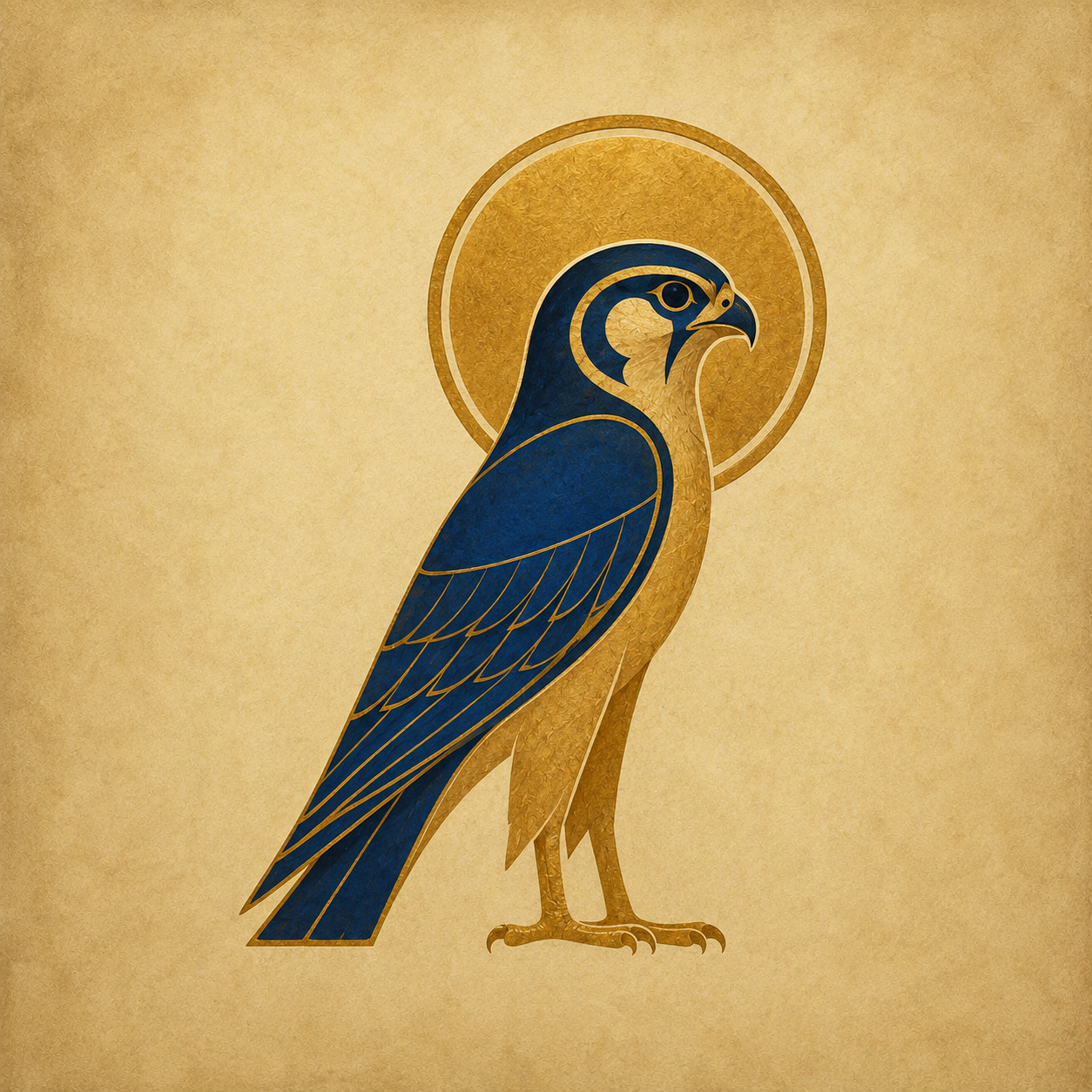
Horus’s primary divine symbol is the sacred falcon. This is deliberately kept separate from the Wedjat, which functions on this page as Horus’s defining artifact and protective emblem. The symbol therefore communicates kingship, celestial watchfulness and royal legitimacy without collapsing every aspect of Horus into the Eye alone.
The Eye of Horus — The Wedjat
The Wedjat is the defining artifact of Horus. Its importance rests not simply in sight but in restored sight. The injured eye becomes sound again: what has been damaged is repaired, what has been divided is restored, and what threatened royal and cosmic integrity is returned to wholeness.
Protection
The Eye wards its bearer against spiritual and physical harm. In game mechanics this appears through resistance to blindness, illusion, corruption and effects that would render a guardian unable to protect others.
Restoration
The artifact heals rather than simply destroys. Its strongest expressions reverse injury, purge debilitating conditions and preserve life at the instant it would otherwise be lost.
Divine Sight
The Eye sees farther and more truly than ordinary vision. Horus’s perception of invisible and hidden threats is part of the deity himself, not an isolated magic-item bonus.
Wholeness
Horus’s mythic restoration in 5.5e and Pathfinder translates the central myth directly: the damaged divine eye becomes whole and the god rises restored. D&D 3.5e instead retains its own native Rejuvenation timing.
The sacred falcon, rather than the Wedjat, remains Horus’s primary deity symbol. This allows the Eye to retain its special identity as artifact and protective emblem rather than performing every symbolic role at once.
Divine Realm — The Court of the Living Falcon
Parent Plane: Arcadia
Layer: Buxenus
Sovereign Divine Realm: Duat
Horus’s Personal Estate: The Court of the Living Falcon
Duat is not a separate Outer Plane in SpiralWorlds. It is a sovereign Pharaonic divine realm within Buxenus, itself a layer of Arcadia. Osiris, Anubis, Thoth, Isis, Horus and the other Pharaonic powers maintain distinct offices within its sacred geography.
The Court of the Living Falcon stands toward the horizonward approaches of Duat, where the nocturnal passage tends toward renewed dawn. Its terraces open beneath an impossible sky. Falcon sanctuaries crown towers of polished stone; processional courts run toward solar gates; royal petition halls stand roofless beneath the stars; and every major axis is aligned toward a horizon whose light changes according to Horus’s judgement.
Purpose of the Court
The court hears matters concerning living authority: contested succession, protection of legitimate heirs, royal oaths, sanctuary, betrayal by office-holders, the duties of rulers toward their subjects and the question of whether a crown still carries divine legitimacy.
It is therefore distinct from the judgement of the dead. A deceased king eventually enters the domains of Osiris and the judges of Duat. A living ruler seeking divine validation, a dispossessed heir demanding recognition or a guardian who has failed a royal charge belongs first to Horus’s jurisdiction.
Entering the Court
Powerful planar magic such as plane shift may reach Duat, but arrival at Horus’s estate is not guaranteed. Royal seals accepted by the god, dawn processions, consecrated falcon rites, divine summons and the intercession of another Pharaonic deity can open safer paths.
Those entering under false pretence may still reach the court. Horus does not require magical barriers to prevent every liar or usurper from arriving; some are permitted to enter precisely because judgement awaits them.
Regional Effects of Horus
Horus does not impose a vast catalogue of supernatural oddities on every place associated with him. These effects appear most strongly around his manifested divine estate, major consecrated sanctuaries or places where he has personally intervened.
Clear Horizon
At dawn, haze and low cloud often break along the eastern horizon. Travellers find distant landmarks easier to distinguish and open-sky navigation unusually reliable. This is not supernatural omniscience: walls, storms, magic and ordinary concealment still matter.
Falcon Witness
Healthy falcons readily nest in high places around the region. Their presence is traditionally read as favourable to guardianship and lawful rule, but they are neither infallible spies nor automatic detectors of lies.
Restorative Dawn
Those who spend the night genuinely protecting another creature often wake with unusual vigour at sunrise. Wounds close cleanly, fear recedes and exhaustion can ease more quickly than normal.
Crowned Sanctuary
Consecrated places associated with Horus reinforce the courage of those defending people placed in their care. The blessing follows duty rather than title: a usurper sitting upon a throne gains no automatic protection merely by calling himself king.
Duration. If Horus withdraws his manifested presence, these extraordinary effects normally fade over 1d10 days. A functioning temple may preserve a much smaller local version through continued rite and divine favour.
The edition-native mechanical translations appear within the relevant Game Statistics tabs above.
Horus in 1454 CE
In 1454, Horus remains one of the great divine measures of sovereignty in Catfolk-ruled Kemet. Within the political and divine order described in The Rise of Kingdoms, Horus remains the divine model of living kingship. The passage of dynasties has not reduced him to a memory of human pharaohs. To the gods, kingship is an office and obligation before it is a species, bloodline or political slogan.
Catfolk royal houses invoke Horus in coronation, succession disputes, military defence and the protection of recognised heirs. Judges, temple guardians, soldiers, administrators and falcon keepers also maintain his cult. His priests are particularly concerned with the difference between possession of power and rightful exercise of power.
Royal Duties Favoured by Horus
- Preserving a clear and lawful succession.
- Protecting recognised heirs and dependants.
- Maintaining courts capable of judgement rather than arbitrary punishment.
- Defending temples, settlements and essential public works.
- Keeping sworn obligations made in the name of the crown.
- Using military force to protect the realm rather than merely enrich the ruler.
- Accepting that divine favour may be withdrawn when kingship ceases to serve its function.
Campaign Conflicts
Two Lawful Heirs
Two claimants possess credible legal and sacred claims. Horus refuses to resolve the problem by simple oracle, forcing the competing houses to prove which candidate can actually bear the obligations of rule.
The Silent Falcon
A coronation reaches its final rite, but the sacred falcon gives none of the expected signs. The problem may lie with the candidate, the priesthood, a concealed crime or a rival who has corrupted the ritual.
The Broken Wedjat
A temple image of the restored Eye is deliberately damaged. The physical act is minor; the theological declaration is not. Someone is announcing that the unity of the crown can be broken again.
Divine Relationships
| Power | Relationship to Horus |
|---|---|
| Isis | Mother, protector of the heir, throne-power and master of ritual knowledge. Her protection makes Horus’s survival and restoration possible in many traditions. |
| Osiris | Father and predecessor within the royal cycle. Osiris governs dead kingship and judgement; Horus governs living sovereignty. |
| Set | Rival in the contest over succession. Their relationship remains adversarial but is not reduced to good deity versus meaningless devil. |
| Thoth | Divine measurer, record-keeper and healer associated with the restoration of Horus’s injured eye in important traditions. |
| Hathor | Closely associated with Horus in major cult traditions. At Edfu, the Feast of the Joyous Union celebrates Horus of Edfu and Hathor of Dendera. |
| Anubis | A fellow power of Duat whose funerary and judgement offices remain distinct from Horus’s jurisdiction over the living crown. |
Mythological and Historical Context
Horus and the Earliest Royal Name
Horus is one of the oldest and most deeply royal deities of ancient Egypt. The Horus name is the oldest attested element of Egyptian royal titulary. In early royal representation the king’s name could appear within a palace-façade device surmounted by the Horus falcon, creating an explicit visual relationship between the living ruler and the god.
This evidence is stronger and historically safer than speculative narratives that attempted to reconstruct Egyptian state formation as an invasion by literal “followers of Horus.” SpiralWorlds therefore treats Horus’s royal significance through cult, titulary, iconography and evolving theology rather than unsupported ethnic conquest.
Horus as Kingship and Celestial Power
Horus was worshipped in numerous forms and locations. Important centres included Edfu, Nekhen/Hierakonpolis and Qus, while other local Horus traditions developed across Upper and Lower Egypt. His celestial character and royal identity repeatedly overlap: the falcon above the land becomes an image of both the high sky and the sovereign who watches over the ordered state.
Horus of Behdet and Ritual Kingship
Research into Horus the Behdetite shows an especially close relationship with rituals of kingship. The god can protect the ruler as a hovering falcon or winged disk, participate in purification and coronation imagery, and express the symbolic binding together of the Two Lands. This martial-protective Horus provides a strong historical basis for the royal-defender emphasis used in the game statistics above.
The Festival of the Living Falcon
At Edfu, the Festival of the Living Falcon involved the selection and ceremonial crowning of a sacred falcon. The bird represented Horus and participated symbolically in the renewal of royal authority. The rite demonstrates how divine kingship could be renewed through cult performance rather than being treated as an abstract theological claim alone.
The Feast of the Joyous Union
The temple traditions of Edfu also preserve the Feast of the Joyous Union, associated with Horus of Edfu and Hathor of Dendera. The celebration joined the two cult centres in an extended sacred encounter and gives Horus a major festival identity beyond war and succession.
The Restored Eye
The Metropolitan Museum of Art identifies the wedjat-eye with the healed Eye of Horus. The name conveys the sense of the eye becoming sound or whole again. Traditions in which the damaged eye is restored by Thoth helped the Wedjat become an enduring emblem of protection, healing, regeneration and restoration.
Horus Video
This single focused Horus overview is retained after the video audit rather than stacking several overlapping embeds. Its conventional Horus-and-Set narrative should be read alongside the more historically cautious distinction between Horus’s forms and the more nuanced SpiralWorlds treatment of Set above.
Video: “Horus – The Ruler of the Skies – Egyptian Mythology”, See U in History / Mythology, 2024.
Historical and Mythological Sources
- University College London — Digital Egypt for Universities: Deities and Divine Names. Useful for the distinction between divine names, forms and manifestations, including Horwer and Horpakhered.
- University College London — Digital Egypt for Universities: Deities and Places. Supports Horus’s associations with kingship and celestial power and identifies major cult centres.
- University College London — Digital Egypt for Universities: The Horus Name. Documents the ancient connection between Horus and royal titulary.
- The Metropolitan Museum of Art: Wedjat Eye Amulet. Discusses the restored Eye of Horus and its associations with healing, protection and regeneration.
- Institute for the Study of Ancient Cultures, University of Chicago: A Study of Horus the Behdetite. Important for Horus of Behdet, ritual kingship, royal protection and coronation imagery.
- Institute for the Study of Ancient Cultures, University of Chicago: The Temple of Horus at Edfu. Provides material on the Festival of the Living Falcon and the Feast of the Joyous Union.
Campaign note: This page presents a fantasy role-playing interpretation of Horus alongside clearly separated historical and mythological context. Ancient sources and modern scholarship describe multiple Horus forms and evolving traditions; SpiralWorlds mechanics, planar placement and 1454 CE developments are campaign canon.